



Abstract

Introduction
Babe Ruth may be the most recognizable name in the history of professional baseball. Several years after his hall of fame career, he developed an anaplastic epidermoid nasopharyngeal carcinoma and died of a widely metastatic disease. This article will review the details of his medical history, including the use of an experimental drug which was used to treat his tumor.
Professional Baseball Career
George Herman Ruth was born on February 6, 1895, in Baltimore Maryland. At the age of 7 he was sent to the St. Mary’s Industrial School for Boys, where he spent 12 years learning a variety of skills, including baseball. 1 At the age of 18 years, he signed a professional baseball contract and played his first major league game with the Boston Red Sox in 1914. As a starting pitcher and power hitter he helped the Red Sox win the World Series in 1915, 1916, and 1918 (Figure 1). After the 1919 season, Ruth’s contract was sold to the New York Yankees, where he spent the next 14 years and was a key participant in 4 World Series titles. His home run totals for his career and for a single season stood as league records well past his retirement. He was inducted into the inaugural class of the Major League Baseball Hall of Fame in 1939. 2
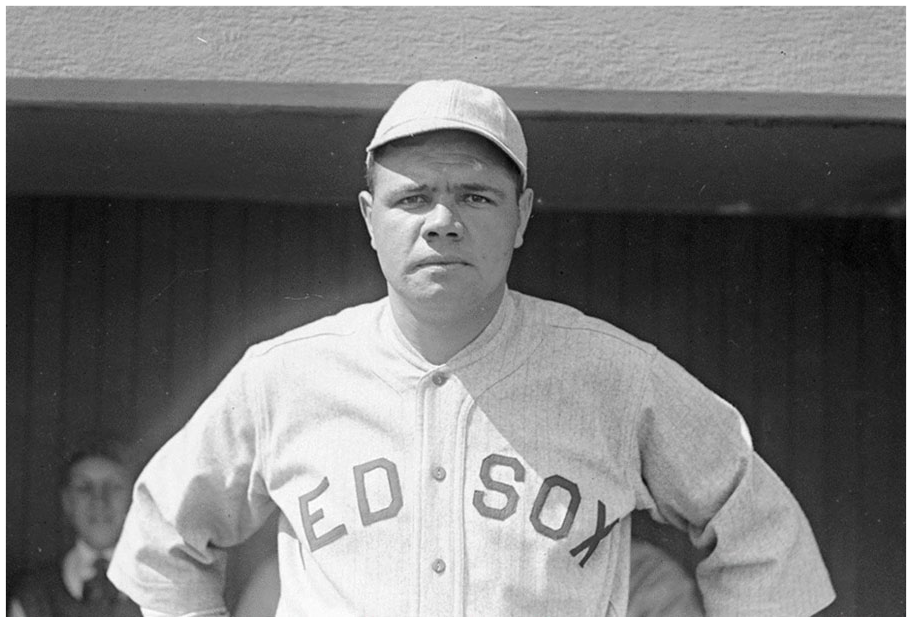
George Herman Ruth 1919. Photo available at https://www.loc.gov/pictures/item/2016827093/.
Ruth enjoyed good health until his 50s, when he had his right knee operated on for pain due to a cartilage problem from his playing days. In 1945, he was advised by his physician to drink less alcohol and reduce his body weight. He was able to lose from 278 pounds to 238 pounds “without dieting,” but it is unclear if he lost weight by consuming less alcohol or if the weight loss was the first sign of his malignancy that was discovered the following year. 3
Medical History
Sinus Infection
In September of 1946, Ruth complained of head-and-neck symptoms that started with hoarseness of his voice. 4 This progressed to pain over his left eye, which was treated as a sinus infection by his physician, Philip MacDonald. In November of 1946 he required admission to the French Hospital in New York City with worsening left face pain and swelling. 5 Ruth had deteriorated so significantly that he entered the hospital in a wheelchair. 5 Clinically, his exam was described as “Horner’s Syndrome,” associated with paralysis of the left palate and left vocal cord. 6 His left eye was swollen, and his left face pain gave him a continuous headache. Early during this admission, some of his symptoms were thought to be due to a dental problem, but extraction of 3 teeth did not relieve any symptoms.5,7
Dr. MacDonald called in a variety of specialists when Ruth’s symptoms progressed to the point that he could no longer swallow, his left eye was swollen shut, and he could barely speak.5,8 When physical exam and X-rays suggested a neck mass, the team of physicians offered operation. 8 Ruth underwent a 2-hour operation on January 6, 1947, which included biopsy of a left neck mass plus ligation of several branches of the left external carotid artery.6,9 Ruth was not told the results of the biopsy, but his wife was informed that the biopsy confirmed cancer. 10
Ruth recovered slowly as he did not walk until January 29 and lost an additional 40 pounds due to his inability to eat. 11 He underwent postoperative radiation therapy to the left side of his head and neck to control his symptoms. 11 News reports from early February described Ruth’s condition as “fair” and did not mention cancer or sinusitis as a diagonosis.12,13 Ruth spent his 52nd birthday in the hospital but was discharged on February 15, looking frail and weighing only 189 pounds.14,15
Ruth had some symptom relief over the next few months. His eating and face swelling improved, and he was well enough on April 27, 1947, to attend “Babe Ruth Day” at Yankee Stadium. 16 By June, his symptoms had recurred, and he was evaluated by physicians at Mount Sinai Hospital in New York where he was offered an experimental treatment directed toward his head-and-neck tumor.17,18
Pteroyltriglutamic Acid (Teropterin) Treatment
Dr. MacDonald informed Ruth that a treatment was available in the form of a “shot” that might help his symptoms. He was told that “this type of treatment had rarely been used on a human being before.” 17 In his autobiography entitled, The Babe Ruth Story, Ruth said the matter was. . . “left up to me. It wasn’t an easy decision. I realized that if anything was learned about that type of treatment whether good or bad, it would be of use in the future to the medical profession and maybe to a lot of people with my same trouble. So I took the shot.” 17
Teropterin, an experimental anticancer drug by Lederle Laboratories, was a folic acid analog similar to methotrexate, which entered common use in the 1970s.19,20 Ruth was started on Teropterin (5 mg daily) in June of 1947, during a brief admission to Mount Sinai Hospital. 21 Within 6 weeks of discharge, Ruth had already demonstrated remarkable improvement. 22 His exam on August 14 showed. . .“the mass in the neck had disappeared completely. His pain has practically gone. He eats solid food without any difficulty in swallowing. The tenderness to palpation is gone. The voice has improved a great deal. The soft palate on the left side now moves as well as the right side. The left vocal cord is still immobile. He has gained twelve pounds in weight.” 23 In February, Ruth celebrated his 53rd birthday in relatively good health. He regained up to 212 pounds, and traveled to Florida where he vacationed in Miami Beach. 24 He returned from his Florida vacation, still feeling well, as he planned a trip to Los Angeles in April of 1948 for the grand opening of the movie “The Babe Ruth Story.” 25,26
Relapse
The New York Yankees retired Ruth’s number “3” jersey on June 13, 1948, at Yankee Stadium, and Ruth attended the ceremony (Figure 2). By the end of the month, Ruth’s symptoms had recurred and he was admitted to Memorial Hospital in New York City (later known as Memorial Slone Kettering Cancer Center). 27 On admission to Memorial Hospital, he was found to have a bulging mass in the left posterior and lateral walls of the nasopharynx, partial paralysis of the soft palate, and a left shoulder drop. 6 He was treated with additional radiation therapy to his left neck for his worsening pain and tube feeding for persistent weight loss 6 On July 20, Ruth had gold seeds implanted around a lymph node in the left neck, which resulted in some minor improvement of his pain.6,28 He developed hiccups near the end of July and a chest X-ray in August showed new metastatic disease in the right chest. 6 Ruth’s condition worsened as he developed fever, peripheral edema, and evidence of hypoxia likely from pneumonia. He died on August 16th, 1948, at 8:01pm. 6
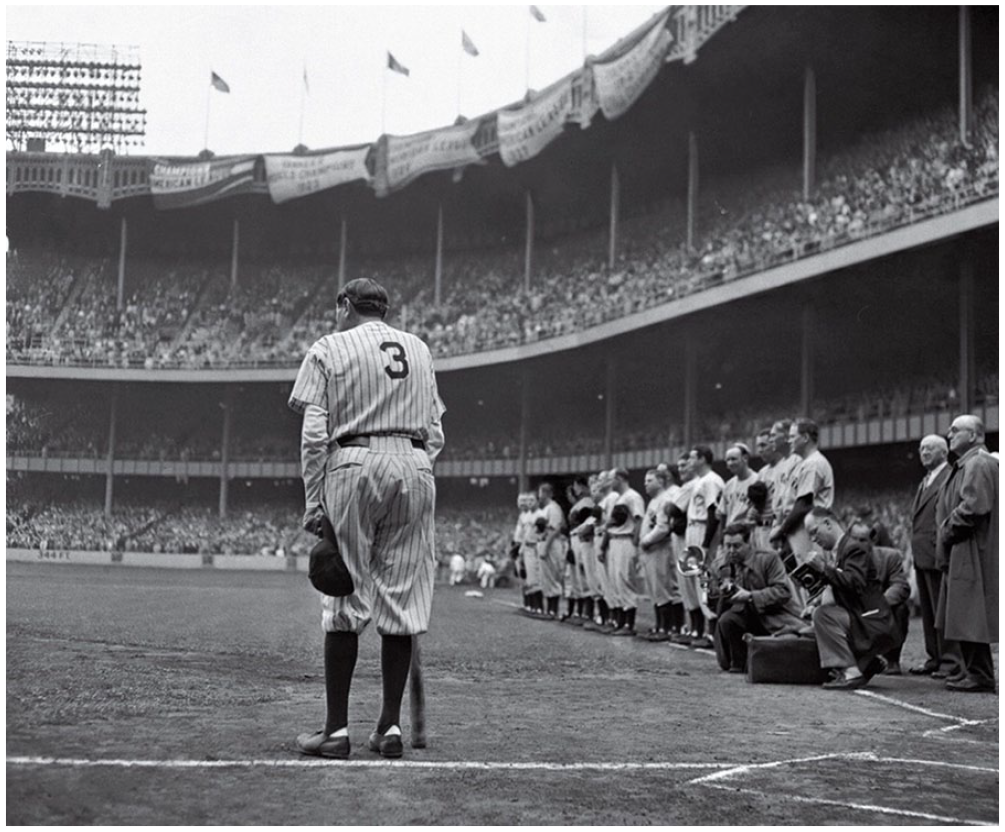
George Herman Ruth, June 13, 1948, Yankee Stadium, Yankees retire Ruth’s number “3.” Available at https://commons.wikimedia.org/wiki/File:Babe_Ruth_Bows_Out.jpg.
The Autopsy
Pathologist Dr. Paul Wozencraft conducted the autopsy on Ruth an hour after his death. The final pathology of Ruth’s tumor was confirmed to be an anaplastic epidermoid carcinoma of the nasopharynx. The tumor had spread regionally to the skull base, encasing cranial nerves 9, 10,11, and 12. He also had widespread metastatic disease in the liver, lung, bone marrow, and adrenals. 6
Discussion
Treatment of a Rare Tumor
Anaplastic epidermoid carcinoma of the nasopharynx was a rare tumor in the 1940s, but at the time of Ruth’s death most head-and-neck surgeons were familiar with the diagnosis and management of the disease. Up to 50% of patients had cranial nerve symptoms and nearly 70% presented with palpable lymph nodes in the neck, similar to Ruth’s clinical course. In the 1940s half of all patients presented with metastatic disease.29,30
Treatment of nasopharyngeal carcinoma was rarely surgical but the operation on Ruth at the French hospital, early in 1947, was conducted to secure a histologic diagnosis. In addition, several branches of the external carotid were ligated during the operation. For head-and-neck tumors of this sort, surgeons in this era, often ligated the blood supply to control bleeding in the operative field or reduce symptoms or tumor growth. 31 Ruth was treated with 3 separate episodes of radiation treatment in an effort to manage his severe symptoms. The first episode of field radiation occurred at the French Hospital in early 1947 which gave him some temporary relief of symptoms. Ruth was treated again with external beam radiation in June of 1948, during his final admission to Memorial Hospital. The symptomatic relief from this second round of radiation was very short in duration. In July of 1948, the physicians at the Memorial Hospital implanted gold seeds around an enlarged lymph node of his left neck.
Radiation was originally the only effective treatment that was described for nasopharyngeal tumors. The first large experience using radiation to treat pharyngeal tumors was reported from Memorial Hospital in 1917. 32 Treatment of the primary lesion often included combined external beam radiation plus intracavitary treatment with radium or radon. 33
Today, the treatment cornerstone for nasopharyngeal carcinoma is concurrent radiation and Cisplatin-based chemotherapy. 34 Both Epstein–Barr virus and Human papillomavirus are thought to be etiologic agents for many nasopharyngeal carcinomas. 35 As with other tumors, the use of immunotherapy in the treatment of nasopharyngeal cancer is an area of active investigation. 36
No One Told Ruth He Had Cancer
It has been alleged that Ruth never knew he had cancer, 24 which is supported by the fact that his autobiography did not mention cancer as a possible diagnosis explaining his debilitating illness. 37 Ruth’s wife stated that he was not told he had cancer, but she presumed that he knew. When he was asked how he felt, Ruth was quoted as saying “. . .. Lousy. And they think they are kidding me. But they aren’t. I know what I got.” 38 Ruth’s knowledge that he was being treated with an experimental drug, and his rational for taking it (“. . .it would be of use in the future. . . to a lot of people with my same trouble. . .”) suggests that he knew the diagnosis. 17 Additionally, when Ruth was admitted to the Memorial Hospital in New York City, he was quoted as saying, “Doc, this is Memorial. Memorial is a cancer hospital. . .” 39 Based on this evidence; it is likely that Ruth presumed he had cancer without being told by his doctors. Before it was common to tell patients their diagnosis, studies demonstrated that most patients knew they had cancer without being told by their physician. 40
Withholding a cancer diagnosis from patients was commonplace in the previous century. The origin of this “ethical” policy is unclear but likely was seen as humane in an era when effective treatments for cancer were limited. 41 By the 1940s and 1950s families were often informed of a cancer diagnosis but the patient was rarely told despite the use of surgical or radiation therapies.42,43 In 1953 a survey of providers stated that the wide majority of providers did not inform cancer patients of their true diagnosis. 44 By the 1960s, medical ethics began to shift to greater honesty toward patients and their medical conditions.45,46 Today clinicians almost never withhold a cancer diagnosis from patients, even children.47,48
How did the Press Handle the News of Babe Ruth’s Illness?
The press appeared to be in on the secret of Ruth’s diagnosis before his death, but they withheld that information from the public until after Ruth died. The news reports which appear on August 12, just 4 days before his death, stated that Ruth was suffering from a “throat ailment.” 49 On August 17, the day after Ruth died, the headline on the front page of the New York Times stated that Ruth “fought losing battle against cancer for 2 years.” 50 A case report of a “famous figure” who received Teropterin was reported on by the Wall Street Journal in September of 1947. The newspaper article celebrated that a 52-year-old patient with head-and-neck cancer had been treated in June of 1947 with intramuscular Teropterin and had a dramatic response to the drug. The case study did not name Ruth but was authored by one of Ruth’s doctors and was reported at a national cancer meeting in the summer of 1947.21,51
Experimental Therapy Without Consent
While experimental cancer therapy was uncommon in the early to mid-20th century, the standards for conducting clinical research were introduced with the Nuremberg Code in 1947. 52 In addition, the rules for obtaining consent for experimental therapy were not formally established until the 1960s with the introduction of the Helsinki accord. 53 Prior to Helsinki, consent was an informal process, documentation was not required, and physicians were given latitude in making risk versus benefit decisions for the patients. 54 Although this seems odd today, it was certainly a common practice in the previous era. Based on the description in his book The Babe Ruth Story, Ruth must have given, at least, verbal consent to receive the experimental drug, Teropterin. His statement that they “. . .left it up to me. It was not an easy decision,”. . . suggests that knew that the drug had not been adequately tested in humans but was willing to take the risk associated with this experimental treatment. 17
Conclusion
George Herman Ruth died in 1948 of complication of an anaplastic epidermoid carcinoma of the nasopharynx. His tumor presented in 1946 with severe pain of the left head and neck, dysphagia, and significant hoarseness. Consistent with ethical norms of the day, Ruth was not informed by his physicians that he had cancer. During his first admission to the hospital, Ruth underwent an operation in an effort to diagnose and palliate his symptoms. Ruth did not improve with surgery but did have some improvement with field radiation to the left head and neck. When his symptoms worsened again, he was offered an experimental medication Teropterin, a folic acid analog, which had only been used in animals before Ruth agreed to the injections. His clinical response to Teropterin was dramatic but lasted less than a year. His symptoms recurred in the summer of 1948 prompting an admission for supportive care at the Memorial Hospital in New York City where he died on August 16, 1948.
Footnotes
Acknowledgements
None.
Data Availability Statement
None (this historical review does not contain data).
Declaration of Conflicting Interests
The author(s) declared no potential conflicts of interest with respect to the research, authorship, and/or publication of this article.
Funding
The author(s) received no financial support for the research, authorship, and/or publication of this article.
Ethical Statement
None required.
Grant Number
None.
Informed Consent
None required for this historical review.
Trial Registration
None.

