



Abstract
Aspiring physicians face a large amount of information that must be learned and retrieved in real time. The skills that helped medical students reach residency may not be the enough to succeed as a physician. For example, like many students, cramming the night before an exam probably helped achieve a satisfactory score. Unfortunately, cramming does not require that the information be retained and applied overtime. The content acquired in medical school is cumulative, that is, the information learned remains relevant months and even years later. Not only does content need to remembered, the knowledge must be constantly updated as new research makes some information more relevant and other information less important. Finally, the stakes as a physician are high. Forgetting a critical piece of information will not result in a lower test score, it can seriously harm patients. This article is a practical approach to teaching medical doctors, based on a literature review, including practical, scientific, and applied research and strategies ways in which teaching can be done that result in depth of learning in the resident.
An examination of learning today provides clarity of the challenge’s educators in higher education face. Content knowledge and delivery, two variables in effective teaching, if done well, result in the highest impact to learning. 1 In higher education, the transition from straight lecture format to co-construction has been slow, although recognized as a concern for many years.2,3 For professors of higher education, the traditional lecture-style delivery has lost its effectiveness, thus requiring a pedagogical shift from lecture to a shared concept of learning.
As discusses this challenge to instruction and stresses that educators must pay attention to learning and its approach. 1 The need for instructional change has become more apparent within the past several years, with a more student-centered focus as the foundation for depth in learning. A five-year teaching experiment led a research team to conclude that inquiry is a valuable strategy to assist students in becoming more engaged and active in learning. 4
Faculty at higher education institutions are changing the instructional delivery of content, and more universities are shifting from primary lecture format to a blended learning strategy.5,6,7 The shift in the role of higher education prepares students to learn and to adapt existing knowledge. The result is the students serve as critical and productive participants, allowing co-construction and management of learning. 8 Teaching and learning in contemporary higher education are a shared process with both professor and student owning the responsibility with successful learning outcomes.
Higher education institutions, particularly, the medical education community, require students to learn a large amount of material with limited time. In this case, residents are responsible for much of their learning. As reported by students and research, lecture and textbook dissemination of material are not adequate. Every time you learn something new, you change the brain—the residue of your experiences is stored. 9 Learning must be meaningful and individualized for each learner. The authors noted in order for mastery to occur, both possession of ready knowledge and the conceptual understanding of how to use it are required.
Brown, et al state that the good news is we now have uncovered simple and practical strategies that can be used, throughout life, to learn better and remember longer. 9 This will add balance to the concern that many non-education professors are teaching, most often from how they were taught or how they best learn.
Brain-Based Research and Learning
Effective teaching facilitates transference of knowledge to long-term memory (Van Lehn, 1996). A meta-analysis by Chernikova et al (2020) identified effective strategies as highlighted. Feedback maintains lecture, PowerPoint and textbook reading are not successful strategies. Highlights of the meta-analysis as related to the current study are listed below: • Students acquire high levels of expertise in complex problem-solving tasks if they have sufficient prior knowledge and engage in an adequate amount of authentic practice related to the profession (Barab et al, 2000). • Real-life practice without systematic guidance is not sufficient. Prior to working with real-life patients, the resident should have ample prior practice experience. In medical education, simulations are used to support diagnostic competencies for the perspective doctor (Cook, 2014; Cook et al, 2013, Hegland et al, 2017). Simulations provide the opportunity for individualized learning to occur, which is not readily available in a life-event situation. • Simulations are used in high education settings to facilitate a deeper understanding of concepts and problem-solving (D’Angelo et al, 2004; Wu and Anderson, 2015). • A scaffolding framework supports individualized learning based on the amount of knowledge each student demonstrates. Tabak and Kyza (2018) suggest scaffolding is a support that shifts control over the learning process from learner to teacher.
Residents in the medical profession are required to be prepared through demonstration of specific competencies. Critical thinking, problem-solving, communication, and collaborations are valuable required skills. Well-structured scenarios can include the required skills, thus providing a resident with ample learning opportunities.
Early educators once thought that intelligence is fixed and remains virtually the same through someone’s entire life. More recent discoveries reveal that physical changes take place in the brain during learning. When someone practices certain skills, they find it easier over time to carry on improving those abilities. Learning has been demonstrated to improve resiliency, working intelligence, and brain function. The evidence thus far suggests that teachers who do use the principles of brain-based learning as the foundation for an engaging curriculum and creative environment can improve the efficiency and speed of their students’ learning.
The core principles of brain-based learning follow. Each principle lays out a formula for better retention and learning among students. • Health and Exercise: The more active and engaged students are physically, the better their learning outcomes. This requires more than a midday recess or a walk between classes. Allowing students to take walking breaks during lessons and throughout the day, for example, revitalizes students, increases their attention span, and better prepares them to retain information. • Positive Emotions: The happier students are, the more they are willing to learn and think effectively. Affirmations from the teacher are one way to raise student self-esteem. • Group Work: Working in teams with classmates allows students to learn from one another. Collaborative environments can help them retain information they may not have accepted or understood from the teacher. • Peer Teaching: When students teach materials to their peers, it helps them retain that same information. This can be done in small groups or through presentations. • Practice: Learning through repetition and trial and error is more effective than simple memorization. Students will gain a better understanding of the subject through practice, rather than just memorizing the details. • Limited Lectures: Only 5–10 percent of information is retained during a lecture, according to Swan.
10
Making lessons largely discussion-based promotes student learning. • Meaningful Information: Students are more likely to remember information if they are engaged with the lesson. By applying the material to their lives, students will find it meaningful. For example, a lesson on economics could be related to smartphone ownership. • Written and Verbal Information: Having students both write and verbalize information will help move it from their short-term memory to their long-term memory. • Stimulation: Catching students’ attention through humor, movement, or games stimulates their brains’ emotional center. In turn, this increases students’ engagement and processing of information. • Less Stress: Stress chemically changes the brain. In a calm classroom environment, students have the opportunity to perform at higher levels.
Learning Styles Revisited
Educational psychologists have moved from cognitive styles and how people think to the idea of learning styles and how people learn. 11 The basic idea is very attractive. We know that a particular piece of instruction might be effective for some students, and not for others, so it seems plausible that if the instruction was specifically designed to take into account a particular student’s preferred learning style, then it would be more effective for that student. This is what psychologists call the general learning-styles hypothesis—the idea that instruction students receive will be more (or less) effective if the instruction takes (or does not take) into account the student’s learning-style preferences.
Within education, a version of the learning styles known by psychologists as the meshing hypothesis has been of particular interest: the idea that students will learn more if they receive instruction that specifically matches their learning-style preferences. In other words, visual learners will learn better if they receive instruction that emphasizes visual ways of presenting information, and auditory learners will learn best by listening.
In their review of research on learning styles for the Association for Psychological Science, Pashler et al
12
came to a stark conclusion: “If classification of students’ learning styles has practical utility, it remains to be demonstrated.” (p. 117). Pashler et al pointed out that experiments designed to investigate the meshing hypothesis would have to satisfy three conditions: 1. Based on an assessment of their presumed learning style, learners would be allocated to two or more groups (e.g., visual, auditory, and kinesthetic learners). 2. Students within each of the learning-style groups would be randomly allocated to at least two different methods of instruction (e.g., visual and auditory-based approaches). 3. All students in the study would be given the same final test of achievement.
In such experiments, the meshing hypothesis would be supported if the results showed that the learning method that optimizes test performance of one learning-style group is different than the learning method that optimizes the test performance of a second learning-style group. In their review, Pashler et al 12 found only one study that gave even partial support to the meshing hypothesis, and two that clearly contradicted it.
The fact that there is currently no evidence that knowing students’ learning styles helps design more effective instruction does not mean that learning styles will never be useful in the future. Some psychologists are likely to continue to look for new ways to look at learning styles, even though there are at least 71 different learning-style classification systems already in existence. 13
Over the last 30 years, psychologists have found that performance on a learning task is a poor predictor of long-term retention. More precisely, when learners do well on a learning task, they are likely to forget things more quickly than if they do badly on the learning task; good instruction creates “desirable difficulties” for the learner.
14
In Daniel Willingham’s memorable phrase, “memory is the residue of thought.”
15
By trying to match our instruction to our students’ preferred learning style, we may, in fact, be reducing learning
Attempting to synthesize such a large and complex body of research is a large undertaking, but an important “takeaway” from the research on learning styles is that teachers need to increase their awareness of individual learning styles if only to avoid the trap of teaching in the style they believe works best for them. As long as teachers are varying their teaching style, then it is likely that all students will get some experience of being in their comfort zone and some experience of being pushed beyond it. Ultimately, we have to remember that teaching is interesting because our students are so different, but only possible because they are so similar. Of course, every student is a unique individual, but it is extraordinary how effective well-planned group instruction can be.
Based on some assessment of their presumed learning style, learners would be allocated to two or more groups (e.g., visual, auditory and kinesthetic learners). Students within each of the learning-style groups would be randomly allocated to at least two different methods of instruction (e.g., visual and auditory-based approaches). All students in the study would be given the same final test of achievement. In such experiments, the meshing hypothesis would be supported if the results showed that the learning method that optimizes test performance of one learning-style group is different than the learning method that optimizes the test performance of a second learning-style group. In their review, Pashler et al found only one study that gave even partial support to the meshing hypothesis, and two that clearly contradicted it. 12
The fact that there is currently no evidence that knowing students’ learning styles helps us design more effective instruction does not mean that learning styles will never be useful in the future—absence of evidence is not the same as evidence of absence. Some psychologists are no doubt likely to continue to look for new ways to look at learning styles, even though there are at least 71 different learning-style classification systems already in existence. 13 However, it could be that the whole idea of learning-styles research is misguided because its basic assumption that the purpose of instructional design is to make learning easy may just be incorrect.
Over the last 30 years, psychologists have found that performance on a learning task is a poor predictor of long-term retention. By trying to match our instruction to our students’ preferred learning style, we may, in fact, be reducing learning. If students do not have to work hard to make sense of what they are learning, then they are less likely to remember it in 6 weeks’ time.
Attempting to synthesize such a large and complex body of research is almost certainly a fool’s errand, but it seems to me that the important “takeaway” from the research on learning styles is that teachers need to know about learning styles if only to avoid the trap of teaching in the style they believe works best for them. As long as teachers are varying their teaching style, then it is likely that all students will get some experience of being in their comfort zone and some experience of being pushed beyond it. Ultimately, we have to remember that teaching is interesting because our students are so different, but only possible because they are so similar.
Evidence-based teaching strategies
An evidence-based teaching strategy is an instructional approach supported by research. However, research shows that some strategies have more impact than others. These evidence-based teaching strategies are grounded in solid research. 16
This list of teaching strategies support: • Hard research, rather than anecdotal case studies or untested theories • Impact on student results that it is substantially higher than typical strategies • Used on a wide range of subject areas and in all year levels
Strategy 1: Clear Lesson Goals
Clarity is crucial. The effect that clarity has on the learner is 32% greater than the effect of holding high expectations for every student (and holding high expectations has a sizeable effect). Clear lesson goals help you (and your students) to focus every other aspect of your lesson on what matters most.
Lesson goals state what you want your students to: • Know and understand • Be able to do
Strategy 2: Show and Tell
The second evidence-based teaching strategy in this list is “show and tell.” You should start most of your lessons with some show and tell. Your lesson goals clarify what you want your students to know and be able to do by the end of the lesson. Now, you need to tell them what they need to know and show them how to do the things you want them to be able to do. Show and tell is the essence of the I Do phase of the I Do—We Do—You Do model. Put simply: • Telling involves sharing information or knowledge with your students • Showing involves modeling how to do something.
Strategy 3: Questioning to Check for Understanding
After informing students what they need to know, you need to check their understanding before moving on. You can do this using: • Random sampling • All student response system
Random sampling involves asking a question, pausing, and then randomly choosing a student to answer. The pause is to allow all students to think of their answer. And, the random sampling can be as simple as names out of a hat. Other popular techniques include popsicle sticks in sand and an online name picker. By using random sampling regularly, students get used to having to have an answer ready in case you select their name. By asking a small number of questions about the content you have just shared and randomly selecting students to answer them, you can get a reasonable estimate of the class’s understanding. The other option is to use some form of all student response system. These systems include the following.
Strategy 4: Summarize New Learning in a Graphical Way
Graphic outlines include things such as mind maps, flow charts, and Venn diagrams. Graphic outlines help learners to: • Summarize what they have learned • Understand the interrelationships between the aspects of what you have taught them
Discussing a graphical summary is a fantastic way to finish off your show and tell. You can then refer to it one more time at the end of your lesson. Studies show that it doesn’t seem to matter who makes the summary graphic, be it the instructor or the learner, provided the graphic is accurate. Discussing a graphical summary is a fantastic way to finish off your show and tell. You can then refer to it one more time at the end of your lesson.
Strategy 5: Plenty of Practice
As the saying goes, practice makes perfect. Practice helps students to retain the knowledge and skills that they have learned during your show and tell. Therefore, you need to choose practice tasks related to your lesson goal. Doing so also gives you another opportunity to check for understanding. You can then use this opportunity to: • Re-explain things to the class or groups • Offer personalized feedback to individual students
However, research also shows that students do better when you give them multiple opportunities to practice spread out over time. So, you need to build in opportunities to practice past material either as part of the lesson or stand-alone sessions.
Strategy 6: Provide Your Students with Feedback
Feedback is the breakfast of champion learners, and it is the breakfast served by extraordinary teachers around the world. Any teachers who seriously want to boost their children’s results should start by giving them plenty of feedback.
Giving feedback involves telling a student: • How they have performed on a particular task • Along with ways that they can improve.
Feedback is different than praise. Praise focuses on the learner rather, but feedback focuses on what your learner did. It provides your students with a tangible understanding of: • What they did well • Where they are at • How they can improve
Strategy 7: Be Flexible About How Long It Takes to Learn
The idea that given enough time, every learner can learn is not as revolutionary as it sounds. It underpins the way we teach martial arts, swimming, and dancing. It is also the central premise behind mastery learning, a technique that has the same effect on student results as socio-economic status and other aspects of home life. When you adopt mastery learning, you differentiate differently. You keep your learning goals the same but vary the time you give each learner to succeed. Within the constraints of a crowded curriculum, this may be easier said than done; however, we can all do it to some degree.
Strategy 8: Productive Group Work
Group work is not new, and you can see it in every classroom. However, productive group work is rare. This is because some students do all the work and all the learning, while others do very little at all. There are several reasons this can happen, but two of the main ones are that some students are more: • Eager than others • Competent than others
To increase the productivity of your groups, you need to be selective about the: • Tasks you assign to them • Individual role that each group member plays • Only ask groups to complete tasks that group members can achieve successfully • Ensure each group member personally responsible for one step in the task.
For example, group work requires students to reflect on prior knowledge, to elaborate upon this knowledge, and to generate new knowledge based on discussions, reflection, and elaboration. 9 Group work allows depth of knowledge to occur on an individual level. In an interview with Biology Professor Wenderoth, study groups redefined as testing groups, resulted in students discussing a question together. In other words, students test one another on points that are not clear. The emphasis in this group work is on exploration, understanding, and individualizing the learning.
Strategy 9: Teach Strategies Not Just Content
You can increase how well your learners do in any subject by explicitly teaching them how to use relevant learning strategies. When teaching students to: • Write you often teach them strategies such as making a plan and checking for transition words. • Read you often teach strategies that will deepen their comprehension. • Mathematics, you often teach them problem-solving strategies.
From assignments and studying to characterization, there are strategies that will help your learners perform better. And, just as with content, you need to: • Tell learners about these strategies • Show them how to use them • Give them guided practice and feedback before asking them to use them independently.
Strategy 10: Nurture Meta-Cognition
Many teachers believe they are encouraging students to use meta-cognition when they are not. Often, they are just asking their students to use strategies. For example: • Making connections when reading • Self-verbalizing when solving problems
Such strategies are useful. However, on their own, they are not meta-cognition. Meta-cognition involves thinking about your options, your choices, and your results. And it has an even larger effect on student results than teaching them strategies. When using meta-cognition your students may think about: • What strategies they could use (options) • What strategies they will use (choices) • How effective their choices were (results) • Whether to continue with or change their chosen strategies
Educational techniques: current trends and best practices in teaching effective teaching and learning strategies
Conceptualizing
McTighe and Silver, reference conceptualizing as a way for students to think big, by using factual knowledge to construct larger concepts and understandings and individualize constructed knowledge. 17 This process of forming learning from observations and connections relies on instructor planning and presentation. Specific tools incorporated into lessons aide the learner.
A pre-organizer, such as a conceptual map, allows the learner to view the process and understand connections in learning. 17 Before beginning a new topic, the professor makes connections to the last topic and builds a map of where the current topic will end. This emphasizes student-centered learning by allowing the student to construct new knowledge, based on prior knowledge, with the end in mind. Concept mapping allows the learning to frame learning around the core content, resulting in connections.
Differentiated instruction
Effective teachers are mindful of each student in their classroom, background, ideologies, learning styles, and beliefs. This awareness allows the professor to construct knowledge based on each individual student. The method allows the professor to respect all individuals, display sensitivity and maintain open communication via individualized feedback. Examples of ways to differentiate instruction may include but are not limited to self-evaluation, reading articles and writing, checklist, informal cooperative learning (small group work), oral presentations or discussion, viewing videos, use of social media, collaborative learning, etc.
Essential questions
When the content is framed with a few open-ended questions, students can make meaning or “uncover” the content on an individual basis. 18 The open-ended questions allow the student to construct meaning, thus allowing the professor to teach for understanding.
Experiential learning cycle
The four stages in this learning cycle encompass actual experiences, reflective observation, abstract conceptualization, and active experimentation. This model recognizes the variety of student learning styles and Tulbure (2012) discusses the value of the professor matching content delivery to student learning styles. In Tulbure’s sample, the Educational Sciences registered the highest academic achievement when a problem-solving strategy is applied. Previous studies had shown these types of students excel when learning through project-based scenarios, open-ended problems, investigations, simulations, role-plays, and discussions.19,20
Lecture
Lecture can be highly successful if done is small bursts. These lecture bursts deliver key points in a short period, specific to the attention span of the audience. Typically, a lecture burst is no more than 20 minutes. A successful strategy when applying the lecture burst is to grab the student’s attention with a question or activity to focus attention on the topic. Throughout the lecture, a professor should check for understanding by posing questions on content delivered thus far. The check for understanding applied by hand raising, writing a one-minute reflection on learning thus far, or sharing knowledge with a partner. All of the checks for understanding are low anxiety induced ways to maintain a pulse on student’s grasp of the delivered content.
Predicting and hypothesis
When professors’ work to engage learners, by implementing predicting and hypothesis strategies applied in all levels of learning, learners are able to construct the knowledge as a process. By using these tools, the learner is more likely to stay engaged in the content. McTighe and Silver 17 discuss “hooks” such as What if, Yes, but why? Questions that puzzle and data that teases, discrepant events, inductive learning, and the crystal ball strategy.
Inquiry
Situational, problem, project are forms of inquiry learning and according to Tomlinson et al, 18 Justice et al conclude inquiry learning methods encourage student to become self-directed learners and therefore, more engaged. These methods of active learning allow the students to question a scenario (situational, problem, project, inquiry) based on preconceived ideas, thus motivating the student to learn the concept.
Student learning becomes guided by a student-centered approach, allowing the student to make meaning of each concept based on prior knowledge. The key to learning in this instance is the students must find value in the posed scenario. The professor guides the student to the knowledge based on student view. Students must be engaged in questioning their preconceived ideas so they can reach a higher level of understanding. These active learning strategies can be alone or collaboratively in small groups.
Reflection
Brown et.al. discuss reflection as several cognitive activities that lead to stronger learning (p. 27). 9 Brown lists these activities as “retrieving knowledge and earlier training form memory, connecting these to new experiences, and visualizing and mentally rehearsing what you might do differently next time.” In the case of a medical doctor, it is especially important to build upon prior learning and visualize the concepts in action. Practice is an important tool for learning and retention including effortful retrieval, repeated retrieval, self-testing, and corrective feedback are valuable tools. 9
Additional tools and strategies
The whiteboard, document reader, PowerPoint, flowchart, visuals, and manipulatives are tools used with any teaching strategy.
Residents and learning
Junior Resident Feedback.
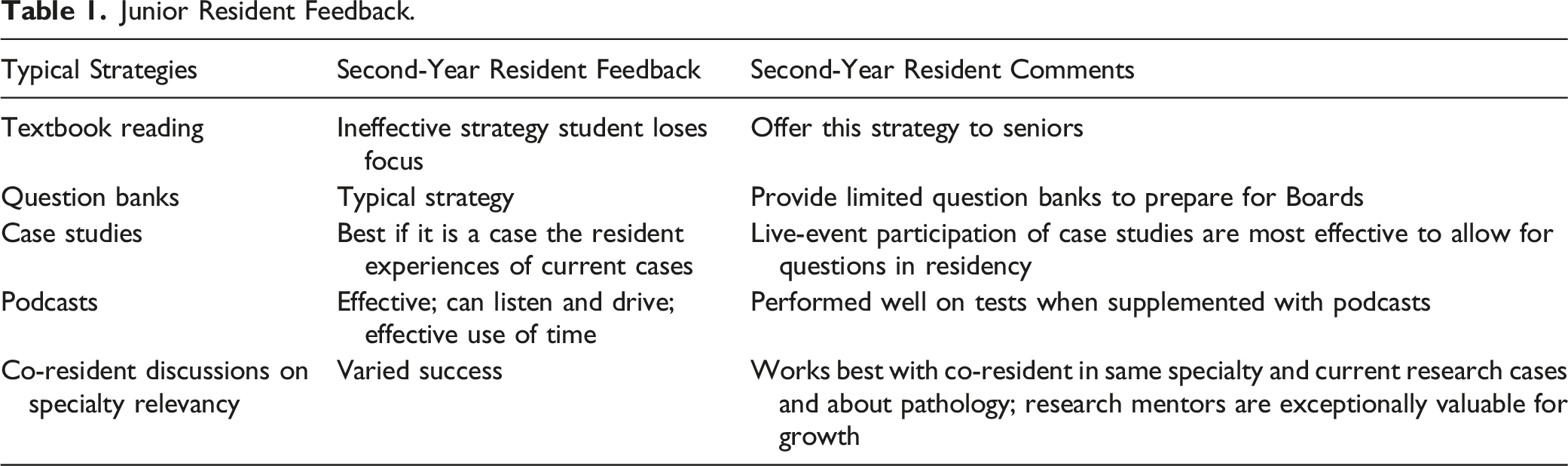
As noted in Brown et al, 9 surveys of college students confirm highlighting, underlining, and sustained poring over notes and tests are the most-used study strategies, while the authors point out that it makes sense to read the text one, and again after a meaningful lapse of time. This is one example of a widely used strategy that with a little tweaking, becomes very meaningful to learning.
Furthermore, students need to self-reflect on their own learning. They need to know personal strengths and weaknesses to determine personal study methodology. Students do not quiz themselves and tend to overestimate mastery. This case is similar when re-reading notes and texts. There is a false sense of true learning, solidifying the fact that students need to self-reflect on weaknesses and study strategies.
Senior Resident Feedback.
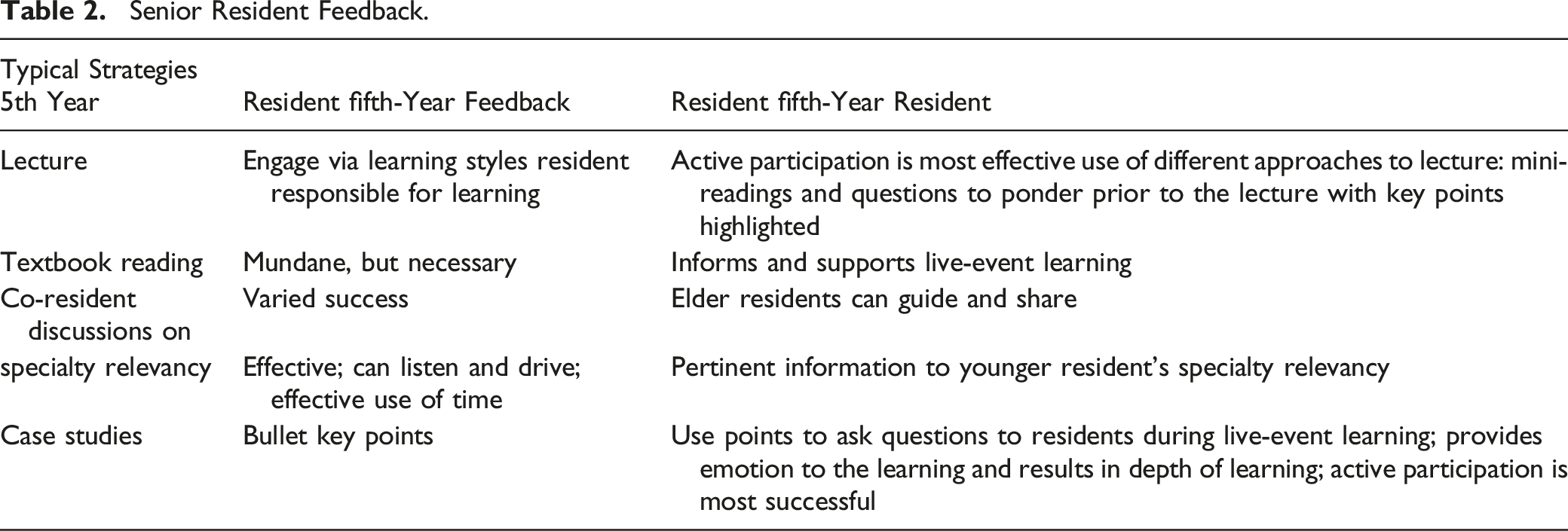
A fifth-year resident, Dr. Joe Derbyshire, shares many views of the second-year resident, as noted in Table 2. However, the fifth-year resident elaborates on the importance of on-the-spot decision making based on what was learned and retained during the prior years of residency. As noted by a fifth-year resident, 22 “during this arduous cycle there is presentation of new information, repetition of old material, and opportunities to educate others. In an ideal world every individual would learn and retain information the same way, so a single syllabus would be needed. Unfortunately, this does not exist, and we live in a world where education is performed in multiple different avenues.”
It is apparent through limited resident feedback that residents learn best with active learning where connections are made and information is dispersed in connected ways, such as mini-readings prior to a lecture, question banks that are built upon for board practice, and podcast assignments to name a few.
Techniques for improving memory
Is it possible to improve memory? Creating an online calendar that sends notifications to your phone can provide reminders of appointments and meetings. Creating daily to-do lists can help remember important tasks that need to be completed. But what about the important information that you need to retain long-term? There are a number of memory techniques that can effectively increase memory and improve recall.
Focus your attention
Attention is one of the major components of memory. In order for information to move from your short-term memory into your long-term memory, you need to actively attend to this information. Try to study in a place free of distractions such as television, music, and other diversions.
Avoid cramming
Studying materials over a number of sessions gives you the time you need to adequately process information. Research has continuously shown that students who study regularly remember the material far better than those who do all of their studying in one marathon session.
Structure and organize
Researchers have found that information is organized in memory in related clusters2. You can take advantage of this by structuring and organizing the materials you’re studying. Try grouping similar concepts and terms together, or make an outline of your notes and textbook readings to help group-related concepts.
Utilize mnemonic devices
Mnemonic devices are a technique often used by students to aid in recall. A mnemonic is simply a way to remember information. For example, you might associate a term you need to remember with a common item that you are very familiar with. The best mnemonics are those that utilize positive imagery, humor, or novelty. Come up with a rhyme, song, or joke to help remember a specific segment of information.
Elaborate and rehearse
In order to recall information, you need to encode what you are studying into long-term memory. One of the most effective encoding techniques is known as elaborative rehearsal. An example of this technique would be to read the definition of a key term, study the definition of that term, and then read a more detailed description of what that term means. After repeating this process a few times, you’ll probably notice that recalling the information is much easier.
Visualize Concepts
Many people benefit greatly from visualizing the information they study. Pay attention to the photographs, charts, and other graphics in your textbooks. If you don't have visual cues to help, try creating your own. Draw charts or figures in the margins of your notes or use highlighters or pens in different colors to group-related ideas in your written study materials.
Relate new information to things you already know
When you're studying unfamiliar material, take the time to think about how this information relates to what you already know. By establishing relationships between new ideas and previously existing memories, you can dramatically increase the likelihood of recalling the recently learned information.
Read out loud
Reading materials out loud significantly improves your memory of the material. Educators and psychologists have also discovered that having students actually teach new concepts to others enhances understanding and recall. Use this approach in your own studies by teaching new concepts and information to a friend or study partner.
Vary your study routine
Another great way to increase your recall is to occasionally change your study routine. If you're accustomed to studying in one specific location, try moving to a different spot during your next study session. If you study in the evening, try spending a few minutes each morning reviewing the information you studied the previous night.
Barriers to Learning
Face to face classes, as opposed to virtual, provide students with the best tools to maximize learning (Lazaro, et.al, 2021). However, lecture while reading PowerPoint slides and assigning large amounts of textbook reading have been identified as prime barriers to resident learning in a traditional learning setting. In this case, Lazaro et al reference students as “expected to have the initiative for their own education and to take charge in their learning process.”
Limited time for physical exercise is an often not discussed as a barrier to learning. Chimitz et al State that “test scores are highly impacted be increasing physical activity.” Given the fact that medical residents work long hours, attend resident classes, and are required to read volumes of textbook material in preparation for boards, leaving very limited time for physical activity.
Poorly constructed scenarios that may have unclear goals; possess multiple solutions, solution paths, or no solutions; or represent uncertainty about which concepts, rules, and principles are necessary for the solution or organized steps (Funke, 2006; Shin et al., 2003).
A medical professor has the task of developing and asking the right questions for inquiry learning to be successful. This proves to be a barrier to learning in that a majority of medical professors are not well-versed in the pedagogy of teaching. Alford, Justice et.al noted that while important, very few works publish the how to develop a good question.4,23 It is the job of the professor to lead the students to think, process, learn, and apply knowledge.
A challenge to learning, and therefore, a barrier, is the amount of retained information in comparison to the amount of content taught. Ebbinhaus initially identified retain information as the “Forgetting Curve” and determined that information is not retained unless it is reviewed over and over. 24
Conclusion
This paper began by searching for a practical approach to teaching aspiring medical physicians that increases both the quantity and depth of learning. We suggested that this goal largely depends on the delivery of content through evidence-based teaching strategies, brain-based research, and best practices in teaching and learning while acknowledging growth through the transference of knowledge to long-term memory. The literature review captures part of this cycle.
With each period of educational research new topics emerge and continue the pedological discourse while reenergizing the desire to make a difference through a renewed focus on the instruction and the learner. At the same time, certain barriers exist across the entire continuum, pushing and pulling the conversation in new as well as familiar directions. Some topics covered in this article noticeably shaped the field, while others reached out to focus on new learner centered audiences.
Teaching and learning are an important aspect of the medical profession. Recognizing readiness, relevant research, existing barriers, and learning styles will help the profession be successful in achieving doctors capable of learning and applying what they have learned. Through it all, however, continuous learning does not stop; there will always be learners in need of greater retention and instructors willing to explore pedagogical strategies that increase the effectiveness of the teaching and learning process.
Footnotes
Declaration of Conflicting Interests
The author(s) declared no potential conflicts of interest with respect to the research, authorship, and/or publication of this article.
Funding
The author(s) received no financial support for the research, authorship, and/or publication of this article.