




Abstract
Objective
To determine if public awareness campaigns in Otolaryngology—Head and Neck Surgery are influencing public interest, as measured by internet searches.
Study Design
Database Query.
Setting
Internet.
Methods
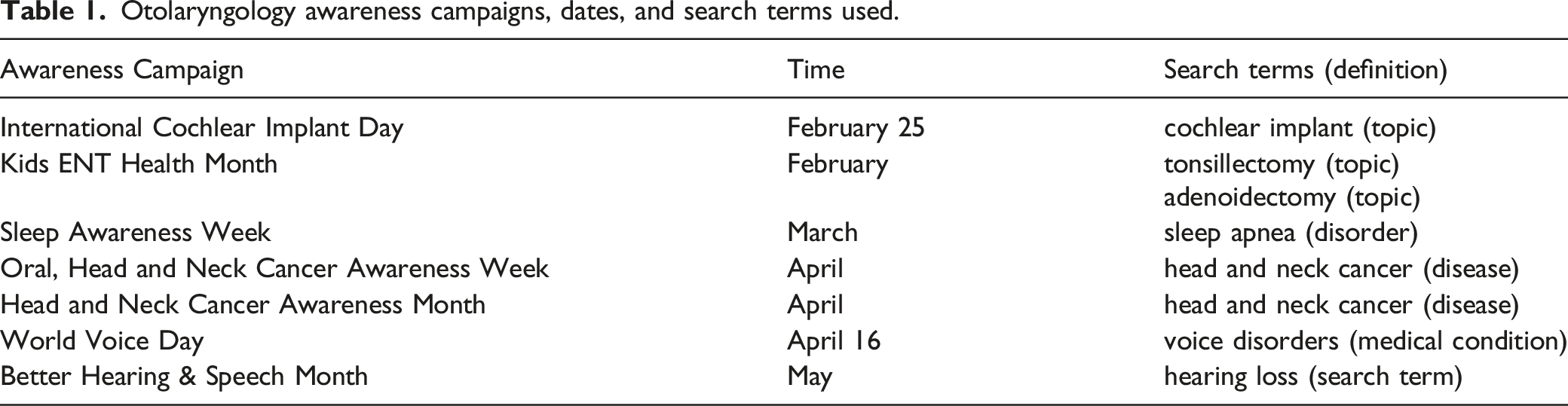
Six awareness campaigns were analyzed over 5 years (2016–2020). Each campaign was assigned one or more relevant Google search terms/topics. Weekly data on United States internet search queries for these topics/terms were collected from Google Trends. “Campaign” dates were defined as 1 week before and 2 weeks after any awareness “day” or “week,” and 2 weeks prior and 2 weeks after any awareness “month.” “Non-campaign” weeks were considered any data outside the “campaign” window. A Welch’s unpaired t-test was used to determine statistically significant differences between “campaign” dates and “non-campaign” dates.
Results
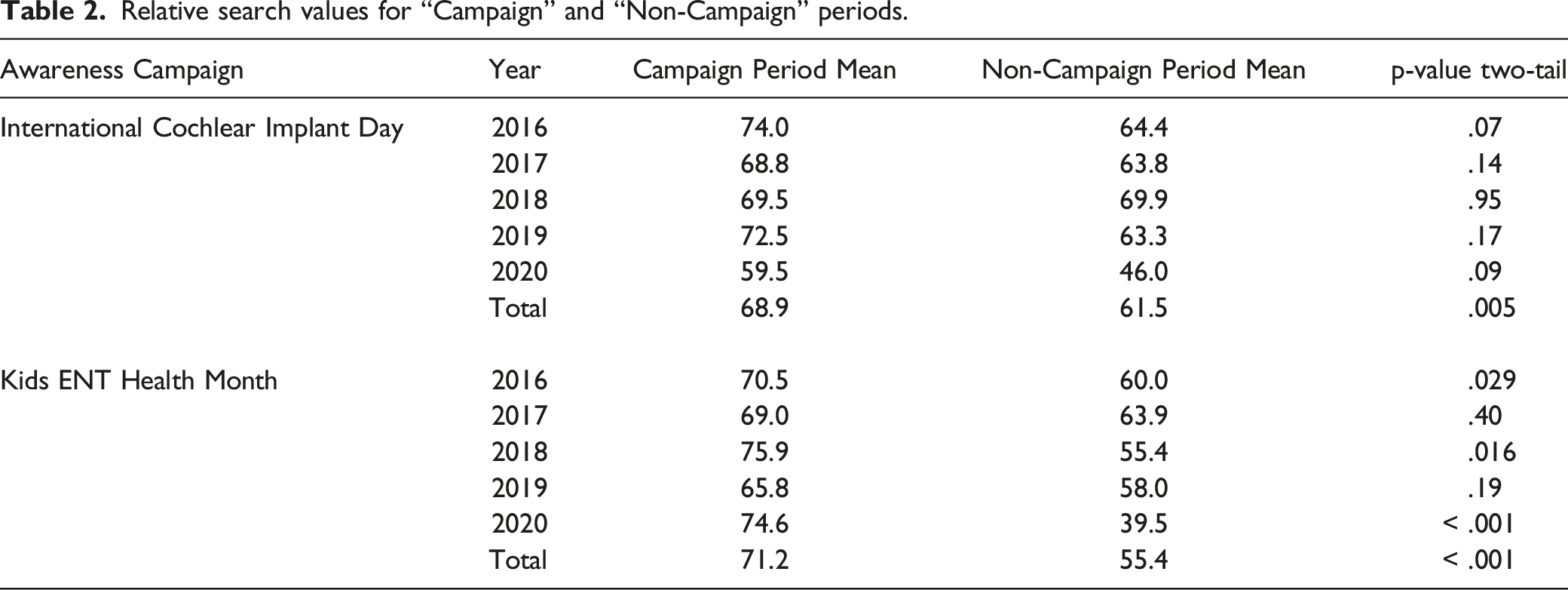
Of the awareness campaigns studied, only “Kids ENT Health Month” (search topic “adenoidectomy,” P = < .001) and “Cochlear Implant Day” (search topic “cochlear implant,” P = .004615) demonstrated a significant increase in internet search activity during the time frame of interest between 2016 and 2020. Although there were some individual years with significant increases for select search terms/topics corresponding to their campaign of interest, none of the campaigns showed increases over the 5-year period studied.
Conclusion
Public health advocacy and outreach has long been recognized as an important component of optimizing otolaryngologic care. However, such efforts to increase public awareness may have varying or even minimal impact. Though an imperfect tool, data from Google Trends suggests that with few exceptions, awareness campaigns in otolaryngology do not necessarily translate to increased internet searches.
Introduction
Public health, defined as “the science and art of preventing disease, prolonging life, and promoting health through the organized efforts and informed choice of society, organization, public and private, communities and individuals,” has likely led to the mitigation of disease, injury, and death more than any other field of modern medicine. 1 Health campaigns, aimed to promote public health, have been successful in nearly every field of medicine including tobacco and substance abuse, infectious disease, heart, lung, kidney, and mental health to name just a few. In fact, there are now hundreds of awareness campaigns per year across the medical spectrum, ranging from World Leprosy Day (January 30) to Food Allergy Awareness Week (May 9–15) to Ultraviolet Safety Month (July). Yet, within the field of otolaryngology—head and neck surgery population health initiatives lag far behind that of other specialties, owing largely to a historic focus on treatment rather than prevention.
Nonetheless, efforts have been made to increase awareness of otorhinolaryngologic conditions amongst the general population. The American Academy of Otolaryngology—Head and Neck Surgery (AAO-HNS) has recognized the importance of campaigns and launched several public health initiatives to raise awareness involving ear, nose, throat, head, and neck health. 2 These include “Better Hearing & Speech Month” (May), “Kids ENT Health Month” (February), “Oral, Head and Neck Cancer Awareness Week” (April), and others. Likewise, other organization have established yearly “awareness” campaigns for issues include cochlear implantation, sleep, and voice.
Despite the growing popularity of public awareness campaigns, evidence supporting the impact of these observances has been lacking. 3 The aim of this study was to explore the impact and trends of awareness campaigns within Otolaryngology—Head and Neck over time, using search engine traffic.
Methods
Otolaryngology advocacy and awareness campaigns were identified from various professional organization websites. Better Hearing and Speech Month; Kids ENT Health Month; Oral, Head and Neck Cancer Awareness Week; Sleep Awareness Week; and World Voice Day were chosen as the American Academy of Otolaryngology—Head and Neck Surgery publicly support these campaigns on their website. International Cochlear Implant Day and Head and Neck Cancer Awareness Month were chosen due to their relevance to the field of otolaryngology—head and neck surgery as well as being publicly supported by the American Cochlear Implant Alliance and the American Association for Cancer Research, respectively. Only campaigns supported by organizations based in the United States were selected for this study, with a focus on those that have been most prominent over the past decade.
Any campaigns that began after 2016 were excluded. Internet search engine traffic was queried via Google Trends (trends.google.com, accessed October 24, 2021) for terms and topics related to each otolaryngologic public health initiative. Google Trends allows for queries to be searched as a “term” or “topic” (or “disease”). “Topics” are a group of “terms” that share the same concept in any given language.
Relative search volume (RSV) data scaled to the highest search proportion per week for Google searches performed each year between 2016 and 2020 was collected. Weekly RSVs were the categorized into “campaign” and “non-campaign” groups. As each public health initiative occurred over a day, week, or month, the “campaign” group was defined by the following criteria: campaigns that occurred on specific days or weeks were defined as those that occur 1 week before, the week of, and 2 weeks after the awareness event while those that spanned over the period of a month were defined at 2 weeks before the month, all weeks in the month, and 2 weeks after the month. The “non-campaign” groups were defined as the weeks occurring outside of our “campaign” window period. A Welch’s t-test (Microsoft Excel, Redmond, Washington) was performed to compare “campaign” and “non-campaign” groups for each year between 2016-2020 individually and in total. Prior to data analysis, an a priori analysis was performed to determine whether the data had normative distribution (allowing for t-test comparisons). The Jarque–Bera test, which is a goodness-of-fit test that determines whether or not sample data have skewness and kurtosis that matches a normal distribution, was utilized to confirm that the data is parametric.
Results
Otolaryngology awareness campaigns, dates, and search terms used.
Relative search values for “Campaign” and “Non-Campaign” periods.
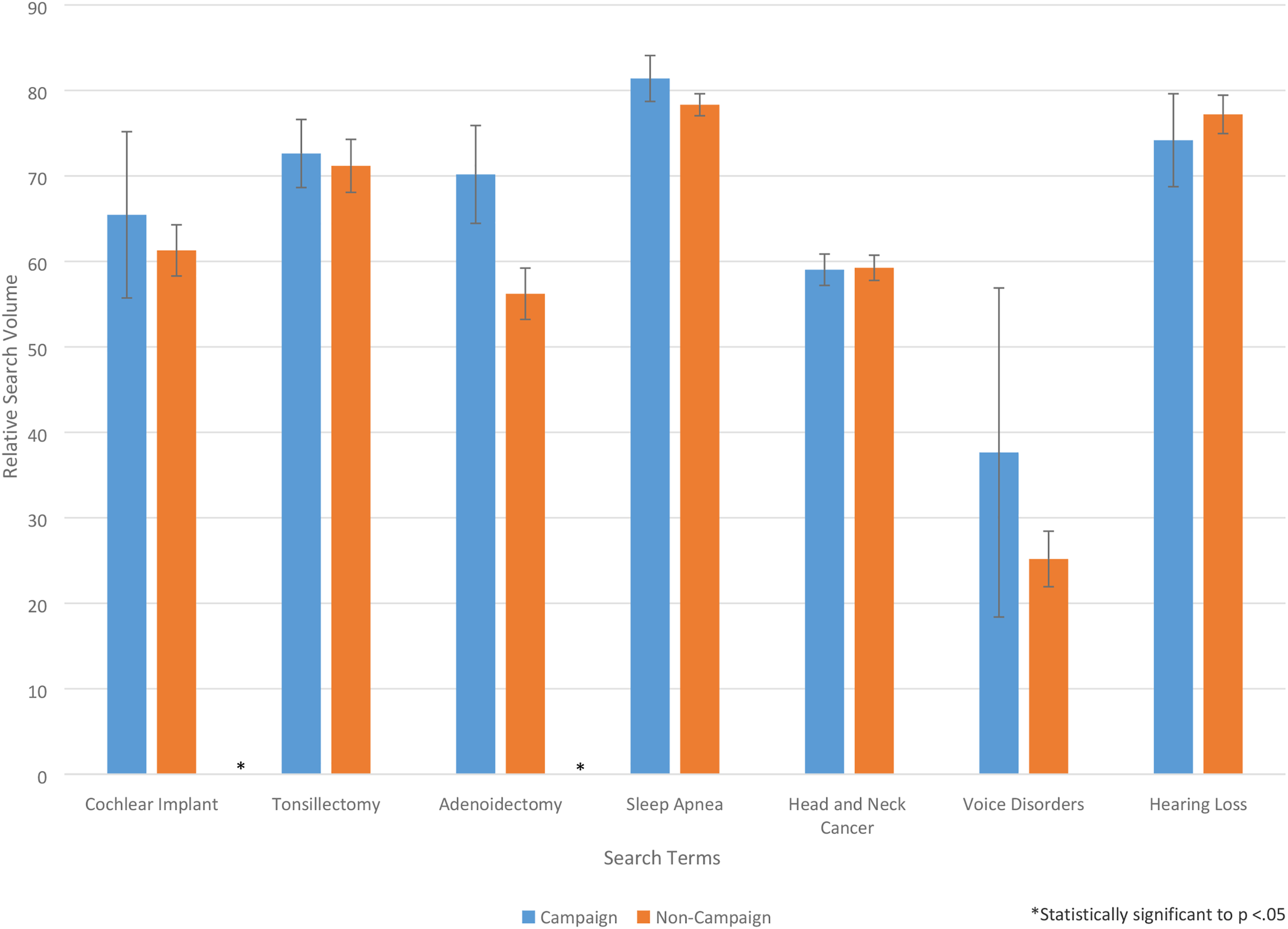
Comparison of average relative search volumes for search terms from 2016 to 2020.
Discussion
Public health awareness can help detect health issues as early as possible and provide appropriate intervention to avoid progression of disease. As such, health promotion and disease awareness campaigns can be leveraged to alleviate local as well as global burden of disease. Despite lagging behind other, larger fields, organized public health efforts aimed at otolaryngologic disorders is not a recent endeavor. As early as 1924, the (then) Academy of Ophthalmology and Otolaryngology established committees dedicated promote public awareness of hearing tests, trachoma eradication, and legislation requiring lye to carry a poison label. 4 Shortly thereafter in 1927, Better Hearing and Speech Month was founded, becoming the first known public awareness campaign in Otolaryngology. Since then, numerous other awareness “days,” “weeks,” and “months” have arisen.
Yet, few if any attempts have been made to examine the success of these efforts. This is largely due to the difficulties is quantifying “impact” by any definition. With the decentralized and sub-specialized nature of otolaryngology care delivery, it has been logistically nearly impossible to quantify the effects of such campaigns at the clinical level. Fortunately, the relatively recent pervasiveness of the internet has revolutionized the field of market analysis, and healthcare has been no exception. One of the most commonly used tools to understand information-seeking behavior about health conditions, Google Trends, is a relatively novel approach that has already been employed by several medical specialties. Several surveillance studies have already shown that public interest in not only disease prevalence but also treatment therapies can be reliably tracked.5-7 Furthermore, the successful application of internet search analysis to track public interest across multiple discipline suggests that these “big data” studies can help advise practice guidelines, patient counseling, and even future clinical research. Specifically looking at the impact of a health campaign, Havelka et al. assessed the effect that global public health days have on online health information seeking behavior. 8 They found that public health campaigns were effective in raising public awareness, albeit inconsistently, as measured by significant increases in internet search traffic in Central and South America. These studies demonstrate that online interest in health conditions and procedures can serve a surrogate marker to track public health education campaigns.
This is not the first study to utilize Google Trends in Otolaryngology. In fact, a flurry of studies has been published recently.9-13 However, to date only one study has specifically looked at the impact of public health campaigns. Murray et al. studied the impact of Mouth Cancer Awareness Day in promoting public awareness about suspicious oral lesions in the Republic of Ireland. 14 This study demonstrated that there was a significant increase in search volume for the terms “mouth cancer” and “oral cancer” in the years following the launch of Mouth Cancer Awareness Day in September 2010.
Unlike the study from Ireland, the findings of the present study suggest that while some public health campaigns in the United States appear to be more effective in raising awareness than others, advocacy for public health awareness in Otolaryngology—Head & Neck Surgery has largely failed to make a significant impact domestically (as measured by internet traffic). Between the years 2016 and 2020, only two Google search terms were more frequently made during the time period correlated to a national health awareness event. Notably, these two terms, “cochlear implant” and “adenoidectomy,” are highly specific terms in the field of otolaryngology which could explain the statistically significant increase in the number of these search terms during International Cochlear Implant Day and Kids ENT Health Month. More general search terms such as “head and neck cancer” does not appear to have a significant increase during the month of April when both Head and Neck Cancer Awareness Month and Oral, Head and Neck Cancer Awareness Week occur. This would suggest that public awareness campaigns can certainly make an impact on the general publics’ perception, but they may not be as effective as intended.
As with any analysis of large data, this study is not without limitations. Google Trends has been used to investigate epidemiological trends of certain diseases and conditions across the world. As Google only makes available relative (and not absolute number) of searches, the reliability of this approach, is imperfect. 15 Another point of concern is that the index for a keyword differs when that keyword is searched as a term versus a topic due to Google’s search algorithm. This difference can create vastly different RSVs for one search term. Additionally, RSV calculations are dependent on undisclosed mathematical approximations and assumptions as determined by Google, which can contribute to obscuring true trends in search traffic. These factors create a challenge in reproducibility of epidemiological research as results heavily depend on consistent and stable data. Furthermore, while health campaigns have the potential to increase public awareness, this increase in awareness may not necessarily translate to an increase in visits to healthcare professionals. Although internet search activity may be associated with health-seeking behavior, there still needs to be more research done to elucidate this relationship. 16
Conclusions
Healthcare advocacy and patient outreach has the potential to substantially impact the health and well-being of our communities. While such efforts are to be applauded and some evidence of success should be recognized, this study suggests that periodic health campaigns in Otolaryngology—Head and Neck Surgery may fall short of their intended impact. Both organizational and individual healthcare providers will need to consider how to better optimize messaging in an effort to raise public awareness.
Footnotes
Author’s Note
This article was presented at the AAO-HNSF 2022 Annual Meeting and OTO Experience, Philadelphia, PA, September 10–14, 2022.
Author Contributions
JMK: Data Collection, Data Analysis and Interpretation, Manuscript Drafting, Final Approval. DHC: Conception, Data Collection, Data Analysis and Interpretation, Manuscript Drafting, Final Approval.
Declaration of Conflicting Interests
The author(s) declared no potential conflicts of interest with respect to the research, authorship, and/or publication of this article.
Funding
The author(s) received no financial support for the research, authorship, and/or publication of this article.
IRB Exemption
Original research, does not involve human research.
