




Abstract

Significance Statement
Secondary otalgia is defined as pain felt in the ear although originating from a non-otologic source. The complex innervation of ear structures makes the identification of the responsible region a challenging procedure. The 2 most common causes of secondary otalgia are the temporomandibular joint dysfunction and dental infections. We present a rare case of secondary otalgia caused by a foreign body hidden deeply in the lateral surface of the tongue.
A 61-year-old male ironworker presented to our emergency Ear, Nose and Throat department complaining about left otalgia accompanied by difficulty in swallowing. Symptoms had started 1 week before in his work environment. The patient was prescribed a 5-day course of antibiotics with ciprofloxacin ear drops combined with painkillers by his family doctor without, however, any signs of improvement. His past medical history was otherwise normal.
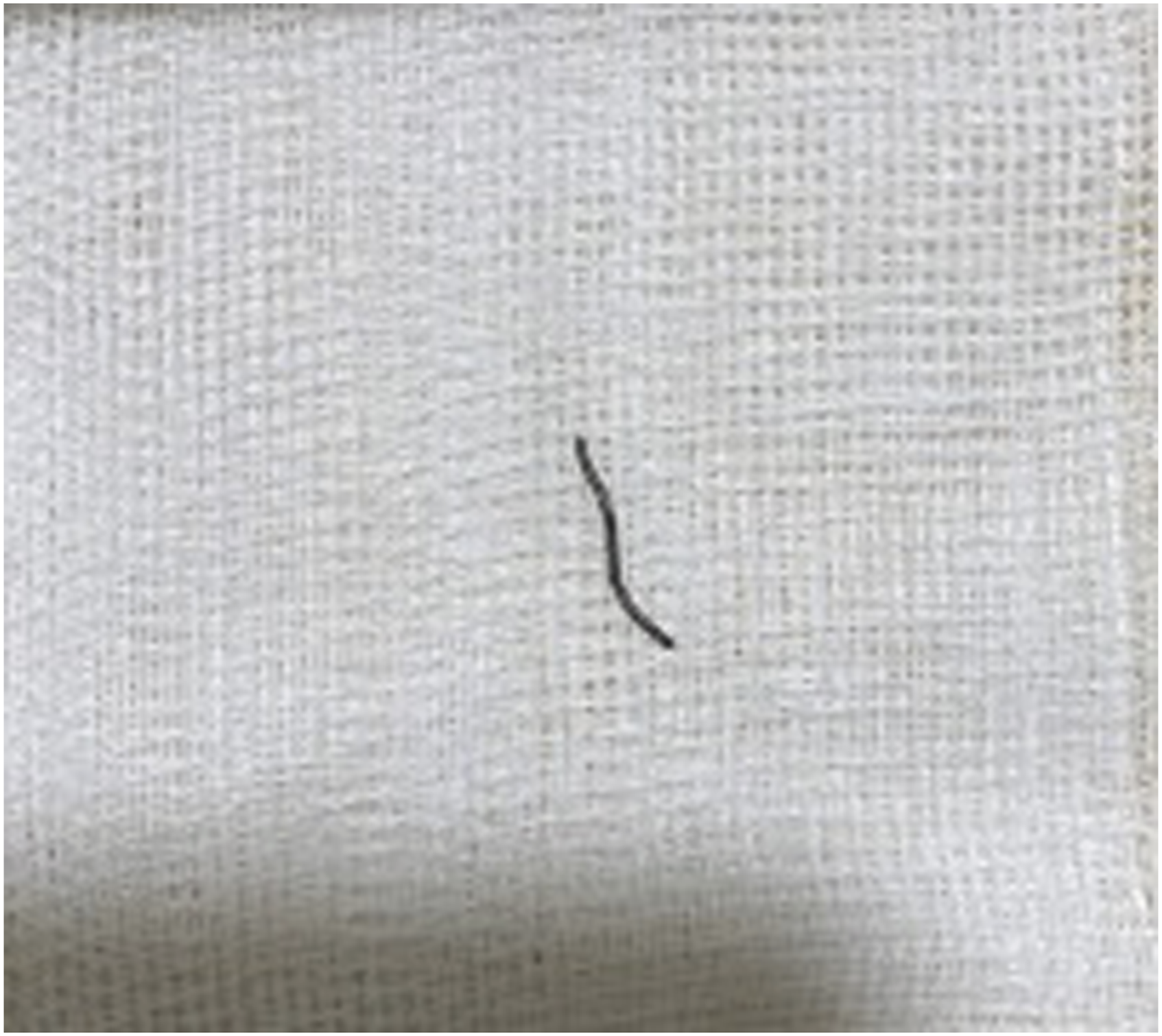
A thorough clinical examination combined with otomicroscopy was unremarkable for any ear pathology. Fiberoptic nasolaryngoscopy and laboratory tests were also normal. Inspection of the oral cavity showed no signs of inflammation; however, a tender area on the left lateral surface of the tongue was noted. After careful observation, a tiny hole was recognized in the same area (Figure 1). An exploration of the area under local anesthesia was conducted and a metallic iron bar of approximately 1.5 cm in length was removed (Figure 2). Symptoms were completely subsided and the patient remained pain free at 1-week follow-up. Oral cavity inspection. Recognition of the painful area on the left lateral surface of the tongue. The extracted foreign body. A metallic iron bar.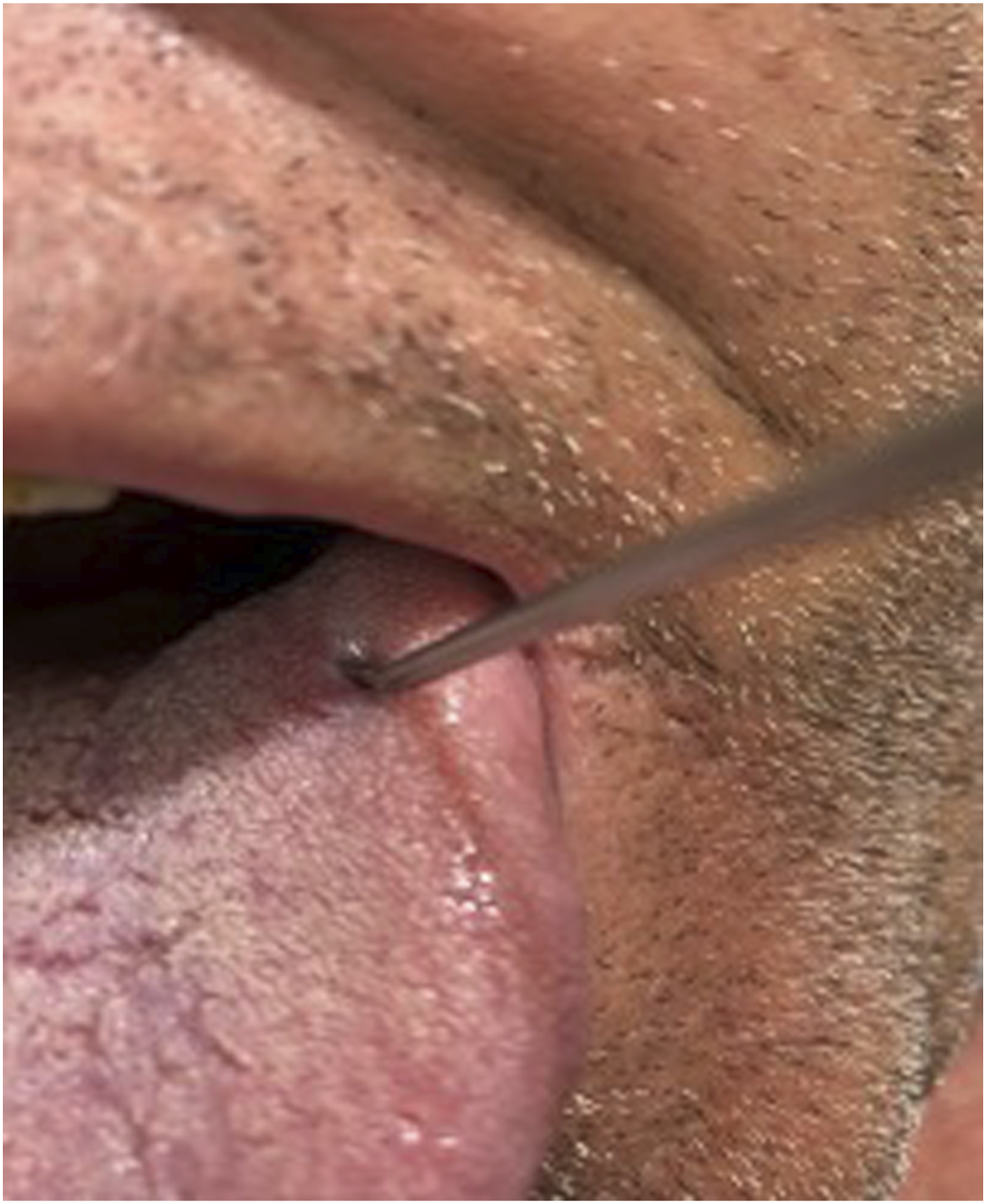
Otalgia is a rather common symptom seen in the primary care setting with many diverse causes. Primary otalgia is related to clinical entities affecting the outer, middle, and inner ear. 1 Inflections such as acute or chronic media otitis, external otitis, folliculitis, mastoiditis, and myringitis constitute the most common etiologic factors. Cerumen obstruction, ear neoplasms, and trauma may also be responsible for primary otalgia. The origin of primary otalgia is almost always easy to be established with otomicroscopy or radiographic imaging. 2
On the other hand, when the cause of pain cannot be localized to the affected ear, it is referred to as secondary otalgia. There is a considerable overlap between the innervation of the ear and the related areas in the head and neck. Innervation of the ear structures comprises multiple lower cranial, upper cervical, and peripheral nerves. They innervate the spine, skull base, salivary glands, pharynx, larynx, oral cavity, orbits, face, paranasal sinuses, and deep neck spaces. The most common causes of secondary otalgia are temporomandibular joint syndrome and dental infections. Additionally, other potential causes of otalgia are Bell’s palsy, salivary gland disorders, pharyngitis, tonsillitis, oral disorders, and cervical osteoarthritis. 2,3
Clinicians should be aware that otalgia could be the primary symptom of a head and neck malignancy. Therefore, a thorough clinical examination of the whole head and neck area is imperative to exclude neoplasms. 3,4
Inflammation, trauma, and neoplasms of the tongue often cause secondary otalgia via the trigeminal (CN V) and the glossopharyngeal nerve (CN IX).
The third branch of the trigeminal, the mandibular nerve (V3), is a mixed nerve. The auriculotemporal nerve is a branch of the V3 that provides sensation to the anterosuperior pinna, anterior external auditory canal, and the anterior lateral aspect of the tympanic membrane. Other branches include the lingual, buccal, and inferior alveolar nerves that provide sensory innervation to the oral cavity, the floor of the mouth, and the anterior two-thirds of the tongue. 5
The glossopharyngeal nerve (CN IX) directly innervates the inner surface of the tympanic membrane as well as the middle ear cavity through sensory fibers of the tympanic nerve (Jacobson nerve). It also provides mixed innervation to the posterior third of the tongue. 6 Secondary otalgia may be caused from anywhere along the course of this nerve. In cases that thorough clinical investigation fails to establish the source of otalgia, a computed tomography or magnetic resonance imaging studies should be considered to define the diagnosis. 5
Footnotes
Declaration of Conflicting Interests
The author(s) declared no potential conflicts of interest with respect to the research, authorship, and/or publication of this article.
Funding
The author(s) received no financial support for the research, authorship, and/or publication of this article.
