




Abstract
This is a case of an innovative method of continuous irrigation approach for wound care following surgical drainage. Compared with the traditional labor-intensive irrigation, this novel handy method is not only reducing the workload but is also less time-consuming and inexpensive. This continuous irrigation approach is an efficient alternative approach for wound care in deep infection of the head and neck.
Case Report
An 84-year-old woman presented with trismus and left cheek swelling with fever for 2 days, which then progressed to swelling and tenderness of the left zygomatic, temporal, and frontal area the next day. Computed tomography of the head and neck revealed an abscess in the left masticator space and infratemporal fossa extending to the extracranial frontotemporal region (Figure 1). These findings indicated the presence of a masticator space abscess. The patient underwent a surgical incision and drainage of the abscess (Figure 2). During the surgery, we applied an innovative continuous irrigation approach for wound care (Figure 3), which included an irrigation tube and a 6-mm Penrose draining tube. The irrigation tube was connected to a continuous normal saline irrigation cannula, and the draining tube was connected to continuous negative suction pressure. To effectively remove the deep-space pus, the irrigation tube was inserted into the neck wound approximately 5 cm deep. This double-lumen irrigation device formed using an irrigation tube and a Penrose drain was well fixed to the wound. After the surgery, continuous irrigation and suction were applied for >12 hours a day, stopping only at night while the patient slept. The wound became increasingly clean with every passing day, and it was smoothly closed on postoperative day 5. The patient was then discharged, and at the 3-month postoperative follow-up, the condition had not recurred.
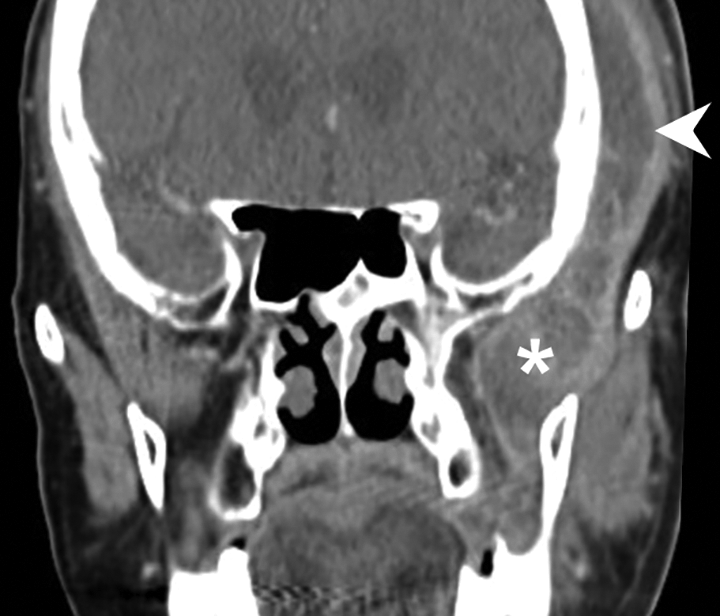
An 84-year-old female patient with a left masticator space abscess. Sagittal view of the computed tomography image demonstrating an abscess located in the left masticator space (the asterisk) extending to the infratemporal fossa and extracranial frontotemporal region (arrowhead).
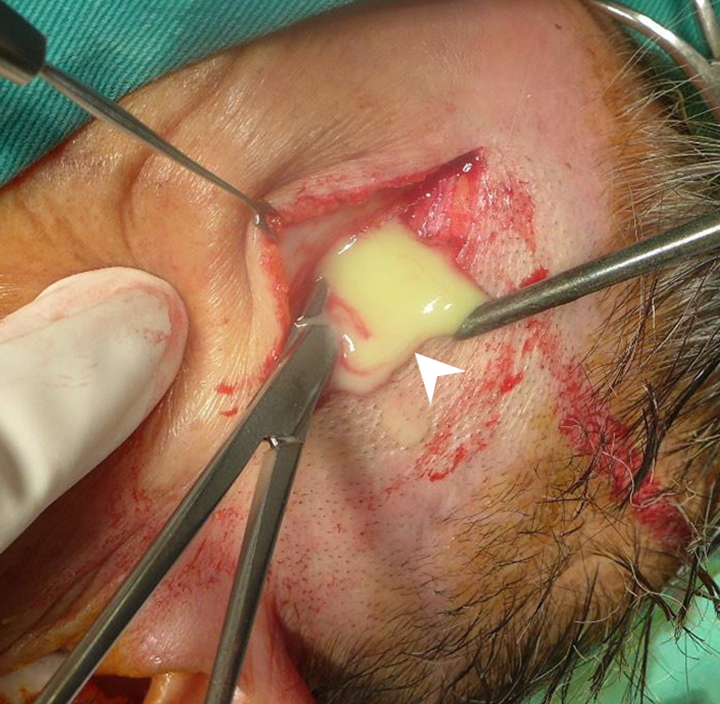
Surgical incision of the abscess was performed, and >15 mL of pus (arrowhead) was drained out.
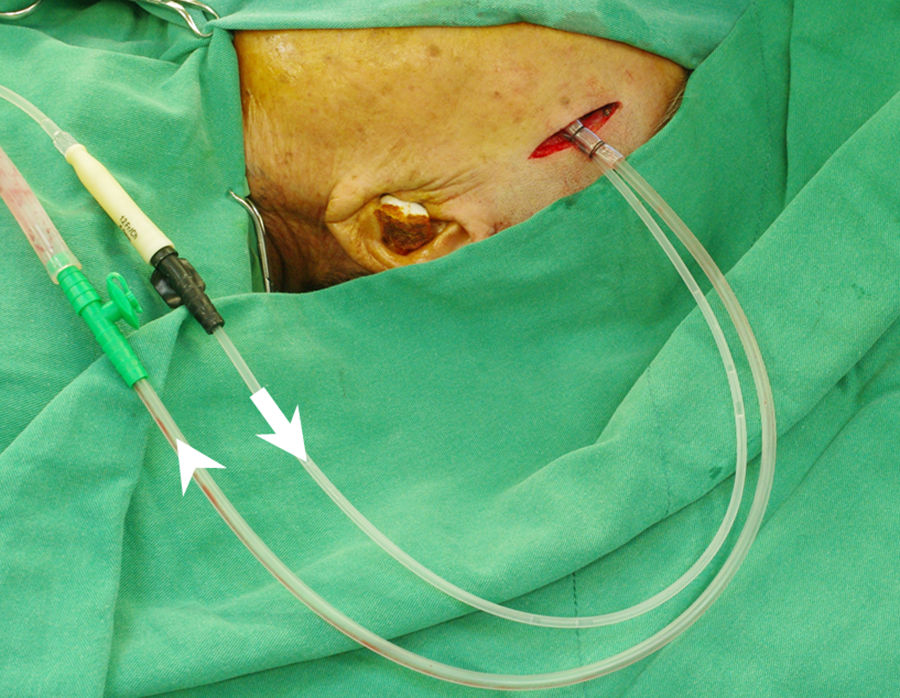
Innovative continuous irrigation approach included an irrigation tube (arrow) and a 6-mm Penrose draining tube (arrowhead).
Discussion
The masticator space (one of the deep neck spaces) is a paired suprahyoid region bounded by the superficial layer of the deep cervical fascia, extending from the top of the parietal bone to the inferior mandible. This space contains mastication muscles, the posterior body and ramus of the mandible, trigeminal nerve, and maxillary artery. 1 Among all the deep neck spaces, masticator space is the most prevalent site of spread of odontogenic infection. 2 Deep neck infection (DNI) is a prevalent bacterial infectious disease found in all age groups 3 and a common emergency condition in otorhinolaryngology. 4 Deep neck infection can extend into the airway and mediastinum and potentially be life-threatening, particularly in patients with systemic diseases5-7 and elderly individuals.8,9 The traditional treatment principle of DNI includes surgical drainage, systemic antibiotics administration, and wound irrigation and dressing. 10 Intensive irrigation usually needs to be implemented by trained clinicians every 4 to 8 hours each day, which increases the burden on medical manpower, and moreover, it is does not sufficiently clean deep wounds. Therefore, this is a case of an innovative method of continuous irrigation approach for wound care following surgical drainage. Compared with the traditional labor-intensive irrigation, this novel handy method is not only reducing the workload but is also less time-consuming and inexpensive. This continuous irrigation method provides satisfactory treatment results without any complications. In conclusion, our innovative continuous irrigation approach is an efficient alternative approach for wound care in deep infection of the head and neck.
Footnotes
Authors’ Note
Hui-Shan Hsieh and Chih-Yuan Lee contributed equally to this work.
Acknowledgments
The authors would like to acknowledge Wallace Academic Editing for editing this manuscript.
Declaration of Conflicting Interests
The author(s) declare no potential conflicts of interest concerning the research, authorship, or publication of this article.
Funding
The author(s) received no financial support for the research, authorship, or publication of this article.
