



Abstract
The COVID-19 pandemic led to a suspension of visiting student rotations across the United States. For senior medical students applying into surgical subspecialties, such as otolaryngology, these away rotations serve a vital role in the residency application process. Prior to the pandemic, there was not a virtual alternative to in-person visiting student rotations for applicants. We developed a replicable and expandable program focused on helping prospective otolaryngology applicants (fourth-year medical students) gain exposure to the experiences typically offered via in-person rotations. The goal was to improve otolaryngology-specific knowledge and to help applicants demonstrate specific program interest, without the financial and logistical challenges associated with in-person away rotations.
Keywords
Introduction
The COVID-19 pandemic led to a suspension of visiting student rotations across the United States. 1,2 For senior medical students applying into surgical subspecialties, such as otolaryngology, these away rotations serve a vital role in the residency application process. 3,4 Prior to the pandemic, there was not a virtual alternative to in-person visiting student rotations for applicants. We developed a replicable and expandable program focused on helping prospective otolaryngology applicants (fourth-year medical students) gain exposure to the experiences typically offered via in-person rotations. The goal was to improve otolaryngology-specific knowledge and to help applicants demonstrate specific program interest, without the financial and logistical challenges associated with in-person away rotations.
Curriculum
The Vanderbilt Otolaryngology Online Medical Student Experience (VOOMSE) was a virtual course lasting 4 weeks, with approximately 15 hours of remote-learning activities, and offered at 4 different blocks from August to November 2020 to maximize student flexibility. It was offered to all U.S. and international fourth-year medical students or recent graduates applying for otolaryngology residency in the 2021 Match cycle. Each block was capped at 15 students to prevent learner saturation. There were 5 main types of activities for participants (Figure 1; Supplement 1): departmental grand rounds, resident teaching conferences with post-conference discussions, “on call” consult sessions, resident socials, and faculty meet-and-greets. Learning objectives were developed based on the ACGME core competencies,
5
teaching concepts from Bloom’s Taxonomy,
6
and aimed to recreate the educational experiences typical of visiting student rotations. All activities were hosted via the online video conference platform Zoom (Zoom Technologies, San Jose, CA). Description of curriculum activities.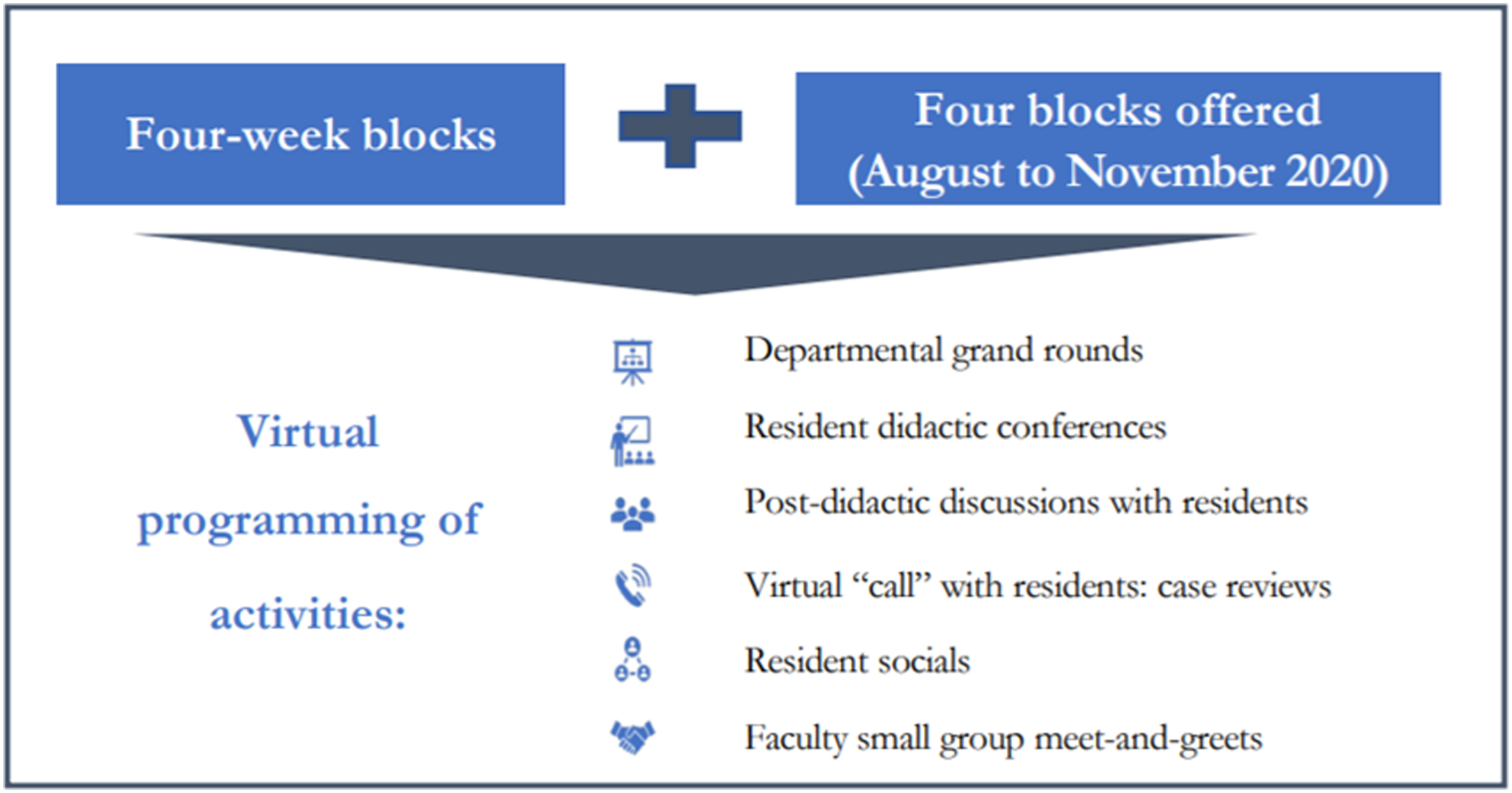
Post-program evaluation was conducted using a voluntary, confidential, and anonymous survey sent to all VOOMSE participants. This study was reviewed by VUMC Institutional Review Board and met criteria for exemption. The survey included quantitative rating questions on a 5-point Likert scale (1 = not useful or successful; 5 = very useful or successful) and qualitative questions, with open-response texts for feedback and suggestions. Analysis utilized a mixed methods approach, with qualitative questions analyzed for themes using emergent coding by two coauthors independently.
We were fortunate to have 49 VOOMSE participants from across the U.S. (and one international student). Of these, 32 participants completed the post-program survey (65% response rate). Six students (19%) reported not having a home institution otolaryngology program. The activities rated as being most useful were the virtual “on-call” consult sessions, resident socials, and faculty meet-and-greets (Figure 2(a)). Overall, VOOMSE was rated as successful in providing an opportunity for prospective applicants to meet current residents, learn about the residency program, and feel innovatively supported during the pandemic (Figures 2(b,c)). For the qualitative open-response question, “which was the most useful component and why?,” responses centered around interactional opportunities and information sharing. With regards to the least useful components and areas for improvement, response themes centered around specific programming relevance, overall program structure, and ways to increase interactions with the department (Supplemental Table 2). Participant ratings of (A) the usefulness of each virtual program activity, (B) VOOMSE success in accomplishing its program objectives, and (C) providing opportunities for applicants.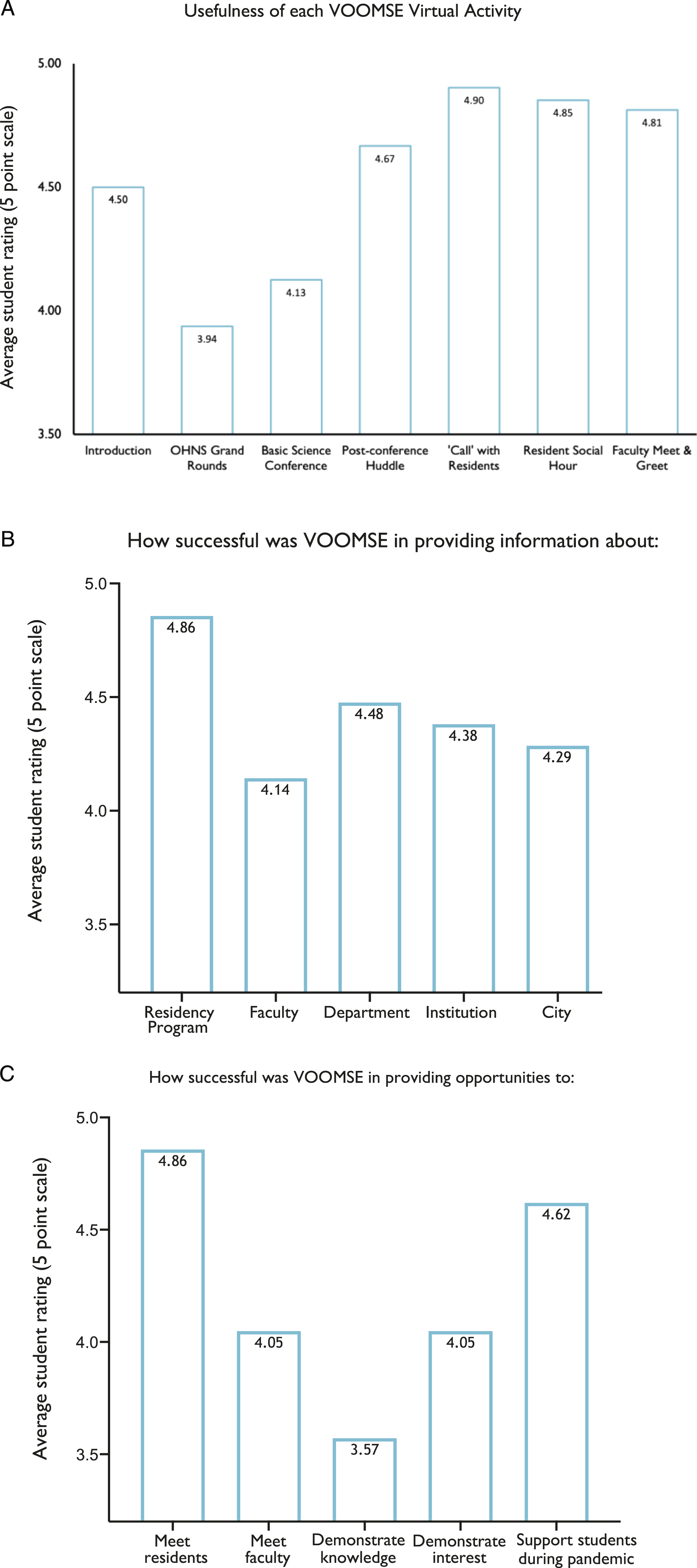
Discussion
During COVID-19, educational institutions responded innovatively with options to offer virtual experiences similar to ones typically available in-person. 5 -7 Here, we describe one academic institution’s experience with implementing and evaluating a replicable and expandable four-week remote-learning rotation designed for prospective otolaryngology applicants. The resulting post-program survey demonstrated program success in providing a virtual platform for specialty-specific learning, opportunities to engage with external faculty and residents, and an opportunity to demonstrate applicant interest in a specific program, which are the most important goals previously reported of in-person away rotations. 4
A successful virtual sub-internship holds abundant potential for future medical students applying into surgical subspecialties. Even once the pandemic subsides, in-person away rotations incur significant financial and logistical costs. 7,8 In this context, the virtual and part-time curriculum design is a valuable alternative, and this was praised by applicants in the open-response comments. The flexible schedule can be well-managed during a home institution elective or research block, while still allowing prospective applicants to foster multi-institutional engagement, show specific program interest, meet external faculty and residents, and meet other co-applicants. Additionally, virtual programming has been shown to increase participant diversity and as such, offers a more accessible and equitable option for students to meet important application goals. 9
Conclusion
VOOMSE was a successful educational initiative, and we believe this virtual curriculum offers a unique opportunity to supplement fourth-year medical student learning while eliminating certain cost, time, and logistical burdens. In the future, continued implementation of virtual options alongside in-person rotations can provide a more accessible opportunity for medical students with limited flexibility or resources.
Supplemental Material
sj-pdf-1-ear-10.1177_01455613211052337 – Supplemental Material for A Four-Week Otolaryngology Virtual Educational Curriculum for Prospective Applicants
Supplemental Material, sj-pdf-1-ear-10.1177_01455613211052337 for A Four-Week Otolaryngology Virtual Educational Curriculum for Prospective Applicants by Jaclyn Lee, Madelyn N. Steven, Kelly C. Landeen, Brittany E. Lipscomb and Amy S. Whigham in Ear, Nose & Throat Journal
Footnotes
Declaration of Conflicting Interests
The author(s) declared no potential conflicts of interest with respect to the research, authorship, and/or publication of this article.
Funding
The author(s) received no financial support for the research, authorship, and/or publication of this article.

Supplemental Material
Supplemental material for this article is available online.
References
Supplementary Material
Please find the following supplemental material available below.
For Open Access articles published under a Creative Commons License, all supplemental material carries the same license as the article it is associated with.
For non-Open Access articles published, all supplemental material carries a non-exclusive license, and permission requests for re-use of supplemental material or any part of supplemental material shall be sent directly to the copyright owner as specified in the copyright notice associated with the article.
