



Abstract

Significance Statement
This case report demonstrates the first described case of anterior glottic web development after bioenzyme aspiration. It is currently unknown whether surgical treatments are successful in this subset of caustic aspirations. We successfully performed surgical division of the anterior glottic web with resolution of the web and improved vocal clarity and consistency.
Laryngoscopic Clinic
A 68-year-old female with a past medical history of Arnold–Chiari malformation and interstitial cystitis presented to the ENT clinic with complaints of decreased vocal projection and clarity. Two months prior, she had consumed an over-the-counter (OTC) gluten enzyme supplement for self-reported gluten sensitivity. The pill broke within her mouth and she aspirated the contained powder, immediately noting hoarseness, decreased strength of voice, and associated odynophagia. As a member of her local choir, she was significantly distressed by this. During her first laryngology clinic visit, the patient had flexible laryngoscopy performed, which demonstrated normal vocal fold mobility and a glottic web extending across the anterior third of the true vocal folds. No subglottic narrowing was noted. The patient elected to perform web excision.
During the procedure, the anterior glottic web was noted to occupy the anterior third of the true vocal folds. Straight laryngeal scissors were used to make a midline incision along the anterior glottic web (Figure 1A). A horizontal neck crease incision was made along the cricothyroid membrane (Figure 1B). A Prolene suture was passed through the needle into the laryngeal lumen, grasped through the laryngoscope, and retrieved through the mouth. The needle was then pulled back out of the neck. Using an empty curved needle, the Prolene suture was passed twice through a rectangular-shaped silastic stent. Intraoperative laryngeal view. The anterior glottic web is shown (A) pre-excision, (B) during excision, and (C) after stent placement.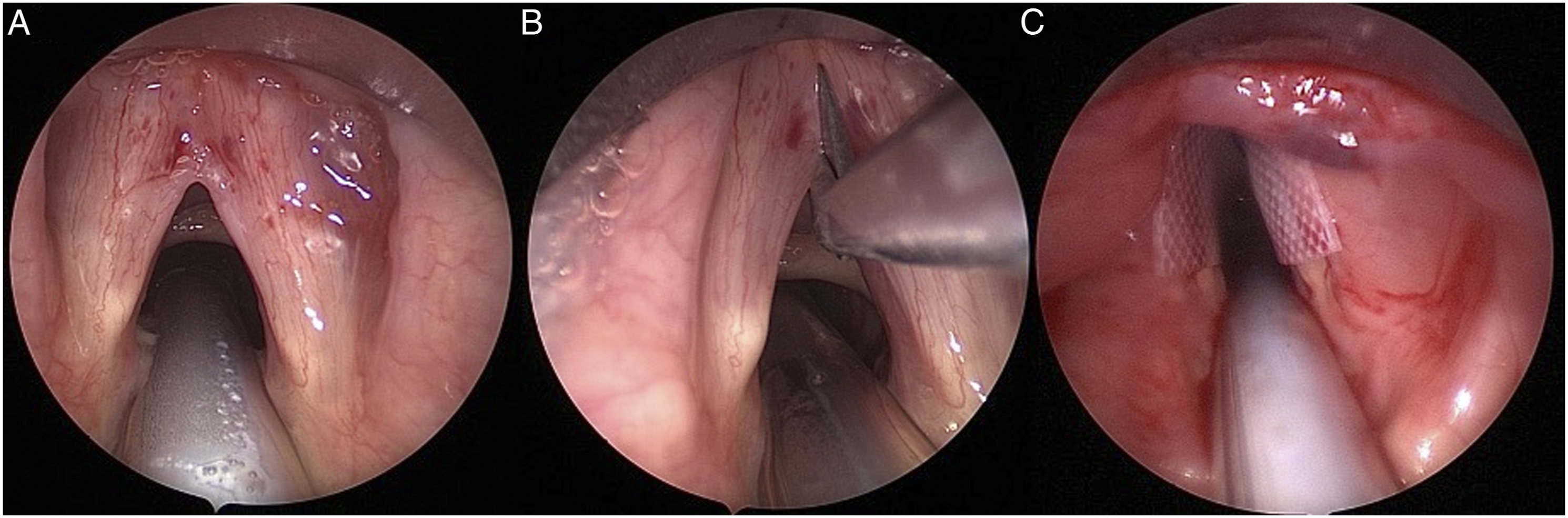
An 18-gauge spinal needle was then passed through the neck incision, entering the larynx a few mm above the anterior commissure in the midline. The free end of the Prolene suture was guided through the laryngoscope into the needle lumen and threaded until visible at the proximal end of the spinal needle. The spinal needle was retracted. The stent was guided into position against the anterior commissure and sutured in place at the neck (Figure 1C).
The patient was taken back to the operating room 3 weeks later for removal of the silastic splint (Figure 2). During her six-week postoperative visit, the patient showed complete resolution of anterior glottic web and reported substantial improvement in voice frequency and clarity. The patient gave consent for publication of the case report. Postoperative laryngeal exam. The intraoperative view (A) before removal of the stent and (B) after initial removal of the stent shows successful lysis of the web with residual inflammation. (C) Six-week postoperative clinic visit demonstrates complete resolution of the anterior glottic web.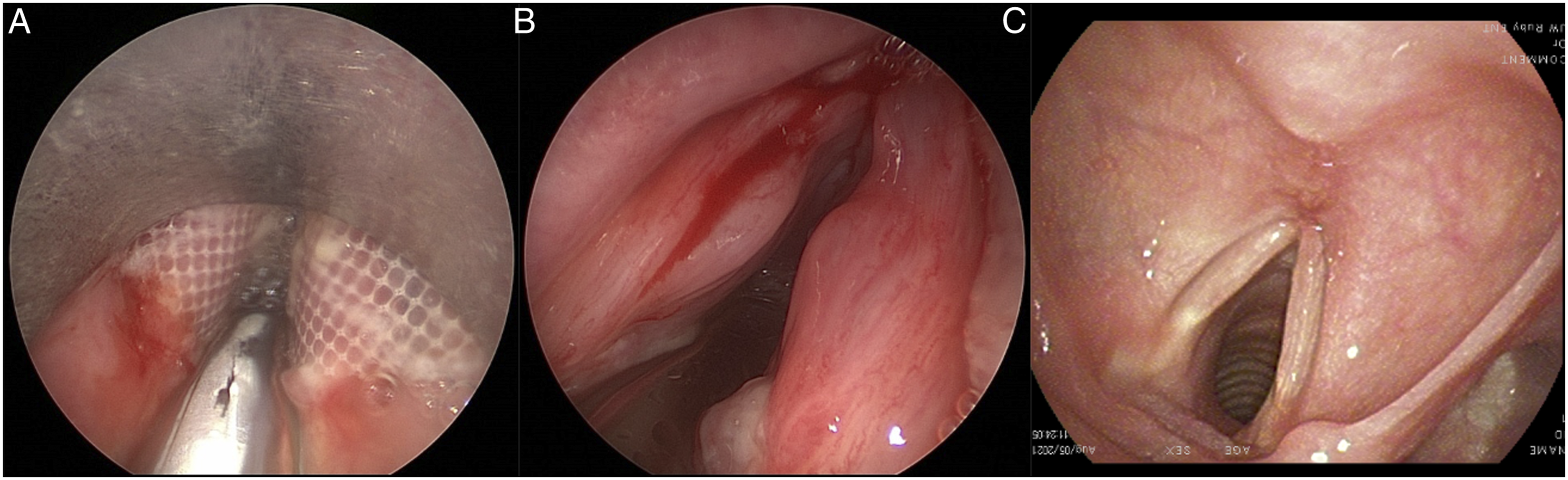
Discussion
An anterior glottic web is an abnormal sheet of mucosal tissue along the anterior glottis that can be acquired or, less commonly, present at birth. 1 Acquired glottic webs can be caused by infection, laryngeal trauma due to frequent or prolonged intubation, external trauma, surgical trauma, inhalation of harmful substances, or laryngopharyngeal reflux.1-4 We report the first known case of a suspected oral supplement bioenzyme aspiration causing an anterior glottic web.
While over-the-counter (OTC) supplements have not been implicated previously in glottic web development, laryngeal burns have been reported following ingestion of bile acid supplements. 5 The use of OTC supplements and bioenzymes has increased in recent years with the increasing popularity of home remedies, and many of these supplements are not Food and Drug Administration (FDA)–approved. 6 Gluten products have received attention recently due to the increasing awareness of gluten sensitivity and celiac disease. 7 Gluten enzyme supplements contain proteases, which may be encased in an enteric capsule that prevents early delivery of the contents to nontarget areas.8,9 Early rupture of the capsule and introduction of proteolytic substances to the true vocal folds could initiate an inflammatory response leading to the formation of a glottic web. 5
While surgical correction is the most described form of treatment for anterior glottic webs, bioenzyme-mediated tissue pathology and its treatment have not been reported previously.2,4 We performed cold steel endoscopic web excision with silastic stent placement and achieved resolution of the web on removal of the stent 3 weeks later.2,4 The patient reported improvement in voice strength and quality after surgery.
This case demonstrates a novel complication following premature release and aspiration of a bioenzyme supplement. While the patient was treated effectively, this case highlights the importance of understanding the risks of supplement use. Future studies into the mechanism of bioenzymatic trauma may clarify immediate risk mitigation strategies and treatment.
Footnotes
Acknowledgments
The authors acknowledge the support of the Department of Otolaryngology at West Virginia University.
Declaration of Conflicting Interests
The author(s) declared no potential conflicts of interest with respect to the research, authorship, and/or publication of this article.
Funding
The author(s) received no financial support for the research, authorship, and/or publication of this article.
Ethics approval
This retrospective study was deemed exempt under the Institutional Review Board of West Virginia University.
