



Abstract

Keywords
Hadrian reigned (117-138 CE) until an illness precipitated his death. He is renowned for scrupulously attending to foreign policy and constructing a wall in northern Britain. From an epitomized chapter of Dio’s Roman History, 1 and the Historia Augusta, 2 a collaboration of biographies, we can evaluate his health. In 1980, Petrakis characterized the emperor’s illness from the constellation of epistaxis, diagonal earlobe creases, and edema as heart failure secondary to coronary artery disease and hypertension. 3 We describe a new diagnosis and develop an expanded differential.
In 138 CE, Hadrian was a 62-year-old male with a history of epistaxis who developed progressive epistaxis, cachexia, and edema, improved by unspecified behaviors, and worsened by abandoning his regimen and indulging in unsuitable food and drink (Table 1).
Symptoms by Original Text and Translation.
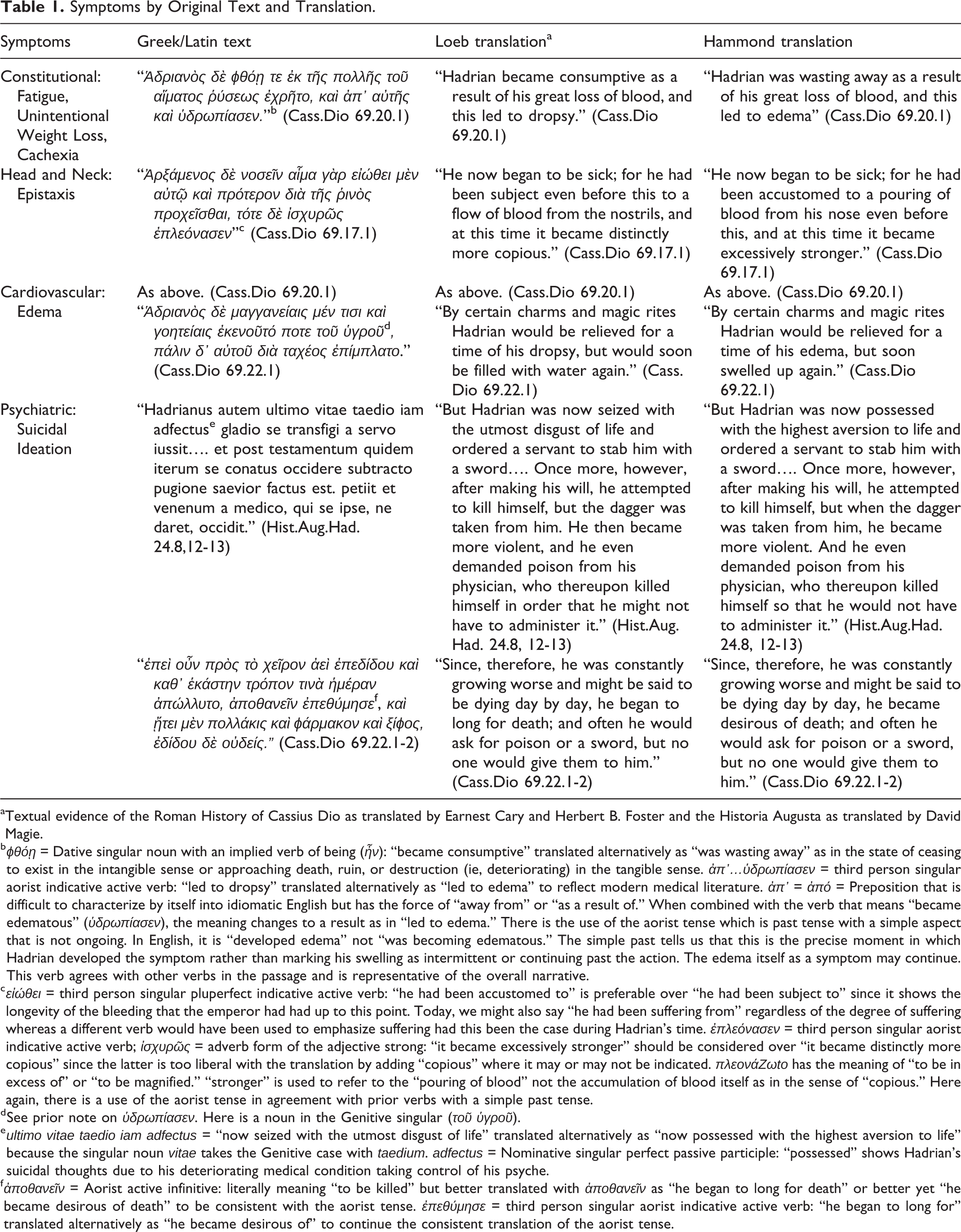
aTextual evidence of the Roman History of Cassius Dio as translated by Earnest Cary and Herbert B. Foster and the Historia Augusta as translated by David Magie.
b ϕθόῃ = Dative singular noun with an implied verb of being (ἦν): “became consumptive” translated alternatively as “was wasting away” as in the state of ceasing to exist in the intangible sense or approaching death, ruin, or destruction (ie, deteriorating) in the tangible sense. ἀπ᾽…ὑδρωπίασεν = third person singular aorist indicative active verb: “led to dropsy” translated alternatively as “led to edema” to reflect modern medical literature. ἀπ᾽ = ἀπό = Preposition that is difficult to characterize by itself into idiomatic English but has the force of “away from” or “as a result of.” When combined with the verb that means “became edematous” (ὑδρωπίασεν), the meaning changes to a result as in “led to edema.” There is the use of the aorist tense which is past tense with a simple aspect that is not ongoing. In English, it is “developed edema” not “was becoming edematous.” The simple past tells us that this is the precise moment in which Hadrian developed the symptom rather than marking his swelling as intermittent or continuing past the action. The edema itself as a symptom may continue. This verb agrees with other verbs in the passage and is representative of the overall narrative.
c εἰώθει = third person singular pluperfect indicative active verb: “he had been accustomed to” is preferable over “he had been subject to” since it shows the longevity of the bleeding that the emperor had had up to this point. Today, we might also say “he had been suffering from” regardless of the degree of suffering whereas a different verb would have been used to emphasize suffering had this been the case during Hadrian’s time. ἐπλεόνασεν = third person singular aorist indicative active verb; ἰσχυρῶς = adverb form of the adjective strong: “it became excessively stronger” should be considered over “it became distinctly more copious” since the latter is too liberal with the translation by adding “copious” where it may or may not be indicated. πλεονάΖωto has the meaning of “to be in excess of” or “to be magnified.” “stronger” is used to refer to the “pouring of blood” not the accumulation of blood itself as in the sense of “copious.” Here again, there is a use of the aorist tense in agreement with prior verbs with a simple past tense.
d See prior note on ὑδρωπίασεν. Here is a noun in the Genitive singular (τοῦ ὑγροῦ).
e ultimo vitae taedio iam adfectus = “now seized with the utmost disgust of life” translated alternatively as “now possessed with the highest aversion to life” because the singular noun vitae takes the Genitive case with taedium. adfectus = Nominative singular perfect passive participle: “possessed” shows Hadrian’s suicidal thoughts due to his deteriorating medical condition taking control of his psyche.
f ἀποθανεῖν = Aorist active infinitive: literally meaning “to be killed” but better translated with ἀποθανεῖν as “he began to long for death” or better yet “he became desirous of death” to be consistent with the aorist tense. ἐπεθύμησε = third person singular aorist indicative active verb: “he began to long for” translated alternatively as “he became desirous of” to continue the consistent translation of the aorist tense.
In a patient with epistaxis, cachexia, and edema, head and neck cancer must be considered. Nasopharyngeal and paranasal sinus tumors, such as squamous cell carcinoma (SCC), adenoid cystic carcinoma, melanoma, and inverted papilloma, are known to cause nosebleeds from angiogenesis and/or obstruction. Of these solid malignancies, SCC may predispose to the form of wasting syndrome that Hadrian experienced, mediated by a cytokine storm, chronic inflammation, hypermetabolism, and insufficient oncotic pressure. 4 And so, the ϕθόη or “wasting away” of Hadrian’s body “led to his edema” ὑδρωπίασεν (Cass.Dio 69.20.1). In addition, the emperor’s relative abstinence from alcohol since he “breakfasted without wine” (Cass.Dio 69.7.3) contrary to the customs of the time does not rule out the development of SCC since cancers in the nasopharynx and paranasal sinus have a lower association with alcohol consumption. Cirrhosis and hepatocellular carcinoma cannot be ruled out either based on the nonspecific evidence of Hadrian’s alcohol intake. Both disorders can manifest with cachexia and edema from hepatic dysfunction, malnutrition, portosystemic shunting, and sarcopenia. 5,6 Liver failure may predispose to nosebleeds via thrombocytopenia, coagulopathy, and estrogen-induced vasodilation. The emperor’s acute deterioration (Cass.Dio 69.22.4) could be attributable to hepatic decompensation.
Although heart failure can account for Hadrian’s cachexia and edema with a possible exacerbation following the withdrawal of his preventative routine, the etiology is questionable. Hypertension, Petrakis hypothesized, accounted for the epistaxis and heart failure. However, it remains controversial that hypertension is associated with nosebleeds with some studies proving association without causality. 7 Likewise, the finding of bilateral earlobe creases (Frank’s sign) on busts of the emperor 3 cannot reliably indicate coronary artery disease as a precipitant and/or concomitant risk factor for heart failure since it has a poor predictive value due to inadequate effect size and selection bias. 8
Another diagnosis to explain heart failure and epistaxis is hereditary hemorrhagic telangiectasia, a disease characterized by arteriovenous malformations leading to recurrent nosebleeds, telangiectasias, and high-output heart failure. The emperor’s history of epistaxis which “became excessively stronger” (Cass.Dio 69.17.1) toward the end of his life suggests this rare autosomal dominant syndrome. However, neither his father (Publius Aelius Hadrianus Afer), his mother (Domitia Paulina), his sister (Aelia Domitia Paulina), or his paternal first cousin once removed and predecessor (Trajan) were known to exhibit the same recurrent pattern of nosebleeds. By inheritance, the disease does not typically skip generations and includes prominent dermatologic manifestations, rendering this diagnosis less likely.
To the critics of the retrospective diagnosis, the fascination with the ailments of famous figures may never end, but this should not detract from the collaboration of humanities and medicine. We present a patient in the setting of antiquity with epistaxis, edema, and cachexia to hone a differential.
