



Abstract
Objectives:
The purpose of this study is to review the CT imaging findings of injuries in the head and neck caused by fireworks through a case series.
Methods:
The imaging database from the University of Chicago Medicine was searched with “fireworks,” “firecrackers,” and “mortar” as keywords and CT as the imaging modality. Cases without acute CT findings or initial CT scans were excluded.
Results:
Eighteen cases with acute CT findings of head and neck firework injuries were identified and included. The associated injuries included skull fractures (5, 28%), ocular injuries (7, 39%), soft tissue trauma (18, 100%), retained foreign bodies (8, 44%), and intracranial trauma (2, 11%).
Conclusions:
Fireworks can cause injuries of varying severity in the head and neck, including blunt and penetrating trauma, that warrant CT evaluation.
Keywords
Introduction
Fireworks are used worldwide for recreational purposes and are a direct cause of significant morbidity in the United States 1 -3 and other parts of the world including Asia 4,5 and Europe. 6,7 Males, young adults, and children are disproportionately affected by fireworks injuries. 1 -3 Common types of fireworks that cause injuries include firecrackers, sparklers, bottle rockets, mortar, and roman candles. 1 -3 In the United States, an estimated 97 562 fireworks-related injuries were treated in the emergency departments from 2000 to 2010, with 42% of these injuries involving the head and neck area. 2 The US Consumer Product Safety Commission estimated that 10 000 fireworks-related injuries were seen and treated in the United States hospital emergency departments during 2019 alone, with 16% of the injuries involving the head/face/ear and 15% affecting the eye. 1 Fireworks injuries to the head and neck region can lead to burns, contusions/lacerations, and less frequently fractures. 1,3
Despite the well-documented prevalence of fireworks injuries, only 24 cases of fireworks-related injuries to the head and neck region with computed tomography (CT) imaging have been reported in the literature dating back to 1984. 8 -25 These were mostly case reports, 8,11 -15,17 -19,21 -25 and case series are scarce with each one including 2 to 3 cases with CT imaging. 9,10,16,20 In addition, there has been no study reviewing CT imaging findings of fireworks injuries to the head and neck in the past literature. The purpose of our study was to characterize the CT imaging features of fireworks injuries in the head and neck via a retrospective study of a case series and review of the literature.
Methods
The radiology reports in the Nuance mPower Clinical Analytics system database were electronically searched using “fireworks,” “firecrackers,” and “mortar” as keywords and CT as the imaging modality. Twenty-eight cases with a history of fireworks injuries to the head and neck region (confirmed by chart review) with CT imaging were identified from 2010 to 2021. Eight cases with only chronic or normal CT imaging findings were excluded. Two additional cases with CT imaging after surgeries were excluded as their initial CT scans were performed at outside hospitals before they underwent ocular or brain surgeries there and were unavailable to us. Additionally, demographic and clinical data, including age, sex, date of presentation to the emergency department, firework type, and mechanism of injury, were collected via a review of patients’ medical records.
Case Reports
A total of 18 distinct cases of fireworks-related injuries to the head and neck with associated acute CT imaging findings, firework type, and mechanism of injury are summarized in Table 1. The mean patient age was 23 years (range, 7-45 years). There were 16 (89%) male patients and 2 (11%) female patients. Twenty-eight percent of patients had skull fractures (Figure 1), 39% had ocular injuries (Figure 2), 44% had retained foreign bodies (Figure 3), and 11% had intracranial trauma (Figure 4).
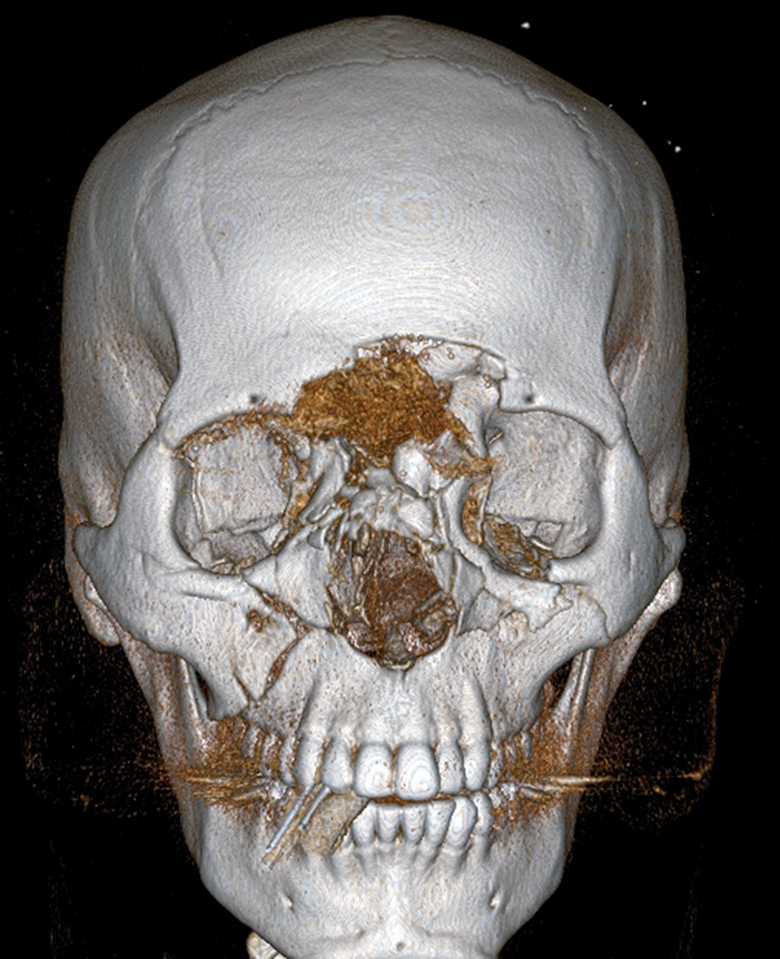
3D computed tomography (CT) image shows facial smash fractures.
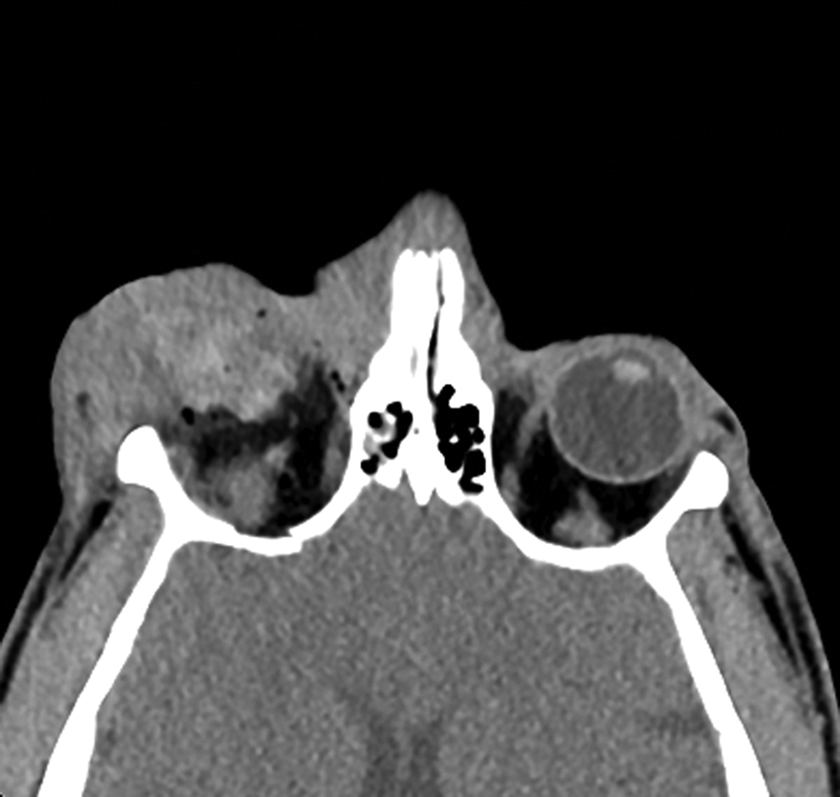
Axial computed tomography (CT) image shows right globe rupture with intraocular hemorrhage and periorbital soft tissue swelling.
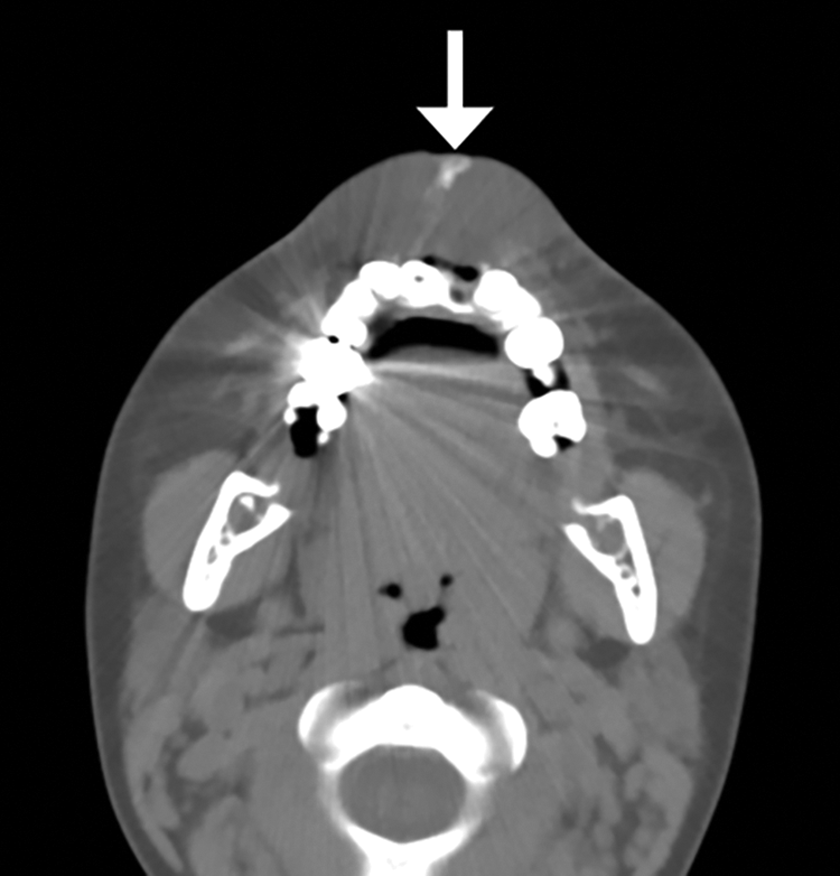
Axial computed tomography (CT) image shows hyperattenuating foreign body (arrow) in the facial soft tissues.
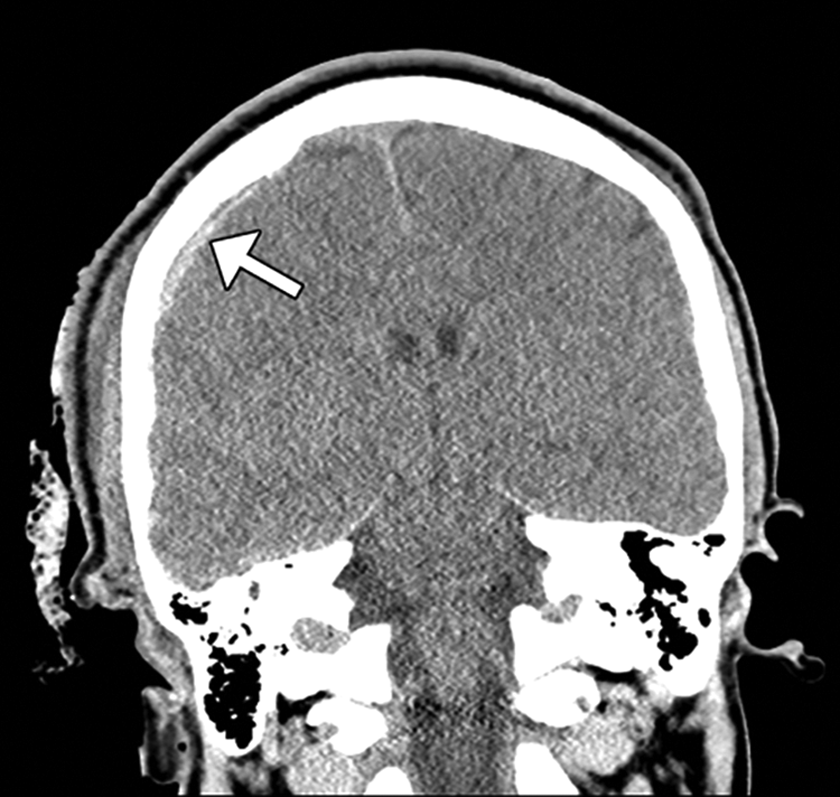
Coronal computed tomography (CT) image shows right cerebral convexity subdural hematoma (arrow) and right scalp soft tissue swelling.
Patient Characteristics and CT Findings of Fireworks Injuries to the Head and Neck.
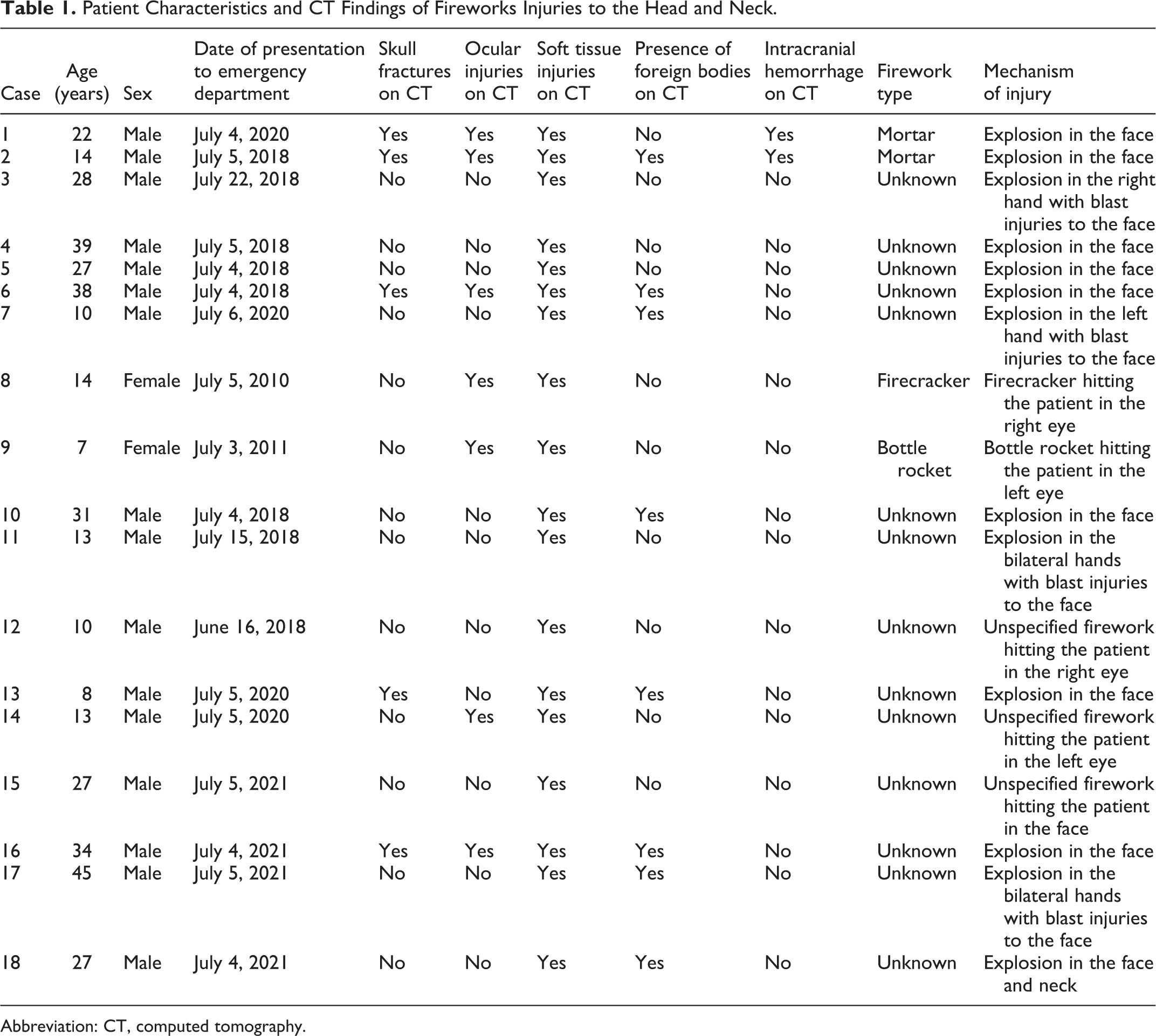
Abbreviation: CT, computed tomography.
Discussion
Fireworks are used to celebrate various holidays and events around the world and can result in significant injuries, with a large portion of these injuries occurring to the head and neck in the United States. 2 Among the fireworks-related injuries treated in the emergency departments in the United States in 2019, injuries to the head/face/ear and to the eye comprised of an estimated 1600 (16%) and 1500 (15%), respectively, and these injuries included soft tissue and hard tissue injuries, such as laceration and fracture. 1 Yet, we have identified only 24 unique cases of fireworks injuries in the head and neck with CT imaging described in the literature with only 4 case series. 8 -25 Here, we presented 18 additional cases that demonstrated a wide range of CT findings, including soft tissue swelling and emphysema; extensive skull fractures; ocular injuries, such as globe rupture; the presence of retained foreign bodies; and intracranial injuries, such as subdural and subarachnoid hemorrhage.
Previous studies have also demonstrated that fireworks injuries disproportionately affect children, young adults, and males, 1 -3 which is consistent with findings from our series of cases. Furthermore, the 24 cases in the literature showed a variety of CT findings: 13 cases with skull/maxillofacial fractures, 13,15 -17,20,25 7 cases with globe rupture, 9,12,16,20 10 cases with foreign bodies, 9,11,14,15,18 -23 11 cases with intracranial hemorrhage or hematoma, 8,10,11,13,16,17,20,24,25 and 7 cases with cerebral contusion. 8,10,13,16,20 These CT imaging findings were similar to our findings.
Both our case series and the review of the literature demonstrated that fireworks-related injuries to the head and neck have a diverse array of findings with varying severity on CT. The cases in the literature 13,15 -17,20,25 and this series (cases 1, 2, 6, 13, and 16) showed that fireworks can cause various skull fractures, including the calvarium and maxillofacial skeleton. However, our cases also demonstrated fracture sites that have not been reported in the literature: case 1 showed fractures of the cribriform plate; case 2 showed fractures of the lamina cribrosa and dehiscence and displacement at the right frontozygomatic suture; and case 13 demonstrated fractures of the maxilla involving the sockets of the central maxillary incisors that resulted in an absent left incisor and loose right central incisor.
Although globe rupture was reported on CT imaging both in the literature 9,12,16,20 and in our case series, our cases also showed signs of acute vitreous hemorrhage with an otherwise intact globe (case 8) and hemorrhage in the anterior chamber of the left ocular globe that suggested acute traumatic injury (case 9). Additionally, extracranial soft tissue injuries on CT were reported in only 3 cases in the past literature, including soft tissue emphysema in the suprahyoid and infrahyoid neck space, 15 swelling of the extraocular muscles, 16 and superficial soft tissue swelling in the right temporal region. 17 However, our cases demonstrated a much broader range of soft tissue findings: preseptal or periorbital soft tissue swelling in cases 4, 5, 7, 9, 12, 14, and 17; periorbital soft tissue hematoma in case 16; scalp and lip swelling in case 15; scalp hematoma in cases 6 and 10; soft tissue emphysema in cases 2, 5, 6, 8, 9, and 11; soft tissue defects in cases 2, 3, 5, 11, and 18; and extensive upper and midfacial soft tissue injuries in case 1.
Furthermore, foreign bodies from firework explosions have been reported in the literature to be intraocular, 21 -23 intraorbital, 9,18 retroorbital, 19 intracranial, 11 in the preauricular soft tissues, 14 and in the oral cavity and submandibular space on CT. 15 In addition to these locations reported in the literature, foreign bodies were also found in scalp soft tissues in case 2 of our series; anterior and lateral to ruptured right globe in case 6; within the bilateral preseptal soft tissues, in the superficial soft tissues of the nose, and along the left auricle in case 7; in the left glabellar region partially embedded in the left nasal bone in case 10; in the upper lip in case 13; in the left periorbital soft tissue in case 16; in the left frontal scalp soft tissues and right medial canthus in case 17; and in the right anterior neck in case 18.
Not surprisingly, all 18 patients in this case series presented with firework injuries during the month of June or July with 15 (83%) of 18 presenting on or around the Fourth of July. Indeed, it was estimated that 73% of fireworks injuries treated in US hospital emergency departments in 2019 occurred between June 21, 2019, and July 21, 2019. 1 Therefore, it is important to advocate and educate the general public on the risks and safe use of fireworks, particularly during summertime festivities when the incidence of fireworks injuries is the highest in the year.
It is interesting to note the broad spectrum of CT findings of fireworks-related injuries to the head and neck, and the variations in CT findings from patient to patient may be due to factors such as the mechanism of injury. For example, in case 2, the firework directly exploded in the patient’s face, leading to extensive fractures of the skull, soft tissue laceration, intracranial hemorrhage, and globe rupture. However, in case 11, the firework exploded in the patient’s hands and caused only soft tissue injuries in the malar regions, which most likely resulted from shrapnel or projectile debris but not from direct blast injury to the face. Another factor that may be responsible for the wide range of CT findings in our cases is the types of fireworks, as certain types of fireworks are more powerful than others. For example, mortar fireworks caused extensive skull fractures, globe ruptures, and intracranial trauma in cases 1 and 2 whereas a firecracker and bottle rocket caused relatively minor ocular and soft tissue injuries in cases 8 and 9, respectively. However, the specific type of fireworks responsible for causing head and neck injuries was not available for each patient due to the retrospective nature of the study and is thus a limitation of our clinical report.
Conclusion
Our case series and the review of the literature demonstrated a wide range of CT findings of fireworks-related injuries to the head and neck region with features of both penetrating and blunt trauma. In particular, injuries included skull fractures, ocular injuries, retained foreign bodies, and intracranial hemorrhage. Attention should be paid to the specific types of fireworks and mechanisms of fireworks injuries, which could explain the variability of CT findings.
Footnotes
Authors’ Note
Y.Y. and D.T.G. conceived and designed the study and contributed to the acquisition and interpretation of data. Y.Y. drafted the manuscript, and D.T.G. revised it critically for important intellectual content, conception, supervision, and Editing. Both authors approved the final manuscript to be submitted and agreed to be accountable for all aspects of work. The authors declare that they had full access to all of the data in this study, and the authors take complete responsibility for the integrity of the data and the accuracy of the data analysis.
Declaration of Conflicting Interests
The author(s) declared no potential conflicts of interest with respect to the research, authorship, and/or publication of this article.
Funding
The author(s) received no financial support for the research, authorship, and/or publication of this article.
