




Abstract
Mechanical feedback is one of the most common difficulties encountered when fitting hearing aids for toddlers and young children. We described the use of 3D printing to tailor a protective cap for a toddler with bilateral microtia/canal atresia to facilitate bone-anchoring hearing aid use.
Keywords
The Case
KT was born at 34 weeks’ gestation by semiurgent cesarean delivery because of intrauterine growth retardation. At very low birth weight of 1.17 kg, KT required noninvasive ventilation and later endotracheal intubation at the first day of life. Newborn physical examination showed left eye ptosis with microphthalmos, bilateral microtia with canal atresia, and micrognathia with central posterior cleft palate. With a working diagnosis of Pierre Robin Sequence, KT was fitted with tracheostomy and gastrostomy for ventilation and nutritional support. Other problems during infancy included hypoglycemia, polycythemia, patent pulmonary ductus arteriosus, and sepsis episodes, which were treated with medical therapy. Genetic study by microarray analysis revealed arr[GRCh37](1-22)x2, (X, Y)x1, of which the clinical significance is unknown. KT was discharged home at 8 months of age.
Challenges of Rehabilitation
KT failed his newborn hearing screening with an estimated threshold of >95 dB in both ears. Imaging by magnetic resonance imaging showed internal acoustic meati and inner ears are structurally intact. Bone-anchoring hearing aid (BAHA 5 Sound Processor, Cochlear Ltd) via a headband was prescribed in January 2018, when KT was 5 months of age. Assessment with sound field audiometry at 7 months showed postnatal neurological growth with an estimated threshold of 45 dB aided hearing. However, the compliance of BAHA headband use was jeopardized when KT started to use corrective spectacles at 16 months of age. KT has functionless left eye (microphthalmos with persistent fetal vasculature, macular fold and scar, and complete ptosis), while his right eye is suffering from high presbyopia with astigmatism. With both the hearing aid and spectacles applied through headbands, KT experienced frequent mechanical feedback from the sound processor. Feedback was further exacerbated when KT, annoyed by the noise, touches his hearing aid. With development of gross and fine motor skills, KT learnt to remove both rehabilitation devices. The compliance of BAHA was reduced to less than an hour a day.
Our Solution: 3D Printing
A protective cap is considered necessary to avoid KT from touching and smashing the sound processor. A model was designed using SolidWorks computer system (by SolidWorks Corp.) and printed with Stratasys 3D printer (model F170, Stratasys Ltd). 1 The model has (1) a basket to protect the BAHA yet freely transmit sound; (2) a pair of flanges for the attachment of the headband; (3) finger guards to prevent KT probing his fingers from the bottom for the basket (Figures 1 and 2). It was made of acrylonitrile butadiene styrene, which is the plastics used for LEGO bricks. Acrylonitrile butadiene styrene has benefit of being impact resistant, durable, relatively light weighted, and easy to clean. The compliance of both BAHA and eye spectacles improved after application of the protective cap, KT gets habituated with the BAHA, he now uses his hearing aid during most hours of the day (Figure 3). At the time of preparation of this manuscript, KT is turning 3 years old. He is able to obey most commands and walks independently. His intellectual ability is developing though there is still a long way ahead. Mandibular distraction osteogenesis and palatoplasty are in plan for the treatment of his upper airway obstruction. Osseointegrated implant for BAHA is contemplated at 5 years of age.
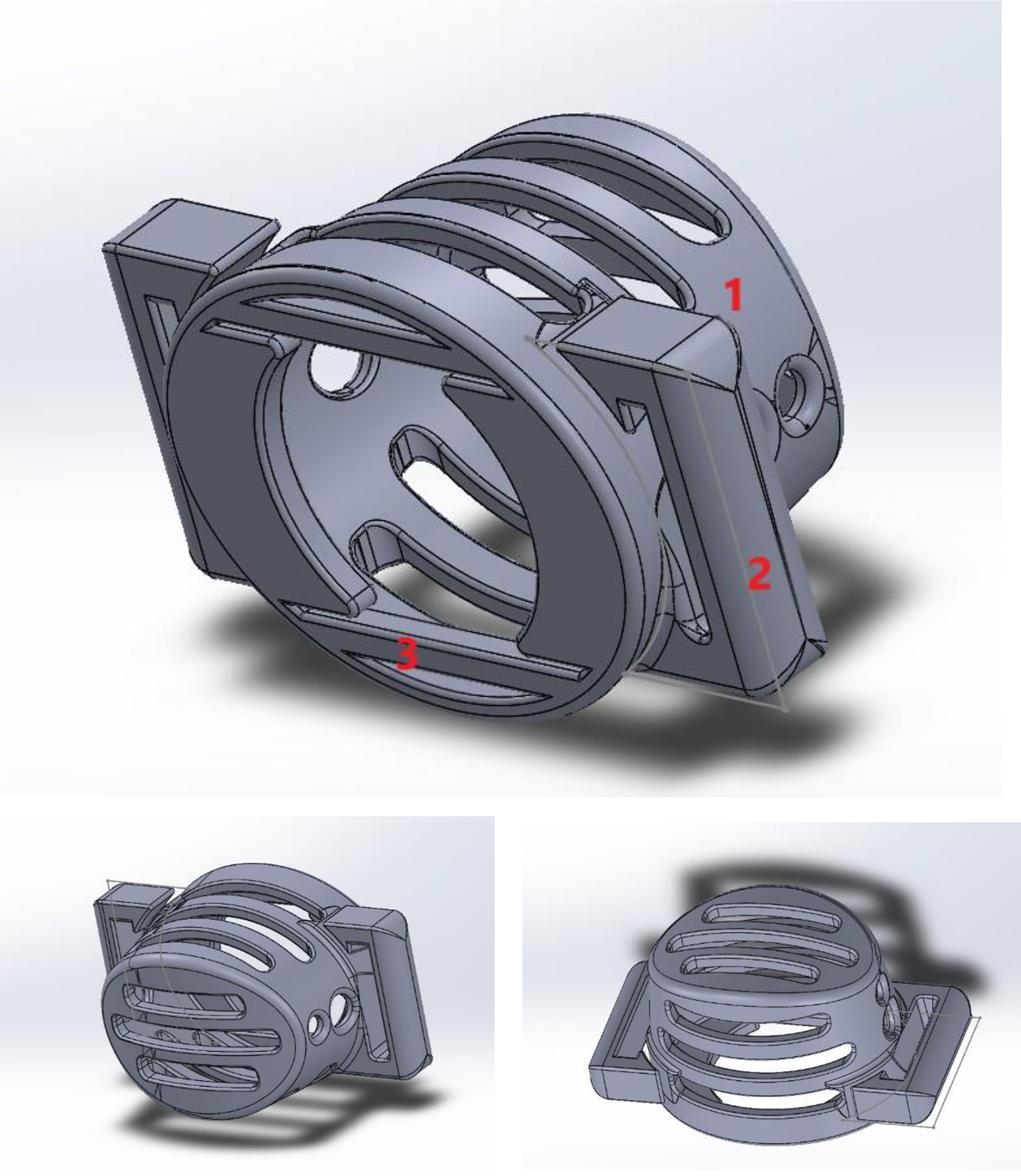
Blueprint of 3D printing for BAHA protective cap. Labelled: (1) basket design, (2) flanges for headband attachment, (3) finger guards.
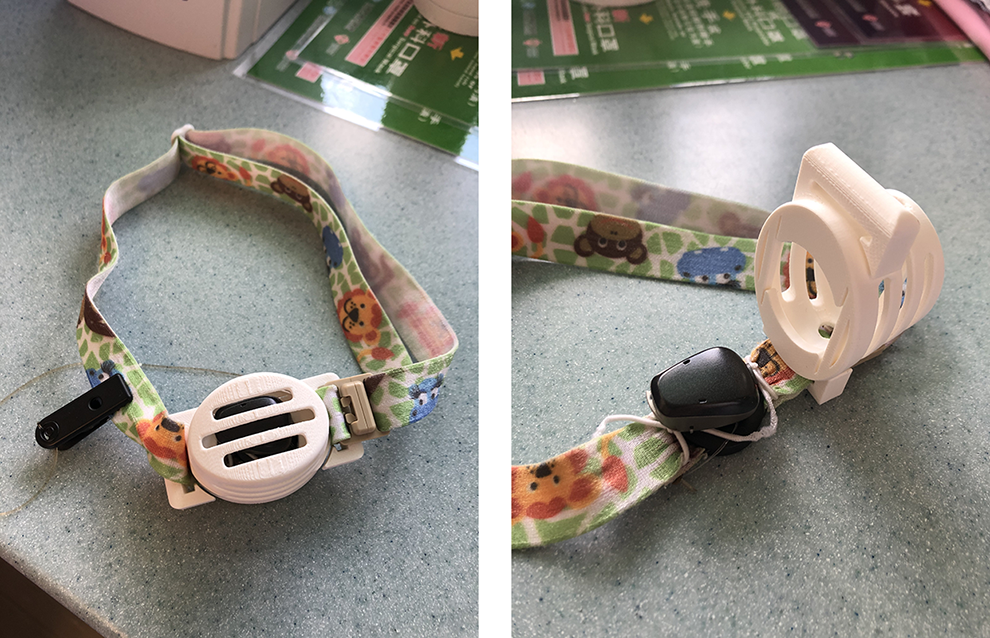
“UC Cap” attached to BAHA sound processor and headband.
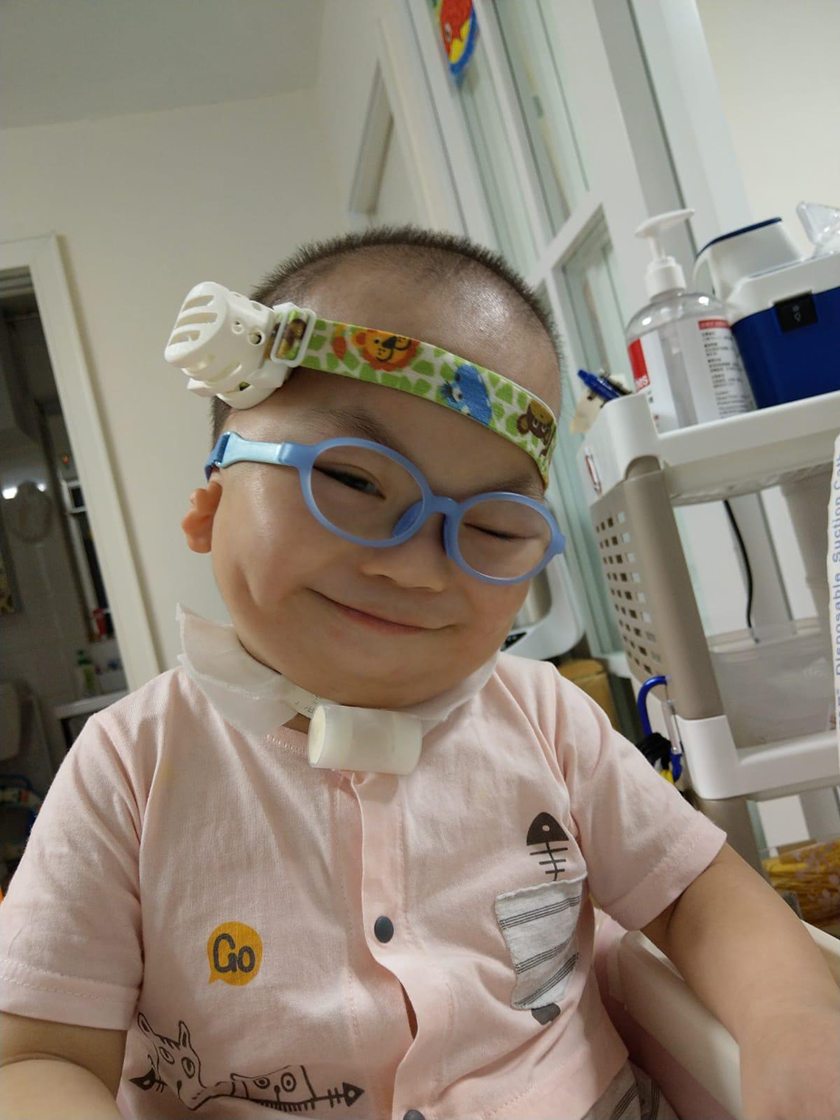
KT, 3 years old, wears his BAHA with UC Cap and spectacles. (Photo publication with consent from KT’s parents.)
Footnotes
Authors’ Note
Dr Alice K. Y. Siu—manuscript preparation, case otolaryngologist; Dr Lilian P. Y. Lee—manuscript advice, consent, case pediatrician; Ms Samantha M. L. Leung—design of device, case occupational therapist.
Acknowledgments
The authors would like to thank occupational therapy assistant, Mr C. H. Law, for his inspiration and SolidWorks 3D drawing of the device; and Ms W. L. Yam, nurse coordinator, who always walks the extra mile to care for children with special needs. We would like this device to be referred as “UC Cap” if cited in the future.
Declaration of Conflicting Interests
The author(s) declared no potential conflicts of interest with respect to the research, authorship, and/or publication of this article.
Funding
The author(s) received no financial support for the research, authorship, and/or publication of this article.
