




Abstract
Objective:
To determine which otolaryngology residency programs have social media platforms and to review which programs are utilizing platforms to advertise virtual open houses and virtual subinternships for residency applicants.
Study Design:
Cross-sectional study.
Setting:
The study was conducted online by reviewing all accredited otolaryngology residency programs in the United States participating in the Electronic Residency Application Service.
Methods:
Otolaryngology residency programs were reviewed for social media presence on Instagram, Twitter, and Facebook. Social media posts were evaluated for virtual open houses and virtual subinternships. Residency websites and the Visiting Student Application Service were evaluated for the presence of virtual subinternships. All data were collected between September 5, 2020, and September 9, 2020. This study did not require approval from the University of Alabama at Birmingham Institutional Review Board for Human Use.
Results:
Among 118 otolaryngology residency programs, 74 (62.7%) participate on Instagram, 52 (44.1%) participate on Twitter, and 44 (37.3%) participate on Facebook. Fifty-one Instagram accounts, 20 Twitter accounts, and 4 Facebook accounts have been created during 2020. Forty-two (36%), 30 (25.4%), and 15 (13%) programs are promoting virtual open houses on Instagram, Twitter, and Facebook, respectively. Two programs on the Visiting Student Application Service offered virtual subinternships. Seven residency program websites offered virtual subinternships. Nine, 6, and 1 program offered virtual subinternships on Instagram, Twitter, and Facebook, respectively.
Conclusion:
This study demonstrates that social media presence on Instagram and Twitter among otolaryngology residency programs has substantially grown in 2020 at a higher rate compared to previous years. These data suggest that otolaryngology residency programs are finding new ways to reach out to applicants amid an unprecedented type of application cycle due to the challenges presented by COVID-19. Many programs are advertising virtual open houses via social media platforms to connect with applicants, and a few programs are offering virtual subinternships to replace traditional subinternships.
Introduction
The US residency application process for medical students has drastically changed since the outbreak of COVID-19. In response, medical schools and residency training programs have implemented strict policies and guidelines to minimize viral spread, thereby limiting interaction between medical students and outside institutions.1-7 Many open house meet-and-greets, external subinternships, and in-person interviews have been cancelled to comply with safety protocols. For competitive surgical specialties like otolaryngology, external rotations are considered critical opportunities for student doctors to showcase their abilities, gather evaluation letters, and foster new relationships with faculty at institutions of interest for potential future residency training. Without these interactions, residency programs must find new ways to evaluate the skills, knowledge, and personalities of applicants. Considering these new limitations after the onset of COVID-19, multiple otolaryngology organizations including the Society of University Otolaryngologists (SUO), Otolaryngology Program Directors Organization (OPDO), and Association of Academic Departments of OHNS (AADO) have released statements, recommending students to avoid away rotations and for residency programs to lower expectations regarding the number of typical outside experiences and evaluation letters on students’ applications.8,9 Furthermore, they suggest programs to expand their online presence and explore opportunities to showcase programs via virtual tours. In this study, we evaluated the use of Twitter, Facebook, and Instagram during the COVID-19 pandemic as an alternative medium for programs to showcase attributes and allow for evaluation and communication with potential residency applicants.
Methods
A list of accredited otolaryngology–head and neck surgery residency programs was gathered from the Electronic Residency Application Service, which consisted of a total of 118 civilian programs. This study excluded programs maintained at military bases. We determined which programs had Instagram accounts through links on residency program websites, Google searches, and suggested Instagram accounts through the “similar accounts” option under each otolaryngology Instagram account. Instagram feeds were reviewed for previous and/or scheduled virtual open house invitations and virtual subinternship opportunities. Twitter and Facebook were evaluated in a similar manner. The Visiting Student Application Service (VSAS) through the Association of American Medical Colleges website was also utilized to determine subinternship opportunities. Twitter data were collected and deemed current as of September 5, 2020. Instagram and Facebook data were collected and deemed current on September 8 and 9, of 2020. Graphs and calculations were generated on Microsoft Excel. This study did not require approval from the University of Alabama at Birmingham (UAB) Institutional Review Board for Human Use.
Results
Of the 118 otolaryngology residency programs, 74 (62.7%) programs participate on Instagram. Twenty-nine (24.6%) only have a department-based account, 38 (32.2%) only have a residency-based account, and 7 (5.9%) have both types of accounts. Forty-two (35.6%) programs are promoting virtual open house meet-and-greets on Instagram (Table 1). Among all 81 Instagram accounts (total number of department and residency accounts), 51 (63.0%) accounts have been created during the 2020 calendar year (Figure 1). Forty-one of the accounts were created in June, July, and August 2020.
Otolaryngology Social Media Platforms.a
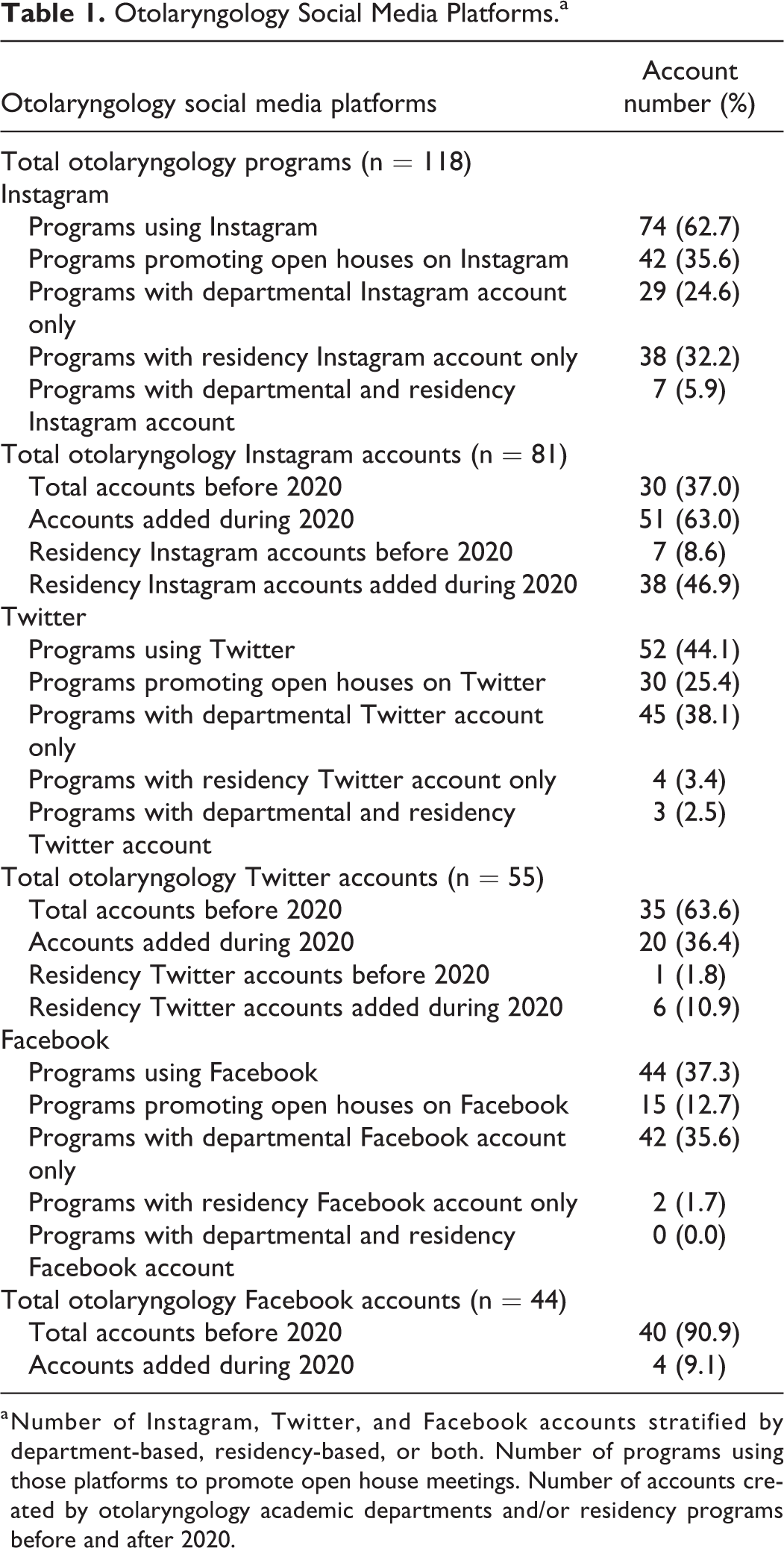
a Number of Instagram, Twitter, and Facebook accounts stratified by department-based, residency-based, or both. Number of programs using those platforms to promote open house meetings. Number of accounts created by otolaryngology academic departments and/or residency programs before and after 2020.
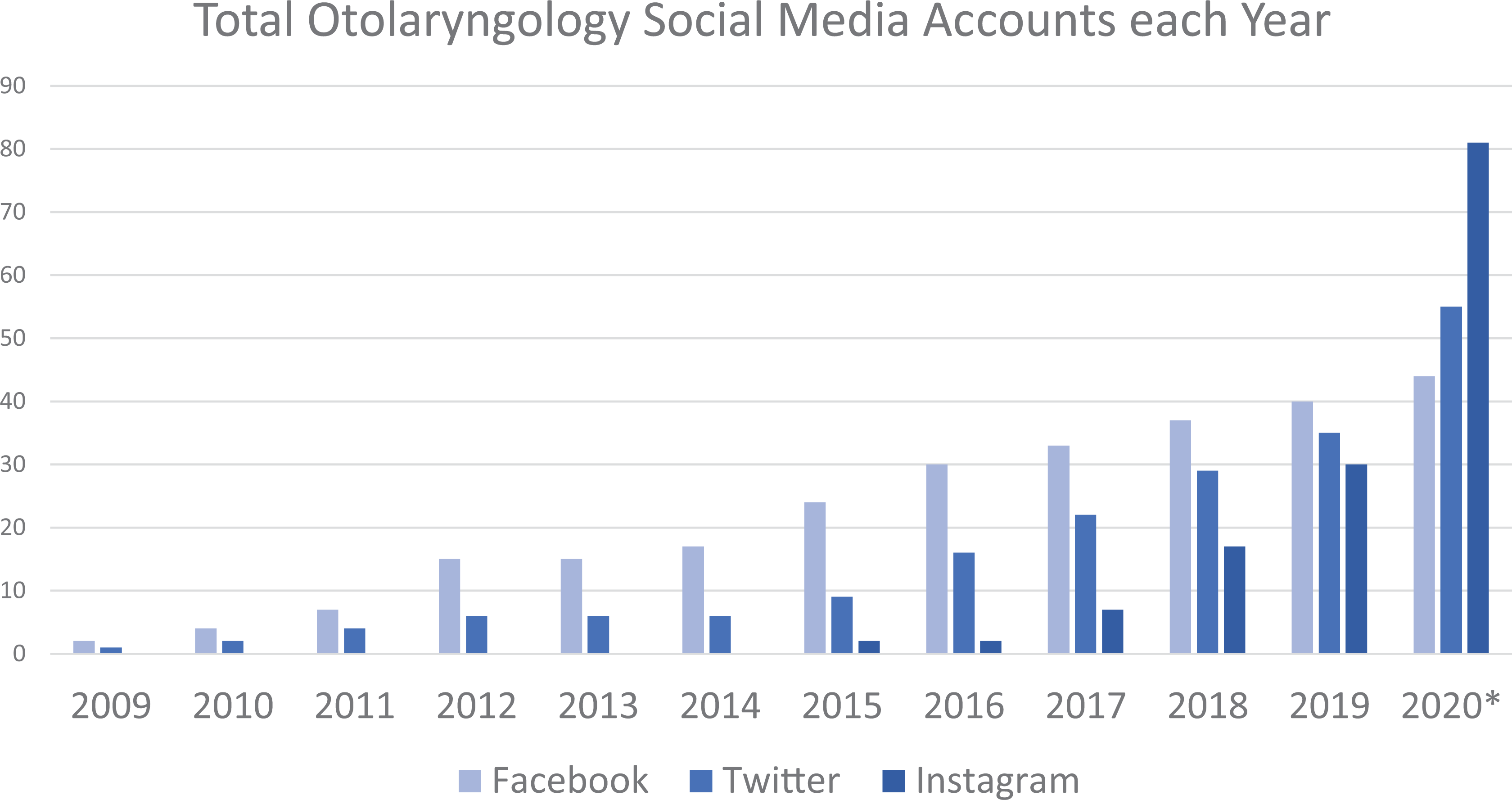
Otolaryngology Instagram, Twitter, and Facebook accounts established by year 2009-2020. *2020 has incomplete data since data were collected in September 2020.
Fifty-two (44.1%) programs participate on Twitter. Forty-five (38.1%) only have a department-based account, 4 (3.4%) only have a residency-based account, and 3 (2.5%) have both accounts. Thirty (25.4%) programs are promoting virtual open house meet-and-greets on Twitter (Table 1). Among all 55 Twitter accounts (total number of department and residency accounts), 20 (36.4%) accounts have been created during the 2020 calendar year (Figure 1). Twelve of the accounts were created in June, July, and August 2020.
Forty-four (37.3%) programs participate on Facebook. Forty-two (35.6%) only have a department-based account, and 2 (1.7%) only have a residency-based account. Fifteen (12.7%) programs are promoting virtual open house meet-and-greets on Facebook (Table 1). Among all 44 Facebook accounts (total number of department and residency accounts), only 4 (9.1%) have been created during the 2020 calendar year (Figure 1). Four Facebook accounts were created in June, July, and August 2020.
Subinternships
Data regarding the number of external subinternships offered in prior years are unavailable on VSAS. Currently, VSAS offers 42 in-person external subinternships which are presumed to be cancelled. Two programs on VSAS are offering virtual subinternships. Nine programs offered virtual away rotations on Instagram. Six programs offered virtual away rotations on Twitter, and 1 program offered virtual away rotations on Facebook. Seven residency program websites offered virtual subinternships.
Discussion
The data show a growing number of social media accounts among academic otolaryngology departments and residency training programs, the rate of which has increased compared to previous years (Figure 1). In our study, there was a relative 170%, 57%, and 10% increase in Instagram, Twitter, and Facebook otolaryngology social media accounts, respectively, between 2019 and 2020. Our data demonstrate a plateauing of Facebook accounts in comparison to the exponential growth witnessed on Instagram and Twitter.
It is pertinent to note that social media usage has increased on a global scale as evidenced by an increase in the number of accounts on Instagram, Twitter, and Facebook in the United States by 5.5%, 0.1%, and 1.4%, respectively, between 2019 and 2020.10-17 This global growth may partially explain our findings. However, these rough estimates may be inaccurate. There is uncertainty surrounding the number of existing social media accounts due to privacy of company data as well as an abundance of fake accounts.18,19 A selection of surveys analyzing social media demographics conducted by the PEW Research Center shows that the percentage of adults who claim to use social media has increased by 3.9% this year compared to 2019.20-22 Younger adults (ages 18-29) appear to utilize Facebook the most (79%), then Instagram (67%), and finally Twitter (38%), which contrasts with the decreased usage seen in adults over 30 on Instagram and Twitter. Our data show a shift toward these 2 platforms (Instagram and Twitter) in recent years among otolaryngology residency programs.
Although global trends contribute to the growth of otolaryngology residency social media accounts, we suspect that most accounts were created this year in response to the cancellation of in-person engagements. These interpretations are primarily based on the timing and increased rate of growth demonstrated by our data in the summer months of 2020 after the onset of the pandemic. The majority (63%) of all otolaryngology Instagram accounts were created this year. Interestingly, 41 Instagram accounts were created in the months of June, July, and August. Twitter accounts followed a similar pattern. The timing of this occurrence aligns with the summer season of fourth-year medical students finalizing applications and engaging potential residency programs. In alignment with the suggestions of the SUO, OPDO, and AADO stated in April 2020, it seems that otolaryngology residency programs have adapted to the new restrictions placed by COVID-19 by expanding their online presence.
Furthermore, otolaryngology residency programs have explored new routes to communicate with applicants via social media platforms. This is supported by the fact that 42 programs and 30 programs are currently using Instagram and Twitter, respectively, to invite students to virtual open houses. Before COVID-19, these opportunities did not exist. In general, posts about virtual open houses will list dates and contact information to sign up for the event. These opportunities offer applicants the option to meet faculty and residents. Social media accounts will also post virtual tours which consist of brief videos featuring facilities, residency workspaces, and other program attributes. The quality and effectiveness of these virtual experiences compared to traditional meetings and tours may be an area of future investigation.
Residency programs appear to be utilizing social media to “brand” themselves.23-25 Facebook reaches a broad and large audience, Instagram engages a younger population with visual content, and Twitter disseminates information with the “@” and “#” functions. A 2020 review on the use of social media for otolaryngology residency programs suggested programs establish a more prominent online presence and use otolaryngology-related Twitter hashtags such as #VirtualOTOMatch and #OTOMatch2021 to reach out to applicants. 26 Department-based accounts may celebrate new faculty, achievements, and post health announcements for the general public and patients, whereas new residency-based accounts likely target applicants. Residency-based accounts may demonstrate “branding” in posts by showcasing resident lifestyles, resident operative time, research involvement, and community outreach. Programs can distinguish themselves and attract applicants who share similar personalities as their online personas.
In-person subinternships are available only to those who lack an at-home institutional otolaryngology program as suggested by the SUO, OPDO, and AADO. New educational modalities are necessary to replace the traditional in-person rotation. 27 For instance, the University of Pennsylvania has established a virtual otolaryngology surgical rotation that is comprised of livestream operations and telehealth patient communication. 28 However, few virtual subinternships are available to applicants currently. The impact of the COVID-19 pandemic on graduate medical education will be revealed in the years to come.
Efforts to preserve medical education and alternative measures to evaluate and connect with otolaryngology resident applicants are essential and will continue to evolve. Here, we demonstrate a growth of otolaryngology social media accounts which we largely attribute to the cancellation of in-person engagements after the onset of COVID-19. Notably, both Instagram and Twitter have surpassed Facebook this year in terms of the number of otolaryngology social media accounts. Instagram is the most prevalent platform. It is possible that this platform’s visual-based content is more appealing, attractive, and preferable among users surveying residency programs. The changes reported in this study will likely continue to impact the dynamic of the otolaryngology residency application process.
Considering the recent exponential growth of social media platforms in the recent months among otolaryngology residency programs, the numbers presented in this study will most likely do not represent the actual numbers during the date of publication. For this reason, data were collected within the same time frame (September 5-9, 2020). It is possible that not all programs were represented in the study due to browsing limitations on the internet. Google searches generate most relevant links and can sometimes hide social media accounts, particularly accounts that are new without as much traction. To combat these possible browsing limitations, social media platforms were searched on Google and within the search engines of respective social media platforms, including a review of suggested accounts.
Conclusion
COVID-19 has changed the residency application process. In response, there has been a notable growth of social media accounts among otolaryngology residency programs within the last few months. Many programs are advertising virtual open houses via social media platforms to connect with residency applicants, and a few programs are offering virtual subinternships to replace traditional external experiences.
Footnotes
Authors’ Note
Andrew B. DeAtkine contributed as primary author by collecting data, generating graphs, writing manuscript, and submitting to journal. Jessica W. Grayson contributed by writing and revising paper. Nikhi P. Singh contributed by organizing project methodology and revising paper. Alexander P. Nocera contributed by formulating project idea and methodology and revising paper. Soroush Rais-Bahrami contributed by formulating project idea and methodology and revising paper. Benjamin J. Greene contributed as senior author by writing and revising paper.
Declaration of Conflicting Interests
The author(s) declared no potential conflicts of interest with respect to the research, authorship, and/or publication of this article.
Funding
The author(s) received no financial support for the research, authorship, and/or publication of this article.
