




Abstract

Stafne bone cavity is a focal defect of the cortical bone that may develop on the lingual surface of the mandible to accommodate a portion of the submandibular salivary gland. Commonly used terms include Stafne bone defect, lingual salivary gland depression, lingual mandibular bone depression, and static bone cavity. The lesion occurs mainly in the third molar angle region between the mandibular canal and the inferior cortex of the mandible and may encroach on either of these structures. It is usually unilateral, but bilateral lesions have been reported. 1 Rare examples have been reported in the mandibular premolar canine and upper ramus regions associated with the sublingual and parotid glands respectively.2,3 The incidence of Stafne bone cavity is between 0.1% and 0.48%, with most cases developing in middle-aged and older men. 4 The lesion is asymptomatic and discovered on routine radiographs. Although most lesions contain salivary gland tissue, a minority appear to contain fat, lymphatic tissue, or muscle. 5
On imaging, a Stafne defect appears as an ovoid or round radiolucent area in the posterior mandibular body below the mandibular canal (Figure 1). The periphery is well defined by a thick and dense sclerotic border. Although the diagnosis of Stafne bone cavity can usually be determined on plain films, additional imaging with computed tomography or magnetic resonance imaging is needed in atypical cases. 6 The lesion is innocuous, and no treatment is required.
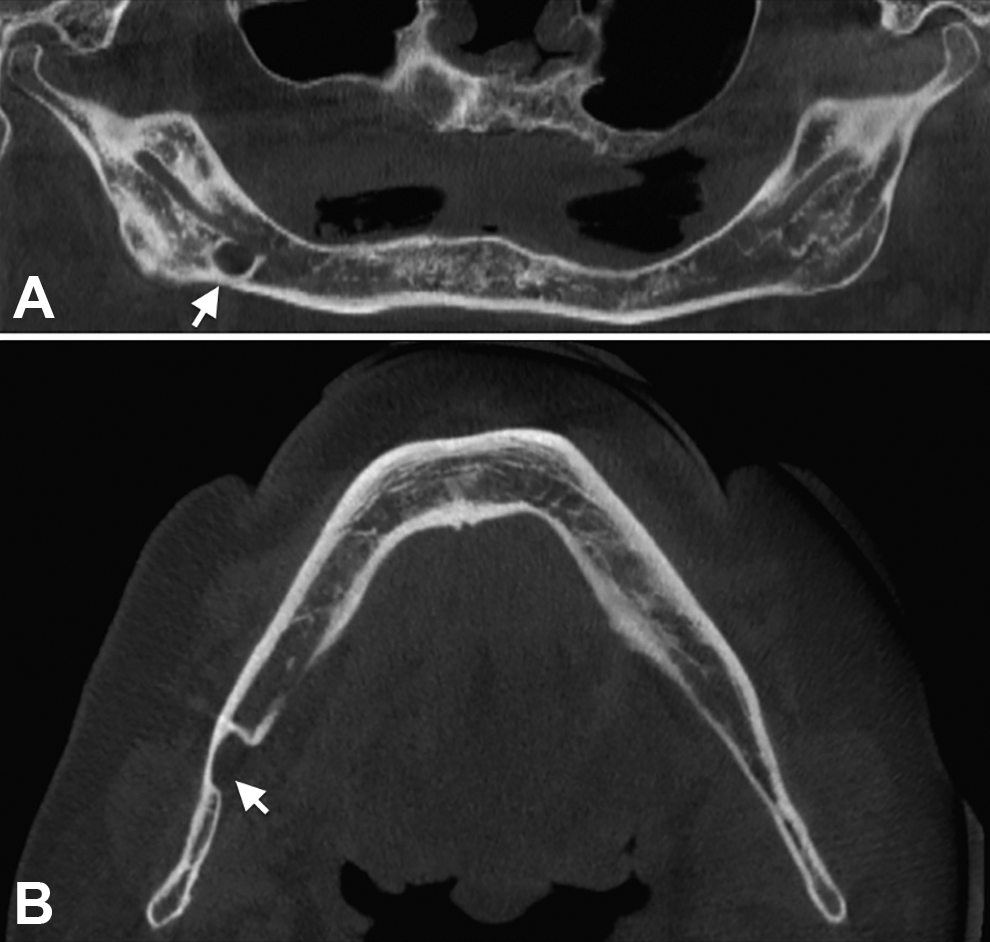
A Stafne bone cavity in a 73-year-old edentulous man. Reformatted thin-slice panoramic (A) and axial (B) cone-beam computed tomography images showing a well-defined, ovoid, radiolucent lesion in the region of the right submandibular gland fossa below the mandibular canal (arrows). The lesion is extending from the medial surface of the mandible and eroding the buccal cortex (arrow in B).
Footnotes
Declaration of Conflicting Interests
The author(s) declared no potential conflicts of interest with respect to the research, authorship, and/or publication of this article.
Funding
The author(s) received no financial support for the research, authorship, and/or publication of this article.
