




Abstract
The supernumerary nostril is a congenital accessory nostril, which is considered to be one of the rarest congenital nasal anomalies with an unknown etiology. We present the first case of a supernumerary nostril in an adult Saudi patient, which is the first such isolated case to be reported among the Middle Eastern Arab countries. An 18-year-old Saudi woman presented to the facial plastic clinic of King Fahad Medical City, Riyadh, with a complaint of an additional small left nasal opening since birth. She underwent circumferential surgical excision of the accessory nostril and its entire tract, following which the overlying skin was sutured. The patient appeared fine postoperatively with a satisfactory nasal appearance. In conclusion, patients with supernumerary nostrils should be thoroughly assessed to eliminate the presence of any other associated congenital anomalies. Early diagnosis and surgical management can facilitate a better reconstructive outcome.
Background
The supernumerary nostril is congenital nasal deformity, which can be defined as an accessory nostril with or without a nasal cartilage. Its etiology remains undetermined. It is one of the rarest congenital nasal anomalies and few published reports have described this condition. 1 A review of the literature revealed that only 33 cases have been reported so far. 2 (1) Lindsay was the first to report such a case in the English literature in 1906. 3 (2) Tawse (1920) 4 described a patient with a unilateral supernumerary nostril, which communicated with the nasal cavity. Reddy and Rao (1987) 5 reported the case of a third nostril that was situated below the left nostril. 6 The accessory nostril usually presented on the left side, as a unilateral and isolated malformation in most reported patients. Moreover, it was reported among almost 45% of patients with other congenital anomalies.7,8 No supernumerary nostril was reported among the population of Arab countries. We present the first case of an isolated supernumerary nostril in an adult Saudi patient, which is also the first reported case among Middle Eastern Arab countries.
Case Description
An 18-year-old Saudi woman presented to the facial plastic clinic of King Fahad Medical City, Riyadh, with a complaint of an additional small left nasal opening since birth. She did not have any associated nasal symptoms including nasal discharge and nasal obstruction. The perinatal and developmental history was uneventful. There was no family history of similar malformations or other congenital anomalies. Physical examination revealed a soft left supernumerary nostril, measuring approximately 1 × 1.5 cm, with a normal skin lining and a blind end approximately 1 to 2 mm superiorly (Figure 1). The skin around the inner margin of the supernumerary nostril was incised. The patient underwent circumferential surgical excision of the accessory nostril with its entire tract and skin was closed primarily with prolene sutures. She was doing fine postoperatively, with a satisfactory nasal appearance (Figure 2).
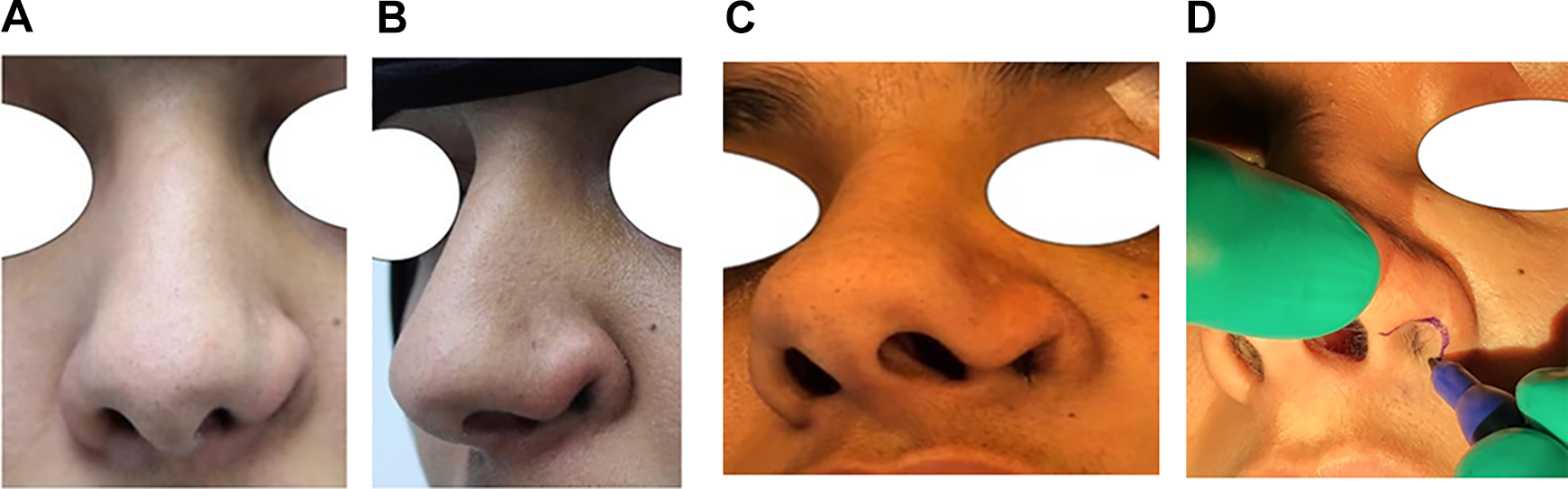
(A-D) Soft left supernumerary nostril measuring approximately 1 × 1.5 cm, with a normal skin lining and a blind end around 1 to 2 mm superiorly.
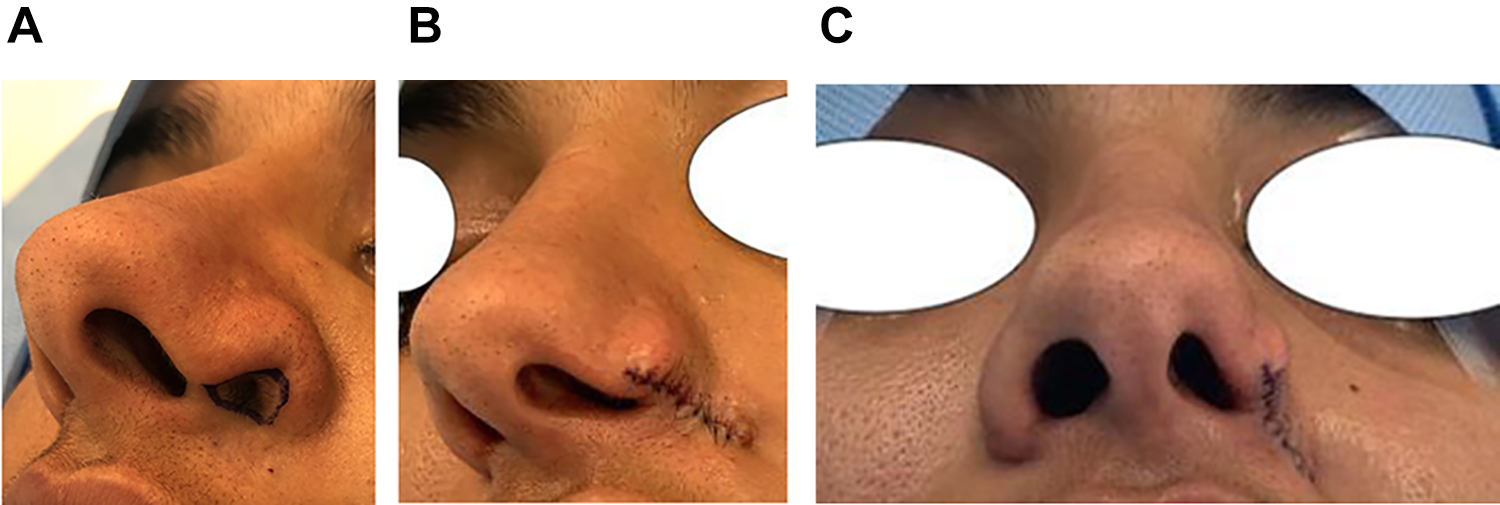
(A-C) Postsurgical excision of the left accessory nostril.
Discussion
The nose starts developing from the frontonasal process during the fourth week of gestation. Subsequently, 2 nasal placodes appear on either side of the frontonasal process, following which the nasal groove forms from center of nasal placode. Finally, the lateral and medial nasal processes develop to deepen the nasal groove and form the nasal pits. The nasal pit becomes deeper at the end of the fifth week to form the nasal sac, which moves to the middle to form the nostrils and nasal cavity. 9
The supernumerary nostril is considered to be one of the rarest congenital nasal anomalies. The exact underlying pathogenesis of this congenital malformation is still not clearly understood. 1 It is defined as an accessory nostril with or without an accessory cartilage, with or without a direct communication with the nasal cavity. The additional nostril was commonly unilateral and left sided among the reported cases in the literature. 7 The supernumerary nostril also presented on the left side of the nose, without any accessory alar cartilage or communication with the nasal cavity in our patient. We used the surgical technique described by Franco et al, which entailed complete circumferential excision of the accessory nostril with its entire tract, followed by primary closure with preservation of the adjacent alar cartilage. 8 The majority of the reported case of supernumerary nostrils were in the Asian population. 10 The first case was reported by Lindsey in 1906, who described a case of bilateral accessory nostrils, which communicated with the nasal cavity. 3 The supernumerary nostril may present as an isolated congenital anomaly or may be associated with other malformations or diseases. According to Franco et al, it was found to be associated with other congenital malformations in 45% of the patients.7,8 The reported associated malformations include complete unilateral cleft lip, congenital cataract, esophageal atresia, imperforate anus and patent ductus arteriosus, bilateral congenital choanal atresia, osteoma of the ethmoid sinus, and congenital adrenal hyperplasia. 7
Recently in 2018, Gupta et al reported a rare case of a supernumerary nostril, which was associated with congenital hydrocephalus, corpus callosum agenesis, a prosencephalic cyst, and cranial vault deficiency. 11 Our patient was a healthy adult woman who presented with isolated supernumerary nostril, without any other associated malformations or dysmorphic features. She came to us at the age of 18 years and she requested removal of the supernumerary nostril with no significant change in the appearance of her nose.
Early diagnosis and surgical management of the supernumerary nostril would improve the reconstructive outcome and decrease psychosocial complications in such patients.
Conclusion
The presence of the supernumerary nostril is one of the rarest congenital anomalies. The cause of this malformation is still not well understood. Patient with supernumerary nostrils should be thoroughly assessed to eliminate the possibility of any other associated congenital anomalies. Early diagnosis and surgical management could improve the reconstructive outcome and decrease psychosocial complications.
Footnotes
Declaration of Conflicting Interests
The author(s) declared no potential conflicts of interest with respect to the research, authorship, and/or publication of this article.
Funding
The author(s) received no financial support for the research, authorship, and/or publication of this article.
