




Abstract
The List of Excluded Individuals and Entities (LEIE) is a federally updated and available list of providers who have been excluded from participating from federal healthcare programs. With over 40 year’s worth of exclusion history, we were able to isolate and identify otolaryngologists who were excluded and the most common cause, albeit exceptionally rare, was revocation of their medical license due to negligence.
Physicians are expected to uphold high professional and ethical values for the sake of their patients and surrounding institutions. When health care workers are implicated in media crises, it provides negative press for all entities tied to the individual. Moreover, patients treated by physicians convicted of fraud and abuse have been shown to have an adjusted mortality rate of 13% to 23% higher compared to those treated by physicians who were not. 1 Medicare fraud is defined as knowingly submitting false claims or making misrepresentations of facts to obtain a Federal health care payment for which no entitlement would otherwise exist. 2 Estimates of the cost of Medicare fraud in the United States put the lowest estimates at 30 billion and the highest estimates in excess of 90 billion. 3 Over the past 40 years, there have been 72 520 entities that have been excluded from participation in Medicare and Medicaid. 4 This article aims to analyze why otolaryngologists have been excluded from Medicare and Medicaid in the past. This is done to catalog a preventative measure in order for current and future otolaryngologists to be conscious of actions that could lead to their exclusion from Medicare and Medicaid.
In order to analyze the data of excluded otolaryngologists, the List of Excluded Individuals and Entities (LEIE) 4 (updated October 10, 2019) was searched for the term “otorhinolaryngologist.” Isolation of the otolaryngologist data within the LEIE allowed the matching of the exclusion criteria codes with the amendment violation which led to exclusion. For exclusion codes deeming the reason as “License revocation, suspension, or surrender,” individual state medical boards were searched for the specific reason that the license was surrendered, suspended, or revoked.
There were 72 520 excluded entities captured in the LEIE database. Of the 72 520 excluded entities, 7055 exclusions were physician exclusions, and 36 were otolaryngologists. Of these, 1 was excluded due to fraud and kickbacks, 1 due to conviction related to patient abuse or negligence, 3 due to controlled substance felonies, 3 were involved in felony health care fraud, 9 were excluded due to conviction of program-related crimes, and 19 were excluded due to license surrender or revocation. Of the 19 excluded due to license surrender or revocation, 6 lost their license due to negligence, 6 due to reasons not publicly available, 4 due to substance abuse or self-prescription of substances, 2 due to criminal charges against them (sexual assault and conspiracy to obtain labor and services by harm or threats), and 1 was deemed unfit to practice after failing to comply with a substance abuse program (see Figure 1).
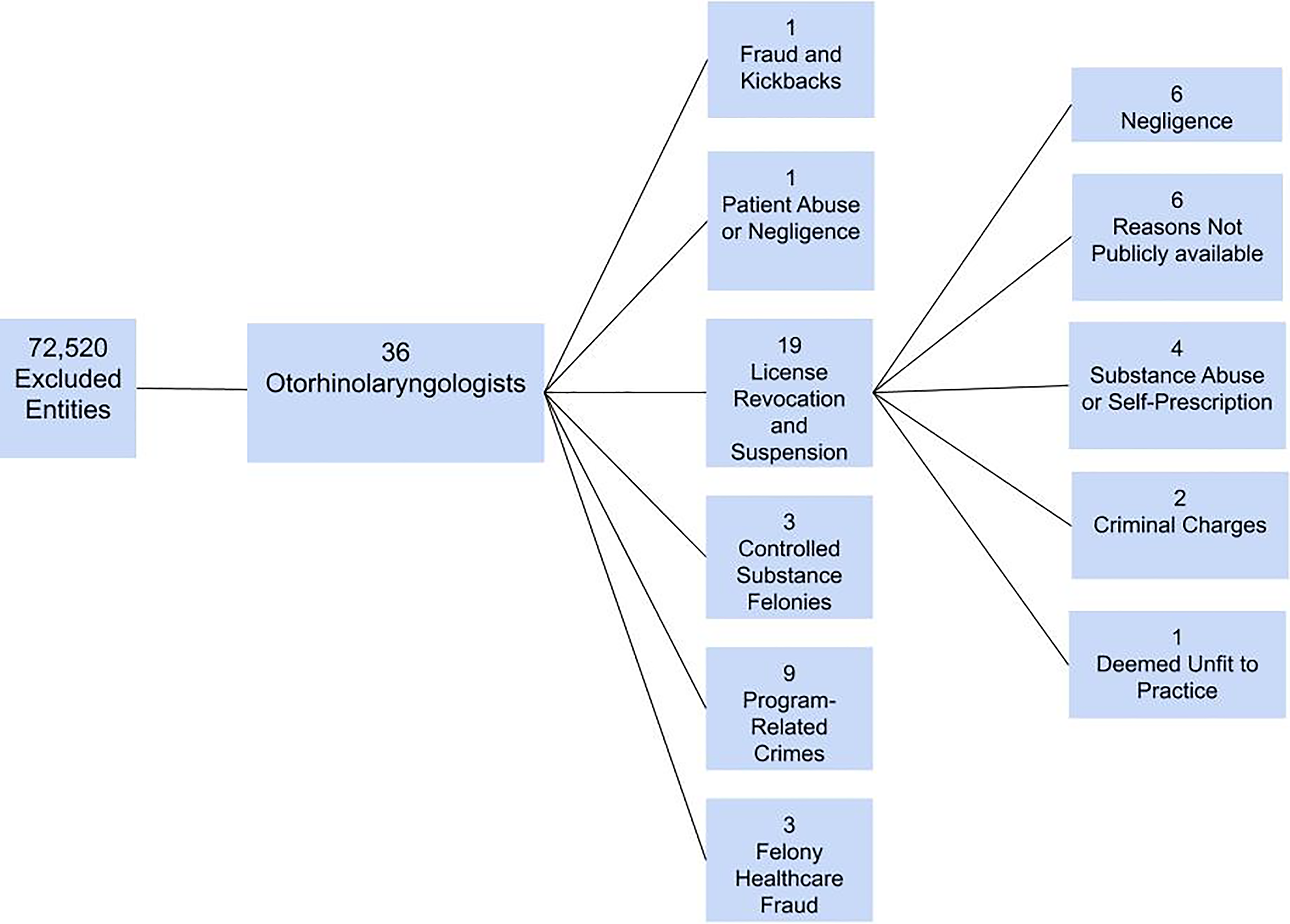
Categorical breakdown of Medicare/Medicaid exclusions among otorhinolaryngologists.
Our data show that 36 otolaryngologists were excluded from participation in Medicare and Medicaid. This is 0.049% of all Medicare and Medicaid exclusions, and 0.51% of physician exclusions over the past 40 years. For perspective, the excluded number of otolaryngologists is 0.37% of the 9526 otolaryngologists who are currently practicing. 5 Moreover, this likely overestimates the total percentage of otolaryngologists that were excluded as compared to those who have worked because the exclusion data include otolaryngologists who have retired and are no longer practicing. The most common cause of exclusion was the revocation of medical licenses, and of those physicians, negligence was the most common cause of revocation. The results portray that otolaryngologists are effectively self-monitoring through medical boards as the majority of exclusions were due to license revocation.
The overall exclusion rates and exclusion rates of different physician specialties put these results into context. For example, the average exclusion rate for the 892 752 physicians currently practicing in the United States is 0.79% and for the 229 047 active primary care providers it is 1.89%.4,5 Additionally, of the 5342 active pain management physicians, 1.64% were excluded from Medicare and Medicaid.4,5 With an exclusion rate of 0.37%, otolaryngologist are rarely excluded from Medicare and Medicaid, and this may be a positive marker of the integrity of most otolaryngologists.
Overall, otolaryngologists, as a specialty, have a low occurrence of fraud and other Medicare violations and seem to be effectively self-monitoring. This speaks to the general ethical nature of the profession. Otolaryngologists should learn from the mistakes and fraudulent actions of physicians in the profession who were disqualified from Medicare/Medicaid compensation. High-quality patient care begins with integrity; Otolaryngologists should continue to demand a high ethical standard of the profession.
