




Abstract

A 51-year-old man visited to our department with a complaint of sore throat and foreign body sensation for 1 month. Initially, he was diagnosed as acute tonsillitis at local clinic and received antibiotic medication. However, the symptoms persisted. Physical examination showed a symmetric appearance of tonsil without hypertrophy, but a sensation of stiffness was palpated over left-sided tonsillar fossa. An X-ray of skull anteroposterior and lateral view revealed an elongated styloid process with calcified ligament on the left side (Figure 1A and B). Three-dimensional computed tomography of the neck demonstrated the anatomic correlation of the elongated styloid process with stylohyoid ligament (measured 8.5 cm on the left side, 4.6 cm on the right side) and hyoid bone (Figure 1C and Supplemental Video).
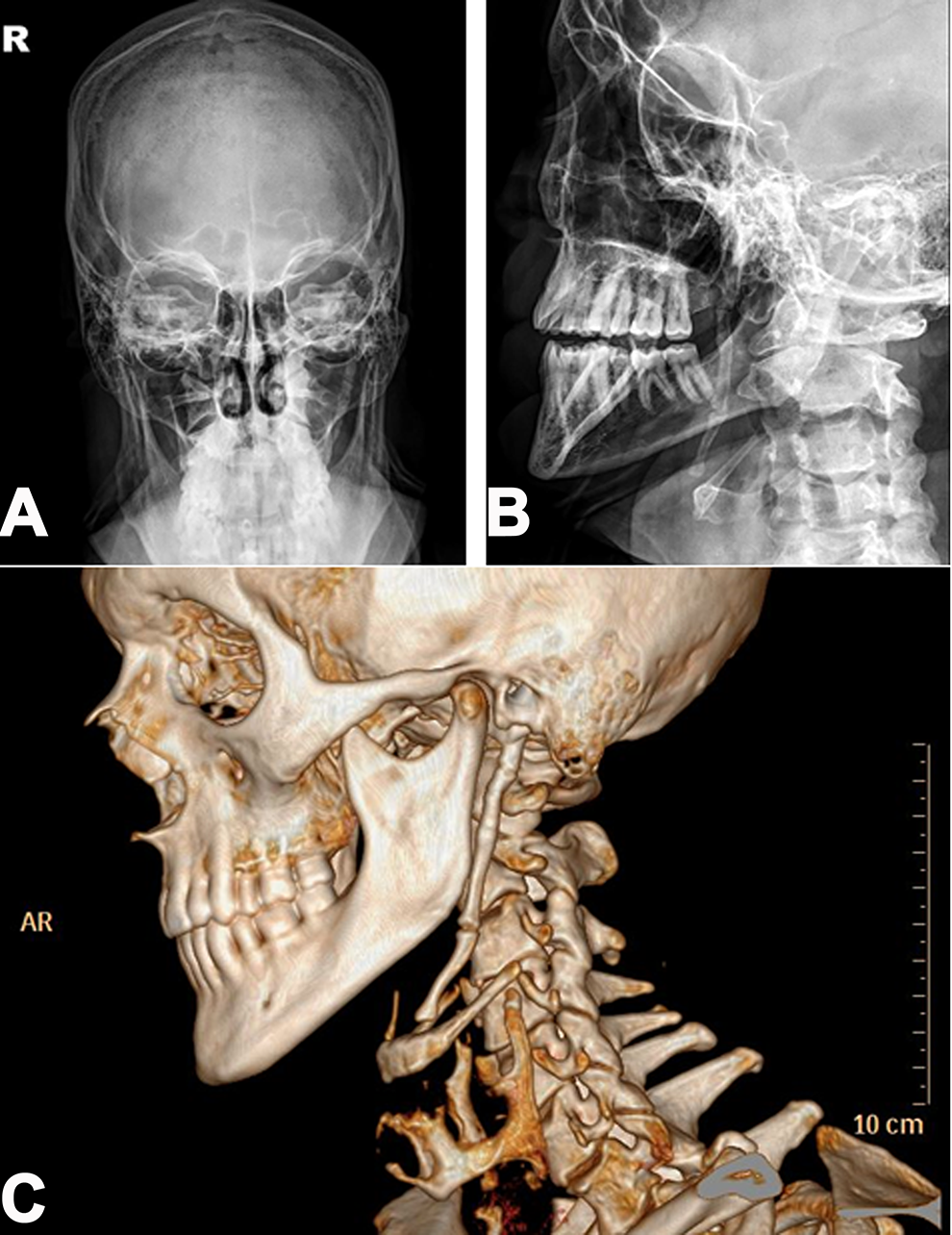
A and B, An elongated styloid process with calcified ligament over the left side skull (anteroposterior and lateral view). C, Three-dimensional computed tomography of the neck demonstrated the anatomic correlation between the elongated styloid process with stylohyoid ligament and hyoid bone.
Eagle syndrome is a rare disease, but it may cause the possible complication of internal carotid artery dissection and consequent ischemic stroke secondary to the pressure of elongated styloid process. 1,2 Tonsillostyloidectomy is recommended for the symptomatic patient.
Footnotes
Declaration of Conflicting Interests
The author(s) declared no potential conflicts of interest with respect to the research, authorship, and/or publication of this article.
Funding
The author(s) disclosed receipt of the following financial support for the research, authorship, and/or publication of this article: This work was supported in part by a grant from the Tri-Service General Hospital (TSGH-D-109053 to H. C. Chen).

Supplemental Material
Supplemental material for this article is available online.
References
Supplementary Material
Please find the following supplemental material available below.
For Open Access articles published under a Creative Commons License, all supplemental material carries the same license as the article it is associated with.
For non-Open Access articles published, all supplemental material carries a non-exclusive license, and permission requests for re-use of supplemental material or any part of supplemental material shall be sent directly to the copyright owner as specified in the copyright notice associated with the article.
