




Abstract
Nasal polyposis (NP) is an inflammatory disease of the paranasal sinuses and nasal cavity. The primary purpose of our study is to determine the expression of 5-HT7 receptors both in nasal polyps and in healthy tissue in the nasal cavity. The subsequent aim is to compare the expression of 5-HT7 receptors in patients with NP and in inferior turbinate tissue (control).The study included 60 participants (40 with NP and 20 controls) aged 35 to 62 years. Nasal polyp samples were collected from all patients and relative 5-HT7 receptor expression analyses were performed. RT-PCR analysis of nasal polyps and control tissue identified 5-HT7 receptor expression in the nasal cavities of controls. This expression was approximately 67 times higher in nasal polyp tissue than in healthy tissue. Our study identifies the expression of 5-HT7 receptors in the nasal cavity for the first time. It is also the first demonstration of increased 5-HT7 receptor expression in tissue from nasal polyps, which occur in the paranasal sinuses and nasal cavity.
Introduction
Nasal polyposis (NP) is a chronic inflammatory disease of the mucosa lining the nasal cavities and paranasal sinuses. 1,2 Its prevalence is 1% to4% in the general population, and it leads to complications such as nasal obstruction and rhinorrhea. 3,4 Although it is a well-known and easily diagnosed pathologic condition, its etiopathogenesis still requires discussion. Previously, NP was suggested to occur because of allergic diseases of the nasal mucosa; however, it is now thought that many factors contribute to its development, including chronic infection, genetic polymorphism, asthma, cystic fibrosis, epithelium cell defects, and mucosa epithelium breakdown. 5
Histologically, NP is recognized as an inflammatory disease that is characterized by the migration of inflammatory cells, such as eosinophils and neutrophils. 6,7,8 Additionally, studies have shown that the immune system and oxidative stress play important roles in the formation and development of NP. 1,9,10 Many studies have been conducted in a search for treatments for NP, and many antioxidant and anti-inflammatory agents have been investigated as potential treatments for this disease.
Currently, NP is treated with systemic or local steroids or the surgical removal of polyp tissue. However, the symptoms can continue even after treatment with steroids and the disease can quickly reappear even after surgical treatment. 11 Therefore, experimental and clinical studies investigating the mechanisms leading to NP are continually being conducted.
Serotonin, which is a vasoactive amine, is an important neurotransmitter and is involved in many behavioral and psychological phenomena, such as pain, appetite, mood, and sleep. 12 Additionally, serotonin has immunomodulatory activities that occur via serotonergic receptoractivation. 13,14 Serotonergic receptors have been characterized in lymphocytes, monocytes, macrophages, and dendritic cells 15 these receptors are divided into seven classes based on their structures, and have been found to cause biologic effects via different signal-transduction pathways. 16 One of these receptor types is the recently discovered 5-HT7 receptor, which is commonly found in the brain and has peripheral effects that are not completely known. 17 -22
The 5-HT7 receptor is expressed in several vascular beds (the pulmonary and coronary arteries and the aorta), has been identified in antigen-presenting dendritic cells, and regulates the activation and function of T lymphocytes. 23 -28 5-HT7 receptors have also been shown to modulate the expression of some inflammatory cytokines. 29 In previous studies, we showed that 5-HT7 receptors have important roles in systemic inflammatory events, such as sepsis, and in the acute inflammation that develops in rats with paw edema. 30,31 We have also shown that inflammatory cytokines and oxidant parameters decreased as a result of the stimulation of 5-HT7 receptors with an agonist. Our studies demonstrate that serotonin has anti-inflammatory and antioxidant effectsvia5-HT7receptors.The important effects that 5-HT7 receptors have on the immune system and inflammation suggest that 5-HT7 receptors could be involved in nasal polyp development. Additionally, serotonin expression has been evaluated in nasal polyp tissue, but the presence and amount of 5-HT7 receptors in the nasal cavity and nasal polyp tissue were not assessed. 32 Therefore, identifying 5-HT7receptor expression in the nasal cavity will be an important contribution to the field.
In light of this information, the primary purpose of our study is to demonstrate the presence of 5-HT7 receptors in nasal polyps and in inferior turbinate tissue. The subsequent aim is to compare the expression of 5-HT7receptorsin tissue from patients with nasal polyps with control tissue.
Materials and Methods
Polyp tissues from patients with CRSwNP and inferior turbinate mucosa from control subjects were obtained through endoscopic examination during surgery.
All patients and controls provided written informed consent before participating in the study. Those who approved and opted for surgical therapy underwent operations.
Relative 5-HT7 receptor expression analyses were performed with StepOnePlus Real Time Polymerase Chain Reaction (PCR) System technology (Applied Biosystems) on cDNA synthesized from nasal polyp RNA. The qPCR was run using the TaqMan Probe Mix and TaqMan probe-based technology (Applied Biosystems). Real-time PCR was performed using primers generated for human 5-HT7 receptors forward, 5′-TTC TCT CCG TCT GGC TTC TC-3′; and reverse, 5′-GCA CAC CTT ATC ATC ATT TAC ATT CT-3′; and for human β-actin forward, 5′-GCA AGC AGG AGT ATG ACG AGT-3′; and reverse, 5′- CAA GAA AGG GTG TAA CGC AAC TAA-3′. The results are expressed as relative to the inferior turbinate tissue from healthy patients. β-actin was used as the reference gene against which the data were normalized. Primers and probes for 5-HT7 receptors and β-actin were designed by Primerdesign (Southampton, UK). For each tissue sample, triplicate determinations were performed in a 96-well optical plate for both targets using 9 µl of cDNA (100 ng), 1 µl of Primer Perfect Probe mix, and 10 µl of QuantiTect Probe PCR Master Mix (Qiagen, Hilden, Germany) in each 20-µl reaction. The plates were heated for 2 minutes at 50°C and 10 minutes at 95°C, after which 40 cycles of 15 seconds at 94°C and 60 seconds at 60°C were applied. All data are expressed as the fold-change in expression compared to that in the healthy group using the 2-ΔΔCt method. 34
Results
Threshold cycle(CT) values of nasal tissues obtained from healthy subjects and patients with nasal polyposis.

polyps
Key: CT = threshold cycle, SD = standard deviation.
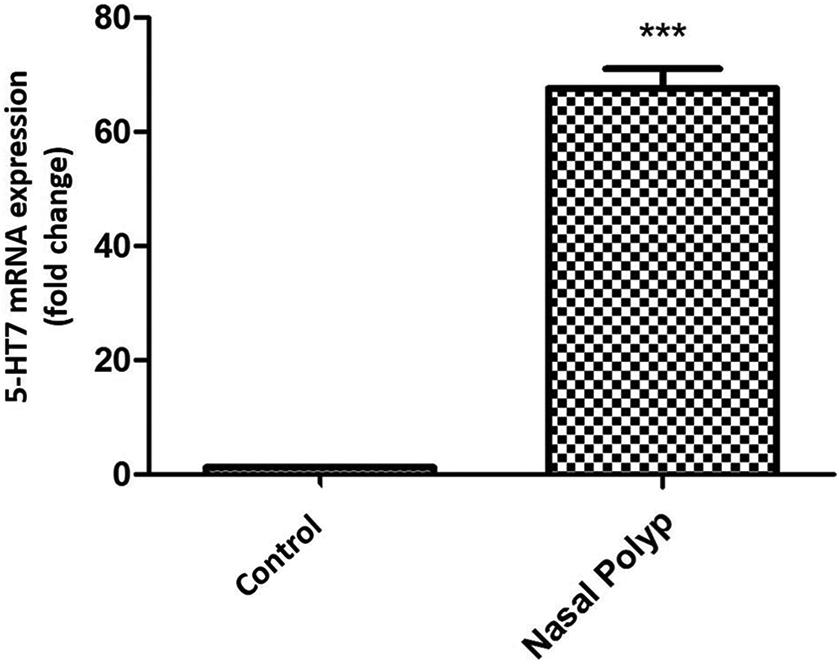
This graph shows 5-HT7 receptor expression in inferior turbinate mucosa (control) and nasal polyps (Unit: fold change). *p < 0.05.
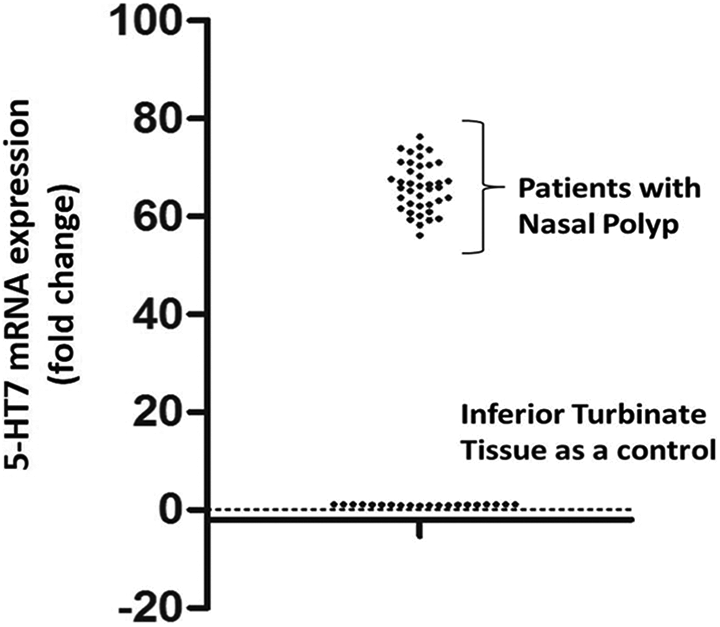
This graph depicts 5-HT7 receptor expression in inferior turbinate mucosa and nasal polyps. (Unit: fold change).
Discussion
In our study, we examined 5-HT7 receptor expression in NP, a disease that leads to complications such as nasal obstruction, rhinorrhea, and anosmia and whose pathogenesis has not been completely described.
As a multifactorial chronic inflammatory disease of the paranasal sinuses and nasal cavity mucosa, the etiology and pathogenesis of NP still require examination. Several theories have been proposed to explain its development. 35 All the theories proposed for the pathogenesis of NP acknowledge that the fundamental pathology that leads to polyp formation is mucosal edema, and these theories attempt to elucidate the cause underlying this edema. 36,37 The immune system, inflammatory mediators, cytokines, and adhesion molecules all play a role in the development of mucosal edema. Despite the many possible treatments for nasal polyps today, problems can still occur after treatment, such as continuing symptoms or disease recurrence. Therefore, new research is continuously being conducted to determine the possible mechanisms underlying the pathophysiology of nasal polyps.
Serotonin has been shown to be released in peripheral tissues, mast cells, basophils, and enterochromaffin cells. The extracellular serotonin levels increase under inflammatory conditions. 38 Therefore, serotonin can be considered to be an immunomodulator. Activation of 5-HT1 and/or 5-HT7 receptors in serotonin monocytes prevents monocytic apoptosis by triggering increases in cyclic adenosine monophosphate levels and cytokine production. 39,40 A recent study detailed 5-HT expression in spleen T cells and showed that naïve T cells selectively express5-HT7receptors. 28 Additionally, the reduction of T cell proliferation caused by the suppression of serotonin synthesis was reversed via treatment with AS-19, a 5-HT7 receptor agonist. This finding suggests that serotonin plays a role in autocrine signaling through activation of 5-HT7 receptors in naïve T cells. Additionally, when we examined the immunologic pattern in more detail, 5-HT7 receptors were found in both humans 41 and rats 42,25 and in immune-response cells such as monocytes, 39 T cells, 28 thymus, peripheral lymphocyte, spleen, and mitogen-activated spleen cells. 42 Consequently, the roles of 5-HT7 receptors in peripheral diseases are currently being investigated. However, little information is available on this subject.
In a study related to ours, serotonin levels were evaluated in patients with nasal polyps but the presence and expression of 5-HT7 receptors were not presented. Our study is the first to show5-HT7 receptor expression in control tissue, and it showed that 5-HT7 receptor expression was increased nearly 67-fold in nasal polyp tissue compared with its expression in healthy tissue. In our previous studies, we showed that stimulation of 5-HT7 receptors with an agonist in the experimental sepsis model created with cecal ligation and puncture caused a recovery in the levels of inflammatory cytokines and oxidative stress parameters, such as TNF-α, IL-1β, and IL-6. 30,31 Likewise, in a previous study, we showed that 5-HT7 receptor expression was increased in acute inflammation that was induced via carrageenan and that the inflammation decreased following the application of a5-HT7receptor agonist. All of these studies support the theory that serotonin plays an important role in the immune system via5-HT7receptors and that it has anti-inflammatory and antioxidant effects. This result suggests that 5-HT7 receptors might play a role in the pathophysiology of nasal polyps.
Our study is the first to demonstrate the expression of 5-HT7 receptors in the nasal cavity. It is also the first to show that 5-HT7 receptors are highly expressed in NP. It is crucial to conduct experimental and clinical studies to examine the role of 5-HT7receptors in the formation and development of nasal polyps. In the future, 5-HT7 agonists and antagonists could be examined as potential novel therapeutic agents for the treatment of nasal polyps.
Footnotes
Declaration of Conflicting Interests
The author(s) declared no potential conflicts of interest with respect to the research, authorship, and/or publication of this article.
Funding
The author(s) disclosed receipt of the following financial support for the research, authorship, and/or publication of this article: This work was supported by The Scientific and Technological Research Council of Turkey (TUBITAK) (grant number 112S627).