



Abstract
Objective:
To determine the utility of treating facial palsy with mirror book therapy in conjunction with facial physical rehabilitation.
Methods:
We randomly selected and reviewed the charts of 25 patients with idiopathic facial palsy. 10 of these patients received facial physical rehabilitation including manual therapy and postural exercises. 15 of these patients received mirror book therapy in conjunction with standard facial rehabilitation. Before and after treatment, patients in both groups were rated using the Facial Grading System (FGS) score, the Facial Disability Index--Physical (FDIP) score, and the Facial Disability Index--Social (FDIS) score. Differences in response to therapy were analyzed.
Results:
Patients in the facial physical rehabilitation group without mirror book therapy group showed on average a 20.8% increase in the FGS score, a 19% increase in the FDIP score, and a 14.6% increase in the FDIS score. Patients in the mirror book therapy group showed an average of 24.9% increase in the Facial Grading System (FGS) score, a 21.6% increase in the Facial Disability Index--Physical (FDIP) score, and a 24.5% increase in the Facial Disability Index--Social (FDIS) score.
Conclusion:
The addition of mirror book therapy to standard facial rehabilitation treatments does significantly improve outcomes in the treatment of idiopathic facial palsy.
Introduction
The facial nerve has a long and tortuous course that predisposes it to a broad range of injuries, illness, and inflammation, with associated subsequent facial weakness. The incidence of facial paralysis is estimated to be between 20 to 30 per 100,000 per year in the United States. 1 -3
Bell’s palsy is an idiopathic, acute peripheral nerve palsy of cranial nerve VII, and it is the most common cause of facial nerve palsy. Cardinal signs include, but are not limited to facial weakness, unilateral paralysis, xerophthalmia, xerostomia, and dysgeusia. The cause is still unclear, but there studies suggest a viral etiology in up to 79% of cases. 4 Other known causes of facial paralysis include Lyme disease, HIV infection, acoustic neuromas, meningiomas, tumors, and trauma. 5
Without intervention, 71% of idiopathic facial palsy patients have a complete recovery after 1 year, 13% have a slight residual weakness, and 16% have fair to poor recovery. 6 The advantages of early intervention include increased patient education in the disease process, proper eye care, and initial home exercises. Given the likelihood of spontaneous recovery in idiopathic causes of facial paralysis, the optimal treatment for this condition remains controversial. The purpose of this retrospective review is to evaluate the usefulness of mirror book therapy in conjunction with traditional rehabilitation therapy for idiopathic facial palsy patients.
Patients and Methods
Forty-five patient charts were selected at random from a pool of approximately 100 patients treated for facial palsy between 1997 and 2008. This was done using a third-party selector who was blinded as to the etiology of the condition, treatment methods utilized, and the success of the patient’s rehabilitation. Of the 45 patients, 25 were found to have idiopathic facial palsy. These charts were selected out for further review and statistical analysis. 15 of these patients received a mirror book therapy treatment plan, while the remaining 10 patients received standard facial rehabilitation treatment consisting of neuromuscular re-education, massage, myofascial release, stretching, taping, and postural training. Each of these patients received a personalized treatment plan designed by expert facial physical therapists. While no plan was identical, the same methods were utilized, in varying degrees, to best treat the palsy and help the patient regain as much of his or her normal facial function and characteristics.
Mirror book therapy is an adaptation from the mirror box originally created by Ramachandran to treat phantom limb pain and paralysis. 7 Our version of this therapy uses a bi-fold mirror to twice reflect the unaffected half of a patient’s face, such that the patient sees a full, unaffected face (Figure 1). The patient then performs a number of facial expression exercises.
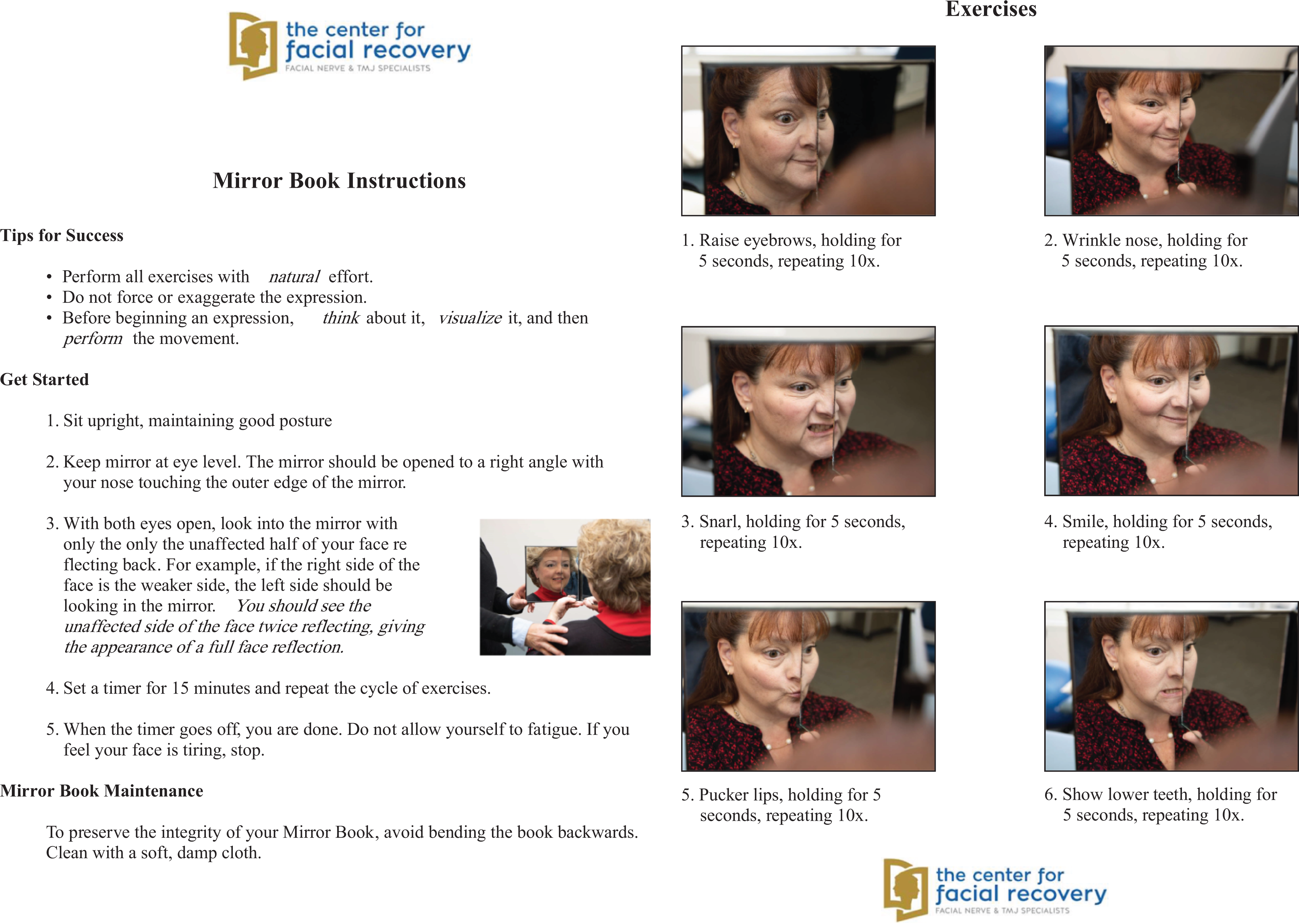
Mirror Book Therapy.
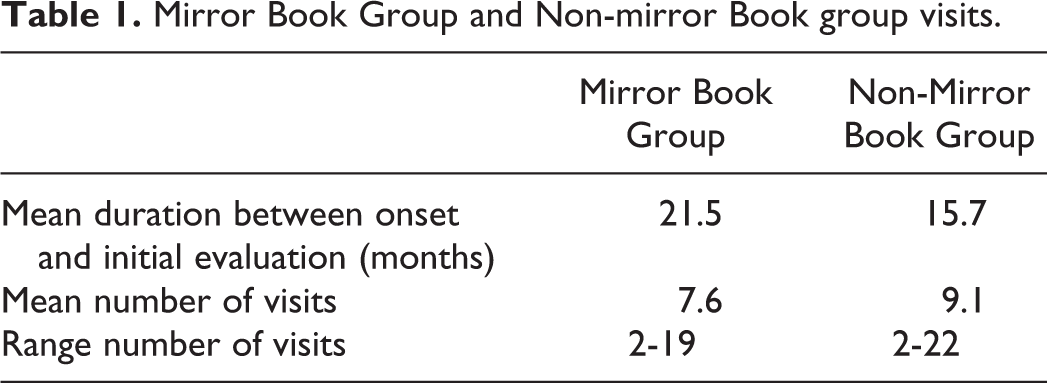
In the mirror book therapy group, average time between onset of facial palsy and initiation of rehabilitative treatment was 21.5 months (Table 1: Mirror Book Group and Non-mirror Book group visits). In the standard rehabilitation group average time between onset of facial palsy and initiation of rehabilitative treatment was 15.7 months. In the mirror book therapy group, patient treatment duration ranged from 2 to 19 sessions, with a mean of 7.6 visits. In the standard rehabilitation group, patient treatment duration ranged from 2 to 22 sessions, with a mean of 9.1 visits. The mirror book therapy as well as the various rehabilitation methods used in the standard rehabilitation group are discussed below.
Mirror Book Group and Non-mirror Book group visits.
Results
The Sunnybrook Facial Grading System (FGS) Observational Scale and the Facial Disability Index (FDI) were measured pre-treatment and post-treatment. The FGS is assessed by the facial physical therapist and the FDI is self-reported. Each of these scales uses a 100-point score
The FGS scale is composed of three sections: resting posture, voluntary movement, and synkinesis (Figure 2). A higher score indicates less impairment, and a lower score indicates greater impairment. The reliability coefficients have been shown to be ≥ 0.9. 8 Construct validity and reliability have been demonstrated for this scale. 9
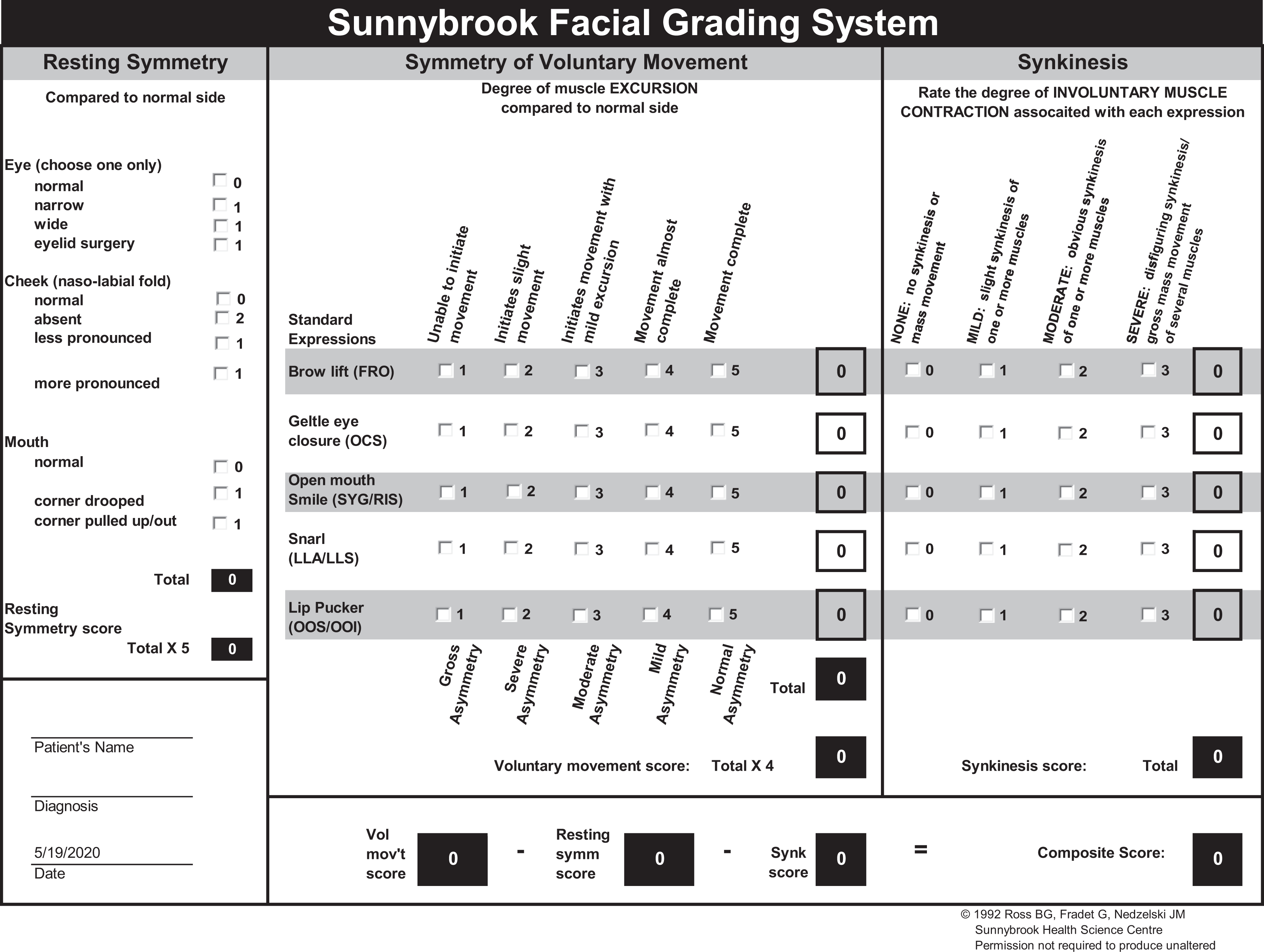
Facial Grading System Observational Scale (FGS).
The FDI is a self-reported instrument for the assessment of physical and psychosocial disability in patients with facial nerve disorders (Figure 3). First described by Van Swearingen and Brach, this score is split into two subscales: physical and social (FDIP and FDIS respectively). 10
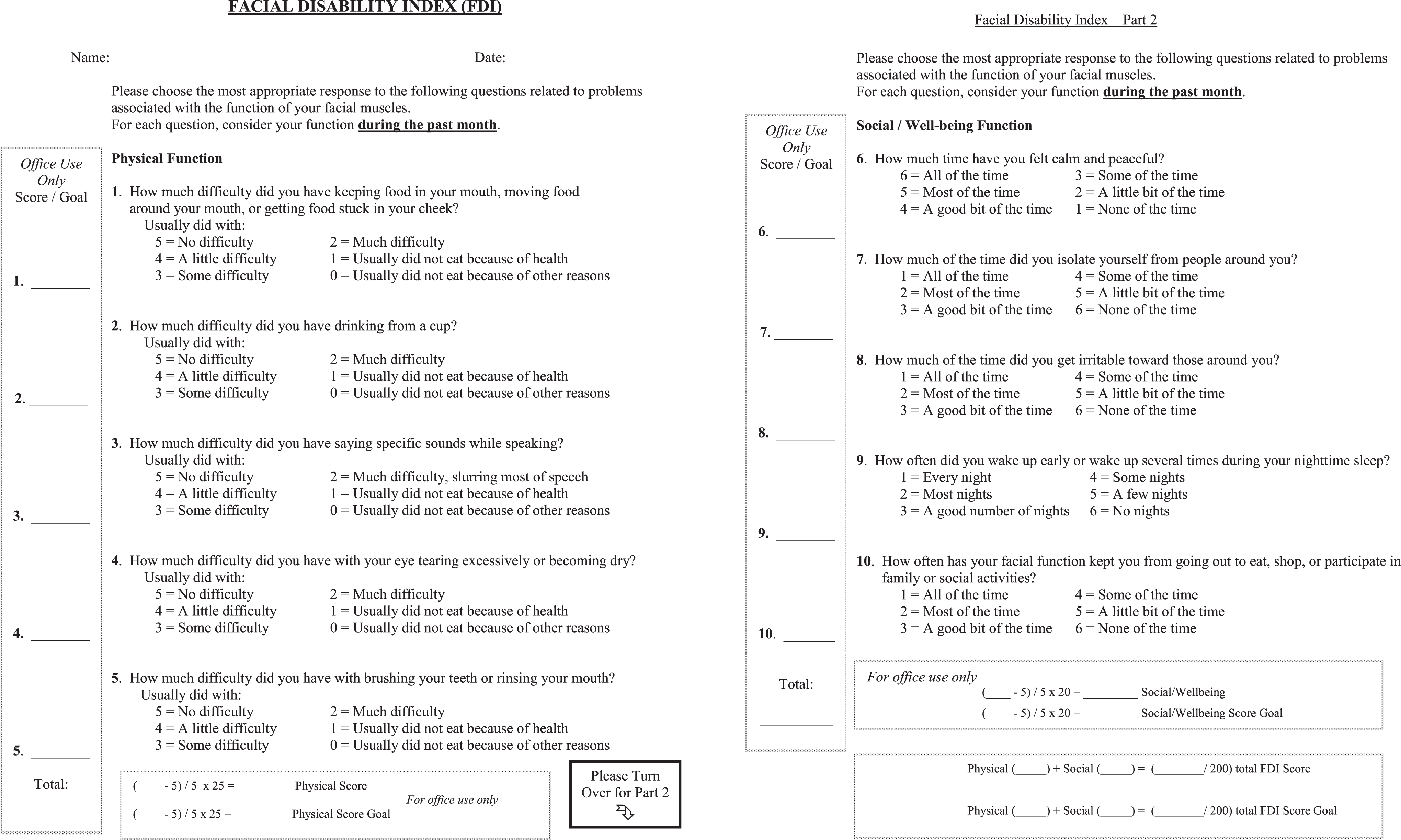
FDIP/FDIS.
Pre-treatment, the average FGS, FDIP, and FDIS scores for the standard rehabilitation group were 61.4%, 68%, and 74% respectively. Pretreatment, the average FGS, FDIP, FDIS scores for the mirror book therapy group were 53.1%, 70%, and 73% respectively. After treatment, the average FGS, FDIP, and FDIS scores for the standard rehabilitation group were 82.2%, 87%, and 88.6% respectively. After treatment, the average FGS, FDIP, and FDIS scores for the mirror book group were 78%, 92%, and 98% respectively. For the standard rehabilitation group there was on average a 20.8% increase in the FGS score, a 19% increase in the FDIP score, and a 14.6% increase in the FDIS score. For the mirror book therapy group there was on average a 24.9% increase in the FGS score, a 21.6% increase in the FDIP score, and a 24.5% increase in the FDIS score (Table 2 & 3: Pre and Post-treatment FGS/FDIP/FDIS measurements for mirror book therapy group/standard rehabilitation group).
Pre- and Post-treatment FGS/FDI measurements for mirror book therapy group.

Pre- and Post-treatment FGS/FDI measurements for standard rehabilitation therapy group.

Discussion
The mainstay for nonsurgical treatment for facial palsy has generally been physical rehabilitative therapy. Mirror biofeedback has been used in addition to standard physical rehabilitation techniques,. Commonly known as “mime therapy”, mirror biofeedback therapy is linked to positive outcomes in the treatment of idiopathic facial palsy. 11 -16
Mirror book therapy is based on a stimulus-response-control hypothesis and allows the patient to visually appreciate the return of muscle activity. By seeing the unaffected face perform the exercises in a normal manner, increased activity of motor command pathways from the unaffected region are utilized to supplement the damaged region. The psychological reinforcement from seeing their normal face provides patients with additional motivation to perform their home exercise. This new technique is a form of biofeedback that has been used in a number of different studies. 11 -16
Unfortunately, the outcome measures used in each of the studies have differed from the rest, rendering a meta-analysis difficult to impossible. A recent systematic review on the use of mirror book therapy in the treatment of idiopathic facial palsy showed a significant improvement in functionality for the mirror therapy group. 17
There are drawbacks to the use of traditional exaggerated normal facial movement exercises. They are non-specific and can further reinforce abnormal movement patterns. This could cause recruitment of excessive motor units producing patterns that are atypical with facial activity. With the use of mirror book therapy, a patient can see his or her own facial movements. Thus, the patient can more effectively use facial exercises to reinforce normal movement patterns. In our study, we did not experience any deterioration or worsening of the facial palsy in either group. The purpose of our study was to add to the current literature on the benefits of mirror biofeedback therapy using two well-validated grading scales. The results of our study indicate a clear benefit to including mirror book therapy within the rehabilitation process of facial palsy patients. All three grading scales showed a significantly greater increase in the mirror book therapy group.
Of note, the mirror book therapy group had a significantly greater increase in the FDIS scores as compared to the FGS and FDIP scores. One reason for this may be that the mirror book therapy had a greater benefit for the psychological reinforcement of the patient. The FDIS is a subjective measure of a patient’s social rehabilitation. It measures whether or not a patient feels “calm”, “peaceful”, and other more psychosocial goals such as whether one feels comfortable going outside in public. Mirror book therapy would benefit patients much in the psychosocial realm, as the treatment involves repeatedly seeing oneself with a normal face through the mirror. Another reason for this discrepancy may be that the different weighting indices of each scale lead to a lower pre-treatment score with the FGS. Regardless of the discrepancy, the improvement in both scales was indeed found to be statistically significant.
Conclusion
Individualized facial rehabilitation therapy with the use of mirror book therapy provides favorable results in the treatment of facial palsy. There is still a dearth of randomized controlled trials that clearly show a favorable benefit of the mirror book therapy. Considering the low costs, and ease of use of this therapy, we recommend including mirror book therapy in the treatment of this condition.
Footnotes
Declaration of Conflicting Interests
The author(s) declared no potential conflicts of interest with respect to the research, authorship, and/or publication of this article.
Funding
The author(s) received no financial support for the research, authorship, and/or publication of this article.