




Abstract

A 39-year-old male presented to the otolaryngology clinic with a 7-day history of a lump in his throat and loud snoring. He reported a recent upper respiratory tract infection prior to onset. On oropharyngeal examination, we identified a well-circumscribed submucosal mass located at the base of his tongue (Figure 1). Cervical lymphadenopathy was not palpated. Head and neck computed tomography revealed a hyperdense lesion attached to the hyoid bone, with prominent homogenous enhancement after contrast administration (Figure 2). The thyroid gland was absent at the normal anatomical location. Hormone assessment revealed a serum thyrotropin level 3.98 mU/L (normal range: 0.25-4.00) and free thyroxine index 2.73 μg/dL (normal range: 2.40-4.00). Further, radioiodine (I-131) thyroid scan revealed focal uptake at the base of tongue instead of the expected cervical region, verifying the diagnosis of lingual thyroid. Levothyroxine replacement therapy was prescribed in attempt at mass reduction, and the patient had marked improvement after 3 months.

Transoral rigid laryngoscopy showing a round submucosal mass at base of the tongue.
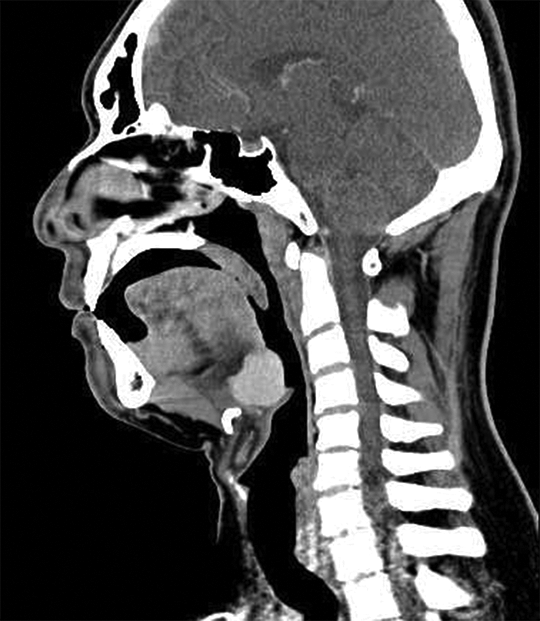
Sagittal view of head and neck contrast-enhanced computed tomography reveals a homogeneous enhancing lesion at base of the tongue.
Lingual thyroid is a rare embryogenic abnormalities that results from failure of thyroid migration from the foramen cecum to pretracheal region. 1,2 Dysphonia, dysphagia, and upper airway obstruction occur in advanced cases. 1,2 The ectopic thyroid is the only thyroid tissue in about 75% of patients with lingual thyroid. 1,2 Hormone production of lingual thyroid is usually inadequate, and therefore, it is associated with hypothyroidism. 1 Malignant transformation of the lingual thyroid is rare with an estimated incidence about 1 per 100 cases. 3,4 The dominant subtype of lingual thyroid carcinoma is follicular cancer. 4 In addition to physical examination, the diagnosis of lingual thyroid is confirmed by radionuclide scan. 1,2 For patients with mild symptoms and hypothyroidism, levothyroxine replacement can be employed to achieve mass reduction. 1,2 Ablative radioiodine therapy or surgical resection may be advisable for refractory or complicated cases. 1,2
Footnotes
Authors’ Note
Yu-Hsuan Lin is also affiliated with Department of Otolaryngology, Head and Neck Surgery, National Defense Medical Center, Taipei, Taiwan.
Declaration of Conflicting Interests
The author(s) declared no potential conflicts of interest with respect to the research, authorship, and/or publication of this article.
Funding
The author(s) received no financial support for the research, authorship, and/or publication of this article.
