



Abstract

A 60-year-old male patient was referred to our clinic upon detection of radiopaque material in the panoramic graphy for dental treatment (Figure 1). He had no complaints such as nasal obstruction, nasal discharge, or bleeding. It was learned that the patient underwent septoplasty operation 40 years ago. During patient’s examination, a metal object was identified, which thought to be the surgical material mostly embedded in the mucosa on the right nasal cavity inferior wall. For excision, we planned surgical operation under general anesthesia.

On panoramic radiograph, the radiopaque body located in the right nasal cavity.
After local anesthetic infiltration and incision at nasal cavity inferior wall on which the foreign body was identified, the mucosa was lifted and the foreign body was removed endoscopically (Figure 2). It was observed that the foreign body was an inferior part of the tip of that instrument called “Bruening Septum Forceps,” which is used in rhinological operations (Figure 3). It was observed that the foreign body caused some erosion in the bone periosteum, but we did not identify any foreign body reaction around it. The operation was performed without any complication. Patient had dental treatment and there were no complications encountered in relation to the nasal foreign body removal operation.
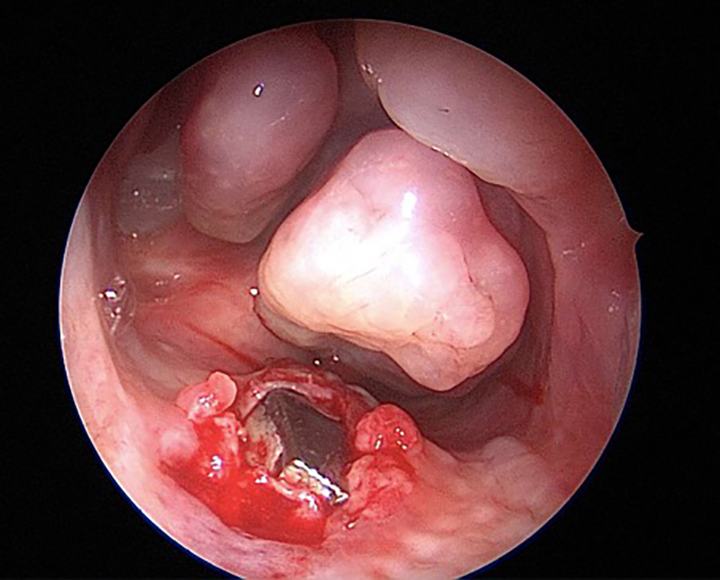
A metal object embedded in the mucosa at the base of the right nasal cavity (after incision of the mucosa).

Inferior part of the tip of that instrument also called “Bruening Septum Forceps.”
Septoplasty is an elective, routinely performed otolaryngologic procedure indicated for improvement of anatomic nasal airway obstruction. It is one of the most commonly performed otolaryngologic surgeries and the most commonly performed nasal surgery, with an estimated 260 000 septoplasties performed per year. 1 Although every surgical procedure is considered as a risk factor for causing a foreign body, this risk is fairly low due to the fact that excessive suturing is not performed during rhinologic operations and the area of surgery is small. Metal and robust instruments are usually used in septoplasty operations
Nasal foreign bodies are commonly encountered in ear, nose, and throat practice, but they are usually noticeable early on and they can be intervened. Foreign bodies in the nasal cavity are usually observed in the pediatric age-group. The most frequently detected foreign bodies were beans, plastic pieces of little toys, foam fragments, and paper fragments. 2 Unrecognized foreign bodies may lead to inflammation, infection, ulceration, and necrosis of nasal mucous membrane, cartilage, or bone. Common complaints include unilateral nasal discharge and epistaxis. Rarely, they can be asymptomatic and may remain in the nasal cavity for a long time without affecting the tissue. 3 It is hard to detect foreign bodies in the nasal cavity that do not cause symptoms. They can be detected on dental panoramic graphy for dental treatment and cranial, maxillofacial computed tomography scan taken for any reason. 4
Most of the foreign bodies in the nasal cavity can be removed with the use of forceps, curved hooks, catheters, and suction without the need for general anesthesia. However, in cases where the ethmoid, maxillary sinus, or foreign body is embedded in the tissue, endoscopic technique may be required under general anesthesia. 2,3
Surgical instruments or materials used during septoplasty operation should be checked at the end of operation. In case of doubt, the nasal cavity should be evaluated carefully and radiopaque substances should be investigated radiologically. Otherwise, as in this case, there may be confusion in the future with diagnostic and therapeutic outcomes that create additional costs. It should not be forgotten that past rhinologic operations are risk factors for foreign bodies in the nasal cavity.
Footnotes
Declaration of Conflicting Interests
The author(s) declared no potential conflicts of interest with respect to the research, authorship, and/or publication of this article.
Funding
The author(s) received no financial support for the research, authorship, and/or publication of this article.