




Abstract
Background:
The authors sought to investigate patient preferences on physician and medical student attire in the outpatient otolaryngology setting.
Methods:
A prospective sample of 50 (23 males, 27 females) patients presenting to an otolaryngology clinic in a North American teaching hospital, Boston, MA, were included. Patients were seen by a researcher wearing a white coat and either (1) a shirt and tie or (2) surgical scrubs, then completed a Likert-style survey evaluating feelings of trust, comfort, and professionalism. Statistical significance was set at α = 0.05.
Results:
Most patients (82%, 41/50) believed that attire was important. Men and older patients were significantly more likely to believe attire was important (P = .01 and .005, respectively). Patients were significantly more comfortable when seen by a provider wearing a shirt and tie compared to scrubs (U = 109.5, P = .021); however, there was no difference in feelings of trust or professionalism (P = .5* and .6*, respectively).
Conclusions:
Physician attire is important for patients presenting to otolaryngology clinic. Patients favored a white coat with a shirt and tie. Level of Evidence: NA.
Introduction
The patient–physician relationship relies on a complex interplay of various factors, ranging from physician attitude and mannerisms to perceptions of professionalism and experience. The way a physician chooses to dress is one modifiable factor that can play an important role in this relationship. Previous studies have shown that physician attire can unconsciously influence patient trust, confidence, and perceived empathy of their physicians. 1,2 This becomes important for several reasons. Increased trust and confidence by patients in their physicians promotes comfortable discussions on sensitive social, sexual, and psychological topics, all of which influence treatment and management. 3 For surgical specialties such as otolaryngology, increased physician trust is particularly important because the choices that the patients and their physician make together carry significant risks and benefits.
On a broader scale, the impact of physician attire also carries implications in undergraduate medical education. Unlike their attending physicians, medical students rotating through an otolaryngology clerkship lack previously established relationships with patients they encounter and must rely on first impressions to establish a relationship. To this end, in addition to gathering medical histories and practicing their examination skills, medical students must learn to engender trust and confidence with patients. In such circumstances, appearance may play an even larger role. 4 At our institution, medical students on their clinical rotations (third and fourth curricular year) are required to wear professional dress with a minimum of business casual attire and variations depending on specific rotation or supervisor.
Despite the potential role of student attire in student–patient relationships, few studies have investigated this relationship, and none to the best of our knowledge have investigated the importance of student attire within otolaryngology.
We sought to fill this gap in the literature by investigating the impact of medical student attire on patient perceptions in the outpatient otolaryngology clinic. We hypothesized that—similar to previous findings with attending physicians—medical student attire will also influence patient perceptions of the student.
Patients and Methods
This study was approved by the institutional review board of Boston Medical Center (H-35936). A prospective sample of 50 consecutive patients presenting to otolaryngology clinic at one North American teaching hospital was included in this study. Children were excluded (age < 18 years).
Student Encounter
One medical student (K.W.) attended otolaryngology clinic randomized to wear a white coat with either (A) a shirt and tie or (B) surgical scrubs. Patients then completed a Likert-style survey evaluating feelings of trust, comfort, and professionalism (Figure 1). Statistical significance was set at α = 0.05 . Demographics were recorded (age, gender, ethnicity) as well as subjective perceptions regarding the importance of student dress: Do you think it is important how medical students dress?
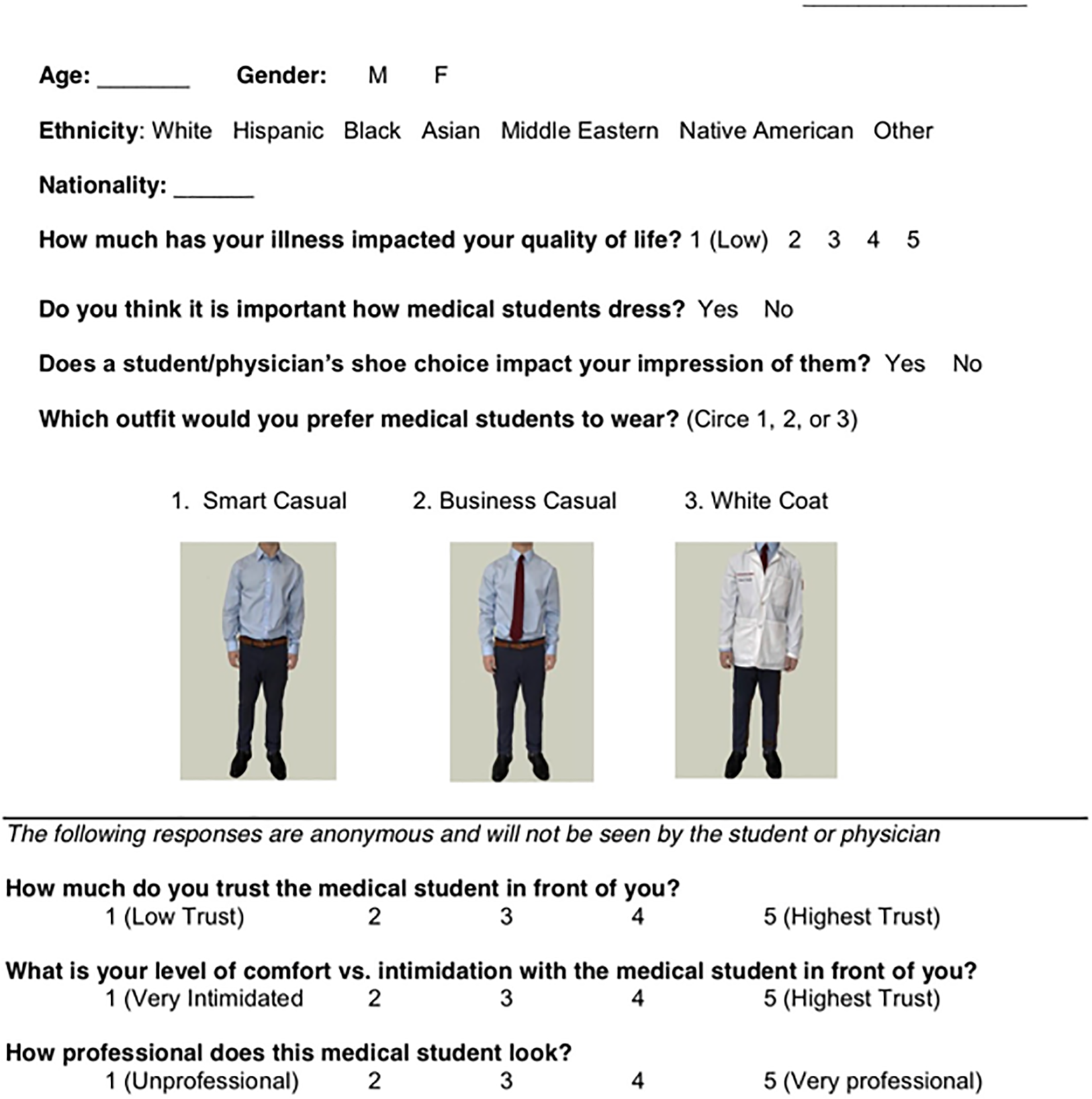
Patient survey evaluating attire.
Results
In total, 50 (23 males, 27 females) patients were included in this study. Mean age was 44.8 ± 17. Twenty-four patients were Caucasian, 14 were Hispanic, 7 were black, 3 were Asian, and 2 were Middle Eastern. With regard to patient preferences, the majority of patients (92%, 46/50) believed student attire was important.
Patients were significantly more comfortable when seen by a provider wearing a shirt and tie compared to scrubs (U = 109.5, P = .02). There was no difference in feelings of trust or professionalism when seen by a provider wearing a shirt and tie compared to scrubs (P = .5 and .6, respectively). Men and older age were associated with a higher likelihood of believing attire was important (P = .01 and .005, respectively).
Discussion
In this study, we sought to evaluate the impact of medical student dress on patient perceptions in the otolaryngology outpatient setting. We found that most patients believe that medical student attire is important. Patients were more comfortable when seen by a student wearing business clothing compared to scrubs. Furthermore, age and gender were associated with differences in preference, with older patients and male gender associated with a greater preference for professional attire.
The impact of physician attire on the patient–physician relationship has been studied in a variety of specialties within medicine—patients value professionalism and an easy way to identify their physicians. However, few papers have focused on medical student attire. Similar to the papers primarily on physicians, our results showed that most patients carried preferences regarding medical student attire. In the literature, preferences on attire vary depending on specialty (pediatrics vs adult medicine) and setting (outpatient vs inpatient). For example, in certain specialties such as pediatrics and psychology, the white coat is considered intimidating or threatening. 5,6 Conversely, in the outpatient internal medicine setting, patients overwhelmingly prefer their physician in professional dress with a white coat. 3 This preference for professional dress has been correlated with improved patient trust, compliance, and return to follow-up. In the surgical setting specifically, both surgeons and patients have agreed that a surgeons’ appearance influences patient opinion about their medical care. In the orthopedic surgery outpatient setting, a picture-based survey by Jennings et al showed that physician attire can affect patient confidence, trust, and patient’s perception of their surgeons’ ability to provide effective care. 7 For male surgeons, a white coat was preferred by patients over all other choices (business attire, scrubs, and casual attire). In a questionnaire-based study by Major et al, surgeons believed that scrubs were appropriate attire, while patient responses regarding scrubs were mixed. 8 Both physicians and patients in this study felt that white coats should be worn. This previous work in the surgical and surgical-subspecialty outpatient setting is useful for otolaryngologists, who often juggle time between the operating room, outpatient clinic, and hospital and will undoubtedly need to wear scrubs outside of the operating room in the outpatient setting. Similarly, medical students rotating in otolaryngology must appropriately transition between the different work environments. Although these previous studies were limited to attending physicians, it is not unreasonable to hypothesize these preferences may extend to other medical professionals including medical students. In a survey given to medical students in Australia and the United States, students responded that they were most influenced by the attire of their physician instructors, more so than their upbringing, school policy, or hospital policy. 9 Medical students, expected to learn clinical and physical examination skills from their physician instructors, similarly retain lessons in professionalism through observing physician–patient interactions during their clerkship years. Our study and these previous studies on physician attire emphasize the importance of professional dress for both physicians and medical students.
Much like previous studies that found professional physician attire inspires confidence in patients, we found that patients in the otolaryngology clinic felt more comfortable around medical students in professional dress. However, there was no difference in feelings of professionalism or trust. One of the earliest studies to examine medical student attire was conducted by Healy et al. Authors administered a questionnaire to patients and medical students regarding attire, and both patients and medical students were more likely to assume professionally dressed students were responsible, knowledgeable, and confident. 10 In the United Kingdom, using a patient questionnaire, Jabbal found that medical students wearing white coats were perceived to be more trustworthy and professional. 11 This contradicts our finding that patients felt no difference in feelings of trust or professionalism. A possible explanation for this discrepancy is that patients in our study were asked to rate their feelings of trust and professionalism based on the medical student they interacted with and not on a series of pictures as in the study by Jabbal and colleagues. The fact there were no differences in feelings of professionalism or trust reflects the many factors at play in the medical student–patient relationship. The medical student is at the very beginning of their career, and during their clinical rotations, they are still mastering the art of interviewing and interacting with patients. Similarly, student age and prior clerkship experiences likely influence their interactions with patients and patients’ perceptions. 12 Professional attire with a white coat can only go so far for these young, budding physicians. Our study reinforces the importance of professional dress in medical student education.
In our study, we found that men were significantly more likely to believe that student attire was important. To date, results on the impact of gender have been mixed. In the outpatient internal medicine setting, Rehman et al found no difference between male and female patients and their feelings on physician attire, though female patients did place more importance on the attire of their female physicians. 3 In both a picture and description-based questionnaire conducted in a variety of medical specialties in Italy, Sotgiu et al found that male patients preferred formal attire and a white coat, while female patients preferred scrubs and white coat. 13 Similar to the results of Rehman and colleagues, a study in a US-based orthopedic surgery practice also found that patient preference can vary depending on physician gender. Male surgeons wearing white coats elicited higher ratings in confidence, whereas female surgeons were not rated differently in white coats or scrubs. 7 Altogether, these results show that patient preferences involve a complex interplay of moving factors, such as practice setting, geographical and socioeconomic setting, and physician gender.
Our study revealed that older otolaryngology patients were more likely to believe that medical student attire was important, which is consistent with previous studies in attending physicians. 14 Regardless of geographic location or specialty, older patients have consistently preferred formal physician attire with professional dress and a white coat. 15 -17 One possible explanation is that older patients have more traditional views on professionalism likely influencing their preference for a traditional white coat. In an editorial from 1973, the chairman of the Division of Plastic Surgery at Duke commented on the changing appearance of medical students: “It seems to me that there has been a rather cataclysmic rejection by them of our traditions of what student doctor should look like…the unique purpose of the medical school is to transform a young layman into a mature physician: if he is to be one, his future patients have the right to expect that he look and act like one.(p.438-439)” 18 Although this is the opinion of one physician, it underscores differences in preferences based on age.
Previous work on physician attire is useful insofar as it provides evidence-based suggestions for proper dress that can indirectly influence medical students. Often, medical students are advised to adhere to a certain set of standards regarding dress and professional behavior, and dress code policies vary across medical schools. In a review on the topic of unprofessional behaviors of medical students, failure to maintain professional appearance and attire, as well as, poor condition of white coats belonged to the theme of “disrespectful behavior.” 12 Although there is a great deal of literature on physician attire, there has been much less research regarding medical student attire and its influence on their interactions with patients. Our findings help fill this gap in the literature.
Our study has several limitations. Research was conducted at an institution in New England, and therefore, it is not generalizable to the global population. Similarly, the research was conducted in an urban setting and may not represent the opinions of patients in more rural areas. Geographic, culture, and climate-related preferences likely exist. 14 The survey questions and choice of outfits surveyed in this study were based on historical studies on this topic including a large multicenter study 19 ; however, there are many combinations of clothing that were not included, for example, white coat over scrubs and professional attire without a tie. Another limitation is that the same one medical student interacted with patients and collected data. This student was male, and therefore, the findings of this study are not generalizable to all medical students. In the future, a study involving more male and female medical students of varying ethnic backgrounds will be useful to draw more conclusions. Lastly, Likert scales have inherent limitations as an ordinal scale with numerical comparisons.
Conclusion
The majority of patients in the otolaryngology outpatient clinic in an urban setting in New England felt medical student attire was important, and patients felt more comfortable when seen by a provider wearing a shirt and tie, as opposed to scrubs. Male patients and those in the older age-group were more likely to believe medical student attire was important. Further research is needed to determine how medical student attire in otolaryngology influences patient’s perceptions of their care.
Footnotes
Declaration of Conflicting Interests
The author(s) declared no potential conflicts of interest with respect to the research, authorship, and/or publication of this article.
Funding
The author(s) received no financial support for the research, authorship, and/or publication of this article.
