




Abstract

Nasal middle meatal narrowing and obstruction of the osteomeatal complex has many possible causes. An infrequent cause of middle meatal narrowing is presented in this case.
A 53-year-old male presented with intermittent right nasal congestion and right cheek discomfort. In spite of extensive medical treatment for sinusitis, his sinus computed tomography scan revealed opacification of the right maxillary sinus and partial opacification of the right ethmoid sinus (Figure 1).
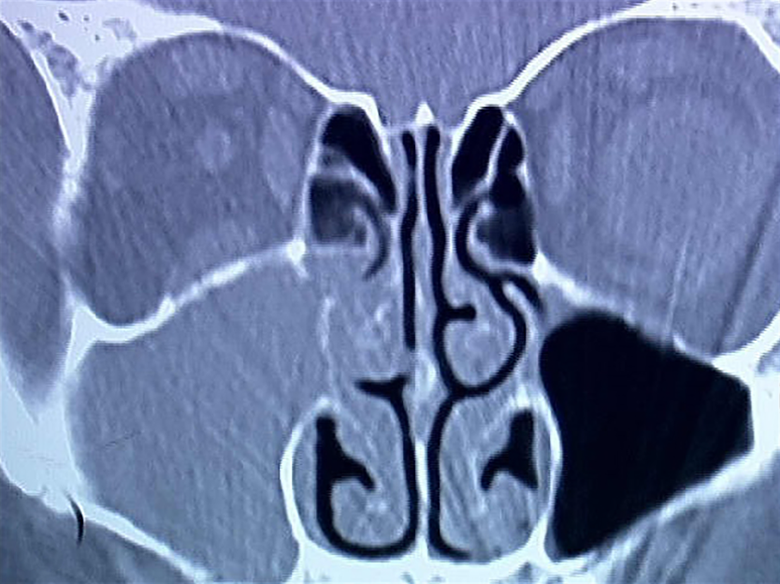
Computed tomography reveals a right opacified maxillary sinus with partial right ethmoid sinus opacification.
Office endoscopic examination revealed a large right middle turbinate (Figure 2). Further examination revealed additional turbinate formation, an accessory middle turbinate, lateral to the main middle turbinate (Figure 3).
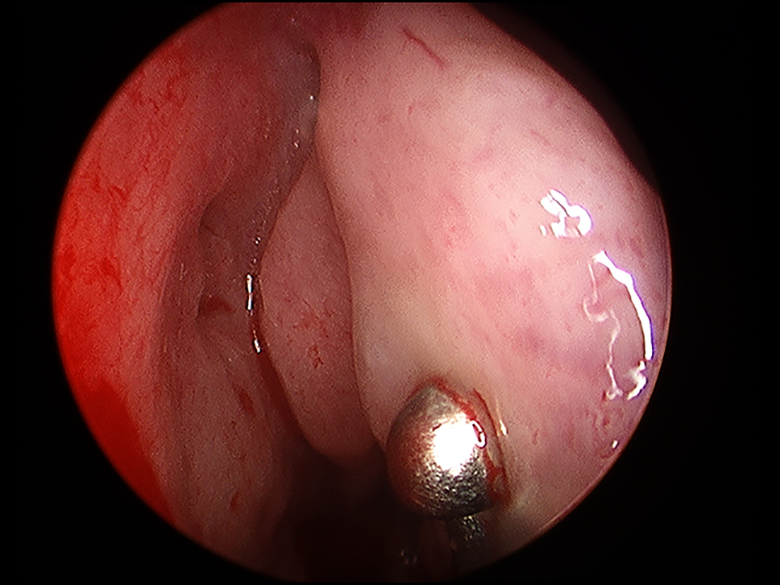
The probe is pushing the right middle turbinate medially revealing an additional turbinate structure.
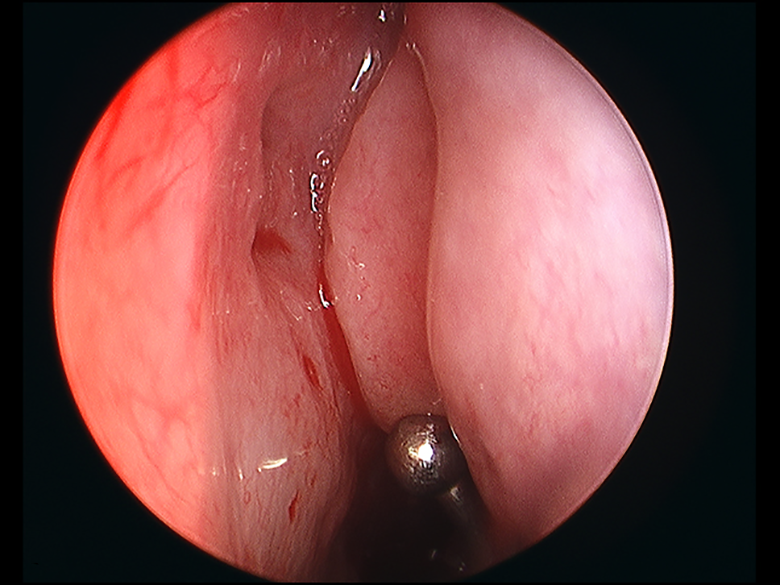
The probe identifies the accessory middle turbinate.
The patient elected to undergo partial right middle turbinate reduction and contouring with removal of the right accessory middle turbinate (Figure 4). The turbinate tissue removal was carried out with a microdebrider (Figure 5). A widely patent right middle meatus was obtained (Figure 6) allowing very good access to the right osteomeatal complex. Right functional endoscopic sinus surgery (FESS) was then performed.
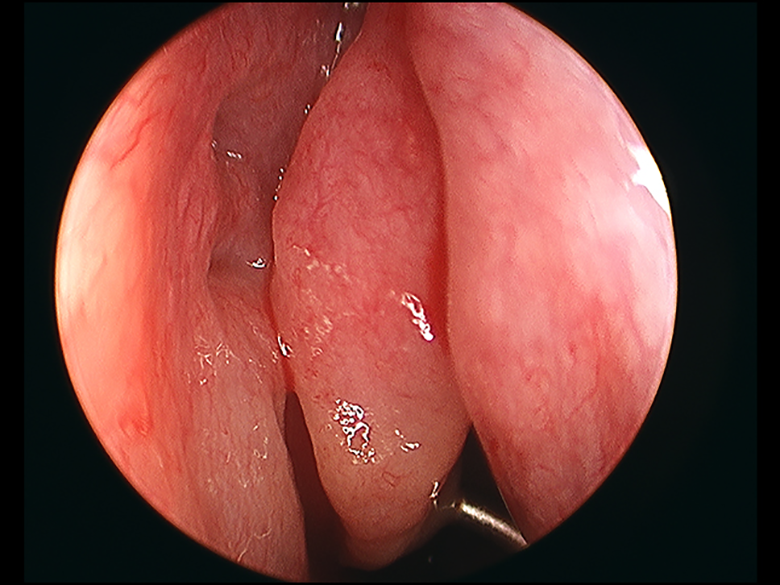
At the time of surgery, the right accessory middle turbinate can be well visualized.
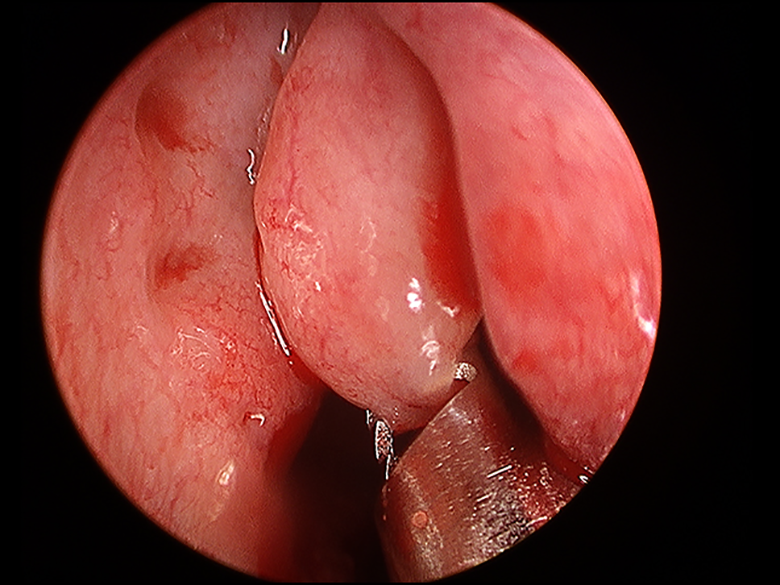
The accessory right middle turbinate is removed with a microdebrider inferiorly to superiorly.
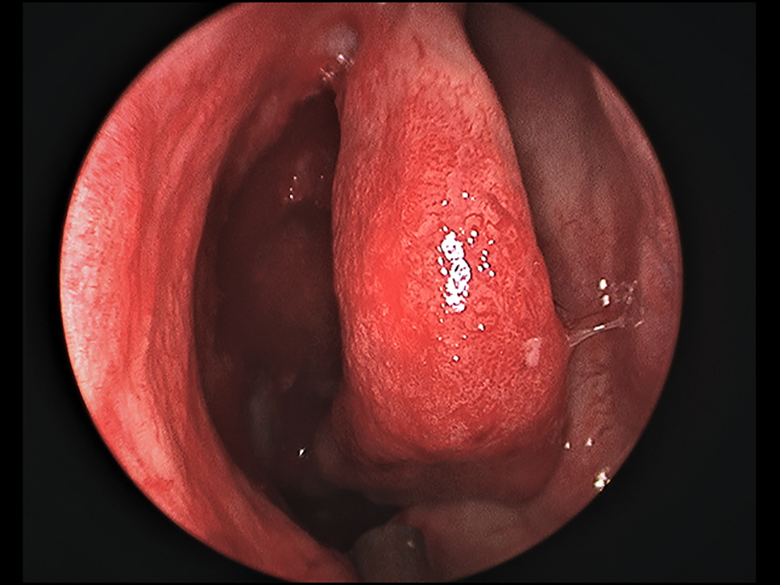
Following removal of the accessory middle turbinate, a widely patent right middle meatus is obtained.
The middle turbinate forms a bony ridge on the lateral nasal wall from the ethmoid bone. It is covered with soft tissue and mucosa and occupies an important landmark in FESS. 1 The middle turbinate can present with several anatomic variants including altered angles, polypoid disease, enlargement through aeration, and a sagittal cleft with bilobed appearance. 2 Familiarity with the anatomy aids the surgeon in successfully negotiating approaches to the middle meatal space in FESS.
Footnotes
Acknowledgment
The authors thank Grayson Bertaina for his assistance in preparing this article.
Declaration of Conflicting Interests
The author(s) declared no potential conflicts of interest with respect to the research, authorship, and/or publication of this article.
Funding
The author(s) received no financial support for the research, authorship, and/or publication of this article.