



Abstract

Unilateral vocal fold paralysis with breathy dysphonia is commonly treated with thyroplasty type 1 as described by Isshiki et al. 1 If there is large posterior gap or level difference between vocal folds during phonation, arytenoid adduction is added to thyroplasty type 1. 2 However, arytenoid adduction is a difficult surgical procedure under local anesthesia because it requires dissection posterior to the thyroid cartilage in order to find the muscular process of the arytenoid cartilage. The airway can become narrow as a result of edema and hematoma of the ipsilateral hemilarynx and piriform sinus, in addition to the adduction of the paralyzed vocal fold. Thus, the patient may develop dyspnea. 3,4
A 42-year-old man presented to our department with hoarseness after aortic arch aneurysm surgery several years previously. He was diagnosed with left vocal fold paralysis with a large gap between the vocal folds during phonation. Left thyroplasty type 1 and arytenoid adduction were planned. He was on warfarin, and his international normalized ratio (INR) was 2.8. Warfarin was stopped. After 1 week, the INR dropped to 2.4, and the surgery was performed. Surgery was uneventful, and intraoperative bleeding was not more than usual (Figure 1). A penrose drain was placed. Postoperatively, he was admitted to the Ear-Nose-Throat ward. Three hours later, he developed respiratory obstruction on the ward. Endoscopy revealed a hematoma in his left piriform sinus and hemilarynx with near-complete airway obstruction. He was taken to operating room emergently. After induction of general anesthesia, intubation was very difficult; there was no visible airway lumen. Tracheotomy was performed (Figure 2). Incision in the hypopharyngeal mucosa did not drain any blood. There was no hematoma in the surgical area, so it was not explored. The next day, there was ecchymoses all over his neck and oropharynx (Figure 3). He was unable to ingest anything during the first 2 postoperative days. On the third day, he could swallow liquids. We were unable to decannulate him on the seventh postoperative day because near-complete airway obstruction continued, although he was able to swallow solids at the end of the first postoperative week. At the end of the second postop week, his airway and phonation were good, and we decannulated him and discharged him on the next day.

Uneventful thyroplasty and arytenoid adduction on a patient using warfarin just before closure of wound.

Hematoma of hypopharynx and larynx right after tracheotomy several hours after thyroplasty and arytenoid adduction. Only epiglottis can be recognized.
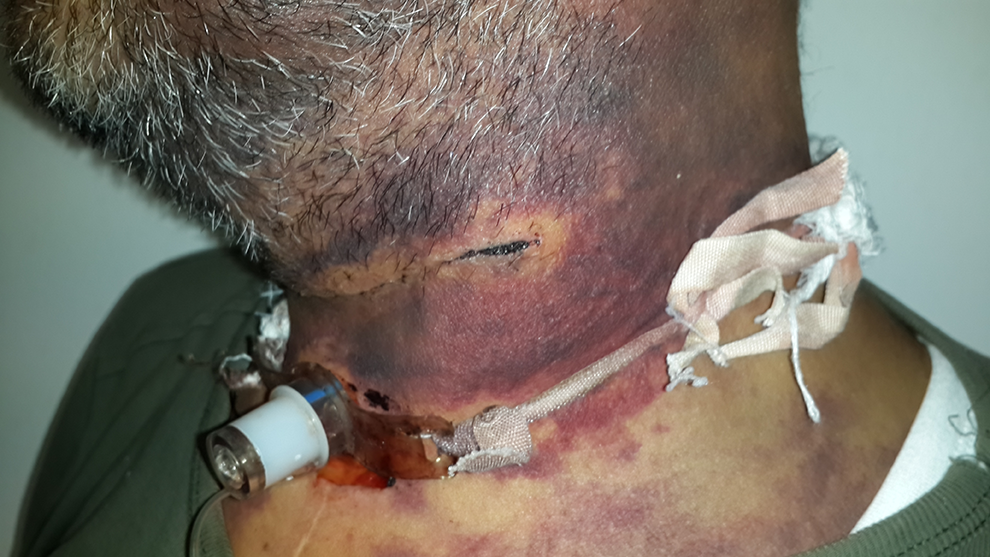
Ecchymoses all over neck skin, including nape and contralateral neck on first postoperative day.
Postoperative airway compromise develops in approximately 27% of patients who undergo arytenoid adduction; 1.6% of these require tracheotomy. 5 Weinman and Maragos 6 reported that 3.5% of their patients who underwent arytenoid adduction required emergency tracheotomy. Placing no drain and postoperative bleeding are significant risk factors for postoperative tracheotomy after arytenoid adduction. 5 Nito et al 5 comment that it is probable that various factors such as blood pressure, blood coagulability, preoperative neck scar, and the surgeon’s experience correlate with postoperative bleeding. Therefore, patients taking antiaggregants or anticoagulants for various medical reasons may be at increased risk of postoperative airway compromise and thus tracheotomy. Consequently, laryngologists must follow recommendations on how to manage patients taking antiaggregants or anticoagulants in order to perform safer thyroplasty and arytenoid adduction. In order to decrease the risk of hemorrhagic complications, it is best for the INR to be between 1.5 and 2.
There is a risk of intra- and postoperative hemorrhage during every surgery. This risk increases further if the patient uses antiaggregants or anticoagulants. If the patient uses an antiaggregant, such as acetylsalicylic acid, clopidogrel, ticlopidine, or prasugrel, it is the usual practice to stop its use 7 to 10 days before surgery, corresponding to the average platelet life span, to allow full normalization of platelet function. In surgeries with a significant bleeding risk, such as thyroplasty with arytenoid adduction, if the patient is taking oral anticoagulants, such as warfarin, which is a vitamin K antagonist, it is recommended that it be stopped 5 days before surgery, and surgery should be postponed if possible until the INR drops to between 1.5 and 2. Patients with prosthetic heart valves, or aortic arch replacement in this case, pose a significant thromboembolic event risk during discontinuation of warfarin; therefore, use of prophylactic low-molecular-weight heparin twice a day for 3 days should be considered; this is called bridging. The last heparin dose (half of the daily dose) is given 24 hours before the procedure and is resumed 24 hours after the procedure in patients at low bleeding risk and 48 to 72 hours after the procedure in those at high bleeding risk. Warfarin is resumed postoperatively at the patient’s usual dose. 7
Footnotes
Declaration of Conflicting Interests
The author(s) declared no potential conflicts of interest with respect to the research, authorship, and/or publication of this article.
Funding
The author(s) received no financial support for the research, authorship, and/or publication of this article.
