




Abstract

A 52-year-old man was referred to the emergency department for an acute dyspnea that required an endotracheal intubation and, a week later, a tracheotomy. The anamnesis of the patient’s wife revealed that he complained of a 3-month history of progressive dyspnea, stridor, and hoarseness. The laryngoscopic examination exhibited bilateral vocal fold immobility, swelling of the soft tissue of the laryngopharyngeal area, and a massive hypertrophy of the hard palate mucosa (Figure 1). Cardiovascular, respiratory, abdominal, and neurological examinations were normal. The head and neck computed tomography scan showed a goiter and a supraglottic complete stenosis due to massive soft mucosa hypertrophy without tumor identification. With regard to the clinical picture, the diagnosis of acromegaly was suspected and confirmed after the detection of a high level of growth hormone (23 ng/mL) and the magnetic resonance imaging objectification of a 2-cm pituitary adenoma. Sleep examination reported a moderate sleep apnea syndrome. A transsphenoidal resection of the pituitary adenoma was performed and there was no recurrence throughout the 5-year follow-up period. The mucosa hypertrophy of the upper aerodigestive tract significantly decreased throughout the follow-up period at the exception of the hard palate mucosa hypertrophy. The patient had no sleep apnea syndrome 5 years after the surgery.
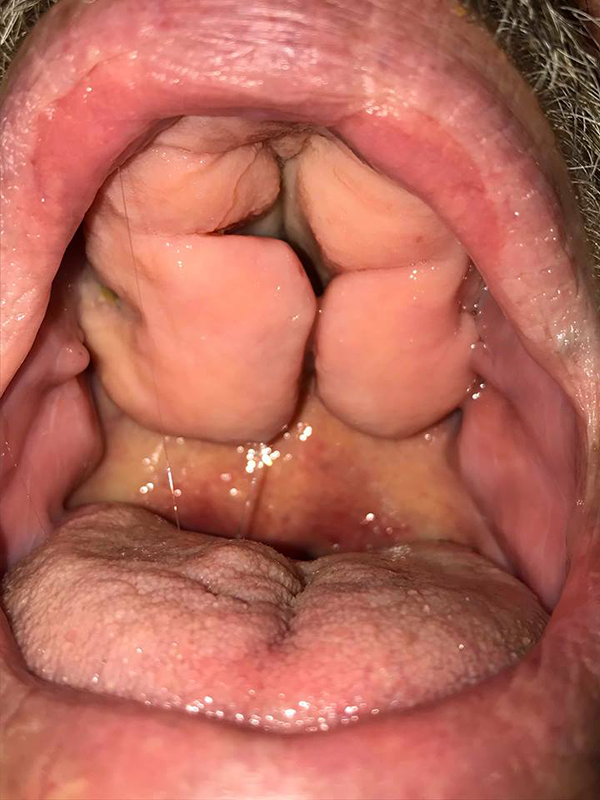
Massive hypertrophy of the mucosa of the hard palate.
Acromegaly is a rare endocrine disorder caused by growth hormone hypersecretion usually due to a pituitary adenoma. The clinical diagnosis of the disease is based on history of general anatomical modification such as enlargement of the hands and feet, forehead, jaw, and nose. In rare cases, the diagnosis is performed through head and neck anatomical changes or complications. 1 In our case, we reported a rare case of acromegaly which the diagnosis was suspected on the basis of bilateral vocal fold paresis and the exhibition of hypertrophy of the upper aerodigestive tract mucosa. Our patient had massive mucosa hypertrophy of hard palate, a rare clinical presentation that is not yet described in the current literature. Indeed, the usual oral modifications related to acromegaly include macroglossia, prognathism, thickened soft palate and uvula, gingival hyperplasia, increased interdental spaces, and the loss of several teeth. 2,3 Moreover, generally, the surgical treatment of acromegaly decreases the mucosa hypertrophy1 and the related functional disorder. In the present case, we observed a significant reduction in the thickening of the pharyngolaryngeal mucosa along the follow-up period, but we did not find substantial change of the mucosa hypertrophy of the hard palate. Although that remains rare manifestation of the disease, the diagnosis of acromegaly must be suspected in patients with progressive development of mucosa hypertrophy of the hard palate.
Footnotes
Declaration of Conflicting Interests
The author(s) declared no potential conflicts of interest with respect to the research, authorship, and/or publication of this article.
Funding
The author(s) received no financial support for the research, authorship, and/or publication of this article.