




Abstract
Gustatory sweating or Frey syndrome is most commonly reported following injury or surgery of the parotid gland. Its incidence following parotidectomy varies between 2% and 43% but has been reported to be as high as 100% when tested using a starch-iodine test. 1,2 The causative theory of Frey syndrome is an aberrant regeneration of the sectioned parasympathetic fibers of the parotid gland to the vessels and sweat glands of the overlying skin. 3 Gustatory sweating outside the parotid gland can follow submandibular gland removal and external auditory canal surgery. Its relationship to the removal of the submandibular gland was reported in 6 cases of this syndrome. 1 -6
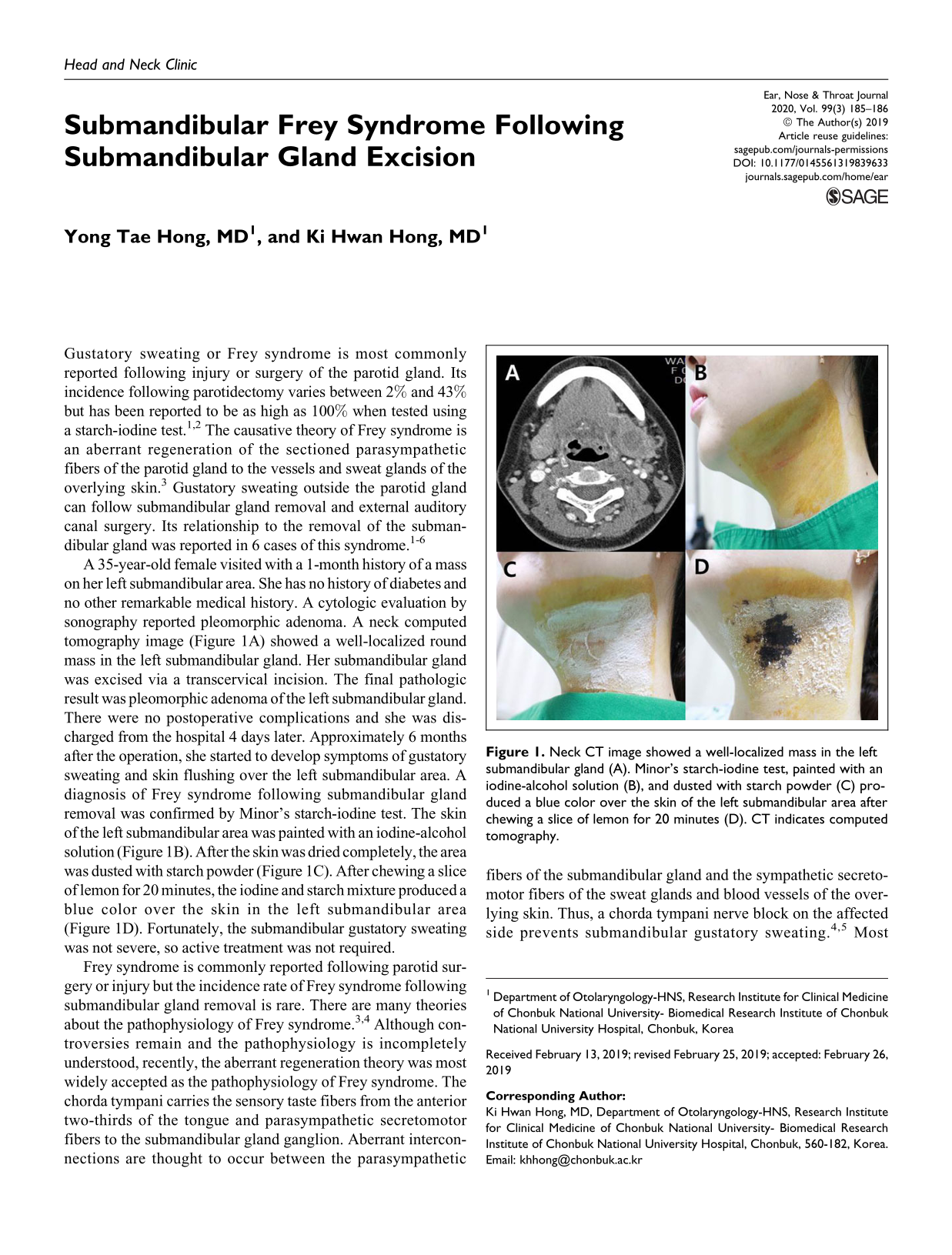
A 35-year-old female visited with a 1-month history of a mass on her left submandibular area. She has no history of diabetes and no other remarkable medical history. A cytologic evaluation by sonography reported pleomorphic adenoma. A neck computed tomography image (Figure 1A) showed a well-localized round mass in the left submandibular gland. Her submandibular gland was excised via a transcervical incision. The final pathologic result was pleomorphic adenoma of the left submandibular gland. There were no postoperative complications and she was discharged from the hospital 4 days later. Approximately 6 months after the operation, she started to develop symptoms of gustatory sweating and skin flushing over the left submandibular area. A diagnosis of Frey syndrome following submandibular gland removal was confirmed by Minor’s starch-iodine test. The skin of the left submandibular area was painted with an iodine-alcohol solution (Figure 1B). After the skin was dried completely, the area was dusted with starch powder (Figure 1C). After chewing a slice of lemon for 20 minutes, the iodine and starch mixture produced a blue color over the skin in the left submandibular area (Figure 1D). Fortunately, the submandibular gustatory sweating was not severe, so active treatment was not required.
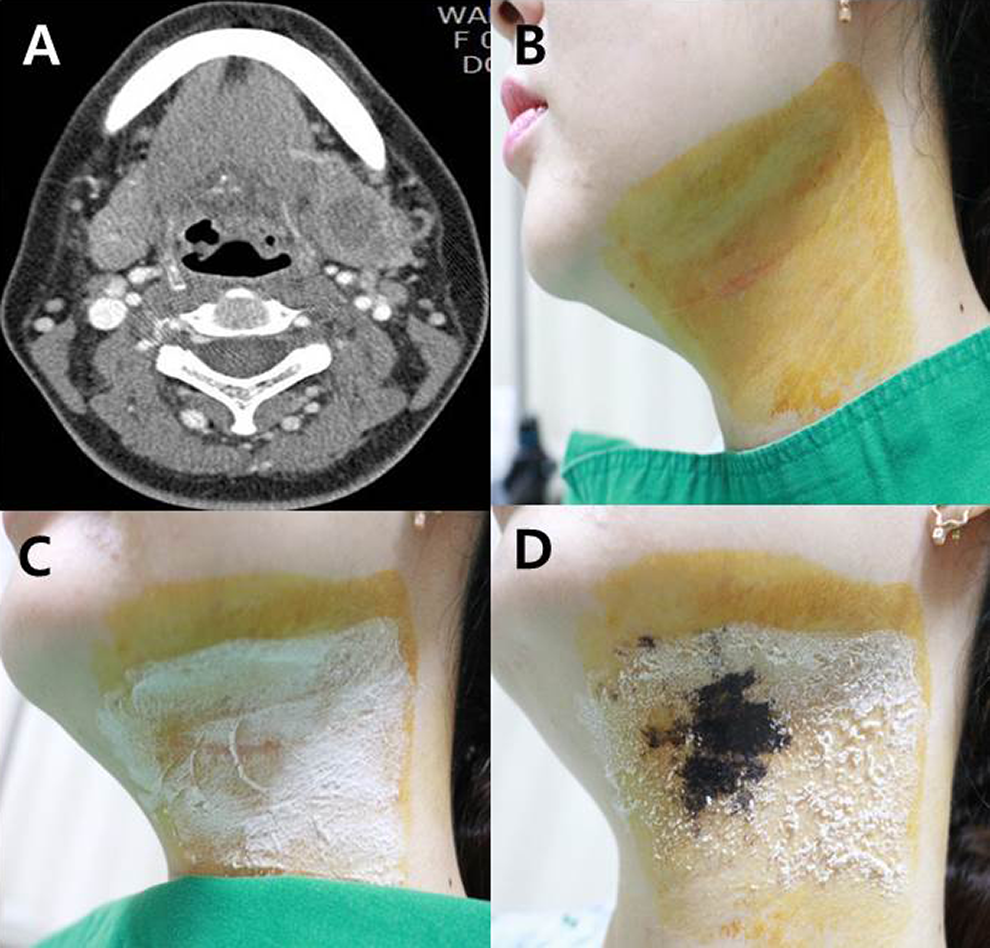
Neck CT image showed a well-localized mass in the left submandibular gland (A). Minor’s starch-iodine test, painted with an iodine-alcohol solution (B), and dusted with starch powder (C) produced a blue color over the skin of the left submandibular area after chewing a slice of lemon for 20 minutes (D). CT indicates computed tomography.
Frey syndrome is commonly reported following parotid surgery or injury but the incidence rate of Frey syndrome following submandibular gland removal is rare. There are many theories about the pathophysiology of Frey syndrome. 3,4 Although controversies remain and the pathophysiology is incompletely understood, recently, the aberrant regeneration theory was most widely accepted as the pathophysiology of Frey syndrome. The chorda tympani carries the sensory taste fibers from the anterior two-thirds of the tongue and parasympathetic secretomotor fibers to the submandibular gland ganglion. Aberrant interconnections are thought to occur between the parasympathetic fibers of the submandibular gland and the sympathetic secretomotor fibers of the sweat glands and blood vessels of the overlying skin. Thus, a chorda tympani nerve block on the affected side prevents submandibular gustatory sweating. 4,5 Most patients need no active treatment and the symptoms of gustatory sweating regress spontaneously. Medical therapies have been used as first-line treatments. Medical therapies, such as local application of antiperspirants and topical anticholinergic drugs, scopolamine hydrobromide cream, and aluminum chloride hexahydrate, satisfy most patients who have symptoms of gustatory sweating. Systemic anticholinergics, such as atropine, have also been tried to control gustatory sweating. 6 However, Frey syndrome uncontrollable by medical therapy or needing long-term control may require surgical management.
Footnotes
Declaration of Conflicting Interests
The author(s) declared no potential conflicts of interest with respect to the research, authorship, and/or publication of this article.
Funding
The author(s) received no financial support for the research, authorship, and/or publication of this article.