




Abstract

A 41-year-old man was referred to our hospital with a painful swelling on the left upper alveolar area occurred 2 months earlier. His medical history was noncontributory, and there was no history of facial trauma or nasal surgery.
Endoscopic examinations revealed a bulging on the anterior floor of the left nasal cavity. Mucosal hypertrophy or purulent discharge was absent. Computed tomography scans showed a well-defined cystic lesion on the left maxilla with bony erosion and inner soft tissue attenuation, and it contains a calcified radio-opaque material (Figure 1A and B). These findings were highly suggestive of dentigerous cyst with possibly fungal ball or calcification.
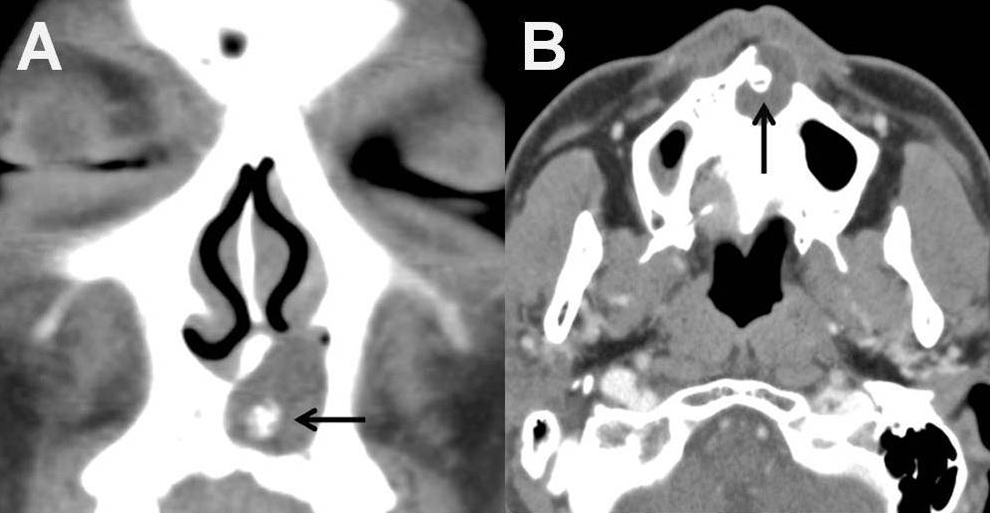
Coronal (A) and axial (B) computed tomography scans show a cystic mass lesion on the left upper alveolar bone. Bony erosion and calcified radio-opaque material (arrows) is observed within the lesion.
We decided to perform endoscopic marsupialization under general anesthesia. Thin mucosal portion of the left nasal cavity floor was palpated with a seeker and perforated. Opening was widened with straight and upward cutting forceps, and the margin was trimmed with a microdebrider. The cyst was filled with serous fluid, and an impacted supernumerary tooth was identified and removed (Figure 2A and B). Pathologic results confirmed the diagnosis of dentigerous cyst and a supernumerary tooth. After operation, his symptoms improved immediately, and he is now well without recurrence.
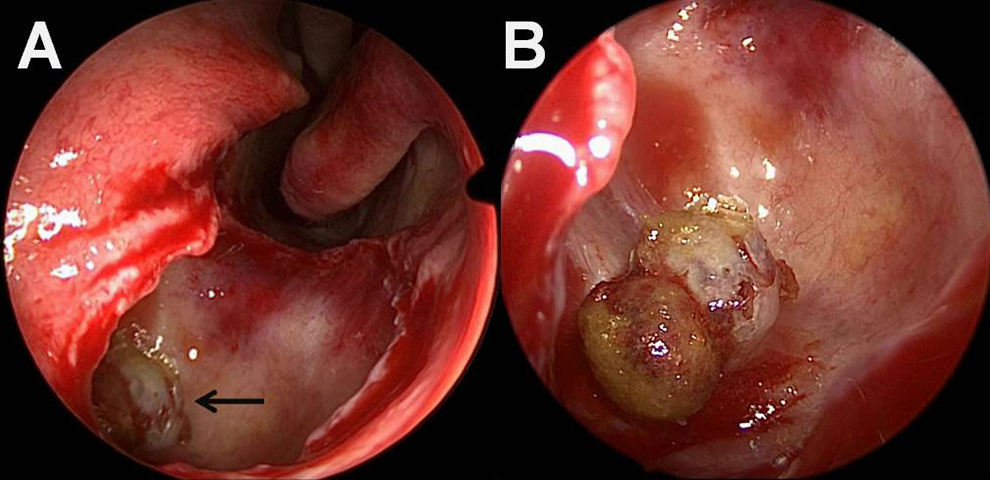
Endoscopic findings after marsupialization. Anterior nasal floor was removed and the inner space of the dentigerous cyst is observed. An impacted supernumerary tooth is noted on 4-mm rigid 0° (A) and 70° (B) endoscopes.
Dentigerous cyst originates within the follicular space of an unerupted tooth with fully formed crown accompanied by fluid accumulation. 1 It is the second most common odontogenic cyst followed by the radicular cyst, and about 70% occur in the mandible and 30% in the maxilla. 1 -3 Dentigerous cyst may contain unerupted permanent teeth, supernumerary teeth, odontomas, and, rarely, deciduous teeth. 3
In this case, it is not definite that dentigerous cyst may originate from a supernumerary tooth, but a possibility exists that the 2 disease entities are associated. 4 Although small dentigerous cyst often requires external approach, the cyst was large enough to perform endoscopic marsupialization and we could reduce the hospital stay and healing period without complications such as oroantral fistula or numbness of the gum and teeth.
Footnotes
Declaration of Conflicting Interests
The author(s) declared no potential conflicts of interest with respect to the research, authorship, and/or publication of this article.
Funding
The author(s) disclosed receipt of the following financial support for the research, authorship, and/or publication of this article: This study was supported by the Soonchunhyang University Research Fund.