




Abstract

Dermoids, or hairy polyps, are rare lesions affecting the head and neck region. Usually they are revealed at birth or in the first year of life, with signs of upper aerodigestive tract obstruction.
A previously healthy 3½-year-old girl was admitted to the pediatric department with a 2-day history of fever, cough, breathing difficulties, and dysphagia. Physical examination revealed a white mass protruding in and out of the nasopharynx. Computed tomography (CT) demonstrated a nonvascularized, fatty, cystic lesion originating from the nasopharynx and without intracranial involvement (figure 1).
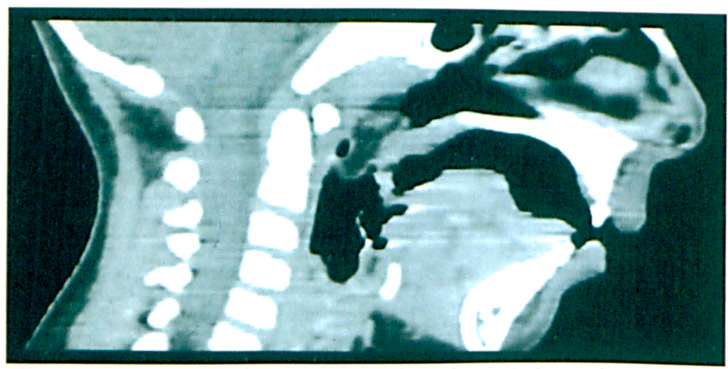
Sagittal CT scan reveals the presence of the dermoid tumor in the nasopharynx.
The patient was transported to the operating room and intubated without difficulty. On endoscopic examination, a white, pedunculated, 3 × 2.5 × 1.2-cm nasopharyngeal mass was found to arise from the left lateral wall of the nasopharynx. The mass was excised at its base with diathermy.
Histopathology revealed a polypoid mass lined with keratinized squamous epithelium overlying thickened fibrovascular tissue containing abortive pilosebaceous units and profiles of eccrine sweat glands and ducts (figure 2). The mesodermal component was represented by fibroadipose tissue and mature-appearing cartilage, consistent with a dermoid. The patient had an uneventful recovery and no recurrence at 3- and 9-month follow-up.
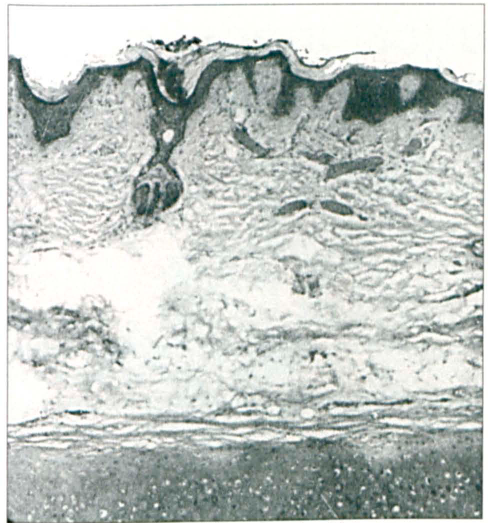
Histologic section shows the polypoid mass.
Dermoids, the most primitive form of teratomas, are benign lesions with limited growth potential. Less than 2% of reported cases of congenital teratomas are found in the head and neck, most often in the cervical area. Nasopharyngeal teratomas are even rarer. Dermoids are the most common type of nasopharyngeal teratomas, accounting for more than 60% of reported cases.1,2 Most are pedunculated, originating from the lateral nasopharyngeal wall or from the superior surface of the soft palate.
The most common presenting symptom of nasopharyngeal dermoids is respiratory distress or difficulty in deglutition. They are usually detected early in life3,4; their occurrence in older patients is rare. 5 Occasionally, if small and not causing obstruction, dermoids may go undetected for years. In such cases, they are normally found accidentally on routine examination for an unrelated condition. Our case is unusual in that the patient presented at 3½ years of age. Dermoids should be considered in the differential diagnosis of nasopharyngeal masses, even in older patients.
Footnotes
Acknowledgment
We wish to extend our appreciation to Ms. Judy Brandt for her skillful English editing and word processing expertise and contributions.