




Abstract

A 50-year-old woman presented with a 2-year history of hoarseness, voice fatigue, and dysphonia. The hoarseness had been getting worse over the preceding few months, and she was having increasing difficulty in her job as a salesperson. She had been diagnosed previously with gastroesophageal reflux disease and vocal fold polyps and had been treated with esomeprazole 40 mg twice daily and voice therapy.
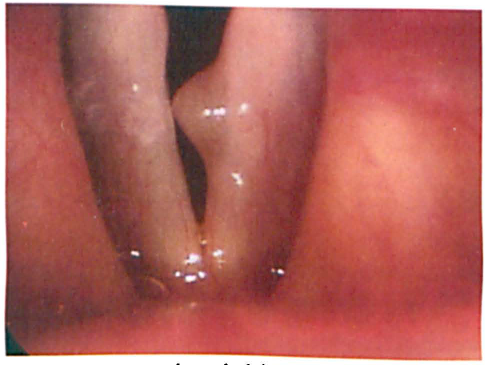
On examination, the patient's voice was moderately hoarse and breathy. Strobovideolaryngoscopy detected mild supraglottic hyperfunction with a decrease in anteroposterior and lateral distance that did not improve with a voluntary increase in pitch. Right vocal fold adduction and abduction were sluggish. The arytenoid cartilages were mildly edematous and moderately erythematous. Mild posterior cobblestoning was present. Varices were present on both true vocal folds. There was a left vocal fold cyst with an associated varicosity and a right vocal fold reactive mass (figure). Bilateral vocal fold scarring also was seen. Glottic closure was incomplete anterior and posterior to the vocal fold masses. The amplitude and waveforms of both vocal folds were decreased, more so on the left. The vibratory function of both musculomembranous vocal folds was decreased. Laryngeal electromyography revealed 40% decreased recruitment in the distribution of the right superior laryngeal nerve and poor relaxation at rest consistent with muscle tension dysphonia.
Figure. Laryngoscopy shows the left vocal fold cyst with a feeding varicosity and the reactive lesion on the right vocal fold.
After a course of voice therapy, the patient underwent microdirect laryngoscopy for excision of the left vocal fold mass and bilateral dexamethasone injections into the areas of stiffness. The mass was a benign vocal fold cyst.
Follow-up examination showed excellent healing in the area of the contact stiffness on the right vocal fold. The left vocal fold healed, as well, and the patient's hoarseness and breathiness decreased rapidly. She continued to improve throughout an additional course of voice therapy.