




Abstract

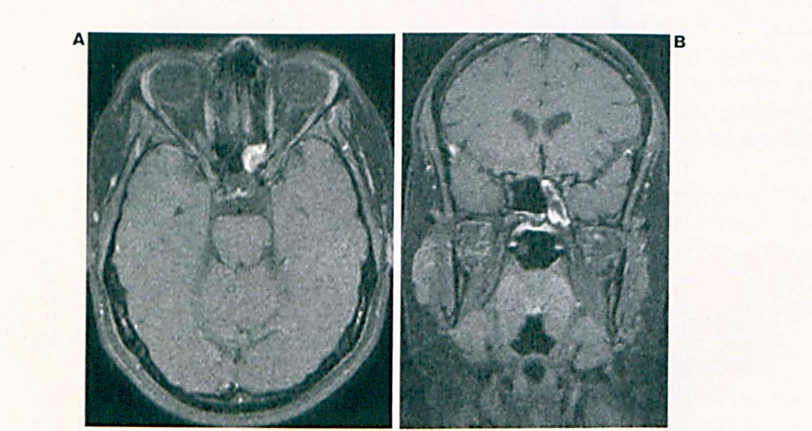
Figure. Axial (
A 25-year-old woman presented with a 10-day history of left-sided headache and intermittent blurred vision. She had been treated for migraine by her family physician with simple analgesia. She reported no nasal symptoms.
Examination by an eye specialist revealed that she had no perception of light in her left eye. Urgent magnetic resonance imaging (MRI) was arranged, and it detected an enhancing soft-tissue mass in the left sphenoid sinus with possible impingement of the optic nerve (figure). The patient had not previously undergone computed tomography.
The ENT service was contacted urgently, and an emergency endoscopic sphenoidotomy was performed within hours of referral. Frank, pus was drained from the sphenoid sinus. Three hours after surgery, the patient's vision was 6/12. The following day her vision had completely returned to normal.
Acute isolated sphenoid sinusitis is seen in less than 3% of all cases of sinusitis. 1 Headache is the most common initial symptom, followed by visual disturbance. An absence of nasal symptoms does not preclude the presence of isolated sphenoid sinusitis, as was illustrated in this case. Sphenoid sinusitis can lead to complications such as orbital cellulitis and abscess, orbital complex syndrome, blindness, sepsis, meningitis, epidural and subdural abscess, cerebral infarction, pituitary abscess, cavernous sinus thrombosis, and internal carotid artery thromosis. 2
Our case illustrates that sphenoid sinusitis is a potentially dangerous condition and should be considered in patients with unilateral headache and visual problems. Prompt diagnosis and treatment can be associated with a full recovery.