




Abstract
Since both medical interventions and rehabilitation programs for people with visual impairments improve, it is vital that researchers and clinicians maintain a client-centered focus. Visual impairments can have a huge effect on the well-being and quality of life of an individual (National Academies of Sciences & Medicine, 2017). Vision impairment is associated with limitations of activities of daily living, as well as higher risk of depression and anxiety (Bookwala & Lawson, 2011).
Low vision rehabilitation services have the potential to improve outcomes for people with low vision in the areas of functional mobility, employment, and information access (Lamoureux et al., 2007). Rehabilitation training programs help clients to best use their residual vision, provide recommendations for low vision devices (including aids that utilize other senses, such as auditory and tactile) and provide assessments and advice on optimizing the lived environment (Matti et al., 2011).
Despite the importance of rehabilitation services, relatively small numbers of people with low vision are currently referred to such services in Australia (∼20%) and worldwide (<10%) (Coker et al., 2018; Pollard et al., 2003). Studies investigating the reasons clients access low vision rehabilitation can assist therapists to tailor programs more effectively. In addition, an evidence-based understanding of the common goals for people with low vision could enable pharmaceutical
by answering questions on this article. For more information, visit:☑ Earn CEs Online
The Canadian Occupational Performance Measure (COPM) is a performance measurement tool used by occupational therapists in both research and clinical practice, to gather this type of client-reported data (Law et al., 1990). The COPM is a semi-structured interview designed to help clients better understand their situation and seek available assistance. Although originally designed as a broad tool for all areas of occupational therapy (e.g., pediatrics, adult physical dysfunction, and mental health) (Law et al., 1990), the COPM has also been used as an effective tool for specialized assessment of low vision assistive technology (Smallfield & Kaldenberg, 2020). For example, the Vision Technology Service (VTS, Canada) used the COPM to monitor performance changes with the implementation of their sight enhancement device (Carswell et al., 2004). However, to our knowledge, a large-scale thematic analysis of COPM responses in a cohort of people with low vision has not yet been reported.
Our research aimed to consolidate COPM data from a diverse group of people with low vision, to understand their needs and challenges in their daily life. By analyzing the COPM datasets in the present study, we are hoping to provide insight into some of the most common goals for people with low vision. This insight provides a benefit to rehabilitation services, and it also enables us to better design outcome measures for future clinical trials to reflect common goals for this cohort.
Methods
Participants
A total of 190 retrospective de-identified COPM surveys, including 466 distinct goals, along with basic demographic and clinical data, were obtained from Vision Australia. Within the 190 de-identified datasets, 122 (64%) of the participants were female. The mean age of participants was 58.14 ± 30.79 years, range from 3 to 103 years. Forty (21.1%) of the datasets were for children aged below 18 years. For these 40 pediatric participants, the COPM was completed by a parent or guardian. Participants’ vision conditions included 15 different pathologies with age-related macular degeneration (AMD; n = 43), glaucoma and optic nerve pathologies (n = 38), and cataracts (n = 39) being the most common three conditions.
The study followed the tenets of the Declaration of Helsinki for research in human subjects. All participants had previously provided informed consent that their datasets could be used for research purposes, and the current project was approved by the University of Melbourne Human Research Ethics Committee (approval ID 2056772, approval date 19/07/2020), in accordance with the National Statement on Ethical Conduct in Human Research.
Administration of COPM
Vision Australia routinely uses the COPM to assist clients in identifying occupational performance goals for their therapeutic plan. An occupational performance goal is defined as “an activity that a person wants to do, needs to do, or is expected to do by others, but can’t do, doesn’t do, or isn’t satisfied with the way that they do it” (Carswell et al., 2004). The COPM was administered by an occupational therapist from Vision Australia to clients of their services using predetermined guidelines and questions (see Appendix 1). The COPM was administered when the clients first registered with Vision Australia across the years 2015 to 2020, prior to any therapeutic intervention. If the clients could not readily self-identify issues, they were prompted to consider how they completed common daily tasks, with a specified list of questions to avoid any biased opinions.
Data Analysis
Clients’ occupational goals were analyzed using the thematic analysis method (Braun & Clarke, 2006). We engaged an external qualitative researcher (Dr. Fylan) to provide independent input into the process. Initial analysis of the data was completed by authors Drs. Jin and Fylan, following preset qualitative research guidelines (Babchuk, 2019). When necessary, the researchers discussed the points of disagreement and reached a consensus in all cases.
We did not apply a predetermined framework for processing the raw text data. Instead, we used an inductive approach to include as many topics as possible (Thomas, 2006). The analysis of the raw data started with identifying the segment of responses corresponding to rehabilitation goals and assigning codes to summarize them. For consistency, the contents of the codes were compared with each other and sometimes regrouped. We also considered the context within which the problematic activity occurs and took that into account when assigning occupational problems to different codes. For example, the initial code “walk in the local community” was regrouped into a broader code “access the local community”. The codes (n = 467) obtained from the primary documents were then structured into different categories. The categories were established to contain similar codes or concepts by the first author of this study (Dr. Jin) and reviewed by the second author (Dr. Fylan). This process was iterative, with codes merging and moving between categories until a set of categories, or subthemes, was identified that covered the full set of codes. Subsequently, we organized the identified subthemes (n = 11) into three main themes.
Results
Three main themes have been identified within participants’ goals: (a) safety and confidence, (b) life skills, and (c) leisure. These themes were then broken into 11 subthemes, and their distribution is summarized in Figure 1. Quotes provided in the following sections are followed by a bracket containing the gender, age, vision condition, and participant ID.
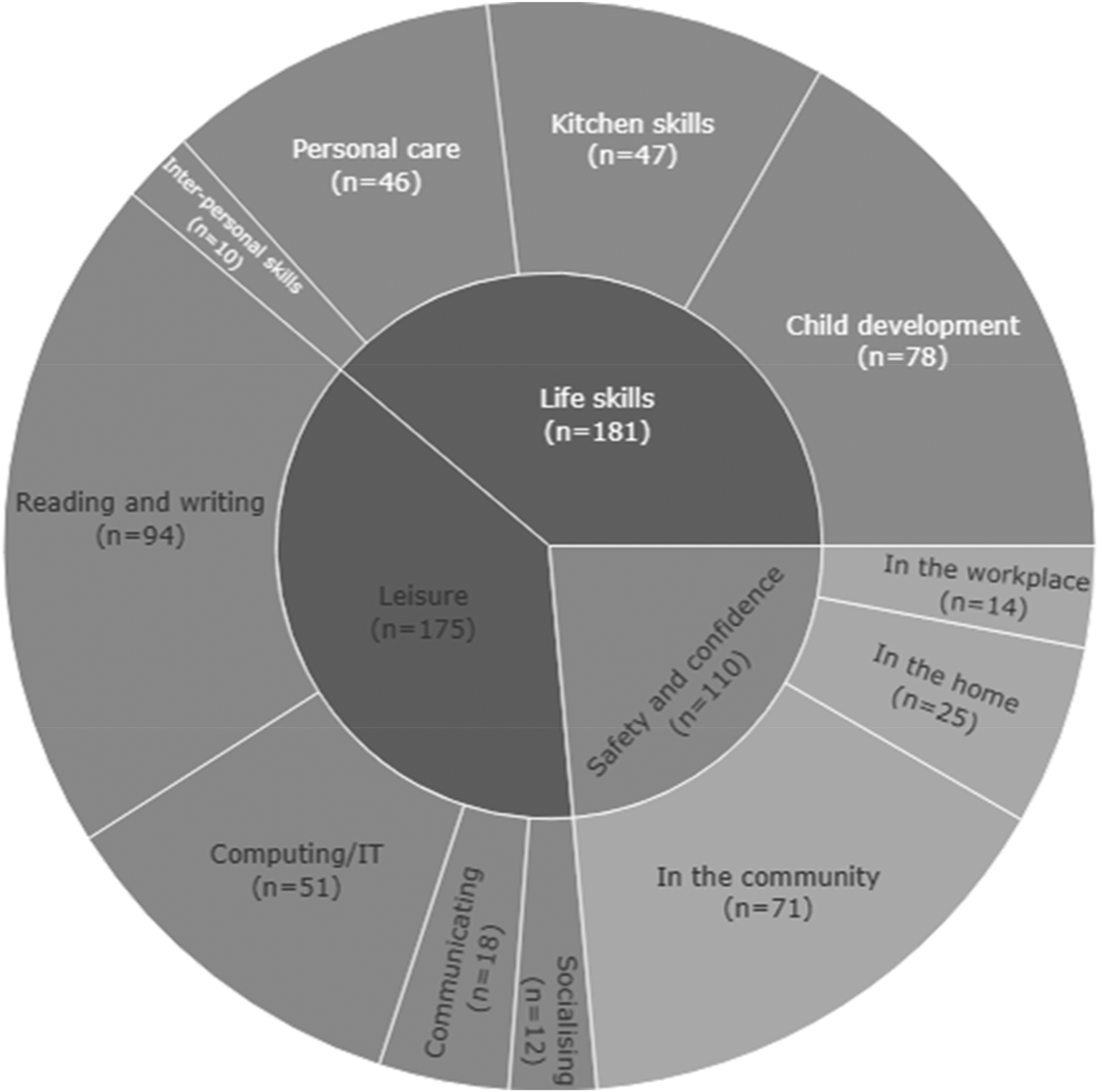
Thematic Structure of All COPM Goals, Showing Distribution of All COPM Goals (n = 466) Among the Three Main Themes and 11 Subthemes.
Safety and Confidence
The theme of safety and confidence consisted of goals related to being able to use their environment safely and to feel confident in their ability to do so. There were 110 participants who identified with these goals, which fell into three subthemes: feeling safe and confident in the home, in the community, and in the workplace.
The subtheme “in the community” emerged as the most frequently (71/110) mentioned, and it described people's goals to access their local communities and further afield, such as neighboring towns or other regions. Most of the goals in this subtheme related to accessing the community independently. Participants also described goals, such as using public transport to access shops or attend medical appointments. They also include accessing or funding support for transport (e.g., taxi subsidy scheme). To navigate public spaces safely and independently, the participants wanted to develop skills including crossing the road, stepping up and down curbs, going up and down stairs, and walking on uneven surfaces. Goals often involved learning to use devices or techniques that would make accessing the community easier, which often involves the use of mobility devices, most commonly a long cane or guide dog or both. The following quotations from the participants’ COPM goals illustrate how goals included both the skills to mobilize, and to feel confident to do so: Would like to access community, seeing steps and kerbs. (Male, 89 years of age, AMD, COPM-00572) I would like to feel more confident when using public transport. I would like to feel more confident and safer when walking at night. (Female, 63 years of age, Glaucoma, COPM-02642)
The subtheme “in the home” (25/110) was described by participants as being able to move around their home environment safely and confidently. High-risk areas around the home environment, including the bathroom and stairs with uneven and slippery surfaces, were featured in the goals to access the home environment. Some participants aimed to make adjustments to their homes and even wanted to renovate parts of their homes so that they would be easier to navigate safely. Participants also sought to access their gardens and yards safely to spend time outdoors, to relax or socialize, or to complete chores, such as hanging the washing. Overall, feeling safe, confident, and independent were the most commonly repeated objectives within the goals of accessing home and wider environments, as shown in the following quotations. I would like to feel safer when getting in and out of the shower. (Female, 88 years of age, Glaucoma, COPM-03880) I will be able to use long cane properly and get around in the house and in the community more safely. (Male, 65 years of age, Glaucoma, COPM-04025)
The subtheme “in the workplace” (11/110) included goals reflecting how participants struggled with finding and adapting to employment. They included conducting assessments to identify adaptations that would improve the workplace environment, making it more accessible and user-friendly. In addition, some goals were about gaining specific employability or professional skills, such as computing skills, leadership skills, or public speaking. The reasoning behind such stated goals could be to help them obtain employment or volunteering positions, or to progress in their career. This is evident in the following participant statements. I would like to have a workplace assessment to continue to do my job efficiently. (Female, 51 years of age, Stargardt's disease, COPM-00862) I would like to use my computer with the focus of gaining employment. (Male, 40 years of age, Glaucoma, COPM-02116)
Life Skills
The life skills theme described goals (n = 181) that participants had in order to take care of themselves. It comprises four subthemes that address being able to use the kitchen independently, managing household activities, to wash and dress themselves, and interpersonal skills to liaise with others socially and professionally. It also includes a subtheme specific to children reaching their developmental milestone (age 3–18 years).
In subtheme “kitchen skills” (46/181), participants described how they would like to improve their independence in preparing food or cooking for themselves or others. These goals were about being able to use kitchen appliances and to use aids and adaptations to make drinks, snacks, and meals. They sought occupational therapist visits for advice or demonstrations, explored technology usage, utilized tactile markers, and developed basic cooking skills to enhance independence. Examples of goals within this subtheme were: I would like my kitchen marked with tactile markers so I can use my kitchen appliances more safely. (Female, 94 years of age, AMD, COPM-00705) I would like an assessment for skills in the kitchen. I would like to be able to use equipment such as talking scales and to be able fill a measuring cup without overflowing it. (Female, 58 years of age, Glaucoma, COPM-1472)
The “personal care” subtheme (47/181) involved goals related to self-care needs, encompassing tasks like dressing, selecting clothes, and taking medication independently (e.g., applying eyedrops). Additionally, goals for interpersonal skills (10/181) were highlighted, covering interactions with other people. Interpersonal skills included a young person wanting to be able to explain their visual condition and to identify and manage potential bullying from peers. The following quotations illustrate these experiences: I would like to feel confident that I am wearing what I want to wear. (Female, 48, Retinitis pigmentosa, COPM-00678) I want to be able to identify teasing and bullying and feel confident to deal with it if it happens. (Female, 15 years of age, Optic glioma, COPM-00130)
In “child development” (78/181), parents or caregivers focused on life skills for their children, emphasizing functional skills, improved interaction, and being able to explore their environment. These goals included developing gross and fine motor skills, standing, walking, riding a bike, and learning self-care tasks like toilet routines, dressing, and washing. Furthermore, parents also wanted their children to develop their communication skills, participate in games, and improve their academic performance. The overarching goals were for children to develop self-care and motor skills in both home and school environments, understand their surroundings, and build essential skills for later life. The following quotations provide insight into these parental goals: For [c]hild to engage in age-appropriate gross motor activities. (Female, 5 years of age, Ocular Albinism, COPM-00328) To promote early literacy. (Male, 5 years of age, Nystagmus, COPM-02554)
Leisure
The leisure theme is about the goals participants had around leisure activities (n = 175). It also includes goals around communicating with other people, and this often involves technology. It comprises four subthemes, including reading and writing for entertainment, social connection, communication, and technology training. The subtheme “Reading and writing” (84/175) was about being able to read mail, books, newspapers, and puzzles, and could refer to both printed and electronic material. Participants also reported goals in seeking assistive tools to help them with reading, ranging from basic devices, such as a magnifier and audiobooks, to training on how to use accessibility settings in a smartphone for reading web pages, or getting training to use a Google Home “smart speaker” to access recipes. The following quotations reflect these experiences and goals: I will be able to find suitable magnifier and lamps for me and be able to read easily, I would like to be able to read my bills and letters with less difficulty. (Male, 67 years of age, Bull's-eye maculopathy, COPM-02583) I would like to have adequate lighting so I can enjoy my craftwork. (Female, 64 years of age, Optic Atrophy, COPM-03895)
Other goals related to socializing with others. This could include joining social or activity groups, or simply to meet other people and make friends. Many participants were motivated to join interest and support groups (e.g., walking groups and handcraft groups), hoping to meet someone with similar conditions to feel socially connected. Interest in technology usage for building relationships was common, including tasks like making and receiving telephone or smartphone calls, sending messages, and using computers for communication purposes. Other goals related to using computers and adaptive technology for other activities, such as electronic organizers. The following quotations further illustrate these goals: I would like to attend the (name) groups when they go on outing to shopping centres and gardens. (Female, 90 years of age, AMD, COPM-04604) I may like to meet other teenagers who have vision like mine. I would like to have the skills to meet new people and build a friendship with them. (Female, 15 years of age, Optic pathway glioma, COPM-00130)
Discussion
The results of this study investigated the common goals and rehabilitation needs in an Australian low vision population. The wide age range (3 to 103 years) of clients provided a comprehensive overview of goals at different life stages with diverse causes of vision loss. The thematic analysis of COPM data revealed three main themes and eleven subthemes. As previous studies have shown (Pijl et al., 2008; Pinquart & Pfeiffer, 2011; Salminen & Karhula, 2014), one of the most common goals in our COPM dataset was to improve mobility, either in a person's home environment or, more commonly, in the wider community. The majority (87%) of responses mentioned the importance of maintaining safety and confidence in indoor and outdoor environments. Functional mobility and community engagement for people with visual impairments is a highly individualized concept, and there is no one optimal choice that suits all. Despite the challenges of balancing statistical rigor with real-world validity in mobility assessments, the needs of people to feel safe and confident while accessing environments supports the continued use of mobility assessments in clinical trials for vision interventions (Ayton et al., 2020).
Most of the goals around mobility were linked with the categories of safety, confidence, and independence, suggesting that mobility challenges are not solely due to a decline in functional capacity, but also due to psychosocial and emotional changes with vision loss. The results highlighted the importance of emotional support in assisting functional mobility. Hence, future rehabilitation therapies could focus more on how to maximize those feelings of safety and confidence and teach people with visual impairments how to be independent in a safe and confident manner. Outcome measurements for new treatments and interventions could also include emotional functioning as an important factor in the evaluation of mobility improvements (Kaldenberg & Smallfield, 2020). For example, after intervention, the participants may not be able to walk faster but may be more confident when they walk.
Another major goal in this cohort was developing kitchen skills including safe preparation of food in the home, with 75% of participants over the age of 18 years reporting this as one of their goals for household tasks. Respondents often identified assistive technologies that could support these tasks (for example, having a COPM goal that reflected their desire to have training in these techniques and obtain appropriate adaptive aids). Surprisingly, only two respondents specifically mentioned that they thought cookware with tactile or audio feedback would be helpful. It is possible that the knowledge and availability of such kitchenware is still low for people entering rehabilitation programs. The high prevalence of food preparation goals also supports its continued use as an assessment in rehabilitation (i.e., this is often used in occupational therapy), and as a clinical trial outcome, as used in the LoVADA outcome battery (Finger et al., 2014). Our results highlight the importance of developing interpersonal skills, and these are likely to be particularly important for young people. In alignment with Salminen and Karhula (2014), the results highlight significant parental concerns about children (aged 3–18 years) being affected by their visual conditions, leading to delays in their developmental progress, including personal care, academic performance, and interpersonal skills. It suggested the importance of early comprehensive training and support programs to ensure that visually impaired children reach their full potential.
The most common goal in the “leisure” theme was the need to access traditional print and electronic copies for information access. With the development of computer vision and text recognition algorithms, devices like OrCam (a portable, artificial vision device) can help people with impaired vision to obtain written information through an audio translation (Waisbourd et al., 2019). Nowadays, most smartphones are equipped with built-in accessibility features like the VoiceOver screen reader, indicating the widespread availability of these technologies (Abraham et al., 2022). More and more developers of games and content creators are also adapting new techniques to improve accessibility for people with low vision, such as magnification and contrast enhancement (Szpiro et al., 2016; Zhao et al., 2015). Our results also demonstrate the importance of socializing with others, and although participants wanted to meet others in person, they were also open to using technology to communicate.
The strength of our study lies in the qualitative approach, delving into the rich data supplied by 190 individuals to summarize the most important goals and common categories in COPM data. Without client-centered assessments like COPM, there can be a tendency to stereotype an individual's need based on their age, vision condition, and funding options. A full cycle of COPM surveying should include problem definition, problem weighting, scoring, and follow-up assessment after therapy (Law et al., 1990). Such surveys provide a client-centered outcome measurement to evaluate the effectiveness of the rehabilitation service and future therapies. Although it was not the focus of this study, it would be interesting to know how the goals of the same cohort change after a period of rehabilitation therapy.
As with all qualitative analyses, the reduction of a rich data course to a summary level risks missing subjective meanings and individual differences in personal goals. The respondents also had a wide range of vision from “low vision” (less than 6/12 acuity) to totally blind, and age of onset (from congenital to later in life). There are many contributing factors to the impact of low vision on daily life. In this study, we only had access to basic demographics (age and gender) and the COPM data from Vision Australia, without reference to their personal details (marital status, occupation, financial status, level of social support, etc.). In future studies, it will be interesting to further investigate any relationship between other social situations, such as marital status, employment status, socioeconomic factors, and their rehabilitation goals, or if there is a difference between people who have previously been involved in support services or not. It should be noted that the rather low (an estimated 20%) uptake of low vision rehabilitation services in Australia (Taylor et al., 2005) indicates that there is a “silent majority,” and it would be informative to see the difference in COPM goals between people who accessed Vision Australia for assistance, and people who did not.
In summary, this analysis of COPM data in 190 individuals with low vision and blindness has identified three main themes regarding goals for services and supports: safety and confidence, life skills, and leisure. We have further identified 11 subthemes, of which the importance of functional mobility, household tasks, and information access were highlighted. The data support the inclusion of mobility, kitchen skills, and reading and writing tasks in both rehabilitation and clinical trial outcomes. They also highlight the importance of self-empowerment, such as confidence, safety, and independence, in helping clients lead independent, safe, and healthy lives despite vision loss. These findings underscore the need for continued focus on these areas in both practice and research, particularly considering the impact of the COVID-19 pandemic and rapid technological advancements. Future longitudinal studies are essential to ensure that interventions remain responsive to these changing dynamics and continue to meet the diverse needs of this population.
Footnotes
Appendix 1
Acknowledgments
This work was supported by a National Health and Medical Research Council Investigator grant to LNA (GNT#1195713; 2022–26), University of Melbourne Driving Research Momentum Fellowship to LNA (2019–24), 2021 Retina Australia grant to LNA, MAP, CDM and JLM and a 2020 Melbourne Disability Institute grant to LNA, JLM, MAP, CDM, SAB and Dr. Jin. The Bionics Institute and Centre for Eye Research Australia acknowledge the support they receive from the Victorian Government through its Operational Infrastructure Support Program. We would also like to thank Vision Australia for their collaboration and supply of the retrospective, de-identified Canadian Occupational Performance Measure survey data, particularly Domenica Maloney and Amelia Ukovic.
Declaration of Conflicting Interests
The author(s) declared no potential conflicts of interest with respect to the research, authorship, and/or publication of this article.
Funding
The author(s) disclosed receipt of the following financial support for the research, authorship, and/or publication of this article: This work was supported by the National Health and Medical Research Council (grant number GNT#1195713).
