




Abstract
Students with visual impairments represent one of the lowest-incidence disability groups enrolled in U.S. public schools. Child count data from the U.S. Department of Education (2011) suggest students with visual impairments represent <0.5% of all students aged 6 through 21 years who are served under Part B of the Individuals with Disabilities Education Act (IDEA, 2004). Moreover, fewer than 10,000 students with a primary label of visual impairment are transition-aged nationwide (aged 14–21 years; U.S. Department of Education, 2022). Yet, despite the low-incidence nature of the disability, students with visual impairments represent a heterogenous group of students (Erin, 2007). Given the diversity among students, teachers need the appropriate training and support to meet the varied demands of this population.
The field of secondary transition for students with visual impairments does not yet include evidence-based practices that have been causally examined to lead to postsecondary education or employment. However, research in special education has long identified a consistent set of predictors for transition programming activities for students with disabilities, and those with visual impairment specifically, that positively correlate with college and career outcomes. First, Lund and Cmar (2020) identified factors related to the employment of transition-aged students with visual impairments. They found that postsecondary education and work experience during high school were predictive factors. Additionally, the authors identified tentative evidence for career counseling, generic academic skills, social skills, self-determination, assistive technology, and orientation and mobility instruction as being predictive of later employment success. Second, Mazzotti et al. (2021) identified 23 predictors of postsecondary education and employment for all students with disabilities. With specific respect to students with visual impairments, Mazzotti et al. highlighted evidence for paid work experiences (Cmar, 2015; Connors et al., 2014); learning how to advocate for accommodations (Newman & Madaus, 2015); parent or caregiver expectations for their student achieving paid work (Cmar, 2015; Schuck et al., 2019); and other student supports (Cmar, 2015) as being predictive of both postsecondary education and employment.
Despite what these two prior reviews have revealed, outcomes for students with visual impairments continue to remain poor. Young people with visual impairments may attend college at similar rates as peers without disabilities, but the U.S. Department of Education (2017) found that as many as 70% of students with visual impairments at 2-year institutions and 46% at 4-year institutions did not graduate from that institution within 150% of the typical amount of time required for students to complete their degrees. Furthermore, individuals with visual impairments have low rates of employment. In a research report on the employment and postsecondary education status of transition-aged students with visual impairments, McDonnall (2010) found that only 38.2% of students with visual impairments who had exited high school and had not attended postsecondary education were employed, compared to the 72.6% of students without disabilities in this situation. And of the 38.2% of students who were employed, only one-third held full-time jobs.
Poor postschool outcomes may be influenced by the degree to which educators actually implement instructional practices and transition services that are recognized as being predictive of later success. The responsibility for the education of students with visual impairments is assumed by a host of different educational professionals. Regarding transition, special educators are tasked with providing career-related planning, instruction, and experiences to support students with visual impairments and additional disabilities. Teachers of students with visual impairments (TVIs) are required to provide instruction in the expanded core curriculum (ECC) to all students with visual impairments. The skills that transition-aged youth with visual impairments need to transition successfully are integrated into each of the nine areas of instruction covered by the ECC (Allman et al., 2014). Although there are other school professionals who can, and should, provide transition instruction and services such as general education teachers, related service providers, orientation and mobility (O&M) specialists, school counselors, pre-employment transition services (Pre-ETS) providers; special educators and TVIs are required to provide transition instruction by their professional standards. Each professional brings expertise and experience that can be critical to the learning and personal development of students with visual impairments as they transition from high school to adulthood. Unfortunately, it is unlikely that TVIs or special educators receive enough instruction on preparing transition-aged youths in their personnel preparation licensure programs (Sapp & Hatlen, 2007; Williams-Diehm et al., 2018). Furthermore, collaboration around transition for youths with visual impairments between these two teacher groups is often limited (Travers & Irland, 2024).
To date, no research has focused on the confidence of educators to implement effective transition practices for students with visual impairments, nor of their continued training and professional development needs. However, in a parallel field, Brock et al. (2014) evaluated the professional development needs of administrators and teachers who support students with autism spectrum disorder. In their study, they asked professionals about their confidence implementing evidence-based practices for youth with autism, not specific to transition-aged youth, and their interest in continued training on said topics. This current study seeks to replicate the Brock et al. study design, but with a new population, a focused age group, and unique survey items.
The purpose of this study was to understand the perspectives of a sample of special educators and TVIs on their confidence in implementing transition practices and their training needs to support youth with visual impairments. First, I questioned teachers about their confidence implementing transition practices for students with visual impairments and their interest in additional training and resources related to these topics. I hypothesized that teachers would have higher ratings of interest in training and resources for transition practices for which they rated lower confidence. Second, I examined if years of experience teaching were associated with confidence in implementation and interest in accessing additional training and resources. I predicted that teachers with more experience overall and specific to working with transition-aged youth would have more confidence implementing the transition practices and would also be less interested in continued training.
Method
Recruitment and Participants
Upon receiving university institutional review board (IRB) approval for this study, I emailed each of the 144 special education directors in Tennessee. In the email, I shared information about the purpose of the study, the inclusion criteria, and the benefits each district would receive with or without participation from educators in their district (i.e., free training and resources to support the successful transition of students with visual impairments). I also embedded a short email that I asked each director to send along to all TVIs and special educators in their district. In this embedded email, I informed teachers of the purpose of the study, the inclusion criteria, the benefits each district would receive, the direct benefit each educator would be eligible for upon completion of the survey (i.e., automatic entry into a drawing for one of 50 $20 gift cards), and a link to the survey. In both the email to the special education directors, as well as in the embedded email to teachers, I encouraged individuals to share information about the study with others who might be eligible to participate. After sending the initial email to the special education directors, I received six responses that their district did not currently have any transition-aged students with visual impairments. Only four directors confirmed that they sent the embedded email along to teachers in their district. In addition to recruiting with the assistance of special education directors, I emailed survey invitations to users of the state online transition portal (n = 2,577) using the same language as the embedded teacher email. About one-half of the users (n = 1,315) opened the email, but only 93 individual users clicked on the link to the survey. In total, 108 school-based individuals responded to the survey. However, I excluded 21 surveys because the participants did not have a transition-aged student with a visual impairment on their caseload at the time that they completed the survey (n = 11), or they were not a special educator or TVI (n = 10).
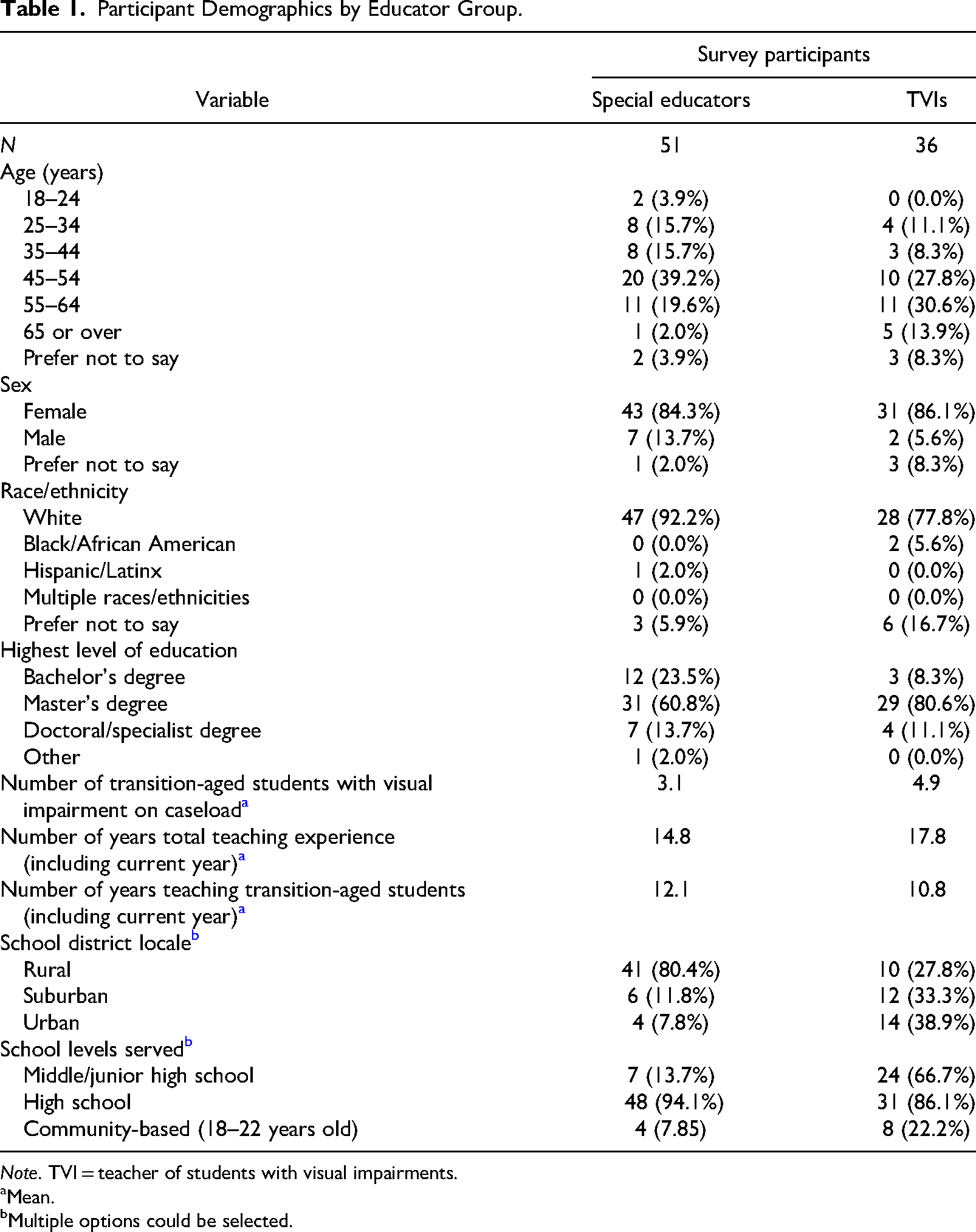
Study participants included 87 educators who, at the time they participated, (a) were teaching at least one transition-aged student receiving special education services under the category of visual impairment (with or without additional disabilities); (b) were a practicing TVI or special educator; and (c) worked in the state of Tennessee. Specifically, the sample included 51 special educators and 36 TVIs. Participants reported working in 41 counties across Tennessee, representing 43.2% of all counties in the state. The number of participants in each county ranged from 1 to 17 (M = 2.2 per county). Demographic data for each group of teachers can be found in Table 1. Of note, the IRB classification for this study did not require participant consent.
Participant Demographics by Educator Group.
Note. TVI = teacher of students with visual impairments.
Mean.
Multiple options could be selected.
Special Educators
On average, special educators reported having 14.8 (SD = 9.1, range 1–39) years of teaching experience and 12.1 (SD = 7.5, range 1–36) years of experience teaching transition-aged youth. At the time of the survey, teachers reported having an average of 3.1 (SD = 5.7, range 1–35) transition-aged students with visual impairments on their caseload. Most special educators (60.8%) held a master's degree as their highest level of education, 23.5% held a bachelor's degree, 13.7% held a doctoral or specialist degree, and 2.0% held another type of degree. Considering school level, 94.1% of special educators worked in high school settings, 13.7% worked in middle school settings, and 7.8% worked in community-based settings with students aged 18–22 years. Finally, most special educators (80.4%) worked in rural communities, 11.8% in suburban areas, and 7.8% in urban locations.
TVIs
On average, TVIs reported having 17.8 (SD = 11.2, range 1–42) years of experience teaching and 10.8 (SD = 8.5, range 1–30) years of experience teaching transition-aged youth. At the time of the survey, teachers reported having an average of 4.9 (SD = 4.0, range 1–15) transition-aged students with visual impairments on their caseload. Most TVIs (80.6%) held a master's degree as their highest level of education, 11.1% held a doctoral or other specialist degree, and 8.3% held a bachelor's degree. Considering school level, 86.1% of TVIs reported working in high school settings, 66.7% in middle school settings, and 22.2% in community-based settings with students aged 18–22 years. Finally, TVIs were most likely (38.9%) to report working in urban communities, 33.3% in suburban communities, and 27.8% in rural communities.
Survey Design and Measures
I developed a 122-item survey to solicit information from educators regarding their (1) demographic information, (2) confidence in implementing transition practices, (3) interest in additional training and resources for these practices, (4) thoughts and attitudes toward transition, and (5) collaborators in transition. Findings related to collaboration are reported in a separate companion paper (Travers & Irland, 2024). Surveys were completed anonymously online using REDCap (Research Electronic Data Capture; Harris et al., 2009). All surveys were completed in the fall and winter of 2021.
Confidence Implementing Transition Practices
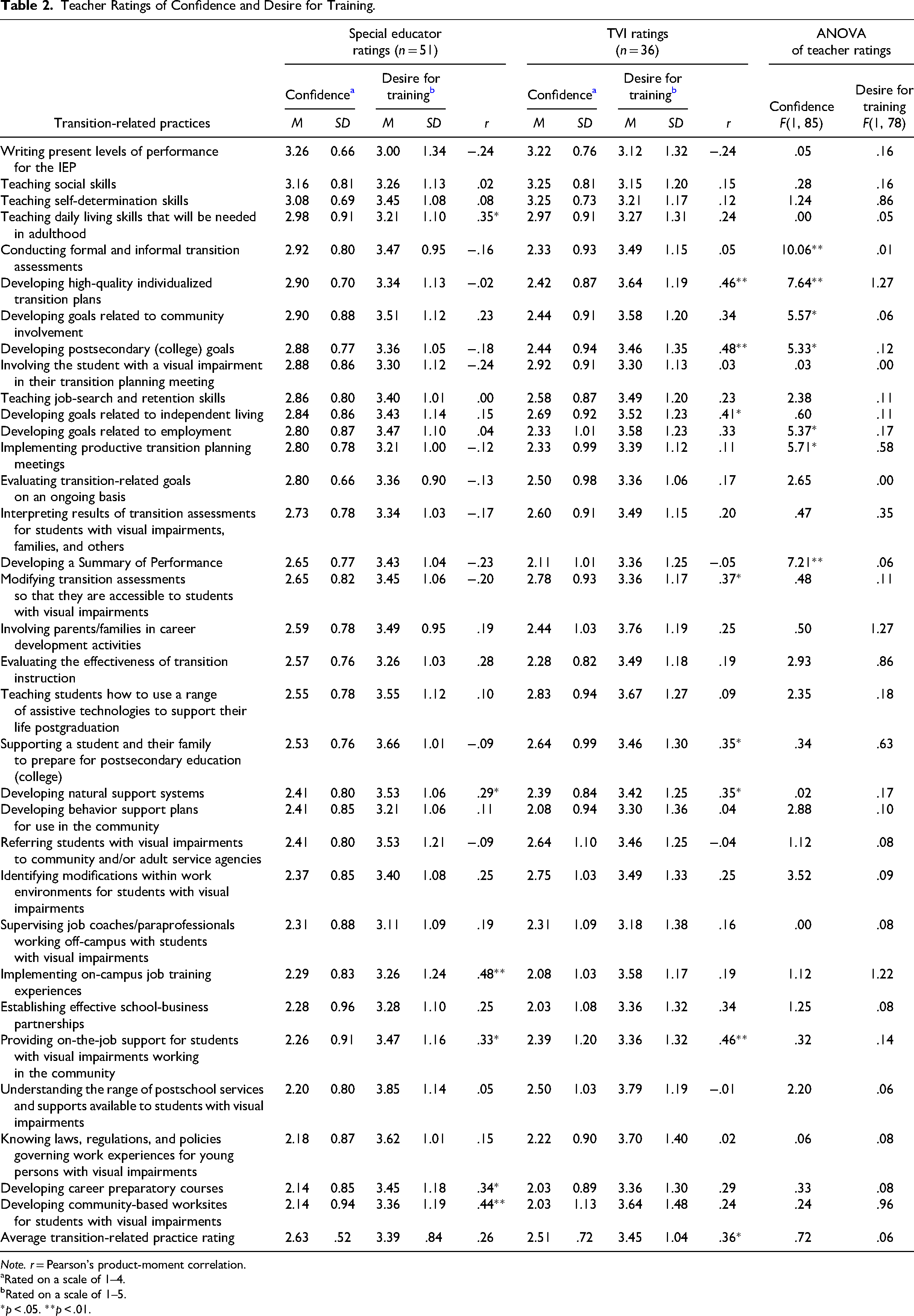
I presented the participants with 33 unique transition practices important for students with visual impairments (see Table 2 for a complete list). Several items were borrowed from similar surveys that were developed by the Tennessee secondary transition technical assistance center to query educators who support transition-aged students about their training needs. Items from these previous surveys were either added to or edited to ensure the transition practices discussed were specifically for the support of students with visual impairments. I asked educators to rate their confidence in providing or addressing each item specifically for the transition-aged student or students with visual impairments on their caseload. Sample survey items included: “Developing high-quality individualized education programs,” “Providing on-the-job support for students with visual impairment working in the community,” and “Understanding the range of postschool services and supports available to students with visual impairment.” Items were rated using a 4-point, Likert-type scale (1 = not at all confident, 2 = a little confident, 3 = somewhat confident, 4 = very confident). All 87 participants responded to each of the 33 items.
Teacher Ratings of Confidence and Desire for Training.
Note. r = Pearson's product-moment correlation.
Rated on a scale of 1–4.
Rated on a scale of 1–5.
*p < .05. **p < .01.
Interest in Additional Training and Resources
I presented participants with the same 33 transition practices as in the confidence implementing practices section. However, for each transition practice, I asked educators to rate their interest in receiving more training or materials related to the practice to better support students with visual impairments. Items were rated using a 5-point, Likert-type scale (1 = not at all interested, 2 = a little interested, 3 = somewhat interested, 4 = interested, 5 = very interested). Only 80 participants responded to each of the 33 “interest in additional training and resources” items.
Quantitative Data Analysis
I used descriptive statistics (i.e., means, standard deviations) to summarize educator ratings on each section of the survey. To summarize overall perspectives on each of the 33 transition practices, I calculated average ratings of overall confidence and overall interest in receiving additional training and resources. To gauge alignment among participants’ perspectives, I used a one-way ANOVA to compare ratings between special educators and TVIs. The test assumptions were checked for each item. When Levene's test for equality of variance was significant, I corrected for it by obtaining Welch's adjusted F ratio. Normality for each variable was checked with a Q-Q plot. No deviations were noted. Finally, I used Pearson's product-moment correlations to quantify the strength of relation (1) among ratings of confidence and interest in training and resources for each teacher group and (2) among educational experience and ratings of overall confidence and overall interest in training and resources. A priori level of significance (α) was set at .05.
Results
How Confident are Teachers in Their Delivery of Transition Instruction?
Overall, special educators indicated modest levels of confidence implementing the 33 transition practices for students with visual impairments (overall M = 2.63, SD = .52, scale range 1–4; individual transition practice means ranged from 2.14 to 3.26; see Table 2). The transition practices for which the highest percentage of special educators said they were somewhat or very confident implementing were writing present levels of performance for the individualized education program (IEP; 88.2%), teaching self-determination skills (84.3%), and teaching social skills (82.4%). Conversely, the transition practices for which the highest percentage of educators said they were not at all or a little confident implementing were developing career preparatory courses (72.6%), understanding the range of postschool services and supports available to students with visual impairments (64.7%), and developing community-based worksites for students with visual impairments (64.7%).
TVIs had similarly modest levels of confidence in implementing each of the 33 transition practices (overall M = 2.51, SD = .72, scale range 1–4; individual transition practice means ranged from 2.03 to 3.25). The transition practices for which TVIs reported being somewhat or very confident were the same as for special educators: writing present levels of performance for the IEP (86.1%), teaching self-determination skills (83.3%), and teaching social skills (77.8%). However, the transition practices for which the highest percentage of TVIs reported being not at all or a little confident somewhat differed from those of special educators and included developing career preparatory courses (31.4%), implementing on-campus job training experiences (33.3%), and developing behavior support plans for use in the community (36.1%).
Interest in Additional Training and Resources
Overall, special educators indicated modest levels of interest in receiving training and resources to support their instruction for transition-aged youth with visual impairments (overall M = 3.39, SD = .84, scale range 1–5; individual item means ranged from 3.00 to 3.85; see Table 2). The transition practices for which the highest percentage of special educators said they were interested or very interested in receiving training and resources were understanding the range of postschool services and supports that are available to students with visual impairments (66.0%); developing goals related to community involvement (63.8%); and knowing laws, regulations, and policies governing work experiences for young persons with visual impairments (63.8%). Conversely, the transition practices for which the highest percentage of special educators said they were not at all or a little interested in receiving additional training and resources included writing present levels of performance for the IEP (34.0%), developing high-quality individualized transition programs (27.7%), involving the student with visual impairment in their transition planning meeting (27.7%), implementing on-campus job training experiences (27.7%), and supervising job coaches or paraeducators working off-campus with students with visual impairments (27.7%).
TVIs similarly indicated modest levels of interest in receiving training and resources for each of the 33 transition practices (overall M = 3.45, SD = 1.04, scale range 1–5; individual item means ranged from 3.12 to 3.79). The transition practices for which TVIs reported being interested or very interested were understanding the range of postschool services and support available to students with visual impairments (72.7%), involving parents or families in career development activities (72.7%), developing high-quality transition plans (66.7%), and developing goals related to employment (66.7%). The practices for which the highest percentage of TVIs reported being not at all or a little interested were writing present levels of performance for the IEP (36.4%), supervising job coaches or paraeducators who worked off-campus with students with visual impairments (33.3%), developing a summary of performance (30.3%), establishing effective school–business partnerships (30.3%), and providing on-the-job support for students with visual impairments who were working in the community (30.3%).
Relations Among Confidence and Interest in Additional Training and Resources
For both groups of teachers (special educators and TVIs), lower confidence in implementation was not associated with significantly higher interest in training and resources for any of the 33 transition practices (see Table 2).
Relations Among Special Educator and TVI Ratings of Transition Topics
For 26 of the 33 transition practices, I did not find a statistically significant difference between the confidence ratings of special educators and TVIs. However, for seven practices, the confidence ratings of special educators were significantly higher than the ratings of TVIs. These included (1) conducting formal and informal transition assessments, F(1, 85) = 10.06; p < .01; (2) developing high-quality individualized transition programs, F(1, 64.6) = 7.64; p < .01; (3) developing a summary of performance, F(1, 62.4) = 7.21; p < .01; (4) implementing productive transition planning meetings, F(1, 63.7) = 5.71; p < .05; (5) developing goals related to community involvement, F(1, 85) = 5.57; p < .05; (6) developing goals related to employment, F(1, 85) = 5.37; p < .05; and (7) developing postsecondary (college) goals, F(1, 65.4) = 5.34; p < .05.
Considering ratings of interest in receiving training and resources, there were no statistically significant differences between special educator and TVI ratings for any of the 33 practices.
Factors Associated with Teacher Ratings
Teachers with more years of experience had higher confidence ratings, r(85) = .29, p < .01, as did teachers who had more years of experience teaching transition-aged youth, r(85) = .46, p < .001. However, neither total years of experience nor years of experience teaching transition-aged youth correlated with lower ratings of interest in training and resources, r(85) = −.07, p = .53 and r(85) = .12, p = .28, respectively.
Discussion
Educators who work with transition-aged youth with visual impairments should feel confident in implementing a range of transition practices and have opportunities to deepen their learning through continued training in this area. The purpose of this study was to better understand the perceptions of practitioners regarding their confidence in implementing transition practices for students with visual impairments and their needs related to continued training and resources. To date, there has been no prior research in this area for this population of students, and the results provide an important foundation on which work can continue in this area.
First, all educators indicated they had modest levels of confidence in implementing a range of transition practices for students with visual impairments. Notably, practices for which all teachers rated the highest confidence tended to revolve around developing the transition-focused IEP and teaching specific skills (e.g., self-determination, social skills). This finding was particularly true for special educators, who indicated that they had significantly higher confidence ratings for seven IEP-related transition practices. Anecdotally, this information makes sense, since special educators in the state of Tennessee are often responsible for writing complete IEPs for every student on their caseload, while TVIs are only responsible for writing complete IEPs for students whose only disability is visual impairment. Furthermore, transition-focused IEPs require additional components (e.g., measurable postsecondary goals, transition services, course of study), which may complicate the writing process for TVIs who have less experience and familiarity with these areas. Alternatively, practitioners seemed increasingly less confident when the transition practice required them to engage in school-community partnerships or to support the student in work experiences. This finding also makes sense, because teachers are not always taught how to or prepared to engage with community members or develop work sites for students (Morningstar et al., 2018). All teachers should be given regular in-service training opportunities to develop their knowledge about the full range of transition practices included in this study. As well, future research should specifically focus on asking teachers about the facilitators and barriers to making successful connections with outside agencies and employers so that this knowledge can be disseminated.
Second, all educators indicated that they had modest levels of interest in training and resources to improve their transition instruction. This finding was consistent with the findings of Brock et al. (2014) suggesting that teachers who support students with disabilities have a desire to engage in ongoing learning to improve their practice. However, contrary to my original hypothesis, interest in training and resources was not related to ratings in confidence.
Although I cannot fully explain these findings related to modest levels of desire for training and resources, I offer two potential explanations here. First, it is possible that items for which teachers had low confidence and low interest in training and resources were items that they did not perceive as being a responsibility of their job role. For example, TVIs rated low confidence in establishing effective school–business partnerships, but this was also one of the items for which there was minimal interest in training and resources. Perhaps the TVIs in this study felt this practice is not a responsibility of their position. More work is needed to understand the perception of teachers related to their roles in preparing transition-aged youth generally, and students with visual impairments specifically. Second, some prior descriptive studies have found that educators who harbor low levels of self-efficacy may also have reduced enthusiasm for engaging in continued training as they do not think this additional training will be effective in helping them become better teachers (Han & Weiss, 2005).
Finally, as I hypothesized, teachers with more years of experience teaching had higher levels of confidence implementing transition practices for youth with visual impairments. However, unexpectedly, teachers with fewer years of experience did not report a greater interest in additional training and resources. Again, I am not able to fully explain this finding; however, I can offer two potential explanations. First, the mean number of total teaching years among participants was high for each teacher group (M = 14.8 among special educators; M = 17.8 among TVIs), indicating a more veteran sample overall. It may be that interest in training is influenced by years of experience. Future research in this area should make a stronger effort to include a larger sample of teachers who are early in their careers to better understand their ongoing training needs and to further explore if the number of years of experience may indeed be correlated with interest in training. Second, it is possible that the perceptions of teachers of their roles and responsibilities are again at play. If teachers do not feel that transition is their responsibility for students with visual impairments, their number of years of experience in the profession would not necessarily affect interest in pursuing continued training sessions on topics that they feel are unimportant to their job.
Implications for Practice
Findings from this work have important implications for educators, administrators, and personnel preparation programs. First, all secondary educators are responsible for supporting transition-aged youth, including students with visual impairments. Special educators, TVIs, and other in-school professionals—for example, O&M specialists, paraeducators, related service providers, career and technical education (CTE) teachers, pre-ETS providers—need to collaborate and coordinate service delivery so that students with visual impairments receive high-quality instruction and experiences to best prepare them for life after high school. Prior research has identified collaboration as key to developing strong partnerships and therefore a successful transition (e.g., Shogren & Wittenburg, 2019). Unfortunately, recent work focused on collaboration between special educators and TVIs around transition for students with visual impairments suggests minimal collaboration is happening (Travers & Irland, 2024). Additional findings from this study suggest that collaboration with partners outside of the school may also be limited. Administrators should arrange planning times when educational teams can meaningfully collaborate around transition topics. Planning times could include information on how transition services can be delivered in multiple settings, from multiple personnel. They could also focus on how to collaborate with outside agencies and community-based providers to better support students with visual impairments.
Second, the results suggested interest in additional training and resources was unrelated to how teachers perceived their own confidence in implementing the range of transition practices. However, I do not know if factors such as location (urban, suburban, or rural), grade levels served, prior training experience, or number of students on caseload affected a teacher's interest in specific training topics. All of these variables should be addressed in future research studies. Moreover, in-service training topics should be purposely (rather than randomly) chosen to enhance the skills of teachers and improve the outcomes of students (Mazzotti et al., 2018). Therefore, each administrator within a particular school or district should survey their own staff members to understand their instructional abilities and confidence in teaching a range of transition practices. In doing so, they may identify areas of strength and areas of weakness where teachers require additional ongoing training, resources, and support.
Third, all personnel preparation programs need to place more emphasis on transition. Although there is a growing emphasis at the state level on in-service support for educators who work with transition-aged youths (e.g., Transition Tennessee), stronger preservice programs could positively affect student outcomes. Transition concepts should be embedded in every methods course, since the purpose of special education as stated in IDEA (2004) is to “prepare [students] for further education, employment, and independent living.” For TVIs, transition could easily be embedded into existing courses by spending more time focused on transition-aged youth when teaching about the ECC. As mentioned previously, each of the nine areas of the ECC are directly relevant to preparing students for life after school. Therefore, college faculty must simply spend time focusing on these areas and how they apply to 14- to 22-year-olds.
Limitations and Future Research
A few limitations to this study must be considered. Given the multipronged approach to recruitment, I cannot determine the total number of educators who received the survey. Moreover, there is no exhaustive list of educators who meet the inclusion criteria across the state. Therefore, it is not possible to discern how representative this sample of educators is compared to the larger population within Tennessee. Future studies could attempt to include larger samples of professionals by extending beyond a single state. Alternatively, I would encourage other states to replicate the procedures used in this study to identify their own ongoing training and resource needs. Finally, I only included special educators and TVIs in the sample. Although these two in-school professionals bear great responsibility for transition instruction for students with visual impairments, there are numerous other in-school educators who can and should play a role in ensuring student success. For example, future studies identifying training needs could include general educators, CTE teachers, or pre-ETS providers. Finally, the survey questions for each section of the survey were presented in unique matrices. Each of the two matrices involved in this study were preceded with a stem that asked teachers to answer each question specific to the students with visual impairments on their caseload. Of course, it is possible that some participants disregarded the prompt and answered questions for all students with disabilities on their caseload. Future studies might include follow-up interviews to confirm the quantitative data.
Footnotes
Declaration of Conflicting Interests
The author(s) declared no potential conflicts of interest with respect to the research, authorship, and/or publication of this article.
Funding
The author(s) disclosed receipt of the following financial support for the research, authorship, and/or publication of this article: This work was supported by the Tennessee Department of Education.
