




Abstract
Specially designed instruction and services are critical for the in- and post-school success of students with deafblindness. However, there remains a lack of consensus about who qualifies as a student with deafblindness across the United States. Deafblindness is defined in the Individuals with Disabilities Education Act (IDEA, 2004) as “concomitant hearing and visual impairments, the combination of which causes such severe communication and other developmental and educational needs that they cannot be accommodated in special education programs solely for children with deafness of children with blindness.” So long as states’ definitions do not exclude students who could be covered by the definition provided in IDEA, each state is allowed the flexibility to adopt a more expansive definition. As a result, eligibility requirements for deafblindness can vary between states (Ward & Zambone, 1992). Furthermore, varied state criteria are correlated with differences in the number of students receiving special education services (Hallahan et al., 2007; Nowicki, 2019).
Two prior reports have documented the variability of deafblindness eligibility criteria. In 2004, Müller and Markowitz evaluated state terminology, definitions, and eligibility criteria for each disability category among 50 states and three nonstate jurisdictions (i.e., the Commonwealth of Northern Mariana Islands, Department of Defense Education Agency, and the U.S. Virgin Islands) as part of Project FORUM for the National Association of State Directors of Special Education. Müller and Markowitz reported 18 states provided specific eligibility criteria for deafblindness; 10 states did not provide any specific eligibility criteria for deafblindness but did specify students met the eligibility criteria for both hearing impairment and visual impairment. Further, they found that one state specified that criteria must be met for hearing impairment, speech and language impairment, and visual impairment.
More recently, the Congressional Research Service (CRS) reported the variability in state eligibility criteria definitions for the 14 IDEA disability categories (Dragoo, 2020). They surveyed 15 states’ regulations and other policy documents to identify operational definitions of eligibility criteria. An operational definition includes procedures, actions, or processes that can be observed and measured. Dragoo selected a non-random sample of 15 states with similar operational definitions of eligibility criteria and compared and contrasted these definitions to evaluate the degree of variability between states. The criteria for deafblindness were mostly consistent by answering questions on this article. For more information, visit:
http://my.aerbvi.org/AER-Store/Publications/BKctl/ViewDetails/SKU/AER
☑Earn CEs Online
Special education service delivery depends on a student's educational needs regardless of the student's disability label. Indeed, if a student receives the label of multiple disabilities, they could still receive services specific to their hearing or vision loss. However, the needs of students with deafblindness (those who have a combination of hearing and vision loss) are unique and different from a student with multiple disabilities. In fact, IDEA's regulatory language specifically states under the category of multiple disabilities that “[m]ultiple disabilities does not include deaf-blindness” (2004). Not having the label of deafblindness may cost children access to specialized personnel or deafblind specific services or both (Müller, 2006). Such personnel includes interveners, deafblind specialists, teachers of students with visual impairments (TVIs), and teachers of the deaf and hard of hearing (TDHHs; Müller, 2006). Further, miscategorizing a student with deafblindness prevents the Individualized Education Program (IEP) team from conceptualizing the immediate and long-term needs of the individual with specific consideration given to the student's level of functional vision and functional hearing. The student's combined hearing and vision must always be a primary consideration; it may not be the focus without the label of deafblind.
This paper was part of a larger project aimed at understanding eligibility requirements for students with sensory impairments (i.e., visual impairment, including blindness; hearing impairment; deafness; and deafblindness) and licensure requirements for professionals who work with students with visual impairments (i.e., TVIs and orientation and mobility (O&M) specialists). The project's complete dataset, along with the project methodology, is freely accessible on openICSPR (Schles et al., 2022). As many states continue to require that eligibility criteria be met for visual impairment to meet eligibility requirements for deafblindness, we direct readers to a companion paper detailing the range of eligibility criteria across states for this separate disability category (Schles & Travers, 2023).
The goal of this current work was to illustrate the range of eligibility criteria used across each of the 50 U.S. states; territories; and Washington, DC, rather than to evaluate the accuracy or quality of eligibility criteria. This paper sought to answer the research question: To what extent are the eligibility criteria for students with deafblindness the same across the United States and its territories?
Method
We systematically reviewed deafblindness eligibility criteria for every U.S. state and territory (i.e., American Samoa, Guam, Northern Mariana Islands, Puerto Rico, U.S. Virgin Islands), including Washington, DC, in state and territory regulations and Department of Education (DOE) resources. The combination of states, territories, and Washington, DC (n = 56) shall henceforth be referred to as “states.” This examination involved a two-step process.
First, we located and stored all web-based information related to deafblind eligibility criteria. All data were located and downloaded between January and March 2021. Data were identified in either state administrative codes (i.e., regulations) or state DOE policy documents. When storing data, we recorded the following: (1) state name, (2) URL to state regulations or policy document; (3) date the data were downloaded and stored; (4) a screenshot or print-to-PDF document of the actual text related to deafblind eligibility criteria; and (4) comments (i.e., researchers’ reflections and questions evoked by website inspection).
Second, we created a data coding sheet to document information related to deafblind eligibility. To do this, the first author purposively selected ten states given their range in required eligibility criteria. Then, the authors jointly created a draft coding sheet that would capture all of the data represented by those states within the pre-determined categories of (1) disability eligibility criteria, (2) evaluative components, and (3) required sensory disability team members to determine eligibility. Using the drafted coding sheet, the first and second authors independently coded an additional six, randomly selected, states. After coding the data for these six states, the authors discussed the coding categories and definitions, editing code definitions for consistency and clarity when there were coding disagreements. The final codebook included the following variable categories: (a) location of state data, (b) use of federal language, (c) additional eligibility criteria (i.e., disability eligibility requirements, evaluative components), and (d) required eligibility team members (i.e., if specific school staff were mentioned by profession to be present for eligibility determinations).
Location of State Data
We coded where state deafblind eligibility information was defined and located (state regulations, DOE policy document, or other). If eligibility criteria were located in both the state regulations and in a policy document we only coded eligibility data from the regulations as this information takes legal precedence.
Use of Federal Eligibility Criteria
We coded the degree to which each state incorporated the use of the federal (IDEA, 2004) eligibility criteria for deafblindness in their definition and if additional criteria not specified in IDEA were included. Coding options were limited to: 0 = state definition uses different language than the federal definition and state definition includes additional eligibility criteria; 1 = state definition is not a verbatim copy of the federal definition but there are no substantive differences (e.g., state definition uses the word students rather than children) and state definition includes additional eligibility criteria; 2 = state definition is a verbatim copy of the federal definition and state definition includes additional eligibility criteria; 3 = state definition uses different language than the federal definition and state definition does not include additional eligibility criteria; 4 = state definition is not a verbatim copy of the federal definition but there are no substantive differences and state definition does not include additional eligibility criteria; 5 = state definition is a verbatim copy of the federal definition and state definition does not include additional eligibility criteria; 6 = state did not provide a definition or deferred to the federal definition provided in IDEA.
Additional Eligibility Criteria
We included 12 codes related to additional eligibility criteria for deafblindness. The following sections describe each of these codes in detail.
Disability Eligibility Requirements
We included three codes to determine if a student with deafblindness must meet the eligibility criteria for other disability categories. We coded (1) if a student must meet the eligibility criteria within the categories of hearing impairment or deaf, or have documentation of a progressive condition indicating they will meet the eligibility requirements for the categories of hearing impairment or deaf in the future; (2) if a student must meet the eligibility criteria within the category of visual impairment, including blindness, or have documentation of a progressive condition indicating they will meet the eligibility requirements for visual impairment, including blindness, in the future; and (3) if the state explicitly noted that the adverse effects of the hearing and visual impairments on the student's educational performance require that the student receive specialized instruction or related services or both.
Evaluative Components
We coded if states required any of nine evaluative components related to deafblind eligibility. The nine evaluative components were identified by the authors as being common to multiple state's eligibility criteria, or generally accepted best practices; they were not part of any official diagnostic criteria. For each evaluative component, we coded not required/not mentioned, requested when available, or “if appropriate,” or required. The nine components we coded for included (1) audiological data or diagnosis indicating a hearing impairment; (2) optometric or ophthalmic data or diagnosis indicating a visual impairment; (3) functional vision assessment (FVA); (4) learning media assessment (LMA); (5) O&M assessment; (6) sign language assessment; (7) assessment of social development and skills; (8) evaluation of receptive and expressive communication skills; and (9) medical report from a licensed physician describing a medical condition that has the potential to, or does, cause a dual sensory impairment.
Eligibility Team Members
We coded if particular school staff, those with professional knowledge about sensory disabilities or communication disorders, were required to conduct eligibility assessments or participate on the eligibility team. Team member eligibility requirements were coded as not required/not mentioned, conditionally required, and required. We coded conditionally required if a state did not necessarily require an assessment and therefore the person who conducted that assessment was conditionally included on the eligibility team. For example, Louisiana eligibility criteria stated procedures for deafblind evaluation should include “an orientation and mobility screening conducted to assess the student's ability to travel around in his or her environment. Based on the results of the screening, an assessment conducted by a qualified orientation and mobility instructor may be warranted” (La. Admin. Code tit. 28, § 703). In this instance, we coded that Louisiana conditionally required an O&M specialist to conduct an assessment or be a part of the eligibility team as involvement was contingent on the results of the initial screening. Seven different professionals were coded: (a) TVI, (b) O&M specialist, (c) speech-language pathologist, (d) deafblind teacher or specialist, (e) intervener, and (f) TDHH. We also coded if an audiologist was required to be a part of the eligibility team beyond conducting audiological assessments.
Coding Reliability
To determine the interrater reliability (IRR) on the coding of each of the 56 states, the second author was trained on the coding manual and independently coded all (100%) of the state data. Interrater reliability averaged 97.0% (range = 81.0%–100%) across states. Following the coding of all data, discrepancies were discussed until a consensus was reached.
Findings
We were able to locate deafblind eligibility data for 54 of 56 states. The majority of state data (n = 42; 75.0%) were located in state regulations; data for 12 states (21.4%) were located in state DOE policy documents. We could not locate deafblind eligibility data for Wisconsin and the U.S. Virgin Islands online. To corroborate our lack of findings for these two states, we consulted with professionals knowledgeable about these two states and confirmed that no explicit policies existed in either the state regulatory or state DOE policy documents. Given that no specific state documents were available, we coded both Wisconsin and the U.S. Virgin Islands as deferring to the federal definition of deafblindness with no additional eligibility criteria. A state-by-state breakdown of all variables is provided in Table 1.
State-by-state breakdown of the use of federal language, the location of state data, and additional eligibility criteria.
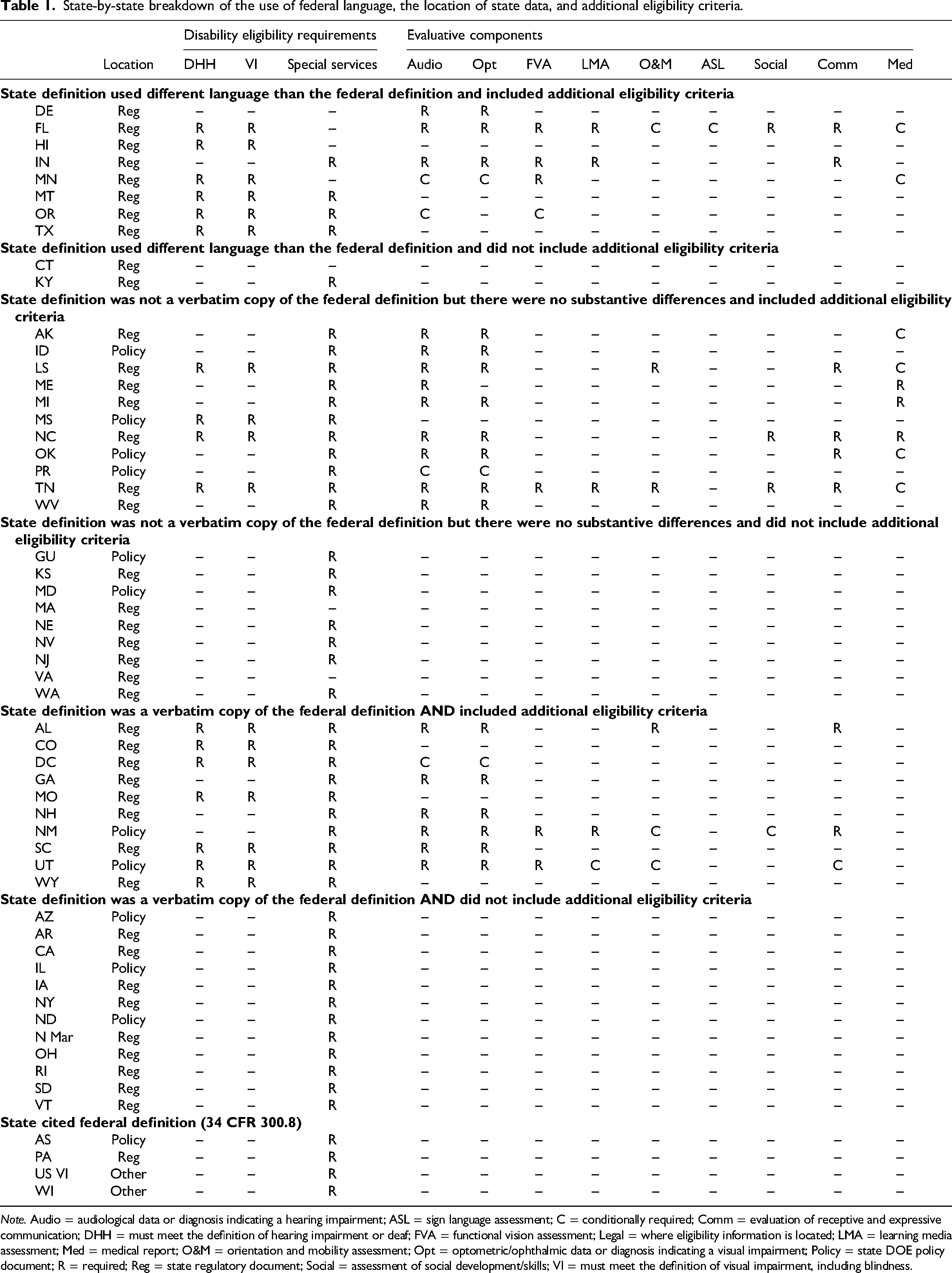
Note. Audio = audiological data or diagnosis indicating a hearing impairment; ASL = sign language assessment; C = conditionally required; Comm = evaluation of receptive and expressive communication; DHH = must meet the definition of hearing impairment or deaf; FVA = functional vision assessment; Legal = where eligibility information is located; LMA = learning media assessment; Med = medical report; O&M = orientation and mobility assessment; Opt = optometric/ophthalmic data or diagnosis indicating a visual impairment; Policy = state DOE policy document; R = required; Reg = state regulatory document; Social = assessment of social development/skills; VI = must meet the definition of visual impairment, including blindness.
Use of Federal Eligibility Criteria
Ten states (17.9%) provided a definition of deafblindness using different language than the federal definition (with or without the inclusion of additional eligibility criteria). Twenty states (35.7%) provided a definition of deafblindness that was not a verbatim copy of the federal definition but there were no substantive differences (with or without the inclusion of additional eligibility criteria). Twenty-two states (39.3%) provided a definition of deafblindness that was a verbatim copy of the federal definition (with or without the inclusion of additional eligibility criteria). Finally, four states (7.1%) did not include a definition of deafblindness but instead cited the federal definition.
Additional Eligibility Criteria
Twenty-nine states (51.8%) required additional eligibility criteria to meet the eligibility requirements of deafblindness. Additional criteria included requirements to meet eligibility criteria for other disability categories (i.e., hearing impairment or deaf; visual impairments, including blindness) and evaluative component criteria.
Disability Requirements
Seventeen states (30.4%) required a student to meet the eligibility criteria under the categories of hearing impairment or deaf, or have documentation of a progressive condition that would meet the hearing impairment or deaf criteria in the future to meet the eligibility criteria for deafblindness. The same 17 states required that a student must meet the eligibility criteria under the category of visual impairment, including blindness, or have documentation of a progressive visual condition to meet the eligibility criteria for deafblindness. Forty-nine states (87.5%) specifically stated that the adverse effects of hearing and visual impairments on the student's educational performance require that the student receive specialized instruction or related services or both.
Evaluative Components
To meet eligibility requirements for deafblindness, 18 states (32.1%) required a student to have audiological data or a diagnosis indicating a hearing impairment, and four states (7.1%) conditionally required this. Seventeen (30.4%) states required a student to have optometric or ophthalmic data or a diagnosis indicating a visual impairment, three states (5.4%) conditionally required this. Six states (10.7%) required a student to receive an FVA, and one state (1.8%) conditionally required this. Four states (7.1%) required a student to receive an LMA, and one state (1.8%) conditionally required this. Three states (5.4%) required a student to receive an O&M assessment, and three states (5.4%) conditionally required this. No states required a student to receive a sign language assessment, though one state (1.8%) conditionally required this. Three states (5.4%) required an assessment of social development and skills, and one state (1.8%) conditionally required this. Eight states (14.3%) required an evaluation of receptive and expressive communication skills, and one state (1.8%) conditionally required this. Finally, three states (5.4%) required a medical report from a licensed physician describing a medical condition that has the potential to, or does, cause a dual sensory impairment, six states (10.7%) conditionally required this.
Required Eligibility Team Members
Few states listed eligibility team members required to determine deafblind eligibility. Four states (7.1%) required a TVI, and one state (1.8%) conditionally required one. No state required an O&M; two states (3.6%) conditionally required an O&M. Three states (5.4%) required a speech-language pathologist, and one state (1.8%) conditionally required one. One state (1.8%) required a TDHH, and one state (1.8%) conditionally required one. No state required an intervener or deafblind specialist. Similarly, no state specifically required an audiologist to be a part of the eligibility team beyond the reference to audiological assessments.
Discussion
Individuals with deafblindness have unique communication, developmental, and educational needs that require special knowledge and expertise beyond what is required by other children with disabilities (Holte et al., 2006). Identification of individuals with deafblindness remains a challenge. In part, this may be due to the lack of consensus on how to define deafblindness and determine who is eligible to receive services under this disability category. The purpose of this work was to document the interstate variability in eligibility criteria for deafblindness.
Findings suggest the majority of states based their definition of deafblindness on the federal language provided in IDEA (2004) (with or without the inclusion of additional eligibility criteria); only 10 states used language to define deafblindness that was substantially different from the federal definition (with or without additional eligibility criteria). Variability in definitions across states can be problematic as it may lead to the misidentification of students and therefore inequal access to deafblind-specific services. However, alignment with or adoption of the federal definition, with no additional criteria provided, does not necessarily guarantee better services or support for students. Indeed, the federal definition of deafblindness is both broad and vague. Without a measurable definition and eligibility criteria it would be hard—if not impossible—to objectively measure the point at which a student's degree of combined hearing and vision loss requires a specialized education program. As proposed by the CRS report (Dragoo, 2020), perhaps the best solution to reduce interstate differences would be to adopt a universal operational definition with defined eligibility criteria that might “ensure a certain level of consistency in how children are identified with a disability and provided special education and related services” (p. 20).
Thirty-one states chose to operationalize their definition of deafblindness or included additional eligibility criteria or both. Additional eligibility criteria varied widely with regard to disability eligibility requirements and evaluative components. Of particular interest, 17 states required students to meet the eligibility requirements for both hearing impairment and visual impairment as prerequisites before deafblindness eligibility could be considered. The requirement to meet eligibility criteria for different disability types is problematic as differences in eligibility criteria for the other categories also vary widely by state (Schles et al., 2022). This finding was consistent with findings from Dragoo (2020): variability in deafblindness criteria depended upon the criteria for the hearing and visual impairment disability categories.
In addition to the 17 states that required students to meet eligibility requirements for hearing impairment and visual impairment, Delaware (14 Del Admin. C. § 925.6.8) required that a qualified physician document that a child is deaf (“a child has a hearing loss so severe that he or she cannot effectively process linguistic information through hearing, with or without the use of a hearing aid”) and legally blind (“a child has a best, corrected visual acuity of 20/200 or less in the better eye, or a peripheral field so contracted that the widest lateral field of vision subtends less than 20 degrees”) to be considered deafblind. Requiring students to meet specific acuity and hearing thresholds to meet the eligibility requirements for deafblindness is particularly problematic. Measuring the acuity or level of one without consideration of the other may lead to invalid results. For example, when there is a severe visual impairment the functional hearing may be different than what is shown on the clinical audiogram or the audiology report. Clarification is needed from OSEP on how states can reasonably operationalize eligibility criteria while still meeting the federal eligibility requirements for separate disability categories.
The amount and level of detail provided for each eligibility criterion also varied considerably. Some states included a sentence or two and others included multiple paragraphs of detail. The written language used across states was also often vague and open to interpretation. For example, in the state of Oklahoma, to qualify as a student meeting the eligibility requirements for deafblindness “children usually meet one of the following conditions under Degree of Vision Loss and one of the conditions listed under Hearing Loss” (OSDE, 2017, p. 81). It is unclear how the phrase “usually meet” should be interpreted in this instance and it would likely require individual educators and school districts to decide who should and should not qualify for eligibility. Again, we reiterate the need for universal criteria to ensure consistency in how children are identified for eligibility. Leaving eligibility determinations up to an IEP team that likely does not require participation from any professionals with knowledge of sensory disabilities (see the “Required eligibility team members” section), could easily lead to misidentification of students with deafblindness.
IDEA states that “a group of qualified professionals and the parent of the child” must determine whether a child is a child with a disability (2004). However, IDEA does not specifically list who constitutes a qualified professional specific to determination for each disability type. Therefore, a universal list of required personnel for deafblind eligibility should be considered for inclusion alongside the development of universal eligibility criteria. We recognize that just because a professional (e.g., TDHH) is not currently listed as a required member of the evaluation team, this does not mean that a TDHH is not included in eligibility determinations. Without a TDHH specifically listed, however, a state does not have to include a TDHH to be found in compliance. Given the systemic shortage of sensory disability educators and a limited number of personnel preparation programs, not requiring a teacher of the deafblind, TDHH, TVI, or O&M specialist may very well be a strategic decision by some states to maintain compliance in eligibility meetings. Or perhaps the shortage simply resulted in a lack of sensory disability professionals being included or consulted during the development of the eligibility criteria for deafblindness in each state. No matter the reason, for all students, eligibility determinations should not be limited by the lack of qualified personnel. By requiring both hearing and vision professionals to be a part of the eligibility team, we may see a rise in the accurate identification of students with deafblindness.
Limitations
Two limitations to this study should be considered. First, the data reflected in this paper represent a snapshot of eligibility criteria at the time data were collected (January–March 2021). State regulatory and policy documents are expected to change over time. Readers should check their state's regulations and DOE documents for the most up-to-date information. Second, this was a strictly quantitative review and therefore we only coded information that was included in the regulations and DOE documents. We only coded information as it was written to reflect the written legal requirements of each state. This may have inadvertently underestimated the number of sensory-knowledgeable professionals who are required to be a part of the eligibility team. For example, Alabama included the following evaluative component: “Performance measures such as developmental scores, diagnostic test(s), observations, communication evaluations, orientation, and mobility assessments that document how the impairment adversely affects the educational performance of the child” (Ala. Admin. Code r. 290- 8–9-.03). We know that O&M specialists are the only professionals who can conduct an O&M assessment. However, since we only coded what was written, we only coded that an O&M assessment was required. We did not code that an O&M specialist was required to be part of the eligibility team.
Implications for Practice
Individuals with deafblindness represent a low-incidence and heterogeneous population. Given the difficulty in assessing hearing and vision in young children (Chapman et al., 2011; Williams et al., 2013), it is likely that many students with deafblindness will continue to be miscategorized as students with multiple disabilities. Compounding these challenges is the fact that no universal operational definition of deafblindness exists. Exploring available data to identify variability in state eligibility criteria is important for practitioners, families, policy makers, state deafblind technical assistance centers, and personnel preparation programs preparing all educators and administrators charged with serving on eligibility teams.
For practitioners, understanding the eligibility requirements in the state they work is critical to helping appropriately identify qualifying students. Practitioners should advocate for the identification of deafblind students by keeping any sensory-related information at the forefront of all eligibility discussions. For families and the professionals that support them, having access to our full data set (Schles et al., 2022) will enable them to understand the family's rights as they move between states. It is important that families understand how their child's eligibility status may change and how they can advocate for their child's sensory-specific needs. For policy makers, this study can serve as a call to action for a universal operational definition. There are clear inequities between states in the number of, specificity, and severity of eligibility requirements. Revisions to current policies are needed to make it easier for students with deafblindness to get access to the specific supports and services they need to be successful. Professionals knowledgeable of deafblindness must be included in these revision discussions. For technical assistance centers, these findings may help to better interpret inter-state variations in child count and lead to the development of materials to be shared with educators about the identification and referral of deafblind students. Finally, for personnel preparation programs, the findings can be used to inform future educators of the eligibility requirements across all states to advocate for the identification of students with deafblindness. In particular, this information is important for teachers of the deafblind, TVI, O&M specialist, and TDHH preparation programs as these are the primary sensory-related professionals with the professional knowledge to make eligibility recommendations for students with deafblindness.
Footnotes
Declaration of Conflicting Interests
The author(s) declared no potential conflicts of interest with respect to the research, authorship, and/or publication of this article.
Funding
The author(s) received no financial support for the research, authorship, and/or publication of this article.
