




Abstract
Keywords
Diabetes UK (2019) estimates that approximately 4.7 million people are living with diabetes in the United Kingdom. There are currently over 110,000 people living with diabetes in Northern Ireland, a country with a population of 1.89 million. The prevalence of people with diabetes in Northern Ireland has increased from 4.5% in 2009 to 5.7% in 2019, which is still low compared to the overall estimate of 7% in the United Kingdom (Lin et al., 2017).
Diabetes can affect multiple organs and is well recognized as a major cause of blindness worldwide. Diabetes UK (2019) estimates that within the United Kingdom, more than 1,700 people have their sight seriously affected by diabetes. The incidence of diabetic retinopathy increases with the duration of the disease; nearly all people with type 1 diabetes will experience some level of diabetic retinopathy in their lifetime and 60% of those with type 2 diabetes will develop some level of diabetic retinopathy (Fong et al., 2004).
Findings from previous studies have suggested that diabetic retinopathy was the most common cause of blindness in working age groups (Ghafour et al., 1983; Tendoesschate, 1982), however recent studies have shown that diabetic retinopathy is no longer the leading cause of blindness in working age groups in England and Wales (Bennett et al., 2009; Thomas et al., 2017). Regional data by Kumar et al. (2006) estimated diabetic retinopathy-related visual impairment at around 6.1% in Leeds; similar data has been produced in other areas such as Cambridgeshire and North, East, and South Devon (Bennett et al., 2009; Lin et al., 2017). To date, no analysis has been conducted on the certification of visual impairment due to diabetic eye disease in Northern Ireland.
In Northern Ireland, the sight impairment register is composed of people who are certified as sight impaired or severely sight impairment as determined by their consultant ophthalmologist (Jackson et al., 2020). Once certified, people can access benefits and services to help them or their caregiver or both with daily activities. Certification is voluntary for the individual with impaired vision, therefore, it is likely that the total number of people with sight impairment due to diabetes is not captured for reasons such as stigma, lack of benefits, and employment issues (Bourkiza et al., 2014).
The purpose of this study is to determine the number of people being certified as either severely sight impaired or sight impaired due to diabetic eye disease. This study aims to look at the trends in the certification of diabetic eye disease in Northern Ireland, not its prevalence.
In Northern Ireland, regional sight impairment data is collected annually by a Certification of Visual Impairment team. This dataset is then analyzed by a multi-professional team to produce annual reports that are presented at regional clinical audit meetings and submitted to the Public Health Agency and Department of Health. The criteria for certification are shown in Table 1 (Dementia and Disabilities Unit, 2017).
Certification Criteria for Severe Sight Impairment (SSI) and Sight Impairment (SI) in Northern Ireland.
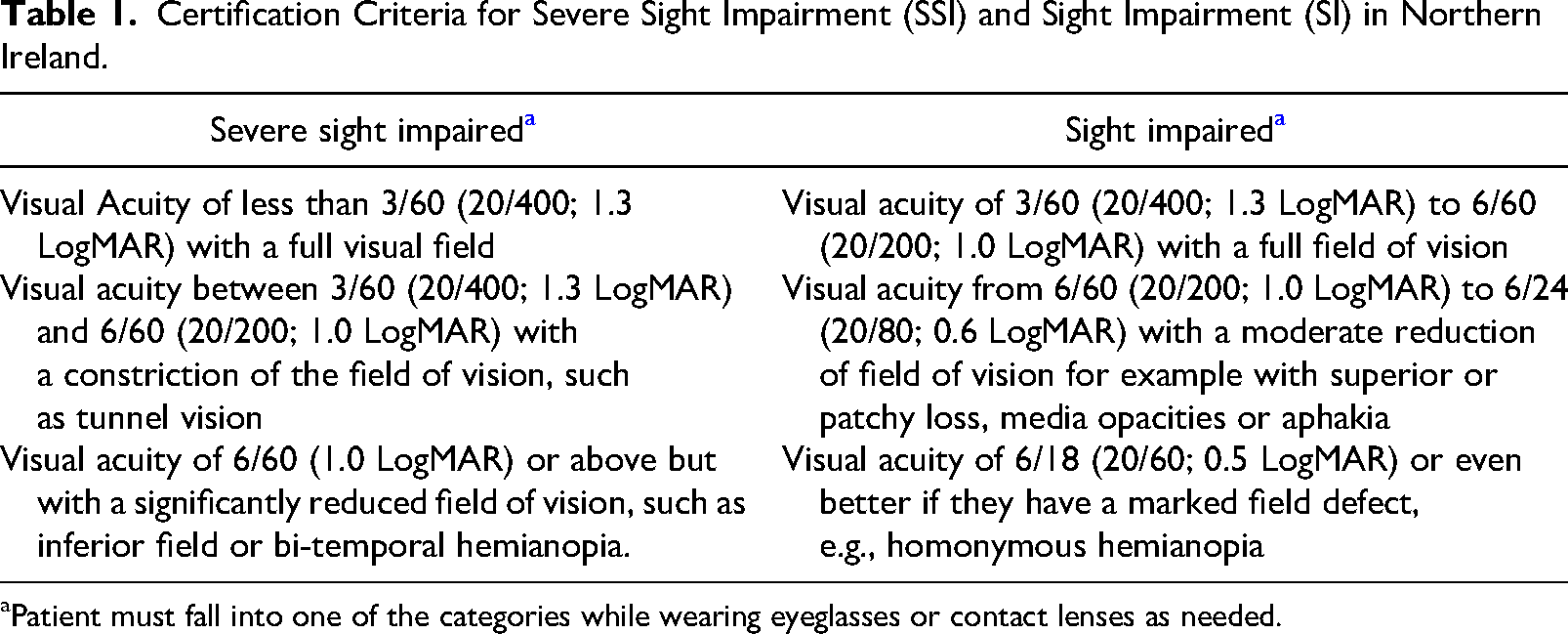
Patient must fall into one of the categories while wearing eyeglasses or contact lenses as needed.
Materials and Methods
Data were entered into an Excel spreadsheet by a member of the certification team, another member of the team checked 10% of the data to ensure accuracy. Data from the years 2014 to 2019 were analyzed to determine diabetic eye disease's contribution to overall sight impairment certification using Stata Version 17. The period of 2014–2019 was used due to improvements in the consistency of data collection and reporting by the certification team. Improved data collection and analysis were supported by the Developing Eyecare Partnership strategy, published in October 2012, allowing for more strategic and stringent data collection and compilation by a local certification team (Jackson et al., 2020). The Northern Ireland Statistics and Research Agency's population data report in June of each year was used to determine the overall population. The number of people with a diagnosis of any type of diabetes in 2019 (108,000) was obtained from the Diabetic Eye Screening Program's Optomize [sic] system. From internal audits, it is estimated the database is over 99% correct (Cushley et al., 2019).
All visual acuity measurements were reported in LogMAR format and a majority were recorded using LogMAR charts. Approximately 17% of visual acuity measures were recorded using counting fingers, hand movements, perception of light, and no perception of light. These measurements were allocated a LogMAR equivalent measure of 1.7, 2.0, 2.5, and 3.0, respectively, to ensure they were analyzed alongside all other visual acuity data and not excluded.
Results
Table 2 reports the total annual certifications of visual impairment from 2014 to 2019. Certifications due to diabetic eye disease (diabetic macular edema and diabetic retinopathy) are included in the table.
Table of Certification Numbers and Demographic of People With Diabetes Certified Due to DED. a
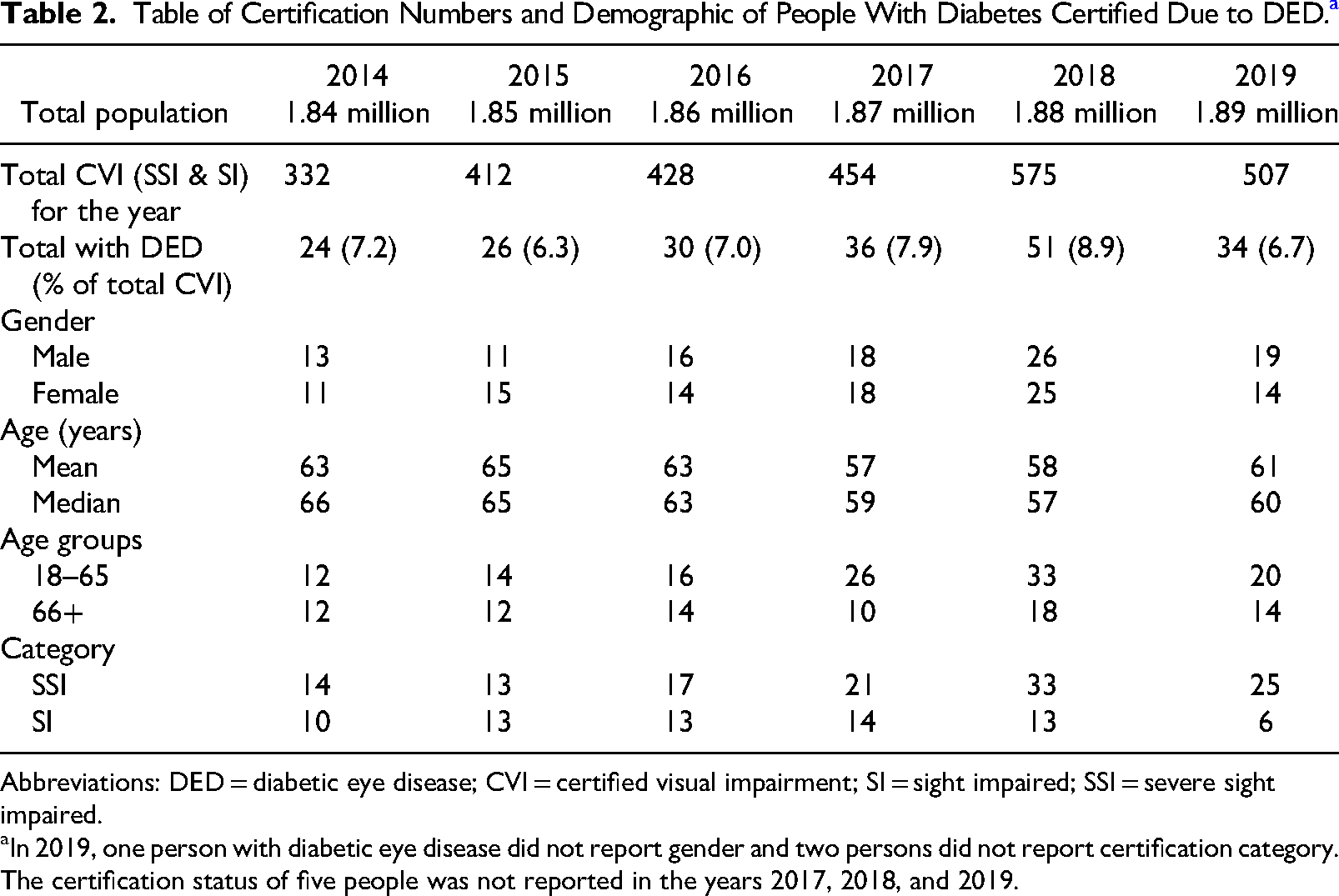
Abbreviations: DED = diabetic eye disease; CVI = certified visual impairment; SI = sight impaired; SSI = severe sight impaired.
In 2019, one person with diabetic eye disease did not report gender and two persons did not report certification category. The certification status of five people was not reported in the years 2017, 2018, and 2019.
From 2014 to 2019, overall certification numbers increased, as did the number of certifications due to diabetic eye disease. The total certifications rose from 174 per million (CI: 155, 193) in 2014 to a peak of 305 per million (CI: 280, 330) in 2018 (incidence rate ratio, IRR, 1.79, p < .001), then steadied at 267 per million (CI: 243, 290) in 2019 (IRR 1.53, p < .001). The number of diabetic eye disease certifications also rose from 12.6 per million (CI: 7.6, 17.7) in 2014 to a peak of 27 per million (CI: 19.7, 34.5) in 2018 (IRR 2.15, p = .002), regressing to 17.4 per million (CI: 11.5, 23.4) in 2019. There was no significant difference in the proportion of diabetic eye disease to total certifications between 2014 and 2019 (overall p = .680).
Overall, more women were certified than men, with 269 certifications per million (255, 282) for females and 210 per million (198, 222) for males (95% CI; IRR: 0.78 for men vs. women, p < .001). Interestingly, diabetic eye disease certifications had a higher proportion of males (IRR 1.41, p = .19).
Severely sight-impaired certifications due to diabetic eye disease rose by 92% between 2014 and 2019, but this figure was not found to be statistically significant (p = .087). Sight impairment certifications remained relatively stable during this time, but sight impairment cases were few and did not reach statistical significance (p = .163).
The mean age of total certifications was older (72.3 years SD) in 2014 by a minimum of 4.5 years and a maximum of 11 years from 2015 to 2019 (p < .05 for all comparisons). When diabetic eye disease certifications were analyzed according to age groups (working age 18–65 years) it was found that diabetic eye disease was not the leading cause of blindness. Despite this finding, the percentage of diabetic eye disease certifications in the working age group increased from 19% in 2014 to a peak of 37.8% in 2018; 36.4% were due to diabetic eye disease in 2019. Other causes of visual impairment in this age group included inherited retinal diseases (range 6.9–17.9%) and glaucoma (range 3.9–11.1%). In addition, around 3% in the working age group were certified due to age-related macular degeneration (AMD) except for in 2018, when it increased to 50% of the working age group. Around 500 individuals are certified as sight impaired or severely sight impaired annually in Northern Ireland with AMD accounting for around 50% of certifications, followed by glaucoma and diabetic eye disease not necessarily in this order every year.
The proportion of severely sight-impaired certifications was 64.5% in diabetic eye disease patients, 54.1% in AMD, and slightly over 80% in glaucoma patients, with no overall statistically significant difference (p = .082).
Discussion
Our results show that overall annual certifications of visual impairment have increased in Northern Ireland from 2014 to 2019, with a higher rate in 2018. Previous annual certification reports showed that Northern Ireland has lower certification rates that the rest of the United Kingdom (Canavan et al., 1997). The Northern Ireland Developing Eyecare Partnership developed a plan in 2014 to improve certification rates in Northern Ireland (Jackson et al., 2020). In 2017, all certification processes and pathways were reviewed and improved (Jackson et al., 2020). Educational activities were undertaken in parallel to promote the new certification pathway to increase the understanding of, and compliance with, the process at both secondary care and community level. The increase in awareness and the introduction of new, province-wide certification forms are likely to have impacted the increase seen in 2018, which brought Northern Irish certification rates on par with the rest of the United Kingdom. Despite this effect, Northern Ireland still certifies proportionally more people as severely sight impaired than England, and further research should be conducted in the future.
Diabetic eye disease certification has also increased since 2014 and this increase has been proportionally greater than the increase in overall certifications. Diabetic eye disease contributes to approximately 7% of all certifications in this dataset, which is now in agreement with data from Bunce and Wormald (2006) showing that diabetic eye disease contributes to 7.4% of visual impairment in England and Wales. This increase could be attributed to the appointment of new clinical lead driving certification processes, conducting audits on multiple areas of diabetic eye disease, and tightening up diabetic eye screening protocols. It may have resulted in improved identification of people with diabetes who had visual impairment.
Interestingly, more males were registered sight impaired due to diabetic eye disease than females, which is in contrast with overall certifications. This finding might be due to the higher prevalence of type 2 diabetes in men than women (Nordstrom et al., 2016).
Certification is voluntary for the patient, therefore, some people may not see the benefit for various reasons such as cultural beliefs and the stigma attached to certification (Bourkiza et al., 2014). In Northern Ireland, benefits include a television license reduction fee, a blue badge (which allows people with disabilities or health conditions, or the people who drive them, to park their private transport closer to their destination), and a “blind person's tax allowance.” Service users may be reluctant to be registered due to the lack of self-awareness of the extent of their own visual impairment. Other issues, such as the stigma attached to such labels as “blind” and “certified,” might deter service users from engaging in the process of certifying their visual impairment (Bourkiza et al., 2014). However, without understanding the granularity at the patient level, we can only speculate on their behavior; thus, further research on this topic is warranted in Northern Ireland.
Limitations of the Research
Although this dataset includes all certifications of visual impairment from 2014 to 2019, it remains a small dataset, with around 500 people certified per year. The Northern Irish population is smaller than the rest of the United Kingdom, thus, further analysis across the United Kingdom is warranted. The small size of the dataset could affect the power of any statistical analysis and limit the scope for determining true trends. In addition, a small amount of demographic data was missing from each year, which could also affect analysis. The short time period of the data also limits the number of long-term trends we can infer.
Conclusions and Future Research
Overall number of certifications of visual impairment have increased in Northern Ireland from 2014 to 2019, as have the number of certifications due to diabetic eye disease. People with diabetes who are certified are more likely to be younger and male than others with this condition. There has been an increase in severely sight-impaired certifications due to diabetic eye disease from 2014 to 2019. Further research into the causes of the increase in certifications overall and of diabetic eye disease, in particular, is warranted in order to fully understand the contribution of multi-factorial improvement in pathways for both certifications of visual impairment and diabetic eye care. Although these data present observations about certification due to diabetes in Northern Ireland, further analysis of patient-level data, such as hemoglobin A1c (HbA1c) level, attendance at the screening, treatment paradigms for eye complications, and other medical data, could help to further understand how to prevent further increase in the number of people losing vision due to diabetes.
Footnotes
Acknowledgments
Ms. Jacqueline Witherow, Royal National Institute for the Blind, Belfast and Developing Eyecare Partnership, Northern Ireland subgroup committee.
Declaration of Conflicting Interests
The author(s) declared no potential conflicts of interest with respect to the research, authorship, and/or publication of this article.
Funding
The author(s) received no financial support for the research, authorship, and/or publication of this article.
