




Abstract
The Individuals with Disabilities Education Act (IDEA; IDEA, 2004) established federal definitions for 14 disability areas in which students may be found eligible for special education services in the United States. Using the IDEA definitions as a guide, states can implement guidance or specifications for the special education eligibility criteria for each disability area (e.g., create an operational definition that may include specific tests, criteria, or decision-making; Dragoo, 2020). As a result, there is a history of variability in special education eligibility criteria across the United States (Lester & Kelman, 1997; Phillips & Odegard, 2017), including for the IDEA category of visual impairment including blindness. In IDEA (2004), the definition of visual impairment, including blindness is, “visual impairment including blindness means an impairment in vision that, even with correction, adversely affects a child's educational performance. The term includes both partial sight and blindness.” These interstate variations in eligibility criteria connect to significant differences in the prevalence of students with visual impairments across states (Hallahan et al., 2007; Schles & McCarthy, 2022), which means that students with visual impairments may be more likely to receive vision-related special education services in one state compared to another, rather than purely based on the educational implications of their disability. To understand the inequities in identification of students with visual impairments in the United States, a detailed analysis of interstate eligibility criteria is needed.
Prior Eligibility Criteria Analysis
In the nearly 50 years of federal special education regulations in the United States, only four reviews have been published regarding the interstate variations in the IDEA category of visual impairment including blindness. Zambone and Allman (1988) investigated whether states mandated early intervention services for children with visual impairments aged birth to 5 years, though only 29 states or territories participated in the survey. Project Forum included a review of eligibility criteria requirements across all IDEA disability categories in every state (Muller & Markowitz, 2004). Findings were reported descriptively without attributions to specific states (e.g., nine states required a functional vision assessment [FVA] and three states required a teacher of students with visual impairments [TVI] to serve on an eligibility team).
In 2018, a review of visual impairment eligibility criteria was conducted by Schles and McCarthy (2022). Like Project Forum, findings were aggregated across states (e.g., FVAs were required by 11 states, sometimes required by eight states, and not required by 29 states), limiting the usefulness for readers seeking details on specific states. Lastly, the Congressional Research Service conducted a review of 15 states to gather information on the overall interstate variability across all 14 IDEA disability categories (Dragoo, 2020). Few conclusions can be drawn from that report, since it lacked depth and detail and did not provide state-specific information. The limitations of these two recent reviews warrant a clearer review and publication of interstate variations in eligibility criteria.
“Dear Colleague” Letters and Visual Impairment Eligibility Criteria
The lack of a clear, universal definition of who is a student with a visual impairment has caused issues for educators and families. The most recent influence on the interpretation of IDEA's definition of visual impairment is the “Dear Colleague” letters released by OSEP (Musgrove, 2014; Ryder, 2017). OSEP clarified that (a) no visual conditions that adversely affect a student's educational performance may be excluded from a state's eligibility criteria and (b) eligibility teams cannot create a two-step eligibility process in which students must first meet specific eye-medical diagnoses or criteria before educational implications are considered.
States and local education agencies have the right to obtain a medical diagnosis before determining eligibility and to operationalize eligibility criteria and require an eye report as part of the visual impairment eligibility process, provided it is at the expense of the local education agency and not the family (Ryder, 2017). In response to the letters, some states revised their operationalized eligibility criteria in favor of the broader federal definition. Given that the prevalence of students with visual impairments varies based on eligibility criteria, particularly assessment components such as functional vision and learning media assessments (LMAs; Schles & McCarthy, 2022), the influence of changing criteria should be monitored over time.
Need for Current Review of Eligibility Criteria
At the macro level, a robust review of interstate eligibility criteria is needed for policymakers, university personnel preparation faculty, and researchers to understand the potential inequities across states. At the micro level, a review is needed to support educators, administrators, families, and students with visual impairments to understand the implications of and navigate interstate moves, since moving from one state to another could result in an enhancement or removal of a student's eligibility for and variety of services provided in connection to their visual impairment.
This study was conducted as part of a larger investigation into interstate variations in the sensory disability eligibility categories (visual impairment, including blindness, deafblindness, deafness, and hearing impairment), and interstate teacher certification variations for teachers of students with visual impairments and orientation and mobility (O&M) specialists. The project's complete dataset is freely accessible on openICSPR (Schles et al., 2022).
Given the gaps in the literature and direct implications for students and practitioners, the following research question guided our inquiry: To what extent are the eligibility criteria for students with visual impairments the same across the United States? The purpose of our inquiry was not to evaluate “good” and “bad” examples of states’ eligibility criteria, but rather to understand the current landscape of criteria in the United States.
Method
We included data for the 50 U.S. states, Washington, DC, and U.S. territories (American Samoa, Guam, Northern Mariana Islands, Puerto Rico, and the U.S. Virgin Islands), referred to as “the 56 states” in this report. The researchers searched for each state and territory's special education eligibility criteria for the IDEA category of “visual impairment, including blindness” between January and March 2021. Since no eligibility criteria could be located for the U.S. Virgin Islands, we referred to the federal definition of “visual impairment, including blindness” provided in IDEA (2004) because the federal guidance is the default in the absence of a specific state policy.
Visual Impairment Eligibility Criteria Components
We developed 20 variables to capture the nuanced variations in state eligibility criteria. Eighteen variables were quantitative (four binary and 14 categorical) and two were qualitative, coded as open-ended responses. The following sections describe the categories and variables we created to summarize the eligibility criteria.
Use of Federal Eligibility Criteria Language and Location of State Data
We created two variables under the category of location and use of federal language. The first categorical variable related to the use of federal criteria language (IDEA, 2004) in the state eligibility criteria. Coding options were limited to 0 = state used different language than the federal definition and included additional criteria; 1 = state used language that was not verbatim with no substantive differences (e.g., omitting the “including blindness” from the first sentence of the definition) from the federal language and included additional criteria; 2 = state used verbatim language to the federal definition and included additional criteria; 3 = state used different language than the federal definition and did not include additional criteria; 4 = state used language that was not verbatim with no substantive differences from the federal language and did not include additional criteria; 5 = state used verbatim language to the federal definition and did not include additional criteria; 6 = state did not provide a definition or deferred to the federal definition provided in IDEA. The second variable captured the location of the eligibility criteria. The location was either in state regulation documents or policy or guidance documents from the state department of education (DOE).
Qualifying Conditions
The qualifying conditions category consisted of seven variables constituting various medical thresholds (e.g., visual acuity) or specific conditions which would qualify a student to be identified as having a visual impairment. We used binary coding (i.e., yes/no) to code four variables in this category: if eligibility was based on the vision in the better eye; if legal blindness (e.g., 20/200 acuity) was specified; if visual field loss or restrictions could qualify a student; and if any specific conditions were listed. We coded two qualifying condition variables as categorical. The first was a visual acuity threshold (e.g., 20/70 acuity or worse). The second was the degree of visual field loss a student needed to demonstrate (e.g., 60° or 20° visual field). The final variable under the qualifying conditions category was open-ended, listing any potentially qualifying conditions. Examples of qualifying conditions included binocular visual conditions, progressive visual conditions, neurological visual impairments, and others.
Assessment Components
The assessment components category contained eight variables (seven categorical and one binary) summarizing assessments states may use to determine if a student's vision qualified them for special education services. Three of the seven related to medical and acuity assessment components: (a) if the state required an eye report, (b) if an acuity threshold was included but an eye report by a medical professional was not required, and (c) if the state required a low vision evaluation. We coded each of these variables as no, conditionally (i.e., only in certain circumstances), or yes. The next three variables were if (a) FVAs, (b) LMAs, and (c) O&M assessments were required, sometimes required, or not required (or mentioned). The seventh variable was whether or not an expanded core curriculum (ECC) assessment was required by name, required for one or more areas of the ECC (but not all nine), or not mentioned. The final variable captured if the state required students to demonstrate an adverse educational impact of the visual impairment in order to be found eligible.
Eligibility Team Members
The eligibility team members’ category consisted of two variables; whether a TVI or an O&M specialist was specifically mentioned or required to conduct assessments or both. These variables were coded categorically: no, conditionally (only in certain circumstances), or yes.
Coding Procedures and Reliability
The codebook was developed primarily by the first author with input from the second author. Both authors had prior experience developing codebooks and coding special education eligibility criteria. The first author trained the second author on the codebook. We used eight states for training the codebook, with the requirement that 90% agreement needed to be reached before both coders could independently code the entire dataset. Reliability averaged 93.5% across the 20 variables for the eight selected states. The two authors coded the remainder of the state eligibility data. Overall agreement for the remaining 48 states averaged 98.8% (one state at 65%, all other states ranging from 80% to 100%) across states. Disagreements were discussed until the coders agreed.
Results
Use of Federal Criteria Language and Location
Most state eligibility criteria were in state regulations documents (n = 43), with 12 states located in DOE policy documents. The use of federal language varied across states. Fourteen states (25%) either deferred to the federal definition, used the federal definition, or used a definition very similar to the federal definition. Sixteen (29%) states used substantively different language from the federal definition and included additional criteria. Overall, 41 states (73%) included language that specified criteria or operationally defined what it meant to be a student with a visual impairment in their state (see Table 1).
Summary of Visual Impairment Eligibility Criteria.
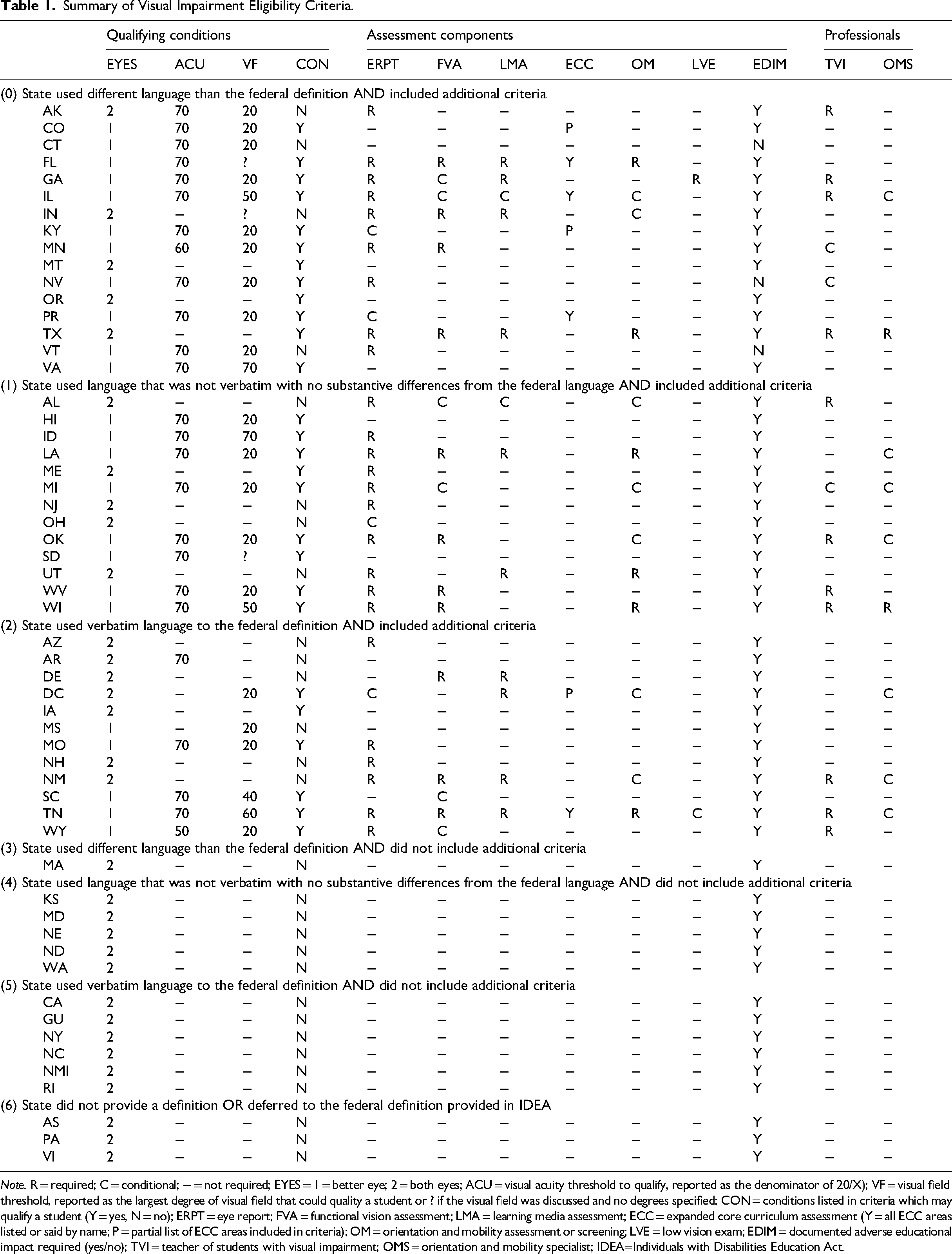
Note. R = required; C = conditional; − = not required; EYES = 1 = better eye; 2 = both eyes; ACU = visual acuity threshold to qualify, reported as the denominator of 20/X); VF = visual field threshold, reported as the largest degree of visual field that could quality a student or ? if the visual field was discussed and no degrees specified; CON = conditions listed in criteria which may qualify a student (Y = yes, N = no); ERPT = eye report; FVA = functional vision assessment; LMA = learning media assessment; ECC = expanded core curriculum assessment (Y = all ECC areas listed or said by name; P = partial list of ECC areas included in criteria); OM = orientation and mobility assessment or screening; LVE = low vision exam; EDIM = documented adverse educational impact required (yes/no); TVI = teacher of students with visual impairment; OMS = orientation and mobility specialist; IDEA=Individuals with Disabilities Education Act.
Qualifying Conditions
States varied in how they quantified thresholds or parameters by which a student could qualify for special education services. Most states included multiple avenues through which a student could qualify. Many used current visual functioning (see the “Acuity and Visual Fields” section). Twenty-six states specified visual conditions that might qualify a student. Most commonly (n = 24), states included language that students diagnosed with progressive or degenerative visual conditions may be found eligible in this category, regardless of current visual function.
Acuity and Visual Fields
Twenty-four states based the presence of a visual impairment on vision in the better eye; 32 states based eligibility on vision in both eyes or did not specify. Twenty-five states included an acuity threshold a student had to meet to qualify; 31 states did not include an acuity threshold. Of the 25 states that included acuity as a qualifying parameter, almost all (n = 23) used the acuity measure of 20/70 as the best visual acuity with which a student could be found eligible in this category (see Table 1).
Visual field restrictions were included in many states’ eligibility criteria (n = 27). A few states (n = 3) indicated visual field restrictions could qualify a student without specific parameters. Most states (n = 24) included the degree of the visual field that would qualify a student. Many (n = 18) referenced a visual field of 20° or less. Other states varied in their visual field parameters: 40° (n = 1), 50°, (n = 2), 60° (n = 1), or 70° (n = 2; see Table 1).
Assessment Components
Three assessment component variables related to medical documentation. Eye reports were required by 25 states, and four states required an eye report only in certain situations (e.g., in Ohio for preschool-aged students only). The next variable captured if a state included an acuity threshold but did not require an eye report (i.e., the state did not require a way to verify the student's acuity). Ten states required students to meet an acuity threshold (always or in some conditions), but did not require an eye report or medical documentation. Lastly, one state required a low vision exam, and one state sometimes required low vision exams for students as part of the eligibility process; 54 states did not reference a low vision exam in their eligibility criteria.
Four variables were coded for specific assessments (FVA, LMA, O&M assessment, and ECC assessment) that may be required to inform eligibility. Each assessment was infrequently required. An FVA was required in 11 states, sometimes required in six states, and not mentioned in 39 states. An LMA was required in 10 states, sometimes required in two states, and not mentioned in 44 states. An O&M assessment or screening was required in five states, sometimes required in seven states, and not mentioned in 44 states. Lastly, an ECC assessment was required in four states, some of the nine areas of the ECC were listed in three states, and the ECC was not mentioned in 49 states.
The final assessment component we coded for was whether states included phrasing in their criteria that the visual impairment resulted in an adverse educational impact for the student under consideration. This clause was included by 53 states and not mentioned in the eligibility criteria of three states.
Team Member Requirements
Eleven states specified that a TVI should be present when school teams are considering eligibility under the category of visual impairment. Three states required or specifically suggested a TVI participate in meetings under certain circumstances. Most states (n = 42) did not mention a TVI. O&M specialists were mentioned less frequently, with just one state requiring them to attend. Eight states specified only in certain situations should an O&M specialist is present. Most states (n = 47) did not mention O&M specialists.
Discussion
The purpose of this review was to understand the extent to which the eligibility criteria for students with visual impairments were the same across the United States. Our findings indicate there were some near-universal aspects of eligibility criteria (e.g., requiring an adverse educational impact or not mentioning a low vision exam). However, there remains significant variation. It is critical that policymakers, administrators, and other stakeholders recognize these variations in eligibility criteria across states. The full effect of these variations on students with visual impairments, both those currently identified and those not yet found to be eligible for special education services needs to be understood.
Degree of Detail in Eligibility Criteria
The findings of this review highlight the divide between states that implemented the federal definition of visual impairment without operationalizing or including measurable components (n = 15 states) and states that operationalized their criteria (n = 41 states; e.g., included acuity measures, potential qualifying conditions, or required assessments). States and local education agencies maintain the right to create and implement operationalized eligibility criteria for special education services. However, states cannot create requirements that are used as gatekeeping measures that might exclude any specific visual conditions (Ryder, 2017). Therefore, the question must be asked, how detailed should eligibility requirements be before they are considered too detailed? The findings of this review identified 27 out of 56 states that listed specific medical conditions as potentially qualifying conditions. Twenty-four states included in their definition of visual impairment students with progressive visual conditions who do not yet meet eligibility standards but are anticipated to qualify in the future. Another 24 states specifically defined acuity-based visual impairments on vision in the better eye (although in most states visual acuity was not the only way to qualify). The authors agree that some of these requirements may be quite beneficial such as including students with diagnosed progressive conditions. Other requirements, however, may unnecessarily complicate how students are identified (e.g., listing specific conditions that may qualify a student). The content of each state's eligibility criteria matters because multiple studies have shown that the number of students identified in a specific disability category directly correlates to eligibility criteria (e.g., Phillips & Odegard, 2017), and the visual impairment category is no exception. States that included an FVA in their criteria had a higher prevalence of students with a primary disability of visual impairment than those that did not include an FVA (Schles & McCarthy, 2022).
Specificity and Clarity of Eligibility Criteria
Although some interstate differences were easy to code, others were much more difficult. For example, in New Jersey, the criteria specified that “An assessment by a specialist qualified to determine visual disability is required” (N.J.A.C. 6A:14–3.5(c)14). Similarly, Alabama regulations stated, “Evidence of visual functioning that adversely affects educational performance as evaluated by a certified vision specialist” (SUPP. No. 13–3, Ch. 290–8–9 290–8–9.03(13)(b)3). In both requirements, it is unclear who precisely qualifies as a “specialist,” since specialists are not defined elsewhere in the regulations. As states continue to evolve their eligibility criteria for special education services, whether, in state regulations or policy guidance, it is critical that professionals trained in each disability are consulted in regard to the language used so that requirements are clear to all readers and not left up to interpretation.
It is easy to make the case that visual impairment eligibility should never be considered without a TVI as an active member of the eligibility team. However, TVIs were only mentioned in the eligibility criteria for 14 out of 56 states. Since only TVIs can conduct the specific assessments needed for visual impairment eligibility, one could argue that they are inherently included and do not need to be specifically listed as required to be present. Yet, the severe and persistent shortage of TVIs, particularly in high-need and rural schools, means that students’ eligibility of having a visual impairment is often considered without a TVI present. Specifically requiring that a TVI conduct an assessment or, more broadly, be a part of the eligibility team could build awareness of the profession, since many educators do not know the role of a TVI. These concerns equally apply to O&M specialists, who were only mentioned in the criteria of eight states. In Michigan, only students who are legally blind (20/200 acuity or visual fields not more than 20°) were required to have an O&M specialist conduct an assessment as part of eligibility (MARSE R 340.1708 Rule 8 section 4). Admittedly, the extreme shortage of school-based O&M specialists may be prohibitive to require an O&M assessment for all students. Given the fact that all students with visual impairments have the right to be evaluated by an O&M specialist, the implications of specifying vision professionals should be considered.
Link Between School-Aged and Postsecondary Eligibility
It may be that some states included eligibility requirements that align with the legal definition of blindness used for social security and other adult social services to ensure consistency of services postgraduation. Legal blindness in the world of adult services, also known as statutory blindness, is defined as: …central visual acuity of 20/200 or less in the better eye with the use of correcting lens. An eye which has a limitation in the field of vision so that the widest diameter of the visual field subtends an angle no greater than 20 degrees is considered to have a central visual acuity of 20/200 or less. (45 FR 55584, Aug. 20, 1980, as amended at 48 FR 5715, Feb. 8, 1983)
Indeed, an issue that states need to contend with as they think about eligibility criteria for school-age students is the implication for students transitioning from school to adult services. How many students with visual impairments are found eligible for school-age services (under IDEA's broad definition) only to be found ineligible for services as an adult? Given the importance of transition and postsecondary supports for students with visual impairments (Cavenaugh & Giesen, 2012; Lund & Cmar, 2020), it may behoove professionals and policy makers to consider not only eligibility criteria for students, but also how to design eligibility to facilitate a smooth transition from school to adult services.
Limitations
Like all studies, there are some limitations to the current review that should be considered. First, this study only reviewed and coded eligibility components that were explicitly listed in state documents. Second, when a state had eligibility criteria described in state regulations and a best practice or similar document from a state DOE, only the state regulations were coded, since they take legal precedent. It is important to note that many of these best practice documents included far more detail and clearer operationalized criteria for visual impairment. For example, a state may use the IDEA definition in its regulations and have a best practice document that recommended all students being considered for visual impairment eligibility have an FVA and LMA conducted by a TVI. In our coding of the data, these states would not be documented as recommending FVAs and LMAs because they are not mentioned in the legally binding definition. Last, the data collected for this study were conceptualized as a time capsule. All regulations and policies were collected between January and March 2021. It is expected that not many, but a few, states may have revised their policies in between the time of data collection and publication of this manuscript. Readers who are interested in obtaining the most up-to-date information for a particular state should refer to the state's current policy documents.
Implications for Practice
The findings of the current review highlight several direct implications for practice. First and foremost, students with visual impairments and their families need to have access to easy-to-understand information on how an interstate move may affect access to special education services. Similarly, so that TVIs and other educators can best support families moving in and out of their state, preservice and in-service teachers must be trained on interstate variations. There are few TVI and O&M training programs in the United States and an increasing push toward interstate consortium models (Ajuwon & Craig, 2008; Ambrose-Zaken & Bozeman, 2010). As a result, teacher preparation programs must be ready to train their preservice educators in how to interpret all states’ criteria, regardless of where the preparation program is located.
The objective of this review was an observational summary of eligibility criteria in place during the winter and spring of 2021. It behooves policymakers, researchers, and advocates to take this work to the next level and begin to examine the direct implications of one state's eligibility criteria over another. It has been established that interstate variations in eligibility criteria correlate with different numbers of students with visual impairments being identified (e.g., Hallahan et al., 2007; Nowicki, 2019; Schles & McCarthy, 2022). It is far past time that we move from documenting interstate differences to working as a field to identify best practices around eligibility criteria. We must codify best practices into state regulations so they become legally binding and establish a measurable universal definition of who is a student with a visual impairment for the purposes of special education eligibility and services.
Footnotes
Declaration of Conflicting Interests
The author(s) declared no potential conflicts of interest with respect to the research, authorship, and/or publication of this article.
Funding
The author(s) received no financial support for the research, authorship, and/or publication of this article.
