




Abstract
Introduction:
An important skill for orientation and mobility (O&M) specialists to have is to monitor clients appropriately when they are learning to cross intersections. Techniques books provide some suggestions for positioning during street crossings, but no research has been conducted about consensus or priorities for making appropriate decisions on positioning. The purpose of this study was to investigate general positioning decisions using visual monitoring techniques.
Method:
A total of 234 participants (practicing O&M specialists, preservice O&M students, and O&M university personnel) completed a 40-question survey. The survey included demographic questions, diagrams of intersections that participants used to select positioning locations, questions about lanes of threat, and questions about important factors to consider when positioning to monitor safety. Commonality of selections were analyzed and compared with demographic information.
Results:
The greatest consensus was found for all intersection types when the client is positioned on the corner waiting to cross and for identification of the first lane of threat. More variable position selections were made for monitoring during the crossings, and the second and third lane of threat selections were also more variable. Factors respondents indicated as most important to consider when positioning aligned with their positioning choices overall.
Discussion:
Personnel preparation programs may want to consider to what extent they teach considerations for positioning before and during crossings, and whether the predominant tendency to put oneself between the client and traffic warrants additional conversation. Future research should look at more complex intersections and the additional nuances used to make positioning choices.
Implications for practitioners:
Practitioners should reflect on whether they actively change their positioning decisions based on the situation and type of intersection versus tending to use a standard strategy.
by answering questions on this article. For more information, visit:
http://my.aerbvi.org/AER-Store/Publications/BKctl/ViewDetails/SKU/AER.☑ Earn CEs Online
Crossing intersections, controlled or uncontrolled, pose risks for pedestrians. Many factors relate to the risks associated with particular intersections including driver yielding behaviors (Wall Emerson et al., 2015), the design of the intersection and environmental features (Jiang et al., 2020; Stipancic et al., 2020), and individual characteristics of pedestrians such as distractibility (Mwakalonge et al., 2015). In orientation and mobility (O&M) training, individuals who are blind or have low vision learn to cross various intersections. An O&M specialist must be in-tune to the various complexities of an intersection to monitor a client’s safety when learning to cross it.
Within personnel preparation programs, preservice O&M students need to develop keen observational skills for intersections and the skill execution of their clients. When first learning and practicing, preservice students may be able to identify “textbook” errors equally as well as O&M specialists, but their rationales may differ or be less tailored to situational cases (Zebehazy et al., 2005). Part of learning to be a good observer during O&M instruction is understanding where to position oneself to monitor safety and gain the best vantage point for observing, for example, upcoming lanes of threat at intersections. (A lane of threat is the traffic lane in which a vehicle could potentially harm the client.) Monitoring at street crossings is a situation that warrants careful consideration of positioning, especially when a client is first learning to analyze and cross various types of intersections. Anecdotally, it is also an area that is frequently corrected when evaluating preservice teacher’s developing observation and monitoring skills.
A review of techniques books (Fazzi & Barlow, 2017; Grow & Long, 2011; Jacobson, 2013; Morais et al., 1997) indicated only small sections dedicated to discussing the positioning of an O&M specialist at a street crossing. Jacobson (2013) mentions that O&M specialists should move, as their client’s proficiency improves, from being in front of the student giving voice cues to being “next to and slightly behind” (p. 239) the student before and during the crossing. He further mentions that prior to crossing, the specialist should be “slightly behind and away from parallel traffic sounds” (p. 239), which avoids blocking sounds and allows monitoring from all streets at the same time. As the student begins crossing, Jacobson (2013) indicates that the O&M specialist should move “behind the student and slightly away from the parallel cars so the student is between him and the parallel traffic” (p. 240).
Fazzi and Barlow (2017) offer a more general rule of thumb for positioning: “the O&M specialist should position himself to react appropriately and consider the direction of vehicle threats” (p. 168). They also indicate the need to establish verbal cues in advance and note that positioning may vary due to the responsiveness of the traveler to these verbal directions or due to the relative size difference between the traveler and the O&M specialist. Interestingly, the illustration in Fazzi and Barlow (2017) depicts an O&M specialist standing slightly behind the traveler toward the parallel street, which is opposite of what Jacobson depicts and suggests.
Morais et al. (1997) describes techniques for O&M specialists who are blind and suggests that the instructor be directly behind the student at the corner (before crossing) so as not to block any auditory information. When crossing, the guide recommends that the O&M specialist remain behind and slightly closer to the parallel traffic to promote the O&M specialist’s ability to respond quickly.
In summary, while there are rules of thumb based on O&M specialists’ experiences and expertise, there is currently no research on instructor positioning. The authors conducted this study to establish a research base of this often-discussed topic in personnel preparation programs and to investigate whether there was commonality among O&M preservice students, O&M faculty in personnel preparation programs, and practicing O&M specialists in regards to positioning using visual monitoring. It is recognized that similar research needs to be conducted to determine the current practices of instructor positioning by O&M specialists who are blind. Initial positioning and positioning choices during crossings may differ and be taught differently to preservice O&M students who are blind in personnel preparation programs. More specifically, the study investigated the following research questions:
Method
Instrument
This study was approved by the Institutional Review Board at the University of Pittsburgh including the manner of informed consent. A 40-item, four-section questionnaire was developed using the web-based survey tool SurveyMonkey. The first section gathered demographic information from each respondent. The second section presented diagrams of intersections (a four-way plus S
Descriptions of intersection crossings (North American traffic patterns) used in the study.
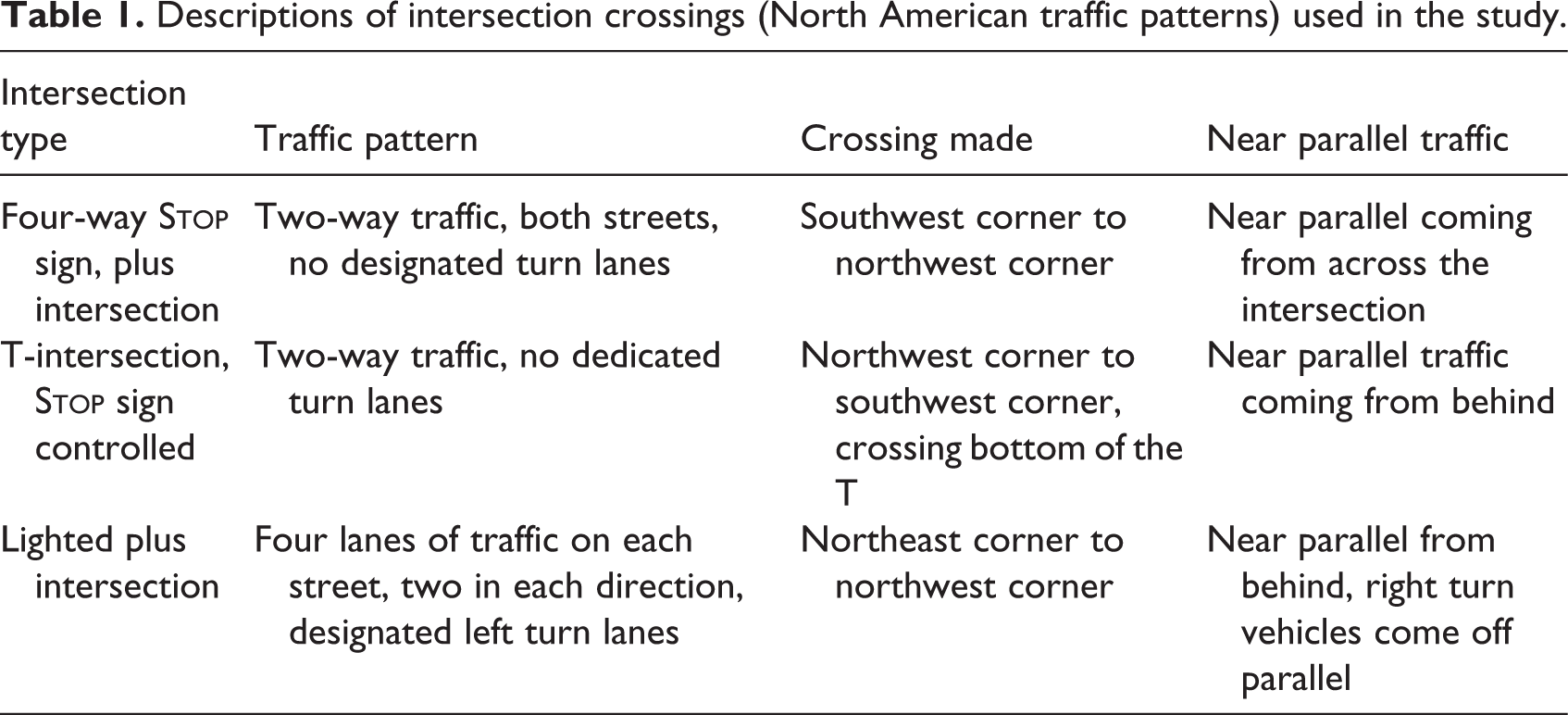
As additional information about how the respondents considered the various factors of the intersection type and traffic flow, the third section asked them to order the lanes of threat for each intersection type. The same intersection and direction of crossing was used as indicated in Table 1, but the diagram showed the client at the corner with an arrow for direction of crossing without the O&M specialist. Lanes were labeled with letters and the respondents were asked to rank the first, second, third, et cetera, lanes of threat as the person would be crossing that intersection.
The fourth section asked respondents to indicate the importance of various factors when determining position prior to and during crossings. The respondents rated the factors on a 3-point Likert-type scale: very important, moderately or somewhat important, and not important. The following are the factors that were rated: (1) being positioned within an arm’s reach of the client or student (hereafter, “client”); (2) not blocking auditory or visual information; (3) having the current lane of threat in your field of view; (4) having the client in your field of view; (5) being positioned to monitor the client’s travel skills; (6) being able to see the center of the intersection; (7) having parallel traffic in your field of view; (8) facing the same direction as the client; (9) being positioned between the client and oncoming vehicles (for during-crossing questions only).
Participants
The survey was disseminated to O&M university faculty at all institutions in the United States that had an O&M program that leads to eligibility for certification. Faculty were invited to participate and asked to pass on the invitation to adjunct and part-time faculty teaching O&M courses and students who had completed an O&M techniques course. The link to the survey was also posted to the Association for the Education and Rehabilitation of the Blind and Visually Impaired O&M electronic discussion group. An alternative nonvisual, described format of the study was offered as part of the posted invitation to participate. A total of 234 people (187 of whom indicated they were currently certified) responded to the survey: 26 students, 189 O&M specialists, and 19 O&M faculty. No participants chose the nonvisual format. Regions where the respondents received their O&M preparation were distributed across the United States: 19% in the Northwest, 13% in the Southwest, 26% in the Midwest, 17% in the Southeast, and 20% in Northeast. In addition, 6% received training outside of the United States. Of the O&M specialists who responded to the question, 48% worked with the school-age population, 25% with adults, and 26% with both populations. O&M specialists’ years teaching in the field ranged from 1 to 11-plus years, with the largest percentage teaching at least 11 years (59%). O&M faculty had 1 to 11-plus years in the field, with 42% having experience in the field at least 11 years followed by 37% having 1 to 5 years in the field. The majority of students (100%), O&M specialists (86%), and O&M faculty (89%) indicated that they were specifically taught about positioning in their personnel preparation programs.
Analysis
Commonality of positioning selections were analyzed for each intersection. Based on the overall responses, four factors, most related to the positioning options provided, were specifically analyzed: (1) O&M specialist is not blocking auditory or visual information (no block), (2) O&M specialist has the current lane of threat in their field of view (threat), (3) O&M specialist is facing the same direction as the traveler (same), and (4) O&M specialist is positioned between the traveler and oncoming vehicles (between). Frequencies of choices and cross tabs (Chi-squares) between the four factors and demographic variables (category of respondent, certified or not, region trained, age level taught, years since completing training, number of years O&M specialists or faculty taught in the field, and “very important” or “not important” selected for prior and during crossing factor ratings) were conducted with standard residuals analyzed for any significant items. In addition, commonality in the order of lanes of threat were analyzed descriptively for each intersection type.
Results
Positioning selections
For “prior to crossing” position selections, one dominant answer (chosen by 66% or greater of respondents) was similar across all intersection types. In this position, the O&M specialist was located behind the traveler, slightly to the right or left (depending on the corner) and angled toward the intersection (see Figure 1). The second most common position selected was one in which the O&M specialist was located behind the traveler, to the right or left (depending on the corner) toward the curb line, but not angled (see Figure 2). Positioning selections for one quarter and three quarters of the way crossings were more variable with no one choice selected by more than 50% of the respondents. The most popular position for the T-intersection and lighted Plus intersection, one quarter of the way through the crossing, was to have the O&M specialist position themselves slightly behind the traveler and out toward the parallel flow of traffic, to put themselves between the area of threat and the traveler (see Figure 3); however, for the S
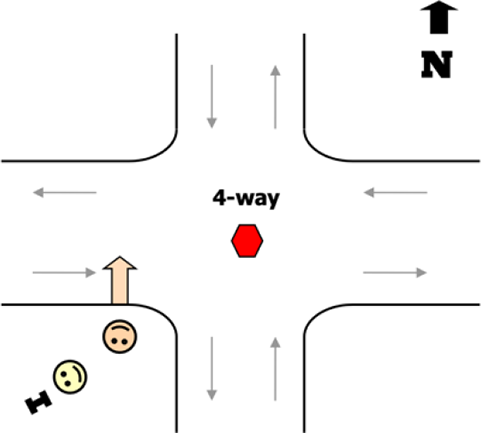
Dominant position chosen for all intersections prior to crossing. Plus lighted intersection pictured as the example.
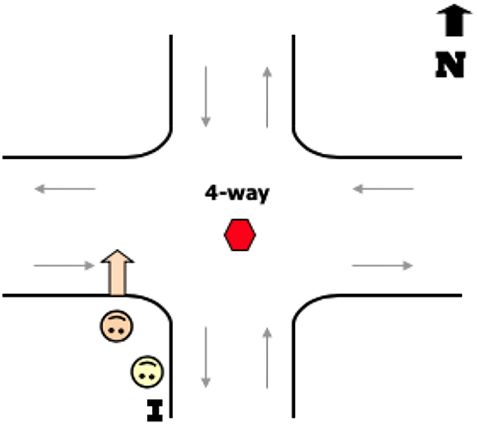
Second most common position chosen prior to crossing. S
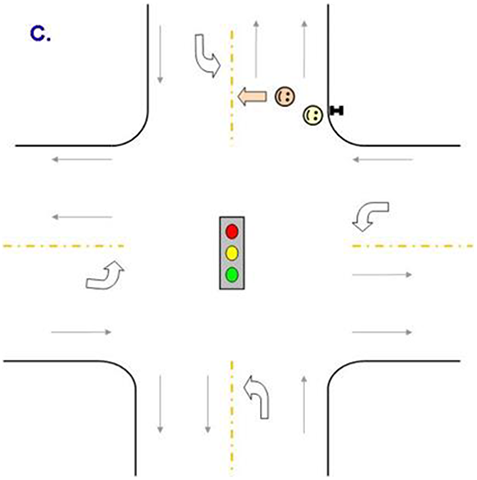
The most popular position for the T-intersection and lighted Plus intersection during ¼ way crossing. Lighted plus intersection pictured as the example.
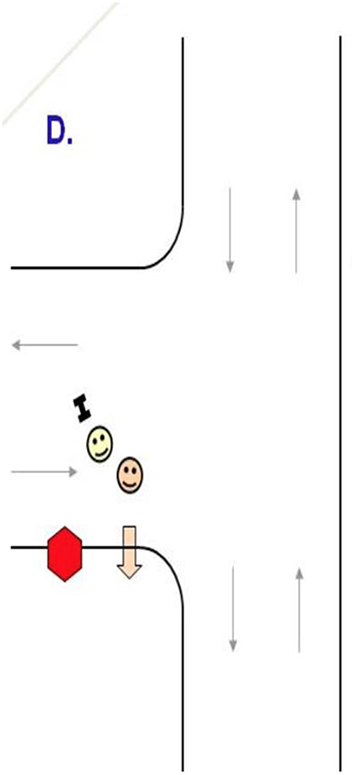
The most popular position for the T-Intersection and S
Factors that influenced positioning decisions
Table 2 shows the percentage of respondents indicating the level of importance of the various factors including the four selected factors (no block, threat, same, and between) for additional analysis regarded as most related to the positioning options in this study. The most variability in response was for the factor regarding the O&M specialist facing the same direction as the traveler. Participants were also asked at the end of the questionnaire whether they would change their positioning decisions if a traveler had low vision or was using a dog guide. The majority of respondents (73% low vision, 64% guide dog) indicated “No.” About 20% of respondents for each question indicated “maybe.”
Importance level of various factors when determining positioning for monitoring street crossings (valid percent).
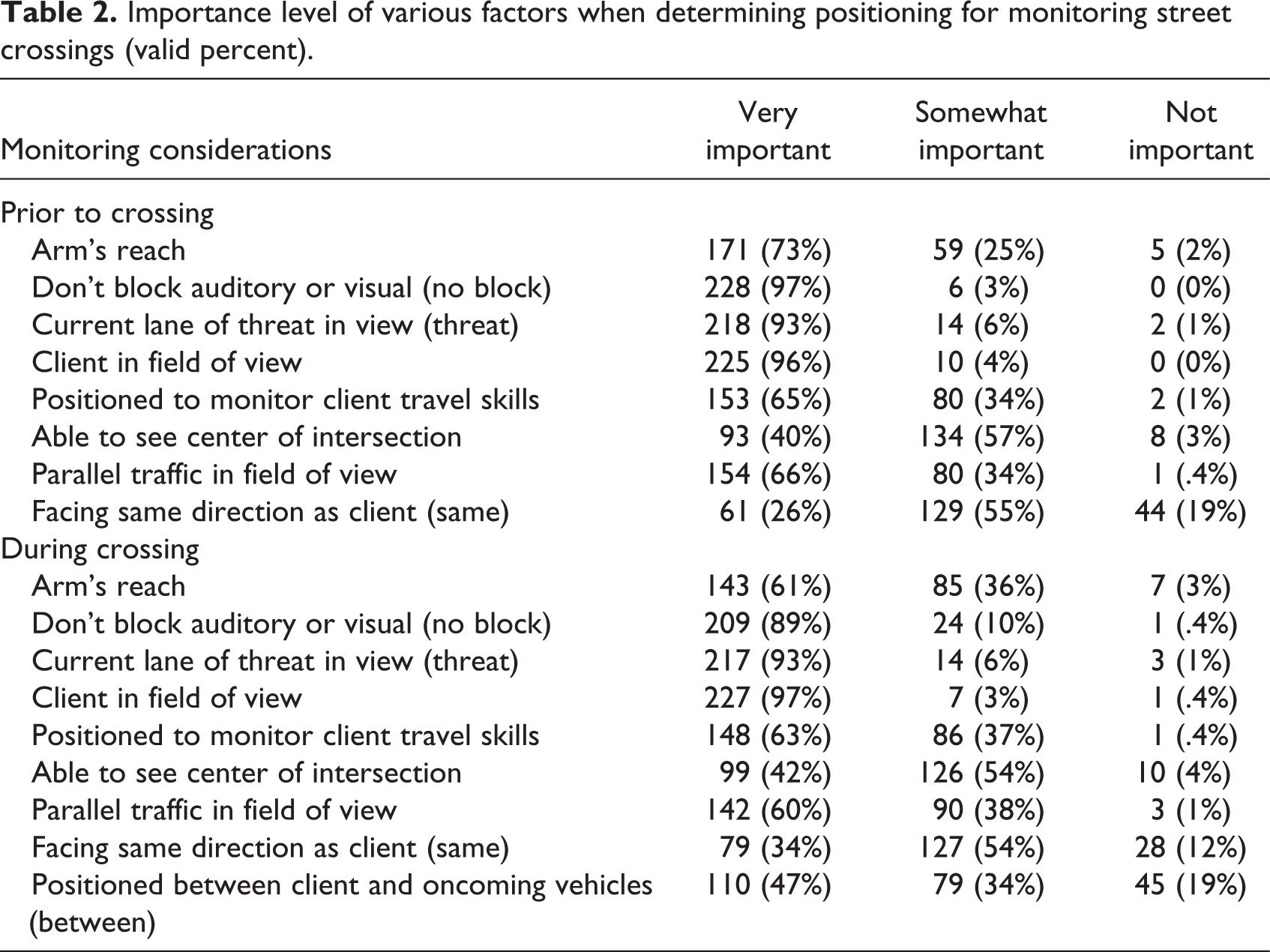
Cross-tabulations and residual analyses at the p ≤ .05 level revealed the following patterns: Respondents who selected no block as “not important” were more likely than expected to select the perpendicular position for the significant intersections (T-intersection prior, lighted prior, S Respondents indicating between as “very important” were significantly more likely to select that position than those not selecting this factor as “very important.” For the lighted one quarter crossing, individuals who did not select threat as “very important” were more likely to choose the option where the O&M specialist was directly behind the client. Students were more likely to choose the position where the instructor was standing directly next to the client on the nonparallel street side facing the same direction than either certified or noncertified O&M specialists. Note, however, that only 5% chose this position overall.
No other significant relationships were found including region trained, years of experience, or type of client taught.
Lanes of threat
On all of the three intersection types, respondents were most in consensus about which option was the first lane of threat for the traveler crossing that intersection (90% agreement four-way stop, 82% T-intersection, 67% lighted plus intersection). The next highest level of agreement for the four-way stop and T-intersections was for what the last lane of threat (52% and 57%). The lighted plus intersection which had more items to order had the second largest agreement for the second to last lane of threat (48%). The options in the middle (second and third lanes of threat) also had more of a variation in consensus similar to the greater variability in the positioning selections during crossings (as compared to before crossing).
Discussion
The results of the study presented here highlight some general commonalities in thought about positioning based on what the vast majority of respondents felt were important factors to consider. These findings align with what the two techniques books indicate (Fazzi & Barlow, 2017; Jacobson, 2013) and what university programs tend to teach students: keeping next lane of threat in view and not blocking auditory or visual information. Beyond those two considerations, more variability was observed in responses. The majority of respondents also rated putting themselves between the parallel traffic cars and client as “very important.” This position can, at times, be in direct contradiction to not blocking auditory and visual information. The issue of whether an O&M specialist should position him- or herself between the parallel traffic and traveler warrants some discussion among personnel preparation programs. To want to move into this position is a natural instinct for O&M specialists, but in the case of different intersections, is it really the safest and best option (including for the O&M specialist)? Should it vary depending on the complexity of the intersection and characteristics of the client? It is not what is recommended by the techniques books, but it seems to be a prominent position for O&M specialists to select. This study was not sensitive enough to consider all the nuances for selecting this option, but the response highlights the need to have more in-depth conversations about what should be considered in positioning in personnel preparation programs and whether the instinct “to protect” should be acted upon.
The wider variation in position selection for the one quarter and three quarters of the way crossings and selection of which lanes of threat were the next ones to consider for the traveler in the process of crossing may indicate that it is more common for O&M specialists and personnel preparation programs to deliberately consider the position at the corner but be more spontaneous or “instinctual” when the crossing becomes more fluid and dynamic with more aspects needing to be monitored. The format of this study demonstrates there is variability in thought about this question, and it highlights an area for further discussion and research and perhaps more focus in personnel preparation programs. It poses the question of how much personnel preparation programs focus on the decision-making process of preservice O&M specialists during crossings and whether faculty have common ideas about it.
The fact that no significant differences were found between most of the demographic variables (e.g., region, type of client taught) indicates that providing some general starting points for making good positioning decisions should be applicable for most O&M preservice students and the general suggestions currently in the techniques books should hold true, at least at basic types of crossings. This study did not consider more complex crossings like angled intersections and roundabouts. Further research into more complex types with methodologies that can tease out additional nuanced considerations would add to the foundational research of this study.
Implications for practitioners
Based on this research, practitioners may want to reflect on their positioning habits at street crossings and consider whether they actively make decisions based on the current situation. In particular, practitioners may find it helpful to observe their current positioning practices and verify that they align with factors that are considered important, such as always having the next lane of threat within their own field of view. Personnel preparation programs can help preservice O&M specialists learn to analyze for the important factors and conditions, as well as assess whether their “instinctual” positioning is safe, effective, and responsive to changing situations before and during crossings.
Limitations and future research
As indicated above, the static nature of a questionnaire, while allowing for a large sample size, cannot discover the more dynamic nuances of instructor positions (such as when a client veers or variations in intersection features or surrounding environmental features like bike lanes). The goal of this study was that its findings would serve as a foundational investigation about a topic discussed in O&M programs but not generally discussed more widely between programs. It is meant to be a catalyst for further discussion. The questionnaire format of the study has some additional limitations that should be noted. First, since there were no participants who chose the nonvisual format of the questionnaire, the positioning selections by the participants assume that the O&M specialist is using vision for monitoring. For O&M specialists who are blind or have low vision, positioning techniques for monitoring safety may be different, which warrants a separate study to investigate commonalities among these specialists. The static aspect of using diagrams and providing limited choices could have affected the position selections, particularly during the one-quarter and three-quarter crossings. Finally, the intersections presented were basic, with four positioning choices given. O&M specialists may have chosen a different position if more options were provided or may make different decisions at more complex intersections. In real life, there will be more variability and complexity at intersections, in which case, any basic rules for positioning indicated from this study would need to be tested for generalizability.
Additional studies to add to the baseline of this study could implement methodologies that observe O&M specialists in action in order to provide additional insight into the nuances to be considered. These studies could validate whether the general rules hold true in more complex, dynamic situations, varying surrounding environments, or when monitoring individuals with different levels of vision or additional disabilities. These “in-action” studies would help identify conditions that require different decision-making about positioning. It would also be useful to determine whether beginning O&M specialists working from basic instruction about positioning are able to tailor what they learned to unique and more complex situations.
Footnotes
Declaration of conflicting interests
The author(s) declared no potential conflicts of interest with respect to the research, authorship, and/or publication of this article.
Funding
The author(s) received no financial support for the research, authorship, and/or publication of this article.