




Abstract
The psychometric properties of the Reward Probability Index (RPI), which assesses environmental reward as an indirect measure of response-contingent positive reinforcement (RCPR), were estimated in a Mexican population. With the voluntary participation of 1297 adults, reliability was assessed, and evidence was collected regarding the internal structure and its relationship with emotional symptomatology and other variables. Good internal consistency indices (ω and α) were found for both the total scale and its dimensions. A two-dimensional structure, comprising Reward Probability and Environmental Suppressors, and a second-order factor consistent with RCPR theory, was confirmed. This model demonstrated measurement invariance across sex, mental health treatment status, and the presence or absence of emotional symptomatology. Consistent relationships were observed between RPI scores and emotional symptomatology, psychological inflexibility, and life satisfaction. Additionally, evidence was found supporting the criterion validity of the RPI in relation to depression. RPI is a psychometrically solid instrument, and its use is recommended in the Mexican population to account for environmental reward, utilizing a total score and by dimensions.
Keywords
Worldwide, approximately 450 million people have experienced depression, and it is estimated that one in four individuals will experience it in their lifetime (World Health Organization, 2023). The Mexican National Psychiatric Epidemiology Survey revealed that 9.2% of individuals experienced a depressive disorder at some point in their lives, while 4.8% suffered from it in the past 12 months (Cerecero-Garcia et al., 2020). This condition is one of the leading causes of disability and global disease burden (Corea, 2021).
Behavioral Activation (BA) is one of the 17 empirically supported treatments for depression recognized by Division 12 of the American Psychological Association (2025). BA is an empirically supported therapy that aims to enhance an individual's engagement in adaptive behaviors (Hopko et al., 2003), increasing activities that provide access to Response Contingent Positive Reinforcement (RCPR; Lewinsohn, 1974), reducing behaviors that perpetuate depressive symptoms (Dimidjian et al., 2011; Martell et al., 2010), and addressing barriers that limit access to sources of positive reinforcement (Bianchi & Henao, 2015).
Response-Contingent Positive Reinforcement (RCPR)
The RCPR is defined as the process by which a behavior is performed, followed by the occurrence of a reinforcing event, which results in a subsequent increase in the frequency of that behavior (Carvalho et al., 2011). RCPR is composed of four components: (a) the number of reinforcing events, (b) the availability of potentially reinforcing events in the environment, (c) the behavior to access sources of reinforcement, and (d) the exposure to aversive events (or function as punishing events) in the environment (Dimidjian et al., 2011).
The behavioral model for depression considers a low rate of RCPR to be an unconditioned stimulus that elicits depressive behaviors (Dygdon & Dienes, 2013; Lewinsohn, 1974); therefore, it is considered a critical predictor of clinical depression (Lewinsohn, 1974; Manos et al., 2010). The relationship between depression and the reduction of reinforcing events, the unavailability of reinforcing events in the environment, and the low rate of instrumental behaviors that elicit reinforcing events have been documented by multiple sources (Hill et al., 2017; Hopko et al., 2003; Lewinsohn, 1974).
The predominant role of RCPR is not only applicable to mood disorders but also to emotional symptoms and mental health in general. For example, the RCPR has shown a negative relationship with emotional distress and depression (Fernández-Rodríguez et al., 2018; Manos et al., 2010). Hill et al. (2017) reported that several studies have shown that increased activation and exposure to environmental rewards increase positive affect and lead to improvements in anxiety and emotional disorders.
The direct assessment of RCPR is complex, as it is required to observe the behavior for long periods and the stimuli that influence the behavior (Manos et al., 2010), so an indirect assessment of the construct is necessary. Two scales that measure environmental reward have been developed within the BA framework: an indirect measure of the RCPR, the Environmental Reward Observation Scale (EROS, Armento & Hopko, 2007) and the Reward Probability Index (RPI, Carvalho et al., 2011). EROS consists of 10 items that assess positive reinforcement as a consequence of reinforcing experiences from the environment (Valderrama et al., 2016). However, EROS does not assess the frequency of reinforcing events but tends to evaluate a long period (Manos et al., 2010) and evidence has been found that it appears to be a screening test (Saavedra et al., 2023). Given these limitations, the RPI was developed (Carvalho et al., 2011); an instrument that assesses the RCPR and its component dimensions (Lewinsohn, 1974).
Reward Probability Index (RPI)
The RPI (Carvalho et al., 2011) was developed to measure the access to environmental rewards and the probability of experiencing rewards. Its internal structure presents two factors that assess the components of the RCPR; Reward Probability which measures (a) the number of likely reinforcing events, and (c) the quantity and quality of operant behaviors to elicit reinforcers; and Environmental Suppressors, which assess (b) the availability of potentially reinforcing events in the environment and (d) the exposure to aversive events. Carvalho et al. (2011) report good internal consistency for the scale overall (α = .88). The same thing happens for the factors Reward Probability (α = .80) and Environmental Suppressors (α = .87). Moreover, they found evidence of convergent validity of environmental reward measured by EROS and depression with BDI-II, in addition to activation/avoidance behaviors through the Behavioral Activation Depression Scale (Carvalho et al., 2011).
The French validation with a non-clinical population (Wagener & Blairy, 2015) and the North American one with individuals exhibiting alcohol consumption patterns (Voss et al., 2021) reported good internal consistency indexes for Reward Probability (α > .85) and Environmental Suppressors (α > .83). Additionally, they confirmed the two-dimensional structure with good goodness of fit indexes.
In the Latin American context, Reyes-Buitrago et al. (2023) analyzed the psychometric properties of the RPI in a sample of 1,129 Colombian adults. In their cross-validation, they reported a two-factor model both in exploratory and confirmatory factor analyses that fit the original model, and it remained invariant across genders. They reported good Cronbach’s alpha coefficients (α = .88) and McDonald’s omega (ω = .88), as well as evidence of relationships with depression, activation, and RCPR (assessed through EROS). One of the study’s main limitations was its application in a non-clinical sample.
Importance of the Current Study
Latin American research has increasingly explored Behavioral Activation (BA) efficacy and effectiveness across diverse populations, including university students (Garcés Rojas et al., 2022; Reyes et al., 2019), adults with depression during the COVID-19 pandemic (Pinzón-Corredor & Bianchi, 2023), and incarcerated individuals (Hernández-Mariño et al., 2024). Mexican studies have focused on BA interventions for university students with comorbid depression and anxiety (Vázquez-Aguilar et al., 2023), cannabis use (Baeza et al., 2021), and vulnerable populations like breast cancer patients (Gálvez et al., 2020) and violence victims (Ramírez-Cruz et al., 2023). While these studies generally report significant depressive symptom reductions post-treatment and at follow-up, no Mexican study has systematically evaluated environmental reward, a core BA component. Critically, assessing environmental reward is essential for understanding BA's mechanism of action: increasing reinforcement sources within an individual's environment to reduce depressive symptoms.
Beyond its association with depression, the RCPR plays a crucial role in the entire spectrum of emotional symptomatology and affective disorders. Given its predictive power for depressive symptoms and the scarcity of research on environmental reward instruments in clinical practice, especially in the Mexican context, the present study was proposed to report the psychometric properties of the RPI in a Mexican sample. The results present internal consistency indexes and item discrimination as reliability measures. Additionally, evidence of the internal structure of the RPI is provided through a confirmatory factor analysis; a second-order factor consistent with the principles of the RCPR (Lewinsohn, 1974) is explored, and factorial invariance is reported for the first time according to emotional symptomatology and whether or not the person is being treated in mental health settings.
Furthermore, evidence of the relationship between environmental reward, emotional symptomatology (depression, anxiety, and stress), psychological inflexibility, and life satisfaction is reported. Additionally, evidence of validity is shown in relation to the criteria of sample type (whether or not the person is receiving mental health treatment), presence of depressive symptomatology, and depression diagnosis. To our knowledge, this is the first study to analyze the psychometric properties of the RPI in Mexico. The study employed a non-experimental, instrumental design (Montero & León, 2005).
Method
Participants
A convenience, non-probability sampling method was employed. A total of 1297 adults aged between 18 and 60 years (M = 27.81, SD = 11.11) participated. Among them, 509 were men and 783 were women. Regarding marital status, 79% reported being single, 14% were married or in a domestic partnership, and 7% indicated being divorced, separated, or widowed. Concerning residential areas, 85% stated they lived in urban areas and 11% in rural areas. Of the total number of participants, 90% resided in the state of Jalisco. In terms of socioeconomic status, 40% belonged to a low level, 40% to an upper-middle level, and 20% to a high level. The most frequent educational level was completed bachelor’s degree at 35%, followed by completed high school at 26%, and postgraduate (specialty, master’s, or doctoral degree) at 7%. Additionally, 10% identified themselves as part of the LGBTIQ+ population.
Of the sample, 25.67% (n = 333) were receiving care in mental health settings, of which 224 were women (67.27%) and 300 participants (90.09%) lived in urban areas. Regarding mental health diagnoses, 246 participants (73.87%) reported having received at least one; the most frequent were anxiety, depression, and eating disorders. Concerning the use of pharmacotherapy, 24.32% referred to being medicated, with the IRSS antidepressants, such as escitalopram/citalopram (19%), and benzodiazepines, such as clonazepam (15.3%), being the most frequently mentioned.
Among the clinical subsample, 39 individuals (9.91%) reported a primary diagnosis of depression, while no participants reported a primary diagnosis of anxiety. Comorbidity between anxiety and depression disorders was observed in 111 cases (33.3%). A total of 76 individuals (22.82%) reported multiple diagnoses, including depression and anxiety disorders, alongside other emotional disorders (e.g., post-traumatic stress disorder, 7%; obsessive-compulsive disorder, 5.4%) or other categories (e.g., eating disorders, 7.8%; personality disorders, 3.9%). In total, 125 individuals (37.5%) reported a diagnosis of depression, either as a primary or comorbid diagnosis.
Instruments
Reward Probability Index (RPI, Carvalho et al., 2010)
The RPI is an instrument that aims to measure the access to environmental reward, based on the Response-Contingent Positive Reinforcement theory (RCPR). The Scale is composed of 20 items divided into two factors: Reward Probability and Environmental Suppressors. Participants respond to each item using a four-point Likert Scale (1 = totally disagree; 4 = totally agree). The psychometric properties of the instrument in the original version show an α = .90, evidence of convergent validity through significant positive correlations with activation, avoidance, depression, and test-retest reliability (r = 0.69). For the validation and adaptation in this study, the Colombian version proposed by Reyes-Buitrago et al. (2023) was used.
Depression Anxiety Stress Scale (DASS-21, Lovibond & Lovibond, 1995)
The objective of the scale is to evaluate the presence of emotional symptomatology associated with symptoms of depression, anxiety, and stress. This instrument is composed of 21 items, with Likert-type response options (0 = Does not apply to me; 3 = Applies to me a lot or most of the time), divided into three factors of 7 items each; depression, anxiety, and stress. The psychometric properties of the instrument in a Mexican context suggest an excellent level of reliability for the scale in general (a = 0.95), and the depression factor (a = 0.90); good for anxiety (a = 0.85) and stress (a = 0.87) as well as good fit indexes for a bifactor, unidimensional and a three-factor model (Salinas-Rodríguez et al., 2023).
Acceptance and Action Questionnaire II (AAQ-II, Bond et al., 2011)
The AAQ-II measures psychological inflexibility with 7 items, with Likert-type response options (1 = totally false; 7 = totally true). In terms of psychometric properties for the Mexican context, good internal consistency values (a = 0.89) and acceptable fit indexes to the unidimensional model have been reported (Mellin & Padrós, 2021).
Satisfaction with Life Scale (SWLS, Diener et al., 1985)
The purpose of this scale is to measure overall satisfaction with life using five items with Likert-type response options (1 = totally disagree; 5 = totally agree). Scores are calculated by summing the direct scores. For its interpretation, the level of satisfaction ranges from low (5 points) to high (25 points). The Mexican validation (Padrós Blázquez et al., 2015) shows a unidimensional factorial structure and good reliability (a = 0.83).
Procedure
To adapt and validate the instrument, a two-phase procedure was followed, in line with the guidelines of Ramada et al. (2013).
Phase 1: Adaptation of the RPI
A direct translation of the original instrument into Spanish was conducted, followed by a back-translation into the original language by an independent translator. This allowed for the identification and resolution of potential semantic and conceptual discrepancies. Subsequently, cognitive interviews were conducted with a sample of seven participants to assess their understanding of the items and to identify any potential ambiguities or difficulties in interpretation. The results of these interviews were used to make adjustments to the instrument.
Phase 2: Form Construction and Application
The final instrument was adapted to a digital format using Google Forms. Special attention was paid to maintaining the original structure and format of the instrument. An external expert in instrument design reviewed the digital version to ensure that the wording, response options, and navigation logic were correct and consistent.
The inclusion criteria considered participants who were over 18 years old, resided in Mexico, and were native Spanish speakers. Exclusion criteria included individuals who reported diagnoses of severe mental disorders (psychosis, pervasive developmental disorders) and those who took more than 30 min to complete the questionnaire. Before accessing the sociodemographic data questionnaire and the instruments, participants had to provide informed consent. The consent form included detailed information about the study, objectives, contact information for the responsible person, potential benefits, risks, and participant rights.
The instrument was administered online through Google Forms. Information about mental health services and helplines was provided to all participants, regardless of whether they completed the study or not. The average time to complete the questionnaire was 15 min. A digital flyer was designed with information about the study and distributed through the social networks WhatsApp, Facebook, and Instagram, reaching academic and research groups in Jalisco and other states of Mexico. This corresponded to a non-probabilistic convenience sampling using a snowball sampling technique. Collaborations were established with clinical psychology professionals, university clinical care centers, and graduate students to expand the recruitment reach to individuals receiving mental health services.
Data Analysis Plan
The internal consistency of the instruments was estimated using McDonald’s Omega and Cronbach’s Alpha indexes. Values <0.70 were considered low, between 0.70 and 0.90 acceptable, and >0.90 redundant for the Omega (Ventura & Caycho, 2017). For the Alpha, values < .50 were “unacceptable”; between 0.50 and 0.59 “poor”; 0.60 to 0.69 “questionable”; between 0.70 and 0.79 “acceptable”; between 0.80 to 0.89 “good,” and >0.90 were “excellent” (George & Mallery, 2022). The item-total and item-dimension correlations accounted for the item discrimination.
To gather evidence of internal structure validity, a confirmatory Factor Analysis (CFA) was implemented with the Diagonally Weighted Least Squares (DWLS) estimator. The goodness-of-fit of the three tested models was evaluated: one factor (1F), two factors (2F) as proposed in the original model (Carvalho et al., 2011), and two factors plus one second-order factor, in line with the RCPR construct. The following goodness-of-fit indexes were calculated: (a) the Root-Mean-Square Error of Approximation (RMSEA), (b) the Comparative Fit Index (CFI), (c) the Non-Normed Fit Index (NNFI), (d) the Standardized Root Mean Square Residual (SRMR), (e) the Expected Cross-Validation Index (ECVI), and (f) the Parsimony Normed Fit Index (PNFI). In addition, the following indexes were considered: CFI greater than, or equal to 0.95, TLI, NFI, and IFI >0.90, and SRMR and RMSEA values <0.05 (Rial et al., 2006). Finally, the lower values of ECVI indicate better model fit, and for PNFI, higher values indicate a more parsimonious model.
To test the configural, metric, scalar, and residual factorial invariance (Elosua, 2005) of the factors regarding sex, sample type (clinical or nonclinical), and emotional symptomatology, CFAs were conducted. The criteria suggested by Lippke et al. (2007), a ∆TLI > 0.050; Putnick and Bornstein (2016), a ∆SRMR value >0.015 and Cheung and Rensvold (2002), a ∆CFI value >0.010 were adopted to reject the models.
The relationship with other variables was obtained from the Pearson Correlation Coefficient (r). Values between 0.10 and 0.29 correspond to small magnitudes; 0.30 to 0.49 medium, and above 0.49 large (Goss-Sampson, 2018).
To gather evidence related to the clinical and non-clinical sample criterion, the sample was divided into the respective subsamples. When dividing the sample according to clinical and non-clinical criteria, the RPI data and its factors did not meet the assumptions of normal distribution and homogeneity of variances for the Student’s t-test (Goss-Sampson, 2018), and the group size ratio exceeded the recommended 1.5:1 for parametric tests. Therefore, the Mann-Whitney U test was used. For the U test, effect size was assessed using Rank-Biserial Correlation (rbc). Values of rbc < 0.10 were considered negligible, 0.10 to 0.30 small, 0.30 to 0.50 medium, and >0.50 large (Goss-Sampson, 2018). Additionally, the clinical subsample was further divided based on high versus low depressive symptomatology and the presence or absence of a depression diagnosis, either alone or comorbid with other disorders. Due to the violation of parametric test assumptions, the Mann-Whitney U test was also used for these comparisons.
For statistical and psychometric analyses, the R programming language (R Core Team, 2022), and the Lavaan (V 0.5-12) and semTools (V. 0.5-6) packages were used through the RStudio integrated development environment (V. 2022.7.1.554; RStudio Team, 2022).
Ethical Considerations
This study was conducted in accordance with the ethical principles outlined in the Declaration of Helsinki and was approved by the Institutional Review Board of the Tecnológico de Sonora under protocol number 210. All participants provided informed consent prior to their participation in the study and received no monetary compensation. To ensure privacy and confidentiality, all data were anonymized and securely stored on encrypted servers accessible only to authorized members of the research team. Participants were informed of their right to withdraw from the study at any time without consequence. The risks and benefits, as well as the potential contributions to society, were communicated during the consent process. Regarding health research regulations, this study adhered to the ethical guidelines of the Mexican Psychological Association’s code of ethics (2010) and, in accordance with Article 17 of the General Health Law on Research (Secretaría de Salud, 2014), was classified as minimal risk. Additional safeguards were implemented throughout the study, including the provision of mental health resources and follow-up support.
Results
Psychometric Analysis
Internal Consistency and Discrimination
The overall RPI presented good internal consistency (ω = .83, IC95% [0.81, 0.84]; α = .87, IC95% [0.86, 0.88]), good indexes were found in Environmental Suppressor (ω = .86, IC95% [0.85, 0.87]; α = .86, IC95% [0.85, 0.87]), and were excellent in Reward Likelihood (ω = .92, IC95% [0.91, 0.93]; α = .92, IC95% [0.92, 0.93]). Internal Consistency is not increased above the upper limit of the confidence interval, neither for the dimension nor for the total, with the elimination of any item.
The discrimination indexes for the Environmental Suppressors (>0.44) and Reward likelihood (>0.51) dimensions were good. Overall item discrimination was acceptable to good (values between 0.33 and 0.62) except for items 9 (r = 0.25), 12 (r = 0.28), and 19 (r = 0.15) of the Environmental Suppressor dimensions. Additionally, higher values were found in the discrimination index against the dimensional than the total, in each of the items (see Table 1).
Internal Consistency Analysis by RPI Item for the Dimensions and the Total.

Item-total correlations lower than 0.30 are shown in bold.
Evidence of Validity in the Internal Structure
The CFA was tested on three models (see Table 2). The 2F model presented excellent fit indexes so did the 2F + second-order model (see Table 2).
The Goodness of Fit Indexes for the Models.

Note. 1F: one factor, 2F: two factors.
In the 2F+ 2° Order model item loadings were good on each dimension (Environmental Suppressors ≥.44 and Reward Probability ≥.52; see Figure 1).
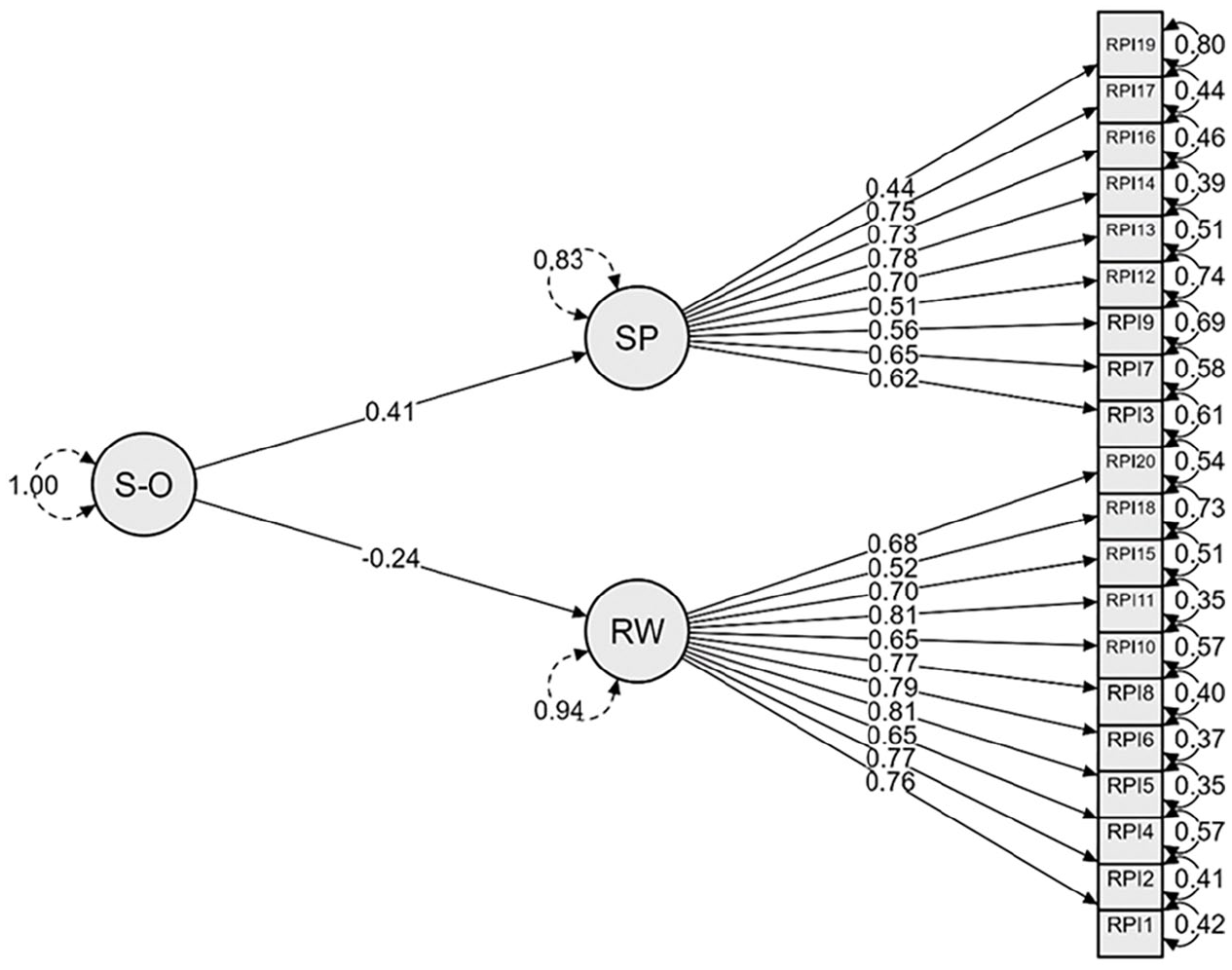
Standardized solution of 2F + Second Order model.
Measurement Invariance
The factorial structure of the 2F + Second Order model resulted invariant concerning the variables “Sex,” “Sample,” and “Emotional Symptomatology,” since it didn’t present significant differences between men and women; nor with the fact of being attended in mental health settings or not. It also presented invariance when scoring or not scoring an indicator of emotional symptomatology (see Table 3). Measurement invariance at the metric, scalar, and strict levels was confirmed because the changes in RMSEA, CFI, TLI, and SRMR were less than 0.01.
Factorial invariance with “Sex,” “Sample,” and “Emotional Symptomatology”.

Evidence of Validity Based on the Relationship With Other Variables
Relationship Between RPI, Emotional Symptomatology, Psychological Inflexibility, and Life Satisfaction
The RPI presented significant correlations (p < .001), theoretically consistent with the scores of the instruments that evaluated the other variables (see Figure 2). Inverse relationships were found with general emotional symptomatology, specific emotional symptomatology (depression, anxiety, and stress), and psychological inflexibility, as well as direct and significant relationships of environmental reward with life satisfaction. The dimensions were also related in the expected way to the instrument scores.
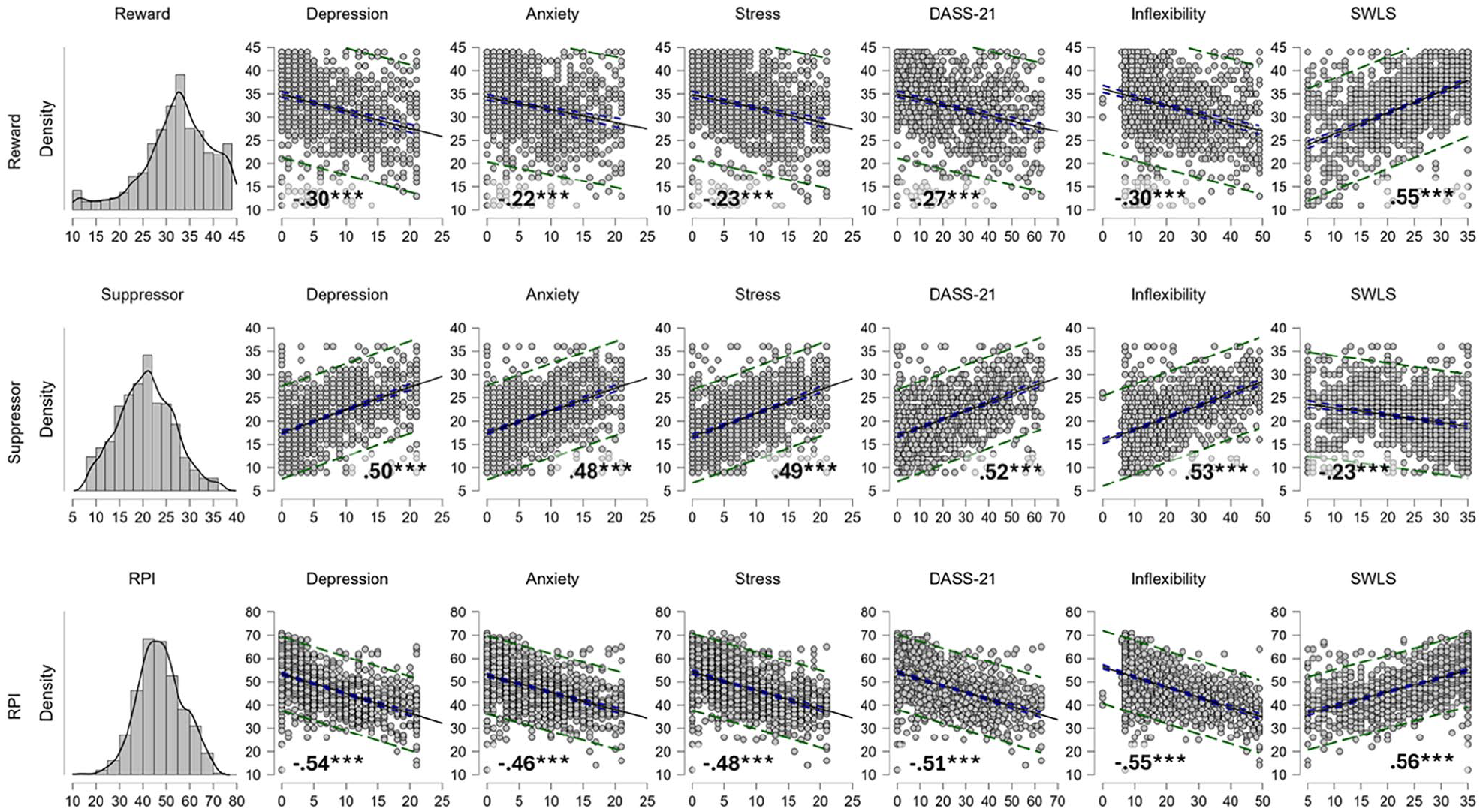
Pearson’s correlations of the RPI and its dimensions with the other variables.
Relationship Between RPI Score With Being Seen in Mental Health Settings, the Presence of Depressive Symptomatology and Depression Diagnostic
In the comparison by samples, with the Mann-Whitney U, clinical (Cl, n = 333) and nonclinical (NCl, n = 924), significant differences were found in the RPI (p > .001) and its dimensions. However, the effect sizes were small (rbc values < .170).
The clinical subsample was divided based on two criteria: (a) individuals who scored high on depressive symptomatology and those who did not; and (b) individuals who reported a diagnosis of depression as a unique diagnosis or as a comorbidity, and those who did not. For the first case, individuals in the clinical sample who presented high Depressive symptomatology (score in Depression dimension of the DASS-21 > 6; Ruiz et al., 2018) showed significantly lower scores (p < .001) in the probability of reward and total RPI (n = 176). The group with low Depressive symptoms (n = 157) presented significantly lower scores (p < .001) on the environmental suppressors dimension (see Table 4).
Comparation of RPI With Emotional Symptomatology Criteria and Sample.

Note. *** = p < 0.001; NCl = nonclinical; Cl = clinical; WS = With elevated depressive symptomatology; WoS = Without depressive symptomatology; No = Without Depression diagnostic; Yes = With Depression diagnostic; U = Mann-Whitney’s U; rbc = Rank Biserial Correlation. Significant Mann-Whitney U values are indicated in bold, accompanied by their respective effect sizes (rbc).
For the second case, individuals with a diagnosis of depression, either as a unique diagnosis or as a comorbidity (n = 125), presented significantly higher scores (p < .001) on the environmental suppressors dimension. On the other hand, individuals without a diagnosis of depression or related disorders presented significantly higher scores (p < .05) on the probability of reward and total RPI (see Table 4).
Discussion
The evaluation of environmental reward, in line with the components of the RCPR, emerges as a highly relevant factor in different global contexts. Its importance lies in considering the available resources to access potential sources of reinforcement, as well as evaluating the likely impact of contextual and population-specific factors on RCPR levels and their constituent elements. This analysis becomes critically relevant in addressing the complexity of interactions between the environment and reward mechanisms, providing a comprehensive perspective for understanding RCPR-related phenomena in diverse sociocultural settings. For this reason, the present research conducted a psychometric analysis of the RPI with the participation of 1,297 Mexicans.
The RPI reliability was excellent for the total score, as well as for its Environmental Suppressors and Reward Probability dimensions. These results are similar to those reported in France (Wagener & Blairy, 2015), as well as in the Colombian population (Reyes-Buitrago et al., 2023). On the other hand, the discrimination indexes of the items against the dimension were adequate and good, and about the total; except for items 9, 12, and 19 of the Environmental Suppressors dimension.
The CFA showed excellent fit indexes for the original two-factor model (Carvalho et al., 2011), which is similar to findings reported in other studies worldwide. However, the two-factor model, plus a second-order factor was tested in the original study without achieving a good model fit (Carvalho et al., 2011). In the analyses of the current study, both the 2F model and the 2F + 2nd-order model showed an excellent fit. These results support a total score of the RPI, which accounts for an overall measure of the RCPR, as well as a rating for its two dimensions that account for the components of the RCPR. This finding is coherent with the initial postulates of Lewinsohn (1974). Additionally, factorial invariance was reported for the first time with population (clinical or nonclinical) and emotional symptomatology with clinical levels. Also, with ratifying the invariance with sex in this Mexican sample. This finding is relevant since it shows that there are no differences in the internal structure of the RPI according to whether or not the patient is being treated in mental health settings, or if high levels of emotional symptomatology are present.
Evidence of validity of the relationship of the RCPR with other variables was theoretically expected. Direct correlations of large magnitude were found between total RPI and the Reward Probability factor with the SWLS (Satisfaction with Life) similar to that reported in a sample of Peruvian students, in which, environmental reward holds a positive relationship with the degree of life satisfaction (Vilca et al., 2022). The relationships with emotional symptomatology and psychological inflexibility were of medium magnitude for the Reward Probability dimension (inverse), and large magnitude with Environmental Suppressors (direct), and total RPI (inverse). As environmental reward increases, the level of life satisfaction increases, and emotional symptomatology decreases (Han & Kim, 2023), as well as psychological inflexibility (Doorley et al., 2020). The study conducted by McPhee et al. (2020) indicates that environmental reward can moderate the symptoms of depression, anxiety, and coping with substance use, particularly when this reward decreases.
Moreover, comparisons between subsamples revealed evidence related to criteria associated with depression, depressive symptomatology, and being treated by mental health professionals. As expected, higher environmental reward scores were found in the non-clinical subsample compared to the clinical one. This evidence is consistent with traditional behavioral theories of depression, as a strong relationship has been established between decreased environmental reward and both clinical depression and increased self-reported depressive symptoms (Carvalho et al., 2011). On the other hand, in the clinical subsample, significant differences were found between those with high and low depressive symptomatology, as well as between those who reported a diagnosis of depression and those who did not. These results are consistent with behavioral activation models of depression, which conceptualize the development and maintenance of depressive symptoms within the context of low availability of RCPR (Carvalho et al., 2011; Dimidjian et al., 2011; Lewinsohn, 1974).
However, larger effect sizes were found when comparing levels of depressive symptomatology than when comparing the diagnosis of depression in the clinical subsample. These results can be explained by the fact that individuals who reported a current diagnosis of depression were not categorized according to their stage of care, which could imply possible changes in their activation levels and access to reward sources. As previously mentioned, environmental reward and emotional distress have a well-established inverse relationship (Fernández Rodriguez et al., 2022), and a low level of RCPR is one of the critical predictors of clinical depression (Hopko et al., 2003; Manos et al., 2010). To date, few studies have explored the underlying mechanisms of depression, specifically the role of reward probability and environmental suppressors in Latin America, and specifically in Mexico, even though depression is highly prevalent in the region (Cerecero-Garcia et al., 2020). A limiting factor is the lack of psychometrically sound measures that can be used to assess environmental reward in individuals from these regions. Given that Hill et al. (2017) suggest that elements of RCPR impact depressive symptoms through different pathways, the present research contributes an instrument with solid psychometric properties that indirectly accounts for RCPR and its elements, facilitating the search for evidence to determine how these elements influence depressive symptoms in the Mexican population.
Limitations and Future Directions
The sample size was big (approximately 65 participants per item), sex representation maintained a ratio of less than 1.5 in group sizes, and information was obtained from a clinical subsample. However, the results seem to be more adjusted to the state of Jalisco than the Mexican population, given the representativeness bias. Additionally, no systematic information on diagnosis was obtained from clinical participants and most of them were young adults. Further analysis is needed to ensure the psychometric properties of the RPI in older and less educated participants.
It is suggested that future research account for test-retest reliability, given that stability over time is relevant in health research since internal consistency does not evaluate the temporal fluctuations of the scores, which are essential to understanding the reliability of the change scores (Polit, 2014). Furthermore, it is suggested to inquire about the sensitivity to treatment, both in interventions that aim to increase RCPR, such as Behavioral Activation (Lejuez et al., 2001), and those that do not, such as cognitive therapy (Beck et al., 1979).
Assessing environmental reward has clinical implications beyond the treatment of depressive episodes. Providing evidence related to cultural differences and similarities in the experience of rewarding and aversive events is relevant to evaluating environmental reward. Cross-cultural studies and researchers interested in using the RPI to assess environmental reward in Mexico compared to other Latin American and world populations should consider the scores of each RPI dimension to evaluate the probability of reward and exposure to environmental suppressors. For example, differences have been found when comparing populations from China and Taiwan with North American populations, where cultural aspects such as family relationships, not assessed by the RPI, seem relevant when evaluating the probability of reward in Eastern populations (Chen et al., 2019).
The evidence of validity in the relationship with other variables was consistent with expectations. However, future research could explore the role of transdiagnostic variables such as repetitive negative thinking, mindfulness, and behavioral activation change processes, as well as the impact of environments with limited access to reinforcement (e.g., institutional settings) in assessing environmental reward.
Conclusion
The RPI demonstrates excellent internal consistency, appropriate item discrimination, and a confirmed and invariant factorial structure across sex, population, and levels of emotional symptomatology. Coupled with evidence of its relationship with emotional symptomatology, psychological inflexibility, and life satisfaction, the RPI emerges as a suitable tool for assessing RCPR and its dimensions in the Mexican population, both at the total score and dimensional levels. Its validation positions the RPI as a valuable tool for local, regional, and global research, as well as clinical evaluation. This advancement promotes evidence-based psychotherapy and preventive interventions by providing reliable and valid indices of environmental reward. These indices facilitate the identification of risk factors and predictive variables for changes in depressive symptomatology, as well as the monitoring of therapeutic progress in the Mexican population.
Footnotes
Acknowledgements
To the health professionals who contributed substantially to the sample recruitment, and of course to all the participants for their support and willingness to participate in this study.
Declaration of Conflicting Interests
The author(s) declared no potential conflicts of interest with respect to the research, authorship, and/or publication of this article.
Funding
The author(s) disclosed receipt of the following financial support for the research, authorship, and/or publication of this article: This research was funded by Universidad de Guadalajara and Fundación Universitaria Konrad Lorenz.

Data Availability
Data will be made available to qualified individuals following written request.