




Abstract
This article presents an approach for teaching policy capacity to civil servants based on a workshop that took place in 2018 under the auspices of the Government of Prince Edward Island’s Policy Capacity Learning Series. It argues that workshops which introduce civil servants to the concept of policy capacity can enhance skills-based training and knowledge of the policy environment. Through a learner-focused, collaborative and constructivist pedagogy, the workshop involved a group activity where civil servants constructed a visual diagram of their policy environment by categorizing actors, skills, resources, institutions and concepts according to a policy capacity framework. This article discusses the workshop’s planning and delivery requirements which can be used, adapted and improved by practitioners in other jurisdictions. It also provides considerations for future training and education in public administration.
Keywords
Introduction
The important role that sub-national governments such as provinces, states, territories and municipalities have in policy development and implementation is well-documented in the literature (e.g., Adeel et al., 2020; Baldacchino and Stuart, 2008; Evans and Veselý, 2014; Setzer, 2014). In jurisdictions such as Canada, where provincial governments provide almost two-thirds of the services in the government sector (McArthur, 2007), it is important for good governance that civil servants in these jurisdictions have the skills and capacity to develop effective public policy. This is reflected in the growing body of literature on training programs to develop current and future policymakers’ policy development skills (e.g., Cameron, 2022; De Coning, 1994; Gleeson et al., 2015; Keynejad et al., 2016; Zubrzycki and McArthur, 2004). However, several studies of policy capacity have highlighted that civil servants may not be familiar with the concept of policy capacity (see Cameron, 2021; Inwood et al., 2011: p. 415). This is problematic when considered alongside literature on teaching, which underscores the importance of ensuring that learners can link the skills they are learning and local knowledge to the “bigger picture” (e.g., Ellis et al., 2003; Gal, 2004). Doing so helps learners to make connections between skills and the larger context within which they are applied.
This article provides an overview of a policy capacity workshop I designed and subsequently delivered to provincial public servants while I was a manager of policy with the Government of Prince Edward Island in 2018. I was asked to provide this training to my peers, given my formal experience developing policy as well as my educational background in public policy and administration. At the time of the workshop, I was completing a PhD in policy studies and my research was focusing on policy capacity in Prince Edward Island. The findings of my research included that civil servants were unfamiliar with the concept policy capacity and its constitutive components (Cameron, 2021).
Unlike the majority of policy development workshops described in the existing literature, the workshop in this article did not focus on developing specific policy skills (for example, desk research, stakeholder consultation, legislative analyses, data analyses, etc.). Rather, its purpose was to introduce learners to the policy capacity concept, which would serve as a foundation for future learning and practice. The aim of the intervention was to provide learners with the “big picture” and connectedness of policy skills, resources and competences—policy capacity—through an approach which drew from collaborative and constructivist pedagogies.
I first provide a brief overview of the workshop followed by specific pre-workshop planning and preparation requirements. Following that, I review delivery elements associated with the workshop. Finally, I discuss future considerations for practitioners who are interested in delivering the workshop in their respective jurisdictions. Professors who are teaching courses on public policy may also be interested in the workshop for its potential to enrich student learning.
Overview and theoretical grounding
The two-and-a-half hour workshop was delivered to a group of approximately twenty provincial civil servants who had registered for the Government of Prince Edward Island’s (2018) Policy Capacity Learning Series. Participants represented a range of positions including policy analysts and coordinators, planners and program officers. The Series contained courses associated with specific policy skills such as writing treasury board memos and executive council memoranda, gender and diversity analysis, risk management, and human-centered design. The workshop was meant to serve as a foundation for these courses.
The workshop was organized in four parts: 1. A pre-workshop reading assignment (Wu et al., 2015), 2. A 30-min instructor-led overview of the policy capacity concept, 3. A 1.5-h card-sorting activity where learners categorized micro-, meso- and macro-level actors, skills, resources, institutions and concepts according to the policy capacity framework described by Wu et al. (2015) and 4. A 30-min “debrief” exercise where learners reflected on what they discovered and how it applied to their daily work.
The policy capacity concept described by Wu et al. (2015, 2018) is essentially a theoretical framework which outlines the analytical, operational and political skills and capabilities required at the individual (micro), organizational (meso) and environmental/system (macro) levels to develop effective public policies. The workshop’s card-sorting activity required that three small groups of learners separately and simultaneously review and discuss actors, skills, resources, institutions and concepts that were labeled on cards, and then categorize the cards by affixing them to their associated level according to Wu et al.’s (2015) framework. The title for each level was printed on large signs and posted on the wall. Since three groups worked simultaneously, there were three sets of levels affixed to the wall as well as three sets of cards for the participants to sort (Figure 1). Workshop diagram.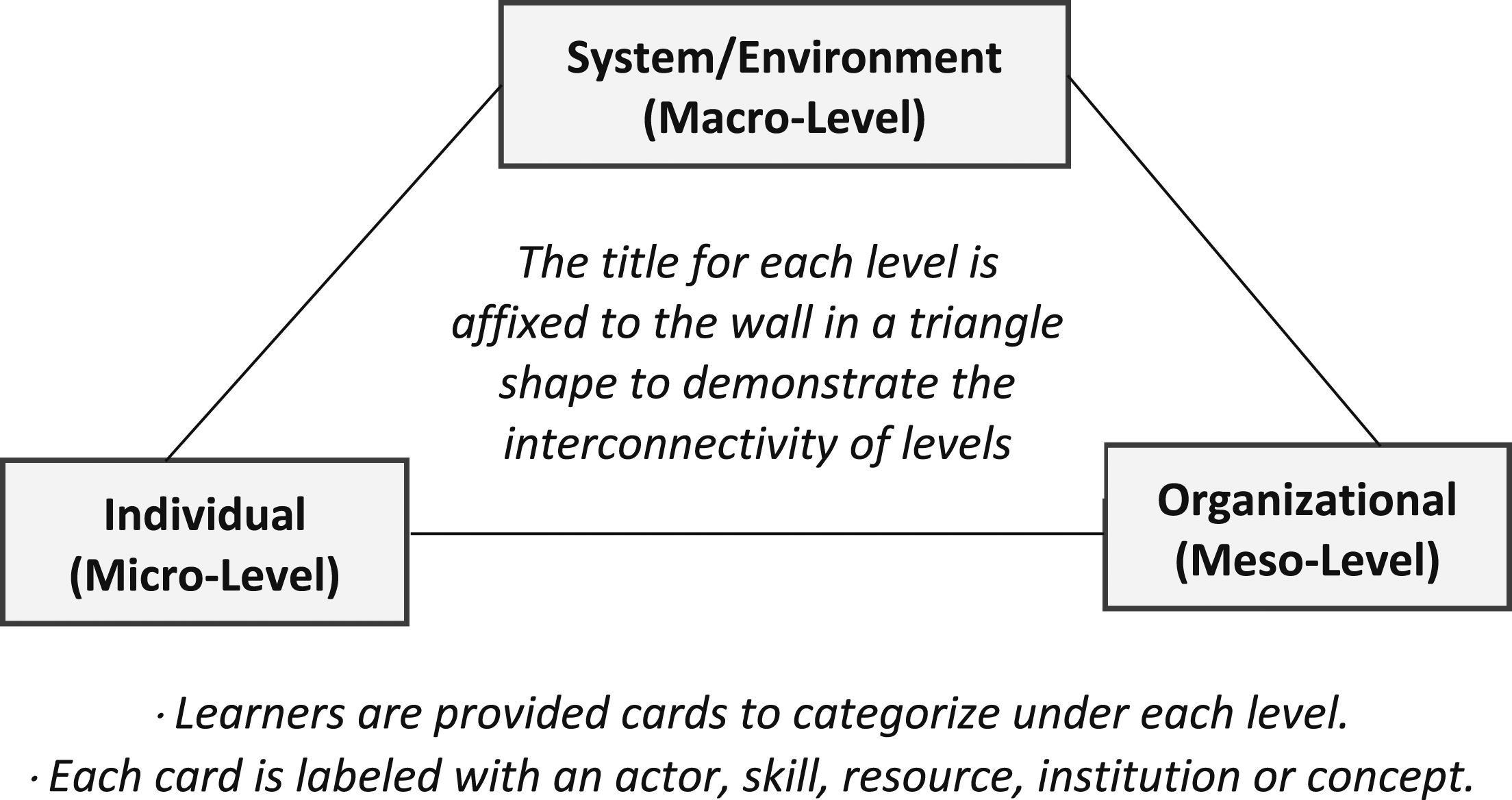
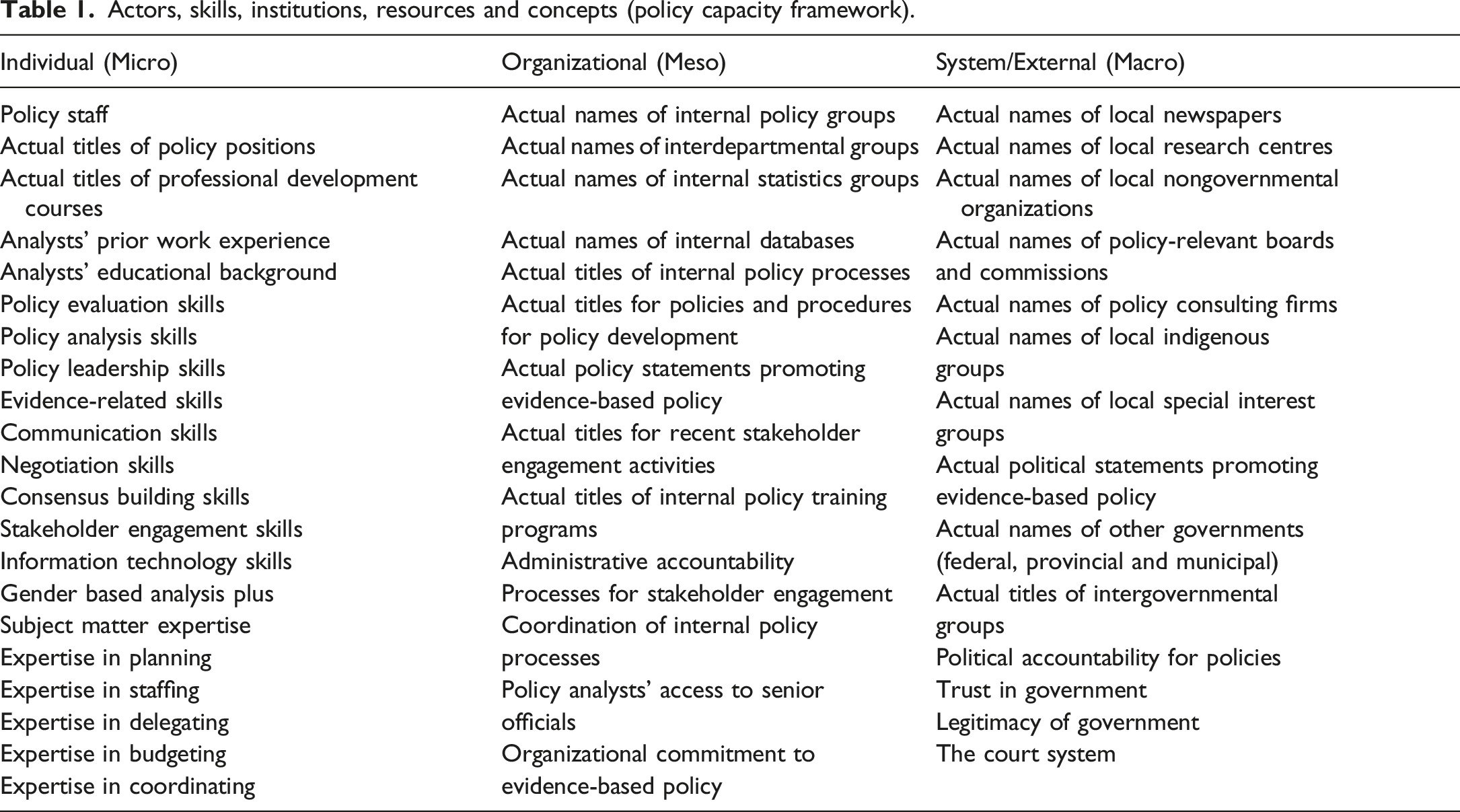
For the purposes of the workshop, actors were considered to be, for example, an individual or individuals, a legal entity or a social group (Knoepfel et al., 2011, p. 39). Skills were considered to be abilities associated with analytical capacity (e.g., policy analysis), operational capacity (e.g., expertise in staffing, coordinating and planning) and political capacity (e.g., skills in communication and consensus building) (Wu et al., 2018). Resources were considered to be materials, actions or strategies that enable effective public policy development such as processes for collecting data, availability of policy personnel, intergovernmental groups and systems for stakeholder engagement (Wu et al., 2018). Finally, concepts were considered to be “cognitive groupings” or “classes of items”, such as abstractions, ideas, objects, symbols or events (Klausmeier, 1992; Spitzer, 1975; Tennyson and Park, 1980).
Planning and preparation
Actors, skills, institutions, resources and concepts (policy capacity framework).
Delivery and pedagogical approaches
The workshop began with a 30-min overview of the policy capacity framework. The overview was based on the framework described in the article that was circulated prior to the workshop (Wu et al., 2015). This was perhaps the only instructor-centered learning activity that occurred during the duration of the workshop. A PowerPoint presentation summarized the key themes of the article, provided a concise definition of policy capacity, and presented a visual presentation of the framework developed by Wu et al. (2015, 2018). Key slides are shown in Figure 2. Presentation slides. Source: Wu et al. (2015).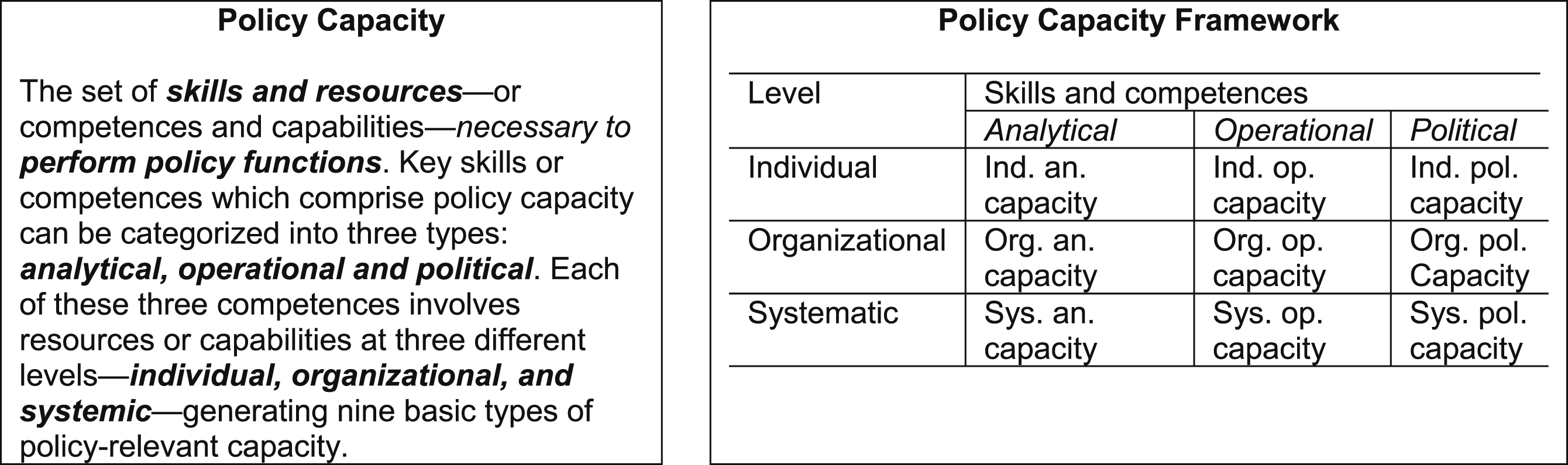
A subsequent slide presented a definition for each of the nine basic types of policy-relevant capacity. This slide remained visible throughout the workshop, so that participants could refer to it when completing the card-sorting activity.
Aside from the 30-min introduction, where I as the facilitator reviewed the policy capacity framework, the workshop was informed primarily by a collaborative and constructivist pedagogical approach. The collaborative approach stresses that “students who work together learn more and retain more” (Howard, 2001: p. 54). It is an approach to teaching which departs from individualist styles of instruction, and instead focuses on small-group discussions and collective problem solving, where the “teacher” acts more as a facilitator (see Howard, 2001; Scott et al., 2020). The constructivist approach emphasizes that students acquire knowledge best from being active in the learning process and authentic experiences that allow for meaning- and sense-making (Brown and King, 2000; Lattuca, 2005). Furthermore, this pedagogical approach promotes the idea that learning should be situated in and reflect local contexts and real-world examples (Brown and King, 2000). Constructivist pedagogies appear to have gained some traction in the teaching of public administration, political science and policy, with articles highlighting how instructors have integrated constructivist pedagogical principles into course design (Howard and Brady, 2015) and used constructivist elements when teaching diverse groups of students (Moseley and Connolly, 2020) and public officials (Silva-Robles and Dutton-Treviño, 2022).
Elements of the workshop which aligned with the collaborative pedagogical approach included the card-sorting activity where participants had to review and discuss each actor, skill, institution, resource and concept and decide which aspect of policy capacity it aligned with (micro, meso or macro). During this activity, participants engaged with one another, and debated and discussed policy capacity and the appropriate category for each card. Critical thinking, regarding both the policy capacity framework and the items labelled on cards, emerged throughout the discussions. Ultimately, groups tended to arrive at a common understanding of how and why the actor, skill, institution, resource or concept aligned with the framework. The constructivist pedagogy led the participants to be “active” in the process of their own learning (both mentally and physically). Having participants physically affix the cards on the wall under the associated policy capacity framework element constructed a common visual that groups agreed with and understood. As the group discussions continued, earlier categorizations were revisited and rearranged on the wall as needed. As such, the participants’ understanding of policy capacity theory was constructed and seemed to become more precise as the activity progressed. Furthermore, using examples of local actors, institutions and resources helped to increase the relevancy of the activity to each participants’ day-to-day work.
During the final 30-min debrief exercise, participants discussed what they learned. I guided a discussion to encourage participants to think about other actors, skills, institutions, resources and concepts that were relevant to the policy capacity framework.
Reflection and future considerations
The policy environment and frameworks for future analyses
It appeared that many participants not only gained new knowledge about policy capacity theory, but also the local policy environment and the micro-meso-macro framework. Many participants commented that, prior to the workshop, they were unaware of several institutions and resources that were included in the card-sorting activity or how they related to policy capacity and public policy. According to the literature, knowledge of the policy environment is an essential competency for policy analysts (Hewison, 2007; Longest, 2004; Malone, 2005). Harold Lasswell himself, known as the founder of the policy sciences discipline, stressed the importance of analysts understanding both the empirical and social-subjective elements of their local environments; what he called having a “contextual orientation” (Torgerson, 1985). In sum, knowledge of the policy environment allows policy analysts to make sense of complex situations (see Milne, 2015), as well as understand, respond to and shape policy environments (Longest, 2004), and ultimately develop public policies that are more likely to achieve their intended goals. The micro-meso-macro framework which structured the card-sorting activity also provides the opportunity for analysts to learn about a tool which can be used in future policy analyses. Commonly applied in economic and sociological contexts (e.g., Dopfer et al., 2004; Serpa and Miguel Ferreira, 2019), the framework allows analysts to dissect problems and solutions to identify constituting elements at the individual, organizational and societal levels (and relationships between the various levels). Therefore, in the future, the workshop should be considered as a mechanism to introduce civil servants to the concept of policy capacity, increase knowledge of the local policy environment and provide an opportunity to learn about a new tool for policy analyses.
Concept-focused workshops
Teaching concepts and theories to public administrators supports the effective design and delivery of government initiatives, policies, programs and services (see Cunningham and Weschler, 2002). Policy capacity is but one of many public administration concepts that can be taught using a workshop with civil servants. Civil servants often have to navigate a broad range of policy options, social relationships, questions, as well as politically- and emotionally-charged situations (Cunningham and Weschler, 2002). Public administration concepts therefore provide important context, guide posts and explanations which can assist with developing solutions for wicked problems.
Four-step process to teach concepts.
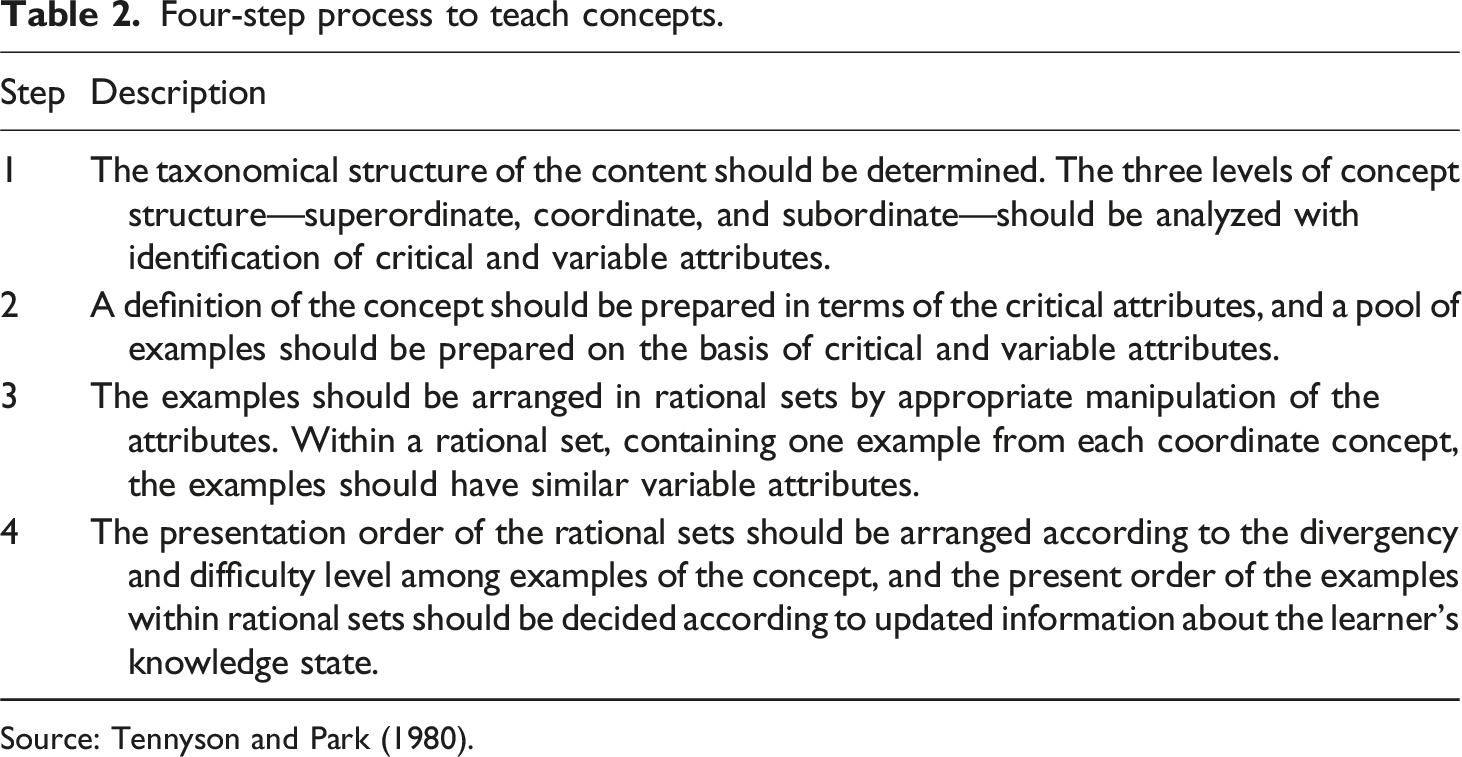
Source: Tennyson and Park (1980).
Furthermore, longitudinal studies of participants who have completed policy capacity training programs should be completed to shed light on the longer-term effects and consequences for policy development skills.
Pedagogy
Through designing, delivering and now reflecting on the workshop, the importance of understanding pedagogical approaches and pedagogic theory when providing training to civil servants (and other learners) is demonstrated. When I set out to design the workshop, I drew on my own past experience as a student in classrooms and the methods that my previous instructors used to deliver lessons. Not having a degree or training in educational instruction meant that I was unsure of the effectiveness of the design and delivery elements I was proposing. It was only after the workshop, when I reflected, that I discovered how elements of a collaborative and constructivist pedagogy were indeed present. As noted in earlier work on training in the public administration context (Cameron, 2022), it is recommended that civil servants who deliver peer-to-peer workshops and other interventions are supported to complete training in adult education, instruction and pedagogy. 1 Further to this point, there is a long history of debate, discussion and guidance regarding pedagogy which could be introduced to public administration graduate students (e.g., Hall, 1905; McDonald, 2023; Watkins and Mortimore, 1999), some of whom may be leading tutorials with undergraduate students or later be required to train their colleagues in the public service. Methods of delivery and learning outcomes would be enhanced by civil servant facilitators and peer instructors having a better understanding of adult education approaches and techniques.
Lessening the theory-practice divide
Finally, it is worth quoting Handley (2005) at length to reflect on the workshop’s role in lessening theory-practice divides. Public administration has traditionally been described as a field in which practitioners and academics work together to produce new and different ways to enhance government operations and to increase understanding of the administrative role within the public sector. Although there is a joint working relationship between academics and practitioners in public administration, some have raised the argument (or implied) that there is a clear and inherent separation between the two that is based on the difference between theory and practice. Most often, this separation occurs when practitioners are enrolled in public administration courses, where it is usually seen as the professor’s job to clearly link theory and practice and to illustrate the importance and practical applicability of theory in the public-sector workplace. (p. 624)
As opposed to assigning the job of linking theory and practice to a professor, PhD students who are also civil servants can be utilized by their government employers to transfer what they are learning to their colleagues. My experience designing and delivering the workshop highlighted several important ways that theory-practice divides can be lessened in public administration. First, by circulating a theoretical article prior to the workshop, an element of scholarship was introduced. Second, by explicitly structuring the workshop based on a theoretical framework developed in academia (i.e., policy capacity), learners were able to make real-world connections between theory and their own practice. Finally, myself being a PhD student at the time of the workshop allowed me to transfer what I was learning at university to my colleagues. Like others have noted (e.g., Lloyd-Williams, 2012), completing a PhD in public administration or policy while employed as a civil servant promotes reflection and reflexivity, increases one’s knowledge of matters relevant to governance and government, and improves practice.
Conclusion
This article has provided an overview of one method to teach policy capacity to civil servants. It highlights how theory from education (e.g., pedagogy), policy studies (e.g., policy capacity) and other disciplines (e.g., the micro-meso-macro framework) can be involved in peer-to-peer learning and introduced to civil servants using examples from their local contexts. This type of workshop provides participants with the opportunity to learn about theory and improve their understanding of the local policy environment. Practitioners in other jurisdictions may be interested delivering, adapting or improving this workshop to increase knowledge of policy capacity and other public administration concepts in their respective jurisdictions.
Footnotes
Declaration of conflicting interests
The author(s) declared no potential conflicts of interest with respect to the research, authorship, and/or publication of this article.
Funding
The author(s) received no financial support for the research, authorship, and/or publication of this article.
