




Abstract
This study aims to explore the role of a doctoral supervisor in doctoral candidates’ state of methodological preparedness within a specific disciplinary and institutional context. The number of doctoral graduates per million is commonly used as an indicator of progress to high-level competence and growth, and has become a global policy priority. The throughput rate of doctoral candidates is closely associated with their methodological preparedness, for which doctoral supervision is one of the key antecedents. While several studies have explored supervisory qualities as perceived and experienced by doctoral candidates, the supervisor’s role, as perceived and experienced by supervisors themselves, appears to be under-researched. This study aims to provide a deeper understanding of this role from both the supervisors’ and doctoral candidates’ perspectives. This study departed from the view that researchers and participants share the world of doctoral supervision. Hence, we used phenomenology as an approach to the world of doctoral supervision, employing the Interpretive Phenomenological Analysis (IPA) method to understand how doctoral supervisors and candidates make sense of their lived experiences of doctoral supervision. We deliberately decided against survey studies as used in related studies. Although previous research utilised the ‘voyage by ocean’ metaphor concerning doctoral education, this study extends the discourse by applying an interpretive phenomenological design to provide a rich description of the supervisor’s role as a coastguard within the context of an open distance learning institution. Doctoral supervisors perform a coastguard role in ensuring that candidates meet the regulatory requirements for their doctoral voyage, are timeously rescued and supported during their voyage, receive the necessary navigation assistance to reach their destinations, and are cared for in a humanitarian way. We recommend that a similar study be conducted on a large scale and in different contexts to further inform the enhancement of doctoral candidates’ methodological preparedness.
Keywords
Introduction
The number of doctoral graduates per million in a country is commonly used as an indicator of a country’s progress towards attaining the high-level competence needed for innovation and growth in productivity (Khuluvhe et al., 2021: 14). Hence, an increased number and quality of doctoral graduates has become a global policy imperative (European University Association, 2007: 5; Loxley and Kearns, 2018: 827; Nega and Kassaye, 2018: 6). This may be one of the reasons why the challenge of optimising doctoral candidates’ throughput rates has been widely investigated by scholars. Amongst the various identified factors that may influence throughput rates is the influential role of the doctoral supervisor in facilitating doctoral candidates’ preparedness for their studies (Corcelles et al., 2019: 926, 929 Crumb, 2022; Helfer and Drew, 2019; Krauss, 2017; Lee, 2018; Loxley and Kearns, 2018: 832; Nega and Kassaye, 2018; Parker-Jenkins, 2018; Peltonen et al., 2017; Prieto et al., 2022).
A recent study on supervisory qualities amongst 698 doctoral students of all disciplines across 15 Australian universities revealed that these students value “human traits consistent with emotional intelligence and … the professional aspects of supervision especially in relation to [the] research process” (Davis, 2019: 432). Furthermore, the students valued the supervisor’s role in “the setting of goals and deadlines in the context of realistic expectations and a clear sense of intellectual engagement and support” (Davis, 2019: 447). While the supervisor’s role in this relationship is well-documented, the process of performing this role is under-documented, leading Davis to suggest research on the perceived role of supervisors in this supervisor-supervisee relationship (2019: 432).
In taking up the suggestion by (Davis, 2019: 432), this article reports on an interpretative phenomenological study of doctoral supervisors’ role in their students’ state of methodological preparedness as experienced by both supervisors and doctoral candidates within the context of a single discipline (Public Administration), a single university (an Open and Distance eLearning institution), and a single country (South Africa). While the phrase ‘methodological preparedness’ is not widely utilised in the literature, we apply this concept in the current study in referring to doctoral candidates’ ongoing and fluent competence in making independent methodological decisions relevant to their doctoral studies (Thani, 2018: 237).
The personal, institutional and theoretical setting of this exploration is provided first. Secondly, we report on the methodological considerations for this study, followed thirdly by an introduction of the ‘voyage by ocean’ metaphor to describe the lived experiences of doctoral candidates (the captains in this metaphor) and supervisors in the latter’s coastguard role concerning doctoral candidates’ methodological preparedness. Fourthly, we report on participants’ interpretation of their lived experiences within their authentic contexts, as well as within the context of the existing literature in doctoral supervision. Although previous studies utilised the ‘voyage by ocean’ metaphor concerning doctoral education, this study extends the discourse by applying an interpretive phenomenological design to provide a rich description of the supervisor’s role as a coastguard within the context of an open distance e-learning (ODeL) institution. The scene for the study on which this article reports is set next.
Setting the scene
This study was situated within three overlapping contexts: the personal lived experience of the authors, the under-researched disciplinary, institutional and country-specific context, and the well-established theoretical setting. While this study was motivated by our lived experiences within the subject-specific, institutional and country-specific contexts, the exploration of the doctoral supervisors’ role was undertaken in an attempt to enrich the theoretical setting with empirical facts and insights. All three contextual dimensions are pivotal for a considered and nuanced sense-making process within an interpretative phenomenological design. The next section describes our personal lived experience as the first context.
Personal
We (XCT, RGV and JSW) are situated in a shared institutional context. RGV and JSW, seasoned doctoral supervisors in the institution, were XCT’s doctoral supervisors. As supervisors and researchers, we share an interest in the topic, but also the world of doctoral supervision.
I (XCT) joined the Department of Public Administration and Management at the University of South Africa in 2007 as a postgraduate assistant. I became involved in the department’s higher degrees committee and fulfilled the responsibilities of a secretariat for the committee. Subsequently, I liaised with registered doctoral students in the department as they were submitting their research proposals to me as the committee’s secretariat. I also communicated the academic experts’ and committee’s feedback on the proposals to the students. During this time, doctoral students informally shared their anxieties with me. I observed the various difficulties and uncertainty doctoral students were experiencing as they refined their research proposals. Due to my prolonged engagement with the doctoral students, I realised they were facing challenges relating to their methodological preparedness at the time of enrolment. This was an unexpected realisation because I assumed doctoral students would be more methodologically prepared. This realisation compelled me to reflect further on the state of doctoral students’ methodological preparedness, resulting in my doctoral research and thesis (Thani, 2018). This article extends my doctoral study by focusing on the doctoral supervisor’s coastguard role in doctoral candidates’ state of methodological preparedness.
Open distance elearning in South Africa
While the South African government’s target for doctoral graduates was set at more than 100 per million people for the year 2030, the figure was only 59 in 2019 (Khuluvhe et al., 2021: 33). The implication is that only 0,2% of the country’s population has attained a doctoral degree – a low percentage compared to Austria (1.3%), Belgium (1.6%), Hungary (0.7%), and the United Kingdom (2.0%)) (Khuluvhe et al., 2021: 33). Within the 2017 academic year, no fewer than 22 572 students enrolled for doctoral degrees in South Africa (DHET, 2019: 13), of which 661 enrolled at the University of South Africa (Unisa) (Unisa, 2020: 45), the institution to which we are affiliated. Compared to the 14.7% average Public Administration doctoral graduation rate of public higher education institutions in South Africa, Unisa’s graduation rate is only 9.3% (information obtained on 25 March 2021 from the Unisa Department of Institutional Intelligence). As the largest OdeL institution in Africa, Unisa has evidently under-performed in terms of doctoral candidates in Public Administration’s graduation, compared to other South African universities. The need for a deepened understanding of this state of affairs serves as justification for selecting this institution as a case for our study, within the broader theoretical context discussed next.
Theoretical setting: Role of the supervisor in doctoral candidates’ methodological preparedness
The doctoral supervisor’s role within the supervisory relationship has been well-researched. A common assumption of these studies has been that this relationship is a necessary condition for “better research outcomes and, by implication, a positive impact on attrition rates” (Howells et al., 2017: 621). These studies are all interested in enhancing this relationship by understanding, amongst others, supervisors’ and doctoral students’ perceptions and expectations of their respective roles and activities (Ali et al., 2016; Davis, 2019; Orellana et al., 2016; Parker-Jenkins, 2018; Pyhalto et al., 2015), the role of human traits such as gratitude and care in the relationship (Davis, 2019; Howells et al., 2017), and the coordination and facilitation of this relationship through learning management systems (Hanna, 2015). A brief review of these studies revealed that this relationship is initiated, built, and strengthened within the immediate context of the doctoral journey. This relationship is defined by (Pyhalto et al. 2015: 5) as “an arena for mediating disciplinary traditions, practices, cultures and norms”. The relationship seems to be a key factor in the successful completion of a doctoral study (Howells et al., 2017; Orellana et al., 2016: 88) and a “determinant of quality supervision” (Ali et al., 2016: 228).
Hanna (2015: 8) acknowledges the complexity of the student-supervisor relationship due to “gaps between experiences and expectations in supervisory styles, feedback and exposure to research and career networks”. This is confirmed by studies conducted by Orellana et al. (2016) and Raffing et al. (2017), who found a discrepancy between the students’ and supervisors’ expectations in the supervision process. (Parker-Jenkins, 2018: 61) also admits that challenges in the relationship are caused by “differences in expectations”. However, the literature has also shown that this relationship is characterised by several distinct attributes, such as the candidate’s guidance through the formal research process towards completion, feedback on submitted work, theoretical and methodological advice, scholarly mentoring, and emotional support. These attributes are discussed next.
Guidance through the formal research process toward completion
This first attribute of this relationship seems to be the goal of ensuring the successful completion of the candidate’s journey. (Gonzalez-Ocampo and Castello 2018: 8) found that students expect supervisors to encourage them “to advance their research”. This expectation is congruent with various studies on doctoral students’ experiences with the supervision relationship (Helfer and Drew, 2019; Howells et al., 2017; Pyhalto et al., 2015).
Despite reasonable agreement on the completion purpose of this relationship, Helfer and Drew (2019): 504) report on different expectations in how this should be achieved; some students expect supervisors to “continuously contribute and actively participate in their research projects”, while supervisors may expect students to work independently. While there might be a general agreement that supervisors are not expected to be overly involved in their students’ research projects, Gonzalez-Ocampo and Castello (2018) claim supervisors may be expected to provide skills, resources and coping strategies to their candidates during the doctoral journey. It goes without saying that unclear expectations may lead to negative experiences in the research process (See Davis, 2019: 447). With the sometimes-conflicting expectations of the nature of this supervisor-supervisee relationship in mind, Helfer and Drew (2019: 514) emphasise the need to clarify mutual expectations in the early stages of the doctoral journey. They provide a useful list of expectations to be clarified, such as “the extent and level of direction given, the level of independence expected of the student, preparation for, frequency and manner in which consultation will occur and feedback that will be provided” (Helfer and Drew, 2019: 514).
Furthermore, the literature revealed several task-specific attributes of the guiding role of the supervisor. (Orellana et al., 2016: 98), for example, hold the view that supervisors should “take responsibility for the development of research competencies” among their doctoral students. Similarly, (Gonzalez-Ocampo and Castello, 2018: 300) refer to the expectation that supervisors guide and advise their doctoral students on the “methodological procedures and theoretical aspects involved in the research project”. The literature has furthermore shown that for supervisors to fulfil their expected guiding role in the supervisory relationship, they need to be knowledgeable, sharing, skilled and experienced supervisors (Davis, 2019: 447; Helfer and Drew, 2019: 514; Pyhalto et al., 2015: 9). While a general agreement seems to exist on the supervisor’s guiding role, the extent of this role has not been clearly articulated. One of the expected guiding activities of a supervisor is the feedback provided to candidates on their submitted work.
Feedback on submitted work
Providing feedback to doctoral students on their submitted work, as the second attribute of doctoral supervisors’ role, is widely accepted as one of the key functions of a doctoral supervisor. In this regard, (Davis, 2019: 434–435) refers to a survey of postgraduate students in the United Kingdom revealing that timeliness and quality feedback is regarded as one of six indicators of an ideal supervisor. Similar results were obtained in a study amongst doctoral students in the United States of America, confirming that an ideal supervisor is one that provides quality feedback (Ferreira, 2006). A recent study amongst doctoral students in Australia also confirmed feedback as one of the main qualities of effective supervision (Helfer and Drew, 2019: 514). (Helfer and Drew, 2019: 514) argue that poor quality supervision affects “time to graduation and increasing dissatisfaction level”. However, while a general agreement may exist on feedback as an attribute of the supervisory relationship, the nature and extent of the feedback in this relationship need some context-specific exploration.
Theoretical and methodological advice to facilitate methodological preparedness
Various studies have been conducted on doctoral candidates’ state of preparedness for their studies (Howells et al., 2017; Mouton et al., 2015; Parker-Jenkins, 2018). Whereas the phrase ‘methodological preparedness’ is not widely utilised in the literature, the concept ‘methodological preparedness’ has different time and task dimensions within different contexts of application, such as at the time of “prospective candidates” (Mouton et al., 2015: 3) enrolment, before “weekly meetings between supervisor and student” (Howells et al., 2017: 627), or emerging preparedness through “the development of the supervisor-supervisee relationship” (Parker-Jenkins, 2018: 59).
The task dimension of methodological preparedness includes the formulation of suitable research problem statements (Ismail and Meerah, 2012), meaningful research questions (Page, 2001), the selection of relevant and appropriate research strategies (Ismail and Meerah, 2012; Labaree, 2003) and methodological approaches (Leonard and Fennema, 2008). The supervisor’s role in doctoral candidates’ methodological preparedness is primarily of an advisory nature. While literature seems to be clear about this advisory role, the boundaries between advising and directing have, on the face of it, not been explored. In addition to the supervisor’s theoretical and methodological advisory role, the literature provides an additional attribute, namely that of a mentor.
Scholarly mentoring
In a study on the influence of mentorship and research engagement on the success of doctoral candidates, (Bagaka’s et al., 2015: 325) identified mentoring as part of the doctoral supervisor’s dual role as advisor and mentor. It includes activities such as teaching, coaching, professional guidance and scholarly exposure. In another study on the doctoral mentoring relationship, (Flora 2017: 219) eloquently articulates this role as a “rich experiential education and learning opportunity” for instilling scholarly leadership in the doctoral candidate. To promote the doctoral candidate’s envisaged leadership role, the supervisor’s role in exposing the candidate to national and international networks and the wider research and scholarly community is pivotal (Corner et al., 2017: 92). By becoming part of the research community, doctoral candidates not only benefit from the social, collegial and fair support structures of the broader scholarly community (Corner et al., 2017: 101; Peltonen et al., 2017: 159), but start preparing for an envisaged role as scholarly leader. Ultimately, the mentorship role is clearly one of creating experiential and learning opportunities for doctoral candidates, not directing and controlling. Considering the well-documented challenges to which doctoral candidates are exposed during the doctoral journey, the supervisor is also expected to provide emotional support when necessary.
Emotional support
The expectation that doctoral supervisors provide emotional support to doctoral candidates is widely documented in the scholarly literature (Corner et al., 2017: 94; Davis, 2019: 436; Gonzalez-Ocampo and Castello, 2018: 299; Helfer and Drew, 2019: 507; Howells et al., 2017; Peltonen et al., 2017: 159). As indicated earlier in this article, Howells and co-authors use the notion of ‘gratitude’ in referring to “both an inner attitude and a conscious practice, focusing on relationships between supervisors and students, and between students themselves” (Howells et al., 2017: 625). Gratitude practices are thus not restricted to the supervisor’s role in this relationship, but all role-players. Emotional support is characterised by, inter alia, friendliness, empathy, approachability, trust, care, listening, and an honest interest in the candidate’s work, demonstrated by timely and constructive feedback. These characteristics contribute to doctoral candidates’ positive experiences of their journey and successfully completing their doctoral studies (Peltonen et al., 2017: 66). Ultimately, gratitude and emotional support constitute an act of caring and enabling, and not controlling.
The theoretical setting to gain an understanding of the doctoral supervisor’s role in the supervisory process postulates four attributes of this role, namely that of a guide, feedback provider, theoretical and methodological advisor, mentor and provider of emotional support and gratitude. These attributes are supported by extensive research in countries like Australia, the United Kingdom, the United States of America, the Republic of Ireland, Colombia, Spain and Finland, to mention just a few. Motivated by the personal, country-specific and institutional setting discussed earlier in this section, this article reports on a study conducted to obtain a deepened understanding of the doctoral supervisor’s role in the supervisory relationship within the context of a specific academic subject, higher education institution, and country. The methodological considerations for this study are presented next.
Methodological considerations
The aim of this phenomenological study was to explore Public Administration doctoral candidates’ methodological preparedness within an OdeL institution in South Africa. However, this article reports on the findings of only one aspect of this study, namely doctoral supervisors’ role in doctoral candidates’ methodological preparedness. Considering our shared being-in-the-world of supervision in the particular institutional setting, we realised the necessity of exploring and describing the lived experiences of both doctoral candidates and doctoral supervisors within this setting. Notwithstanding previous research on the supervisory relationship and the subsequent theoretical propositions about the supervisor’s role within this relationship, we opted for an exploratory method, allowing for things to manifest without theoretical influences. To this end, we decided on phenomenology as an approach to the “being of entities” (Heidegger, 1962: 61) without theoretical preconception (Heidegger, 1988: xvii). Thus, it is an approach that allows “things [to] manifest themselves” (Richardson and Heidegger, 2003: xiv). Within this approach, we selected Interpretive Phenomenological Analysis (IPA) as a method to understand “how people make sense of their life experiences” (Smith et al., 2009: 13). This method was selected for its primary focus on and closeness to understanding the lived experiences of human beings within “the context of time, place and situational influences” (Smythe et al., 2008: 1392). By choosing this approach and method for obtaining a deeper understanding of the research phenomenon, we deliberately decided against survey studies, as used in related studies (see for example Davis, 2019; Helfer and Drew, 2019; Pyhalto et al., 2015).
Participant selection
The goal of qualitative research is to present a thorough description that includes multiple views from participants and the setting. The intent is to purposefully select “participants and sites … that will best help the researcher understand the problem and the research question.” (Creswell and Creswell, 2018: 185). This does not suggest a large sample size, rather, transferability is promoted through a description of the setting, the participants, the events and the process (Creswell and Creswell, 2018: 186).
The population for this study consisted of doctoral candidates and doctoral supervisors. All Public Administration doctoral candidates registered during the period 2000 to 2015 at the selected OdeL institution were included in the population. Choosing a period of 15 years assisted us in purposively selecting 25 candidates belonging to three categories: Public Administration doctoral candidates who (a) were registered at the time of the study (9 candidates), (b) had terminated their studies before completion (8 candidates), and (c) successfully completed their studies (8 candidates). By doing so, we recognised the importance of diverse and context-specific experiences of the phenomenon under study. In addition, we included all doctoral supervisors affiliated with the institution supervising Public Administration doctoral candidates at the time of the study. Ten of the 13 active supervisors of the Department of Public Administration and Management availed themselves to participate. The above participant groups were thus purposefully selected to represent “information-rich cases” (Pietkiewicz and Smith, 2014: 10).
After receiving research ethics approval and institutional permission to undertake this study, prospective participants were invited to participate: the candidates telephonically and the supervisors by email. Those willing to participate received an information sheet and signed a consent form to promote voluntary informed participation in the study.
Data collection
XCT collected the data via semi-structured interviews (lasting 45–60 min each) to reflect a specific time and task dimension, with the initial focus on the candidates’ methodological preparedness at the time of enrolment (Mouton et al., 2015, 3). Naïve sketches (2-3 pages each) complemented the doctoral candidates’ interview data. A naïve sketch is “a candid description such as an essay, short story or notes” (Giorgi, 1985, 48). In light of doctoral supervisors’ workload, they were not required to complete the naïve sketches.
The following open-ended questions were posed to each participating doctoral candidate during the interview and in the naïve sketch to acquire their authentic experiences of the supervisor’s role in their methodological preparedness: • Reflecting on your experience as a doctoral candidate, how prepared were you regarding the research methodology (design and methods) at the time of enrolment? • What would have facilitated your methodological preparedness at the time of enrolment?
In addition, the participating doctoral supervisors’ authentic experiences of their candidates’ methodological preparedness were obtained through the following open-ended interview questions: • How methodologically prepared were your doctoral students when they enrolled for their doctoral studies? • Reflecting on your own supervision experience, what is needed to facilitate the methodological preparedness of doctoral candidates in this department?
Data analysis and interpretation
The participants’ lived experiences, as documented in the original interview transcripts and written naïve sketches, were analysed by following the four-stage approach of (Pietkiewicz and Smith, 2014: 12–13) • Initial stage: Reading the original transcripts several times and making notes. • Second stage: Identifying emerging themes that contain enough abstraction to offer a conceptual understanding. • Third stage: Finding patterns in the emerging themes and producing a structure that was helpful in highlighting converging ideas. At this stage, the voyage by ocean metaphor was realised and adopted. This metaphor was used to construct the reality of the participants. • Fourth stage: Compiling a table of themes, showing the major and subthemes, keeping the voyage by ocean metaphor in mind.
Following the example of other qualitative researchers, a literature control was conducted to re-contextualise the findings into existing scholarly literature (Havenga et al., 2014; Lazarus et al., 2012). This was done to demonstrate the usefulness and implications of the findings for the existing scholarship. Furthermore, strategies were employed to ensure the study’s trustworthiness, focusing on truth value, applicability, consistency, and neutrality (See Johansen et al., 2019; Smythe et al., 2008).
Within the context of all the theoretical considerations discussed above, we carefully and respectfully embarked on a process of sense-making on which we report next.
Lived experiences of supervisors’ role in doctoral candidates’ state of methodological preparedness
While the purpose of this article is to make sense of supervisors’ role in doctoral candidates’ state of methodological preparedness, this process was informed by participants’ responses to the broad questions posed to them. Although no direct question on the supervisor’s role was posed to the participants, both categories of participants were probed on their experiences of what may be necessary to enhance doctoral candidates’ methodological preparedness. We analysed interview records through the adopted process of (Pietkiewicz and Smith, 2014, 12–13). This sense-making narrative was preceded by several readings and re-readings of the original transcripts, leading to the identification of emerging themes with adequate levels of abstraction necessary for conceptual understanding. Hence, the emergence of a voyage by ocean metaphor.
The use of metaphors has become a powerful feature of scholarly sense-making (Barnard, 2018), with the metaphor “doctoral journey” being widely used (Corcelles et al., 2019; Corner et al., 2017; Hughes and Tight, 2013; Lofstrom and Pyhalto, 2017). The richness and versatility of this metaphor for our study have been well demonstrated by (Hughes and Tight, 2013: 765), who describe a doctoral journey as the doctoral student’s “experience of change, difficulty and progress in doctoral studies”. They extend the metaphorical possibilities of this journey to “an excursion, a voyage or a spiritual quest” (Hughes and Tight, 2013: 766). Informed by our context-specific observations and the results of the semi-structured interviews, we realised that the doctoral journey is sometimes unpredictable and highly challenging. Hence, we followed Batchelor and Napoli’s (2006) example in selecting the rich metaphor of a voyage by ocean to analyse the data of the current study.
The voyage by ocean metaphor
In their article on the doctoral journey, Batchelor and Napoli (2006:13) frame a voyage as a process of experimenting with various possibilities to gain an understanding and entry to unknown territories. The lived experiences of doctoral candidates fit this description. While we have not fully replicated their unpacking of the metaphor regarding the two directions of the voyage (out and back), their study nevertheless informed the distinct stages of our metaphor to depict a supervisor-supervisee relationship.
Within the four stages of this metaphor, various contextual descriptions are provided (e.g., the ocean and the harbour) within which the actions (e.g., departing, being in, preparedness and reaching the destination) of specific role-players (e.g., the captain and the coastguard) are taking place. In common language, the word ‘coastguard’ has mainly two references, namely that of “an organization keeping watch on coastal waters in order to assist people or ships in danger and to prevent smuggling” (Shorter Oxford English Dictionary, 2016), and that of “an official who is employed to watch the sea near to a coast for ships that are in danger or involved with illegal activities” (Cambridge Dictionary, 2022). For this study’s purpose, a coastguard is regarded as an individual, namely the doctoral supervisor, performing specific tasks.
The scene of the metaphorical coastguard has been eloquently described by Russell, as far back as 1984, as “a coastguard looks out to sea where he thought he saw a rescue flare go up. If the weather is clear and his point of focus not too far distant, he can be certain that he saw a flare and set forth; in fog and at great distances he is less certain. But the degree of uncertainty is the coastguard’s” (Russell, 1984: 31). He concludes his reference to this metaphor in the context of studying human beings with a remark that “the weather conditions are typically poor due to the fact that humans have the competence to be unpredictable” (Russell, 1984: 34). This metaphor provides an unpredictable human context within which the coastguard must perform some key functions.
The functions of real-life coastguards have been well-documented, especially by military researchers in the United States of America. The functions performed within the littoral context include – • regulation, to ensure marine safety preparedness for catastrophic threats, • conducting emergency search and rescue operations, • navigating assistance, and • providing humanitarian and international assistance to vessels (Alfultis, 2007: 3; Gibson, 1998: 3; Harkins, 2007: 44; Kammer, 2011: 4; United States Government Accountability Office, 2010: 29).
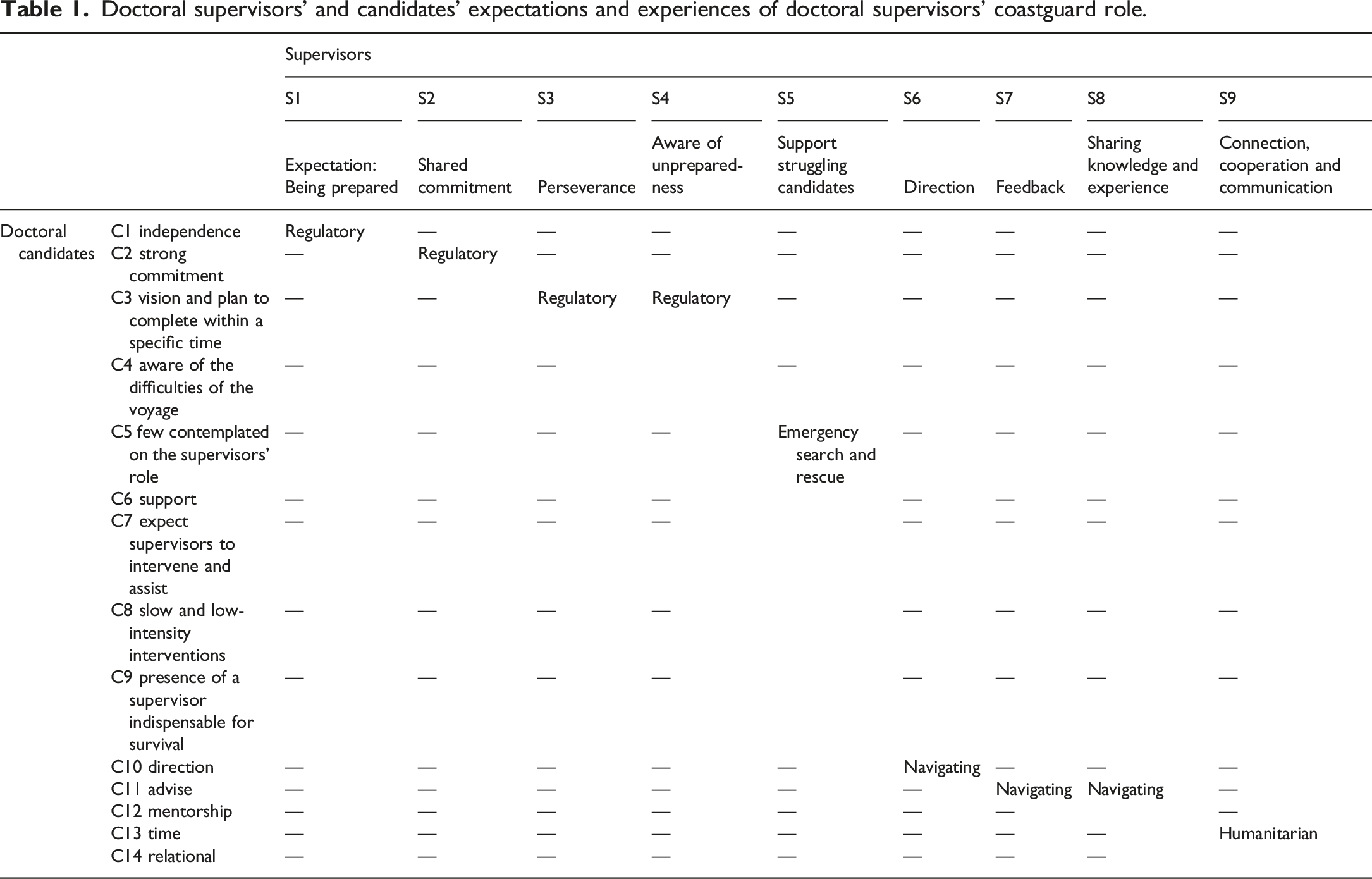
Doctoral supervisors’ and candidates’ expectations and experiences of doctoral supervisors’ coastguard role.
Unpacking the voyage by ocean metaphor.
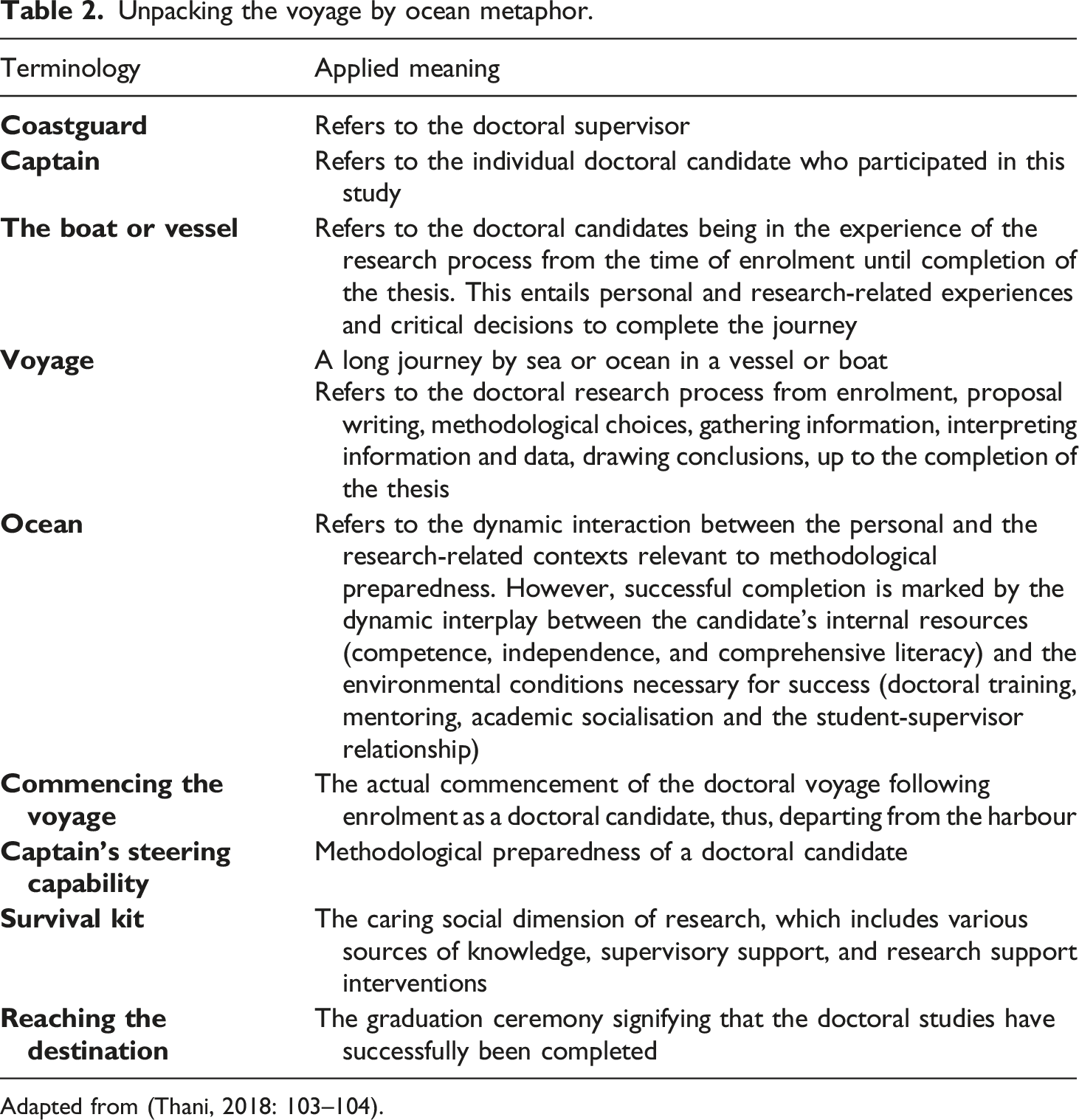
Adapted from (Thani, 2018: 103–104).
The voyage by ocean metaphor is used to structure the themes and sub-themes identified during stages three and four of the process applied by (Pietkiewicz and Smith, 2014: 12–13). Subsequently, we explored and described the participants’ (coastguards and captains) lived experiences of the coastguards’ role in the captains’ methodological preparedness to navigate and steer their respective boats through the different legs of the voyage. These experiences are described for various stages of the voyage, namely commencing the voyage, being in the experience, facing stormy waters, and reaching the destination.
Commencing the voyage
The first theme identified while reading the interview transcripts is ‘commencing the voyage’, referring to the time following the captains’ enrolment for the voyage by sea. The two categories of participants’ lived experiences during this leg of the voyage were different and justified separate descriptions.
The coastguards’ expectations and lived experiences of their roles in the captains’ respective voyages
While coastguards expected the captains to be prepared for their voyage by sea at the point of the voyage commencement, nearly all of them were disappointed with the captains’ state of preparedness for steering their boats (methodological preparedness) when they departed from the harbour. In fact, one coastguard was quite blunt in stating that while “we take [it] for granted that students are aware of the methodology they want to follow”, this awareness “is a myth” (Supervisor 3). Nearly all the supervisors confirmed this view with statements such as “I have not worked with one student that was actually prepared and knowledgeable about the methods to use” (Supervisor 4), students are “vague in terms of methods” (Supervisor 2), they do “not think methodologically” (Supervisor 3), are “not prepared at first” (Supervisor 5), have “little practical experience in methodology” and “struggle with writing” (supervisor 6), and are “unable to match the different types of research methodologies” (supervisor 7). That is probably why, “in the majority of cases … doctoral degree candidates struggle to compile an acceptable research proposal” (Supervisor 9). Informed by these shared experiences, one coastguard concluded that doctoral candidates need “gross [sic!] assistance” (Supervisor 1). The coastguards were seemingly well-aware of the captains’ unpreparedness in steering their boats into the waters under their jurisdiction, and their subsequent need for assistance and guidance from the coastguards.
While coastguards’ general experiences were that most of the captains were underprepared, they also had rare experiences of well-prepared captains. These captains were either “academics before” (Supervisor 5), “lecturers in the Department [or] involved in academic activities at a university” (Supervisor 9), completed “their master’s degree under your supervision” (Supervisor 6), “gathered from their honours degrees” some preparation (Supervisor 7), or obtained their master’s “at a very good university” (Supervisor 8). It seems that the coastguards’ positive experiences were all related to the captains’ current or previous ocean (academic) involvement.
We deduce from the above that the coastguards were aware of the captains’ state of methodological unpreparedness to make the necessary decisions for their respective boats to proceed. They were also aware of the factors contributing to the captains’ preparedness and the need for support among those captains that were less prepared.
As indicated earlier in this article, we explored the lived experiences of three categories of captains, namely those who terminated their voyage without reaching their destination, those captains who were, at the time of the study, still part of the voyage, and those who had completed the voyage by sea successfully. In the analysis of the interview transcripts and naïve sketches, two main themes emerged during the commencing leg of the voyage, namely that of positive emotional experiences and the envisioning of the destiny. The following section reports on the positive emotions experienced by the captains when they commenced their voyage.
Positive emotions experienced by the captains when commencing their respective voyages
Unlike the coastguards, the three groups of captains were seemingly unaware of the state of their methodological preparedness when entering the ocean. While most of their experiences appeared positive at the start of the voyage, the data revealed a difference in emphasis between the three groups of captains.
Those captains who terminated their voyage demonstrated strong idealistic positive emotions. For example, Faith 1 shared that she “was excited and looking forward to contributing towards the body of knowledge for future generations to further expand on my chosen topic” (Faith, naïve sketch), while Mandla was also “looking forward, energetic and motivated” to “make a contribution to the body of knowledge” (Mandla, semi-structured interview). This urge to make a knowledge contribution was also shared by Cedric, who “was really excited” about it (Cedric, semi-structured interview).
The captains who were still participating in the voyage at the time of the research also experienced positive emotions when commencing their voyage, although the emotions of some were slightly muted. Prudence (naïve sketch), for example, was “happy … to further my studies”, while Jonathan (semi-structured interview) was “overall excited … to enrol for the doctorate”. S’phiwo (naïve sketch) experienced positive emotions about the possibility of “more career opportunities” after completing the doctoral voyage. These emotions were shared by Sibusiso (semi-structured interview), who was inspired by the expectation to “go further even in my later age” after obtaining a doctorate. Kgomotso (semi-structured interview) departed on her voyage with a sense of hope that she would “learn more and … know more”.
The third group of captains involved in the research was those who successfully completed their voyage by sea at the time of the study. These captains commenced their voyage “excited to actually get to that point” (Rejoice, semi-structured interview), and excited about the opportunity to become one of “very few black people in the field of Public Administration … to pursue a PhD” (Bongani, semi-structured interview). Commencing this voyage was experienced as “an achievement that I can record at a personal level” (Sifiso, semi-structured interview). While one captain “was prepared for the challenge” (Justice, semi-structured interview), Pretty “thought it will be easier” (Pretty, semi-structured interview), indicating a possible awareness of a need for support.
The three categories of captains started their respective voyages with varying idealistic emotions. This is probably why they did not articulate any expectations for the role of their coastguards during this stage of the voyage. A second sub-theme of the theme ‘commencing the voyage’ relates to captains envisioning their destiny, which is discussed next.
The captains’ envisioning of the destiny
Our analysis of the data revealed that all captains envisioned completing the journey. Some captains started their respective journeys with a vision to complete the journey within a specific time. Gift, for example, was well-aware of the specific timeframe for completing her doctorate, namely “less than 10 years’ time” after completing her first degree (Gift, semi-structured interview). Joe wanted “to complete the degree in the years determined by the university” (Joe, semi-structured interview).
Other captains just envisioned themselves reaching their destination. While Njabulo looked “forward in achieving this doctoral degree” (Njabulo, semi-structured interview), Given envisaged himself bragging about his achievement as “a PhD for me [is] a social status thing” (Given, naïve sketch). It was only by hindsight that Fortunate contemplated, “maybe, I wasn’t prepared. Maybe I wasn’t ready, but now I know better” (Fortunate, semi-structured interview). As these captains did not seriously anticipate what it would take to reach their destiny, they also did not foresee the possible supportive role of their coastguards.
Another element emerging from the captains’ lived experiences within the first stage of their journey was a realisation of the difficulty of the envisaged voyage. While Junaid realised that “doing a PhD is not easy” (Junaid, semi-structured interview), S’phiwo expected this voyage to be “a massive project” (S’phiwo, naïve sketch). Sibusiso envisaged the voyage to be “a marathon … [requiring] time to complete” (Sibusiso, semi-structured interview). Jonathan expected “to endure the pressure that comes with being a doctoral student” (Jonathan, semi-structured interview). Bongani visualised the voyage as an opportunity to “learn more tricks and learn more aspects of research” (Bongani, naïve sketch). While the captains were aware of the difficulty of their envisioned voyage, they did not reveal awareness of the importance of the supporting role of their coastguards. S’phiwo was the only captain who foresaw the “need to know who to contact for help” and who recognised the supporting role of the supervisor by stating: “for help we usually rely on supervisors” (S’phiwo, naïve sketch).
From the above, we deduced that the coastguards, being experienced in their roles, were aware of the captains’ varying states of preparedness when commencing their voyages. Hence, they continuously assessed the progress of the boats entering their jurisdiction, as well as the preparedness of the captains to make decisions necessary for the boats to proceed. They were also aware of the factors contributing to the captains’ preparedness and the need to support those unprepared captains. However, the captains had varying experiences with their state of preparedness when commencing their voyages. While the captains had a shared focus on completing the voyage, their understanding of what was necessary to complete the journey differed. Only a few captains contemplated the coastguards’ role regarding their own state of preparedness while still in the commencing stage of their voyage. However, this mindset had changed in the next stage of the voyage, namely that of being in the experience.
Being in the experience
The second theme identified while analysing the various data sources is that of ‘being in the experience’. This theme refers mainly to the captains’ personal and voyage-related experiences steering their respective boats towards completing their journeys, as well as the coastguards’ experiences of their interactions with the captains. These experiences were closely related to how the captains made the most of their survival kits (see Table 2), enabling them to steer their boats towards their destiny. As the current article focuses primarily on the role of the supervisor, this section is confined to the participants’ lived experiences of the coastguards’ role in their state of preparedness to survive the voyage. The coastguards’ experiences are discussed first, followed by those of the captains.
The coastguards’ lived experiences of their roles in the captains’ respective voyages
Four sub-themes emerged from the analysis of the transcribed coastguards’ reflections on their role in the captains’ state of preparedness for dealing with the unfolding challenges of their voyage. These sub-themes are communication, advice, direction and feedback, consequently demonstrating the coastguards’ role in creating a caring social research dimension.
Communication: The coastguards experienced communication as a core attribute for providing supervisory support to the respective captains. One of the coastguards described communication as foundational to “the creation of a relation of trust and cooperation … [and] … a proper working relationship between supervisor and student” (Supervisor 9, semi-structured interview). Another coastguard expressed that “the students who communicates more with me … are better students … and will complete” (Supervisor 4, semi-structured interview). Communication is experienced as an opportunity for captains “to sit down … and … tell you what they want to do” (Supervisor 1, semi-structured interview), to “bleed out unconsciously” (Supervisor 2, semi-structured interview), and for coastguards “to have discussions with our students to help them” (Supervisor 7, semi-structured interview). The coastguard does not only facilitate the communication, but also, if necessary, initiates communication. Hence, “if he does not phone you … phone him and say: What is the problem? It might be a tiny thing that is blocking his progress, but you cannot be able to find that if you do not communicate, if you do not talk to him, if you do not ask him what the problem is” (Supervisor 10, semi-structured interview).
Advice: In addition to the communication attribute, some coastguards utilised communication to provide advice to the captains within their jurisdiction. A primary element of this advisory role entails directing them to the various sources of knowledge in the survival kit on board their boats. These sources include: • Doctoral theses: “I give them past theses that have been completed and that can be said they are good…” (Supervisor 1, semi-structured interview); “take four or five recent theses or dissertations, work through chapters 1 and see how they actually went about it, because they are all the same, it is like writing a letter” (Supervisor 8, semi-structured interview). • Literature on research methodology: “I refer to … the methods of gathering evidence” in order for them “to see what kind of study they want to work on” (Supervisor 5, semi-structured interview); “I usually give them some names of the books that I think are books that can be used and I also give them names of books they should avoid” (Supervisor 6, semi-structured interview); “I just request them to find literature on research methodology, not one but maybe up to five, read them, scan them and also try to understand” (Supervisor 2, semi-structured interview). • Literature on their topic: “I prefer that they do their own searches on research methodology, especially at doctoral level” (Supervisor 4, semi-structured interview); “I will advise them to look at a topic of their own interest from among the theses that have been stored in the library to say that: look at this particular chapter and look at how that particular individual has written the research design and research methodology” (Supervisor 7, semi-structured interview).
Direction: The direction role suggests the provision of research support interventions (survival kit) from the nearby involvement of the coastguards in the captains’ decisions. To this effect, “get them to your office … [and] sit with them” (Supervisor 6, semi-structured interview) has been perceived as “the only way to get the students to understand something” (Supervisor 6, semi-structured interview). One of the coastguards experienced that, while “it might be a tiny thing that is blocking [the captain’s] progress,” the coastguard needs to “ask [the captain] what the problem is” (Supervisor 10, semi-structured interview). This specific coastguard viewed the process of unblocking a captain as vital: “I often travelled in my own vehicle to Johannesburg and see a postgraduate student which could not come here” (Supervisor 10, semi-structured interview). Coastguards perceived communication and advice from a distance as insufficient to steer captains through their voyage: “In order to solve the problem we need to … actually meet with students … to have discussions with our students to help them …” (Supervisor 7, semi-structured interview). Hence, some coastguards “make an appointment with the student to come and see me and spend about three to 5 hours in the office where we run through the entire research proposal, specifically in terms of methodology and of course research objectives [and] research questions that follow after that” (Supervisor 3, semi-structured interview). Another coastguard went further by expecting captains “to come and visit his/her supervisor for a week so that the supervisor can introduce to him/her the biggest library in the world” (Supervisor 8, semi-structured interview).
Feedback: The fourth dimension of the coastguards’ role emerged as the use of communication to provide feedback to the captains on their progress. One coastguard held the view that the “close connection and cooperation between supervisor and student is important, coupled with constant interaction and feedback” as this “lead to success and making a difference to academic space” (Supervisor 3, semi-structured interview). Another coastguard had a similar experience: “I took him from a colleague who It here... This student improved very, very much when we gave him feedback” (Supervisor 7, semi-structured interview).
While the coastguards’ reflections were informed by their interactions with several captains over an extended period, the captains’ experiences were singular and related to their progress in their respective voyages. Next, we turn to the experiences of the captains who terminated their voyages before completion.
The captains’ lived experiences of the coastguard’s role during their respective voyages
Depending on where they were in their respective voyages, the captains experienced their coastguards’ role from diverse perspectives, namely that of time, relational, mentorship, support, advice, direction and independence.
Time: A primary dimension of the captains’ experiences of the coastguards’ role was identified as time. Pretty and her coastguard spent “nights working on the concepts in terms of what it means to me and my studies” and “nights as well to teach me methodology” (Pretty, semi-structured interview). Justice had similar experiences of various sessions with coastguards “to sort out this methodology … panel-beating and editing” (Justice, semi-structured interview). While these two captains specifically articulated the time dimension of the coastguards’ role, the time dimension is implicit in the other perspectives, as discussed next.
Relational: Junaid’s experience was that it is “very important to have a good relationship” with the coastguard (Junaid, semi-structured interview). Rejoice also had “a good relationship” with her “patient and very nice” coastguard, resulting in her not feeling “embarrassed to ask and say I do not know” (Rejoice, semi-structured interview). For Phumi, this was “not an easy relationship [but] … delicate” (Phumi, naïve sketch). The captains expected coastguards in this relationship to “listen and understand and be open” (Junaid, semi-structured interview) to the captain’s views, to establish “what exactly I wanted to do … [and] what could be the appropriate method … to achieve what we wanted to achieve” (Jonathan, semi-structured interview). Bongani emphasised the importance of time for “regular meetings and discussions” (Bongani, semi-structured interview) to enhance a good relationship with a coastguard. Bongani, as a fellow lecturer, had the advantage of sufficient time to build a good relationship with his coastguards. He shared “the same corridors with [his] supervisors” (Bongani, semi-structured interview). Thus, it appears the relationship dimension implies the coastguards’ role was experienced as a continual integral part of the captains’ respective voyages, rather than a one-time event.
Mentorship: Several captains experienced the need for mentorship from their coastguards: “you need a mentor to guide you” (Kgomotso, naïve sketch); “a mentor … to guide us to say whether we are on the right track or not” (Prudence, semi-structured interview). Bongani had regular meetings with his coastguards, during which he “received mentorship from the two guys” (Bongani, semi-structured interviews). Joe was used to sending his work “to my mentor so that I may get advice” (Joe, semi-structured interview). When his mentoring coastguard left the institution, he felt that “I was on my own” causing him to “struggle much because there was not someone”. For Joe, “it was not easy not having a mentor” (Joe, semi-structured interview). While the other participants did not use the concept ‘mentorship’, the way Joe used it suggests a direct relationship between the captain and the coastguard in which the coastguard had a supporting and directing role.
Support: While ‘being in the experience’ of struggling with her proposal, Faith experienced her coastguard’s remark “I support your passion” as encouraging (Faith, naïve sketch). Similarly, Mandla felt the coastguard “was there to provide support” (Mandla, semi-structured interview). Cedric also held the view that “you really need a very intense support from your supervisory team, the people that have been there” (Cedric, semi-structured interview). Closely related to and perhaps overlapping the perspective of the coastguard’s supportive role is the perspective of an advisory role.
Advise: Peter emphasised that the coastguard’s “role should be more of an advisory” nature, especially when “I might be derailing at times … so that you don’t miss a destination” (Peter, semi-structured interview). Kgomotso experienced this advisory role of coastguards as assisting captains to be “methodologically prepared” for their respective voyages (Kgomotso, semi-structured interview).
Direction: Some captains needed more than just advice, but decisive direction from the coastguard. George, for example, wished that his “supervisor could have narrowed it and say this is what you need to focus on” (George, semi-structured interview). Others had the opposite experience, namely that it “is frustrating when you spend so much time on your research proposal and your supervisor keeps on shaping the proposals but at the end it helps with the structure” (Junaid, semi-structured interview). For the captains, the coastguards’ directive role had two elements, namely time and guidance. Njabulo eloquently combined these two elements by expecting the coastguard to “give you 3 years or 4 years and say 6 months, I expect that, in November, I expect that and next year June you must be there. He/she must give you timeline … If you have a certain timeframe you will know that in 6 months I have to deliver that …” (Njabulo, semi-structured interview). Cedric referred to the guiding dimension as providing “a roadmap you really need … to get to the methodology that will really help you to get to where you really want to be” (Cedric, semi-structured interview). Isaac experienced that “my supervisors provided me with some guidance” by “pinpointing things that I needed to … I was prompted by my supervisors to go and read about the various research designs… I think [it] is a good sequence because … some students have done the research design before the literature review” (Isaac, semi-structured interview). Given’s coastguard “draw me far deeper in non-quantitative methods … [and strategies such as] phenomenology and case study … you can use in your research” (Given, semi-structured interview). Bongani had two coastguards who jointly provided direction regarding “the kind of approach that … will be the most appropriate” (Bongani, semi-structured interview). The coastguards’ directing role was experienced as “quite useful ... Because … they know what you have to do” (Gift, semi-structured interview), such as “do follow-up interviews....to complement the questionnaire” (Charles, semi-structured interview). Some captains who had not received this direction from their coastguards “got so discouraged and … left” (Fortunate, semi-structured interview).
Independence: The last dimension of the supervisory relationship experienced by captains is independence. Phumi, for example, had the experience that “the supervisor is not willing to assist you” while the supervisor actually “wants you to find it yourself” (Phumi, naïve sketch). The independence dimension of this relationship was not easy for some captains. Sibusiso explained that “I had to take the bull by the horns… I would not say I am an expert, I am still struggling even now but on average I can manage” (Sibusiso, semi-structured interview). Kgomotso similarly experienced that “you do most of the things on your own but you keep on knocking [on] your supervisors [door] to say I have read, can we put it together …” (Kgomotso, semi-structured interview).
Stormy waters
The third theme identified in the doctoral candidates’ metaphorical voyage by ocean is that of ‘stormy waters’. This theme refers to the challenges faced by these captains and their ability to survive these challenges. We report firstly on the lived experiences of the coastguards and then on the experiences of the captains.
The coastguards’ lived experiences of their own role in assisting the captains to deal with the stormy waters
The stormy waters of the captains’ respective voyages exposed their methodological shortcomings to the coastguards. One coastguard observed that some captains “do not have a good understanding of what they want to do and in terms of methodologies they are going to follow” (Supervisor 3, semi-structured interview). Thus, they embarked on this voyage without having a clear vision of what they needed to reach their destination. Another coastguard observed that while “our research is more hermeneutical”, some captains struggled with how “we read and understand” (Supervisor 5, semi-structured interview). It seems that some captains started their voyage unprepared, which became evident when they entered stormy waters. During these observed instances of unpreparedness, coastguards assisted those struggling captains.
The captains’ lived experiences of the coastguards’ role in assisting them while dealing with stormy waters
When confronted with stormy waters, the captains became vividly aware of their unpreparedness in dealing with these challenges. For Sifiso, the stormy waters started “when I commenced with my writing. It was clear that this section of research methodology is highly demanding and requires a lot of support from a supervisor to have an acceptable research proposal” (Sifiso, semi-structured interview). Other captains shared this realisation by acknowledging in nearly identical words, “I was not prepared” (Kgomotso, semi-structured interview), “I do not think I was prepared” (Isaac, semi-structured interview), “I would not say I was fully prepared methodologically” (Lethabo, semi-structured interview), “I was not well prepared” (Pretty, semi-structured interview), “I was not fully prepared methodologically” (Pretty, semi-structured interview), “I was bouncing from pillar to post trying to find information. It was just one big nightmare” (Justice, semi-structured interview). Joe stated frankly, “I don’t think one was well prepared with regards to research methodology [hence] this is not easy … especially [for] us who are not in academia” (Joe, semi-structured interview).
The lack of preparedness means that captains like Njabulo “didn’t know the various types of designs and methods that I could employ”, causing them to go “for qualitative [methodology] because I thought it will be easier” (Njabulo, semi-structured interview). This unpreparedness meant research and research methodology was “more complicated than they seem at face value” for some captains (Mandla, naïve sketch). Some “struggle to understand [their] main research question” (Jonathan, semi-structured interview) and “to try and figure out what is research designs, methodologies, validity, questionnaires based on quantitative [research]” (George, semi-structured interview). Phumi experienced “the whole process [to be] very difficult” (Phumi, naïve sketch). When experiencing inadequate preparation for methodological challenges, captains expected coastguards to simultaneously intervene and assist them.
However, based on several captains’ accounts, this did not materialise. Given, for example, experienced the lack of timeous intervention and assistance as being “bad luck with supervising”, resulting in him “quitting my studies” (Given, naïve sketch). Fortunate had similar frustrating experiences: “the time I am ready it will not be the time he/she is ready, when I email him/her he/she will take some time to respond … I will see the supervisor once a month or after 3 weeks, even when I get there to see him/her one on one he/she is always busy and in a hurry and doesn’t really look at it thoroughly and will just browse through and give me a summary and tell me to go redo it” (Fortunate, semi-structured interview). Her experiences were not unique as Prudence also mentioned being “on my own [and] not sure whether I am doing the right thing” (Prudence, semi-structured interview). While Given, Fortunate and Prudence experienced their coastguards to be nearly absent, other captains had different experiences.
In contrast to the slow and low-intensity interventions by coastguards described above, other captains reported high-intensity interventions from coastguards. Joe, for example, “got discouraged along the way with regard to my design and method [due to] … a communication gap between me and the professor” (Joe, semi-structured interview). However, his coastguard was not absent as Joe reportedly “kept on receiving corrections. I will work through them and return them and he will come again with more corrections to do … I realised I am not sure whether I am … the right person to continue with these studies” (Joe, semi-structured interview). Njabulo also experienced an active coastguard who “is also telling you do this and do that and to change things and what happens is that what you want to do at the end of the day is completely changed; more like what the supervisor wants and that is what happened in my case” (Njabulo, semi-structured interview). Njabulo’s coastguard was not only active, but seemingly very authoritative in the direction provided to the captain. While coastguards may have different styles of guiding the captains in their jurisdictional waters, their presence appears indispensable to the captains’ survival. In this regard, Kgomotso referred to the role of the coastguard in his voyage as someone who “paved the way in preparing you methodologically” (Kgomotso, semi-structured interview). Consequently, it is necessary to take note of Cedric’s advice that the appointment of coastguards “should be a carefully, carefully, carefully, crafted process because if students don’t get the best advice, best supervisory direction from the supervisory team you will see people really dropping [out] and the competence as well [is] very important, the competence of the supervisory team …” (Cedric, semi-structured interview).
Reaching the destination
The fourth theme that emerged from the metaphorical voyage by ocean is that of ‘reaching the destination’. This theme refers to the successful completion of the respective candidates’ doctoral studies. While the different participant categories experienced this phase differently, it inevitably implies ending this relationship.
The coastguards’ lived experiences of their own role in assisting the captains to reach their destinations
Most of the coastguards reflected on their lived experiences of those antecedents necessary for captains to successfully reach their destination. One coastguard highlighted the need for a close connection and cooperation with the captain, demonstrated by “constant interaction and feedback and encouraging words” as well as a shared commitment to “making a difference to academic space” (Supervisor 3, semi-structured interview). Another coastguard identified the importance of an “excellent and open relationship between supervisor and student, a relationship that has trust and mutual respect as foundation” (Supervisor 9, semi-structured interview) enabling coastguards to share knowledge and experience with captains willing to “learn from the supervisor” (Supervisor 8, semi-structured interview). Furthermore, the coastguards held the view that the responsibility for successfully reaching their destination rests squarely on the captains’ shoulders. In this regard, Supervisor five referred to “hard work [as] the most important factor leading to successful completion” (Supervisor 5, semi-structured interview). Supervisor 6 identified several antecedents for the successful completion of the captains’ voyage, such as “perseverance, continued research and hard work, focus on the topic, being structured in your approach and read, read and more reading” (Supervisor 6, semi-structured interview). All these factors related to the responsibility of the captains, and not that of the coastguards.
The captains’ lived experience of the coastguards’ role in assisting them to reach their destinations
Those captains who terminated their voyage without reaching their destination attributed their termination to various personal, work-related or supervisory factors. Personal factors included “a life changing loss of my husband” (Faith, naïve sketch) and children in matric “that I had to make time for” (Njabulo, semi-structured interview). Work-related factors, such as a redeployment to rural areas making it “difficult for me to continue accessing resources and materials” (Mandla, semi-structured interview) may confront captains with a choice between the requirements of either the doctoral voyage or their employer, resulting in choosing “the one set by the employer, because that’s where it pays me my bread” (Joe, semi-structured interview). Some of the captains, however, blamed the non-completion of their voyages on “just bad luck with supervising” (Given, naïve sketch), an “uncooperative supervisor [for whom] I was not a priority then” (Fortunate, semi-structured interview), the fact that “I could not get a reply” from the coastguard (Gift, naïve sketch), or a supervisor being a “person … on contract and … that contract … [not] renewed and you have another person again” (Cedric, semi-structured interview).
The captains who were still heading to their destination experienced a strong commitment and urge “from the bottom of my heart” (Jonathan, semi-structured interviews) “to complete my studies with a doctoral degree” (Phumi, semi-structured interviews), irrespective of “challenges or questions” (George, semi-structured interviews). Hence, one of the captains expressed his commitment to overcoming these challenges by having “a plan that this specific year I have to finish” (Kgomotso, semi-structured interviews). Prudence, however, still felt deserted by the supervisor and needed “someone … to check the correctness” of his voyage-related decisions (Prudence, semi-structured interviews).
Making sense of supervisors’ coastguard role
The previous section reported on supervisors’ (coastguards) and doctoral candidates’ (captains) lived experiences of the supervisors’ role in the state of doctoral candidates’ methodological preparedness within the context of a single discipline (Public Administration), a single university (an Open and Distance eLearning institution), and a single country (South Africa). This section attempts to make sense of those core and interrelated themes that emerged from these lived experiences (see Table 1) by applying the core coastguard roles (see Table 2) as a sense-making lens. Following (Davis, 2019: 342) suggestion for a study on how supervisors see themselves in their supervisory role, the themes identified from the supervisors’ own experiences (see the columns in Table 1) are used as points of departure for the sense-making process. The themes derived from the doctoral candidates’ lived experiences constitute the rows of the table, while the shaded cells in the table indicate supervisors’ respective coastguard roles. The sense-making process is structured according to the supervisors’ roles within the coastguard metaphor. It entails regulation, emergency search and rescue, navigating assistance and humanitarian assistance.
The coastguard as a regulator
While the coastguard’s regulatory role within the marine environment is aimed at marine safety and preparedness for catastrophic threats, this role within the context of doctoral supervision is aimed at promoting doctoral candidates’ preparedness throughout their doctoral voyage. Doctoral supervisors’ regulatory role is derived from their own assumption that doctoral candidates should be prepared for their studies when commencing their doctoral voyage (theme S1 of Table 1). Thus, they expect doctoral candidates to meet the preparatory requirements for their envisioned doctoral voyage. Their assumption is echoed by the theme of independence (theme C1 in Table 1), which emerged from the doctoral candidates’ lived experiences of supervisors’ unwillingness to immediately assist them, since supervisors want their candidates to discover things for themselves. A study by Helfer and Drew confirms that doctoral supervisors “may expect students to undertake research more independently” (2019: 514). This expectation also correlates with the results from a survey conducted by Mouton et al. with doctoral supervisors in South Africa, revealing that “independent thinking” is regarded as the most important criterion for the selection of a PhD (2015: 14). Therefore, Parker-Jenkins’ warning against a supervisory style resulting in students becoming “overly dependent on a supervisor” (2018: 60) makes sense. Similar to coastguards regulating the preparatory requirements for captains and their vessels, the supervisors’ role is to ensure that their candidates meet the requirements, enabling them to proceed with their voyage.
In performing this role of ensuring doctoral candidates’ preparedness for meeting these requirements, doctoral supervisors expect a shared commitment amongst supervisors and candidates to promote the successful completion of the candidate’s voyage (theme S2 in Table 1). This theme was also articulated by some candidates emphasising the need for a strong commitment to overcome the challenges of the voyage (theme C2 in Table 1). The importance of this theme in the context of doctoral supervision has been confirmed in a study by (Pyhalo et al.. 2015: 8)., who identified a mutual commitment to the doctoral voyage as one of the central prerequisites for a supervisor. Furthermore, (Howells et al., 2017: 626) refer to doctoral candidates’ “all-consuming passion and long-term interest” in this voyage, with the expectation from their supervisors to “bring the same intensity of commitment to the project”. While (Davis, 2019: 450)study reveals that the doctoral candidates perceived the ideal supervisor “to have commitment to the student”, the current study has shown that supervisors also perceive shared commitment as an attribute of a sound supervisory relationship.
Furthermore, the supervisors’ regulatory role revealed them to expect captains’ perseverance to complete their doctoral voyage (theme S3 in Table 1). This expectation relates closely to the theme vision and plans to complete within a specific time (theme C3 in Table 1) emerging from the doctoral candidates’ experiences. While perseverance seemingly does not feature as a keyword in the supervisory-related literature, it appears that ‘persistence’ may have the same meaning, namely “leading to the successful completion of a doctoral degree in the field of education” (Spaulding and Rockinson-Szapkiw, 2012: 206). The direct relationship between the coherence of doctoral candidates’ vision and plans, and their perseverance to complete their voyage within a specific period, has been confirmed by Loftstrom and Pyhalto as they found that a “misfit between doctoral students’ goals, expectations and the norms and practices in their scholarly community negatively affected their persistence” (2017: 234). Supervisors’ coastguard regulatory role thus encompasses them expecting their candidates to persevere in their efforts to meet the preparatory requirements necessary for them to complete their voyage.
The coastguards’ regulatory role implies a response to them becoming aware of their candidates’ unpreparedness (theme S4 in Table 1), which seemingly coincides with doctoral candidates becoming aware of the (seemingly unexpected) difficulties of their voyage (theme C4 of Table 1). Doctoral candidates’ experiences of difficulties are likely caused by their unpreparedness, as Chakraverty observed that “students felt unqualified and underprepared, and without enough training” (2020: 168). Hence, doctoral candidates “expressed fear of rejection and discomfort with the subjectivity of the review process, not feeling fully prepared to deal with reviews that were harsh but not constructive” (Chakraverty, 2020: 168). This state of unpreparedness relates to the inadequateness of their “competencies as researchers (e.g., defining research questions, resolving methodological issues, collecting and analysing data) or as scientific communicators (e.g., managing research genres in writing and oral communication or publishing)” (Corcelles et al., 2019, 923). Within the South African context, a survey of doctoral supervisors confirmed that the “poor quality and unpreparedness of many of their students” (Mouton et al., 2015: 20) are among the main challenges supervisors experience. In this context, doctoral supervisors “take on larger numbers of students to supervise [amidst] … the generally poor quality and unpreparedness of many of their students” (Mouton et al., 2015: 15). This role of regulation seems to entail that supervisors identify the areas of unpreparedness to be improved before the candidates can proceed with their voyage. Irrespective of supervisors performing this coastguard role, some doctoral candidates still experience emergencies resulting in them sending up a rescue flare.
Emergency search and rescue
The second coastguard role to be performed by doctoral supervisors is one responding to the metaphorical rescue flare, namely that of emergency search and rescue. This role is derived from supervisors realising their imperative to provide support to their struggling candidates (theme S5 in Table 1). This theme has been shown to relate closely to some doctoral candidates contemplating the assisting role of their supervisors (theme C5 in Table 1). This contemplation appears strongly articulated as candidates’ expectation of supervisors’ support (theme C6 in Table 1), interventions by supervisors (theme C7 in Table 1), and some candidates’ dissatisfaction with the slow and low intensity of supervisory interventions (theme C8 in Table 1). While the supervisors realised their obligation to support struggling doctoral candidates, these candidates also became aware of the indispensability of doctoral supervisors for them to survive and continue with their voyage (theme C9 in Table 1). The themes identified above relate directly to the findings of a study in Finland, indicating the necessity to identify doctoral candidates at risk at an early stage of their voyage to assist them “with sufficient support … to reduce the risk of study prolongation and dropping-out” (Peltonen et al., 2017: 166). Considering the importance of supporting doctoral candidates and the draining effect that this role may have on supervisors, it may be advisable to consider Helfer and Drew’s recommendations to share and increase “the range of advice and support available to each student [by using] supervisory panels as opposed to individual supervisions” (Helfer and Drew, 2019: 500). A study by Cornér et al. (2017: 92) resulted in a similar recommendation, namely “to assist doctoral students with sufficient support … [while] greater emphasis could be put on group supervision and other collective forms of supervision”. Doctoral supervisors’ emergency search and rescue role appears not only to be imperative for the continuation of doctoral candidates’ voyage, but precede supervisors’ navigating assistance role.
Navigating assistance
Supervisors’ coastguard role of navigating assistance reflects several themes identified from their lived experiences, like providing direction and feedback, and sharing knowledge and experience. Both doctoral supervisors and candidates said doctoral supervisors provide direction to their candidates (themes S6 and C10 of Table 1). In this respect, Helfer and Drew argue that clarity is necessary on “the extent and level of direction given” (2019: 514). Within the South African context, the extent and level of direction given occur against the backdrop of the burden on supervisors to increasingly supervise more students who are often unprepared for their voyage (Mouton et al., 2015: 15). Furthermore, Mouton et al. (2015: 15) found that since supervisors are under pressure to ensure candidates complete their doctoral voyage as quickly as possible, supervisors provide high levels of support to their students, along with structure and direction. In a related study, Steyn (2020) investigated the ethical dilemmas associated with “the hyper-structured student research project (HSSRP)” (2020: 231). His study found that “the level of public worth of the HSSRP might be less than when more traditional modes of supervision are used [as] the higher level outcomes, such as graduateness and professional preparedness, are not achieved through the HSSRP” (Steyn, 2020: 231). Thus, supervisors’ high level of direction may contribute to candidates completing their voyage with a reduced level of independence.
Another navigation-related theme that emerged from the supervisors’ lived experiences is providing feedback to their candidates on their research and writing (theme S7 in Table 1). Doctoral candidates seem to experience feedback as supervisors’ advice to them for further improvement (theme C11 in Table 1). Studies amongst postgraduate students in the United Kingdom, United States of America and Australia confirm timeliness and quality feedback as a key attribute of doctoral supervisors (Davis, 2019; Ferreira, 2006; Helfer and Drew, 2019). The theme of feedback is closely related to another theme, namely that of supervisors sharing their knowledge and experience with their candidates (theme S8 in Table 1). While this may be another dimension of the advice experienced by doctoral candidates (theme C11 in Table 1), this theme may also overlap with what doctoral candidates identified as supervisors’ mentoring (theme C12 in Table 1). The mentoring role of doctoral supervisors was recognised by Bagaka’s et al. (2015) as a dual role consisting of the sharing of knowledge and experience, as well as coaching, professional guidance and scholarly exposure. This role is also described by Flora (2017: 219) as providing “rich experiential education and learning,” while Corner et al. (2017) mention exposing a doctoral candidate to national and international networks and the wider research and scholarly community. Supervisors have been shown to provide navigation assistance to their doctoral candidates by giving them direction, feedback, advice and mentorship, and by sharing their knowledge and experience.
Humanitarian assistance
The coastguard’s role in providing humanitarian assistance is derived from supervisors’ lived experiences of facilitating a close connection, cooperation and communication with doctoral candidates (theme S9 of Table 1). This experience correlates with doctoral candidates’ positive experiences of spending time with their supervisors and sustaining a good relationship with their supervisors (themes C12 and C13 of Table 1). Furthermore, our study also found that students who terminated their studies before completion were dissatisfied with the supervisor-student relationship. The broader validity of these themes is confirmed by Howells et al. emphasising the value of “relationships between supervisors and students, and between students themselves” (2017: 625). Similarly, recent findings by (Helfer and Drew, 2019:499) reported that “lack of involvement of supervisors in the research projects and lack of supervisor’s knowledge in the field being supervised” causes dissatisfaction with supervisors. (Raffing et al., 2017: 1) found that students who experienced insufficient supervision withdrew from their doctoral programmes. The literature also attributes doctoral candidates’ ability to complete their doctoral voyage to meaningful social connections with their supervisors and fellow students (Jairam and Kahl, 2012: 312). Leijen et al. (2016: 132)reported similar findings by ascribing doctoral candidates’ lack of progress in their voyage to insufficient and infrequent communication with their supervisors and scholarly community. The literature thus confirms supervisors’ and doctoral candidates’ lived experiences of the value of connection, cooperation and communication to ensure a sound supervisory relationship in which ample time is spent improving doctoral candidates’ methodological preparedness.
An analysis and interpretation of the lived experiences of doctoral supervisors and candidates in this study revealed that supervisors’ coastguard role consists of four dimensions, namely regulation, emergency search and rescue, navigating assistance, and humanitarian assistance. While these dimensions appear interrelated, their distinct weight may vary according to the specific context within which supervisors perform their coastguard role.
Conclusion
We used the IPA method to explore doctoral supervisors’ role in the state of methodological preparedness of Public Administration doctoral candidates within an ODeL institution in South Africa. In doing so, we applied the voyage by sea metaphor for the doctoral voyage with a specific focus on doctoral supervisors’ coastguard role. Our study identified themes from naïve sketches and interview transcripts articulating the distinct expectations and lived experiences of doctoral supervisors and candidates. Doctoral supervisors’ expectations and lived experiences of their role were articulated by nine themes: expecting full preparedness; shared commitment; perseverance; awareness of unpreparedness; supporting struggling candidates; direction; feedback; sharing knowledge and experience; connection, cooperation and communication. These themes illustrate the need to learn how supervisors perceive their role in the supervisory process, as identified by Davis (2019). The following themes reflected doctoral candidates’ expectations and lived experiences: independence; strong commitment; awareness of difficulties of voyage; contemplation of supervisors’ role; support; expect supervisors to intervene and assist; slow and low intensity of interventions; indispensability of presence of supervisors; direction; advisory; mentorship; time; relational.
By applying the voyage by ocean metaphor, we derived from the above two sets of themes the following attributes of the doctoral supervisors’ coastguard role (see Table 1): regulation; emergency search and rescue; navigation assistance; and humanitarian assistance. While these attributes have been shown to correlate with existing literature on the role of doctoral supervisors, the use of the coastguard metaphor contributes to the scholarly sense-making of this role in a distinct way. These metaphorical attributes are especially relevant considering the global emphasis on increasing the number of doctorates. As indicated in this article, one of the consequences of this emphasis is unprepared candidates commencing a doctoral voyage. While the theoretical setting described in this article does not specify supervisors’ regulatory role, this study reported an increased emphasis on supervisors ensuring that their candidates meet the requirements for entering the next phase of the voyage. Furthermore, doctoral candidates’ state of unpreparedness also requires supervisors to undertake the emergency search and rescue coastguard role to ensure candidates do not drop out. Our study has also confirmed the literature on supervisors’ guidance and feedback role, and the coastguard’s navigation-assistance role. Lastly, the coastguard’s humanitarian assisting role also supports the literature emphasising the importance of supervisors emotionally supporting doctoral candidates.
Using the voyage by ocean metaphor to explore doctoral supervisors’ role in the supervisory process, this study illustrated that doctoral supervisors (in the specific context of this study) perform a coastguard’s role. It entails ensuring that candidates meet the regulatory requirements for their doctoral voyage, are timeously rescued and supported during their voyage, receive the necessary navigation assistance to reach their destination, and receive the necessary emotional and humanitarian support. Thus, the study confirmed that ‘methodological preparedness’ is not a static state of being during doctoral candidates’ enrolment, but an emerging process of becoming prepared under the guidance of a doctoral supervisor.
Strengthening doctoral supervisors’ coastguard role may be pivotal in the global drive to increase the number and quality of doctoral graduates required to attain high-level competence and achieve innovation and growth in productivity. While this study was limited to a specific context (academic subject field, institution and country), we recommend that similar studies be conducted involving larger and more diverse settings to further inform the supervisor’s role in enhancing the methodological preparedness of doctoral candidates.
Footnotes
Declaration of conflicting interests
The author(s) declared no potential conflicts of interest with respect to the research, authorship, and/or publication of this article.
Funding
The author(s) received no financial support for the research, authorship, and/or publication of this article.
