




Abstract
Teaching public administration theory and linking it to practice can be challenging; yet are central goals to MPA programs. Using relevant examples that students can relate to is instrumental in achieving the pedagogical goals of linking theory to practice and achieving the NASPAA competencies. New Amsterdam is used as a case study for MPA students to achieve the above mentioned goals. In this work, I provide a list of episodes accompanied by themes of the episode and core public administration areas each apply to such as budgeting, human resources, decision making, as well as discussion questions used. This work contributes to our pedagogical toolbox by adding relevant examples in a healthcare administration setting that helps students master the NASPAA competencies while linking theory to practice.
Introduction
Linking public administration theoretical frameworks to practice is a common goal in most MPA program curriculums and courses. There are a number of pedagogical approaches used to introduce students to theories in the field of public management and public administration; however, many students face challenges in understanding how theory may be linked to public service practices. While textbook content and discussions in class may focus on best practices in public management and leadership, students will be faced with situations in the field that require critical thinking where theories can merely guide their decisions. Having examples of public sector leaders facing challenges and working through those challenges to create timely, innovative solutions is instrumental to student development.
Using television shows can be useful in illustrating public service leadership and management skills that link to practices commonly used in the field. McSwite explores narratives of public administration in media that can be used to link theory to practice in the field and notes, “the truly exciting thing about the field is that for all intents and purposes it is a preeminent laboratory for understanding social phenomena and for the creation and application of social theory” (2001, 89). Recently, scholars in the field of public administration have used film and television series as case studies and examples of public service practices to teach useful lessons. For instance, NBC’s Parks and Recreation has been used to demonstrate core concepts of public administration (Borry 2018). Norman and Kelso (2012) also used Parks and Recreation as learning material to shed light on citizens’ thoughts and feelings of government. Most recently scholars have used television series and film to teach core areas of public administration, such as ethics and leadership. While preparing students for ethical leadership in public service is an important to provide real-life examples. Meyer (2020) used The Good Place to teach administrative ethics in MPA courses. Additionally, Bharath (2020) shares insight into using The Avenger’s to make ethical decision making by examining threats to organizations through government regulation, internal conflicts and private threats. HBO’s Game of Throne’s have been used to teach leadership theory in an MPA curriculum (Yu and Campbell 2020). Harry Potter has been used to teach leadership approaches to include a wide array of situational and behavioral approaches used in modern public affairs classrooms and beyond (Yu et al., 2022).
In this work, NBC’s New Amsterdam is used as a tool for MPA students to: connect theory to practice and illustrate their attainment of learning objectives derived from the NASPAA competencies. New Amsterdam follows Dr. Max Goodwin, Medical Director of New Amsterdam, a public hospital in New York. The series, debuted in 2018 and is currently in its fourth season, is described as “A new medical director breaks the rules to heal the system at America’s oldest public hospital” (2022). The series illustrates how Max thinks critically and creatively to overcome obstacles within the organization deriving from red-tape associated with traditional, bureaucratic organizations as well as addressing external challenges the hospital faces. While he navigates both personal and professional challenges that students can relate to, Dr. Goodwin, although a fictional character, displays public service principles and leadership qualities that extend beyond application to a healthcare setting. His catch-phrase “How may I help?” illustrates a perspective of public service that MPA students and emerging leaders in public service should strives to have, especially in time when the images of public servants are being highlighted and analyzed. The series explores in real-time how social issues, such as the opioid crisis, COVID-19 pandemic and the Black Lives Matter movement, effects public policy, operations of a public organizations, healthcare administration and personnel management. This activity is unique in that it offers insightful lessons within a healthcare administration context.
In the past, researchers have noted that bureaucrat bashing is highlighted when Hollywood illustrates faceless and emotionless bureaucrats (Goodsell 2000; King and Stivers 1998). More contemporary research has continued to address images of public servants and highlighted the “positive” side of public service. For example, researchers have built upon Ostrom’s challenge with an invitation to walk on the bright side of public service and illustrated the importance of highlighting high performing public servants, devoted to: principles of social equity, high performance in public service delivery and resilience approaches in navigating threats and risks (Douglas et al., 2021). The COVID-19 pandemic has directly spotlighted the role of public administrators with enhanced scrutiny, questioning authority, legitimacy, and principles of public servants during a time of crisis. Scholars argue that “today, in the face of COVID-19 and other disruptive problems such as climate chaos, globalized terrorism, the US opioid crisis and huge oil spills, it has becoming increasingly clear that the public sector is ill-equipped to address such issues” (Ansell et al., 2021, 950).
The COVID-19 pandemic has resulted in greater awareness of many social inequalities and set a new precedent for public leaders to be adaptative, resilient, competent, and empathic to others. The pillars of public administration, effectiveness, efficiency, economy and equity, are nested into the NASPAA competencies and thus, in MPA coursework making it imperative for students not only to understand the pillars but have a plan of action in accomplishing these in their professional work. During this time of a prolonged pandemic, it is increasingly important to introduce students to decision making and administrative matters within the context of healthcare policy and administration. O’Flynn suggests that public servants can make a difference during and after the COVID-19 pandemic by getting “comfortable with complexity” and work collaboratively outside of silos to move forward intellectually and practically (2020, 961). In order to prepare students to achieve these goals and to make a difference during trying times, it is important to provide students with examples of how to lead during challenging times.
In this article, the importance and use of linking theory to practice as well as NASPAA competencies in MPA programs and curriculum are discussed. Next, New Amsterdam is used as a tool to create case studies for MPA students to achieve the NASPAA core competencies and to connect theory to practice. Specific episodes of New Amsterdam are highlighted and linked directly to NASPAA competencies and theories commonly introduced in MPA curriculum. Finally, pedagogical tips of linking theory to practice with the goals of enhancing student learning and preparation for public service are offered.
Teaching theory and practice
Making theory relevant to future public servants is a challenging task for educators. This is not a new challenge or unique to the field of public administration. As a matter of fact, the Journal of Public Affairs Education published a special issue solely devoted to “Theory and Practice in the Teaching of Public Administration” in 2018. When theory is woven into curriculum and linked to practices of public administration effectively, “a tapestry that produces meaningful insights into how to address, and how not to address, certain challenges found in public sector management” (Broadnax 1997, 395). Hummel suggests that, “theory becomes useful to a person engaged in practice only if the practitioner has already suffered a breakdown of practice” (1997, 375). In this special issue, Miller’s (1997) work also suggests theory in the classroom should have meaning, as students can be skeptical of learning theory. Theory is carried out every day in public service; however, in the classroom, theory must adapt to better able to explain current events and phenomenon. Public administration “students and faculty must learn habits of mind that will make them more aware and critical of theory in both its forms and of the potential for reflective discourse” (Weschler, 1997, 386).
The importance of using theory in MPA classrooms are clear; however, the pedagogical approaches vary widely to incorporate theory in the classroom and link it clearly to practice. Public administration, as a discipline, and MPA programs worldwide, welcome students from varying professional backgrounds with varying degrees of experience. MPA students lacking extensive practical knowledge may find the tasks of linking theory to practice especially daunting. Additionally, educators are tasked with preparing public administration students for public service in turbulent times, where governmental cynicism is high and resiliency is imperative in facing challenges of addressing social equity in addition to the traditional pillars.
More specifically, the COVID-19 pandemic has impacted public service and public administration education. The COVID-19 crisis highlighted the greater need to prepare future public service leaders for having foresight, protection, and resilience to face the many challenges plaguing the public sector (Ansell et al., 2021). O’Flynn suggests that the key challenges highlighted by the COVID-19 pandemic propels public managers and public administration researchers to “move forward intellectually and practically” (2020, 961). Many successful pedagogical approaches that link theory to practice include service-learning projects, practicums, or field experiences that were interrupted to the COVID-19 pandemic. Adapting coursework to online platforms or practicing social distancing prevented students from connecting theory to real-live practices in the field. Thus, new innovative pedagogical approaches that provide practical situations that are relevant to students is much needed. This work provides one such example.
NASPAA competencies in MPA curriculum
NASPAA competencies.
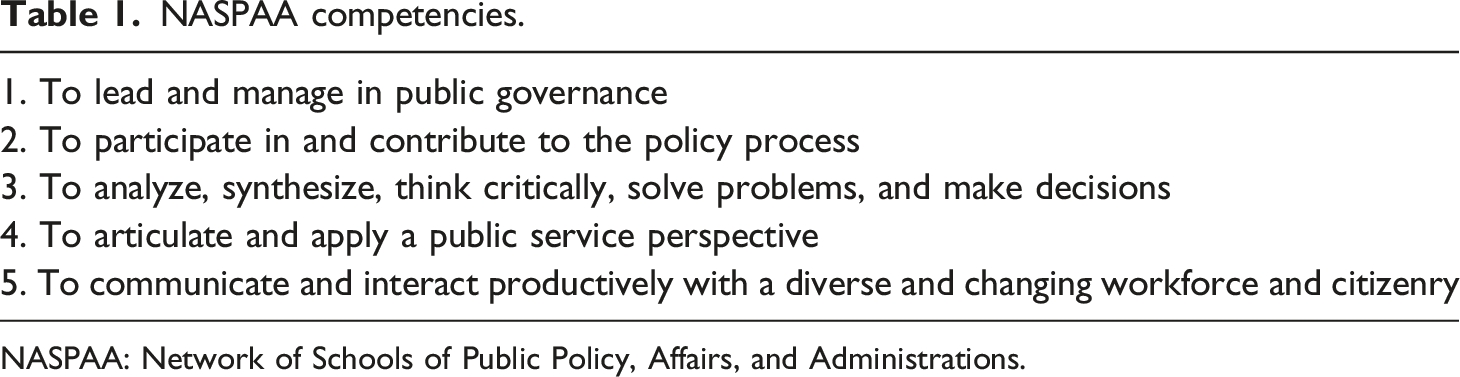
NASPAA: Network of Schools of Public Policy, Affairs, and Administrations.
While the NASPAA competencies serve as a guide for student learning objectives, there are a number of pedagogical approaches that can be used to achieve these goals. Educators must also make the competencies relevant to current events and the unique communities the future public leader will serve. According to Lopez- Littleton and Blesset, “public administration professionals will need to be prepared to lead and manage to meet the changing demands” as they advocate for cultural competency to be incorporated into curriculum of public administration programs (2015: 557). In a recent study, researchers find that NASPAA competencies are useful to local government leadership and suggests that “MPA programs need to emphasize leadership development skills along with a more thorough integration of policy and administration into curricula” (Haupt et al., 2017: 611). Their findings also indicate that MPA programs should specifically emphasize application of NASPAA’s core competencies in terms of applying critical thinking and analytical skills to the decision-making process (Haupt et al., 2017). Integrating critical thinking skills into curriculum is important to prepare students to adapt, adjust and react to public service challenges they will face. It also fosters a life-learning approach that students carry with them in leading communities that face complex challenges.
New Amsterdam as a case study in MPA courses
Prior to preparing this case study, I reviewed course objectives and content for an introductory course in the MPA program entitled “Public Administration Theory and Practice”. This introductory course uses the five NASPAA competencies as student learning objectives and aims to introduce students to public administration theory and practice and survey the core areas of public administration, such as leadership, budgeting, organizational theory, human resource management, and decision-making. By reviewing the course syllabi and focusing on the need to link theory to practice in real-life situations within the core areas of public administration, I began analyzing content from New Amsterdam that aligns with the core areas of public administration and the five NASPAA competencies. Each episode of New Amsterdam selected for analysis had a theme that directly related to areas of emphasis in the course.
Similar to the approached used by both Borry (2018) and Meyer (2020) to incorporate the use of television shows to MPA classroom learning, this section examines five selected episodes of New Amsterdam, the main theme of the episode and the discussions students are to address in completing the case study. Using episodes of New Amsterdam in the Public Administration classroom serves an effective case study to link theory to practice, achieve core competencies, and provide real-world, relevant examples. The case study highlights how critical thinking can be used to creatively address problems within public institutions, with stakeholders, and in the community being served. Many best practices can be observed from leaders in New Amsterdam. While the series follows Dr. Max Goodwin, Medical Director of New Amsterdam, it also depicts interactions of colleagues in the hospital engaged in organizational external problem solving. The series provides insight into healthcare administration during a time when managing health and safety has become a priority of all public servants.
While only five episodes were selected for this case study and used in a virtual classroom due to the pandemic, new episodes of New Amsterdam may also be included as a tool in public administration classrooms. For instance, in the latest season of New Amsterdam, the medical personnel continue to face issues within the organization that are spurred by external events. The series approaches current events and embraces leaders and medical personnel confronting these timely issues. Social equity continues to be a major theme in the latest season, as medical personnel must recognize that the presence of police officers in the emergency room may make some patients uncomfortable in the context of the Black Lives Matter and immigration changes. It also illustrates how systems theory is used to explain how external factors, such as a pandemic, issues of social inequity, policy changes to healthcare, impact organizational performance. Using this series as a tool to link theory to practice in public affairs classroom helps students to understand how current events, like the pandemic, social injustices, policy changes, impact organizations and decision making within public organizations. Students can see examples of how core areas of public administration, such as human resources, public policy, budgeting and leadership are carried out in real time and how decision making in those areas are impacted by a number of internal and external factors.
New Amsterdam case study overview.
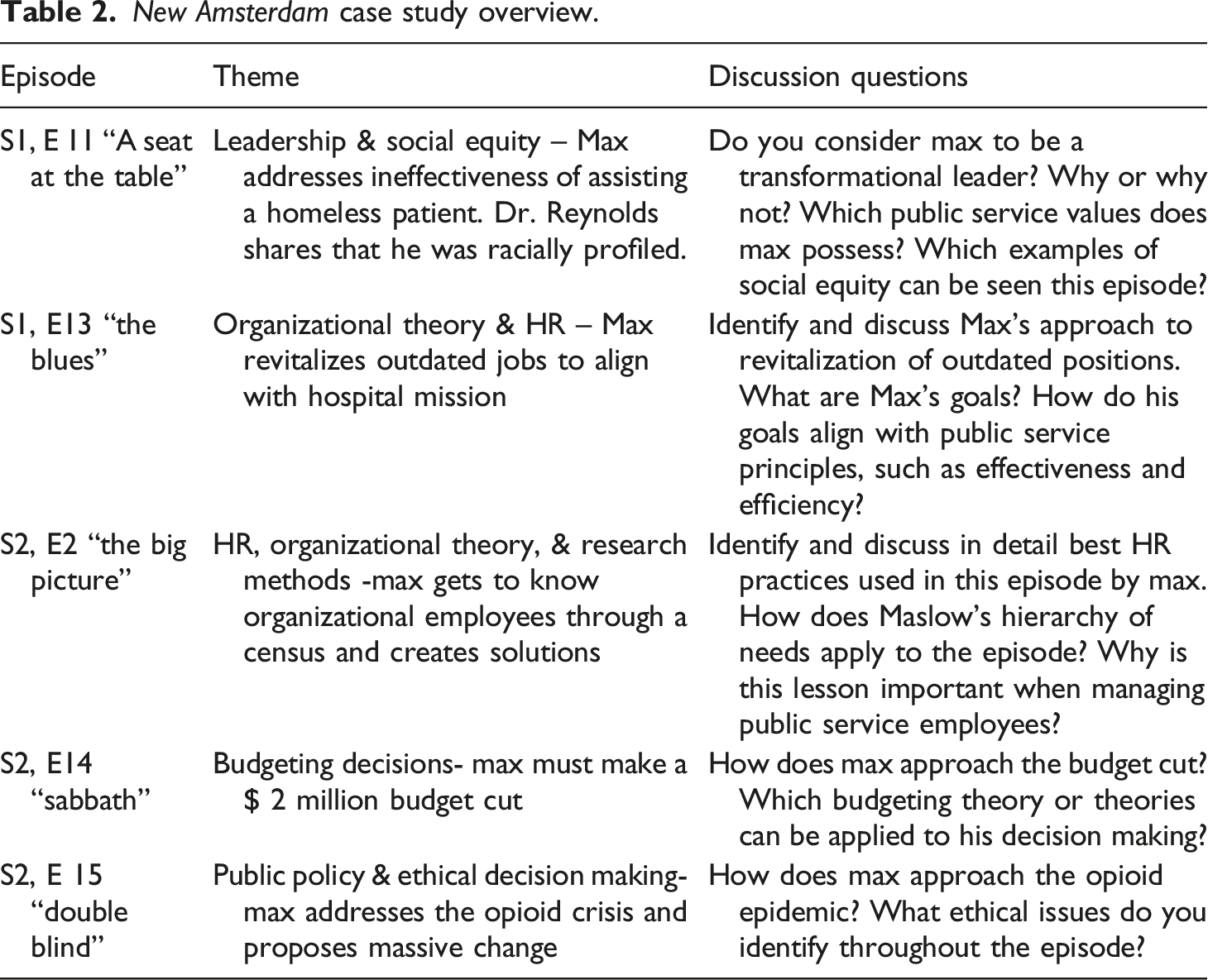
Table 2 “New Amsterdam Case Study Overview” lists episodes from seasons one and two; however, the latest episodes also continue to address many pertinent issues that can be incorporated into MPA classrooms. In Table 2, the first column identifies the season, episode, and title of the episode. The second column highlights the theme of the selected episode, which includes a brief synopsis of the episode in addition to areas that link to public policy and administration. The third column contains discussion questions for MPA students to consider after viewing the episodes. The discussion questions allow students to incorporate course materials and theories learned to answer the question. Since this case study was completed during the pandemic to supplement regularly scheduled service learning and community engagement activities that were suspended due to social distancing and health measures, students were able to share their insight and discuss the series in a virtual classroom. Additional readings may be assigned to each corresponding episode to further illustrate how theories and best practices from research articles can be helpful in addressing problems and creating solutions. In this particular class, peer-reviewed journal articles in public administration and public health disciplines were assigned to supplement the viewing of each episode. The purpose of assigning additional reading was to familiarize students with how researchers use various theories and core skills of public administration to solve problems. Using information from these readings, students were able to adapt information learned to develop theoretical tools in order to solve issues presented in New Amsterdam. In the end, students created a portfolio, where each analysis of each episode served as an individual case to demonstrate the student’s understanding of core areas of public administration, the NASPAA competencies, and their ability to link theory to practice.
The following section analyzes the selected episodes listed in Table 2.
Season 1, Episodee 11 “A Seat at the Table”
While Max battles his own health challenges and cancer treatments, he balances his own healthcare and his new professional responsibilities as Medical Director overseeing the daily operations of New Amsterdam. Meanwhile, Max’s staff face issues of social equity that permeate the hospital. Dr. Bloom treats a homeless patient “Andy” in the Emergency Department who is considered a “frequent flyer”, a patient that frequently visits New Amsterdam. Dr. Bloom notifies Max of the frequent flyer and asks “How can I help?”. Max researches the patients’ history and finds that Andy has been treated in New Amsterdam over 100 times, costing the hospital 1.4 million this year and believes they have not truly helped this patient. Max meets with all physicians to ask them how they can address this problem. During the brainstorming session, attending physicians explain that homeless patient comes into the hospital to get out of the sun, snow and rain or to get a hot meal and other doctors explain the medical issues seem to be a recurring issue. Max explains to Andy that New Amsterdam has done a disservice to him and each of his symptoms is related to the harsh environment he is experiencing due to lack of housing. Max prescribes Andy a home; New Amsterdam leadership questions Max’s initiation of renting an apartment for Andy and a discussion of fairness ensues. Max welcomes Andy home to rented apartment.
Meanwhile, Dr. Reynolds is being interviewed and photographed by a reporter who wants to run a story on him. The reporter discovers that Dr. Reynolds, a successful African American cardiothoracic surgeon was arrested 10 years ago and she insists on running the story. Dr. Reynolds approaches Max with concerns that the potential story would harm New Amsterdam’s reputation. Max assists Dr. Reynolds by suggesting the legal team become involved and Max uses leadership skills to navigate the situation, while also being sensitive to the racial profiling of Dr. Reynolds. Dr. Reynolds explains that he was arrested 10 years ago in a racial profiling incident and explains how ashamed he was of the mugshot and incident. Max displays leadership skills of listening and supporting colleagues, as he reassures Dr. Reynolds that his past and the past arrest does not change the fact that he is an excellent surgeon.
In this episode, there are two major themes student should focus on when viewing. The first theme is illustrated is Max’s ability to lead a public organization that in a transformative manner that faces issues internally caused by external issues of social equity. The episode also demonstrates how external factors, such as homelessness and racial profiling of an employee impact an organization, especially organizational performance and organizational reputation. After watching this episode, students can understand how public leaders and public organizations are faced directly with issues of social equity. Students also see Max leading with empathy and care, elements integral to leading organizations in matters of social equity, as he personally welcomes the homelessness patient Andy home to a new apartment and provides support to his colleague Dr. Reynolds.
Season 1, Episode 13 “The Blues”
The theme of this episode centers on revitalizing outdated jobs at New Amsterdam. As Medical Director, Max is focused on outdated, obsolete occupations and discovers that New Amsterdam has a number of these positions. He informs staff of this discovery and relieves their fears of being fired. Max meets with the Board of Directors to initiate an experiment for one day in each department to discover which jobs are actually obsolete. He encourages employees who find their job to be obsolete to report it to him so he can then create a new position for them, which would inspire these employees to makes a difference and be an integral part of achieving the organization’s mission.
Throughout the episode, Max meets with various employees holding outdated, obsolete positions at New Amsterdam and he is met with varied responses from employees. Max meets with an employee whose job is to print x-rays, a service that has not been used since 2008. During this meeting, Max discovers the employee had great pride in his work and offers him an opportunity to take on new responsibilities that would benefit the hospital. The employee doesn’t want to be trained to learn new technology. Max then meets with another employee who checked badges at the entrance of the hospital but his job was replaced by an automatic card swipe entry. After meeting with numerous employees individually, he meets with all employees holding outdated jobs and hires them to work at a new, satellite clinic in a small area on the outskirts of Brooklyn that lacks adequate healthcare. He discovers the need for services in this location, as a patient is admitted to New Amsterdam and treated. He assigns employees to new positions that allows them to use their individual skill set in a new way.
In this episode, students can see how organizational leaders engage in contemporary issues of human resource management. While employees holding outdated positions fear being fired, Max meets with each of them to discover their real skills, talents, and desire. Students can see how elements of job satisfaction are applied to human resource management and ultimately, how public leaders like Max, ensure organizational effectiveness and efficiency while making difficult changes but keeping humans’ the most important component of human resource management. Organizational theory concepts are also applied to this particular episode, as students can see Max’s focus on organizational performance and effectiveness drives his initiative to address the revitalization of obsolete jobs. Students can also witness how technological advances, an external factor, impacts organizations and the need to modify job responsibilities in real time. NASPAA competencies 1, 3, four and five are covered in this episode.
Season 2, Episode 2 “The Big Picture”
This episode begins by Max calling all employees into a large auditorium to reflect on the U.S. Census results and how data from the census provides information on zip codes and health outcomes and disparities. He suggested that New Amsterdam is a “community” and wants to know more about each, individual employee, in an effort to improve their quality of life, which would in turn improve patients’ quality of service. He asks a rhetorical question; “How can you take care of others, if you are not taking care of yourself?”. In order to learn more about employees, Max asks them to complete the New Amsterdam census, so he can learn more about them. The theme of this lessons blends content of research methods, organizational theory and human resources.
While leading this initiative and running the hospital, Max is also fighting his own cancer diagnosis and treatment, grieving the loss of his wife, and parenting an infant as a widow. A colleague encourages Max to seek help and poses the rhetorical question back to Max- “How can you take care of others, if you are not taking care of yourself?”. His colleague encourages him to take time to grieve. Students can apply Maslow’s hierarchy of needs to this case, as it is theme in this episode.
Max initiatives data-driven surveys to learn more about employee’s needs, which provides students an opportunity to explore how Maslow’s hierarchy of needs is used in organizations and human resource management. Census results indicate that employees need more time. Hospital staff report that they do not eat meals with family regularly, allowing Max to discover the need to help create a healthy work-life balance for hospital staff. Max also finds that the Census results indicate that the hospital staff is not getting enough sleep. To follow up on this finding, Max meets with staff members over coffee to discover various reasons why staff members are not getting enough sleep. Max held a discussion with those employees who did not complete the survey and asks why non-respondents did not complete the hospital census. Once again, he discovers employees do not have enough time in their schedule and inefficiencies, complaints, and dissatisfaction “is all because of time”. Reflecting on the problem of time that he discovered, he solves the issue with a creative approach. He provides transportation to employees by hiring charter buses for hospital staff, which gives employees 2 hours back to spend time with family, have meals with family, and get much needed sleep. Max believes his solution in “solving time” will result in focused, alert employees ready to help patients.
This episode highlights how leaders can initiate data collection through an employee census to gain information about employee needs and use data to make informed, creative solutions to strengthen job satisfaction and ultimately, organizational effectiveness. Max displays the ability to collect both quantitative and qualitative data and uses the data to create solutions to achieving job satisfaction. This particular case illustrates how public leaders use skills from research methods to lead and manage in the public sector. He discovers employees do not have enough time in their day and need an appropriate work-life balance. He goes the extra mile in helping staff members by “solving time”. NASPAA competencies 1, 3, and five are covered in this case.
Season 2, Episode 14 “Sabbath”
The theme of this episode center on budget crisis, which provides students insight into the complexities of budgeting within a public agency with many departments and programs. Max’s assistant Todd delivers a message from the board that two million dollars must be cut from the budget immediately. The consequences of not making the two million dollar budget cut will result in employees not making payroll. Max prefers to make small, cuts to each department rather than cutting an entire program and begins with analyze and weigh options. Students can observe Max’s decision making process as he approaches the best approach to balancing the budget. He and his assistant engage in line-item budgeting weighing options to cut various programs, such as neonatal care for undocumented immigrants, contracting out or closing the on-site day care services, and replacing personnel with computer -based assessments, eliminate non-essential, annual testing like mammograms.
After Max carefully considers each program and meets directly with those working in these programs, he is struggling with the idea that each potential cut would make the hospital worst. His assistant encourages him to pick “one big ticket item” to cut, as it would not compromise the quality of care and hospital performance. Max decides on cutting postnatal care for undocumented mothers and strikes the program from the budget but continues to struggle with his decision. After much struggle with his decision, he tells his assistant Todd that he has changes his mind and suggested creating a new program that would generate revenue for the hospital. This new program would contract specialized doctors out to areas of the country lacking medical care with goals of filling America’s healthcare gaps, get compensated fairly and balance the budget.
This episode serves as an excellent example of how budgeting and decision- making theories guide practices of balancing a budget. Students can use this episode as a case study to illustrate their understanding of NASPAA competencies 1, 2, 3, and four by examining how Max uses leadership and decision-making skills to balance with budget without compromising on organizational performance.
Season 2, Episode 15 “Double Blind”
Episode 15 centers on the costs of the opioid epidemic and how much “damage” Max can do to the opioid epidemic, as New Amsterdam’s Chairwomen asks him to creatively tackle the problem. Max identifies the problem within New Amsterdam by meeting with one percent of the physicians of New Amsterdam who are responsible for prescribing 79% of the opioids. Max gives these physicians a year to prescribe 79% less or declares they will be fired. The Chairwomen tells Max she is disappointed in this approach and wants a macro level approach to be taken and “to do better”. Max decides to close the Emergency Department and re-routes all ambulances to surrounding hospitals.
Then, he meets with the directors of all surrounding hospitals to discuss how the use of opioids have changed over time and encourages everyone to return to ethical behavior. He proposes canceling the pharmaceutical contract for opioids and asks the other directors to follow suit, as they all walk out. In this episode, Max is faced with ethical decision making and doing the right thing, as he understands that financial support that pharmaceutical company provides in turn to the hospital, as a wing of the hospital is named after the pharmaceutical company. Max hears the story of addiction from a deceased patient’s family member and he asks to display her photo on the wall in the wing of the hospital funded by the drug company. As he leaves his shift, he passed the wall filled with memories, photos, and letters honoring those lost to opioid addiction. At this point, a peer director also agrees to terminate their contract with the drug company and proposes “unity” to fight the shakedown.
In this episode, students can connect policy making and decision -making theories to practice, illustrating their understanding of NASPAA competencies 1, 2, 3, and 4. As Max uses history, facts, and evidence of opioid abuse to guide his ethical decision making to meet his goal of limiting the use of prescriptions.
Conclusion
Using television, books, and even music can help students to see how public administration theories can be used in practice. The use of episodes from New Amsterdam as a case study can be helpful to public administration students understanding theory, connecting theory to practice, and mastering core areas of public administration and the NASPAA competencies. The series is an excellent example of how organizations and public servants are impacted by external factors like funding, epidemics, homelessness, and more. Using the series as a case study helps to illustrate the importance of core skills in public administration, such as budgeting, human resources, organizational management and leadership.
Additionally, Max’s leadership approaches are also useful to public administration students, as he portrays ethical leadership and creative, forward -thinking solutions to organizational problems. Max’s catch phrase of “How can I help?” provides students with an exceptional example of how to exercise public servant perspectives and values. Using this series as a case study is a timely, relevant example into public healthcare administration and leadership.
Footnotes
Declaration of conflicting interests
The author(s) declared no potential conflicts of interest with respect to the research, authorship, and/or publication of this article.
Funding
The author(s) received no financial support for the research, authorship, and/or publication of this article.
