




Abstract
Mixed methods approaches are increasing advocated for researching complex problems in the social sciences, but they are not widely used by postgraduate students of public management. This article describes a study where qualitative and quantitative methods lecturers worked collaboratively to design and teach both methodology courses in an integrated way to encourage public management master’s students to see the two methods as complementary, and thus possibly be more open to consider using the mixed methods approach in their research. A multi-method research design was used in this study. Students’ prior studies of qualitative and quantitative research methodology were not found to predict their summative course marks significantly on qualitative and quantitative components, respectively, but initial cognitive competence in the study of statistics correlates with summative performance in the quantitative component. Qualitative and quantitative summative scores correlate strongly, with those students with higher qualitative and higher quantitative summative scores tending to score higher on a task where they reflect on the value of both approaches to their own proposed research. However, students with lower scores, who comprise the majority of the sample, are not able to demonstrate appreciation of the possibilities or status of applying both methodologies to their own research. They tend to misunderstand foundational concepts when applied to their research design and/or show limited ability to apply their understanding to design their own work accurately or in a workable way. This study suggests that, where postgraduate students have prior limited exposure to research methods, improving the quality of student research and their engagement with mixed methods may require more mastery of both methods and methodologies than the scope and pacing of taught master’s programmes usually allow.
Keywords
Introduction
Postgraduate students who study public management, administration, policy or governance while working in the public sector are faced with the dual challenge of completing independent research projects to fulfil their degree requirements, and addressing complex problems in their workplaces. Both tasks require the capacity to engage with research studies and work with data. Many degrees provide research methods courses, making sense of data, and completing a proposal in preparation for undertaking independent research. The approach that students adopt in undertaking their research is the result of a complex interaction of their exposure to various teaching and supervisory orientations, the approach characteristic of their discipline, and their numerical/statistics anxieties, among other factors. Typically, across the social sciences, students completing their independent research components tend to shy away from working with quantitative methods, and consequently, with engaging with quantitative and mixed methods designs (Hesse-Biber, 2015; Onwuegbuzie and Leech, 2005). This is also the case in the public management context that is explored in this study (Hammersley, 2004).
Conditions in higher education make it difficult to teach social sciences research methods courses well (Hammersley 2012). Many of these difficulties have been documented in this journal (Engbers, 2016; Foster and Gunn, 2017) and more broadly in the social sciences research methods teaching literature. These difficulties are compounded when students enter taught master’s degrees, like public management, where they study in multi-disciplinary areas that are not necessarily the same as their prior studies or areas of work. In addition, public management students may be mature, part-time students. Few assumptions can be made about common disciplinary exposure or being able to build on prior subject knowledge, methodological understanding, or knowledge of fundamental research methods.
Increasingly, within the research methodology field in the social sciences, mixed methods research is proposed as the most appropriate methodology for engaging with complex problems, addressing requirements of rigour, and bridging what can still be observed as divides between qualitative and quantitative methods, both theoretically and in terms of willingness to engage with both (Christ, 2009; Hesse-Biber, 2015; Onwuegbuzie and Leech, 2005; Payne, 2014). As not all discussions on teaching mixed methods distinguish between the design types of mixed-model and mixed-method (where the mixing, combination and integration of methods is different), in common with Johnson and Onwuegbuzie (2004) this article refers to ‘mixed methods’ as the more commonly used term used when discussing general issues related to the teaching of a mixture of methods from both qualitative & quantitative approaches in combination, and makes distinctions between the two when necessary for clarity in methodological discussions.
However, teaching mixed methods is complex. One challenge is that the qualitative and quantitative methods are often taught as separate research methodology courses (Onwuegbuzie and Leech, 2005; Payne and Williams, 2011), or prioritised differently depending on disciplinary areas (Scott Jones and Goldring, 2015), teacher preferences (Scott Jones and Goldring, 2015) and epistemic attachments and knowledge (Daniel, 2018; Payne, 2014). When degrees are structured for qualitative and quantitative courses taught separately, students often prioritise the approach that is compatible with the research they are proposing, or with which they and their supervisors are more comfortable (Daniel, 2018; Scott Jones and Goldring, 2015). Statistics anxiety and weak quantitative literacy contribute to some students avoiding the quantitative components where possible, and to defining themselves as quantitatively averse (Onwuegbuzie and Wilson, 2003). This is particularly so in the South African context referenced in this study, where a history of poor mathematics and numeracy teaching in the schooling system has left students ill-equipped to engage with quantitatively-oriented subjects at tertiary level (Jojo, 2017; Lewin and Mawoyo, 2014). This situation is reflected in other countries in various ways (Murtonen, 2015; Murtonen and Lehtinen, 2005; Tobbell and O'Donnell, 2013) with concerns about declining numeracy skills in the UK (Scott Jones and Goldring, 2015) and its implications for poor preparation for quantitative work (Clark and Foster, 2017).
As research methodology lecturers, the authors of this paper were motivated to address student anxieties about quantitative courses and reluctance to engaging with quantitative methods in a South African school of public management. Historically, within this school, the qualitative and quantitative methods courses have been scheduled to run separately, but in parallel in the programme. Moreover, the majority (over 80%) of students conduct their research qualitatively. Over several years, the lecturers collaborated teaching the qualitative and quantitative methods courses in a manner conducive to undertaking a mixed methods approach. Accordingly, this paper reflects on an empirical study carried out on a cohort of part-time Master of Public Management students taking these courses in parallel over a period of five months. The lecturers posited that a method of teaching qualitative and quantitative research methodology courses to adult learners in parallel using a common, topical and engaging subject theme, might encourage students to see the two approaches as complementary, and thus consider using the mixed methods approach in the independent research required for their degrees.
The lecturers of the qualitative and quantitative methods courses required their common group of students to conduct qualitative and quantitative research in parallel on their fellow classmates on a topical policy question, under their supervision and guidance. In this way, they operationalised the theoretical principles of mixed methods research taught in the courses, and also linked the courses to the substantive core curriculum which addressed policy, management, governance and development. The study is thus an example of a type of mixed methods/mixed model approach applied to a common subject or theme.
The study’s objectives were threefold (Figure 1): First, to examine the effect of prior study and attitudes on subsequent summative scores: the relationship between prior study of qualitative research and the summative outputs of the qualitative course, between prior study of quantitative research and the summative outputs of the quantitative course, between prior study of quantitative research and prior attitudes to statistics, and between prior attitudes to statistics and summative quantitative output (labelled 1a, 1b, 1c and 1d, respectively, in Figure 1). Three main objectives of the study (depicted as 1a-1d, 2, 3a-3b).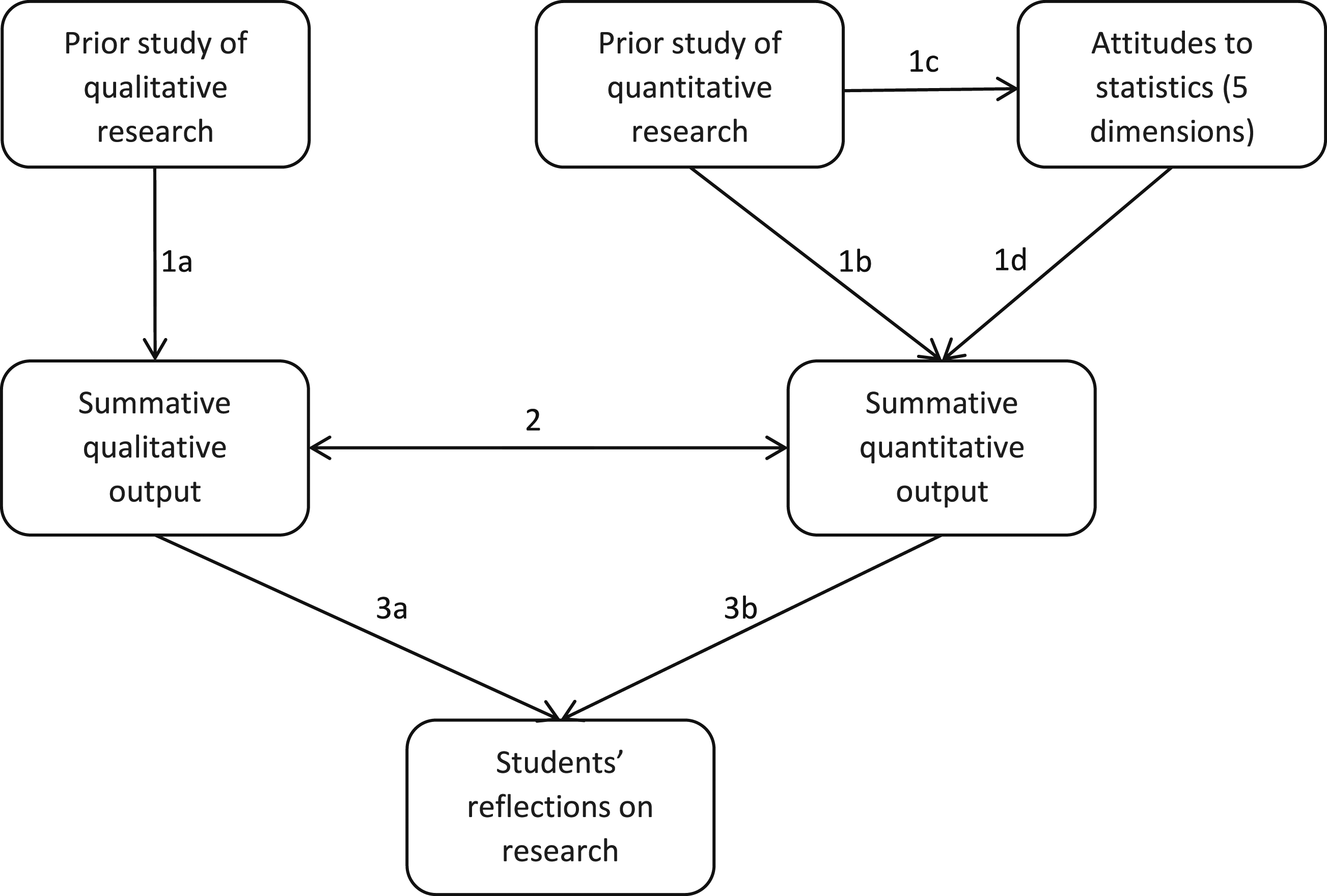
Second, to examine the relationship between the summative outputs of the qualitative and quantitative courses (labelled 2 in Figure 1), considering the effects of prior study and attitudes to statistics. Third, to describe and analyse the students’ perceptions of the merits of the qualitative and quantitative methodologies, and relate these perceptions to the summative qualitative and quantitative scores (labelled 3a and 3b in Figure 1). The study also informs broad debates on pedagogy and curriculum designs for research methods teaching.
This paper begins by outlining key literature on teaching research methods in public management and in the social sciences, the challenges facing lecturers who teach these courses to postgraduates and mature students, and implications for curriculum designs using mixed methods.
Teaching research methods in public management and the social sciences
The broad objectives of research methods courses across the social sciences is to develop students’ research competence – either as producers of research, critical consumers of research, or both, when they are required to produce research reports, postgraduate dissertations or theses. A range of positions on appropriate methodologies, diverse student groupings, demands for increased postgraduate numbers, and regulation of “research training” make it increasingly difficult to teach these courses well (Hammersley, 2012: 8). These courses often have no agreed curricula, and their methods and content are dynamic, contested and evolving, especially for qualitative research (Eisenhart and Jurow, 2011; Lewthwaite and Nind, 2016), making content selection challenging for lecturers and students (Abutabenjeh and Jaradat, 2018). Academic staff may thus rely on peers, “trial and error’' and methodological know-how, rather than pedagogic knowledge in relation to research methods informed by theory and research (Earley, 2014:243). Teachers also have various epistemic attachments across the qualitative/quantitative continuum (Daniel, 2018).
The lack of scholarly attention to the teaching of research methods is partly attributed to research methods not being an established field of scholarship (Earley, 2014). Until relatively recently, discussions about pedagogy and the scholarship of teaching and learning associated with the teaching of research methods in the social sciences have also been lacking. Some researchers have begun to fill this gap across the social sciences (among others Earley, 2014; Garner et al., 2009; Kilburn et al., 2014; Nind et al., 2015; Wagner et al., 2011). Few research articles detail descriptions of course design and pedagogy, and a limited number explore assessment practices (for example Earley, 2014; Hosein and Rao, 2015; Hosein and Rao, 2017; James et al., 2009).
In the emerging literature on research methods teaching, there seem to be broadly agreed common approaches to teaching research methods in the social sciences, broadly endorsed pedagogic practices and common assessment types. These involve acculturation into becoming researchers or reviewers of research, hands-on work with research (Clark and Foster, 2017; Daniel, 2018; Engbers, 2016; Gunn, 2017), and a focus on process (Garner et al., 2009; James et al., 2009; Sarter, 2019).
The picture is similar in public administration and related areas of study, like public management, management studies, policy studies and political science. This is reflected in discussions in this journal and in management studies more broadly on approaches to teaching research methodology (Abutabenjeh and Jaradat, 2018; Engbers, 2016; Lapointe, 2019; Sarter, 2019).
Challenges facing teachers of research methods courses to postgraduates and mature students
Designing and teaching introductory quantitative methods courses has to negotiate/contend with students’ reluctance that is often underpinned by statistics and mathematics anxiety at undergraduate level (Bernstein and Allen, 2013). At graduate level, between 67% and 80% of students are apprehensive to studying statistics (Onwuegbuzie and Wilson, 2003). The relation between statistics anxiety and performance is complicated by several factors, including students’ prior statistics knowledge, their interest in the subject, their self-concept, and different measures of the construct (Macher et al., 2015), and antecedents such as previous experience with mathematics, age and gender (for reviews see Baloğlu and Zelhart, 2003; Coetzee and Merwe, 2010; Macher et al., 2015; Onwuegbuzie and Wilson, 2003). Macher et al. (2015) cite three studies that provide evidence of a moderate negative effect of statistics anxiety on academic performance, more so in the cases of older students, and those studying longer courses and writing more challenging examinations. That statistics anxiety is part of a multidimensional construct of attitudes to statistics adds complexity (Cruise et al., 1985; Onwuegbuzie and Wilson, 2003; Ramirez et al., 2012). For example, older students have been found to be more anxious about statistics than younger but to appreciate the usefulness of statistics more (Baloğlu and Zelhart, 2003). In a South African study of undergraduate and graduate psychology students, older students similarly showed somewhat more positive affect towards statistics, but found it less difficult compared to younger students (Coetzee and Merwe, 2010). In view of these somewhat ambiguous findings on the correlates of student attitudes to statistics, the researchers introduced the construct into this study as a potential obstacle to the performance of the students in the quantitative methods course, and as a covariate in their choice of using quantitative (and hence mixed) methods in their individual research.
Earley’s (2014) meta synthesis of undergraduates and postgraduates across the social sciences highlights student anxieties, misconceptions and negativity related to research methodology courses in general, and empirical research and statistics anxiety in particular (Murtonen 2015). Multiple factors may explain this research-related pessimism. These include their inadequate exposure to qualitative and quantitative methods, possible biases in their research disciplines to a certain approach, personal preferences, and their research lecturers’ knowledge or exposure that may be weighted towards a certain research approach (Onwuegbuzie et al., 2010). There may also be a disconnect between research methods courses and the broader curriculum of which they are a part, exacerbated by modularisation in degree programmes and relegation of these courses to particular years of study (Clarke and Foster 2017). Two factors that influence students’ choice of research methodology are the methodological research orientation of their supervisor/s as well as their own familiarity with particular methods (Daniel et al., 2018).
Ambitious demands for developing postgraduate level research competence have to be accommodated in minimal time, and may require “rapid fire theory” and “triage statistics” where students have little exposure to research methods teaching at undergraduate level (Kramer and Schechter, 2011:329). These accelerated approaches are more typical at undergraduate level, and often at odds with longer term processes for developing scholarly research capacity and dispositions required at postgraduate level. This is combined with increasing pressure on staff to improve completion times, both locally (Mouton et al., 2015) and globally (McCormack, 2004). In the South African context of this study, the 2008 master’s degree postgraduate completion rate over 3 and 5 years was only 33% and 47%, respectively, across disciplines and levels of study. Practitioners and professionals increasingly favour part-time and coursework master’s study, and the non-completion of the research component of taught degrees places additional pressures on supervisors and teachers of research methods courses (Hewlett, 2006; Massyn, 2018; O'Neil and dos Santos, 2018; Shaw and le Roux, 2017). The scenario of mature postgraduate students who return to study after working in occupations and professions is typical of South Africa, where there are few opportunities for funded postgraduate study. However, the literature on transitions to postgraduate study in the UK, USA and Australia, focuses on doctoral candidates, international students and language issues (Stagg and Kimmins, 2014) more than on master’s students, particularly coursework master’s students.
Implications for curriculum designs using mixed methods
Adopting mixed methods approaches in the teaching of research methods courses is increasingly advocated. One of the proposals for addressing students’ widely reported negativity towards quantitative methods, and for overcoming potential teaching bias towards qualitative or quantitative approaches, is to teach the qualitative and quantitative components together in a series of mixed methods courses increasing in complexity (Baran, 2010; Onwuegbuzie and Leech, 2005; Onwuegbuzie et al., 2010). The growing literature on mixed methods teaching addresses curriculum issues as well as lecturer reflections on the structuring, sequencing and models for mixed methods teaching (Baran, 2010; Christ, 2009; Earley, 2007; Ivankova, 2010; Onwuegbuzie and Leech, 2005; Onwuegbuzie et al., 2010; Niglas, 2007).
There are, however, particular challenges for teaching mixed methods research at postgraduate master’s degree level, some common to undergraduate level (Eisenhart and Jurow, 2011). This literature reflects concerns about limited exposure of students to the complexity of mixed methods in single courses, concerns about inadequate exposure to both qualitative and quantitative methods compromising students’ abilities to apply mixed methods, and the methodological research orientation of supervisors (Daniel et al., 2018). Additionally, concerns are raised about not distinguishing between research courses aimed at assisting students to meet dissertation requirements and those targeted at increasing their understanding of published mixed methods research more specifically (Earley, 2014; Ivankova and Plano Clark, 2018) and social research methods more broadly (Nind et al., 2015).
In conclusion, while many of the challenges of teaching research methods to social sciences and public management or public administration postgraduates have been identified, there is still relatively little work detailing and reflecting on attempts to introduce the use of mixed methods in teaching within these constraints, and on the consequences of these interventions.
Collaborating to promote the use of mixed methods
The lecturers used the programme structure of two separate, short methods courses scheduled to run in parallel to teach mixed methods research in collaboration. The students studied part-time, worked mostly in the public sector, and had originally studied in various undergraduate fields.
The course, context and teaching intervention
The broader master’s degree curriculum of this study assumes that students from multiple disciplinary backgrounds with little prior engagement with research methods can be supported through two short methods courses to become sufficiently competent to design and carry out research under supervisors’ guidance. National qualification standards assume that a person with a master’s degree “can contribute to the development of knowledge at an advanced level” (DHET, 2014: 32). Seamless transitions from undergraduate to postgraduate study are assumed both globally (Crisan et al., 2018; Kiley and Cumming, 2014; Stagg and Kimmins, 2014; Tobbell and O'Donnell, 2013) and locally (Hoffman and Julie, 2012) despite this not being the case for many mature, part-time students.
The teaching intervention was intended to be to be an example of a type of mixed methods/mixed model approach where students were involved in conducting research on a topical policy issue. The issue selected was the decriminalisation of sex work that was being debated at the time in government in committee and media. Through extensive collaboration, the two lecturers used this issue to operationalise the theoretical principles of selected research methods and promote students’ reflections on these research methods. Under lecturer supervision and guidance, the students conducted parallel qualitative and quantitative research on their fellow classmates on the policy issue. The courses guided students systematically through the phases of mixed methods research from conceptualization to design, execution, analysis and write up, so that students could adopt the identity of researchers using both qualitative and quantitative methods.
Accordingly, students undertook guided literature reviews, designed the components of the studies, and then collected qualitative and quantitative data on the perceptions of fellow students in the class on the different effects of the decriminalisation. Different student groups examined the perceptions of the decriminalization of sex workers from legal, social, safety, psychological, religious, health and moral perspectives. In the quantitative research methodology classes, for example, one student group constructed closed-ended knowledge and attitude questionnaires on the health effects associated with decriminalisation, while others constructed their questionnaires from the perspective of human rights. In the qualitative research methodology course, one of the student groups used interviewing principles taught on the course to compile and conduct in-depth interviews on the perceptions of their fellow students on the effects of the proposed decriminalisation of sex workers on the safety of sex workers. Another interviewed colleagues on perceptions of public responses to the proposed legislative changes.
The two courses were integrated in several ways: first, they shared a current, policy-related researchable topic that could act as a conceptual and thematic linking device across both courses. Second, both courses stressed a broader understanding of social research and in so doing, we were attempting both to introduce broader understandings of research methods as a field of inquiry, and to address both workplace needs. Third, both courses took a common cohort of students through the research process of conceptualising, designing, collecting and analysing data. Fourth, the lecturers displayed highly visible team-based collaboration across the two courses (an approach also suggested by Hesse-Biber, 2015) as a pedagogical model for mixed methods teaching. As an example, they provided a common list of sources for reviewing the literature on the topic. Fifth, students were expected to model the university ethics requirements and procedures for the two courses jointly, even though they were using their consenting classmates as respondents.
The lecturers assessed students’ mastery of operationalising the various research methods using their fellow students in the class as their units of analysis. Thus, by the end of the two courses, the student cohort had experience of both qualitative and quantitative research methodologies, from the perspectives of both execution and participation. A capstone formal exercise involved evaluating the merits of each of the two approaches.
Research methods teaching and learning assumptions
The approach of the study of exposing students to the entire research process, from conceptualisation to data analysis and reporting, is similar to the contemporary social science research methods teaching approach of “….connecting learners to research, giving direct and immersive experiences of research practice and promoting reflexivity” (Lewthwaite and Nind, 2016: 413). The experiential aspect is furthermore suited to students whose primary work identity is procedural, short-term and solution-driven, like public administrators or managers, rather than researchers. Furthermore, although these were postgraduate courses, they had to start from an introductory level, as most of the students involved were mature, from different undergraduate degrees, with limited exposure to research and research methods, and had been out of formal education for some time.
The lecturers presented research methods within an analysis of broader local contemporary policy questions, with solutions informed by the research evidence. This ‘embedding’ (Gunn, 2017) of the core qualitative and quantitative research areas into the contemporary policy topic, integrated research methods and subject knowledge that students often experience as disconnected. It also demonstrated to the students how a mix of methods could be applied to understanding a policy issue.
Of necessity, both courses involved a mere selection from the broader body of knowledge on research methods. Furthermore, given the constraints of working unassisted with large postgraduate classes (40-80 students), and the qualitative and quantitative classes scheduled to run in parallel, the lecturers adopted a student group project approach, partially for the qualitative course, and largely for the quantitative course. While group projects and group learning processes may be associated with constructivist approaches to teaching (sometimes erroneously), the conceptualisation of learning in the qualitative component was more of a mix between didactic and constructivist. Although there are many suggestions about the superiority of minimally guided approaches in the form of experiential learning for courses like these, the lecturers had experience of the limited success of this approach for novice learners in complex fields (Kirschner et al., 2006). For example, in the quantitative component, limited time and limited prior exposure to research methods, basic statistics and basic mathematics required explicit and directed ‘rapid fire’, knowledge-rich, condensed, explicit use of basic quantitative techniques, data analysis and reporting conventions. However, while a more didactic approach was undertaken for the knowledge component of what research requires (particularly quantitative methods), the lecturers recognised that some skills can only be learned through an active process of conducting research, engaging with reflexive accounts of other researchers (Hammersley 2004), and engaging in reflection and reflexive practice (Cassell et al., 2009).
Qualitative methods involved the students developing interview guides and conducting interviews. Students consulted resources on the initial stages, with peer feedback and the lecturer’s oversight of the final interview questions. The lecturer also provided more guided instruction on the stages of conducting qualitative thematic analysis (Braun and Clarke, 2006). Throughout the course, there was a strong focus on engaging with existing studies on the topic, and the research question guiding the choice of most appropriate methods (Daniel 2018). For the quantitative methods, student groups constructed a basic online survey questionnaire under guided instruction, with description and staging of the steps required to collect, sort and analyse their data (using Excel for data cleaning, and SPSS for basic descriptive statistics), and then wrote their findings in the form of a research report.
Method
The conceptual framework of multi-method research was used in the design of this study, with distinctions drawn between multi-method research studies that involve multiple qualitative methods only, multiple quantitative methods only, and a combination of qualitative and quantitative methods. Multi-method research includes mixed methods research and mixed model research. In mixed methods research, qualitative and quantitative data are collected in the same study and methods of analysis and results are integrated during or at the end of the study. Mixed model research may incorporate different “strands” of research, each with its own research questions and objectives addressed by quantitative or qualitative methods individually or in combination (Potter, 2012: 162), as in the research approach adopted in this study whereby each lecturer involved the students in parallel streams of research. A flow diagram of the research design is provided in Figure 2 wherein the qualitative and quantitative research studies of the two research methodology courses are shown as individual strands. As is common in integrating qualitative and quantitative research (Bryman, 2006), the strands were linked in practice as students were required to conduct in-depth semi-structured interviews to explore the findings based on the quantitative questionnaires. Mixed model research using parallel qualitative and quantitative strands (modification of exhibit of Potter, 2012:163).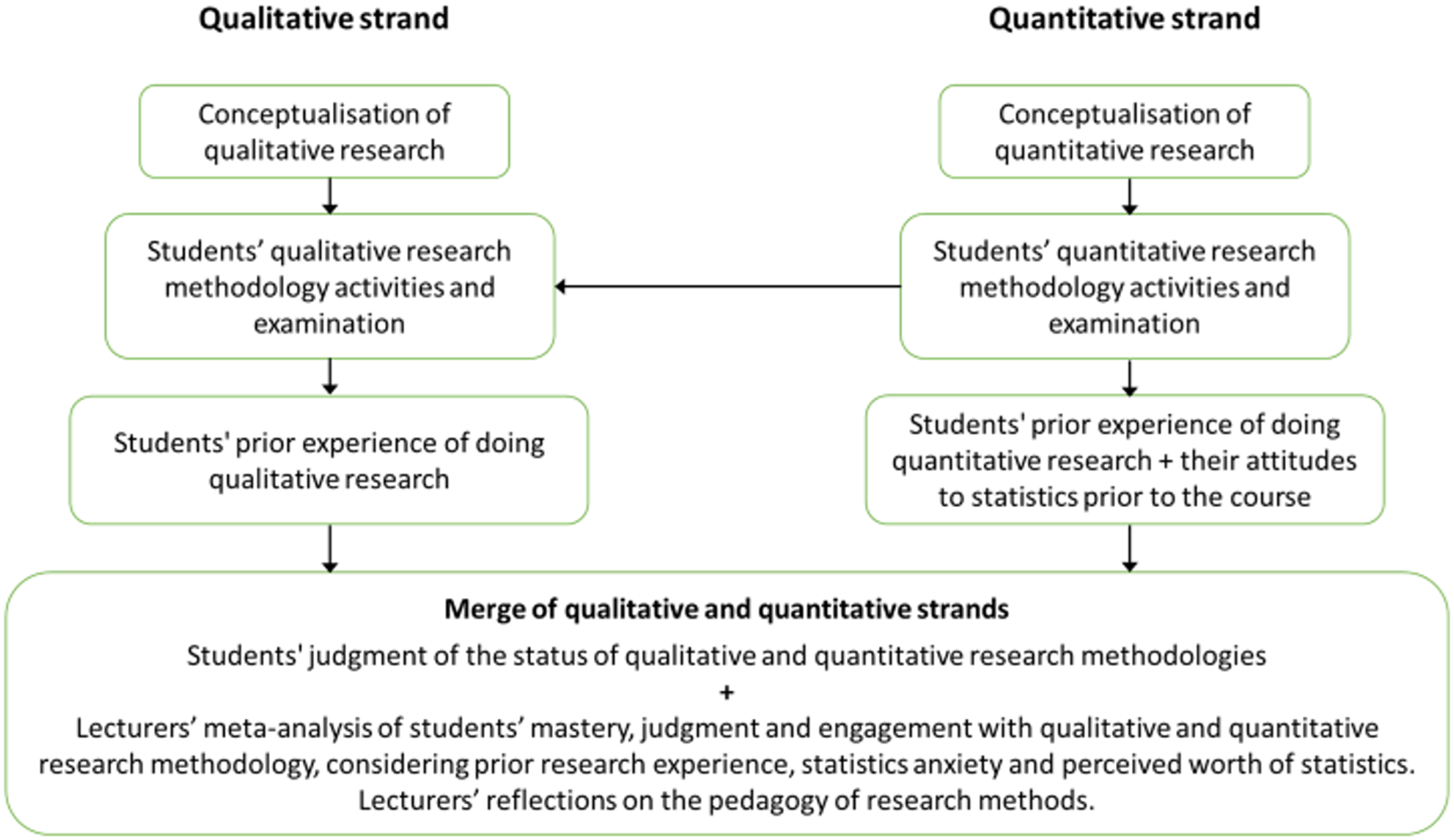
The quantitative strand incorporated analysis of the students’ summative marks as well as the students’ statistics anxiety scores and the details of their prior experience with previous research. The qualitative and quantitative strands then merge in the last block which represents meta-analysis at two levels: first, the students’ overall analysis of the merits of the two approaches and assessment of each ones place in research, and second, the lecturers’ meta-analysis of all the students’ summative marks (qualitative and quantitative) and lecturer reflections on their own pedagogy and experiences of collaborating in this way. This block thus represents the relationships of all the indicators of students’ mastery, judgment and engagement, as well as their attitudes towards statistics and prior research experience.
Participants
The research was conducted on a cohort of 48 master’s students who completed the pre-course questionnaire on attitudes to statistics. Six students did not write the final examinations of one or both courses, thus reducing the sample to 42 for the main analyses.
Approximately half (48%) of the 48 student cohort had studied quantitative research methodology prior to the master’s courses, and the same percentage (different students) had studied qualitative research methodology before. Forty-four percent (21 students) had not studied either qualitative or quantitative methodology beforehand, highlighting the teaching difficulties of producing students capable of conducting research at a master’s level. Fewer than 10% (4 students) had been exposed to prior qualitative research methodology only, and another 4 students had been exposed to prior quantitative research methodology only, possibly related to opportunities to learn (OTL) in different social sciences disciplines (Gess et al., 2017) and their particular courses.
Measures
The two lecturers designed their summative assessments of the courses similarly: individual assignments, class tests, a final examination, and students’ reflections on research approaches.
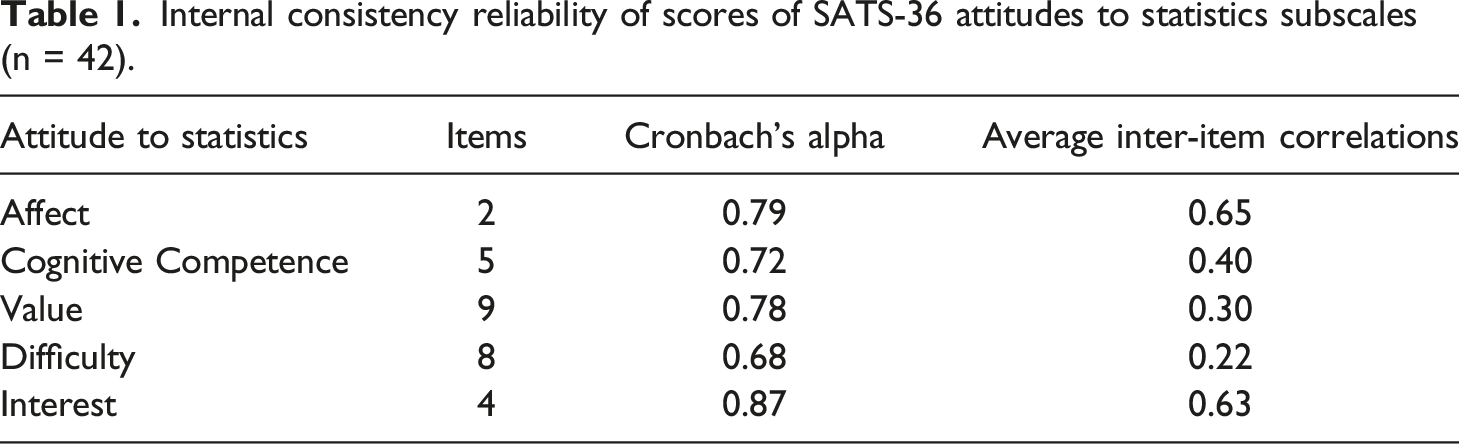
Internal consistency reliability of scores of SATS-36 attitudes to statistics subscales (n = 42).
The lecturers attempted to control for the effect of social desirability in the reflections of the students by assuring them that there were no correct or wrong answers, and that their responses would not be counted towards their final marks. Lecturer reflections on this course were enabled through regular collaborative planning and reflective meetings, attendance of some classes on both courses, and fieldnotes during and at the end of the courses.
Data analysis
The analyses addressed the three main objectives of the research as follows:
Prior study of research methodology, summative outcomes (qualitative and quantitative), and attitudes to statistics.
The parts of this research objective are depicted as 1a – 1d in Figure 1.
No significant difference was found between the qualitative summative scores of students who had, versus had not, studied qualitative research methodology prior to the course (Objective 1a: t(40) = 1.69, p = .098, M 1 = 64.5, M 2 = 58.6, S 1 = 10.25, S 2 = 12.54). Likewise, no significant difference was found between the quantitative summative scores of students who had, versus had not, studied quantitative research methodology prior to the course (Objective 1b: t(40) = 0.47, p = .643, M 1 = 59.0, M 2 = 57.06, S 1 = 14.58, S 2 = 12.64).
Students’ attitudes toward statistics, by previous quantitative study (n = 48)
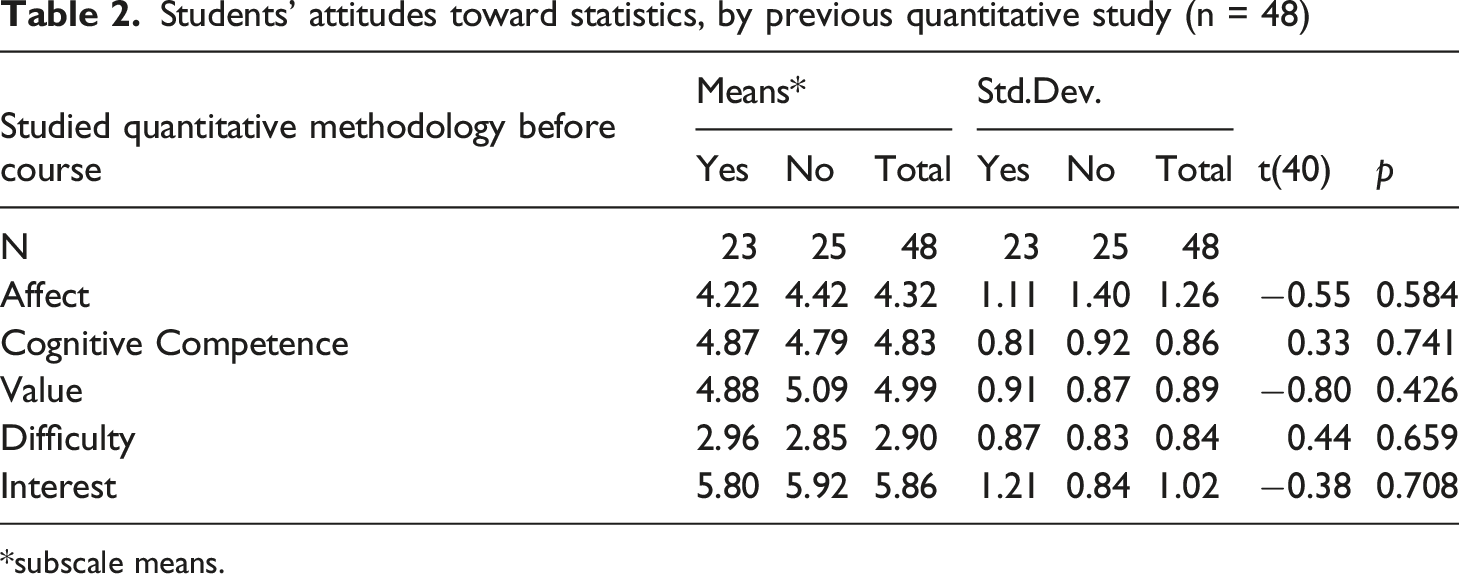
subscale means.
Significant correlations were found between the quantitative summative scores and scores on two of the dimensions of the SATS scale: the Cognitive Competence dimension (r(40) = .51, p = .001) and Difficulty dimension (r(40) = .42, p = .005). The correlations with the Affect, Value and Interest dimensions were not significant at .27, .25 and .20, respectively, p > .05 (Objective 1d).
The correlation between the summative scores for the qualitative and quantitative courses was high and significant at r = .64 (p < .001) (Objective 2).
Finally, both the Spearman Rank Order correlations between the Reflective summative scores and the qualitative and quantitative summative scores were significant and strong (r = .82 and r = .74, respectively) (Objective 3).
In summary, prior qualitative and quantitative research methodology studies were not found to predict subsequent summative course marks significantly. Prior study of quantitative research methodology was also not found to predict attitude towards statistics significantly. However, students who perceived themselves as having better statistics knowledge and skills, and those who perceived the study of statistics as less difficult, tended to have somewhat higher quantitative summative scores than their fellow students. Finally, students with higher qualitative summative scores, and those with higher quantitative summative scores, scored significantly higher on the reflective task.
Appreciation of the status of both methodologies
Students’ appreciation of the status of the two methodologies as applied to their own research was analysed by conducting a qualitative meta-analysis of the content of an assessed assignment designed to tap this issue. In this assignment, students were asked to reflect on the qualitative and quantitative approaches they had studied, rethink their intended approach to their master’s research mini-dissertation, and to change it, from a predominantly qualitative to a predominantly quantitative design (and vice versa) or from a mixed methods design that was qualitative or quantitative dominant to its alternate version. As the task required reflection on how a chosen approach would change the nature of the design, the categories for analysing reflections developed by Kember et al. (2008) to distinguish between levels of reflection were used to analyse the nature of the shift that occurred. The four categories are: ‘Non-reflection’ where there is largely reproduction of sources with no interpretation; ‘Understanding’ where there is reliance on textbook or lecture notes without application (or appropriate application) to practical situations; ‘Reflection’ where there is practical application of theory and insights beyond the textbooks; and ‘Critical reflection’ indicating an informed change in perspective in relation to understanding of key concepts.
Coding of responses to reflective task requiring a change of methodological approach using Kember et al., 2008 (n=46).
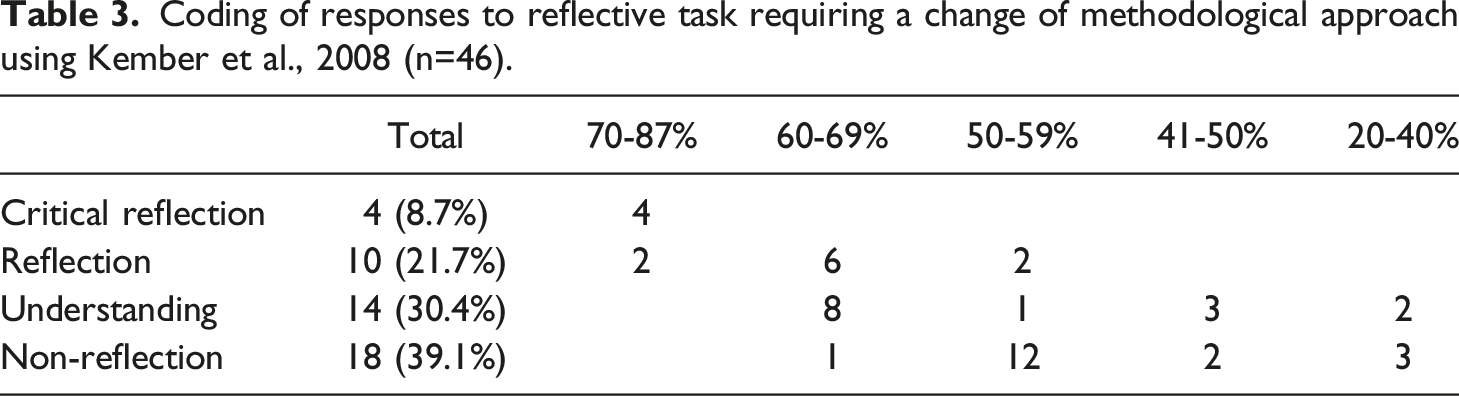
Those in the ‘Non-reflection’ category (39%) tended to focus on changing the sampling approach (size and nature of sample) and the method of data collection without (where necessary) changing the main research question/s to align with the methodology. There was thus often a disconnect between the main research question and an appropriate methodology (and sometimes method) that would allow for being able to answer it. There were inaccuracies in the labelling of sampling approaches and inappropriate qualitative approaches selected, or it was not clear how these might be applied. For the shift to quantitative research, most indicated the use of a survey, but it was not necessarily appropriate for the target population and this was not indicated. Most showed partial or misunderstanding of foundational concepts when applied to their research design.
Those categorised as ‘Understanding’ (30%) relied heavily on textbooks and lecture notes with limited ability to apply the information to making a change from one methodology to another or use them in a mixed methods design. They attempted to apply theory to their own research projects, but foundational concepts were often misunderstood or used inaccurately, and many designs were not workable.
For the ‘Reflection’ and ‘Critical reflection’ responses there was evidence of beginning to apply the theory to change their research design in thoughtful ways. In the ‘Reflection’ category, students were mostly accurate in their use of concepts and were able to indicate tentativeness in application according to unknown to unclear context/circumstances and propose alternatives related to constraints, indicating an awareness of the flexibility needed in making research design decisions. Those categorised as ‘Critical reflection’ were able to alter their designs and produce designs that could be developed further and were workable.
Perceptions of the merits of both methodologies
Analysis of students’ perceptions of the merits of the qualitative and quantitative methodologies involved meta-analysis of an open-ended unassessed question in the same task that asked students to reflect on whether the exposure to the two courses as integrated had impacted on how they saw their research problem and how to investigate it.
For the ‘Non-reflection’ and ‘Understanding’ categories, the responses reflected the view that the courses and delivery design had not shifted them from their original planned research methodology, but had been an “eye-opener” (Student Y) in terms of not being sure of where to start in the research process or having so little background that everything was new. For others, the courses had given them practical guidance on designing a project. Most described what they had learned in content terms rather than reflecting on the merits of both methodologies. These responses may have indicated social desirability bias than more reflective responses. The responses that were coded as ‘Reflection’ and ‘Critical reflection’ indicated students who saw the merits of both methodologies, indicated that the process of working with them on the course had affirmed and strengthened their initial choices and, in some cases, indicated that they now felt more able to defend their choices. There were some indications of appreciation of the alternate methodology, but it was perceived as impractical to apply it to their own research – with the timing and completion frames for the degree being a main concern. While the issue of social desirability prohibits inference on whether they were able to appreciate the merits of both methodologies for this category, there is evidence of students being able to apply the chosen method to their projects if they wished to do so.
Across the categories, the nature of the change in how they saw their research problem and how to investigate it was expressed more in terms of general research design considerations: a narrowing of the scope of the study, a better appreciation of the relationship between the main research question/s and the choice of methodology, a better understanding of the research process, and a better sense of what a researchable focus or topic could be.
Discussion
The similar performance levels of students across both qualitative and quantitative components in this research suggests and echoes other research (see Gess et al., 2017) that the competence to engage with research and the analytical skills required to work with research concepts and data are common across both research methods, despite students perceiving them as different and seeing themselves as being more able in terms of one or the other methodologically. While there are few valid tools for measuring students’ research competence (in part related to differing notions about the nature of competence itself, and research competence in particular), there have been attempts at modelling research competences (Böttcher and Thiel, 2018; Hauser et al., 2018) to enable cross-disciplinary comparisons. The structural competence model that evolved from this research argues that when seeing research competence in terms of both skills and knowledge, the key competences are: skills in reviewing the state of research, methodological skills, reflecting on research findings and communication of results. These are placed alongside the dimension of content knowledge itself (Böttcher and Thiel, 2018: 95), with the proposed addition of ethical and moral values (Hauser et al., 2018). Our research suggests these broader competences may be more important than prior statistics competence as a predictor of overall performance.
However, the effect of statistics anxiety and perceived worth of statistics on achievement in the courses, although not causal, may highlight the importance of considering this construct in teaching courses involving numeracy to these and similar students. Student comments indicated that for some, anxiety and a lack of basic knowledge may have impacted their initial (and final choices) of a dominant research methodology. Their comments on perceptions and merits of both methodologies indicated that very few students were able to engage with complexity. While they expressed enthusiasm and indicated the approach taken in the combined courses had been “eye opening” (Student Y), these comments were mostly indicative of very basic initial knowledge of research methodology and methods generally.
The limited prior knowledge in relation to research methodology of students like these who enter coursework master’s degree postgraduate study from diverse fields of study with limited exposure to explicit teaching of research methodology makes it unlikely that they will be able to gain scholarly insights into the field of research methodology and any breadth of competence in choosing and applying mixed methods with only an introductory course (that could just as well be taught at an undergraduate level due to its introductory nature). Achieving the competence and confidence to work independently would, at the minimum, require several courses increasing in complexity and options for consultation with research methods specialised staff on the design of instruments and interpretation and analysis of data (beyond supervisors).
The lecturers also noted the reluctance of some supervisors to supervise students using mixed methods. This reluctance appears to stem from their own knowledge of quantitative methods particularly, the pressures they are under to graduate students in short time periods, the time they have available to work with individual students, and perceptions that master’s research using more than one method slows students down in terms of completion times. In similar ways to students, many supervisors adopt a pragmatic approach and narrow the scope of the research to be limited and achievable within the students’ limited research skills and knowledge sets. While students express interest and enthusiasm during the research courses, these are narrowed when faced with the reality of completion times.
Improving the quality of student research and their engagement with mixed methods may require more mastery of both methods and methodologies than the scope and pacing of current programmes allow. Literature reflects concerns about limited exposure of students to the complexity of mixed methods in single courses, and concerns about inadequate exposure to both qualitative and quantitative methods compromising students’ abilities to apply mixed methods. Some argue for an alternative approach of teaching the qualitative and quantitative components together in a series of mixed methods courses increasing in complexity (Baran, 2010; Onwuegbuzie and Leech, 2005; Onwuegbuzie et al., 2010) across the curriculum and certainly beginning at undergraduate level. One of the reasons put forward for teaching research methods as mixed methods is to address the widely reported negativity towards quantitative methods, and the bias towards the one or the other that may be related to disciplines or related to personal preferences and knowledge of research methods lecturers (Onwuegbuzie et al., 2010). While students may require assistance to meet their dissertation requirements, research courses should be targeted at increasing their understanding of published mixed methods research more specifically (Earley, 2014; Ivankova and Plano Clark, 2018), and social research methods more broadly (Nind et al., 2015).
Working collaboratively across qualitative and quantitative studies where previously each lecturer has specialised in one or the other, also requires dedicated time for lecturer learning, reading and acquiring new skills to be able to engage with different types of mixed methods designs and analysis rather than a simple combination of more than one method type.
Conclusion
Although not all students see their future identities as researchers or producers of knowledge, students have to take on the identity of novice researchers to complete master’s degree requirements – a difficult transition for the mature, policy-oriented bureaucrats, practitioners and public administrators and managers that these courses address. Pressure from policy makers and universities for standardised and generic researcher ‘skills-development’ programmes (often delinked from disciplinary content) do not recognise that this is a difficult and slow transition (Loxley et al., 2013) that does not take place within the boundaries of one short course or promote the advocated reflexivity that may come from facilitated immersive experiences (Lewthwaite and Nind, 2016: 413). Conducting and analysing research demand high levels of abstraction and conceptual understanding that cannot be developed through research methods courses alone, particularly when they involve ‘triage’ under pressure of short completion times.
Research indicates that students’ choice of research methods is influenced by the domain being studied, the nature of the question being posed, familiarity and confidence with particular methods and methodologies, and supervisor influence (Daniel, 2018). There has been relatively little exploration of the role of supervisors and their own willingness and ability to supervise mixed methods research and develop their own knowledge and skills. An increasing global and local emphasis on training interventions related to ‘better supervision’ does not always seem to be matched with a similar focus on providing the time, support and incentives for supervisors to expand their own methods range.
There does seem to be a need for several courses at different levels of complexity, and this may require cross department/school/discipline collaboration to be financially viable and sustainable. There is also a need for seeing research methods as a subject, rather than a set of skills, to be able to encourage more of a mixed methods research culture (Daniel et al., 2018), let alone progressing to the more complex question related to mixed methodologies.
In this research it was not possible to infer a relation, let alone a causal one, between the mixed model approach to teaching research methodology to the students and their subsequent intention to adopt the particular methodologies in their research component, due to the time lag to completion. We can only wish that the unequal distribution of quantitative and mixed methodologies used in the dissertations of public management students might begin to change following their exposure to teaching approaches such as this, and building on them further, but recognise that this would involve curriculum change that actively builds a research methodology curriculum extending across degrees.
Our approach was situated within one school in one institution. While the conclusions we draw may not be directly applicable to postgraduate public management/administration students elsewhere, they do raise some of the complexities of teaching research methods to practitioner postgraduates and open debates on some of the assumptions about transitions from undergraduate to postgraduate studies in teaching research methods.
Footnotes
Declaration of conflicting interests
The author(s) declared no potential conflicts of interest with respect to the research, authorship, and/or publication of this article.
Funding
The author(s) received no financial support for the research, authorship, and/or publication of this article.
