




Abstract
Student difficulty in public administration has witnessed some writings within the African context. Although these studies are emerging, there seems to be minimal research on the influence of school libraries on students’ understanding of public administration. This gap in the public administration literature precludes educational managers from determining whether or not the variable influences students understanding of the course/programme. Not establishing this places educational managers in a situation that inhibits them from placing measures to enhance the understanding of the course from the lenses of school libraries. This study responds to the gap in the public administration literature by employing a mixed-method approach to investigate the influence of the variable in the study of public administration by Ghanaian and Nigerian university students using a sample of N = 650. Anchored on the Culturo-Techno- Contextual Approach, the study results suggest significant differences in corruption, governance, and defining public administration (p < .001) when there are poor school libraries. Both theoretical and practical implications have been proferred for the use of school libraries to enhance students’ understanding of difficult concepts in the study of public administration in Ghanaian and Nigerian universities.
Keywords
Introduction
Ensuring accessibility of web content is key to ensuring that users have equal access to online information and services; however, even with legal requirements, accessibility problems exist across the web, especially with online content created and shared by libraries (Spina, 2019). While the accessibility of online library resources is a challenge, accessing learning materials, lecture slides, video lectures, shared assignments, and forum messages is the most frequently performed online learning activity; however, students with different purposes, motivations, and preferences may exhibit different behaviours when accessing these materials (Li and Tsai, 2017). While the work of Li and Tsai (2017) gives a clue on students’ use of online study materials, in a study to identify differences in test performance between native English speakers and students for whom English is a foreign language (EFL), EFL student performance was lower than native English speakers on examinations. English is a foreign language students were less satisfied with the quality of their notes (Desselle and Shane, 2019). Their study gives reason for library materials in countries where English is a foreign language to students to have local content in such library materials to enhance students’ understanding of concepts.
The essence of public administration is the provision of public goods and services. This is the instrument through which the contract between government and citizens is operationalised. Public administration provides numerous goods and services for the public’s welfare; law and order, defence, education, medical care, social security, employment, etc. The role of public administration in the modern democratic state keep expanding and encompass several dimensions. Despite the long-held view by various scholars that democracy and public administration are intrinsically antithetical, recent research points to the central role of public administration in sustaining citizen support of democracy. Ariely (2013) finds that the image of public service correlates strongly with satisfaction with democracy and that the quality of public administration correlates positively with satisfaction with democracy to a degree comparable with alternative explanations.
Where the institution of public administration is well trained and capable, the state runs smoothly, performing its obligations to citizens efficiently. This drive propelled the suggestion of Greenwood and Eggins (1995) that curriculum shift away from the social sciences and towards management, and changes like the British public sector, have profoundly influenced approaches to teaching public administration raising questions about the extent public administration teachers in British universities are equipped to present the more applied and skills-based teaching. This answer to this question can not be delisted from an effective school library that will enhance the use of appropriate study materials to ensure an adequate understanding of public administration.
In furtherance, Lodge and Wegrich (2014) argue that any debate about administrative capacity considers delivery, coordination, regulatory, and analytical capacities. These subtypes are central to determining the efficiency of public administrations. According to Parrado (2014), Policy analytical capacity is essential for evidence-based policymaking. To effectively achieve these administrative capacities entails the effective teaching of students in public administration who eventually operate the public sector. Again, it will be argued that capacity building in public administration will entail many factors, including adequately stocked libraries.
Despite the importance of public administration in socio-economic development and in improving the welfare of populations, capacities remain weak in many developing countries, especially in Sab-Sahara Africa (Botero et al., 2013; Peters, 2010). Ugwuanyi and Chukwuemeka (2013) observe that several brilliant government policies fail to yield any significant results in Nigeria because of the inability to effectively implement such policies. In the view of Makinde (2005), these policies fail because of an implementation gap caused by factors including bribery and corruption; the tendency of the government to impose top-down policies on communities without their participation; the failure of the policymakers to take into consideration the social, political, economic and administrative variables when analysing for policy formulation; and “plan indiscipline”, which occurs when originally planned projects are abandoned without convincing reasons thus resulting in distortion of the original plan. As a result of this implementation gap, the country remains underdeveloped despite its numerous natural riches.
Many Scholars cite diverse other factors to explain the inefficiency of public administration in developing countries. Some of these factors include poor management practices (Bloom et al., 2015; Rasul and Rogger, 2018), poor incentives and motivation (Dal Bo et al., 2013; Fisman and Wang, 2017), poor monitoring and accountability systems (Botero et al., 2013), lack of adequate resources (Kleinknecht et al., 2016), and an unproductive relationship structure between bureaucrats and politicians (Dahlström and Lapuente, 2017; Hymowitz, 2016; Nistotskaya and Cingolani, 2016). In a recent study on 21 government ministries in Tanzania, Nsubuga (2017) attributes inefficiency in most public sector organisations in developing countries to coordination failure, “as workers are trapped in unproductive meetings and poor filing".
While these challenges have been identified, researchers have catalogued studies establishing factors that are depressants to PA’s study, establishing that understanding PA in the classroom is a pathway to good public service performance. In these studies, what seems absent is the influence of school libraries on students' understanding of public administration.
In the light of these, it is worth investigating what is meant by difficulty in studying a concept. The difficulty of a topic is determined by the typical student’s ability to comprehend or understand the topic. While Buah and Akuffo (2017) identified a lack of practical teaching and the overload of the curriculum, the work of Awaah et al. (2021a) attributed students' difficulty in understanding public administration to students not making time to learn, preconceived biases of the subject difficulty, and large classroom sizes, which makes it difficult for students to gain the appropriate attention from lecturers in the class.
The works of Buah and Akuffo (2017) and Awaah et al. (2021a) on attributes of difficulties notwithstanding, public administration and its training have remained vital to African nations. The government enacts legislation that protects the rights of ordinary Ghanaians and fosters investment and a vibrant private sector as the main driver in the pursuit of good governance in a country (Adam, 2018). To attain these goals, public administration training must be effective because it ensures students' comprehension of concepts taught in institutions.
The continued inefficiencies in the public sector in African countries are a testament to a seeming failure of public administration education. Some studies have attempted to establish the relations between different variables and how they relate to students' understanding of public administration - non has investigated the difficulties from the lenses of school libraries. For instance, Awaah et al. (2020) sought answers to topics in public administration students found difficult to study; Awaah et al. (2021b) purposed to find out the reasons accounting for subject difficulty in the study of PA by African university students; Awaah et al. (2021c) purposed to establish the relationships between “no opportunity for group studies” and concept difficulties in the study of public administration in African universities.
This series of studies has not established the relationship between school libraries and students' understanding of PA. This study aims to establish whether or not there is a statistically significant difference between good and poor school libraries on how Ghanaian and Nigerian university students perceive a concept in the study of public administration to be difficult. In line with the research objective, the study seeks to answer the questions; Are there statistically significant differences between good and poor school libraries on how Ghanaian and Nigerian university students perceive a concept in the study of public administration to be difficult?
Theory
The study finds relevance in the Cuturo- Techno- Contextual Approach. The Culturo-Techno-Contextual Approach is a learning philosophy based on culture, technology, and the context or environment in which teaching and learning occur (Okebukola, 2020). Kwame Nkrumah’s (ethnophilosophy) for culture, Martin Heidegger’s (techno-philosophy) for technology, and Michael Williams’ (Contextualism) for the contextual element of CTCA are the relevant philosophies that the approach is anchored.
Ethno-philosophy in this context is rooted in the idea of the uniqueness and specific culture of the African people as pioneered by Kwame Nkrumah, who asserts that African culture is unique from European ways of life but in no sense inferior to it (Houtondji 1996). It is borrowed into the teaching and learning literature to reflect the critical role of culture in aiding students' understanding of concepts. Ethnophisophy espouses that when students learn from their cultural milieu, their academic achievements are likely to be enhanced compared to learning from the cultures of others.
CTCA’s ‘techno’ components are deeply rooted in the ‘Heideggerian’ definition of technology “a technique of disclosing the universe, a revelation in which people seize authority over reality. It argues that students’ academic achievements will be enhanced when technology is used as the basis of learning. Heidegger refers to this as technophilosophy.
CTCA’s context element is based on the Contextualism philosophical framework by Michael Williams. Contextualism claims that our acts, utterances, expressions, and learning can only be understood in the context in which they occur. When using CTCA, the learning should be relevant to students' immediate environment (context) to enhance understanding.
The school library
Children and teenagers eventually are the future adult users of libraries. How they are treated in school and/or public libraries, can cement lifelong memories and habits in them (Snowball, 2008). The works of Lance (1992) on the Impact of School Library Media Centers on Academic Achievement provide evidence of the positive impact of library media centres (LMCs) on academic achievements. He found that where LMCs are better funded, academic achievement is higher, Enhanced funding for library media centres fosters academic achievement by providing students access to more library media staff and larger and more varied collections; among predictors of academic achievement, the size of the library media centres staff and collection are second only to the absence of at-risk conditions, particularly poverty and low educational attainment among adults; library media expenditures and staffing tend to rise and fall with total school expenditures and staffing; And students whose library media specialists participate in the instructional process are higher academic achievers.
Covid-19 increased inequality in learning opportunities because better-off families were more successful at using libraries during the pandemic than worse-off families. Jæger & Blaabæk (2020). Also, a key challenge relative to the study of library materials in most parts of Africa is the issue of using English as a foreign language and foreign contents that may not be situated within the African context. Integrating content and language learning through the planning of content and language learning objectives is a key curriculum strategy (Kong. (2015)).
In Uganda, the relevance of school libraries to education has become so important that there is a call for a national library policy. Magara and Nyumba (2004) argue that the vision of the school library policy should reflect the vision for education. For example, in Uganda, this vision can be summarised as “A Uganda where national development is enhanced through lifelong learning and information literate society capable of harnessing the environment around them”. . The policy should aim at promoting the development, use, and effective utilisation of library and information services for sustainable quality education and lifelong learning in Uganda.
Methods
A mixed-method was employed. The quantitative aspect involved using the Difficult Concepts in Public Administration Questionnaire, while the qualitative drew from the Difficult Concepts in Public Administration Interview Guide.
Undergraduate students studying public administration in Ghanaian and Nigerian universities formed the population of this study. The sample (n = 650) was drawn from five universities; Lagos State University, Crawford University Igbesa, the University of Ghana, Ghana Institute of Management & Public Administration, and the University of Professional Studies Accra. The sample breakdown from the various universities was n = 74, n = 10, n = 50, n = 191, and n = 345 regarding Lagos State University, Crawford University Igbesa, University of Ghana, Ghana Institute of Management and Public Administration and University of Professional Studies Accra, respectively. The five universities met the criterion of the researchers of the school who have taught the course for at least 10 years.
Fifteen experts in education studies were relied on to draft, review, and validate the instruments within 2 weeks before their administration to students. Test-Retest reliability was conducted to determine the consistency of participants' responses. Using a sample of 50 students from the University of Professional Studies – Accra, the reliability test results showed an acceptable coefficient (r = .87).
Data generated from the questionnaire were analysed with IBM - SPSS statistical software version 26 to present the information in tables and frequencies. Descriptive statistics and chi-square were further used.
Results
The study sought to establish whether or not there is a statistically significant difference between good and poor school libraries on how African university students perceive a concept in public administration study to be difficult. The findings were subjected to cross-tabulation and chi-square. The results are shown in Table 1.
Difficult concepts in Public Administration between good and poor school library.
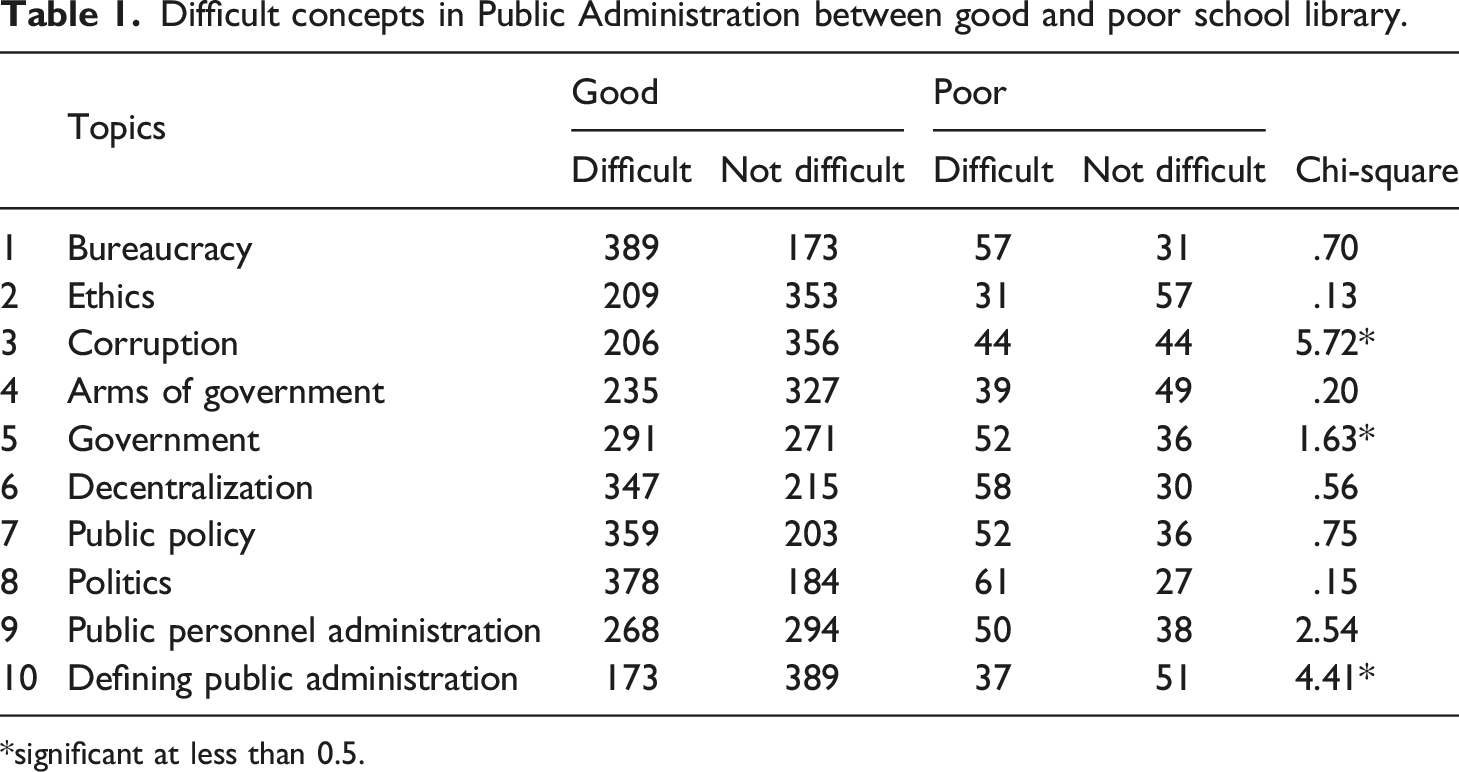
*significant at less than 0.5.
When qualitatively interrogated, randomly sampled participants reported the ensuing (in their own words and unedited).
We have a beautiful library, but usually, we do not have good public administration books written to reflect our local content.
We have an outdated book on public administration in the library, and we do not have access to the university’s online library resources.
It is not enough to use the books in our libraries. We should be able to have access to the library of institutions like the ministry of local government and rural development or even the institute of local government studies. Since they do practical public administration, their libraries may have good materials for our course.
Discussions
In this study, the school library was investigated to test its influence on Ghanaian and Nigerian students' perceived difficulties with concepts in the study of public administration. We found statistically significant differences between good and poor school libraries in how Ghanaian and Nigerian university students perceive concepts in the study of public administration (p < .001). This finding shows relationships between the school library and students' understanding of concepts in the study of public administration. The quantitative findings imply that the library is considered an important variable in students’ understanding of public administration. With a good library, students get good texts on public administration and have the opportunity to study in serene environs that support understanding of concepts. Our finding relates with the work of Lance (1992) and Magara and Nyumba (2004) aand Snowball (2008).
In the Lance (1992) study, it was found that better funding for library media centres fosters academic achievement through the provision of students access to more library media staff and larger and more varied collections; and students whose library media specialists participate in the instructional process are higher academic achievers.
In the (Magara and Nyumba (2004) study, they assert that the vision of the school library policy should reflect the vision for education. This can mean that school libraries and related facilities should be built, bearing in mind the quality of education that such facilities are intended to achieve for national development. In that sense, it would be expected that school libraries will meet such requirements as being stocked with up-to-date books, accessible online study material, and books written to reflect the nation’s local contents and developmental needs.
In Snowball’s (2008) study, he asserts that children and teenagers are the future adult users of libraries. How they are treated in libraries, particularly school and public libraries, can cement lifelong memories and habits in these young people. The assertion of Snowball (2008) can be interpreted to mean that a good library allows students to compare how concepts are taught in other jurisdictions away from their classrooms. This gives ample room for a better understanding of concepts that a teacher may not have explained well in class. Contrary, a bad library presents bad studies. Public administration students will have compounded difficulties if the library facilities are outmoded and do not speak to current public affairs issues like governance, private-public partnership, etc.
The qualitative data have implications for theory and literature and are specifically reflective of the works of Okebukola (2020); Desselle and Shane (2019); Spina (2019); and Snowball (2008).
For instance, Kwame’s (pseudo name) report that they have a beautiful library but usually do not have good public administration books written to reflect their local contents has relevance to the cultural component of the CTCA. Based on Nkrumah’s ethnophilosophy, the cultural component of the CTCA espouses that when students learn with their culture as the basis, they tend to understand concepts better than when foreign cultures are the basis of learning. This is demonstrated in this study by the response of Kwame, indicating that the non-availability of public administration books written from the Ghanaian perspectives in his school library affects his understanding of public administration.
Further, the work of Desselle and Shane (2019) that, in a study to identify differences in test performance between native English speakers and students for whom EFL, EFL student performance was lower than native English speakers on examinations. English is a foreign language students were less satisfied with the quality of their notes. This reflects the need for local ctttttt in the books written stocked in school libraries in Ghanain and Nigerian libraries to mitigate the challenge of excessive cultural and language influences in the public administration books found in these libraries. This thinking finds semblance in the work of Kong (2015) that integrating content and language learning through the planning of content and language learning objectives is a key curriculum strategy.
The qualitative insights of Kwame’s (pseudo name) further find meaning in Magara and Nyumba’s (2004) that the vision of the school library policy should reflect the vision for education. Public administration education in Ghana and Nigeria is intended to imbibe students with the skills needed to manage the public sectors of both countries. This invariably implies the need to teach students based on the cultural values of Ghana and Nigeria. A departure from this by stocking libraries with non-Ghanaian and Nigerian culturally oriented books may impede students understanding of the course as identified by Kwame.
Also, the response of Adwoa (pseudo name) that they have outdated books on public administration in the library but do not have access to the university’s online library resources is a key factor affecting her understanding of public administration. Her assertion gives credence to the technological bit of the CTCA, which emphasises that when students learn with the aid of technology(online library in this instance), they have a better understanding of concepts than those studying without technology. The technological bit as espoused by Heidegger is drawn from his techno philosophy, which largely argues for technology as a basis for students’ academic achievements.
Her assertion further finds evidence in the assertion that ensuring the accessibility of web content is key to ensuring that users have equal access to online information and services; however, even with the need for compliance to legal requirements, problems of accessibility exist across the web, especially with online contents created and shared by libraries (Spina, 2019).
The qualitative findings from Robert (pseudo name) further showed that it is not enough to use the books in their libraries. Since they will engage in practical public sector management after graduating, they should have access to the library of institutions like the ministry of local government and rural development and the institute of local government studies. A lack of this gives impetus to the work of Snowball (2008) that children and teenagers are the future adult users of libraries. How they are treated in libraries, particularly school and public libraries, can cement lifelong memories and habits in these young people.
Robert’s responses further bring out the contextual bit of the CTCA. The subject is practical and taught within a given environment (Ghana and Nigeria in this instance). Suppose libraries of the practicing institutions (ministry of local government and rural development and the institute of local government studies) are made available to students; they are likely to be able to comprehend the concepts since the libraries are not theoretical as those of universities
Conclusion
This mixed-method investigated the relationships between the school library and students’ understanding of concepts in the study of public administration using a sample of N = 650 drawn from university students in Ghana and Nigeria. Analysis of quantitative data from the difficulty in public administration questionnaire showed that Ghanaian and Nigerian students’ perception of concept difficulty in the study of public administration relates to school libraries. University students perceive many concepts in the study of public administration to be difficult when there is a poor school library. Hence, statistically significant differences were found in some of the concepts observed-corruption, government and defining public administration (p < .001). Similar to most findings in the literature, the library is considered the engine of education in many parts of the world. With a good library, students get good texts on public administration and have the opportunity to study in serene environs that support understanding of concepts.
Recommendations
Based on the findings, we recommend enhancing effective librarying that will influence students understanding of public administration.
Public administration books written by Africans should be stocked in the libraries to overcome the challenge of students complaining of books in the library not written to reflect local contents.
Also, current and up-to-date books should be made available in the libraries to ensure students overcome the challenges relative to outdated books in the library.
Further, it is recommended that library management make access to the online library available to students.
Universities are encouraged to get into some partnerships with other libraries beyond their own where students can be allowed to use other library materials.
Limitations and future research
A major limitation is that the study is based on five universities in both Ghana and Nigeria, with 650 university students. We are aware that the small number of universities and samples might not make a very strong case for quantitative analysis, but under such circumstances, it does provide direct evidence that the students under research perceived library as a significant factor influencing concept difficulty in the study of public administration. That stated, the qualitative aspect of the study helps validate the quantitative data results.
Footnotes
Declaration of conflicting interests
The author(s) declared no potential conflicts of interest with respect to the research, authorship, and/or publication of this article.
Funding
The author(s) received no financial support for the research, authorship, and/or publication of this article.
