




Abstract
Case studies provide helpful teaching tools to capture the complexity of administrative problems from an action-oriented perspective. With increasingly complex policy problems at hand, more interdisciplinary, interactive, and discursive approaches to teaching are also in demand. However, the case method offers a broad variety of options for teaching programs, ranging from short case illustrations or vignettes to full-length case studies. Attached to various types of case materials are different didactic approaches that pursue different pedagogic logics and are likely to make different contributions to in-classroom teaching. The case method in teaching public administration, however, comes at a cost and requires extra capacity, higher time budgets as well as new qualifications and roles of teachers plus a good fit of student (self)-selection and teaching objectives. If meaningfully utilized, it enhances our capacity to prepare (future) executives for complex environments.
Introduction: The case method in the context of public sector education and training
The case method is widely used in college teaching across many departments and disciplines—and even more widely talked about in academic and professional circles as an important approach in higher education. In part, however, this popularity owes much to the fact that case teaching is often only vaguely defined, being used in different settings for different purposes. For the sake of clarification and a more systematic treatment of this teaching method, this article sets out to analyze cases and their use in the classroom by way of a typology of case material and corresponding learning goals. In doing so, it considers the case method with a wide angle, so as to encompass both its roots in teaching philosophies and didactic approaches and its account of assets and liabilities.
Case studies represent an established approach in research and teaching across a wide range of academic disciplines. In social science research, the merits of the case study approach are particularly appreciated by advocates of qualitative methods who value their high degree of internal validity and the close link between empirical data and their context, including institutions and actors (Yin, 2018). In social science teaching, particularly in the domain of management training (Andersen and Schiano, 2014; Ellet, 2007; Jennings, 1996, 1997; Lundberg and Winn, 2005; Lundberg et al., 2001), the case method—especially at the Harvard Business School that adopted this technique from law schools (Christensen, 1989)—has been highlighted and praised for a long time for their problem-oriented nature and interactive potential in the classroom (Andrews, 1953; Barnes et al., 1994; Erskine et al., 2003; Hunt, 1951; Naumes and Naumes, 2012; Penn et al., 2016; Stein, 1952). This potential is also brought to bear in the disciplines that constitute the public management, public administration and public policy community (see for example Borins, 1990; Clemons and McBeth, 2009; Foster et al., 2010; Hatcher et al., 2018; Lynn, 1999).
Still, the full capacity and variety of applications of the case method has not yet been aptly appreciated in the broad range of education and training programs at undergraduate and graduate levels in our fields of instruction. In fact, the full range of different types of case material (ranging from short case illustrations or vignettes to full-length case studies) has to be realized in order to assess their specific merits in the classroom. Attached to various types of case materials are different didactic approaches that pursue different pedagogic logics and are likely to make different contributions to in-classroom teaching (Foster et al., 2010). Consequently, this article offers a more systematic treatment of what different purposes the case method as a didactic tool can be used for in different settings of public sector education and training.
In what follows, we, first, set the case method in the context of learning theories and teaching philosophies as an inductive approach to knowledge transfer and acquisition. Against this background, we will discuss specific assets and liabilities that are typically associated with this form of instruction. Our argument is eventually geared to identify different types of cases and match them with different types of approaches to case teaching in order to probe more systematically into the question of how cases can be utilized for different learning outcomes in the classroom.
Teaching philosophies and pedagogy: putting the case teaching approach in context
The case for case teaching can serve as an antithesis to the orthodoxy of lecturer-centered formal instruction in the classroom. It flows from this that most controversies involving the case method are typically organized around two camps of advocates and critics, who tend to represent distinct perspectives on the acquisition of knowledge in an academic setting: the deductive or inductive approach to teaching and learning (similarly, Markant et al., 2016 pit active and passive learning against each other). What sets these approaches apart is mainly how they relate theory to practice or rather to applicable knowledge and concrete action as a result of this transferred knowledge (Argyris, 1980 with reference to executive programs; see also Lundberg et al., 2001). While, if taken to their logical conclusions, these models of learning can be presented as diametrically opposed or even mutually exclusive, they seem to prove compatible in practice, allowing for a variety of combinations and iterations in classroom teaching.
Before spelling out in greater detail what characterizes the deductive and inductive approaches, the theoretical context of these teaching philosophies deserves our attention (for overviews see Bélanger, 2011; Illeris, 2018; Leonard, 2002; Mezirow, 1996). In fact, they seem to correspond with different notions of learning: either leaning towards a model focusing on individual educational achievements through collecting and connecting data and information to form knowledge and memorizing it until it can be applied or favoring an ideal of learning as a social and affective process which forms and transfers knowledge by way of shared experiences and actions. The first notion appears to conform more with a behaviorist frame (Skinner, 1974; Thorndike, 1931), which defines effective teaching as getting the external incentives right to make the stimulus-response mechanism work. Consequently, the learning environment is meant to be well structured and controlled with educators neatly pre-planning their curriculum into digestible parts in a hierarchical fashion ranging from simple to more complex content (see also Bélanger, 2011: 20). The second perspective on learning, however, resonates better with social cognitivist (Bandura, 1977; Bruner, 1996; Gagné, 1985) and constructivist theories (Lave and Wenger, 1991; Piaget, 1964) that recognize the importance of social cognitive dissonances and the exposure to problem situations as the major drivers of learning. It flows from this that learning tends to work best in open situations, permitting discovery and exploration, with instructors serving as facilitators, who provide support to the degree that it is needed (see also Bélanger, 2011: 24, 30). The constructivist variant of learning theories, in particular, emphasizes the social dimension of learning—in contrast to the understanding of learning as an individual achievement—and highlights the role of “communities of practice” (Wenger, 1998) and of social interaction in the process of acquiring new skills and knowledge. While the complexity of learning theories lies beyond the scope of our analysis, the juxtaposition of these basic elements helps preparing the theoretical ground for the discussion of deductive and inductive teaching approaches.
In brief, protagonists of the deductive camp maintain that the “eye does not see what the mind does not know.” If taken to its logical conclusion, this position calls for a hefty dose of instruction in theoretical reasoning, conceptual backgrounds and also in the factual-empirical content that defines and contextualizes the problem at hand. Starting from this vantage point, instructors are most likely to suggest first the reading of “classic” texts and, like using a funnel, will delve into the scholarly literature looking in a first step for a more abstract and general treatment of the subject matter before attention shifts to more specific accounts of the material. As a consequence, the proper understanding of a problem is methodologically derived or deduced from a set of theoretical frames and empirical observations that are eventually applied to specific cases. Here, case material, if used at all, merely serves to illustrate and exemplify theories and concepts (see for example Griffith, 2012), thus facilitating the knowledge transfer from academe to administrative practice. What this approach prioritizes, however, is the mastery of scholarly knowledge and content. It assumes that this content serves as a critical navigation tool and fundamental frame of orientation for any student or future graduate who has to deal with complex situations in his or her professional career. Oftentimes, however, this content—pre-defined as a set of theories, methods and empirical facts—is also regarded as a value in its own right, particularly if and when it is meant to define the core of an academic discipline. At this point, at the latest, many critics of this deductive approach will raise their voices and take issue with the perceived lack of action-driven and inductive teaching.
According to the mind-set of advocates of the inductive approach, the overriding goal of instruction is to train people “not only to know but to act” (Barnes et al., 1994: 41). In this context, the “inductive approach” can be used as an umbrella term, which not only includes case studies but also encompasses “a range of instructional methods, including inquiry learning, problem-based learning, project-based learning, […] discovery learning, and just-in-time teaching” (Prince and Felder, 2006: 123). The need and ambition to solve problems by acting is supposed to be the motivating starting point of any teaching experience, rather than being the final result of a long process of deductive reasoning and knowledge application. Initiated by the exposure to realistic case descriptions of various breadth and depth (see our typology below), students—in keeping with this perspective—will inductively develop an understanding of the general behavioral patterns and specific problems under investigation. By drawing conclusions from individual cases and consolidating the results from specific case solutions, this approach may also facilitate theory building (Yeung, 2007). However, the major thrust of inductive teaching formats lies primarily with the action-oriented analysis of the case material which motivates students to adopt the underlying case problem as their own and discuss possible plans of action as a group and with their instructors (cf. Kunselman and Johnson, 2004; Rees and Porter, 2002a). Against this background, the case method epitomizes the inductive approach as it “rejects the doctrine that students should first learn passively, and then, having learned, should apply knowledge” (Whitehead, 1947: 218, quoted in Barnes et al., 1994: 34).
Having said that, we should be quick to make mention of the considerable room for overlap and compatibility between those “teaching philosophies” in the reality of the classroom. When practicing academic teaching, the key question is more often than not couched in terms of how to balance the elements of deductive and inductive approaches over the course of a degree program, rather than making an “either/or” decision. While both approaches can be considered as legitimate and—within their own frames of reference—effective approaches to teaching in higher education, their relative strengths, however, suggest that they cater to two distinct kinds of knowledge: “One is the kind of knowledge that is associated with the scientist who is seeking to make verifiable propositions about a certain class of phenomena. The other is the kind of knowledge that is associated with the practitioner of a skill in relation to a class of phenomena” (Roethlisberger, 1954: 6, quoted in Barnes et al., 1994: 50).
Looking at the assets and liabilities of the case method
Potential benefits and advantages
The case method provides effective teaching instruments to convey academic and professional knowledge to students of public administration, policy and/or management. The case method, however, may serve different purposes: it may help to illustrate, test or develop theories (see for public administration theories Mosher, 1939; generally for building theories from case study research see also Eisenhardt, 1989; and Levy, 2008), but also to facilitate analytical and reflexive thinking or to provide a basis for simulations and practical experiences in the classroom (for linking academic teaching to practice see Barnes et al., 1994; Lynn, 1999; Yeung, 2007). As a consequence, the case method may bridge the gap between traditional ways of academic education (lectures and seminar-style teaching) and approaches to vocational and professional training based on mastering a craft and answering “how-to-do” questions.
To bring these strengths to fruition, certain learning habitats can provide particularly fertile soil. When courses of study are designed for practitioners, as is the case with executive education and mid-career programs, who bring not only first degrees in academic disciplines but also years of professional experience with them, the potential benefits of teaching full-fledged comprehensive cases can be best exploited. This holds particularly true in an interactive and discursive teaching atmosphere, which endorses, even heavily relies, on horizontal learning among peers and denies the usefulness of simple, unidirectional associations or clear-cut “how-to-do” lessons cascading down from instructor to student. It flows from this that the case method appears to lend itself to teaching environments in which pre-trained executives need to be prepared for the handling of ambiguous and complex situations. In fact, with more mid-career programs and executive trainings being offered, with more but also shorter training stages over the span of a work life and increased lateral entrants from other professions to the public sector, adequate teaching philosophies and didactic instruments are in need to offer student-oriented and interactive teaching methods that are easily accessible to professionals and still qualify for academic degree programs.
What is more, this approach appreciates the increasingly complex nature of organizational or policy-related problems that escape binary “false-or-true” codifications. While public administrators tend to be confronted with increasingly complex and “wicked” policy problems (see for a discussion Head and Alford, 2015; Peters and Tarpey, 2019), which are difficult, if not impossible, to tackle with clear-cut legal or hierarchical responsibilities, neatly-defined jurisdictions between “silos” or linear and mono-causal policy projections, the ability of public sector executives to deal adequately with these policy challenges rests primarily on their capacity to cooperate across sectors, apply interdisciplinary knowledge and critical, reflexive thinking as well as their ability to communicate effectively and build support from different sources for public sector programs. The combined effect of these public sector developments draws further attention to more interactive and discursive methods of instruction as offered by case teaching.
The merit accorded to the case method is in no small measure associated with its contribution to the atmosphere in the classroom by redefining the relationship between instructors and students. Rather than being restricted to a passive or receptive role description, course participants are encouraged to contribute actively to the course content by discussing and evaluating the case material (Jennings, 1996: 8). In doing so, students stand a much better chance, if compared to formal settings of frontal classroom teaching, to relate their prior (work) experience to the subject matter, feel emotionally involved in the learning process and build teams with their classmates. In this way, the case method blends cognitive with affective learning modes (Barnes et al., 1994: 46), which also helps making knowledge more memorable and retrievable because of the motivating and activating quality of this teaching format (see for example Desiraju and Gopinath, 2001; Markant et al., 2016).
Still, the cognitive learning mode plays a significant role in case-based teaching approaches. The requirement of this content-related component can be satisfied by reference to empirical facts or data included in the case material, or specific theories and concepts embodied in accompanying questions and guidelines for the case work. In addition to the content-related component, however, a specialty of the case method lies in the process-related aspects of the teaching and learning experience. In this context, “process” relates to the dynamics of individual and collective interaction as described in the case material. Depending on the width and depth of the case, students can more or less immerse themselves in the provided material that—at best—simulates the complexity, goal ambiguity, and information overload of administrative practice. Going beyond mastering the content of the case, this process-orientation helps focusing the analysis on patterns of organizational behavior, sequential phases of decision-making, fault lines running through stakeholders or mechanisms of conflict resolution and consensus-building.
On a different level, it is the process of discussing cases with fellow students and instructors, building teams to find answers to case questions and resolve management problems and organizing the case work itself that provides a training ground for a full range of interpersonal skills. So, the case study learning experience itself helps creating a conducive environment for a three-fold competence profile: knowing the content with regard to a specific field, being able to understand organizational processes, and having the necessary social and communicative competencies to adopt and adapt different kinds of knowledge to real-life cases and settings.
Potential risks and liabilities
The list of potential benefits and advantages, however, have to be discounted against the risks and liabilities associated with the case method (Smith, 1987). Apparently, the benefits come at a price. In what follows, we are looking at this price tag from different angles, so as to assess its total value (see also Rees and Porter, 2002b; Romm and Mahler, 1991).
The most fundamental attack against case teaching may be launched from a heuristic point of view. This critique turns one of the assets of the case method into a liability. The very fact that cases provide context to the analysis of data and information and allow students to put themselves in the shoes of relevant case actors is also the port of entry for individual or systematic biases, manipulations, and context-specific constraints (see for a discussion the case study in research Blatter and Haverland, 2012; Campbell, 1975; Gomm et al., 2000; Hamel et al., 1993; Lijphart, 1975; Stake, 1995; Tellis, 1997). Arguably, these potential pitfalls and limitations are always present when teaching (or researching) any relevant issue emerging from the social sciences or humanities (or, for that matter, from any academic discipline). However, the risks of ecological fallacies, personal biases and lack of external validity appear to run higher—if compared to more deductive or quantitative approaches—when basic assumptions about value judgments can be more easily woven into the fabric of the case material, obscured as context-specific information or embedded in questions or comments that are meant to guide the case analysis. On top of that, the very nature of a single case is likely to raise the question: Where do we go from here? What conclusions can be drawn from—albeit in-depth—observations from a single case? In face of these questions, the case method, not surprisingly, has been criticized for offering only limited chances of generalizable results.
In a similar vein, the virtues of the case study teaching philosophy may turn into corresponding vices, if the principles of case teaching are taken to their logical extremes and/or applied in institutional settings that are unfit for the case method. For one, the “full immersion” approach of case teaching, inductive as it is, is often prone to produce a-theoretical and a-historical accounts of a subject matter—unless, of course, students have already command of theoretical and conceptual knowledge or have the opportunity (e.g., by way of accompanying lectures and seminars running parallel to their case work) to put the results from case analysis into a broader perspective. The risk of lacking critical reflection runs particularly high, when case teachers or case teaching institutions (such as professional schools or university departments) cannot resist the temptation of offering or even imposing prescriptive standardized “plans of action” as the perceived “right way” of averting a crisis or responding to administrative problems (cf. Lundberg et al., 2001). In doing so, teachers and teaching institutions do not only do injustice to the case method, they are also more likely to fall victim to the fades and fashion of (public or private) management studies. In part, however, this potential liability of case teaching is inherent to this didactic method, because it tends to focus heavily on process-related knowledge and patterns of managerial action. It flows from this that repeated case work with almost automated or mechanistic management responses to “solve problems properly” may convey a false sense of security, thus limiting the choice of available options.
Picking up on the leads from our last point, we shift attention from the epistemology of the case method to a rather profane, but nonetheless important matter: extra costs. Rolling out the case method across a significant part of teaching programs is by no means an inexpensive decision to take. The necessary expenses are associated with different components of the value production chain. First of all, it is the case material itself that has to be researched and written, which not only requires time and effort but also specific expertise and access or insight into the realm of administrative or corporate practice. Rarely, all of those requirements will fall together in the person of the course instructor of record (Jennings, 1996: 9).
Consequently, case writing has become a sought-after qualification in its own right (Graham, 2011; Hatcher et al., 2018; Jennings, 1997; Lundberg et al., 2001) which is often outsourced and well paid-for. The industry of case writing, based at major centers, however, sets a cycle in motion that propels forward less desired developments as discussed above: case material from external sources may be inclined to be less sensitive to culture-specific aspects of administrative practice and cover more generic management problems that might miss some or most of the content required in specific regions of the world or sectors and functions of public organizations (cf. Jennings, 1996: 9).
Cost of teaching, of course, is also, and perhaps primarily, a function of required resources as measured in time (particularly face time with instructors) and space. In this respect, the case method seems best suited for resourceful institutions, which can afford (and justify) to organize a cohort of program participants into small, seminar-sized groups with qualified instructors in attendance for intensive coaching and facilitation of classroom discussions.
While higher levels of students’ motivation is often an expected benefit of the case method, in reality case work may also carry a risk of demotivation. What is at stake here is the challenge of managing expectations and establishing a good fit of students and teachers with the teaching method of choice. In fact, students have been known for asking for clear instructions and “how-to-do” lists from their teachers. In these cases, students may find it difficult to tolerate the ambiguity and contingency of case “solutions” which more clearly identify problems than recipe-like answers. It is also hard to deny that team work in case analysis can be a very time-consuming and nerve-racking process, particularly if students vary significantly in motivation, commitment and/or prior experience and levels of knowledge (Hughes et al., 2010). While those challenges can be seen as integral part of the learning experience, they are also potentially demotivating factors. Teachers, too, may find it difficult to unequivocally embrace a full-fledged case method approach in their classrooms. Not only that they may need to acquire additional skills and competences as case writers, coaches, mentors, and facilitators of classroom discussions, they also have to let go of their ambition to control the classroom to the fullest extent. Again, this change of role expectations may be a potential source of conflict with faculty members who find themselves best suited as “instructors” in the literal sense of the word.
Less than enthusiastic responses to case teaching are oftentimes also rooted in concerns for effective and efficient quality management in institutions of higher learning. In systems of higher education that have increasingly moved towards modularized, accredited, “quality-controlled” and competence-driven degree programs, the case method resembles a double-edged sword that cuts both ways. On the one hand, it satisfies—probably better than most rivaling teaching formats—the requirements for the transfer of theories into practice, trains students in transferable competencies (rather than handing-down knowledge) and highlights the action-oriented skills that also make future graduates more employable. On the other hand, the results of this didactic approach are more difficult to repeat over a series of courses and student cohorts. What is more, those results are not as easy to test as the results of classical lectures and seminars (difficult enough as it is) in which educational attainment is regularly demonstrated in closed-book exams, essays, or research papers, if not in more standardized forms such as multiple-choice questionnaires. In fact, the nature of the case method, which yields different results in different group settings and allows different students to draw different conclusions from the case material, defies the logic of a more uniformed and standardized approach of tertiary education and training.
A typology of cases: matching the case content with teaching approaches
Bringing order to variety: scope and utilization of case material
What constitutes a case for the purpose of our analysis? For a definition, two independent dimensions suggest themselves. First, there is a collection of material, generally speaking a record of an administrative issue which is of relevance for executives of public sector organizations. Typically, the case is supported by qualitative and/or quantitative data and information concerning the facts, interests, and opinions that define the environment in which public administrators or managers operate. To be sure, this collection of material may vary considerably with regard to its sheer volume and its type of content. However, it is only the application of certain teaching approaches to this case material that turns the collected data and information into knowledge. Consequently, there is—second—a wide range of didactic approaches or teaching philosophies that can be utilized to process and digest the case material. Again, these variants of pedagogy may differ significantly from another. They are likely to be located on the established spectrum (as introduced above) of deductive or inductive, more cognitive or rather affective teaching and learning processes. The number of possible permutations of the two dimensions results in a crowded universe of types of cases that can be used for coursework.
One should be quick to mention, however, that this variety of possible case types (see for an overview Lundberg et al., 2001: 457–459) is not to be misunderstood as a “supermarket model,” which offers a range of choices for lecturers to pick and choose from indiscriminately. Rather, matching case material with teaching approaches is primarily dependent upon the desired learning outcome, which, in turn, will be affected (as shown below) by circumstantial factors such as levels of academic qualification and experience, available resources and the propensities of students and lecturers alike.
To help us navigate through this variety, a typology of case studies can be employed to better assess which type of case study is best suited for which didactic approach and learning outcome. To this end, it is helpful to use the two dimensions for a typology that considers both the scope of the case (volume and content of case material) to be covered during coursework and the way the case study is to be utilized in class (didactic approach).
With regard to the scope of the case, we distinguish between small episodes or vignettes, medium-sized cases of approximately four to six pages and very large cases with comprehensive appendices with which practical problems are to be simulated as accurately as possible for course purposes. The didactic dimension refers to the question whether the discussion of the case material should be steered by precise questions at the end of the case description (i.e., pre-structured analysis of the case) or whether students are faced with the task of having to deal with the described facts independently and to submit proposals for solutions to the core problem identified by themselves (i.e., self-structured analysis) (see also Desiraju and Gopinath, 2001: 394–395). This operationalization echoes the distinction between deductive and inductive teaching philosophies with pre-structured (and primarily lecturer-driven discussions) questions representing the deductive camp (including its proximity to classic cognitive learning processes) and (self- or open-structured discussions representing the inductive approach, which also tends to be more receptive to affective learning processes).
In the case of episodes and vignettes, the fact that such short descriptions contain very little substantial information for one’s own deliberations makes it appropriate to work very strongly with concrete questions in a lecturer-driven manner, for example, to draw attention to certain theoretical approaches or approaches to a problem constellation. Episodes or vignettes without specific questions should at best be used for the purpose of creating a problem awareness for certain topics.
Even in medium-sized cases, it cannot be assumed that a realistic practical simulation is possible given its limited scope. For this reason, it is recommended that the discussion in the class room be guided by concrete questions which, however, may already have a stronger connection to theoretical concepts or analytical techniques (see also Abrams, 2016). In this regard, it only makes sense, if at all, to work with open questions or completely without questions in this type of case study if the same or a similar background of experience exists in the student group or if missing information or premises can be supplemented or substituted by students themselves on the basis of their own practical experience. However, this approach carries the risk that familiar decision-making routines will be used and that the learning success actually aimed for by the case method, that is, to deal independently with a new problem situation, will be missed.
In the case of the “comprehensive set of case material,” the didactic approach via a concrete catalogue of questions is—as a rule—inappropriate. The comprehensive provision of information, data and figures is intended to simulate a practical situation in which students do not have to work through a given questionnaire, but are forced—as in their future role of civil servants, public managers or external management consultants—to orient themselves, process information, develop their own problem analysis and come up with independent recommendations for action.
There are also close links between the types of case studies and the types of teaching approaches on the one hand with the learning outcome, that is, the skills and competences to be acquired by students on the other hand. When working with episodes and vignettes using specific questions, the aim is to transmit scientific or professional knowledge mostly using a cognitive form of learning or knowledge transfer—as prescribed by members of the deductive camp. In the intermediate cases, the aim often is to practice the management of complexity, which can contribute to an improvement of social competence; in supplementary lecture sections, knowledge can also be conveyed systematically with a thematic reference to the case studies and introduced into the critical questioning of theoretical approaches. The most comprehensive type of case study in terms of skills and competencies are the extensive cases with open questions, because the aim here is to convey the entire range of competencies, which includes not only professional and methodological skills but also social personal competences. This combination of case material and teaching philosophy is the closest approximation to an ideal-typical inductive approach, which also emphasizes the significance of affective learning processes.
Matching types of cases with teaching approaches.
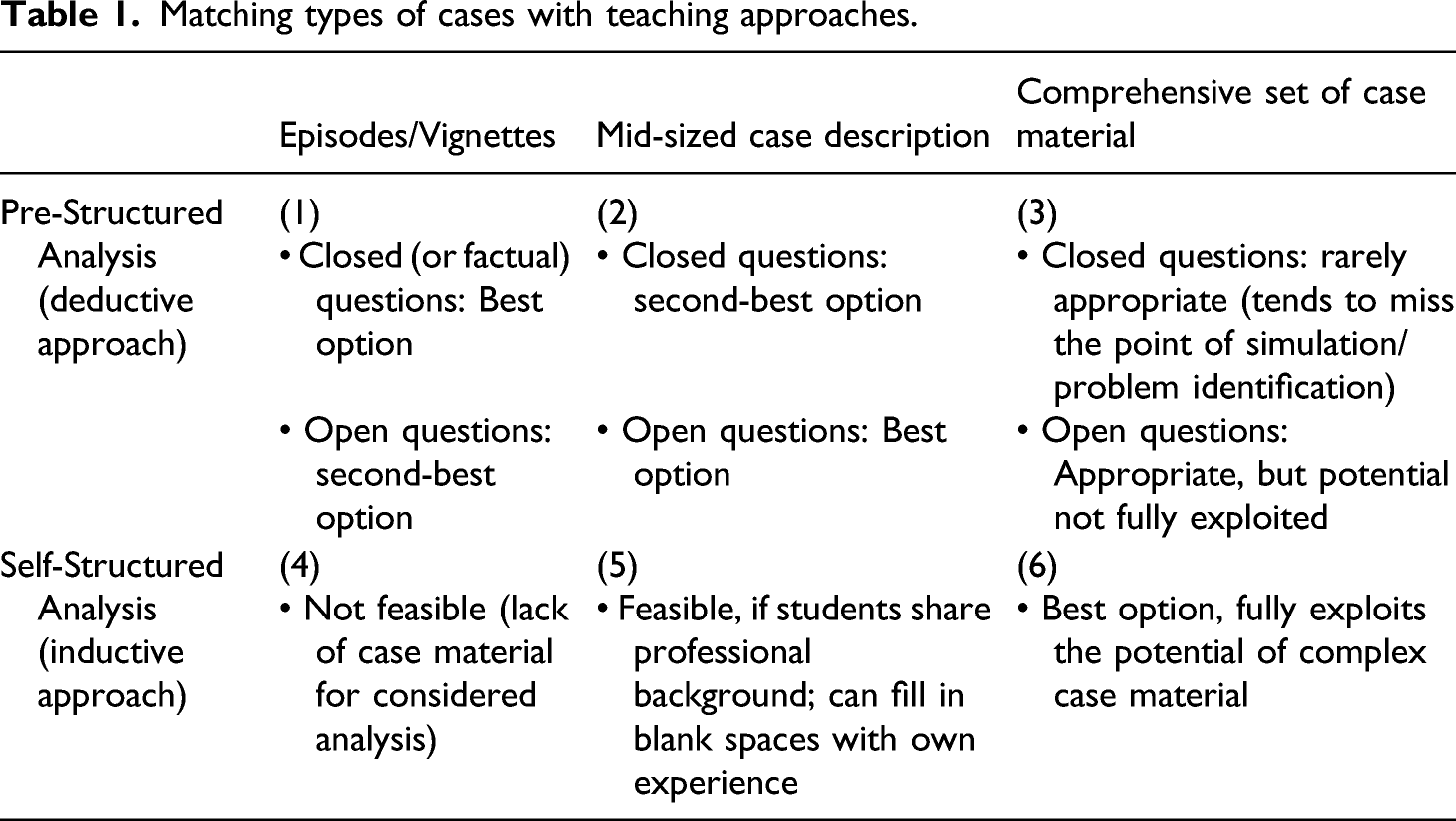
Different combinations of the scope of cases and applied teaching approaches make different learning outcomes more or less likely to be achieved. Starting with episodes and vignettes, a short case may suggest itself to a cognitive learning mode and may help students to understand key concepts and to apply theoretical knowledge to the case material. Going beyond that learning outcome, a mid-sized case description seizes the middle ground between cognitive and affective learning modes and allows students not only to apply concepts and theories but also to process relevant information in complex and dynamic situations. Finally, a comprehensive set of case material, if combined with an affective learning mode based on the inductive approach, extends this list of acquired skills and competencies by adding action-oriented and interpersonal elements: in particular, the ability to assess and take managerial decisions under simulated real-life conditions.
Applying the case method to classroom teaching
When using the case method in the classroom, the question also arises whether the case work ought to be assigned to students individually, to small groups or teams of students or to the full class in a plenary session. Based on the considerations above, individual assignments, though not the only available option, seem to be particularly appropriate for episodes and vignettes, for example, to first attract attention to course topics. In a second step, these relevant topics can then be discussed by all class participants to convey, for example, systematically prepared knowledge about highlighted theoretical approaches and key concepts. For medium-sized case studies, however, it might be more suitable to work on the case in small teams given the complexity of this type of case study, which allows a meaningful exchange of arguments and counter-arguments in small working groups. Again, it might be advisable to present students with a compact overview of conceptual or theoretical insights related to the content of the case before or after the discussion of the case study in plenary sessions. Whether the whole class can be meaningfully involved in the case work is less of a question of the case type but rather of class size. As a rule, smaller classes allow for more intensive treatment of comprehensive case material, whereas higher student numbers work effectively against a shared learning experience in case teaching—unless the didactic approach aims for cognitive learning goals based on short episodes or vignettes.
For the successful implementation of the case method in public affairs teaching, the changing role of professors and their interactions with different types of students are of paramount importance. When an instructor works with episodes or vignettes, this case work can take place in full class meetings and be done by individual students after which the lecturer invites a general discussion. In this setting, the lecturer’s role is supposed to be more active with, for example, concrete questions and classical elements of a lecture conveying knowledge using illustrative examples of the episode or vignette and introducing selected theories and concluding with suggested case solutions. In relatively simple case studies of medium size with concrete, closed questions, the role of professors does not change significantly. In more complex cases, which allow for an exchange of substantive arguments and counter-arguments between students in small groups, instructors will be required (in addition to their lecturing role) to act as a discussion leader and moderator. When using an extensive case study in which there are no concrete questions, but only a generally formulated task (which can consist, for example, of putting oneself in the role of a superior or an external management consultant who has to work out important problems and propose solutions), the learning objective for the students is to independently deal with a complex issue in small groups, to present their work results professionally and to be able to defend them against critical objections. In this case, the task of instructors can be compared to that of a coach who initially accompanies the group work in an advisory capacity and then finally analyzes and evaluates single results comparatively across the whole group.
Cases can play a relevant role even in traditional lectures which operate as a stream of one-way communication and focus on the transfer of knowledge from lecturer to students. Taking the form of smaller episodes, they might provide extra motivation to class participants, raise questions of knowledge transfer into practice and soften up the orthodoxy of the classroom atmosphere. Still, at this stage cases are rarely a game changer of the didactic approach. When working with medium or large cases, however, the stream of communication between lecturer and students is likely to change considerably, because students are expected to read and prepare the case in advance, to participate much more actively and lecturers have to respond to their contributions appropriately. Consequently, lecturers are increasingly asked in their role of facilitators who need to incorporate substantive contributions (both of the constructive or destructive type) as well as handle the social dynamics of group discussions. In doing so, they cannot fall back on prefabricated, “ready-made” teaching content.
The patterns and styles of interactions between professors and students, however, also crucially depends on the degree of maturity, academic advancement and prior practical work experience that students bring with them to their classes. When enrolled students lack any professional experience, it seems to be more appropriate to work with small to medium-sized cases accompanied by concrete questions for analysis. When teaching more mature students and academically advanced, however, cases will tend to be more extensive, more complex and therefore more demanding. This is particularly true for those teaching programs in which experienced practitioners in mid-career return to higher learning for additional qualifications and formal educational attainment.
A final consideration revolves around the question as to where the appropriate case material for this teaching method might be coming from. Cases do not write themselves and their production, labor-intensive as it may be, does not carry the academic esteem of writing textbooks, monographies, let alone of getting published in refereed journals. Rather than relying on their own material, instructors may find it easier to turn to professional providers of cases for teaching purposes—even though their repertoire may be restricted to standard problems. Understandably, it can be particularly rewarding for faculty members to work with their own case material, because it allows tailor-made approaches and gives flexibility to instructors, who wish to capture specific policy issues or administrative problems in their course work. This option can have special appeal to researchers, who might be able to transform their findings into teaching cases. However, successful researchers are not necessarily gifted case writers—and even if they are, there may be limits to the extent of which their research observations can be meaningfully translated in case material. Organization research has to comply with privacy laws, often operates under the condition of anonymity and if not, it might still be wise not to reveal all institutional, let alone individual identities to maintain levels of trust and avoid stigmatization of actors and their organizations. Against this background, case material, particularly for more complex and comprehensive cases, often tends to take on a semi-fictional nature, blending evidence from “real cases” with fictional content to camouflage its origin and present the material in an attractive way to students. Purely fictional cases, however, seem to be more practical for shorter episodes and vignettes, which are meant to represent generic organizational problems or illustrate key concepts from the literature. In any event, much of the success of the case method seems to rely on the willingness of teaching institutions to acknowledge the value of this teaching format and develop further the skill of preparing case material and write different types of cases among their faculty members.
In conclusion: A critical assessment
Cases provide helpful teaching tools to capture the complexity of administrative problems from an action-oriented perspective. What is less appreciated, however, is the fact that the case method offers a broad variety of options for teachers and teaching institutions. In principle, these options become available if we combine different types of cases (as defined by their scope of content and material) with different ways of working with cases in the classroom (as defined by the degree to which case work is to be pre-structured by lecturers or self-structured by students). This potential variety of case teaching gives instructors and university administrators more flexibility as to how the case method can be used to assist, augment or even replace other teaching formats. While the essence of the case method (its inductive approach paired with the commitment to linking knowledge to action) remains largely intact for all options identified, each variant has its own focus at which it is supposed to perform best: be it content-related training for shorter cases with pre-structured questions or more analytical skills and process-related competences for comprehensive cases which are approached with broader or even open questions.
As a method of teaching, case work is often well reputed but still poorly understood. Much of the reputation stems from prestigious professional schools which made case teaching their hallmark and lend much of their academic cache to this form of instruction. The move towards case teaching, however, appears also to be justified by the way how this format—and the teaching philosophy surrounding it—corresponds with a series of challenges that public sector education and training is confronted with (Schröter and Röber, 2015). While operational environments of public sector organizations are growing increasingly complex, dynamic, and uncertain (Lundberg et al., 2001: 451), administrative leaders are hard pressed for interdisciplinary and intersectoral responses (Sprain and Timpson, 2012). Simultaneously, the enrolment in mid-career programs for executives (often in part-time) are on the rise owing to changing demographics and an emphasis on life-long-learning. Alongside with the demographics of student populations, their expectations and demands are shifting as well towards more horizontal and interactive teaching styles. Understandably, program designers are on the look-out for teaching tools that are able to quickly catch the attention of practitioners (or other graduate students, for that matter), engage them actively in action-oriented discussions, and support a three-fold profile of content-focused, process-related and interpersonal competences.
However, the case method is no panacea for all deficiencies or challenges of higher education. Rather, the expected benefits have to be discounted against potential pitfalls. Clearly, case analysis in the classroom comes at a cost and requires extra capacity, higher time budgets as well as new qualifications and roles of teachers plus a good fit of student (self)-selection and teaching objectives (see for the importance of objectives Romm and Mahler, 1991). More fundamentally, case teaching, if offered exclusively, produces—like any other format—its distinct omissions and biases (Argyris, 1980). Also, one should be quick to point out that the case method has no monopoly of activating students in the classroom or transferring scholarly knowledge to real-life problems as many participants of seminars, tutorials, internships, or capstone projects can attest to. And yet, case teaching adds to the repertoire of teaching formats. If meaningfully utilized, it enhances our capacity to prepare (future) executives for complex environments.
With this assessment in mind, however, more systematic research is still needed to examine under which circumstances the case method is most likely to be fruitful and how its possible strengths and weaknesses play out in different teaching environments (such as civil service academies, professional schools or university departments, but also with regard to different degree programs and student populations). To a significant extent, these teaching environments are likely to be shaped by cultural traits as well. As the case method appears to be particularly bound to cultural contexts, a note of caution is in order when teaching formats and case content travel across national or regional cultures. Again, more coordinated and concerted effort is called for to investigate how the variety of options of case teaching discussed above might work in different institutional and cultural habitats. In addition to being an object of much needed research, the case method should also constitute an integral part of a revised training curriculum for faculty members of schools and institutes of public administration. Teaching with cases effectively is no trivial matter and requires, alongside with a necessary role change from dominant class instructor to facilitating class coach, specific skills and didactic qualifications.
Footnotes
Declaration of conflicting interests
The author(s) declared no potential conflicts of interest with respect to the research, authorship, and/or publication of this article.
Funding
The author(s) received no financial support for the research, authorship, and/or publication of this article.
