




Abstract
Many professors will recognize the dilemma when having to choose between the values of professionalism and of collegiality. Everyone will endorse these two values as important in academic teaching, yet professors sometimes find them conflicting. The central research question of this manuscript is threefold: which value conflicts do academic teachers perceive in the Netherlands; what strategies are used to deal with these conflicts; and what value profiles do they have? The empirical study took place at the Vrije Universiteit Amsterdam. Data from Q-methodological and 32 semi-structured interviews were gathered and analysed to answer the research question. Thirty-five of the 41 dilemmas found fell within three categories: dilemmas in this particular case study of higher education occur mainly in the area of quality versus efficiency, quality versus equity and between equality and reasonableness. Mostly the old institutional professional values (quality of teaching, equality, and reasonableness) prevail among the academic teachers. Yet, in these times of cutbacks, the tensions between the professional and economic value systems are clearly prevalent in this Dutch case study. The most important coping strategy is hybridization. This indicates something important about the profession of academic teacher. Hybridization is a strategy often used when professionals cannot choose between two values because they value both too highly. For better or worse, the academic teachers (in this case) want to guard the quality of teaching against pressures from career demands (doing research and publish successfully) and from cutbacks and concomitant heavy teaching loads.
Background and research questions
In the Netherlands, universities are public organizations, and, as with public service delivery and other professions, there are conflicting values (and loyalties) at all levels in academic education. The rules on integrity are not always clear, and the choices to be made are not always between good and bad. Many professors will recognize the dilemma when having to choose between the values of professionalism and of collegiality (Winter, 2009). Everyone will endorse these two values as important in academic teaching, yet professors sometimes find them conflicting. An example would be when grading a master’s thesis as a second reader. When in doubt that a thesis should be awarded a pass, one might feel pressure in relation to the supervisor to allow the student to pass. Impartiality – treating all students the same – is another value we all agree is important in teaching. But what does that mean in practice when teaching and grading in academia? Dividing the teacher’s time equally among all students? Or helping those students who are struggling? Or investing more time in challenging the best students to get the most out of them?
The central research question of this article is threefold: which value conflicts do academic teachers perceive in the Netherlands; what strategies are used to deal with these conflicts; and what value profiles do they have?
The empirical study consists of one case in the Netherlands: the study took place at the Vrije Universiteit Amsterdam, in the Netherlands. Q-methodological and 32 semi-structured interviews data were gathered and analysed to answer the research question.
Values, university and the profession of academic teacher
Here values are studied in universities. Values are defined as qualities appreciated for, contributing to or constituting what is good, right, beautiful or worthy of praise and admiration (De Graaf and Van der Wal, 2008). Public values are the important qualities of public governance. Norms are regulations prescribing proper general and situational conduct. Value conflict is the tension one experiences between two or more values; value profiles the values one considers most and least important.
Together with the Water Authorities and the Catholic Church, universities belong to the oldest institutions in the Netherlands. Institutions are characterized by specific values which determine for a large part the actions of their members (Van de Donk, 2014): ‘In universities, perhaps the “most value-laden institutions in modern society” (Scott, 2004), values such as collegial governance, institutional autonomy and academic freedom have a long tradition of defining the essential elements of academic and university identities’ (Winter, 2009: 122). In most accounts of the ideal university, the university is characterized as a community of scholars, committed to the pursuit of truth (Lawton, 2019), which is marked by ‘honesty, intellectual courtesy, indifference to mere fashion in ideas’ (Coady, 2000: 6). Generally regarded values belonging to university identities include the value of truth, critical inquiry, an appreciation of learning, and intellectual freedom (Becher and Trowler, 2001; Hussey and Smith, 2010; Winter and O’Donohue 2012: 565).
In the academic literature, there is more attention to the identities of academic teachers than their value conflicts or value profiles (e.g. Morales Vázquez, 2019; Shams, 2019; Yandow-Reilly, 2019). Values of academic teachers are mostly discussed in the context of worries that neoliberal ideology (e.g. Dugas et al., 2018) and the related use and promotion of reward systems that highlighted competition and performativity based on the quantifiable measurement of productivity and performance have influenced the values of academics (Morales Vázquez, 2019: x). Winter and O’Donohue (2012: 565–566) state: ‘As governments increasingly position higher education in “terms of the economic role it can fulfil”’ (McArthur, 2011: 737), ‘unitary business values and practices originating in the private sector are “squeezing out” broader liberal education values and goals of the public university’ (Winter and Bolden, 2020: 169). There is pressure in public universities to combine and sustain competing and contradictory managerial (economic) and academic (professional) value systems (Winter and O’Donohue, 2012: 565).
Concerning value conflicts, according to Winter (2009: 127) academic teachers express value incongruence in degree programmes that have been ‘dumbed down’ (Clarke, 1998: 56), or quality framed in ‘established budgetary targets’, rather than ‘student learning’ (Randle and Brady, 1997: 235).
When it comes to values profiles of academic teachers, the values of academic autonomy, professionalism and collegial relations are mentioned in research in the UK, Australia and New Zealand (Winter, 2009: 128). Winter (2009: 127) argues that academic teachers ‘often emphasize their professional identities given their specialized teaching roles and discipline expertise. Hence, normative values, such as the “importance and (joys) of teaching and learning” (AD Brown and Humphreys, 2006: 240) and knowledge for its own sake (Nixon, 1996), are stressed, as well as more distinctive values, such as “creating knowledge, educating youth and contributing to their discipline professions” (Churchman, 2006: 9)’.
Conflicting values and coping strategies
The constant pursuit of the good is characterized by conflict. The things we knowingly pursue – let alone the things we unknowingly pursue – are often uncombinable, and also incommensurable; in governance and teaching this is no different.
In trying to realize intrinsic values in public organizations such as universities, intrinsic values conflict and lead to dilemmas. Value conflict, in itself, is not a problem; value conflicts can bring forth change for the better by prompting alertness and innovation. And – as can be learned from Lipsky’s (1980) seminal study or later the work by Maynard-Moody and Musheno (2003) – value conflict is unavoidable; it is a fact of life. Dilemmas are interesting because in studying dilemmas, one studies which values are important in a given context. In a dilemma, there is conflict between two values that are apparently equally important. If one of them was not, there would not be a dilemma. Here, we are not interested in solving dilemmas, in stating what are the morally right things to do: it is more important to describe what the dilemmas are. Through studying dilemmas, we can uncover the values trail.
Coping strategies (or coping mechanisms, as they are also called in the literature) should prevent a state of paralysis for those who face value conflicts. For example, Lipsky (1980) showed how civil servants sometimes cope by routinizing their actions. Doing so makes life easier, since choices for a particular value have to be made only once, after which it becomes routine. Thacher and Rein (2004) describe how value conflicts that are unsolved can lead to psychological stress and can paralyze public actors. Conventionally, they argue, the response of public actors to value conflicts has been seen as either a matter of balancing competing goals or making a trade-off. The archetype of trade-offs is the cost-benefit analysis: the public values are given a monetary value and the optimum is calculated. But as Lukes (1996) has shown, not all our choices are to be understood as trade-offs. Thacher and Rein (2004) developed an (empirically grounded) theoretical framework for understanding how policy actors cope with value ambiguity, with each strategy having its own advantages and disadvantages. They identify three coping strategies: firewalls, cycling and casuistry. In the context of policy change, Stewart (2006) discusses these three strategies, referring to them as processes, and adds three more, incrementalism, hybridization and bias. None of these strategies require commensurability, yet they avoid a paralyzing situation which is often the result of carefully weighing the relative importance of conflicting values; in the proposed research, they will be used as conceptual lenses to study how conflicting values are dealt with in academic education. The six coping strategies are as follows:
Firewalls mean that different organizations, departments or people are made responsible for the realization of different values.
Bias entails that some values are no longer recognized as important, taking away the value conflict between these and other values.
Casuistry entails that public officials make decisions for each particular value conflict based on their experiences in similar cases.
Cycling means that the values that are considered to be important are limited for a specific period until resistance leads to them being overturned and other values being taken into account once more.
Hybridization entails the combination of various conflicting values; for instance, as a result of new additions to earlier policies introducing new values.
Incrementalism is the sixth strategy and entails more and more emphasis slowly being put on one particular value.
Reflecting on the character of the various strategies, one notices that they differ conceptually. First of all, while some coping mechanisms are conscious reactions to experienced conflicts (like casuistry), others (like cycling) seem to originate from a series of choices made over time. As a result, while some are more likely to be found at an institutional level (e.g. creating firewalls), others are more likely to be coping mechanisms at actor level (e.g. bias).
Methodology
In this study, an explorative and inductive research strategy is used (De Graaf and Huberts, 2008; Eisenhardt, 1989a; Glaser and Strauss, 1967). The case study design focuses on understanding the dynamics present within single settings (Eisenhardt, 1989b; Herriott and Firestone, 1983; Yin, 1989) in order to generate theory in the shape of propositions (Gersick, 1988; Harris and Sutton, 1986). This method is appropriate when not much is known about the phenomenon being researched, or when the phenomenon is so complex that neither the variables nor the exact relationship between the variables are fully definable (Hoesel, 1985), as is the case with the research question in hand.
This study focuses on the value conflicts that are perceived by academic teachers, and how they are dealt with in one case in the Netherlands: the case of the Gamma domain of the Vrije Universiteit Amsterdam is central. Thirty-two academic teachers at the Vrije Universiteit were interviewed (semi-open). It was a possibility that the value conflicts experienced would differ among different kinds of academic teachers teachers: those without a PhD (4), assistant professors (15), associate professors (5) and full professors (8). The interviewees all work in the Gamma domain: the School of Business and Economics (SBE), the Faculty of Law (FL) and the Faculty of Social Sciences (FSS), including public administration teachers.
First, some teachers were approached randomly by looking up their email addresses on the faculty websites. Additional respondents were recruited using snowball sampling (Boeije, 2010), making sure that in each of the three faculties, respondents represented each of the different academic positions.
From previous research on values (e.g. De Graaf et al., 2016; Willis and Mastrofski, 2016), it has become clear that many interviewees initially consider the role of values in their profession to be an abstract one. However, they were able to make the values more concrete – for themselves and the researchers – when actual (value) conflicts were discussed. As stated, dilemmas are interesting because in studying dilemmas, one studies which values are important in a given context. For that reason, questions were asked about the difficult situations or dilemmas experienced. Questions were asked about: (a) perceptions of conflicting values within academic teaching; (b) relevant dilemmas experienced, foreseen or known; and (c) how best to deal with the dilemmas. The specific (value) conflicts which respondents perceive is important here, as is how they justify (Boltanski and Thévenot, 1999, 2006) and frame (Schön and Rein, 1994) them. All interviews were taped and transcribed literally. All respondents were guaranteed that their identities would not be made public. The interviews lasted between 20 and 60 minutes.
To find the different value profiles of academic teachers – the third part of the research question – Q-methodology was used (cf. De Graaf and Van Exel, 2009; Selden et al., 1999). All respondents were asked at the end of the interview to rank 10 values in a Q-sort, in order to get a first impression of the value profiles among the respondents (De Graaf and Van Exel, 2009). Q-methodology was deemed most suitable because Q-study results are clusters that are functional rather than logical. In other words, the clusters are not logically constructed by the researchers, they result from the empirical data; they are operant (De Graaf and Van Exel, 2009). Q-methodology can reveal a characteristic independently of the distribution of that characteristic relative to other characteristics in a population. Unlike surveys, which provide patterns of variables, Q-methodology provides patterns of people: in this case, administrators and their value profiles. Q-methodology is a mixed qualitative-quantitative small-sample method that provides a scientific foundation for the systematic study of subjectivity, such as people’s opinions, attitudes, preferences and so on (cf. S Brown, 1980, 1993; De Graaf, 2011; Twijnstra and De Graaf, 2013; Van Exel et al., 2005; Watts and Stenner, 2005).
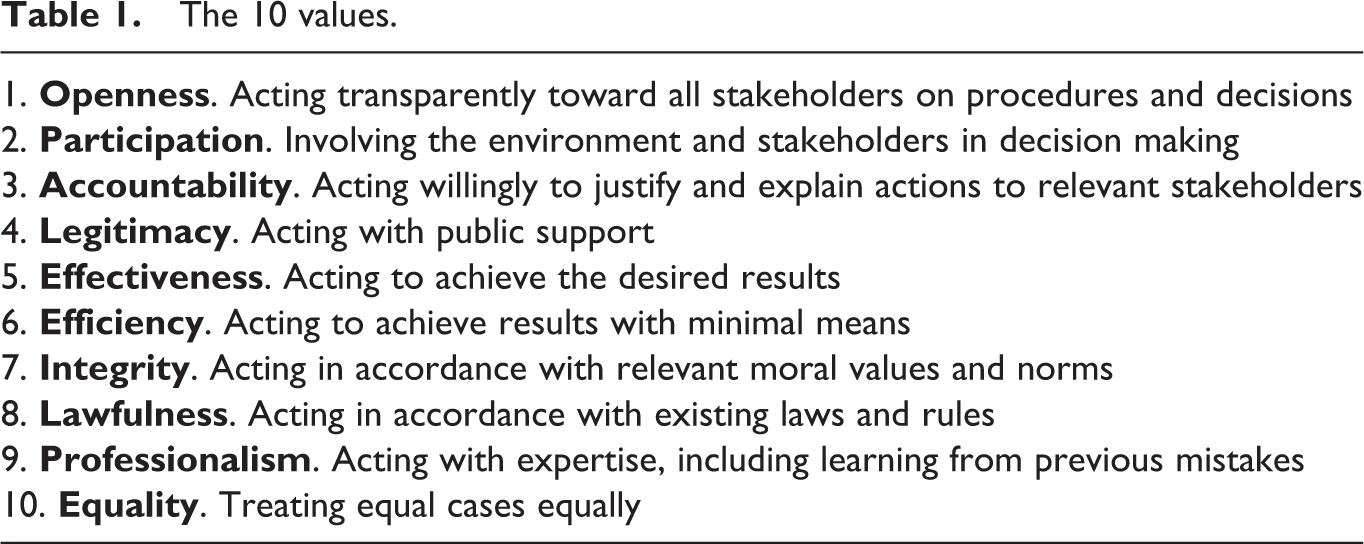
For the 10 values, values obtained from previous research in public institutions were used (De Graaf and Meijer, 2019), see Table 1. They originate from the Dutch governance code for the public sector, drafted by the Dutch Ministry of the Interior and Kingdom Relations in 2009 (Koninkrijksrelaties, 2009). Using the same values from previous research makes comparison with other public sector organizations possible.
The 10 values.
Coding and research heuristic
The transcribed interviews produced a great deal of data. Using the software program MAXQDA to help with the text analysis, the interviews were coded in various steps (Boeije (2010). The purpose of the coding was to identify the specific value conflicts experienced in the case and the specific coping strategies that were used. To accomplish that, first, all the dilemmas were identified. These steps were based on systematic approaches to coding qualitative material (Schilling, 2006).
Once all the dilemmas recorded in the transcripts were coded, the next step was to identify the specific value conflicts experienced and to determine which coping strategy had been used, based on the descriptions of the strategies given earlier.
Next, first impressions of overall patterns were observed and then juxtaposed with the empirical data. This inductive process is clearly not a matter of counting. Respondents were not randomly selected, and 32 interviews are, for quantitative purposes, too small a number, but the idea of this explorative study is to consider the nuances and context of value conflicts that are experienced. Constant comparison was conducted (Boeije, 2010), in which the researchers repeatedly go through the themes to compare results. Thus, it is not just important that a respondent experienced a value conflict, but which one and how it was dealt with and how it was worded. Each dilemma was coded simultaneously in MAXQDA on both the specific value conflict as the specific coping strategy used (as stated, based on the descriptions of the strategies given earlier). This inductive analysis process was repeated many times before the final analysis was written up. Eisenhardt (1989b: 541) states: The central idea is that researchers constantly compare theory with data – iterating toward a theory which closely fits the data. A close fit is important to building good theory because it takes advantage of the new insights possible from the data and yields an empirically valid theory.
Results
Value conflicts and coping strategies in academic teaching
Table 2 provides the number of respondents referring to different value conflicts and the coping strategy involved. Hereafter, each value conflict is discussed.
Number of respondents referring to value conflicts and the coping strategy used.
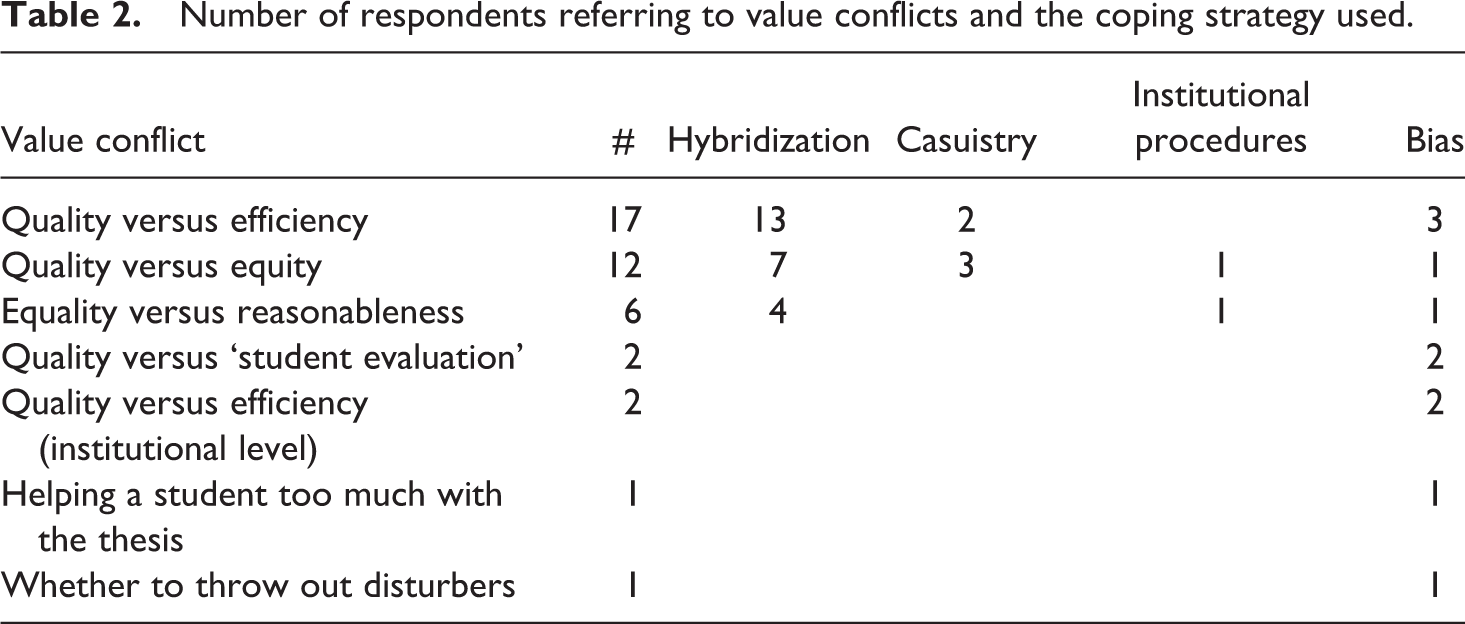
Quality versus efficiency (17)
As was found to be the case in previous research on value conflicts (De Graaf and Meijer, 2019; De Graaf and Paanakker, 2015), the most frequently perceived conflict in this case study is the classic one between quality (effective teaching) and efficient teaching (working in a more efficient manner might mean that the work is done less effectively); the value conflict is between quality of education and efficiency. The more time you put into teaching, the better the outcome. But time is limited. All who fall in this category are assistant/associate/full professors (roughly evenly divided between the three faculties), so all these respondents also conduct research and it is perceived that research achievements are more important for their own career. Thus, in most of the cases, this category is a representation of the academic teacher-specific dilemma of spending time on teaching or on research: Full professor, FL: I give a big course with many students, and it becomes harder and harder to give a lot of feedback. Associate professor, FSS: It is a consideration, what to spend your time on. If you spend it on research, then you are mainly doing that for yourself…I really like that and it is good for my career, because then I write articles and I gain a reputation. Education is good for the students and nice for the university and my department, because then you receive good student evaluations at the National Student Surveys and Elsevier…but you yourself do not profit from it. Associate professor, SBE: There is an easy solution, I can make the course easy and do multiple choice exams, and everybody is happy. Some colleagues do that, but as a coordinator I have always fought against it, because I think it is a disgrace. Assistant professor, FL: I think that we, as teachers, are heavily burdened in the sense that we constantly have to choose between research and teaching. I see colleagues, and I also notice it with myself, that it can be hard to do all your tasks without getting burnout. Assistant professor, FL: You can make teaching better by looking for more examples and current events. But you have to make a judgement whether you can manage in the time you have. Assistant professor, SBE: In general, assistant professors have to find a balance between research and teaching…In the end you are judged on research, on the publications you have, more than on your teaching. Also when you apply elsewhere for a job, they look at your publication list, and not to the number of courses you taught and those kinds of aspects.’ Assistant professor, SBE: The biggest dilemmas are balancing education and research…Do you want to do your teaching optimally, or just well enough?
Quality versus equity (12)
The second most frequently mentioned conflict refers to aspects of good education that might conflict with each other (12). Conflicts experienced between quality and equity concern two aspects: the varying quality of students, and the tension between students’ own responsibility and the need for teachers to provide guidance. With the value equity, ‘circumstances have to be taken into consideration’ (Beck Jørgensen and Bozeman, 2007: 369). It is notable that four of the six who mentioned this work in the Law Department): Full professor, SBE: Sometimes I have students who do econometrics, so they are very technical and good at maths, others are not. So when the group is very diverse, on the one hand that is very nice, but it means that what you teach is easy for some, and when we make it more demanding, others find it too hard. There is a challenge in finding a good balance. Full professor, Law: In legal studies we have a diverse student population…very diverse in how well they prepare for class and how easily they pick up what you say. And that means sometimes balancing between those who pick things up easily and not putting the others to sleep, so to speak. Associate professor, FSS: A dilemma in class: do I cater for the good students who are well prepared, and lose those who read nothing, or do I cater for the mediocre students and explain more about the reading, in which case I am kind of punishing the students who are well prepared’.
Equality versus reasonableness (6)
The third most commonly found dilemma is one of equality versus reasonableness (justice). This dilemma was evenly distributed among the three faculties, but it is notable that none of the full professors mentioned it: Associate professor, FSS: We all know these situations. Students who come to you with this thing or that thing that has happened to them, when they have a time conflict with another piece of work or another deadline. ‘Can I be treated specially, can I tape the class, or can I take the exam later?’ Students who ask for exceptions. That is difficult because on the one hand you want to help students who are in tough situations, but on the other you want to treat students equally. Assistant professor, SBE: What I find difficult is when students ask for exceptions, which in general I want to make for them, but in so doing I can disadvantage other students who I do not make an exception for. Assistant professor, FSS: I always find it tough dealing with the people who do not work by the rules and what to do about that. Students always have some issue.
Quality versus good student evaluations. (2)
This is a dilemma about perverse incentives: Associate professor, FSS: I do not think that it is always the best teacher who gets the highest student evaluations because sometimes students do not like it when you are strict, or when you get them to do assignments they do not immediately see the value of. And yes, you do want top evaluations. Assistant professor, SBE: We are really judged on student evaluations. A dilemma arises when you take that into account and let the quality of teaching suffer. I do things that I know do not add to the quality of my teaching nor to learning outcomes. I do them purely because otherwise I get whining in my evaluations and thus from management.
Quality versus efficiency on institutional level (2)
Assistant Professor, SBE: There has been pressure on us because we have very low passing percentages. We are in first year and you shouldn’t want 80–90% passing percentages, we have about 40%. You have to select. But there was pressure, also from students to make it easier, or to have a lower passing grade.
Whether to throw out disturbers (1)
Full professor, FFS: I have had the situation in a large class where a group in the back was busy with everything except the theme of the class. At one point I saw no other solution than to ask them to leave. But I thought that was a big gamble. Because what do I do if they do not leave? I cannot drag them personally or call security or anything. So I did think I was taking a big gamble. But they left the classroom quietly.
Helping a student too much (1)
Assistant professor, FL: How far do you go in helping thesis students to graduate? There are students who are really not good, and when they get to the point of starting their thesis, you cannot just abandon them. I go to some lengths to take them by the hand, and that takes a great deal of energy, and time, and really, the student should be allowed to fail during that stage. I have never done that, I have never given students an inadequate grade for their thesis. But I should. That is an incredibly difficult choice, failing someone who has come so far in their study and has perhaps already spent half a year on the thesis.
Various value profiles
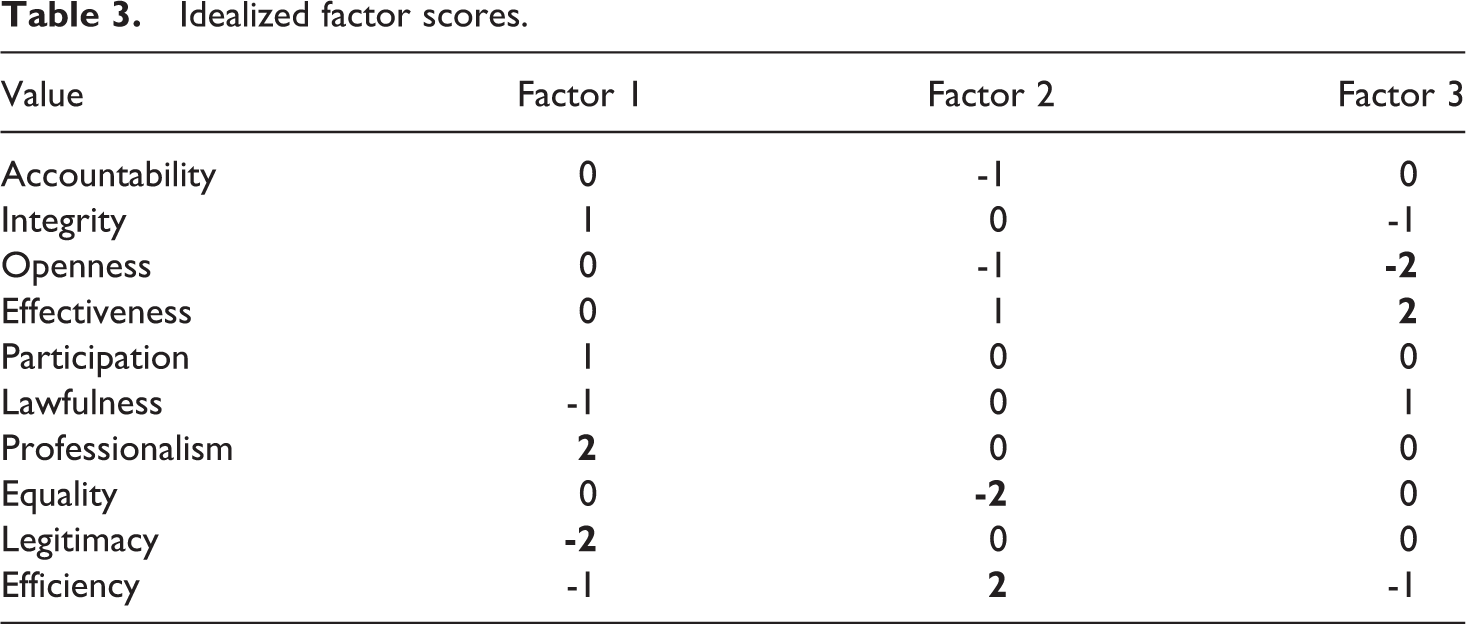
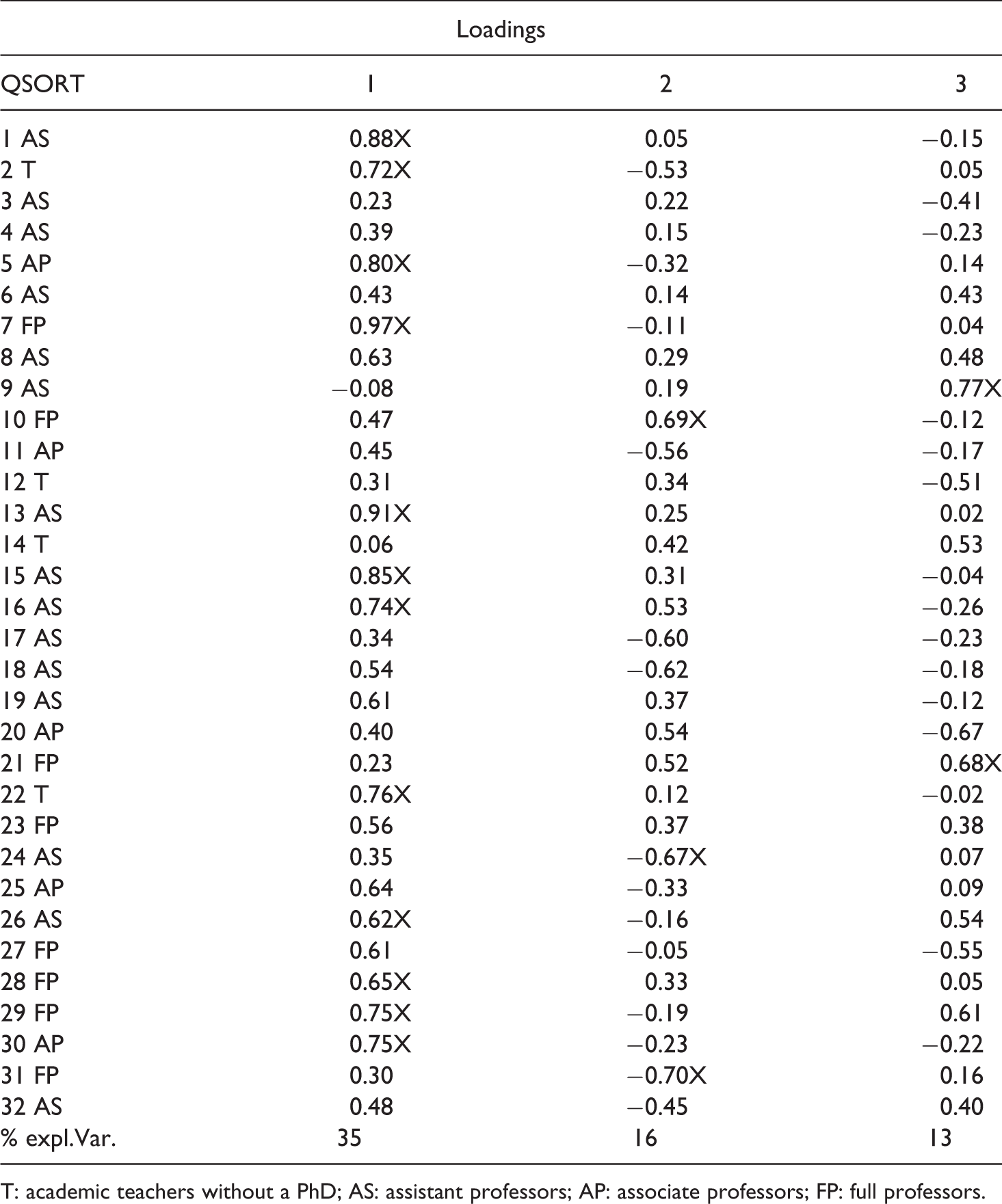
The Q-study resulted in three separate factors, each with its own value profile, see the Appendix for the loadings of each respondent on each factor. For each factor, a composite sort was computed, based on the rankings of the respondents’ loading on that factor and their correlation coefficient with the factor as weight (see Table 2). This idealized Q-sort represents the way in which a person loading 100% on that factor would have ranked the 10 values. Each factor was interpreted and described using the characterizing and distinguishing values and the explanations of respondents’ loading on the factor. A value is characterizing by its position in the outer columns of the idealized Q-sort of the factor and is distinguishing if the position is statistically significantly different from its position in the idealized Q-sorts of all other factors.
The results of the Q-study show that there is not much diversity in the value profiles of Dutch academic teachers. Professionalism is valued highly, just as reaching teaching goals (effectiveness) The main value cluster, containing 12 of the 15 positive defining variates, revolves around professionalism.
Table 3 shows the idealized factor scores.
Idealized factor scores.
Factor A: The professional teacher
This is the dominant value profile with 12 of the 15 positive defining variates. The value profile revolves around professionalism (Z-score 1811), and what is meant by that becomes clear from the explanation the respondents provided for ranking this specific value so highly: “I always try to learn from the mistakes I make and the students are always happy to make me face the facts. They always tell me what I do wrong. And I always try to improve my teaching.” “Professionalism is very important, that you try to be good in your job. Students have a right to that, even though education is of course, first of all, the responsibility of the students themselves. I can only influence my own actions, they have to be as good as possible.” “Professionalism? For me that includes integrity and a few of those other values.’; ‘I think we have a serious job. We shouldn’t just fool around and take our job seriously and that includes consultation, being open and reaching goals.” “A superordinate norm for professionalism and equality.” “Moral principles are overarching, I am not so formalistic.” “I see integrity as a sort of over- overarching norm for the others, when you treat people equally, that is in accordance with relevant values and norms.” “Acting with public support? Of course, I do not think that is unimportant, but compared to the other values, it is the least important to me. A university is funded with public money, so, in a general sense, it is very important that there is public support for what we do. But with every specific activity I undertake, I do not think about that; I do not even want to think about that because I am arrogant enough to think that I can better determine what is more important than public support, whatever it may be.” “Take, for example, method courses. I do not know whether there is public support for that. I think it is more important that students learn, that they can determine what research reliability and validity mean.” “Of course we should ask ourselves whether what we do has legitimacy in the sense that is has public support, but that is part of the structure. Not just the formal structure, but also how a university functions in society. And we should reflect on that. But that is a meta value which is not of importance in that moment when you are teaching.” “That is of a higher level. I do not check for example whether a student is a legal resident in the Netherlands or whether he has paid tuition.” “Lawfulness is a sort of prerequisite that is guaranteed by the way we are organized as a university. So I do not have to worry about that.” “I do not think we should hide behind rules. I found moral values and norms more important. An example: there was a student who forgot to bring her student ID to an exam, so officially she couldn’t take the exam. But I said: I recognize you, show me a bankcard and everything is OK.” “I wouldn’t go against the law, but I find it more important to show to students why we do the things that we do, and that I maintain professional standards.”
Factor B: (not) the neoliberal teacher
This is a remarkable value profile: two of the three defining variates score significantly negative on the factor, so in a sense they do value most what they had in the -2 category. The factor is in itself about efficiency and effectiveness, meaning that the two negative loadings do not value these highly. One could say that these respondents do not like management mumbo jumbo; a anti-neoliberalism discourse. The following quotes are from the two negative defining variates.
On efficiency (2.119) (followed by effectiveness (0.707)): “‘Efficiency’? That is typical managerial language and I do not care for that, just like ‘return on investment’. I try to stay away from perverse incentives.” “When time pressure played a role, I always found my responsibilities towards teaching most important.” “Equality: that is article number 1. I find it important to treat equal cases equally.” “I find treating equal cases equally very important, that you are fair to your students.”
Factor C: the effective teacher
The third value profile – with just two defining variates (an assistant professor and a full professor) – resembles the first one to a certain extent but, here, reaching concrete goals is emphasized, with effectiveness (Z-score 1.936) given as the most important value: “Effectiveness is the most important, because it is all about what the student learns, it is important to reach that goal.” “Effectiveness is what it is all about, to bring people to a higher level and reach my teaching goals.” “I do not find that to be in line with my professionalism. People should expect that I do my work well.” “Should I explain everything to everybody? That is not necessary, I am a professional. My priorities are not with this value.”
Conclusion and discussion
The central question of this article was: which value conflicts do academic teachers perceive, what strategies are used to deal with these conflicts, and what value profiles do they have?
Thirty-five of the 41 dilemmas found, fall within three categories: dilemmas in this particular case study of higher education occur mainly in the area of quality versus efficiency, quality versus equity, and between equality and reasonableness. As far as the dominant value conflict goes – quality (effectiveness of education) versus efficiency, De Graaf and Paanakker (2014) found similar results in relation to value conflicts of public servants in municipalities: public servants mostly experience conflicts between efficiency and effectiveness. Also, in a case study on the police (De Graaf and Meijer, 2019), the value conflict that was by far most frequently perceived was between effectiveness and efficiency.
Since dilemmas point to the values that really matter – they uncover the values trail – we can now conclude that quality and efficiency play an important role in this case of academic teachers. Other important values in this case study of academic teachers were equality and reasonableness. Earlier, the tension between professional (academic) and economic (managerial) value systems was described, in research that was mainly done in the UK, Australia and New Zealand (Winter and O’Donohue, 2012). In this case study of a Dutch public university, mostly the old institutional professional values (quality of teaching, equality, and reasonableness) prevail among the academic teachers. This is very much in line with survey research in Australia (Winter and O’Donohue, 2012), where academics in lecturer and professor positions expressed a strong response to statements indicative of professional values (Winter and O’Donohue, 2012: 568). Yet the tensions and conflicts with efficiency (an economic value) are also very clear in the Dutch case study. In these times of cutbacks, the tensions between the professional and economic values systems are clearly prevalent in this Dutch case study.
The most important coping strategy is hybridization. This indicates something important about the profession of academic teacher. Of all the known studies on coping strategies, the strategy is by far the most found in this case of academic teachers. For example, in a comparable case study on the police (De Graaf and Meijer, 2019), bias was the most-used strategy. Hybridization is a strategy often used when professionals cannot choose between two values because they value both too highly. For better or worse, the academic teachers (in this case) want to guard the quality of teaching against pressures from career demands (doing research and publishing successfully) and from cutbacks and concomitant heavy teaching loads.
Stewart (2006: 188) states: ‘Hybrids…satisfy the need for an all-embracing rhetoric, although at the practical level, they give little guidance for dealing with conflict (Langford, 2005).’ University management does not officially want to choose between quality and efficiency, for either professional or economic values (Winter and O’Donohue, 2012), and thus there is a great need for an all-embracing rhetoric. Despite the severe pressure in recent years on the budgets of Dutch public universities, apparently within academic institutions it is unacceptable to compromise the professional value of quality. The disadvantages of hybridization should be carefully considered, however. At the operational level, hybridization gives no clarity and little guidance for how to deal with the conflict, leading to stress for academic teachers. Contrary to the strategy of casuistry – theoretically another possibility – academic teachers cannot fall back on carefully built-up jurisprudence on how to deal with the value conflict. Furthermore, there are signs that because of worries about quality in times of austerity, at the national level formal responsibility is made important and firewalls are chosen as a coping strategy (De Graaf, 2016). All kinds of formal assessment procedures – for example, course dossiers, assessment plans, basic teacher qualification and senior teaching qualification requirements, severe programme assessment procedures, or new faculty procedures with detailed requirement lists – are installed to guarantee quality. A strong case can be made that because of the time pressure and stress these procedures involve, and because it is known that the biggest disadvantages of firewalls are that they hamper organizational learning capabilities and produce stress and tension elsewhere in the system (Stewart, 2006), the current combination of hybridization at the individual level and firewalls at the institutional level lowers the quality of education.
According to Steenhuisen and Van Eeten (2012), the hybridization strategy can enrich performance, but can also disguise bad performance. Just like in many other public organizations (Steenhuisen and Van Eeten, 2008), the hybridization coping strategy in this case study of a Dutch university seems to have emerged over time; it was not designed. University management can – recognizing the difficult position of academic teachers – upscale the dilemma between quality and efficiency and use more deliberately designed coping strategies. From the literature, we know that it is first of all crucial for management to recognize the value conflict (Steenhuisen and Van Eeten, 2008). Furthermore, the temptation at the national level to choose a firewalls strategy to guard quality could be reconsidered; it might mostly harm it.
The values provided by the Q-study also point to characteristics of the profession of academic teacher, and that especially professional values are important, as opposed to economic values (Winter and O’Donohue, 2012). The values of (especially) professionalism and effectiveness (reaching teaching objectives) came out as the important ones. The dominant value profiles of academic teachers found here differ considerably from the value profiles of other public professionals in municipalities, and hospitals (De Graaf et al., 2016), where professionalism was considered much less important. Profession-related characteristics thus seem to determine to a great extent the values that one considers important. And, in the case of academic teachers, professionalism is an important one in the value profile. More research is needed, especially internationally comparative studies, to determine the extent to which the professional context is indeed of importance to value profiles of academic teachers.
Footnotes
Declaration of conflicting interests
The author(s) declared no potential conflicts of interest with respect to the research, authorship and/or publication of this article.
Funding
The author(s) received no financial support for the research, authorship and/or publication of this article.

Appendix: Factor matrix with an X indicating a defining sort
| Loadings | |||
|---|---|---|---|
| QSORT | 1 | 2 | 3 |
| 1 AS | 0.88X | 0.05 | −0.15 |
| 2 T | 0.72X | −0.53 | 0.05 |
| 3 AS | 0.23 | 0.22 | −0.41 |
| 4 AS | 0.39 | 0.15 | −0.23 |
| 5 AP | 0.80X | −0.32 | 0.14 |
| 6 AS | 0.43 | 0.14 | 0.43 |
| 7 FP | 0.97X | −0.11 | 0.04 |
| 8 AS | 0.63 | 0.29 | 0.48 |
| 9 AS | −0.08 | 0.19 | 0.77X |
| 10 FP | 0.47 | 0.69X | −0.12 |
| 11 AP | 0.45 | −0.56 | −0.17 |
| 12 T | 0.31 | 0.34 | −0.51 |
| 13 AS | 0.91X | 0.25 | 0.02 |
| 14 T | 0.06 | 0.42 | 0.53 |
| 15 AS | 0.85X | 0.31 | −0.04 |
| 16 AS | 0.74X | 0.53 | −0.26 |
| 17 AS | 0.34 | −0.60 | −0.23 |
| 18 AS | 0.54 | −0.62 | −0.18 |
| 19 AS | 0.61 | 0.37 | −0.12 |
| 20 AP | 0.40 | 0.54 | −0.67 |
| 21 FP | 0.23 | 0.52 | 0.68X |
| 22 T | 0.76X | 0.12 | −0.02 |
| 23 FP | 0.56 | 0.37 | 0.38 |
| 24 AS | 0.35 | −0.67X | 0.07 |
| 25 AP | 0.64 | −0.33 | 0.09 |
| 26 AS | 0.62X | −0.16 | 0.54 |
| 27 FP | 0.61 | −0.05 | −0.55 |
| 28 FP | 0.65X | 0.33 | 0.05 |
| 29 FP | 0.75X | −0.19 | 0.61 |
| 30 AP | 0.75X | −0.23 | −0.22 |
| 31 FP | 0.30 | −0.70X | 0.16 |
| 32 AS | 0.48 | −0.45 | 0.40 |
| % expl.Var. | 35 | 16 | 13 |
T: academic teachers without a PhD; AS: assistant professors; AP: associate professors; FP: full professors.