




Abstract
Transitioning toward global carbon neutrality requires developing energy conversion and storage technologies that surpass current solutions in efficiency, durability, and scalability. In this context, nanocatalysts have emerged as indispensable for advancing clean energy systems, owing to their tunable surface chemistry, structural diversity, and potential for defect engineering. In this review, we present a reproducible roadmap that links nanoscale design strategies to practical applications and eventual industrial adoption. Beginning with fundamental design approaches including morphology manipulation, alloying, heterostructuring, and hierarchical architectures, the review outlines how these strategies enhance electrocatalytic activity, specificity, and stability. The discussion further encompasses nanocatalyst applications in water splitting for sustainable hydrogen production, fuel cells for efficient electrochemical conversion, and advanced energy storage technologies, including batteries, supercapacitors, and hybrid systems. From an industrial perspective, the review also examines scalable synthesis, electrode fabrication, techno-economic evaluation, and life-cycle assessment. Distinct from previous reviews, this work emphasizes the role of artificial intelligence and machine learning in accelerating catalyst development through high-throughput discovery, predictive modeling of catalytic performance, and digital twin-based durability assessment. By integrating nanoscale innovations with pathways for industrial translation, this review provides a comprehensive roadmap for deploying nanocatalyst technologies at scale within renewable energy infrastructure. These insights are critical for mitigating greenhouse gas emissions and fostering sustainable, cost-effective, and commercially viable clean energy technologies.
Keywords
Introduction
The rapidly escalating global energy demand is predominantly driven by population growth, accelerated urbanization, and industrial expansion. Reliance on fossil fuels, although historically foundational to economic development, has led to profound environmental repercussions, including increased greenhouse gas emissions, widespread air pollution, and intensifying climate change (Kaur et al., 2025). These concerns have prompted a global paradigm shift toward cleaner and more sustainable energy alternatives, underscoring the imperative for decarbonizing the energy system (Ahmed et al., 2025; Shah et al., 2024). Recent developments in nanostructured catalysts have demonstrated significant progress in achieving high catalytic efficiency, stability, and multifunctionality across energy conversion systems. Emerging materials such as metal–organic framework (MOF)-derived hybrids have enabled improved reaction kinetics and catalytic performance (Fang et al., 2025). In addition, doped nanostructures have shown enhanced electronic properties and stability under operating conditions (Guo et al., 2023). Furthermore, heterostructured composites have demonstrated superior charge transfer characteristics and multifunctional catalytic behavior, making them promising candidates for next-generation energy applications (Jiang et al., 2026).
Renewable energy technologies such as solar photovoltaics, wind, and bioenergy are increasingly adopted for their capacity to generate electricity with minimal environmental footprints. Nonetheless, the inherent intermittency and variability of these sources have drawn significant attention to the challenges of energy conversion and storage (Kaur et al., 2025). In this context, hydrogen has emerged as a versatile energy carrier capable of storing renewable electricity and fueling a range of applications, from transportation (cars, trucks) to industrial processes and residential heating (Lu et al., 2020).
Realizing the full potential of hydrogen-based systems and other renewable technologies necessitates breakthroughs in catalysis. Advanced catalysts are essential to reduce kinetic barriers associated with electrochemical and photoelectrochemical reactions, thereby enabling large-scale hydrogen production, efficient fuel cells, and high-performance energy storage systems (Wang et al., 2025). The transition to clean energy is both an environmental and socio-economic necessity for achieving an inclusive net-zero future, as rising global energy demand sustains dependence on fossil fuels despite growing adoption of renewables (Figure 1(a)). Nanocatalysts provide a critical bridge between renewable inputs and practical energy outputs by enabling efficient water splitting, improved fuel cells, and stable energy storage systems (Figure 1(b)) (Nyamai and Phaahlamohlaka, 2025).

Global energy demand trends and the role of nanocatalysts in clean energy systems. (a) Projected transition from fossil fuels to renewable energy sources, highlighting the increasing contribution of hydrogen and energy storage technologies. (b) Schematic representation of nanocatalysts enabling water splitting, fuel cell reactions, and energy storage processes. H2: hydrogen; CO2: carbon dioxide.
Although extensive research exists on nanomaterials for energy applications, most review studies focus on specific areas such as electrocatalysis, photocatalysis, or particular device implementations. They often overlook the vital connections between nanoscale design, system integration, and scalability in industry. Additionally, many reviews highlight performance metrics but do not adequately address techno-economic feasibility, life-cycle sustainability, or emerging digital methods such as AI-driven catalyst discovery.
To address these limitations, the present review adopts a comprehensive and integrative framework that connects fundamental nano-architectural design strategies with real-world deployment pathways across water splitting, fuel cells, and energy storage systems. Unlike conventional reviews, this work systematically bridges material-level innovations with industrial considerations, including scalable synthesis, electrode fabrication, techno-economic analysis (TEA), and environmental impact assessment.
This review mainly covers literature from 2018 to 2025, highlighting recent high-impact studies that show progress in catalyst stability, scalability, and multifunctionality. This approach ensures the discussion reflects the most recent advances and emerging trends in nano-architected catalyst design and application.
The role of nanocatalysts in energy transportation and storage
Catalysts are integral to the performance and efficiency of energy conversion and storage systems. Conventional bulk catalysts, however, are constrained by limited active surface area, suboptimal charge-transfer dynamics, and poor long-term operational stability. Nanocatalysts have emerged as a promising alternative, capitalizing on unique size-dependent phenomena, including enhanced surface-to-volume ratios, quantum confinement effects, and customizable surface chemistries, to overcome these limitations (Gao et al., 2025).
At the nanoscale, precise control over structural features such as morphology (e.g., nanoparticles, nanowires, nanosheets), defect sites, alloying compositions, and heterostructure interfaces allows for the tailored design of catalytic behavior (Zhang et al., 2025). For instance, transition-metal nanostructures and carbon-based hybrid materials have demonstrated superior electrocatalytic activity for the hydrogen evolution reaction (HER) and oxygen evolution reaction (OER) in water splitting. Similarly, doped or alloyed nanoparticles have significantly reduced overpotentials for key processes in fuel cells, including the oxygen reduction and alcohol oxidation reactions (Lin et al., 2025; Vasu et al., 2025).
In energy storage systems, nanostructured materials such as metal oxides, conductive carbons, and MXenes are transforming battery and supercapacitor electrodes by enhancing ionic conductivity, diffusion pathways, and structural durability. Notably, nanocatalyst design also enables the strategic replacement of scarce and expensive noble metals with earth-abundant alternatives, contributing to cost-effective and scalable solutions (Subhadarshini et al., 2024).
The adaptability of nanostructures enables their integration into various energy platforms, including water electrolyzers, proton exchange membrane fuel cells (PEMFCs), direct alcohol fuel cells, lithium–sulfur batteries, and zinc–air batteries. The convergence of high catalytic activity, stability, and scalability renders nanocatalysts indispensable to the advancement of next-generation clean energy technologies (Lv et al., 2023; Sun et al., 2024).
Aims and scope of this review
Although several reviews have addressed nanomaterials for energy applications, comprehensive evaluations that systematically integrate nanoscale design strategies with functional mechanisms, device-level performance, and industrial scalability remain limited. Existing studies often focus on isolated aspects such as electrocatalysis, photocatalysis, or specific energy devices, without establishing a coherent link between material design, system-level functionality, and real-world deployment. To address this gap, the present review provides an integrative and application-oriented perspective on nano-architected catalysts across water-splitting, fuel cell, and energy storage technologies.
This review primarily covers literature from 2018 to 2025, focusing on recent high-impact studies highlighting advances in catalyst stability, scalability, and multifunctionality. This approach ensures the discussion aligns with current research trends and highlights emerging innovations in nano-architected catalyst design.
The review begins with a systematic discussion of fundamental design principles, including morphology control, electronic and defect engineering, alloying and doping strategies, and the construction of hierarchical and core–shell architectures. These design approaches are then critically examined in the context of three major application domains: (i) water splitting for sustainable hydrogen production, (ii) fuel cells for efficient electrochemical energy conversion, and (iii) advanced energy storage systems, including batteries, supercapacitors, and hybrid devices.
A key contribution of this review lies in its emphasis on the translational potential of nano-architected catalysts. Beyond reporting laboratory-scale performance, the discussion extends to industrially relevant considerations, including large-scale synthesis methods, electrode and cell fabrication techniques, TEA, and life cycle assessment (LCA). This integrated perspective enables a more realistic evaluation of how nanoscale innovations can be translated into commercially viable energy technologies.
The review emphasizes key challenges like catalyst durability in industrial settings, cost efficiency, and integration with renewable energy infrastructure. It also discusses new paradigms, such as the use of artificial intelligence (AI) and machine learning (ML) for catalyst discovery, as well as digital twin frameworks for predicting performance. These methods mark a shift from traditional trial-and-error to data-driven and predictive approaches in materials engineering.
By bridging fundamental nanoscale design, system-level implementation, and industrial scalability, this review aims to provide a comprehensive roadmap for advancing nano-architected catalysts from laboratory research to real-world energy applications. The insights presented are intended to support researchers, engineers, and policymakers in accelerating the development of sustainable, efficient, and economically viable clean energy systems.
Outline of the paper
The remainder of this paper is structured to systematically connect nanoscale design principles with application-specific performance and industrial-scale implementation pathways. Following the introduction, the “Design principles of nanocatalysts” section presents the foundational design principles of nanocatalysts, focusing on morphological engineering, electronic and defect modulation, alloying/doping, and hierarchical core–shell architectures.
The “Nanocatalysts for water splitting” section examines the role of nanocatalysts in water splitting, encompassing HER and OER electrocatalysts, photocatalysts for solar-assisted hydrogen evolution, and integrated tandem systems for overall water splitting (OWS). The “Nanocatalysts for fuel cells” section discusses nanocatalysts for fuel cell technologies, including oxygen-reduction reaction (ORR) catalysts, alcohol-oxidation catalysts, and advanced systems such as direct ammonia and solid-oxide fuel cells.
The “Nanocatalysts for energy storage devices” section provides a critical review of nanocatalysts for energy storage applications, focusing on lithium–sulfur, sodium-ion, and zinc–air batteries, as well as supercapacitors and hybrid energy storage devices. The “Industrial scale-up and commercialization” section explores industrial-scale-up considerations, including electrode engineering, manufacturing techniques, TEAs, and LCAs.
The “Current challenges and future directions” section addresses prevailing challenges and emerging opportunities, including mass-production scalability, catalyst durability, and integration with renewable energy infrastructure, while highlighting the potential of AI and ML to accelerate catalyst innovation. The paper concludes by synthesizing the main insights and proposing future research and industrial pathways for leveraging nanocatalysts in the global clean energy transition.
Design principles of nanocatalysts
The capacity to modulate the physicochemical properties of catalysts at the nanoscale represents a fundamental advancement in enhancing performance across energy conversion and storage technologies (Kim et al., 2025). Rational design strategies such as morphology control, electronic and defect engineering, alloying and doping, and the construction of core–shell or hierarchical architectures enable the optimization of catalytic active sites, electron-transport pathways, and structural robustness (Selvakumar et al., 2022). Collectively, these strategies aim to develop nanocatalysts that are not only highly active and durable but also cost-effective, thereby expanding their practical applicability in water splitting, fuel cells, and energy storage systems (Jin et al., 2022). Various strategies have been developed for the rational design of nanocatalysts, including morphology control, electronic and defect engineering, alloying and doping, and hierarchical core–shell architectures (Li et al., 2025). When employed in combination, these approaches enable the synergistic optimization of surface area to enhance catalytic activity, and of charge transport and structural durability to improve selectivity and stability, respectively (Ye et al., 2022). These design principles provide a foundation for developing a roadmap toward nanocatalyst-based clean energy systems, as summarized in Figure 2.

Design principles of nano-architected catalysts: fundamental design strategies of nano-architected catalysts, including morphology control, electronic and defect engineering, alloying and doping, and hierarchical/core–shell architectures. These approaches collectively enhance catalytic activity, stability, and charge transport properties. CB: conduction band; VB: valence band.
Control of morphology (zero-dimensional, one-dimensional, two-dimensional, and three-dimensional architectures)
Morphological characteristics profoundly influence catalytic behavior, particularly by determining the accessibility of active surface sites and the efficiency of mass and electron transport. Zero-dimensional (0D) nanostructures, such as nanoparticles and quantum dots, exhibit exceptionally high surface-to-volume ratios and quantum confinement effects, which can significantly enhance catalytic reactivity (Fathirad et al., 2023). One-dimensional (1D) structures, including nanowires, nanotubes, and nanorods, enable directed charge transport and mitigate charge recombination, making them promising candidates for photo- and electrocatalytic water-splitting applications (Archana et al., 2023).
Two-dimensional (2D) materials, such as graphene analogs, layered double hydroxides (LDHs), and transition-metal dichalcogenides, present extended basal planes and tunable surface chemistry, facilitating strong interfacial coupling with substrates (Ma et al., 2025). Meanwhile, three-dimensional (3D) nanoarchitectures, such as mesoporous networks and hierarchical nanoflowers, combine high surface-site accessibility with porous structures that facilitate reactant diffusion (Sharifi et al., 2025). These 3D systems exhibit superior catalytic performance, particularly at high current densities (Arshad et al., 2023). The catalytic activity of nanoparticles scales with surface-to-volume ratio, as given by Equation (1), where d is particle diameter. This relationship highlights why 0D and 1D nanostructures are attractive for maximizing the exposure of active sites (Meng et al., 2025).

Electronic and defect engineering
The adsorption and desorption behaviors of key catalytic intermediates are intrinsically governed by the electronic structure of the nanocatalysts. Engineering of oxygen vacancies, introduction of heteroatom defects, and lattice distortions can effectively lower energy barriers for the HER (Hu et al., 2023) and OER (Li et al., 2020). For instance, defect-rich LDHs and doped spinel oxides have demonstrated enhanced electrical conductivity and optimal band alignment for efficient charge transfer (Li et al., 2022).
Vacancy sites serve as centers for intermediate stabilization, while heteroatom doping alters the local electron density surrounding catalytically active sites. Moreover, inducing lattice strain in 2D nanosheets or nanoparticle frameworks can modulate the d-band center of metal sites, thereby fine-tuning adsorption energies (Huzaifa et al., 2025). Such defect engineering approaches not only increase the electrochemically active surface area but also bolster long-term catalytic stability through improved intermediate stabilization (Chen and Li, 2025). The reaction overpotential

Formation of alloys, doping, and heterostructures
Alloying and doping are widely adopted strategies for tailoring catalytic behavior through synergistic interactions among multiple elements. The incorporation of secondary metals, such as in Ni–Fe, Co–Mo, or Pt–Cu alloys, enables electronic structure modulation and promotes bifunctional catalytic activity (Yadav et al., 2025). Non-metal dopants, including nitrogen, sulfur, and phosphorus, further enhance electronic conductivity and modulate active site geometry and functionality (Sivagurunathan et al., 2024).
Beyond compositional tuning, the construction of heterostructures by coupling materials such as transition-metal phosphides with oxides or sulfides induces internal electric fields and generates interfacial boundaries that promote efficient charge separation (Jeong et al., 2023; Yaseen et al., 2022). These features are also critical for stabilizing metastable intermediates, thereby contributing to catalyst longevity. For example, NiPd nano-alloys exhibit low overpotentials for HER and OER, while CuMo oxynitride–graphene hybrids with engineered electronic structures demonstrate excellent multifunctional catalytic performance (Babar et al., 2022; Balamurugan et al., 2021).
Core–shell and hierarchical architectures
Core–shell nanostructures represent a rational design paradigm in which a catalytically active shell is supported by a robust, conductive core. This configuration effectively mitigates catalyst dissolution and agglomeration under severe electrochemical conditions by leveraging the core's structural integrity and the shell's catalytic functionality (Wang, Cui et al., 2022; Wang, Li et al., 2022). For instance, NiFe LDH nanosheets, structured as 3D hierarchical assemblies on conductive CuO scaffolds or carbon substrates, have exhibited enhanced OER activity and impressive durability (Arshad et al., 2023).
Hierarchical architectures extend this concept by integrating multiple structural motifs, such as nanoparticles on nanosheets or nanofibers embedded in porous 3D frameworks. These complex systems maximize exposure of catalytically active sites, enhance electrolyte infiltration, and facilitate gas bubble detachment during gas-evolving reactions. Such attributes render hierarchical nanocatalysts especially suitable for high-current-density applications and support their scalable fabrication for industrial deployment (Li et al., 2025; Wang et al., 2021).
The rational design of nanocatalysts can be broadly categorized into four interrelated strategies: (1) morphology control; (2) electronic structure and defect engineering; (3) alloying and/or doping accompanied by heterostructure formation; and (4) the construction of core–shell or hierarchical architectures (Liu et al., 2021; Zhao et al., 2020), as outlined in Table 1. From an application perspective, the selection of nano-architected catalysts depends strongly on the target reaction environment and performance requirements. For hydrogen and OERs, transition-metal-based LDHs (e.g., NiFe LDHs) and metal phosphides are particularly effective due to their favorable adsorption energies and high conductivity. In oxygen reduction reactions in fuel cells, Fe–N–C and Pt alloy catalysts are widely preferred for their superior activity and stability under acidic and alkaline conditions.
Summary of Key Nanocatalyst Design Strategies and Examples.
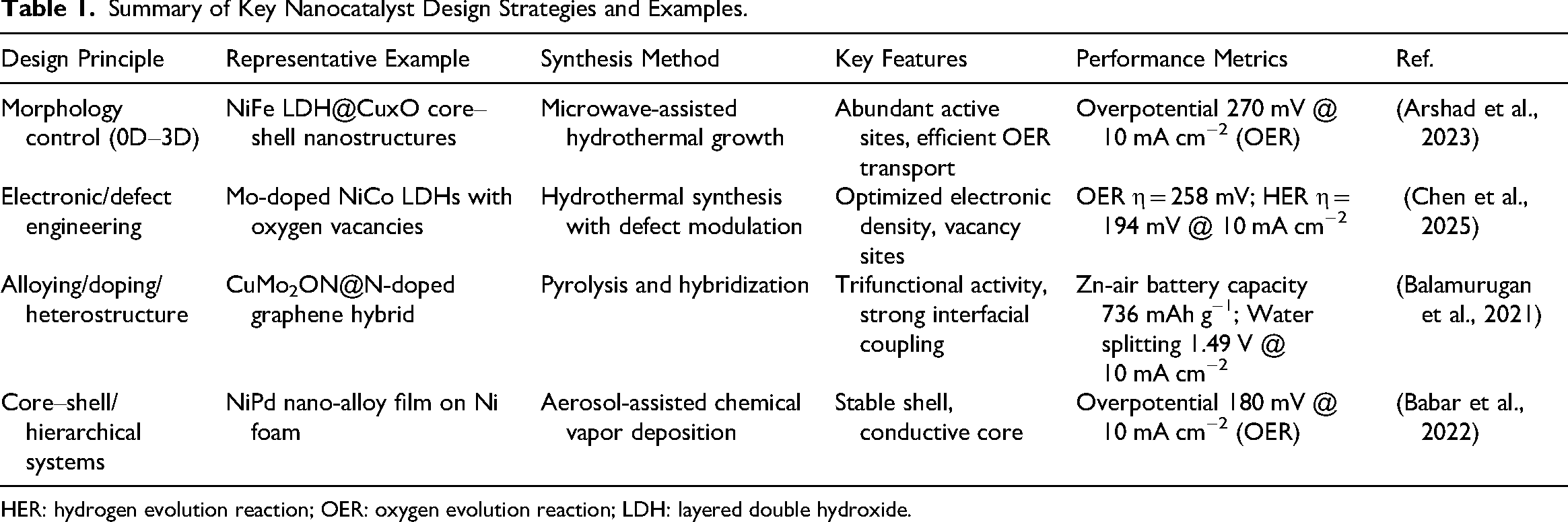
HER: hydrogen evolution reaction; OER: oxygen evolution reaction; LDH: layered double hydroxide.
For alcohol oxidation reactions, Pt-based bimetallic and trimetallic systems (e.g., Pt–Ru, Pt–Sn) demonstrate enhanced resistance to poisoning and improved catalytic kinetics. In energy storage systems, metal oxides, sulfides, and heteroatom-doped carbon materials are commonly employed to facilitate redox reactions and improve charge transport. Therefore, the rational selection of catalyst composition and architecture must align with the specific electrochemical reaction, operating environment, and desired balance between activity, durability, and cost.
Each of these strategies not only tailors the catalytic activity and operational durability but also introduces distinct synthesis pathways and performance benchmarks. Together, they emphasize the critical role of nanoscale engineering in the systematic advancement of high-performance energy conversion and storage technologies.
In summary, designing nano-architected catalysts by controlling morphology, tuning electronic properties and defects, adjusting composition, and implementing hierarchical structures offers a flexible platform for enhancing catalytic performance. These approaches allow for precise regulation of active sites, charge flow, and structural stability, laying the groundwork for efficient energy conversion and storage.
Nanocatalysts for water splitting
Electrochemical water splitting represents a cornerstone technology for sustainable hydrogen production (Zhang, Wang et al., 2025). The process encompasses two half-reactions, namely, the HER and the OER, both of which are kinetically sluggish and require efficient catalysts to overcome significant energy barriers. Beyond traditional electrocatalysis, solar-driven photocatalysis and integrated tandem systems have been actively explored as viable strategies for achieving cost-effective and scalable OWS (Zhao et al., 2025). Within this context, rationally engineered nanocatalysts have emerged as critical intermediates owing to their customizable surface properties, high density of accessible active sites, and superior operational stability. These attributes position nanocatalysts at the forefront of advancing green hydrogen technologies (Tan et al., 2025). Recent advancements in data-driven modeling have demonstrated that ML approaches can significantly enhance hydrogen production efficiency by optimizing reaction parameters and predicting system performance. For instance, deep learning frameworks have been successfully applied to improve hydrogen yield prediction in co-gasification processes, highlighting the potential of AI-assisted optimization in energy systems (Vaiyapuri et al., 2025).
The development of nanocatalysts for water splitting relies on comprehensive knowledge of the underlying mechanisms, the classes of relevant materials, and the routes to their fabrication. As illustrated in Figure 3(a), the principles by which nanostructures enhance energy absorption, catalytic activity, and efficiency enable sustainable, long-term hydrogen production. The general categories of nanocatalysts are presented in Figure 3(b), with noble and non-noble metals, perovskites, and carbon-based nanomaterials typically classified, each exhibiting distinct structural and electronic advantages. Common synthesis approaches, including chemical reduction, sol–gel, hydrothermal, and photochemical deposition, are shown in Figure 3(c), together with activity (turnover frequency) and stability performance metrics, which guide optimization toward achieving high activity, durability, and cost-effective large-scale implementation. For instance, MOF–LDH hybrid catalysts such as Co-MOF@NiMn-LDH have demonstrated significantly reduced overpotentials and enhanced long-term stability, owing to synergistic interfacial interactions and improved active-site exposure, highlighting the effectiveness of surface-engineered composite systems in water-splitting applications.

Nanocatalysts for water splitting: overview of nanocatalysts for water splitting. (a) Mechanistic illustration of hydrogen generation via catalytic processes, (b) classification of nanocatalyst materials including metals, oxides, and carbon-based systems, and (c) synthesis routes and performance evaluation metrics. HER: hydrogen evolution reaction; OER: oxygen evolution reaction.
Electrocatalysts for HER and OER
The efficiency of HER and OER is often constrained by slow reaction kinetics and the accumulation of surface gas bubbles, both of which affect overpotentials and catalytic durability. These limitations can be mitigated through meticulous compositional and structural engineering of electrocatalysts. Recent advances in nano-architected electrocatalysts further demonstrate that interfacial engineering and multi-component hybridization significantly enhance catalytic activity and stability (Abazari et al., 2025). For instance, MOF-derived and LDH-based nanocomposites have shown exceptional OER performance, with reduced overpotentials and improved durability, owing to synergistic interactions and enhanced active-site exposure (Sanati et al., 2025). Similarly, hybrid textile-supported catalysts and porous nanostructures have been reported to improve charge transfer and structural robustness, enabling efficient OWS under practical conditions (Zhou et al., 2024). Among the most widely studied materials are NiFe LDHs, transition-metal sulfides, and phosphides, selected for their low cost, earth-abundance, and tunable catalytic performance. Catalyst performance is commonly benchmarked by the overpotential (Equation 3), the difference between the applied potential and the thermodynamic requirement (1.23 V for OER) (Zhou et al., 2025; Zou et al., 2025).
For instance, 3D core–shell NiFe LDH nanosheets synthesized on Cu x O substrates have demonstrated an impressive OER overpotential of merely 270 mV at 10 mA cm−2, surpassing the performance of IrO2 benchmarks due to enhanced charge transfer efficiency (Arshad et al., 2023). Similarly, NiPd nano-alloy films fabricated on nickel foam exhibited remarkably low HER overpotentials (η = 180 mV) and high current densities, underscoring the synergistic effects of alloying in modulating electronic structures and improving catalytic yield (Babar et al., 2022; Chen et al., 2024). Additionally, defect engineering has proven effective in enhancing catalytic behavior; Fe-doped CoP nanosheets, for example, exhibited reduced OER overpotentials compared to commercial catalysts due to charge redistribution and increased active site density (Chen et al., 2021). These studies demonstrate that nanoscale tailoring significantly enhances intrinsic activity, electron transport, and long-term electrode stability.
Photocatalysts in solar-driven water splitting
Photocatalytic water splitting seeks to harness solar energy directly at the atomic scale to generate hydrogen, thereby reducing reliance on external electrical input. This approach substitutes applied potential with photon energy, and as such, it faces two principal challenges: extending light absorption into the visible spectrum and promoting effective charge separation (Das et al., 2020; Kumar et al., 2024).
For efficient photocatalytic water splitting, the selection of semiconductor materials is governed by specific thermodynamic and electronic criteria. The band gap energy must be sufficiently wide to drive the overall water-splitting reaction (minimum 1.23 eV) while also enabling effective absorption of visible light, typically 1.8–3.0 eV. In addition to band gap magnitude, the positions of the conduction band (CB) and valence band (VB) edges must straddle the redox potentials of water, such that the CB is more negative than the hydrogen evolution potential (0 V vs. NHE) and the VB is more positive than the oxygen evolution potential (1.23 V vs. NHE).
The fundamental criteria governing photocatalytic water splitting, including band-gap requirements and band-edge alignment relative to the water redox potentials, are illustrated in Figure 4. It shows that an effective photocatalyst must possess a CB potential more negative than the hydrogen evolution potential (0 V vs. NHE) and a VB potential more positive than the oxygen evolution potential (1.23 V vs. NHE), thereby enabling thermodynamically feasible redox reactions.

Band gap alignment and photocatalytic water splitting mechanism: band gap alignment and photocatalytic water splitting mechanism showing CB and VB positions relative to water redox potentials. The schematic illustrates photon absorption, charge carrier generation, and subsequent reduction and oxidation reactions for hydrogen and oxygen evolution. CB: conduction band; VB: valence band; HER: hydrogen evolution reaction; OER: oxygen evolution reaction.
Moreover, efficient photocatalysis requires rapid charge separation and minimized recombination of photogenerated electron–hole pairs. Strategies such as heterojunction formation, defect engineering, and co-catalyst loading are commonly employed to enhance charge carrier dynamics. Therefore, optimal photocatalysts must simultaneously satisfy the criteria for band alignment, light absorption, and charge transport, which collectively determine the overall hydrogen production efficiency.
Materials such as metal oxynitrides, graphitic carbon nitride (g-C₃N₄), and doped perovskites have shown substantial promise. For example, gallium-modified Co–Cu–Fe oxide nanocatalysts, characterized by tunable surface structures and engineered defects, exhibited exceptional solar-driven H2 production due to bandgap modulation and enhanced visible-light activity (Kotwal et al., 2024). Likewise, carbon-vacancy-optimized g-C₃N₄ nanotubes demonstrated a 21-fold increase in photocatalytic hydrogen evolution compared to pristine g-C₃N₄, attributable to improved surface area and charge separation efficiency (Lu et al., 2025). Moreover, morphology-independent platforms, such as Cu2− x Se nanoparticles sensitized with Eosin Y dye and deposited using scalable techniques, have shown robust hydrogen production, further illustrating the importance of interfacial engineering and light-harvesting optimization (Lim et al., 2023). These findings underscore the value of nanostructure tuning, defect manipulation, and heterojunction construction in advancing photocatalytic performance.
Tandem systems for overall water splitting
While individual HER and OER catalysts offer notable performance, integrating both catalytic functions into tandem or bifunctional systems is essential for efficient OWS. Heterostructured systems that combine transition-metal phosphides, sulfides, or oxides are particularly effective, as they provide complementary catalytic behavior in each half-reaction, thereby facilitating holistic efficiency gains (Guo et al., 2021).
For instance, phosphorus-doped CoS2 hybrid catalysts have demonstrated HER overpotentials as low as 129 mV in acidic media and 170 mV in alkaline environments, coupled with 24-h operational durability, thereby validating their bifunctionality across diverse pH conditions (Nan et al., 2024). Similarly, Cu-doped and compositionally optimized Cu–Ni sulfide nanoflakes achieved HER and OER overpotentials of 152 and 189 mV, respectively, with sustained electrochemical stability (Trivedi et al., 2023). Notably, advanced tandem systems, such as Ni2P nanocrystals anchored on vanadium phosphate nanosheets, yielded ultralow electrolyzer voltages of 1.44 V at 10 mA cm−2, surpassing the performance of conventional Pt/C||IrO2 catalyst pairs (Fan et al., 2025).
These integrated systems exemplify the impact of synergistic charge redistribution, interfacial coupling, and tailored nanoarchitectures in enabling practical and scalable OWS. Such approaches hold promise for bridging the gap between laboratory-scale advancements and industrial-scale hydrogen generation. A diverse range of nanocatalyst systems, including alloyed and defect-engineered electrocatalysts, photocatalysts, and bifunctional hybrid materials, has shown substantial advances in water splitting, as summarized in Table 2. Design strategies such as core–shell configurations, carbon vacancy modulation, and interfacial heterostructure engineering have been particularly effective in reducing overpotentials, enhancing charge-carrier mobility, and improving operational stability for both the HER and OER processes. These representative examples underscore the pivotal role of rational nanostructure design in driving the bottom-up development of high-efficiency, scalable hydrogen generation technologies.
Representative Nanocatalysts for Water Splitting.
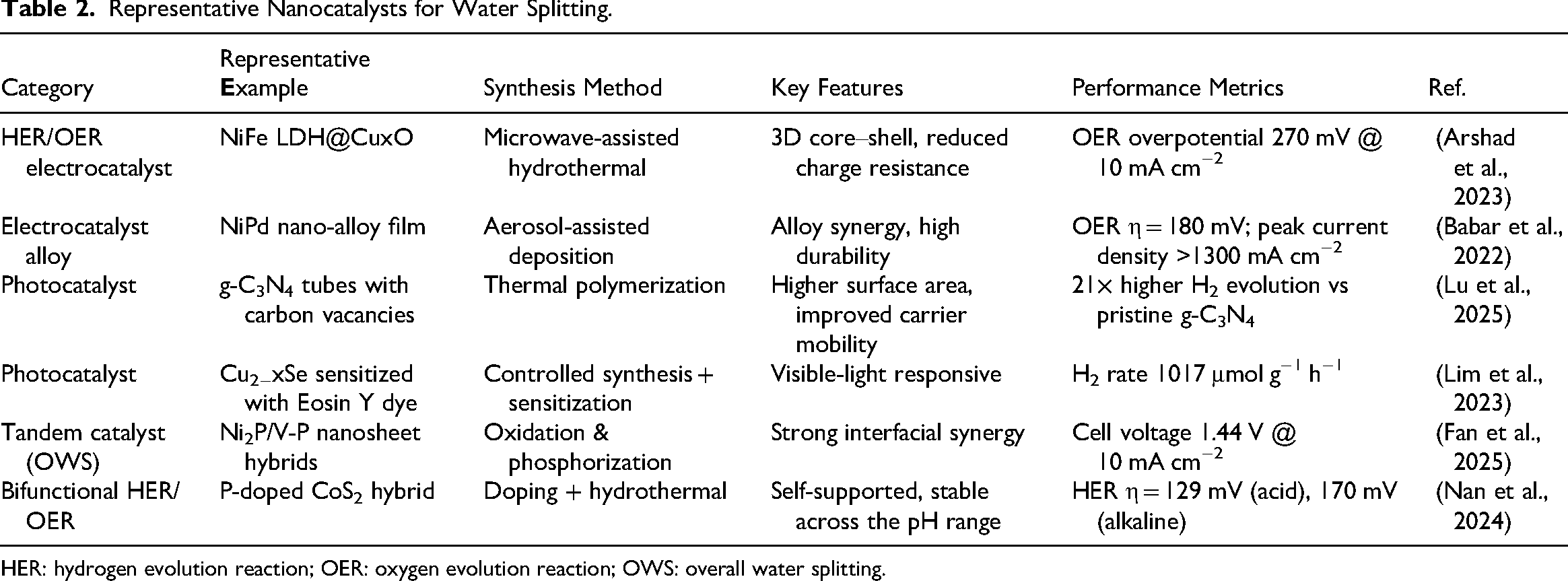
HER: hydrogen evolution reaction; OER: oxygen evolution reaction; OWS: overall water splitting.
Recent studies have emphasized the development of multifunctional and trifunctional electrocatalysts capable of simultaneously driving HER, OER, and auxiliary reactions such as urea oxidation. These systems significantly reduce energy consumption and improve overall efficiency, highlighting their potential for large-scale hydrogen production (Abazari et al., 2026). Such advancements underline the importance of integrating catalytic activity with long-term operational stability and system-level efficiency.
In addition to efficient hydrogen generation, the storage and transportation of hydrogen and oxygen are critical for practical energy applications. Hydrogen can be stored in compressed gas form, as a liquid, or in solid-state storage materials such as metal hydrides and chemical carriers. Each method presents trade-offs between energy density, safety, and cost. For instance, compressed hydrogen storage offers simplicity but requires high-pressure systems, whereas solid-state storage provides enhanced safety but may suffer from slow kinetics and material degradation.
Similarly, oxygen generated during water splitting can be utilized in industrial oxidation processes or medical applications, necessitating appropriate storage and handling strategies. The integration of nanocatalyst-based water splitting systems with downstream storage and transport infrastructure remains a key challenge, requiring coordinated optimization of production efficiency, storage stability, and system-level energy balance.
Overall, nano-architected catalysts have demonstrated significant advancements in water splitting by enhancing catalytic activity, reducing overpotentials, and improving operational stability. The integration of electrocatalytic, photocatalytic, and tandem systems highlights the potential for efficient and scalable hydrogen production, although further improvements in durability and system integration remain essential for industrial deployment.
Nanocatalysts for fuel cells
The direct conversion of chemical energy into electricity with high efficiency and minimal emissions renders fuel cells a pivotal technology for decarbonized energy systems. Among the components that dictate fuel cell performance, catalysts play a critical role, particularly for kinetically sluggish electrochemical processes such as the ORR, alcohol oxidation reactions (e.g., methanol and ethanol), and in emerging systems utilizing alternative fuels like ammonia (Verma et al., 2020). Nanocatalysts offer distinct advantages due to their high surface-to-volume ratios, higher density of exposed active sites, and precise tunability of their structural and electronic properties. These features collectively enable advanced catalytic performance. Notably, rational nanocatalyst design holds transformative potential for minimizing reliance on platinum group metals (PGMs), thereby reducing costs and accelerating commercial deployment (Cui et al., 2024; Zou et al., 2022).
Beyond catalyst design, system-level optimization plays a crucial role in improving fuel cell performance. Recent studies have demonstrated that thermal management and structural design, such as optimized cooling channel configurations, significantly influence efficiency, durability, and power output in fuel cells (Lai et al., 2026). These findings highlight the need for integrating catalyst innovation with engineering design for practical deployment. With the advent of nanocatalysts, fuel cell technology has advanced rapidly beyond the constraints of precious-metal catalysts. ORR catalysts (Figure 5(a)) exemplify non-precious metal systems, such as Fe–N–C and Co alloys, which demonstrate improved activity, selectivity, and durability under varying pH conditions. Catalysts designed to enhance CO tolerance in methanol and ethanol oxidation (Figure 5(b)), including PtRu and Pd-based alloys, promote the HCOOH pathway to mitigate CO poisoning and provide kinetic advantages for direct methanol fuel cells (DMFCs). Finally, next-generation systems, including alkaline, solid oxide, and direct ammonia fuel cells (Figure 5(c)), employ cost-effective transition-metal nanocatalysts, thereby reducing costs, extending operational lifetimes, and improving efficiency, which collectively render these technologies highly promising for future energy applications.

Nanocatalysts in fuel cell applications: representative nanocatalyst strategies for fuel cell technologies. (a) Oxygen reduction reaction catalysts, (b) methanol and ethanol oxidation catalysts, and (c) emerging systems including alkaline, solid oxide, and direct ammonia fuel cells. ORR: oxygen reduction reaction; DMFC: direct methanol fuel cell; SOFC: solid oxide fuel cell.
Catalysts for the ORR
The ORR at the cathode represents a major kinetic bottleneck in both PEMFCs and alkaline fuel cells (AFCs). While carbon-supported platinum nanoparticles remain the benchmark, their high cost and limited durability necessitate the development of alternative, non-PGM catalysts (López-Leal et al., 2025). Transition metal–nitrogen–carbon (M–N–C) materials, particularly those containing atomically dispersed Fe–N₄ coordination sites have exhibited catalytic activities approaching those of Pt-based systems, yet at a significantly lower cost (Liu et al., 2022; Nguyen et al., 2023). The exchange current density 
Alloyed nanostructures, such as Pt–Co and Pt–Ni, further enhance performance by modulating the electronic structure, leading to improved oxygen adsorption kinetics and greater stability. Additionally, defective nitrogen- and sulfur-doped carbon frameworks form stable, conductive backbones that synergize with transition metals, achieving high activity under both acidic and alkaline conditions. These strategies exemplify how nanostructured catalyst systems can be tailored to improve ORR efficiency while mitigating economic and operational limitations (Hou et al., 2022; Selvakumar et al., 2022).
Oxidation catalysts for methanol and ethanol
At the anode of DMFCs and direct ethanol fuel cells (DEFCs), efficient catalysts are required for alcohol oxidation reactions. PtRu alloys are widely investigated for their superior tolerance to carbon monoxide poisoning, attributed to Ru's ability to generate oxygenated species that facilitate the oxidative removal of CO intermediates (Pal et al., 2022).
Beyond binary alloys, bimetallic and trimetallic nanocatalysts such as Pt–Sn, Pt–Ni, and Pd-based systems have demonstrated significant improvements in poisoning resistance while reducing the overall PGM loading. Hybrid configurations that couple noble metals with nanostructured oxides (e.g., SnO2, CeO2) further enhance CO tolerance and catalytic durability. Ethanol oxidation poses an additional challenge due to the need for C–C bond cleavage. Nanostructured Pt–Pd–Au systems and perovskite oxides have shown promise in overcoming this limitation by enhancing selectivity for complete oxidation, thereby improving energy conversion efficiency (Regmi et al., 2020).
Emerging fuel cell systems: Alkaline, solid oxide, and direct ammonia
Beyond conventional PEMFCs, several emerging fuel cell configurations are gaining prominence. AFCs offer expanded catalytic flexibility due to the compatibility of alkaline media with non-precious metals such as Ag, Co, and Mn oxides. Recent advancements have demonstrated the efficacy of nanostructured perovskites and spinel oxides as low-cost alternatives to PGMs, delivering promising ORR and OER activities in alkaline environments (Sebbani et al., 2025).
Solid oxide fuel cells (SOFCs), operating at elevated temperatures, utilize mixed ionic–electronic conducting oxides such as La₀.₆Sr₀.₄Co₀.2Fe₀.₈O₃ (LSCF) and CeO2-based nanocatalysts. These materials facilitate ionic diffusion and enhance thermal stability due to their tailored nanoarchitectures. Meanwhile, DAFCs present new opportunities for carbon-free fuel utilization. The catalytic challenge in DAFCs lies in the robust cleavage of N–H bonds and resistance to poisoning. Ru-based nanocatalysts supported on nitrogen-doped carbon substrates, along with bimetallic Pt–Ir systems, have recently demonstrated high activity for ammonia oxidation and impressive long-term operational stability (Wu et al., 2025).
Collectively, the application of nanocatalysts across various fuel cell technologies illustrates the power of deliberate nanoarchitectural and electronic-structure engineering. By enabling high catalytic activity, selectivity, and durability while potentially lowering material costs, nanocatalyst systems pave the way for next-generation fuel cells with enhanced commercial viability (Dinesha et al., 2021). Nanocatalysts engineered to target the diverse electrochemical reactions integral to fuel cell operation, such as the ORR and alcohol oxidation, have been systematically developed, as illustrated in Table 3. Approaches including alloying platinum with transition metals, incorporating atomic Fe–N–C active sites, and nanostructuring spinel oxides have demonstrably enhanced catalytic activity, reduced platinum loading, and improved operational stability. These representative strategies exemplify how nanoscale engineering can effectively accelerate the path toward the commercialization of a broad spectrum of fuel cell technologies.
Representative Nanocatalysts for Fuel Cell Reactions.

PEMFC: proton exchange membrane fuel cell; ORR: oxygen-reduction reaction; DMFC: direct methanol fuel cell; AFC: alkaline fuel cell; DEFC: direct ethanol fuel cell; LSCF: La0.6Sr0.4Co0.2Fe0.8O3.
In conclusion, nanocatalyst engineering has significantly improved fuel cell performance by enhancing reaction kinetics, decreasing noble metal usage, and increasing durability. Ongoing advancements in catalyst design and system optimization are likely to speed up the commercialization of next-generation fuel cell technologies.
Nanocatalysts for energy storage devices
While efficient energy conversion technologies are essential, they alone are insufficient to enable the transition toward a low-carbon energy infrastructure. Robust energy storage systems are equally critical. The integration of nanocatalysts plays a pivotal role in enhancing the performance of batteries, supercapacitors, and hybrid storage devices (Zou et al., 2025). Owing to their high surface area, shortened ion diffusion pathways, and tunable electronic properties, nanocatalysts contribute significantly to improved redox kinetics, electrochemical stability, and overall energy density (Koundal et al., 2025). This section outlines recent advancements in nanocatalyst design for lithium–sulfur (Li–S), sodium-ion (Na-ion), and zinc–air (Zn–air) batteries, as well as for supercapacitors and their hybrid configurations (Malik et al., 2024; Zou et al., 2022).
Battery electrocatalysts (Li–S, Na-ion, Zn–air)
Lithium–sulfur (Li–S) batteries are considered promising for next-generation storage due to their exceptionally high theoretical energy densities. However, their widespread adoption is limited by the polysulfide shuttle effect and sluggish redox kinetics. Nanocatalysts, including transition metal oxides (TMOs) (e.g., TiO2, MnO2), sulfides, and doped carbon materials, have shown promise in mitigating these challenges by immobilizing polysulfides and catalyzing conversion reactions. For example, cobalt–nitrogen-doped carbon nanosheets encapsulating Co nanoparticles effectively trap polysulfides and reduce charge-transfer resistance, thereby enhancing cycling stability (Wang, Cui et al., 2022).
Sodium-ion (Na-ion) batteries are more suitable for large-scale energy storage due to the abundance and low cost of sodium. Nanocatalysts accelerate ion diffusion and enhance structural robustness. NiCo2O₄ spinel nanostructures, with their porous morphology and high electronic conductivity, have demonstrated excellent capacity retention (Liu et al., 2021). Furthermore, heterostructured Fe2O₃/graphene composites provide synergistic buffering and catalytic activity, thereby improving sodium storage.
Zinc–air (Zn–air) batteries demand efficient bifunctional catalysts for both the ORR and the OER. High-entropy alloy (HEA) nanoparticles and Mn/Co/N-doped carbons have exhibited outstanding bifunctionality, thereby enhancing round-trip efficiency. For instance, NiFe–MOF-derived porous carbons enabled high power density and long cycling life, outperforming traditional Pt/C–IrO2 benchmarks (Zhao et al., 2022).
Supercapacitor electrode materials
Supercapacitors are known for their high-power densities and excellent charge–discharge performance; however, their energy density remains comparatively low. The design of redox-active nanostructures with large electrochemically active surface areas is crucial to enhancing their storage capacity. TMOs, such as MnO2, RuO2, and Co₃O₄, when prepared in nanowire, nanosheet, or hierarchical porous architectures, exhibit superior pseudocapacitive behavior (Cui et al., 2020). For example, NiCo2O₄ nanoneedles grown on conductive carbon cloth showed high areal capacitance and excellent cycling stability (Liu et al., 2024; Wang et al., 2024).
Moreover, the performance of these materials is further enhanced by incorporating conductive polymers and/or heteroatom-doped carbon layers, which improve both electrical conductivity and mechanical flexibility. Specific capacitance (Equation 5) quantifies charge storage capacity, where I is discharge current, 


Among emerging electrode materials, 2D materials, particularly MXenes such as Ti₃C2Tx, are of great interest due to their metallic conductivity, hydrophilic surfaces, and tunable interlayer spacing. When hybridized with transition metal compounds, MXenes provide enhanced capacitance and faster, more stable kinetics compared to traditional carbon-based systems. For instance, Ti₃C2Tx combined with MnO2 nanosheets delivered ultrahigh specific capacitance and outstanding rate performance (Yang et al., 2023).
Hybrid energy storage systems
Hybrid energy storage systems integrate the high energy density of batteries with the high power density of supercapacitors. These systems require electrode materials that exhibit both faradaic (battery-type) and capacitive (supercapacitor-type) behaviors. Nanocatalyst design enables the fabrication of such dual-function electrodes with hierarchical nanoarchitectures. For example, ZnCo2O₄ nanorods anchored on reduced graphene oxide simultaneously support multiple redox transitions and rapid ion diffusion, resulting in a favorable energy–power balance (Fan et al., 2024; Modi et al., 2024).
One notable hybrid platform is the lithium-ion capacitor (LIC), which combines a battery-type anode with a capacitor-type cathode. Nanocatalysts such as doped TiO2 nanotubes or Nb2O₅ nanoparticles serve to accelerate lithium intercalation while maintaining structural integrity (Zou et al., 2022). Similarly, sodium-ion and zinc-ion hybrid capacitors have benefited from defect-engineered carbon materials and nanostructured TMOs. These hybrid configurations offer a practical pathway to bridge the performance gap between traditional batteries and supercapacitors (Dhar et al., 2024).
The engineering of nanocatalysts has provided robust strategies to address longstanding bottlenecks in energy storage. By enhancing charge transport, redox kinetics, and structural stability, nanostructured materials are enabling the development of next-generation storage systems with higher capacity, faster response times, and extended cycle life. As illustrated in Table 4, the integration of nanocatalysts has catalyzed significant advancements across various energy storage systems, including Li–S, Na-ion, and Zn–air batteries, as well as supercapacitors and hybrid storage devices. The strategic application of nanoscale engineering to modulate redox kinetics, enhance electrical conductivity, and improve cycling stability, such as Co–N-doped carbon for polysulfide confinement, NiCo2O₄ nanostructures for optimized sodium storage, and MXene–MnO2 hybrids for superior capacitance, demonstrates considerable potential in narrowing the performance divide between high-energy and high-power storage technologies.
Representative Nanocatalysts for Energy Storage Devices.

OER: oxygen evolution reaction; ORR: oxygen-reduction reaction.
In summary, nano-architected materials are essential for advancing energy storage by enhancing charge transfer, redox reaction kinetics, and structural integrity. Developing multifunctional and hybrid systems provides a promising route to attain both high energy and power densities, meeting the growing needs of modern energy applications.
Industrial scale-up and commercialization
Despite the impressive performance of nanocatalysts in laboratory-scale evaluations, their widespread industrial adoption necessitates scalable synthesis methods, durable electrode integration, and favorable techno-economic viability. The successful deployment of nanocatalyst-based fuel cells, electrolyzers, and energy storage devices within existing energy infrastructures requires addressing key challenges in cost, reproducibility, and process scalability, particularly the transition from milligram-scale synthesis in academic laboratories to kilogram- or ton-scale production needed for commercial applications (Hussain et al., 2024; Nithiyasri et al., 2025). This section highlights recent advances in three interrelated domains: large-scale catalyst synthesis strategies, electrode and cell fabrication with performance validation, and TEA combined with LCA (Xiao et al., 2023). Recent research also emphasizes the concept of process-integrated catalysis, where nano-architected catalysts function as miniaturized chemical systems capable of simultaneously performing reaction, transport, and transformation processes. This approach enhances efficiency and bridges the gap between laboratory-scale catalysis and industrial chemical engineering (Tian et al., 2026). Such process intensification strategies are expected to play a pivotal role in future large-scale energy systems. In addition to catalyst design, optimization techniques play a critical role in industrial-scale deployment. ML models combined with advanced optimization algorithms have been shown to improve process efficiency and enable real-time anomaly detection in complex manufacturing environments, supporting reliable and scalable system operation (Dalal et al., 2025). Recent developments in advanced materials and intelligent monitoring systems have further enhanced the performance and reliability of energy conversion devices. For instance, the use of high-purity 4H-SiC materials, combined with IoT-based monitoring and machine-learning models, has demonstrated significant improvements in inverter efficiency, thermal stability, and operational reliability, highlighting the importance of integrating material innovation with real-time, data-driven control in modern energy systems (Munimathan et al., 2026).
Strategic scale-up from laboratory synthesis to practical application is essential for implementing nanocatalysts (Chen et al., 2025). Laboratory-scale synthesis (Figure 6(a)) allows precise control over nanostructure design and fabrication through methods such as sol–gel processing, atomic layer deposition (ALD), and spray pyrolysis; however, it remains constrained by low throughput. Pilot-scale fabrication (Figure 6(b)) bridges discovery and application by integrating nanocatalysts into electrodes and assessing their stability under practical operating conditions. At the industrial level, commercialization (Figure 6(c)) involves large-scale deployment across fuel cells, electrolyzers, and energy storage systems, supported by TEA and life-cycle analyses to ensure a sustainable transition.

Industrial scale-up of nano-architected catalysts: pathways for industrial scale-up and commercialization of nano-architected catalysts. (a) Laboratory-scale synthesis, (b) pilot-scale fabrication and validation, and (c) large-scale industrial deployment supported by techno-economic and life cycle evaluation. TEA: techno-economic analysis; LCA: life cycle assessment.
Large-scale catalyst synthesis strategies
A primary bottleneck in the commercialization of nanocatalysts is the development of scalable and reproducible synthesis techniques. Approaches such as spray pyrolysis, sol–gel processing, hydrothermal/solvothermal synthesis, and ALD have been adapted for bulk production (Kavinkumar et al., 2021). Spray pyrolysis is particularly well suited to the continuous synthesis of nanostructured oxides and sulfides with tunable porosity. Sol–gel methods enable the large-scale preparation of homogeneously dispersed nanoparticles, particularly for mixed-metal oxides used in ORR and OER catalysis (Østrøm et al. n.d). Although ALD remains cost-intensive, its ability to achieve atomic-level coatings over extensive electrode surfaces renders it attractive for high-value applications, such as cathodes in polymer electrolyte membrane (PEM) fuel cells (Song et al., 2024).
Emerging techniques, such as flame spray pyrolysis for synthesizing HEA nanoparticles, offer scalable, cost-effective routes to producing multifunctional catalysts with high throughput. Additionally, bio-inspired synthesis methods, employing plant extracts, biopolymers, or microbial templates, are being explored for their environmental sustainability and potential for scale-up. Crucially, all scalable methods must preserve nanoscale structural features such as defects, porosity, and interfacial characteristics that are essential for catalytic activity (He et al., 2024; Li et al., 2026).
Electrode/cell fabrication and performance validation
Translating nanocatalyst powders into functional devices requires integrating them into electrodes and testing under conditions relevant to industrial applications. Common fabrication approaches include ink formulation and slurry casting, in which catalysts are combined with binders and conductive additives and applied to current collectors. For water electrolyzers, self-supported electrodes, such as directly grown nanocatalysts on nickel foam, carbon cloth, or stainless-steel meshes, minimize contact resistance and enhance mass transport (Polat et al., 2023).
Performance validation must extend beyond laboratory-scale testing. Industrial electrolyzers typically operate at current densities of 500–1000 mA cm−2 for extended periods. Notably, NiFe-based LDH catalysts grown on conductive supports have demonstrated over 100 h of stable performance at 1000 mA cm−2 in alkaline electrolyzers, approaching industrial benchmarks (Zhang et al., 2024). Similarly, the development of bifunctional catalysts for Zn–air batteries and DAFCs underscores the necessity of long-term cycling tests under realistic conditions. There is a growing emphasis on standardized testing protocols, including benchmarking against commercial Pt/C and IrO2 catalysts at relevant temperatures and pressures, to ensure meaningful comparability between laboratory data and industrial performance projections (Al Bostami et al., 2025).
TEA and LCA
Although nanocatalysts exhibit high catalytic efficiency and durability, their commercial viability depends on their cost-effectiveness and environmental impact. TEA provides a framework for evaluating material and production costs relative to conventional catalysts. For instance, replacing Pt with Fe–N–C catalysts in PEM fuel cell cathodes can reduce costs by up to 80%, though stability remains a critical limitation (Liang et al., 2024).
Complementing TEA, LCA evaluates the environmental footprint of nanocatalyst production and use, accounting for raw material extraction, energy demands for synthesis, and end-of-life management, including recycling and disposal. Energy-intensive methods such as ALD or solvothermal synthesis can result in a significant carbon footprint, potentially offsetting the environmental benefits of nanoscale catalytic efficiency. Therefore, integrating greener synthesis pathways and circular economy principles is imperative. Examples include recycling noble metals from spent catalysts and reusing carbon-based supports like carbon nanotubes or graphene. To guide responsible commercialization, researchers and industry stakeholders are developing hybrid evaluation metrics such as performance-per-dollar and performance-per-CO2-emission to balance technological effectiveness with economic and environmental sustainability (Zimmermann et al., 2022). Industrial viability can be benchmarked using cost-performance indices (Equation 8), which normalize catalyst cost relative to catalytic activity. Life-cycle CO2 emissions (Equation 9) are calculated from energy inputs 

The successful scale-up and commercialization of nanocatalysts require a dual focus: optimizing catalytic performance while minimizing economic and environmental burdens. Advances in scalable synthesis, practical electrode fabrication, and integrated TEA/LCA methodologies are essential to transition nanocatalysts from the laboratory to real-world energy systems. A commitment to responsible nanotechnology will be central to realizing its potential in future clean energy infrastructures (Xu et al., 2025; Zhang et al., 2026).
The growing significance of nano-glass catalysts, and their associated structural and longevity benefits, is being highlighted in the context of efforts to recondition (regenerate) and/or recycle existing catalytic materials for future use. Regeneration of spent catalysts can often be achieved through thermal treatment, electrochemical reactivation, and/or chemical leaching, thereby restoring active sites and eliminating residues of active-site contamination from the catalyst surface. Also, through recycling strategies, primarily for noble metal-based catalyst materials, recovery and reuse of valuable materials occur, and thus greatly reduce the overall cost associated with the total system.
Moreover, savings are achieved through the design of recyclable catalyst supports (e.g., carbon-based frameworks, metal foams), enabling multiple recycling cycles with negligible performance degradation. Thus, incorporating recyclability into the design of catalytic materials enhances their long-term viability while improving the economic feasibility of large-scale energy systems. Future research should focus on developing closed-loop recycling systems to encompass the recovery, regeneration, and reuse of catalysts in closed-loop industrial applications.
As illustrated in Table 5, key elements in the industrial scale-up of nanocatalysts include scalable synthesis techniques, reproducible yet industrially viable electrode fabrication methods, and comprehensive techno-economic validation. Several promising pathways toward commercialization demonstrate the potential to scale without compromising performance, including Pt–Co alloys synthesized via ALD, HEAs produced via flame spray pyrolysis, and self-supported NiFe LDH-based electrodes. When coupled with rigorous cost analysis and LCAs, these strategies emphasize the imperative of integrating cutting-edge catalytic functionality with complementary economic and environmental considerations (Chen et al., 2025; Liu et al., 2024).
Industrial Scale-Up and Commercialization Strategies for Nanocatalysts.

OER: oxygen evolution reaction; PEMFC: proton exchange membrane fuel cell; ORR: oxygen-reduction reaction; LDH: layered double hydroxide; HEA: high-entropy alloy; ALD: atomic layer deposition; PEM: polymer electrolyte membrane.
Figure 7 illustrates the integrated TEA–LCA framework for nano-architected catalysts. This framework encompasses all connected stages, from raw material extraction and catalyst synthesis to device integration, performance assessment, environmental impact analysis, and recycling strategies. It emphasizes the relationship between performance, economic viability, and environmental sustainability, underscoring the importance of a comprehensive evaluation in catalyst development.

TEA–LCA framework for nano-architected catalysts: Integrated TEA and LCA framework for nano-architected catalysts. The diagram illustrates the interconnected stages from raw material extraction and catalyst synthesis to device integration, performance evaluation, environmental impact assessment, and recycling pathways. TEA: techno-economic analysis; LCA: life cycle assessment.
Overall, moving from laboratory research to industrial use involves adopting scalable synthesis techniques, ensuring dependable device manufacturing, and conducting thorough techno-economic and environmental assessments. Tackling these aspects is crucial to verify the practical viability and sustainability of nano-architected catalyst technologies.
Current challenges and future directions
Although nanoscale catalysts have shown remarkable promise for enhancing energy conversion and storage, the transition from laboratory-scale innovations to practical, real-world technologies remains a significant hurdle. Key challenges include mass production, durability under industrial operating conditions, integration into energy systems, and adoption of digital tools, such as AI, for catalyst discovery. This section outlines the current limitations and emerging strategies poised to shape the future trajectory of nanocatalyst research and deployment (Si et al., 2025; Zhang, Wang et al., 2025).
The key challenges and corresponding innovation-driven solution pathways for nano-architected catalysts are illustrated in Figure 8. It shows major limitations related to scalability, durability, system integration, and cost are addressed through strategies such as scalable synthesis, core–shell stabilization, smart grid integration, and AI/ML-assisted optimization. It highlights the transition from existing bottlenecks to future-ready solutions, emphasizing a structured innovation pathway toward industrial-scale deployment. Collectively, these directions establish a pathway toward the realization of sustainable, efficient, and commercially scalable nanocatalyst technologies (Aslam et al., 2024).

Challenges and innovation pathways for nano-architected catalysts: key challenges and corresponding innovation pathways for nano-architected catalysts. Major barriers such as scalability, durability, system integration, and cost are mapped to solution strategies including scalable synthesis, structural stabilization, smart energy integration, and AI/ML-assisted optimization. AI: artificial intelligence; ML: machine learning.
Mass production and cost reduction
The synthesis of nanocatalysts often relies on intricate techniques such as ALD, solvothermal synthesis, and high-temperature pyrolysis which are inherently complex and difficult to scale. Moreover, the incorporation of precious metals such as platinum (Pt), iridium (Ir), and ruthenium (Ru) significantly inflates material costs, thereby limiting their large-scale application. While promising non-noble metal alternatives such as Fe–N–C complexes and Ni–Co oxides have exhibited high catalytic activity, achieving batch-to-batch reproducibility at scale remains a persistent challenge (Kavinkumar et al., 2021; Østrøm et al., n.d).
Future research should prioritize green and scalable synthesis strategies, including flame spray pyrolysis, continuous hydrothermal flow synthesis, and bio-inspired methods. Additionally, the recycling of noble metals and reuse of conductive supports, such as carbon nanotubes, will be critical to ensuring cost-effective commercialization. Addressing these challenges will be pivotal in developing economically viable nanocatalysts for large-scale deployment.
Durability under industrial operating conditions
Catalyst degradation represents one of the most formidable obstacles to commercialization. Under harsh operational conditions such as elevated temperatures, corrosive electrolytes, and high current densities, nanocatalysts are susceptible to structural degradation, dissolution, and surface poisoning. Phenomena such as the demetalization of Fe–N–C catalysts during oxygen reduction and phase transitions in NiFe LDHs during long-term electrolysis exemplify degradation pathways collectively referred to as elemental rearrangement (Yang et al., 2020).
Advanced strategies to mitigate these issues include implementing protective core–shell architectures, elemental doping for stabilization, and encapsulation within conductive matrices. While significant durability improvements have been demonstrated under laboratory conditions (typically ≤10 mA cm−2), real-world applications demand stability at much higher current densities. Therefore, validating catalyst longevity under industry-relevant operational protocols is essential to enable meaningful scale-up (Zhang et al. 2021).
Integration with renewable energy infrastructures
Beyond their electrochemical functionality, nanocatalyst-based systems must be designed for seamless integration into hybrid renewable energy infrastructures, such as solar-driven hydrogen production units, grid-scale storage solutions, and fuel cell-powered mobility platforms. These systems must operate reliably under intermittent power inputs, fluctuating loads, and varied electrolytic environments, which introduces additional layers of complexity.
Challenges such as chloride-induced corrosion in seawater electrolysis and competitive side reactions underscore the need for catalysts that are both selective and tolerant to impurities. The development of robust nanocatalysts with high chemical resilience will be critical. Furthermore, the integration of such systems with smart grids, demand-response mechanisms, and carbon capture technologies will be essential for realizing resilient, low-carbon energy networks (Ahmed et al., 2025; Ye et al., 2022).
AI/ML-assisted catalyst discovery and digital twin technologies
The vast compositional, morphological, and structural design space of nanocatalysts renders traditional experimental discovery methods increasingly inefficient. In response, AI and ML are emerging as transformative tools for catalyst development (Bhowmik, Kumar et al., 2025; Bhowmik, Nithin et al., 2025). These tools enable high-throughput screening of composition–structure–function relationships, facilitating rapid identification of optimal materials, reaction mechanisms, and synthesis protocols (Cui et al., 2024).
AI models trained on extensive experimental and computational datasets can outperform conventional approaches in predicting catalyst performance. Additionally, digital twin frameworks, virtual replicas of catalytic systems, offer real-time predictive maintenance, performance optimization, and process simulation. Coupled with robotic synthesis platforms and autonomous laboratories, these digital tools are poised to significantly accelerate the discovery-to-deployment timeline for nanocatalysts (Gu et al., 2024).
Although nanocatalyst development is fundamentally rooted in nanoscale engineering, industrial-scale implementation remains the defining challenge for the future. Strategic advancements across key pillars, cost reduction, durability enhancement, system-level integration, and digital transformation, will be imperative. If successfully addressed, these pillars could position nanocatalysts as a central enabler in achieving global decarbonization and sustainable energy goals that remain otherwise difficult to attain (Kaur et al., 2025; Mbasso et al., 2025). The integration of ML into complex engineering systems enables enhanced decision-making, predictive analysis, and adaptive control. Such approaches are increasingly being explored for optimizing catalyst performance and system-level efficiency in next-generation energy technologies (Natarajan et al., 2025).
The challenges associated with nanocatalyst development, particularly regarding cost, operational durability, and system-level integration, remain significant, as outlined in Table 6. Promising avenues for overcoming these barriers include adopting scalable, environmentally benign synthesis methods, implementing protective core–shell stabilization strategies, and designing selective catalysts capable of operating in complex environments, such as those encountered in seawater electrolysis. Furthermore, AI/ML-guided discovery frameworks and circular economy approaches offer substantial opportunities to accelerate innovation while minimizing environmental impact. Collectively, these transformative strategies delineate a viable pathway for the industrial deployment of nanocatalyst technologies.
Challenges and Emerging Future Directions for Nanocatalysts.
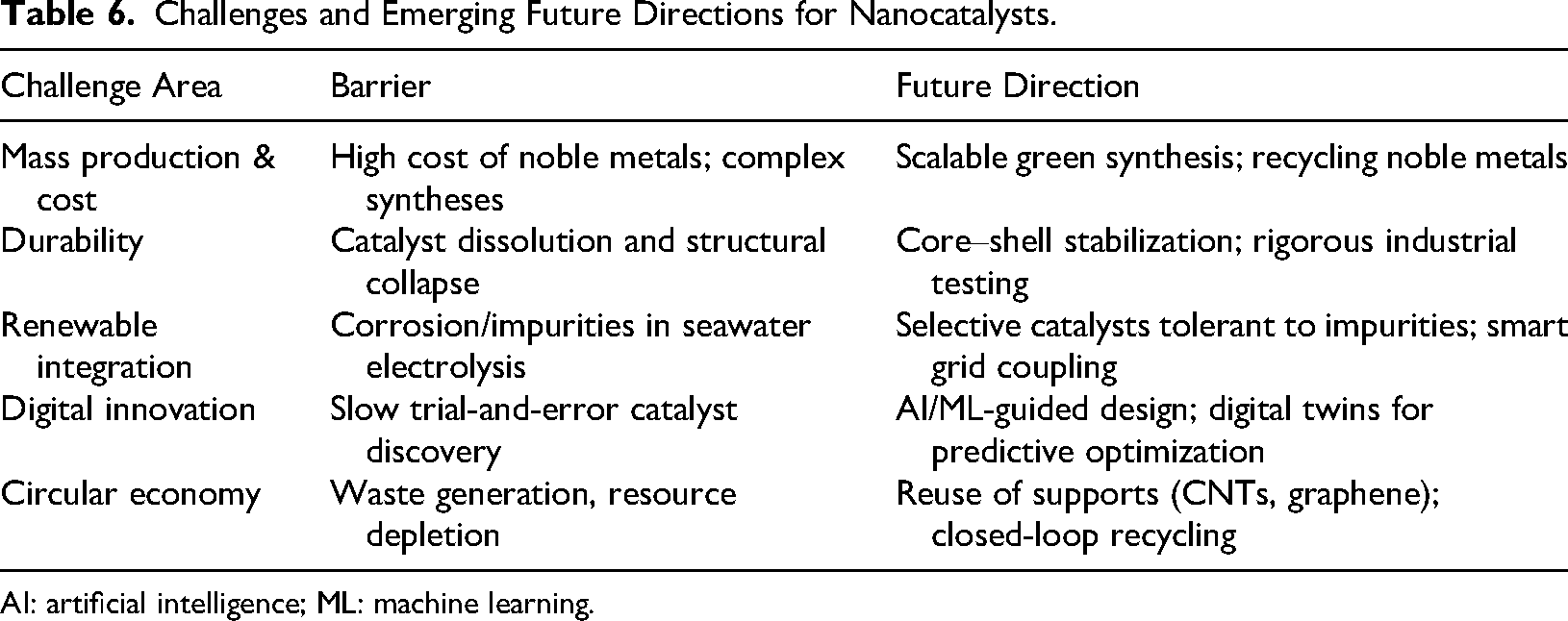
AI: artificial intelligence; ML: machine learning.
A unified approach, grounded in centralized design strategies encompassing morphology control, alloy engineering, and state architectures, creates new opportunities to advance water-splitting, fuel cells, and energy storage technologies. Figure 9, these innovations enabled through combinatorial scalable synthesis, techno-economic validation, and AI/ML-assisted discovery outline a clear trajectory toward global commercialization and the broader renewable energy transition.

Roadmap for nano-architected catalyst deployment: Roadmap for the development and deployment of nano-architected catalysts, integrating design strategies, scalable synthesis, techno-economic validation, and digital innovation to enable sustainable clean energy technologies. TEA: techno-economic analysis; LCA: life cycle assessment.
Discovery of catalysts with AI/ML and their sustainable deployment
Recent advances in AI and ML are transforming catalyst design, shifting the paradigm from empirical trial-and-error approaches to predictive, increasingly autonomous discovery processes. The integration of high-throughput screening platforms with ML algorithms enables the rapid exploration of vast compositional and structural spaces, thereby significantly reducing the timescale required to identify high-performance nanocatalysts. Beyond discovery, digital twin frameworks are being developed to simulate catalyst performance under realistic operating conditions, allowing for predictive durability assessments and proactive failure prevention. Furthermore, AI-powered self-optimizing reactor systems provide real-time feedback and adaptive control, enabling instantaneous adjustments to catalytic parameters to maximize performance while ensuring efficient resource utilization (Shafiee et al., 2025).
Equally critical is the sustainable deployment of nanocatalysts. Issues related to resource depletion and waste generation during synthesis and subsequent use can be mitigated through recycling strategies for spent nanocatalysts, including selective leaching, electrochemical regeneration, and closed-loop material recycling. Systematic LCAs are essential to quantify the environmental footprint associated with nanocatalyst production, application, and disposal. Embedding sustainability metrics within AI/ML-driven discovery pipelines offers the dual benefit of accelerating innovation while maintaining responsible material usage. Collectively, these approaches provide a pathway toward the development of efficient, durable, environmentally sustainable, and economically viable next-generation nanocatalysts (Wang et al., 2025).
Recent research indicates a shift in how researchers seek to improve nano-architected catalysts, toward more innovative and targeted strategies. One area where a lot of exciting research is being conducted is defect-engineered catalysts. Defect-engineered catalysts are catalysts engineered to provide controlled amounts of vacancies and/or heteroatoms, allowing researchers to finely tune adsorption energies to selectively catalyze specific reactions. Another exciting area of research related to nano-architected catalysts is interface engineering of heterostructured systems. This research is very promising because, by engineering the catalyst interface, researchers can control charge redistribution and accelerate reaction rates. This is especially true for bifunctional catalytic systems (i.e., water-splitting and oxygen-reduction).
In addition to producing excellent laboratory-scale results with highly engineered nanostructures, it is very important to balance a catalyst's performance with its production cost. Whereas most highly engineered nanostructures demonstrate excellent activity when produced in the laboratory, it is more difficult to produce these same materials at the industrial level. Thus, there is significant emphasis on scaling up nanostructure production to enable cost-effective manufacturing while maintaining nanoscale characteristics. One critical element in achieving cost-effective production with engineered nanostructured catalysts is incorporating performance-cost trade-offs into catalyst design. Recent advancements in integrated control frameworks have demonstrated the potential of combining ML-based forecasting with optimization and adaptive control for renewable-rich energy systems. For example, closed-loop architectures integrating LSTM-based forecasting with hybrid optimization techniques have shown significant improvements in system stability, efficiency, and resilience in microgrid environments under uncertainty (Mbasso et al., 2026).
Additionally, as nanostructured catalysts are developed, increasingly, the application of data-driven approaches to assist in the design of improved catalysts is becoming the norm. For example, AI/ML are being used to screen material compositions, predict catalytic behavior, and optimize processing conditions. The application of these tools, in conjunction with digital twin frameworks, will afford real-time information on the degradation of catalysts over time, how their performance changes, and the overall efficiency of the systems that they support, thus significantly reducing the time between the discovery of a catalyst and putting it into an industrial production environment.
The ultimate goal of this field of research is to create catalyst systems that are robust, earth-abundant, and recyclable, and can operate efficiently under industrial processing conditions—such as high current densities, varying load conditions, and complicated chemical environments. Accomplishing this goal will require a multidisciplinary effort involving nanoscale materials design, engineering process development, and sustainability assessments. Continued advancement in these areas will facilitate the large-scale development of clean energy technologies that rely on nano-architected catalytic systems.
Moreover, recent advances in catalyst design highlight the importance of recyclability and regeneration for sustainable deployment. Studies on MOF-based and heterogeneous catalysts demonstrate that structural stability and catalytic activity can be maintained over multiple cycles (Duan et al., 2024), emphasizing the feasibility of reusable catalyst systems for industrial applications (Duan et al., 2025). These findings reinforce the need to incorporate durability and recyclability as key design parameters in next-generation nano-architected catalysts.
These insights provide a structured framework for systematically addressing current limitations, paving the way for the practical deployment of nano-architected catalysts. The next section summarizes the main findings of this review and discusses the broader implications for future research and industrial applications.
Conclusions
Nanocatalysts that exhibit superior catalytic activity, selectivity, and durability through the coupling of tailored morphologies, defect engineering, alloying, and hierarchical architectures have emerged as critical materials for advancing clean energy technologies. In this review, we present an integrative roadmap linking fundamental design strategies with their applications in water splitting, fuel cells, and energy storage devices, while further extending these approaches to industrial-scale synthesis, techno-economic evaluation, and LCA. The discussion demonstrates that nanoscale engineering can be effectively translated from laboratory-scale innovation to commercialization pathways, enabling solutions that are both scalable and economically viable.
A key contribution of this work lies in its forward-looking perspective. AI/ML-driven high-throughput screening, digital twin frameworks for predictive durability, and AI-powered self-optimizing reactor systems collectively highlight the potential to accelerate catalyst discovery and deployment. When combined with sustainability considerations such as recycling of spent catalysts and minimizing the environmental footprint, nanocatalysts offer a compelling case for enabling responsible and resilient innovation.
Ultimately, nanocatalysts represent a unique interface for integrating renewable energy inputs with catalytic outputs, including hydrogen production, electrochemical conversion, and energy storage. Their scalable development and industrial adoption are essential for advancing the global renewable energy transition and achieving carbon neutrality targets. To this end, the insights consolidated in this review provide both a comprehensive state-of-the-art overview and a forward-looking framework to guide the research and deployment of next-generation nanocatalysis.
Footnotes
Ethical approval
Not applicable. This article does not involve studies with human participants or animals.
Authors’ contributions
All authors contributed equally to the conception, drafting, and final approval of the manuscript.
Funding
The authors received no financial support for the research, authorship, and/or publication of this article.
Declaration of conflicting interests
The authors declared no potential conflicts of interest with respect to the research, authorship, and/or publication of this article.
Data availability
Data sharing is not applicable to this article as no new datasets were generated or analyzed during the current study.
