




Abstract
The net-metering in Palestine bounds the capacity to recuperate numerous expenses which causes financial inequalities. Distribution companies (Discos) started to impose constrains to slow down the deployment of residential PV systems. This research proposes installing battery energy storage (BESS) to reduce the excess energy injected to electrical grid by storing surplus PV generation for later consumption. Thus, dropping grid export capacities and lessening network strain. Furthermore, the research assumes five wholesale price scenarios to observe their influence on optimum PV system and BESS capacity and financial results with a fixed purchasing retail price. Performance indicators including net present value (NPV), profitability index (PI), self-consumption ratio (SCR), self-sufficiency ratio (SSR), and generation-to-consumption ratio (GCR) were calculated to capture both technical and economic performance. Results show that higher wholesale prices reduce optimal PV sizing and increase grid dependence, whereas lower wholesale prices encourage larger PV systems but may increase grid management challenges. Scenarios with high SSR often correspond to lower SCR, highlighting the trade-off between energy autonomy and PV utilization efficiency. The sensitivity investigation in solar system cost, presented that optimal PV sizing is only temperately affected in low-export scenarios but remains unaffected under policy constrained cases. Though SCR and SSR were mainly steady, PI was extremely subtle to solar system in scenario 1 yet persisted negative in scenarios 2–5. The BESS capacity was unaffected, representing that storage sizing is affected more on tariff constructions and export restraints than on solar system.
Keywords
Introduction
Renewable energy systems (RES) play a significant impact in addressing urgent societal issues like climate change and resource depletion. Alarms and misgivings over fossil fuel exhaustion and its environmental and economic influences are crucial and challenging. This tendency climaxes the grave need to develop RES (Wang and Azam, 2024). Among the options available is the photovoltaic (PV) rooftop systems which composed substantial physical potential in electricity generation (Zidane et al., 2023).
Rooftop PV systems have developed as progressively approved solution in Palestine to decrease need of electrical energy purchased from Israeli Electrical Company and alleviate the cost electrical kWh (Abuhelwa et al., 2025; El-Khozondar et al., 2024).
The limited daytime hours and fluctuations in weather conditions over the year are considered main disadvantages of PV energy, resulting in a gap between energy consumption and energy generation from PV power plants (Bahloul et al., 2024). The use of grid connected PV systems in particular have become an essential feature in today's energy system offering in nature a green alternative to traditional fossil fuels. While the use of complementary technologies, like battery energy storage system (BESS) is required to improve its reliability and stability, due to the intermittency of solar energy which makes it a difficult technology to add to the electrical grid (Zakeri et al., 2021).
BESS are a useful tool for lessening the discrepancies between the supply and demand of electricity caused by intermittent energy sources. In response to the demand for a more consistent supply of electricity, a number of researchers and companies in the field of PV technologies have begun to create and market storage solutions based on battery technologies (Morais et al., 2022 and Yasin et al., 2025).
While adding BESS to a PV system increases the total investment cost that plant operators must bear, it also increases the value of the electricity produced by giving the option to shift the supply of electricity to different times (Castillejo-Cuberos et al., 2023).
The intermittency of solar energy leads to the necessity of BESS to solve the dissimilarity in both power generation and the unpredictable power generation. During non-production or peak demand times, releasing stored electricity into the grid, the BESS ensures the energy is independently controlled by PVs and could further stabilize the energy supply which also reduces the reliance on grid electricity and improved overall PV system performance (Gagliano et al., 2020). The feasibility and practicality of PV and BESS integration differs and relies on several factors, including initial capital cost, operational and maintenance cost, energy saved, market opportunity revenue from grid services, incentives, etc. (Liu et al., 2020). Reductions in costs and performance improvements of PV panels, power electronics, and battery storage tend to make PV with storage more viable to residential and commercial on-grid users (Mahfuz-Ur-Rahman et al., 2021). Hassan et al. (2024) offers optimization methods for sizing PV system attached with BESS to improve self-consumption ratio (SCR) and self-sufficiency ratio (SSR) in residential systems by using high-resolution data and assesses economic feasibility. Başaran et al. (2025) emphasize on managing the energy flow between PV system attached with BESS, and electrical network to enhance self-consumption ratio and economic profits. Semmelmann et al. (2024) offer an experimental field assessment of procedures designed to improve SCR, evaluating their influence on consumer conduct and overall well-being. Yu (2021) provides wider visions into how PV self-consumption relates with power system economics and steadiness, highlighting the potential role of storage in promoting integration and reducing electrical network influences. Han et al. (2022) perform dynamic optimization of PV system attached with BESS systems across consumer groups in the period between 2020 and 2050, the study includes deep sensitivity analysis on costs, prices, and strategies. Hoshino et al. (2024) presented a basic, instinctive method for sizing PV system attached with BESS based on cost curves which is valuable for sensitivity and policy investigation. Norouzi et al. (2025) performed techno-economic research to find out how numerous pricing strategies like net-metering, feed-in tariffs and storage grants impact grid-connected PV system attached with BESS sizing and performance in residential PV systems. Omar (2025) evaluated the economic effects of net-metering on residential PV grid connected systems in Palestine, it inspects the PV designs under net-metering schemes and examines financial consequences for households. Alrbai et al. (2025) related net-metering, net-billing, zero export with BESS, sell-all and buy-all strategies for assessing payback, levelized cost of energy (LCOE), and net present value (NPV) with different scenarios. Alrbai et al. (2025) assessed how tariff strategy impacts BESS, financial feasibility, and payback procedure in the absence of grants; visions into the importance of time of use and export rating.
Other research studies were specific to the region countries, with almost similar conditions. Table 1 summarize the main outcomes of these studies. Table 1 relates the case under evaluation (Palestine) with other countries in the region. Table 1 concentrates on how alterations in tariff constructions, export reimbursement, and electric network steadiness lead to basically diverse PV–BESS operative behavior.
Comparative literature to highlight difference between different related studies.
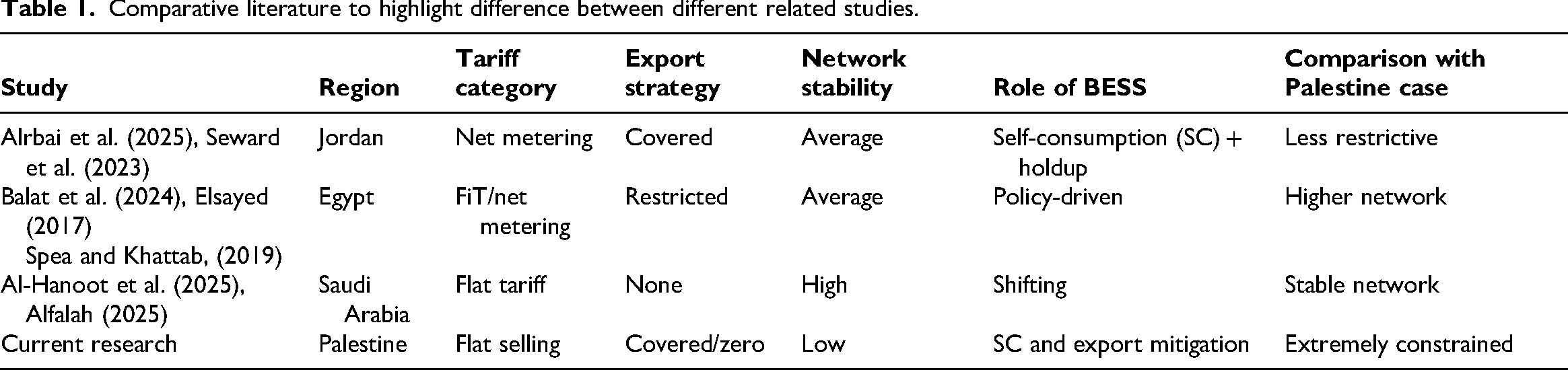
The electricity energy sector in Palestine varies from many neighboring counties as the tariff is based on energy. The PV energy export may be capped or unremunerated. The electrical network instability bounds hinder power flow because of the various problem occurred from PV export to grid. These circumstances change the role of BES from income generation to self-consumption improvement and export vindication. This ensuing the difference in system behavior and optimal sizing from those stated in open markets or other types of tariffs.
The residential PV systems offer a good solution for green energy. The success of those initiatives depends deeply on policies like net-metering and feed-in tariffs (FiT), which control how extra energy is held. In FiT arrangement as shown in Figure 1 the client has two distinct energy meters. The kWh meter measures the electricity generated by PV system and the second kWh meter measures the energy consumed by the household. In FiT scheme the energy produced by PV system is vended to grid irrespective of the household consumption at assigned electrical energy rate agreed by the users and distribution companies (Discos) under the supervision of the Palestinian Electricity Sector Regulatory Council (PERC). The electrical energy supplied by the household from the grid is sold at the normal assigned rate (PENRA, 2020 and Poullikkas, 2013).
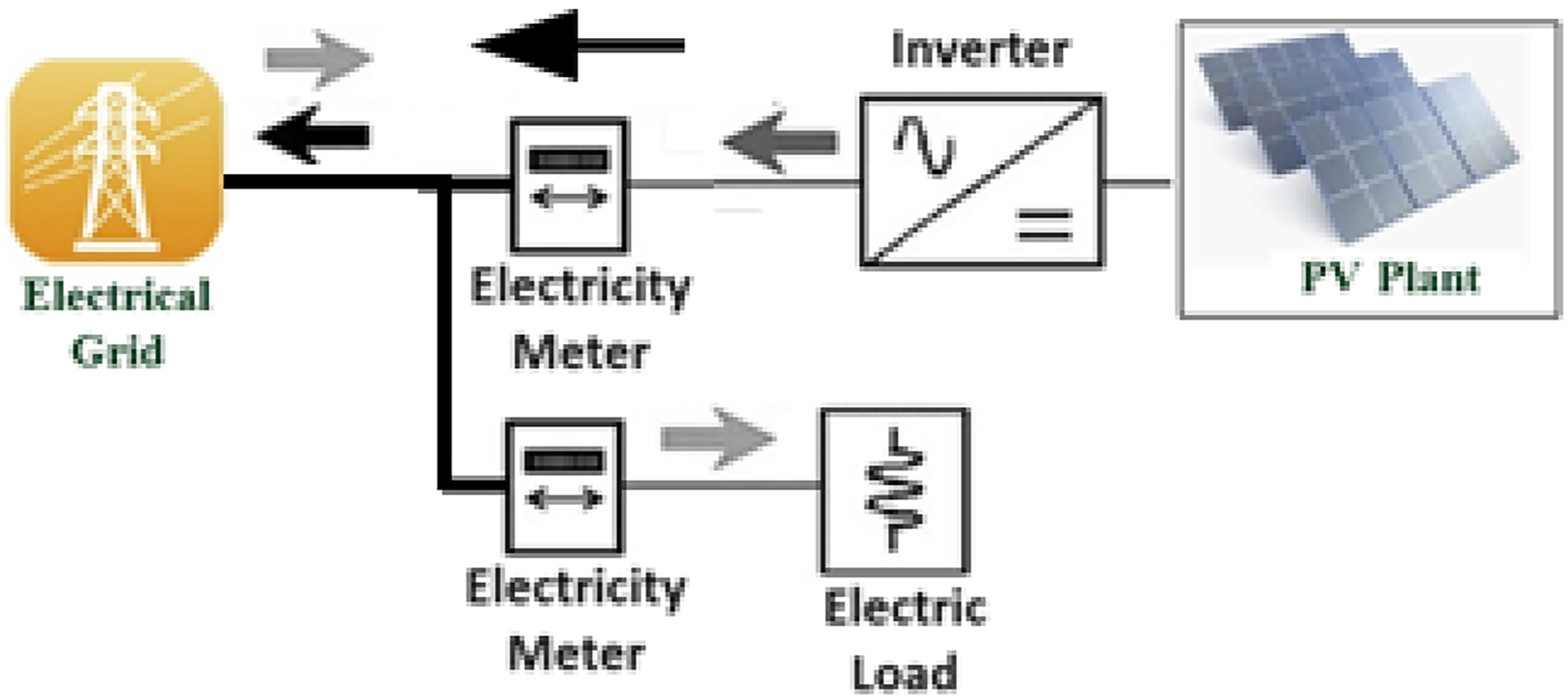
Grid-connected PV rooftop system with FiT arrangement.
The net-metering arrangement as shown in Figure 2 that permits small-scale PV energy producers to store the excess energy. Figure 2 shows that the configuration includes a bidirectional energy meter which measures the energy injected to grid from the local PV system and the energy consumed by the household (PENRA, 2020) . In this arrangement the clients pay for the net electricity consumed over the billing period at a specific rate which is different in each Disco and municipality.
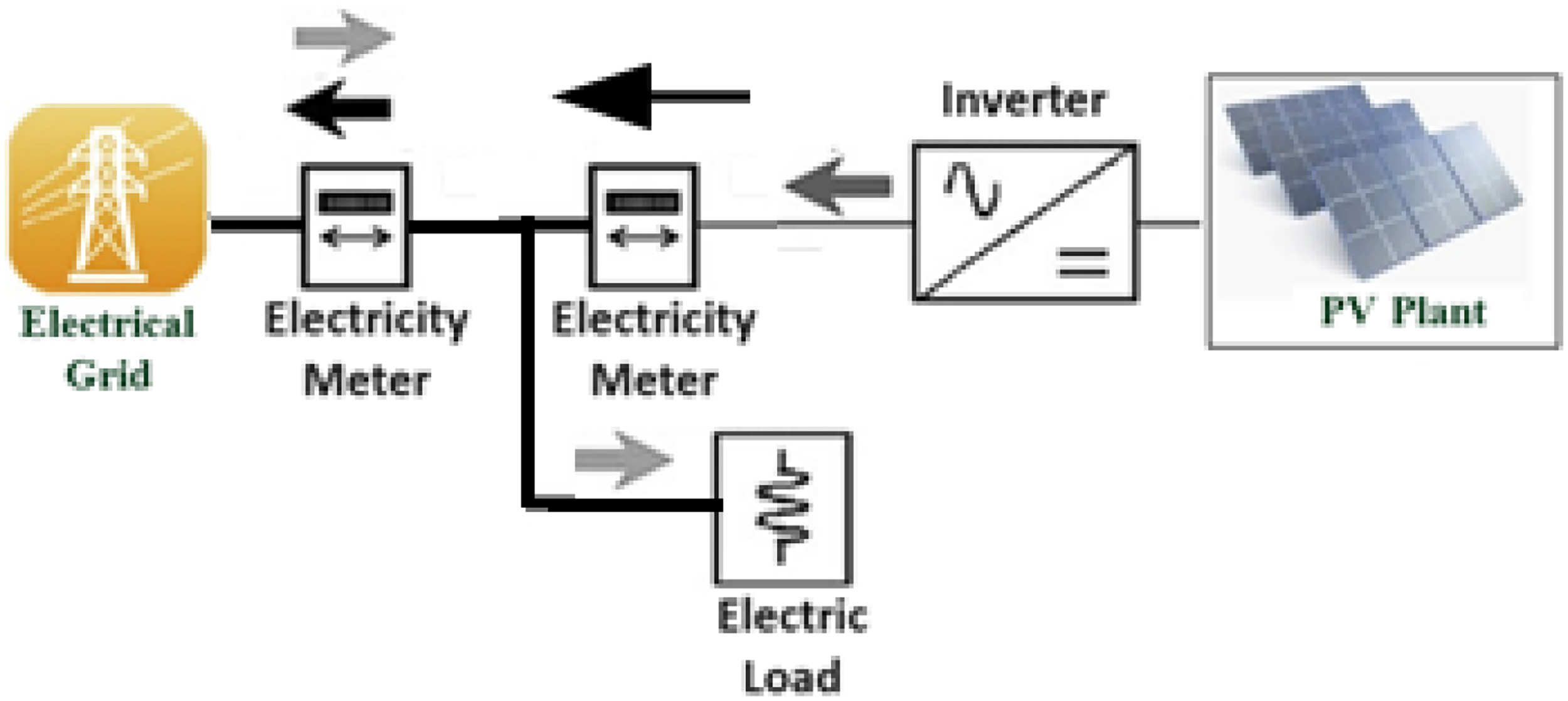
Grid-connected PV rooftop system with net-metering arrangement.
The integration of grid-connected PV systems with BESS has received significant attention from researchers, policy makers, and industry stakeholders due to its potential to enhance energy reliability and sustainability. This literature review brings together recent developments and findings in the economic and technical aspects of these integrated systems.
This research sheds light on the growing problem in installing PV systems in residential sector and small-scale commercial sector in Palestine. Electrical Discos and other municipalities enforce firm limitations on residential PV systems such as restraining selling energy to the grid, rejecting to reimburse for excess energy production, or limiting the size of PV systems allowed under net-metering policies. These restrictions decrease the economic feasibility of stand-alone residential PV systems. To lessen the severity of those limitations and constraints imposed, this paper introduces BESS to the residential system as complementary component to PV which consequently reduces grid import/export. In other words, it is bypassing policy limitations. To further analyze the system performance various key performance indicators (KPIs) are used.
This paper suggests a model for a commercial grid-connected PV power plant combined with BESS. This model is built using MatLab software. The model encompasses system design, performance metrics, cost–benefit analysis, and the potential impacts on the grid. The model is based on five different scenarios. The model details and scenarios are illustrated in the methodology and discussion, but in general starts by reading the annual solar radiation, annual temperature, and power demand of the load. These advantages consider the life of the system, where electricity will be sold to the local grid at peak times. Often, the daytime loads will be covered from the PV system and the evening loads from the battery storage system. The proposed model is applied in Nablus, Palestine (“32.223°N”, “35.256°E”) with a capacity of 1.5 MW. The multi-scenario analysis is evaluated by changing the main parameters of the PV–BESS system to obtain the optimal energy output and the highest annual savings.
The remaining parts of this paper are organized as follows: the second section illustrates the data collection and methodology which encountered definition of residential PV–BESS system limitation and structure, model input parameters and techno economic model. The obtained results and sensitivity analysis are discussed in the third and fourth sections. The paper conclusion is introduced in the fifth section.
Data and methodology
To investigate the technical and economic feasibility of installing BESS for residential PV system in PT considering the constraints imposed by the DISCOs. Figure 3 illustrates the methodology followed in the research, it starts from reading model input parameters. After stating the electricity prices scenarios, the model starts implementing techno-economic model of PV–BESS system which is based on energy estimation and economic indicators. The optimum size of PV and BESS is found based on the best NPV. The model performs high number of simulations as different ranges of PV capacities are simulated as well as different capacities of BESS. The model output includes important KPIs that offer a complete thought of how professionally the PV–BESS system encounters household energy demand, how it decreases grid reliance, and how efficiently solar energy is exploited.
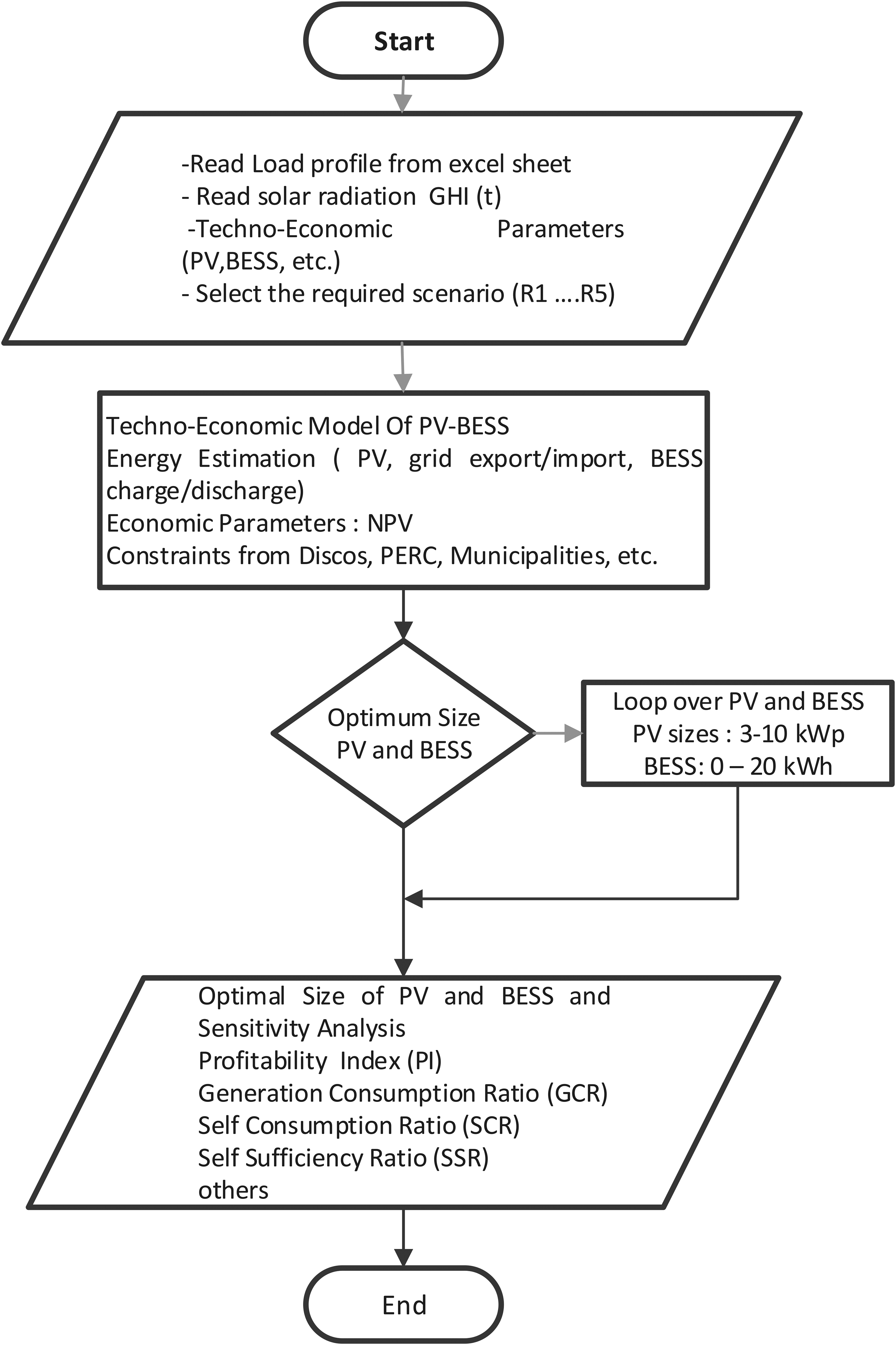
Overview of the model structure.
The BESS is functioned by means of an hourly PV-first dispatch strategy. When PV energy surpasses the load, excess energy is used to charge BESS within its existing capacity, and any residual energy is transferred to the network. When PV energy is inadequate, BESS is discharged to source the load until it is fully dischargd and limits power, with the grid covering any remaining demand. BESS charging from the grid is not allowable. This approach arranges direct PV self-consumption and load shifting while fulfilling with electrical network export restrictions.
Residential PV–BESS system limitations and structure
Figure 4 shows the layout of the system under investigation in this paper. It assumes a PV system used to electrify a household with BESS system perform a suitable consistency between the load demand and solar radiation. The system is connected to electrical grid to increase the reliability and feasibility of the system. The objective of the PV–BESS system is to fulfill the energy demand during peak hours using energy generated by the PV modules or stored in the BESS. When the PV–BESS system is not working, the grid serves as the primary power source.
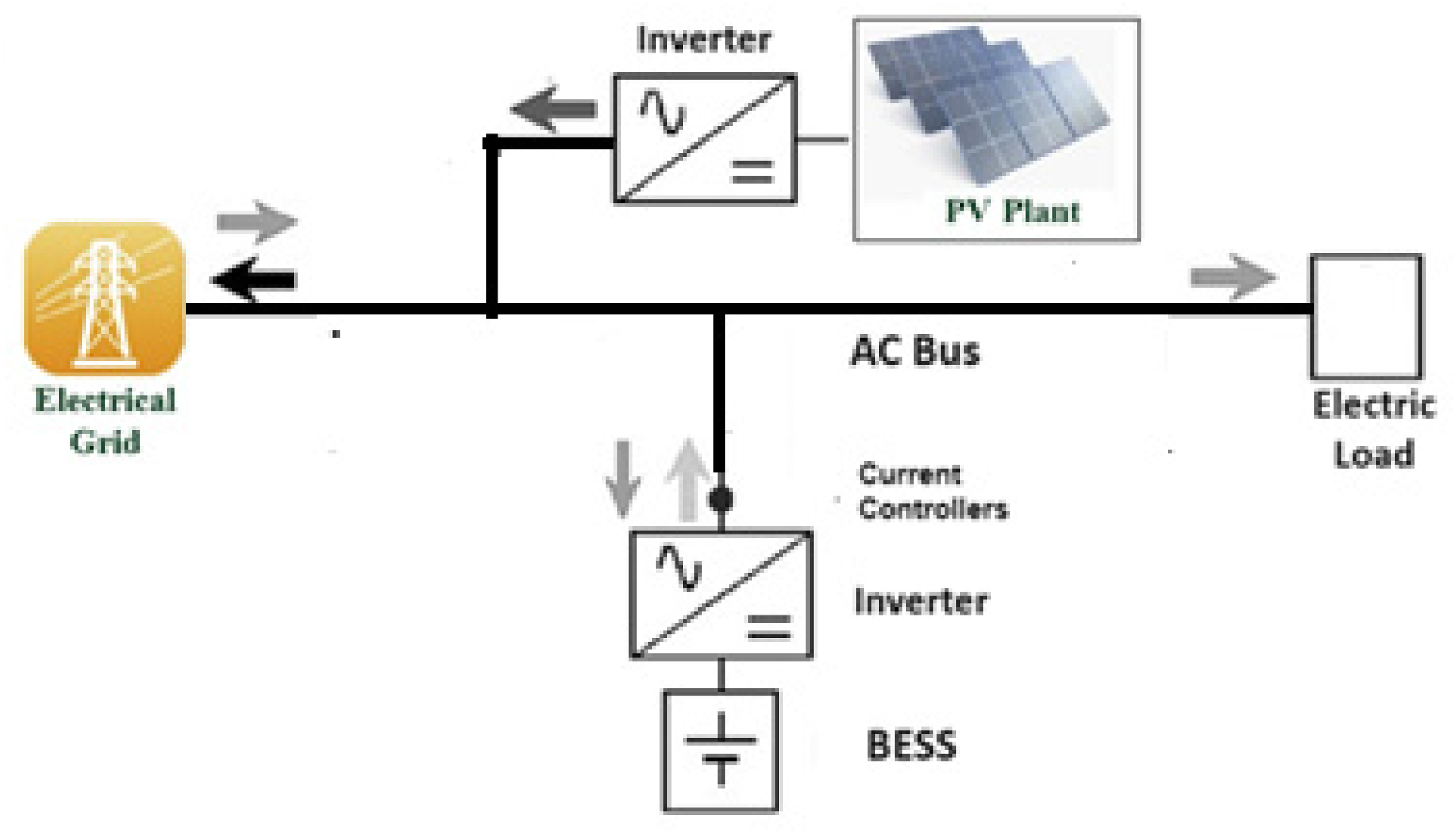
Layout of PV–BESS rooftop grid connected residential system.
Model input parameters
Load profile and solar radiation data
The main model inputs are Palestinian houseold load profile for an average-income family. The load profile considers the changes in the load consumption during the four seasons. The average daily consumption is approximately 27 kWh, the monthly average being 826 kWh, and total annual energy consumption 9921 kWh (ERC, 2025). The input data to the model is hourly data and obtained from publicly accessible data. Because of the lack of measured domestic data, the load profile was created using the annual domestic consumption extracted energy audit studies in residential and institutional sectors. The load profile data aligns with the typical consumption range in Palestine. The unintended outages may vary the real battery storage dispatch. As outage timetables are not accessible nor existed and fluctuate based on the areas, the current prototypical does not simulate outage-driven charging or discharging cases and it is itemized as a restriction and a chance for upcoming effort once consistent outage data are available.
The hourly solar energy over one year for Palestine is also another imporant input to the model and it is taken from the weather data station of Energy Research Center of An-Najah National University (ERC, 2025). Figure 5 shows the average annual load profile and average annual solar radiation for a location in Nablus city in Palestine (“32.223°N”, “35.256°E”). Figure 5 shows that the PV system cannot cover the load demand throughout the day which requires another source of energy.
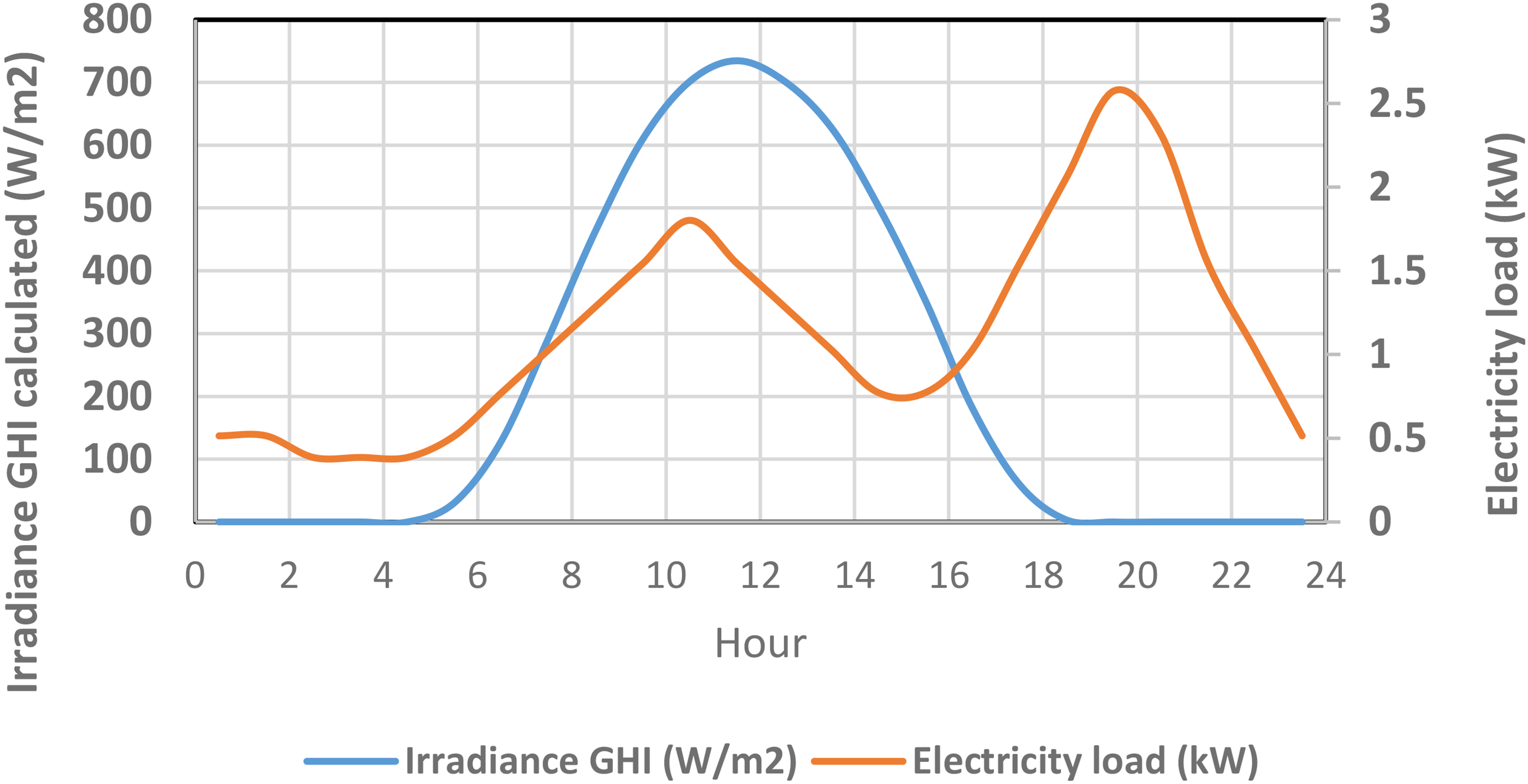
Annual average power daily load profile of a Palestinian household and daily average annual solar global radiation.
In fact, there are grid constraints imposed by Discos and municipalities for implementing PV systems and they depend on the capacity installed. The main constraints in the residential sector depend on the capacity installed in each feeder which must not exceed 25% of the transformers, the capacity is in the low voltage side. This is to protect the grid from voltage fluctuations, total harmonic distortions, etc. Normally, no grid impact assessment study is required from the residential users which normally includes short-circuit study, and a harmonic analysis, load flow analysis, voltage flicker, power factor and reverse power. The surplus generated energy from PV system supported with BESS is technically not practical under the present network condition and therefore not planned to characterize instantly implementable solutions.
Electricity prices scenarios
The retail price of electrical energy unit (kWh) in this study is 0.55 NIS (0.167 USD according to the average rate change for July 2025). It is good practice to note that PT, Discos and municipalities do not reimburse end-users cash money for the exported kWh units. As an alternative, they may permit limited net-metering up to the customer's yearly consumption, buying excess kWh units at a lower rate than retail rate, or in some cases, take any surplus beyond the yearly bill offset without payment—an approach often labeled as non-compensated feed-in or zero export credit beyond offset.
The study assumes that exported energy from the system is sold at lower price than retail price. This price often refered a wholesale price to indicate that a good margin of profit may be achieved by the Discos and municipalities. The wholesale price normally excluded the operational expenses of the network and profit margin. This price is normally not constant and vary widely in PT and this is according to Disco, municipality or village councils. In this study it is expressed as a percentage of retail rate as shown in Table 2. This allows flexible wholesale scenario which imitates representative policy contexts. This technique also allows reasonable analysis across diverse reimbursement arrangements while keeping the retail price constant, as is usually the case in controlled residential marketplaces.
Electricity energy export price scenarios.

Economic inputs of PV costs and BESS system.

Table 3 shows the main cost for the PV system and BESS used in this research. These values agree with local market prices in PT which increases the reliability and precision of the analysis. The replacement cost of the inverter and BESS is included in the model. The study assumes that the inverter and BESS is replaced every 10 years. The replacement cost of the BESS is 75% of the initial cost. The BESS power electronics and the power inverter are anticipated to last a lifetime. Yearly operation and maintenance (O&M) costs for BESS were supposed to be 2% of the initial cost. This price considers monitoring, preventive maintenance, and slight repairing of BESS and power electronics conditioning systems. A basic battery degradation model is considered in this study assuming 2% annual capacity degradation rate which reduces the effective capacity of BESS as shown in the following model:
As the BESS ages the effective capacity is reduced correspondingly to the residual operational capacity, thereby restraining the energy that can be stored and later discharged.
Till now, there is no specific Palestinian published policy for PV-BESS. In case of grid connected, DISCOs give some tolerance by easing the permission only. This paper presents a guide for policy developers and DISCOs, it enables them to understand the potential feasibility of such systems under different scenarios.
When it comes to the feasibility, at the time of writing this discussion, the cost of installing 5–10 kWp for residential units varies from 600 to 700 $/kWp. Adding a suitable sized BESS system increases the cost. But, taking into consideration the relatively high average residential electric tariff (0.16–21 $/kWh), using BESS has very good financial potential.
For the Palestinian citizens, the earlier studies of PENRA showed that on an average, 10% of the family's income is spent for energy expenses, and that residential grid connected PV systems normally recover its investment in less than 3.5 years despite that, there is no specific incentive programs for PV-BESS residential systems. Therefore, this investment is very attractive for families, and deserve more attention from policy and governmental incentives point of view.
Techno-economic model of PV-BES S
The simulation model performs the required calculations for finding the optimum PV capacity and the corresponding optimum BESS. The output PV energy generated from the corresponding capacity of PV is estimated by using
where the capacity factor is assumed to be 18% in this study and G(t) is the global solar radiation.
The model estimates the self-consumption as shown in equation 2 and it states the amount of PV energy that is utilized by the household rather than disseminated to the grid.
The software assesses whether conditions permit the BESS to be charged or discharged at each time step. This is shown in Equations 3 through 7 which numerically illustrates the circumstances at which charging and discharging occurs.
where PV_Excess is the excess PV energy which is estimated using equation (4) and max_CP is the rate at which BESS can be charged and is estimated using equation (5).

State of charge (SOC) of the battery is changed with time to quantify the energy stored at each hour, confirming that charging/discharging processes with respect to BESSs capacity limits and present energy level. The amount of discharged energy from BESS is estimated from 
where
The SOC is the amount of energy stored in BESS, max_DP is the maximum rate at which the BESS can deliver energy, and unmetload(t) is the load that PV ccannot cover and it is given by
The model also tracks energy exchange with the grid which is important in assessing the viability of the system. 

Model output and analysis and KPIs
NPV is defined in equation (10) and it is a financial indicator that computes the total value of an investment over the project lifetime (Zubi et al., 2018)
where r is the discount rate and T is the lifetime of the project. The annual net saving is calculated by subtracting the annual O&M cost, replacement cost from annual income of energy saving. The energy saving is signified as discount in electricity introduced from the utility due to the operation of the proposed PV-BESS. The O&M cost (CO&M) is estimated using equation 11 which is assumed to be 5% of the PV system cost
The replacement cost (Creplacement) is estimated using equation 11 and is assumed to be 10 years after installation with 75% of the initial cost
Profitability index (PI) is defined in equation (13) and expresses the achieved profit per unit of BESS investment. It is supportive when grid limitations complicate the business case or when NPV is marginal (Hoppmann et al., 2014).
where BESS investment cost is the initial cost of the BESS system only. SCR is defined in equation (14) (Hoppmann et al., 2014) and it expresses how much generated PV energy is really utilized by the household.
As the SCR increases it means that relatively smaller amount of energy is disseminated to the grid and more PV energy is useful. In fact, it is critical in PT case as the Discos and municipalities may not pay or pay less for exported energy. To conclude, SCR aids the designer to properly size the system, higher SCR shows the system is well-suited, and BESS increases SCR by shifting excess PV energy from daytime to night use. SSR is defined in equation (13) (Merei et al., 2016).
SSR expresses how much the load demand is covered by PV system whether directly or via BESS. It measures the degree of the system dependent from the grid. If it is close to 1, the system is nearly standalone and if it is 0.5 the system covers 50% of the energy needs. Normally introduction of BESS improves SSR.
Generation-to-consumption ratio (GCR) is defined in equation (14) (Hoppmann et al., 2014). It expresses the amount of PV energy generation in relation to load demand. If GCR is exactly 1, this means the PV generated energy is the same as load demand which rarely occurs. If it is greator than 1 the PV is oversized and undersized if it is less than 1.
Results of the study
Figure 6 shows the optimal size of PV system and BESS at five different electricity price scenarios. The range of PV capacity simulated in the software starts from 3 kWp to 10 kWp at 0.5 kW increase step and the range of BESS capacity simulated in the software starts from 0 kWh to 20 kWh at 3.5 kW power.
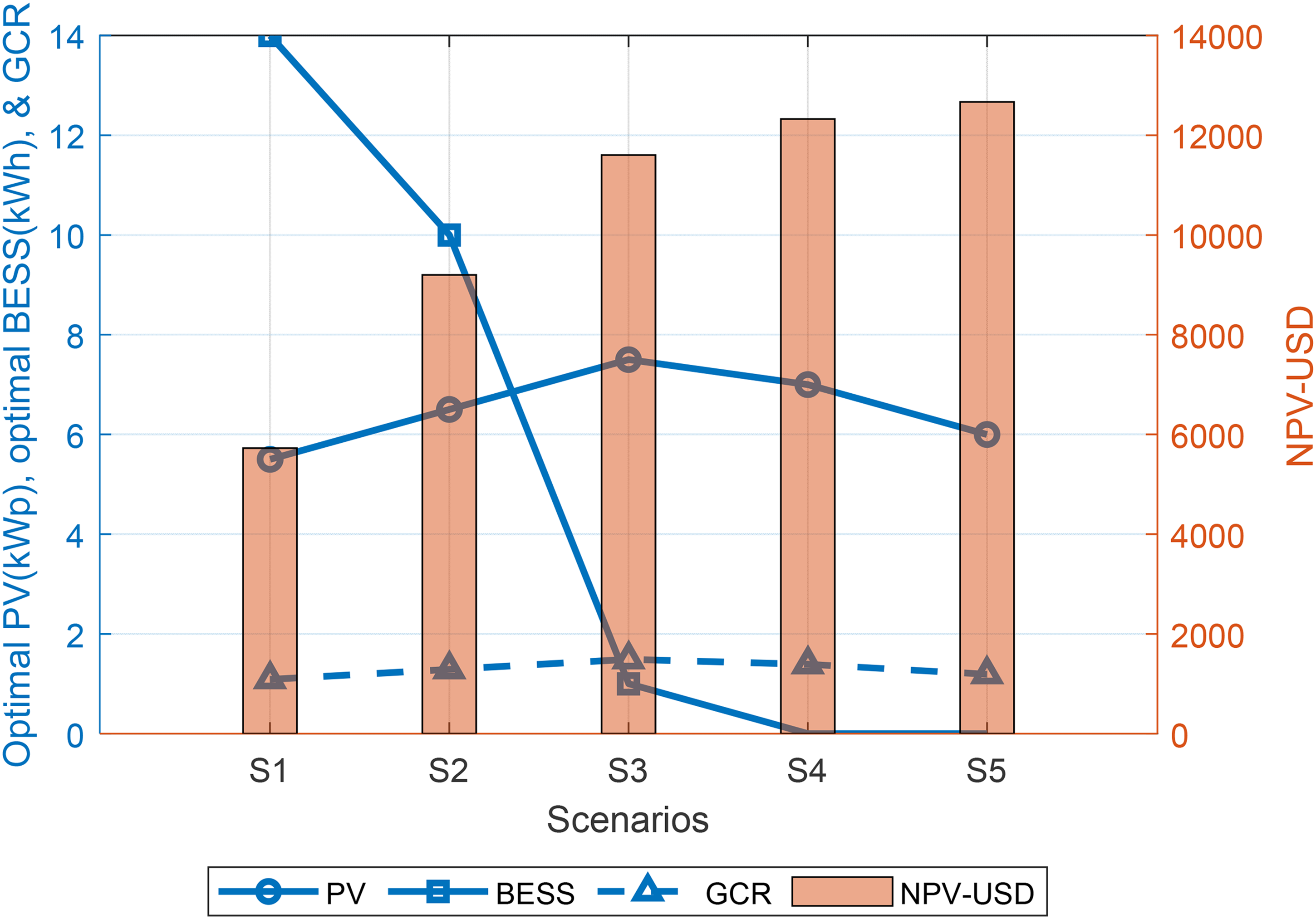
Optimal PV, BESS size, and GCR under electricity price scenarios S1–S5.
To further analyze scenario 1, it is good practice to refer to Table 4 which illustrates the PI for each scenario.
Profitability index of each scenario.

Figure 7 shows the relation between the five wholesale scenarios versus SCR and SSR. The SCR for scenario 1 (S1) is 0.41 which is the highest.
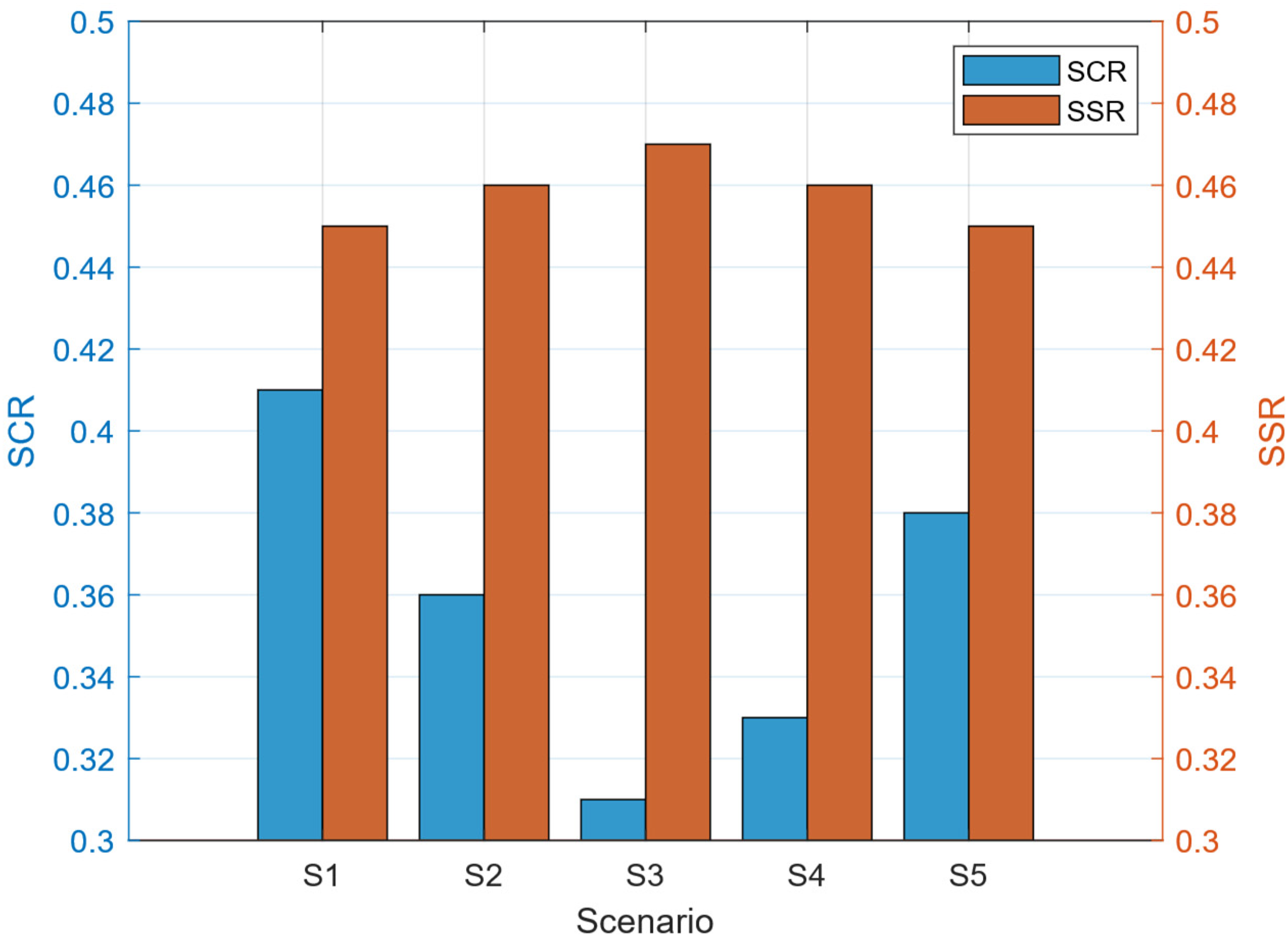
SSR and SCR vs. wholesale scenarios.
For further understanding SCR and economic calculation foundation Figure 8 represents the overall logic calculation for yearly average daily load.
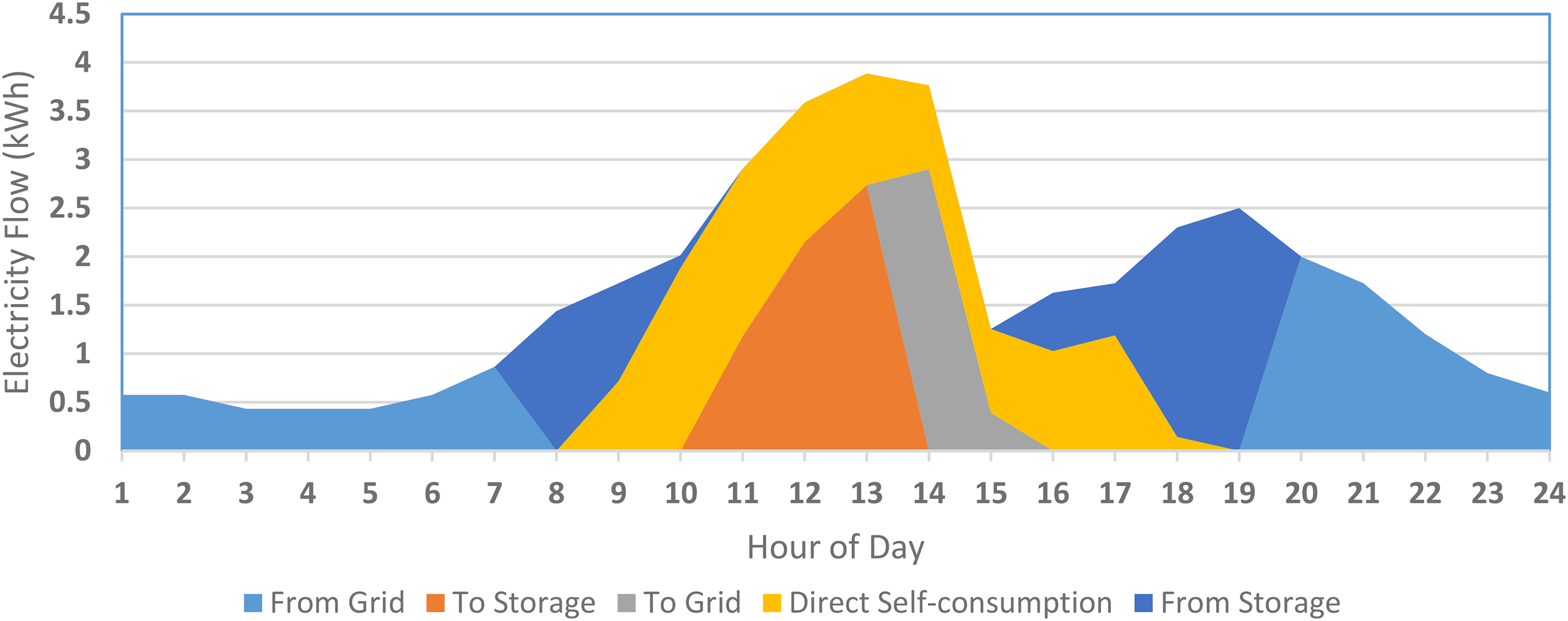
Self-consumption module.
Figure 8 represents also the amount of electrical energy consumed from the grid in case of the PV system and energy storage system is not available or cannot cover the required demand. It also represents a branch of electrical energy supplied by BESS.
Discussion
As shown in Figure 6, the GCR is approximately 1.1 which means that the PV system in scenario 1 (S1) generates more energy than the load demand over the year and there is surplus energy exported to the grid (Figure 6). Also includes the GCR at each optimum size. As can be seen under S1 scenario which is at 0 USD/kWh wholesale price, the optimum size of PV system is 5.5 kWp and optimum BESS is 14kWh. The selection is based on best NPV. Table 4 shows that PI for scenario 1 (S1) is 0.3 which means BESS investment is profitable even the NPV is limited regarding to other scenarios. In fact, this is reasonable result as S1 assumes 0 USD/kWh wholesale price which corresponds to no income from exporting energy to grid. In scenario 2 which is at 0.0661 USD/kWh wholesale price, the optimum size of PV system is 6.5 kWp and optimum BESS is 10 kWh. GCR is 1.3 which means that the PV system in S2 generates more excess energy greater than S1. As shown in Table 4 PI in S2 is −0.5. S2 depends more on PV export as PI for is less than 0. GCR is higher than 1 indicates oversizing the PV to exploit export revenue. As wholesale prices increase, PV systems tend to be oversized (GCR > 1), tending to export over storage. However, this strategy constantly results in negative PI values, showing that battery investments continue financially unviable under high wholesale reimbursement. Table 4 shows that PI in S3, S4, and S5 is undefined because no BESS investment is made which means that BESS is economically acceptable under the specified conditions in those scenarios.
Figure 7 indicates that S1 is the most effective in terms of PV energy utilization. It is a good indication of a better matching between generation and consumption because of efficient battery usage or load shifting. SSR at Scenario 3 is 0.47 which is the highest between all scenarios. This indicates that in S3 a largest share of the load demand with solar is obtained, while it wastes a more share of its PV (low SCR).
This frequently happens when the PV system is oversized (high GCR), providing more energy than desired. S2 and S4 have reasonable SCR and fairly high SSR, signifying they yield more than they can consume directly, depending less on storage and more on export. S5 balances both SCR and SSR well, attaining an SCR of 0.38 and an SSR of 0.45. This proposes a comparatively well-sized system where PV generation is neither extremely exported nor insufficient to meet household demand, reflecting a good compromise between energy efficiency and self-sufficiency. It is expected from Figure 8 that when electrical energy demand throughout the day can be provided by the simultaneous electrical energy generated by PV system, the household consumes its own demand as seen in Figure 8 (direct self-consumption). If electrical energy generated by PV system exceeds the house demand, electrical energy is either deposited for future consumption or wholesaled to the electrical network if the BESS is full.
Sensitivity analysis
The sensitivity investigation, led by changing the solar energy system cost by ±25% whereas holding the BESS capacity constant, reveals distinct patterns across the examined scenarios. In Figure 9, the optimal PV capacity illustrates little sensitivity in Scenarios S1 (from 5 to 6.5 kWp). By contrast, Scenarios S2–S3 remain insensitive to PV cost fluctuations, maintaining optimal capacities. This indicates that in these scenarios the sizing decision is primarily constrained by policy limitations, grid export restrictions, or the intrinsic mismatch between solar generation and household load, rather than by investment cost. S3 and S4 show modest sensitivity to the PV-BESS cost.
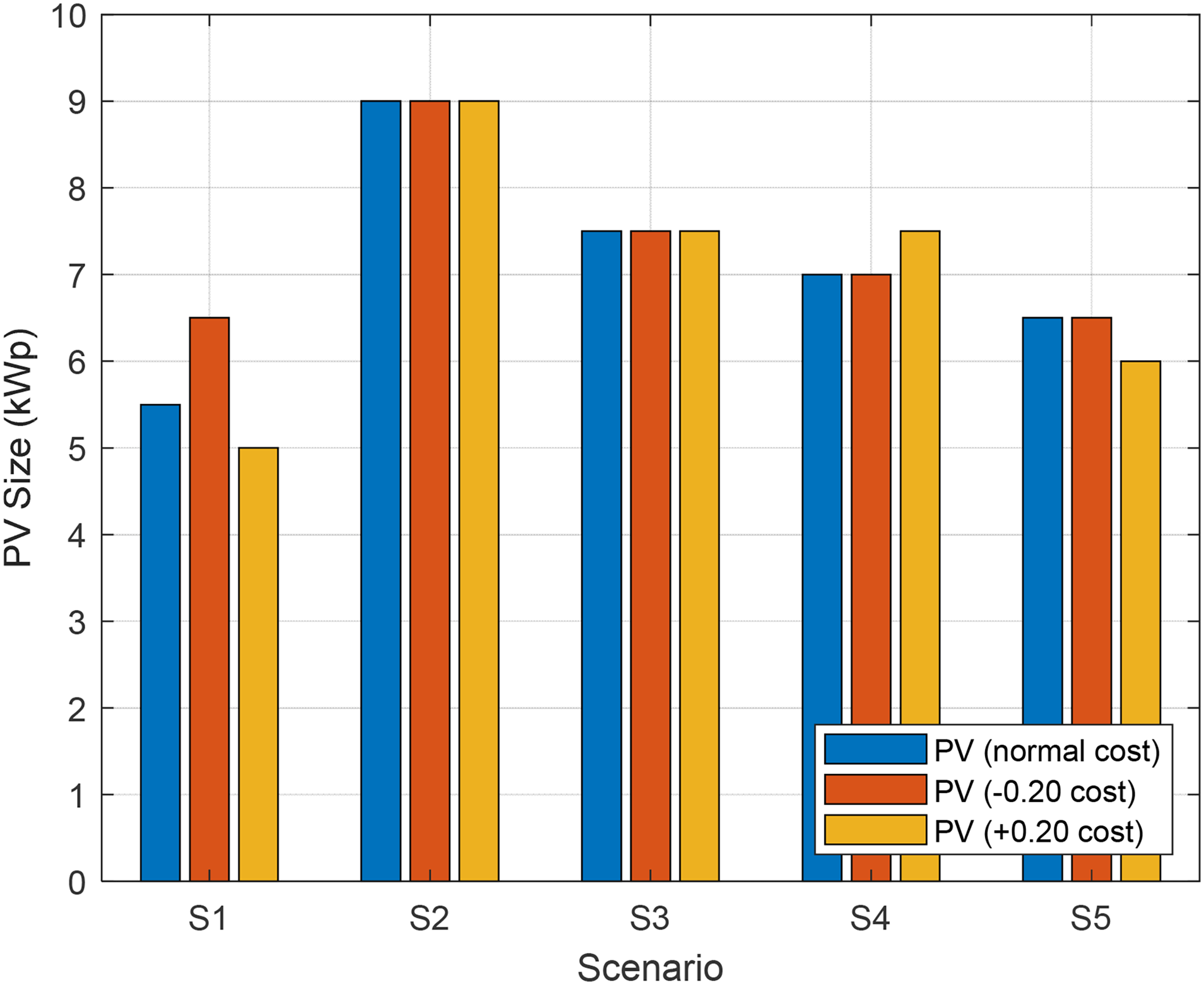
Sensitivity analysis of the system cost on optimal PV capacity.
Sensitivity analysis of the system cost on optimal PV capacity, SCR, SSR, and PI
The performance indicators further support this understanding. In Figure 10, the SCR differs only slightly (0.25–0.44), while Figure 11 shows that SSR remains approximately persistent (0.44–0.47) across all cost cases except S1 more precisely at 20% reduction in the cost. This persistence emphasizes the main role of load profile and export limitations in determining system efficiency.
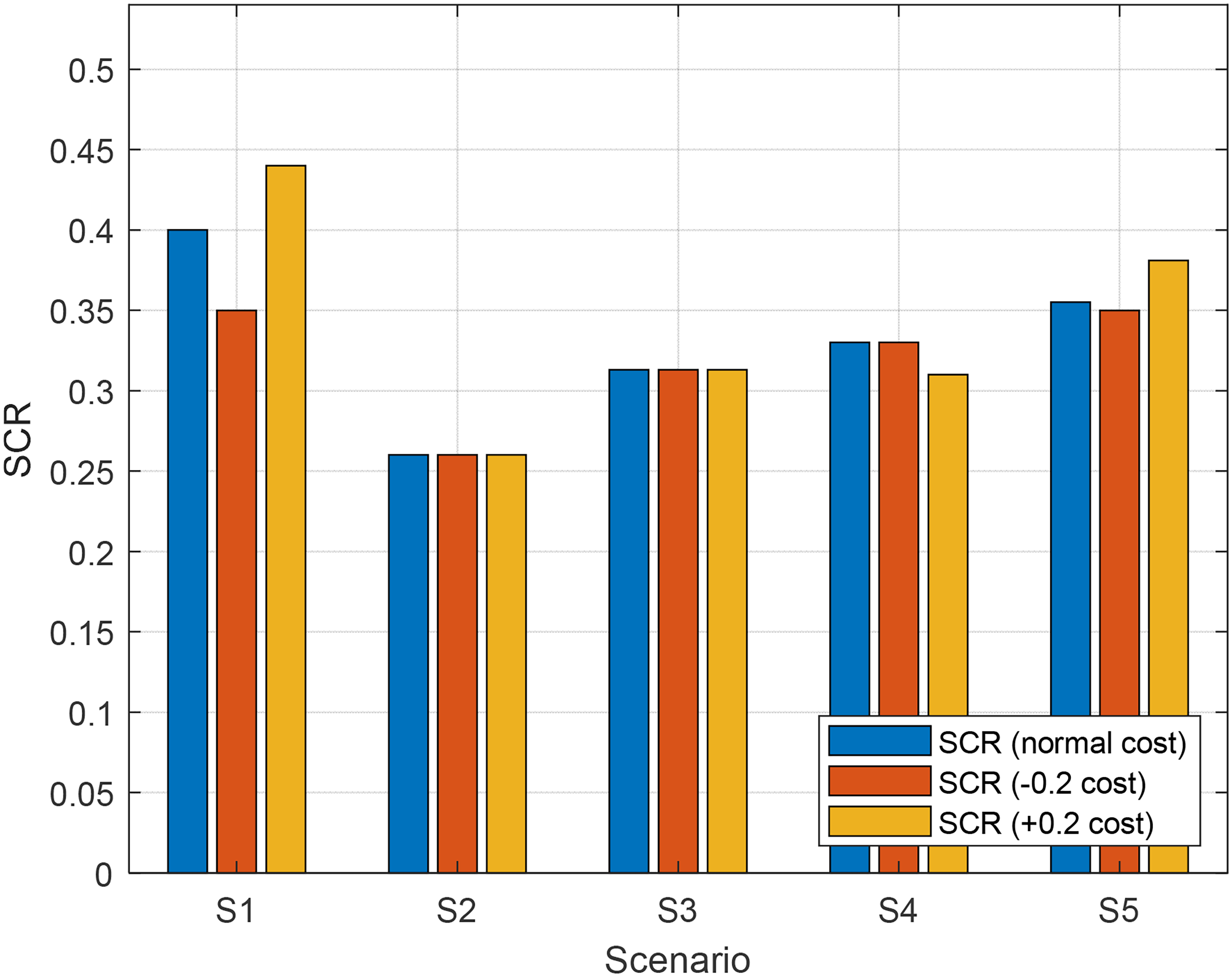
Sensitivity analysis of PV–BESS system cost on SCR.
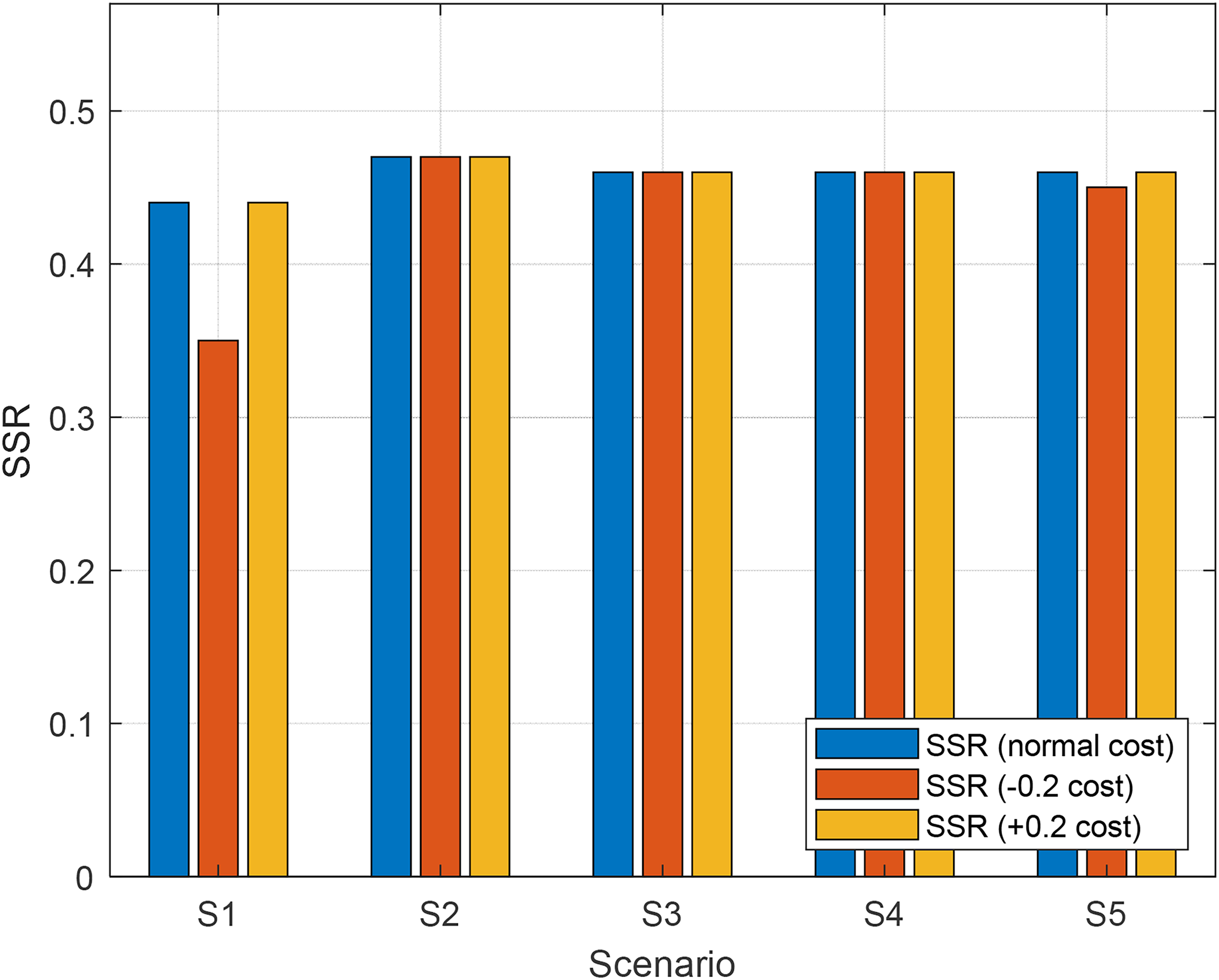
Sensitivity analysis of PV–BESS system cost on SSR.
Figure 12 shows that the PI proves prominent sensitivity in Scenarios S1. However, in Scenarios S2–S5 the PI remains insistently negative, irrespective of cost difference, reflecting the restricted economic value of storage when larger PV capacities are already installed and export compensation is constrained.
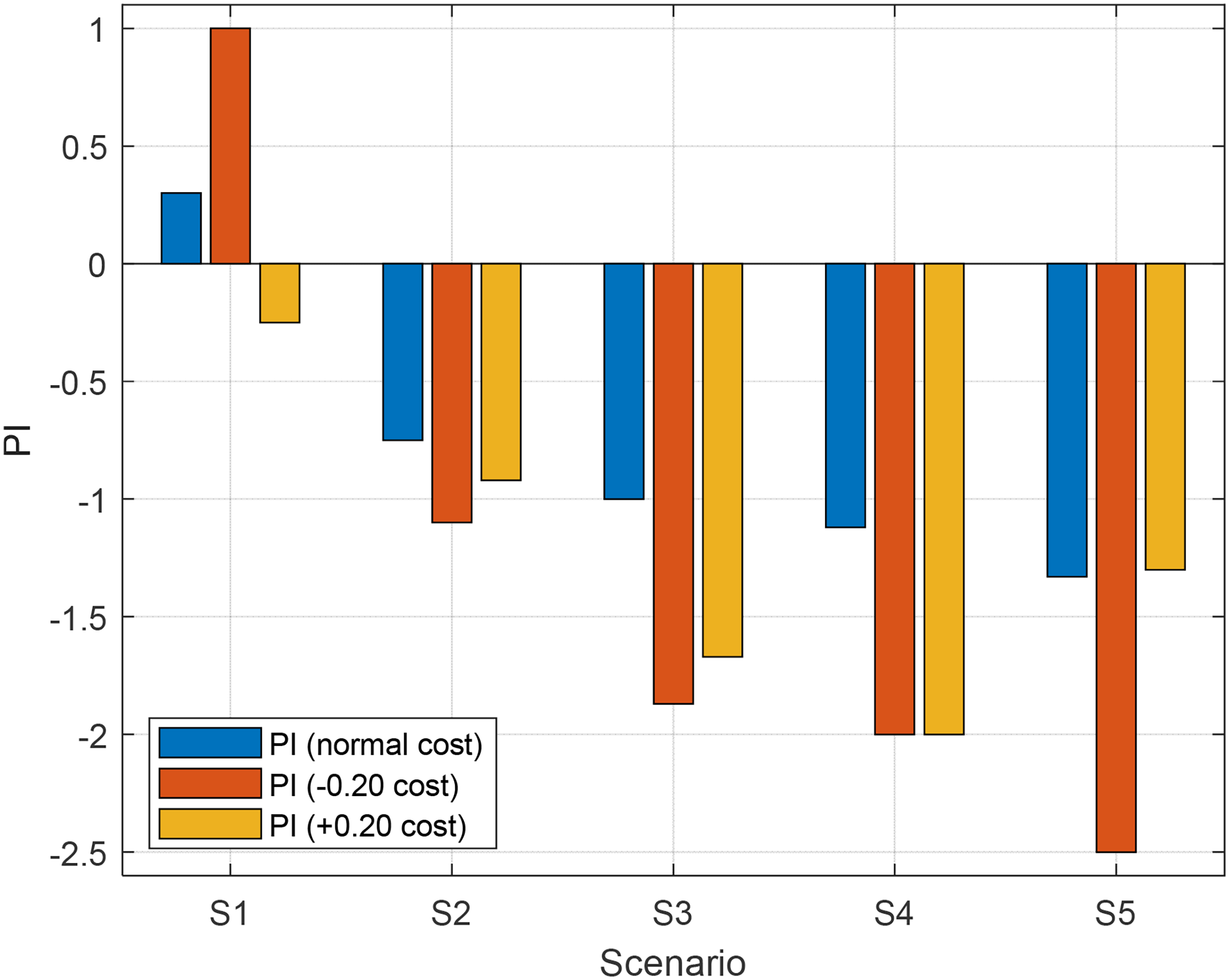
Sensitivity analysis of PV–BESS system cost on PI.
The steadiness of the optimum BESS size across all scenarios strengthens the conclusion that battery sizing is ruled more by tariff constructions, round-trip efficiency, and sundown load coverage than by solar system cost. In general, these results propose that in the Palestinian situation, discounts in solar system cost improve system profitability mainly in low-export settings, while scenarios with higher export limits are strongminded more by regulatory and technical constraints than by hardware price variations.
A time-of-use (TOU)-based arbitrage is not presently allowed for residential users in Palestine, the outcomes propose that time-dependent assessing could improve the economic viability of BESS and may signify a future policy opportunity. TOU is currently applied for some governorate in Palestine from Mega scale power stations. Seasonal effects were indirectly taken through the usage of hourly annual data, which reproduces truthful differences in irradiance and residential demand across the year. It is good practice to mention that Palestine profits from comparatively high and steady annual solar irradiation, with inadequate interannual inconsistency. In fact, the peak shaving is not considered in this study as present regulatory limitations bound grid-interactive BESS process, reducing the application of peak-oriented dispatch. For these reasons, the investigation emphases on self-consumption and load-shifting strategies. The depth-of-discharge (DoD) is adjusted in this study between 70 and 85% and BESS efficiency is adjusted between 85 and 95%. It becomes clear that DoD and BESS efficiency impact the actual energy available for load fluctuating but do not change the fundamental dispatch considered in this study. The outcomes show that changing DoD and efficiency slightly lesser SSR and SCR, the optimum PV and BESS sizing and global scenario position persist unaffected. This approves that the key results of the study are vigorous compared to rational differences in BESS technical expectations.
Conclusion
The wholesale price powerfully affects the residential PV system sizing. As a wholesale price increases the PV capacities increases with lesser or no BESS, though lower wholesale prices boost BESS integration to increase SCR. The PI declines as wholesale price rises, since BESS become less economically justified when export is compensated. The peak PI values happened under zero-compensation scenarios, where storage offsets grid imports.
The SSR and SCR exhibit a trade-off, high SSR recovers energy autonomy but often coincides with lower SCR due to PV oversizing and excess export; high SCR improves PV utilization efficiency but relies more on grid imports. The GCR is greater than 1 in most scenarios, approving PV oversizing to allow export under promising tariffs.
Under present PT policy of low or zero export compensation, PV-BESS configurations with higher SCR provide better technical and economic outcomes, dropping exported energy and supporting electrical network stability.
The sensitivity investigation, in which solar system costs were wide-ranging by ±20%, confirmed that optimal PV volumes are temperately affected in scenarios with restricted export value (S1), but persist unaffected in scenarios dominated by strategy and technical restraints (S2–S5). Indicators such as SCR and SSR were mainly steady across cost variations, whereas PI presented robust sensitivity to PV cost in S1 but continued insistently negative in S2–S5. Prominently, the optimal BESS size did not differ across any of the sensitivity cases, settling that battery sizing is strongminded mainly by tariff construction, load shifting potential, and export boundaries rather than by solar system cost.
The outcomes of this study reveal that the financial and operative value of residential BES is powerfully affected by tariff strategy and export reimbursement. Under present limitations and inadequate export payment, BES mainly increases self-consumption and decreases electric need rather than producing direct income. Representatives and regulators in energy sector may consequently consider reviewing export compensation structures or presenting modified tariffs to recover the economic viability of residential BES while modifying power quality. Such actions could back higher dissemination of PV systems without imposing extra technical cargos on Discos. Another limitation of the study is the cost analysis is based on combined unit cost such as per kilowatt and kilowatt-hour and does not include detailed analysis and system configuration such as inverter-topology, PV array and connection, etc. This is inconsistent with the scope of this analysis.
This research is subject to numerous restrictions that should be taken into consideration when understanding and discussing the outcomes of the study. First, the load profile used in this study is demonstrated based on typical household consumption designs and accessible statistical data not direct measurements. Although the assumed profile replicates common daily and seasonal usage features, it may not detect all differences in inhabitant behavior. Second, the solar radiation profile is created based on illustrative irradiance data and does not consider short-term weather inconsistency or extreme cases. Third, BES degradation is represented using a simplified linear approximation. In addition, the analysis assumes fixed tariff structures and does not clearly model thorough distribution network limitations such as voltage limits or transformer loading. These limitations are not likely to change the proportional valuation across scenarios.
Footnotes
List of abbreviations
Acknowledgments
None.

Ethical approval
None.
Funding
The authors received no financial support for the research, authorship, and/or publication of this article.
Declaration of conflicting interests
The authors declared no potential conflicts of interest with respect to the research, authorship, and/or publication of this article.