




Abstract
In order to reduce energy waste caused by insufficient absorption capacity, improve the stability and reliability of the wind and solar energy storage system, reduce power costs, reduce greenhouse gas emissions, and enhance environmental benefits. A new optimization method for vanadium redox batteries that considers the wind and solar absorptive capacity is studied. The outputs of the wind worm wheel, photovoltaic, and new vanadium redox batteries in the wind–solar vanadium redox battery are calculated and analyzed. Based on the calculation results, the wind light memory capacity majorization arrange blueprint is constructed, and the impersonal ability of the blueprint is to determine the maximum total consumption of recyclable energy, the highest energy utilization efficiency, the minimum cycle energy of energy memory battery and the minimum cycle fever memory of fever memory tank, and the minimum amount of wind and light discarded. After the relevant constraints are designed, the upgraded quantum particle flock majorization arithmetic is used to solve the impersonal ability to obtain the arrange majorization results of the new vanadium redox battery. The test results show that after the majorization of energy memory arrange by this method, the maximum values of distributed generation absorption ratio, load peak valley difference degree, and load fluctuation degree are 0.74, 0.15, and 0.17, respectively; energy utilization efficiency reaches 75.5%; the change of the state of condition of the vanadium redox battery is relatively gentle, and the fluctuation range is between 0% and 60%; the effective wind and solar absorptive capacity of each node is above 11 GW/h.
Keywords
Introduction
Renewable energy sources such as wind energy and solar energy are intermittent and fluctuating. For example, solar power generation depends on sunshine conditions, and the power generation will drop significantly in cloudy days, nights, and other periods (Abbassi et al., 2022; Geleta and Manshahia, 2022). Wind power generation is affected by the change of wind speed, and when the wind is unstable, the power generation will also fluctuate. This instability brings challenges to the stable operation of power system, leading to the instability of power supply and affecting power quality (Cao et al., 2022). By studying the optimization method of new energy storage system configuration, we can better store redundant electric energy, release it when renewable energy is insufficient, smooth power fluctuation, and improve the stability and reliability of power system (Amorosi et al., 2022; Subramanian and Jayaparvathy, 2021). This is of great significance for optimizing the configuration of new energy storage system, improving the power grid's ability to accept, configure, and regulate clean energy, and at the same time, it is of great significance for reducing the waste of new energy, reducing the dependence on fossil energy power generation, saving energy costs for users and promoting high-quality energy development.
In reference (Abbassi et al., 2022), to realize the effective management of the vanadium redox battery, the alternation Fourier transform is used to analyze the scatter of the capacity exchanged by the memory elements to build the management impersonal ability of the vanadium redox battery. Considering the authority loss probability, the scale of the recyclable vanadium redox battery is optimized to upgrade the dependability of the capacity memory arrangement. However, in the application process, this method can decrease the cost of authority generation but cannot effectively upgrade the exploitation rate of recyclable capacity. To realize the arrangement majorization of the vanadium redox battery, the literature (Hajiaghasi et al., 2021) transfers the difference between the authority generation and load expense to the rate field. After the cutoff rate is determined, the optimized cost impersonal ability, alternation Fourier transform, and particle flock majorization arithmetic are obtained to achieve the definitive size majorization of the vanadium redox battery. However, in the application process, this method can decrease the arrange cost of the vanadium redox battery but has a low ability to upgrade the absorptive capacity of recyclable capacity. In Bhayo et al. (2022), to achieve capacity memory majorization fully considers the unsteady recyclable capacity, configures the vanadium redox battery, and uses particle flock majorization arithmetic to obtain the definitive arrange size to decrease the arrange cost of the vanadium redox battery. However, this method cannot decrease the amount of wind and light abandoned by recyclable capacity in the application process. In order to improve the reliability and security under seasonal uncertainty, reference Ebeed et al. (2023b) proposed the best integration scheme of PVs based on inverter and inherent DSTATCOM function, through the extensive evaluation of reliability performance indicators, including load-oriented and user-oriented reliability indicators. Monte Carlo simulation and scenario reduction methods are used to predict the random behaviors of different sources of uncertainty. The IEEE 33-node test network verifies the superiority of the proposed method by considering different seasonal loads. In addition, the installation of protection device and the influence of linear failure rate of feeder on reliability index are discussed. However, this method only focuses on the improvement of reliability and safety indicators and cannot effectively improve the utilization rate of recyclable capacity. An improved Jellyfish Search Optimizer (EJSO) was proposed in Ahmed et al. (2024) to solve the EM problem of 85-node MMGS system, so as to minimize the total cost and improve the system performance. This algorithm is based on Weibull flight motion and fitness distance balance to solve the stagnation problem of traditional JSO technology. The results show that the EM solution of the algorithm can reduce the cost and improve the voltage distribution and stability of the system. However, there is no research on reducing wind and solar energy waste and optimizing the performance of energy storage batteries, which makes the utilization rate of recoverable capacity low. An improved Capuchin search algorithm is proposed in reference Ebeed et al. (2023a) and applied to the energy management of MMGs. Three strategies are used to enhance the search ability and optimize the function multi-objective, which are verified by standard tests. When applied to IEEE 33 and 69 node mmg, the cost and VD sum can be reduced. However, the comprehensive optimization of key indicators such as the consumption ratio of distributed generation and the peak valley difference of load is not considered, which leads to the inability to effectively improve the utilization rate of recoverable capacity.
However, the above methods still have some limitations and cannot effectively improve the utilization rate of renewable energy. A new optimization method for vanadium redox batteries considering wind and solar absorption capacity needs to be studied, in order to ensure the determined utilization rate of vanadium redox batteries, improve the wind and solar energy consumption capacity, and reduce the amount of wind and solar waste electricity. This article proposes a new optimization method for vanadium batteries that considers the wind and solar absorption capacity and deeply analyzes the output characteristics of wind turbines, photovoltaics, and new vanadium batteries in wind and solar energy storage systems. Vanadium redox batteries play a role in “peak shaving and valley filling” by storing excess electricity and releasing it during peak electricity demand, enhancing the grid's ability to accept, allocate, and regulate clean energy. The new vanadium redox battery also better coordinates with the recoverable capacity, fully considering the solar energy capacity absorption ability (Zou et al., 2022), and solves the problems caused by the intermittency and fluctuation of solar energy capacity and electricity. It can absorb this reverse power at low loads and release power capacity at peak loads (Alizadeh Zolbin et al., 2022), which is an effective means to increase the proportion of new capacity consumption in decentralized power grids. To this end, this article constructs an optimized configuration scheme for wind and solar energy storage capacity through calculation results, with the objective functions of determining the maximum total consumption of recyclable energy, the highest energy utilization efficiency, the minimum cycle energy of energy storage batteries, the minimum cycle heat storage of thermal storage tanks, and the minimum amount of wind and solar waste electricity and designing relevant constraint conditions. Using an improved quantum particle swarm optimization algorithm to solve the objective function, the optimized configuration results of a new vanadium battery are obtained.
This article chooses an improved quantum particle swarm optimization algorithm to solve optimization problems, which upgrades the traditional particle swarm optimization algorithm from the perspective of quantum mechanics. By optimizing the particle inertia weights and introducing the Pareto dominance principle to ensure particle diversity, the algorithm's global search capability and solution accuracy have been improved. In the process of solving, it is possible to more effectively find the optimal vanadium battery configuration scheme that satisfies multiple constraint conditions, overcoming the limitation of traditional optimization algorithms that are prone to getting stuck in local optimal solutions when dealing with complex multi-objective optimization problems.
In the current era of rapid development of new energy, the volatility and uncertainty of wind and solar power generation pose many challenges to the stable operation of the power system. Although research has explored the management and layout optimization of vanadium redox batteries, there are still issues such as insufficient consideration of wind and solar absorption capacity, limited improvement in renewable energy utilization, serious wind and solar power abandonment, and difficulty in balancing the cost and performance of energy storage system layout. Therefore, how to optimize the configuration of energy storage systems, improve energy utilization efficiency, and reduce wind and solar power waste while fully considering the characteristics of wind and solar power generation has become a key issue that urgently needs to be addressed in the field of new energy. This article aims to propose a new optimization method to effectively address the above challenges and promote the further development of new energy storage technology by optimizing the layout of new vanadium redox batteries.
Considering the majorization of the arrange of new capacity memory channels such as custom and solar capacity expense capacity
Analysis of the operation properties of custom authority and memory combined generation channel
In the paper, so as to study the majorization of the arrange of the new vanadium redox battery considering the ability of custom and light expense, it is essential to fully analyze the operating properties of the custom and light memory combined authority generation channel under the consideration of the custom and light expense, based on the custom authority and photovoltaic authority in the authority generation channel, as well as the prosecuting and disprosecuting properties of the new vanadium redox battery (Helist et al., 2021), and analyze the new vanadium redox battery for the custom and light hybrid authority generation capacity of the expense. The custom and light memory joint authority generation channel as a whole contains three parts, for photovoltaic authority generation, custom authority generation, and the new vanadium redox battery, in which the new vanadium redox battery is a combination of batteries and supercapacitors to form, so as to meet the custom and light complementary authority generation when the custom and light expense capacity needs (Mohandes et al., 2021). The architecture of custom and solar vanadium redox batteries is shown in Figure 1.
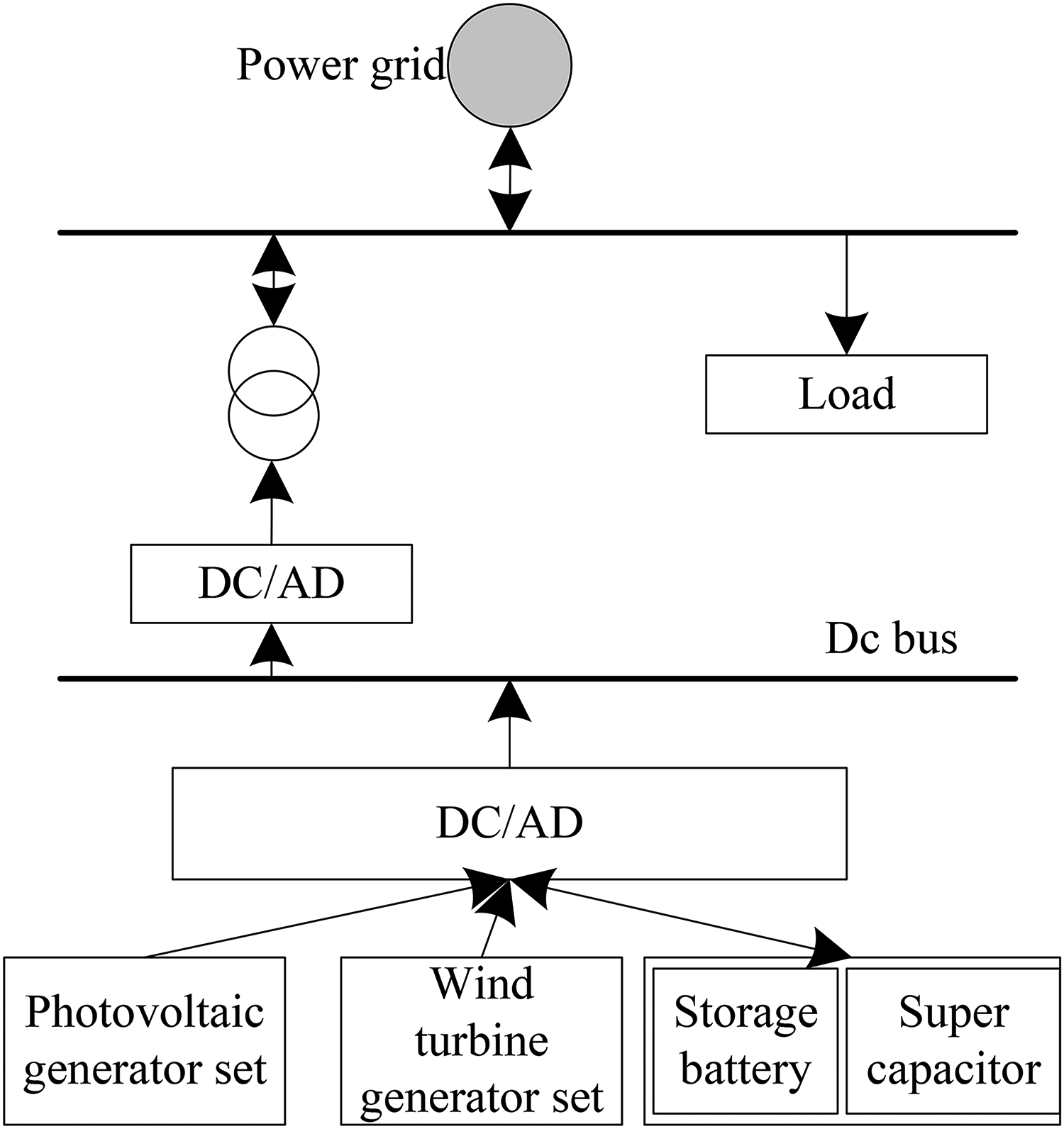
Structure of custom solar vanadium redox battery.
According to the architecture in Figure 1, in the custom solar hybrid authority generation channel, part of the capacity generated is directly converted for the authority supply of the DC bus, and a gross amount of capacity cannot be consumed by the scatter meshwork. This part of the capacity is sent back to the main grid, resulting in capacity waste and affecting the safety and stability of the scatter meshwork operation (Bhol and Sahu, 2021). Therefore, the new vanadium redox battery can absorb this part of the inverted authority when the load is low, convert the capacity into electric capacity for memory, and upgrade the custom and solar capacity absorption capacity. When the load is at a peak, or the electric capacity is released, it has a significant ability to increase the proportion of custom and solar capacity absorption.
If
Photovoltaics
The formula of photovoltaic authority generation

Custom worm wheel authority generation
The formula of custom authority



New capacity memory channels
According to the effective situation, the charging and discharging process voltage is set to be constant, the charging and discharging current is kept constant within one optimized time step (Javed et al., 2021), and the battery performance is not affected by changes in external temperature, humidity, etc., within one scheduling cycle (Shams and Ahmadi, 2021). The calculation formula for both the charging and discharging states is as follows:


Majorization strategy of new vanadium redox battery arrange considering custom and solar capacity expense capacity
Novel vanadium redox battery arrange majorization impersonal ability
Through the analysis of the properties of the custom vanadium redox battery in the above subsection, it can be seen that in the custom capacity memory joint power generation channel, the charging and discharging power of the new vanadium redox battery is the sum of the power generated by the combination of the custom power and photovoltaic power. Therefore, the new vanadium redox battery enhances the consumption capacity of custom power by balancing the custom power and photovoltaic power (Emrani et al., 2022). In this study, to ensure the best photovoltaic expense capacity, from the comprehensive expense of custom authority, photovoltaic authority as a focus (Dhar and Chakraborty, 2021; Kumar et al., 2022; Sirjani and Ahmad, 2021), considering the capacity memory and custom authority, photovoltaic authority, and capacity memory capacity conversion expense, four new vanadium redox batteries are chosen to arrange the majorization impersonal ability, which are the total amount of solar capacity expense maximize max f1, the most efficient exploit of custom and solar capacity max f2, capacity memory battery cycling capacity and thermal memory tank cycling fever memory capacity minimized min f3, and custom and solar authority generation minimized min f4. The above four impersonal abilities are selected because the exploit efficiency of solar capacity and custom and light abandonment are indicators that indirectly prove the total absorption capacity of solar capacity; the new vanadium redox battery will have some capacity loss and affect the service life of the new vanadium redox battery; therefore, the absorption and memory capacity of the new vanadium redox battery also directly affects the absorption capacity of the landscape capacity. Therefore, to ensure absorption capacity, a new vanadium redox battery is lost during solar capacity conversion. Therefore, the circulating quantity of the capacity memory battery and circulating fever memory index of the fever memory tank are designed. The calculation formulas for the four impersonal abilities are as follows:




Constraints
Determining the new vanadium redox battery arrange majorization impersonal ability, so as to ensure the best sub-custom and solar capacity expense capacity, the corresponding constraints need to be set. The paper combined with the consideration of photovoltaic capacity of the new vanadium redox battery arranges majorization impersonal ability, mainly from the custom pile machine capacity, custom authority expense, new vanadium redox battery charging and discharging situation and the state of condition, and photovoltaic capacity expense of the memory channel for the constraints on the several aspects of constraints, the details of which are as follows.
(1) Custom and solar installed capacity allocation constraints
If the capacity of a custom worm wheel pile machine significantly exceeds the authority demand and the conversion capacity of the vanadium redox battery, there will still be a gross amount of light and air discards, which will not achieve the better goal of custom worm wheel expense. Therefore, it is essential to restrict the arrangement of custom worm wheel installed capacity, whose formula is as follows:


(2) Custom authority expense constraints
Considering that the custom authority expense ability is the core of this study to realize the majorization of the new vanadium redox battery decoration, it is essential to constrain the custom authority expense ability, which is formulated as follows:


(3) Constraints related to new capacity memory channels
The premise of new vanadium redox batteries is to enhance the custom authority expense capacity and to realize the conversion of custom authority capacity under the condition of ensuring the practical life of the new vanadium redox battery. Therefore, the constraints related to the new vanadium redox battery are listed as follows: the number of times of charging and discharging, the state of the vanadium redox battery constraints, the constraints related to the residual capacity memory capacity, and the constraints related to the state of the condition of the capacity memory. The constraint formulas of the three aspects are described in the following order: (15), (16), and (17).



(4) To ensure the consumption capacity of the customs authority, it is necessary to fully consider the impact of the customs authority's consumption demand and its own charge - discharge power on the charge - discharge power of the energy storage. Therefore, two constraints are designed: one related to the charge - discharge power of the energy storage considering the customs authority's consumption demand, and the other related to the charge - discharge power of the energy storage considering its own charge - discharge power.


Impersonal ability solving
First, it is essential to collect historical data of custom authority generation and photovoltaic authority generation, including output authority, custom speed, and light intensity. The data will be used to analyze the volatility of the new capacity absorption capacity and predict future capacity generation. Next, the custom authority channel, photovoltaic authority generation channel, and new capacity memory channels (such as batteries and fever memory tanks) are blueprinted. The blueprint of each component should consider its physical properties, operating parameters, and performance indicators. For example, the blueprint of a custom authority channel may include fan authority curves and mechanical transmission efficiency. The blueprint of photovoltaic authority generation channel may involve the conversion efficiency of solar panels, the temperature effect, etc. The blueprint of the vanadium redox battery needs to consider elements such as the condition, discharge efficiency, capacity density, and cycle life. Blueprints of custom authority and photovoltaic authority generation are integrated, taking into account the complementarity and volatility between them. Through the prediction blueprint, the future generation of custom capacity is estimated, and the arrangement and scheduling strategy of the vanadium redox battery is optimized based on this information. Based on the above component blueprint and the prediction of custom solar absorption capacity, the custom solar capacity memory majorization arrangement blueprint is established. The impersonal ability of the blueprint is to maximize the cost of recyclable capacity, upgrade the efficiency of capacity exploitation, and minimize the recycling capacity and custom waste of the vanadium redox battery. The constraints may include the capacity limit of the vanadium redox battery, the condition and discharge rate limit, and the operation safety constraint. Upgraded quantum granule flock majorization arithmetic or other majorization arithmetic methods are used to solve the definitive arrange blueprint. These arithmetic methods find the vanadium redox battery arrangement scheme that satisfies the constraint conditions and optimizes the impersonal ability through iterative search. After completing the impersonal ability solving based on the above subsection, the weights of each impersonal ability are calculated using the adaptive deviation ranking method, and the aggregated impersonal ability F is constructed. Upgraded quantum granule flock arithmetic is used to solve the problem, and each granule corresponds to a feasible solution. The search space of the granule is the possible solution space, that is, the possible solution space of the impersonal ability.
Based on traditional granule flock majorization arithmetic, the upgraded quantum granule flock majorization arithmetic is upgraded from the perspective of quantum mechanics, and the inertia weight of granules is optimized. At the same time, the Pareto dominance principle is introduced to ensure the diversity of granules to form the upgraded quantum granule flock majorization arithmetic. In the solution process of this arithmetic, there is no certain trajectory and speed when the granules move, and the state of the granules is determined by the wave ability γ(x, t). The probability density of granules appearing at a certain point in space is represented by the square of ability. The probability density ability of granules appearing at a certain point in space is obtained by solving the Schrödinger equation. Finally, the position equation formula of the granules is obtained using a Monte Carlo random simulation as follows:


The formula for Γ
id
is as follows:

The value of the parameter β has a direct influence on the global convergence of the arithmetic. In the early stage of global search, its value is larger in favor of global convergence, and when the arithmetic is in the later stage of the search, the parameter needs to be appropriately decreased to ensure the local search ability and upgrade the arithmetic's solving accuracy. Therefore, adaptive adjustment capability is required for β, which is calculated as follows:

Except for the parameter β, the inertia weights w play the role of weighing the local majorization and global majorization and have a greater impact on the convergence performance of the arithmetic. A larger value of w is more favorable for global search and makes the arithmetic converge faster. A smaller value of w is more favorable for local search, which makes the arithmetic converge with higher accuracy; and there is also some implications for the value of w to the adaptive tuning of β. Therefore, to allow the w to balance global and localized search capabilities, as well as the adaptive adjustment ability of β, in this study, the difference between the current position of the granule and the definitive position of the population is selected to guide the w values, and as the difference changes, the value of w taken is adjusted accordingly. If the ith granule, at the kth iteration, the difference from the global definitive position of the population is

The inertial weight of the ith granule at the kth iteration is calculated as follows:

In the process of solving the impersonal ability, since the impersonal ability is a multi-impersonal aggregation ability, it belongs to multi-impersonal comprehensive solution. Therefore, to ensure the dependability of solving the impersonal ability, the Pareto dominance principle is introduced to obtain the Pareto solution generated by granules with nondominance relationships. To maintain the diversity of Pareto solutions, it is essential to compare the advantages and disadvantages of each granule in a solution. The crowding distance represents the density between each granule and the adjacent granules in the Pareto solution, which represents the uniformity of the granule scatter. The crowding distance of granule xi is calculated using the following formula:

The larger the crowding distance, the thinner is the scatter of the solutions. After the granule position is updated, the scope of the search solutions increases. The granules in the Pareto solution are sorted according to their crowding distance from gross to small. When updating the granules, one of the top 10% granules is randomly selected as the population definitive solution, and the solution result of the impersonal ability is obtained, that is, the arrange majorization result of the new vanadium redox battery considering the custom and solar absorptive capacity. The entire solution process is shown in Figure 2.
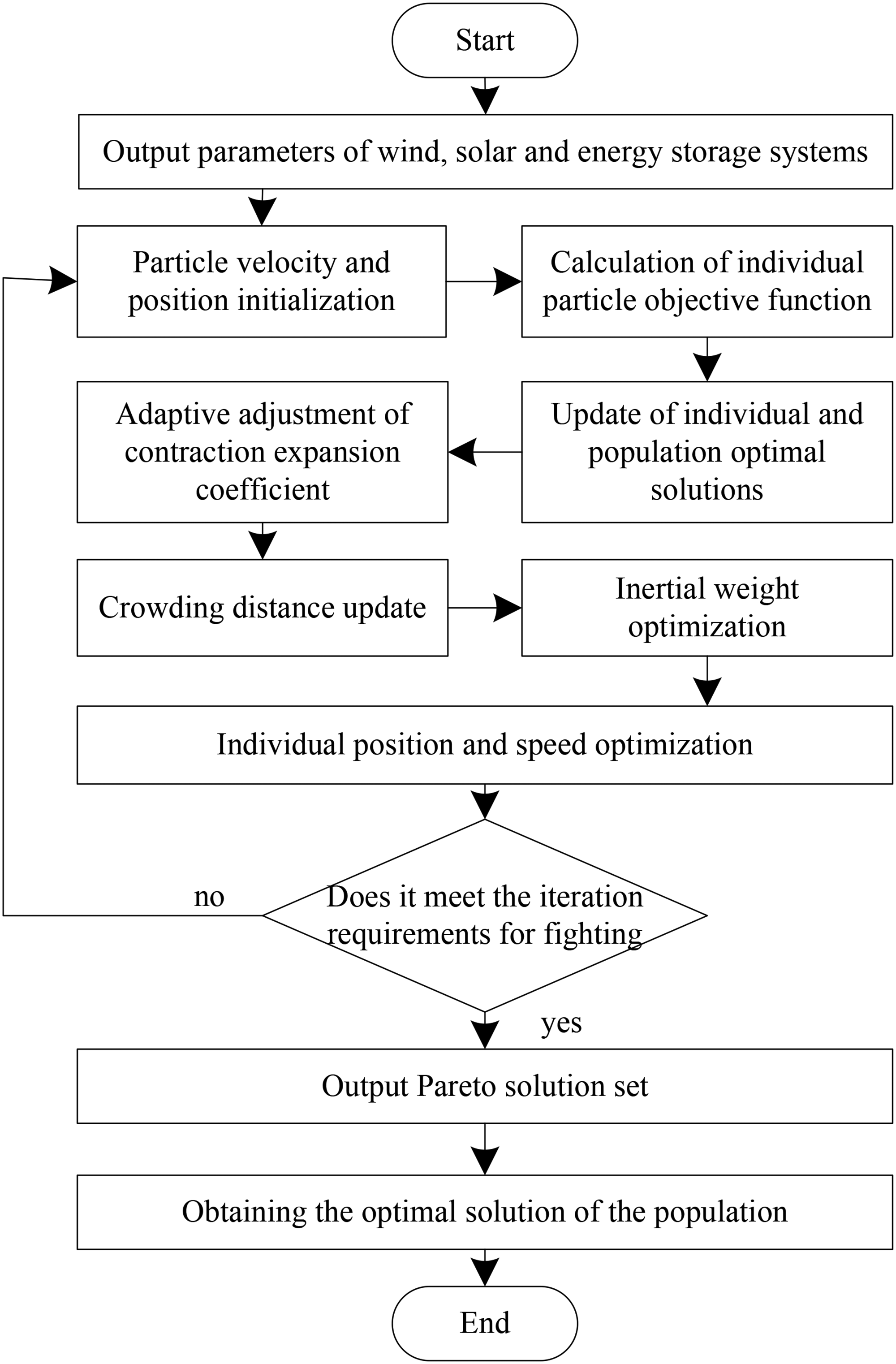
Impersonal ability solving process based on upgraded quantum granule flock majorization arithmetic.
Analysis of results
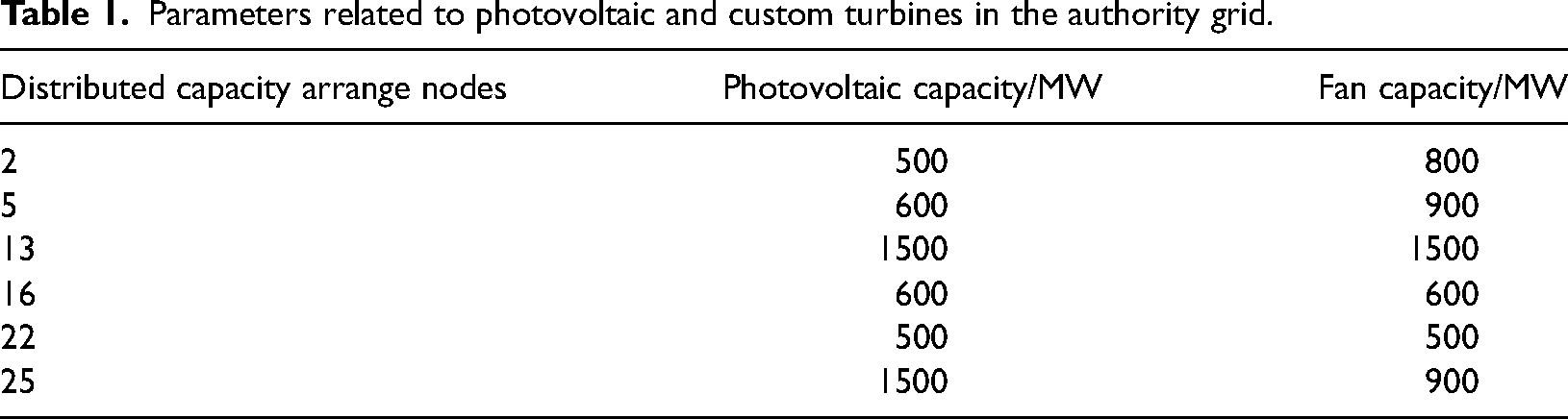
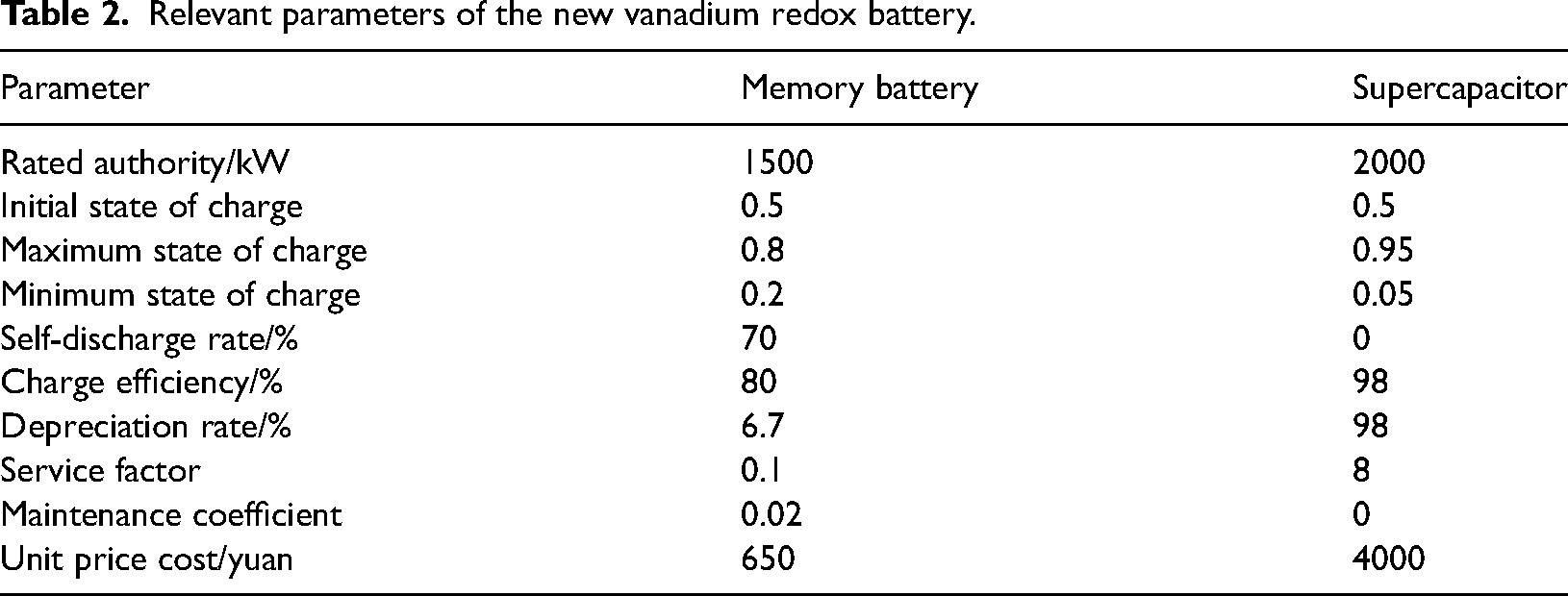
The method proposed in this paper is used in a 30-node grid architecture, which is connected to the PV and custom worm wheel, and a new vanadium redox battery (supercapacitor + battery) is installed at Figure 3; the access point of the PV and the custom worm wheel in the authority grid are shown in Table 1; the architecture of the new vanadium redox battery are shown in Table 2.
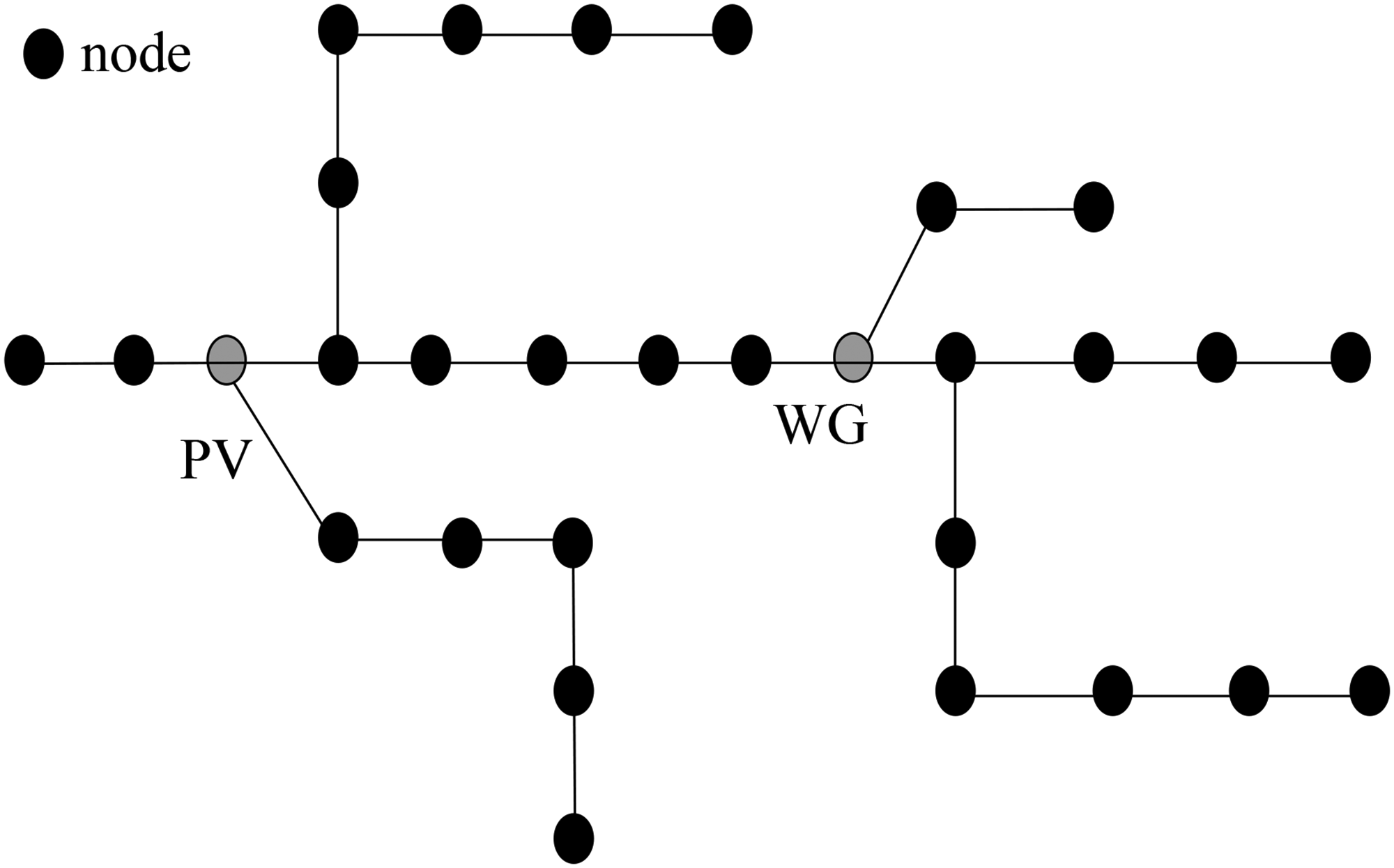
Test grid architecture.
Parameters related to photovoltaic and custom turbines in the authority grid.
Relevant parameters of the new vanadium redox battery.
So as to verify the application effect of the method proposed in the paper, the proportion of distributed authority expense 


Based on the above equations, it is calculated that after optimizing the arrange of the vanadium redox battery under different custom authority, the results of the tests
Test results of distributed authority generation expense ratio, load peak valley difference degree, and load fluctuation degree.
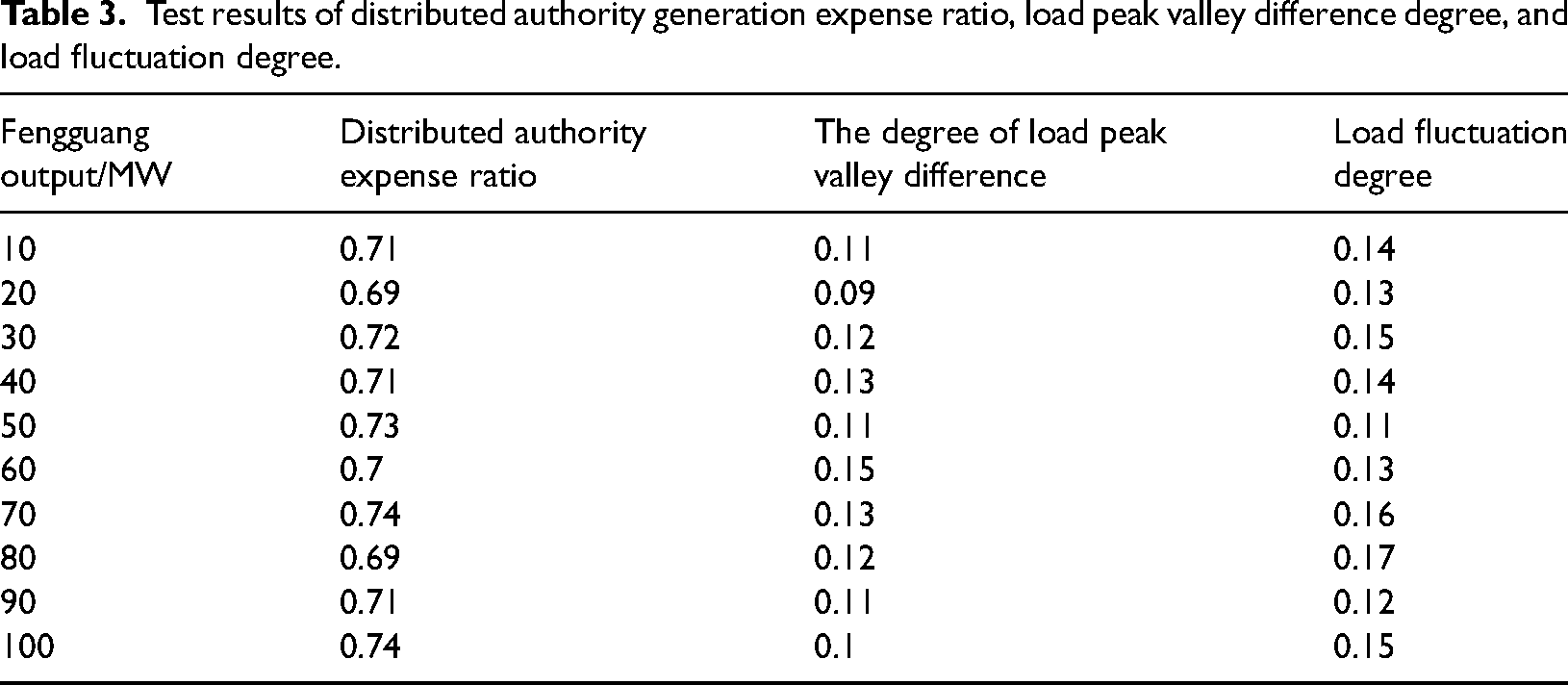
After analyzing the test results in Table 3, it is concluded that, under different custom authority, after optimizing the arrange of the vanadium redox battery by using the method in the paper, the maximum values of the test results
To verify the application effect of the method proposed in the study, a grid with different degrees of custom and light authority fluctuation ratio, using the method in the paper for the majorization of the vanadium redox battery arrange, to obtain the majorization before and after the amount of custom and light abandonment as well as the results of the capacity efficiency, the test results are shown in Table 4.
Test results of custom and light abandonment and capacity exploit efficiency.
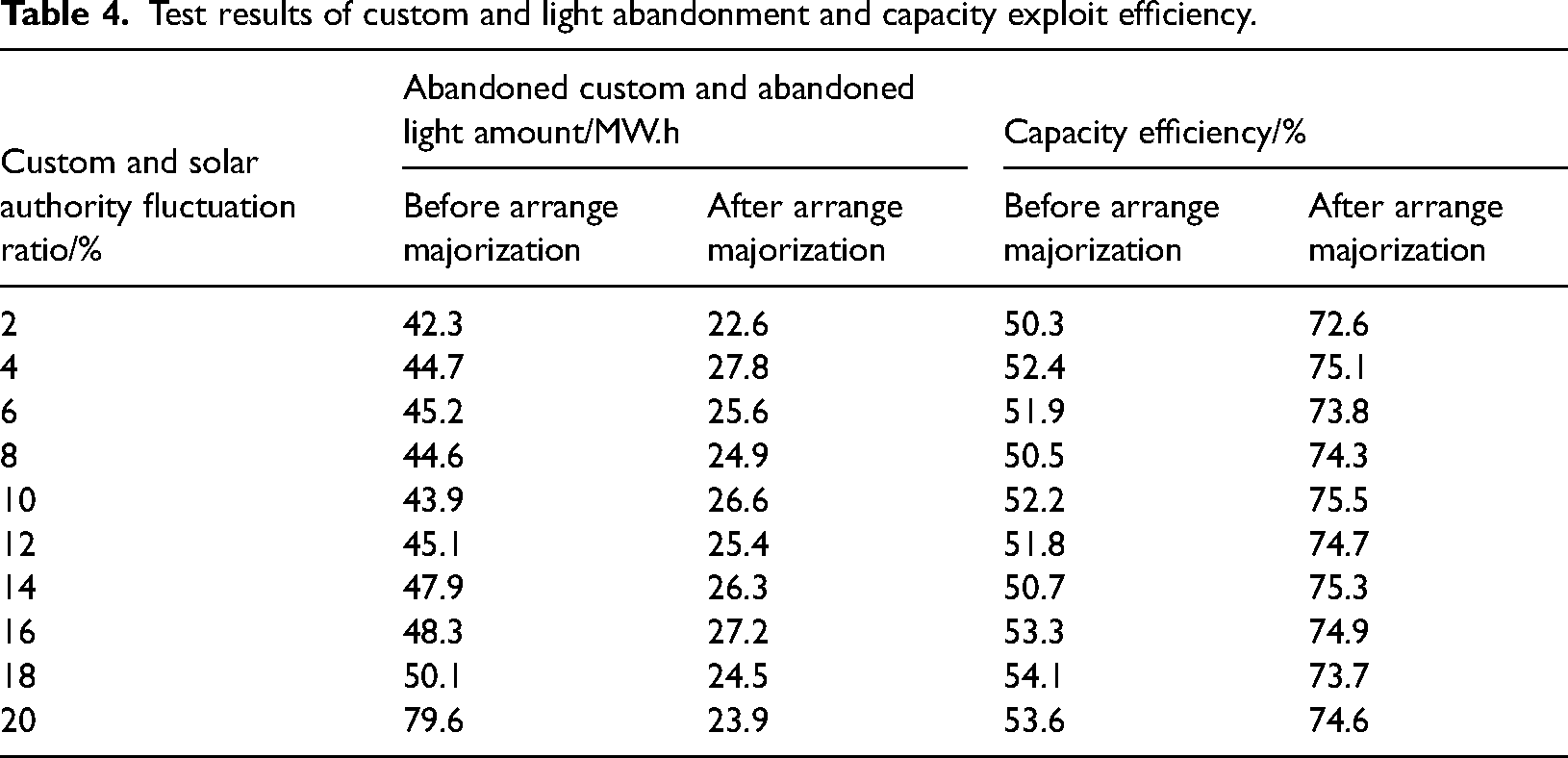
Based on the analysis of the test results in Table 4, it is concluded that with the gradual increase of the proportion of custom and solar authority fluctuations, the amount of custom and light discarded is significantly decreased after the majorization of the vanadium redox battery arrange using the method in the article, and the application effect is significant compared with the amount of custom and light discarded before the application of the method in the article, and the capacity exploit efficiency has been significantly upgraded, with the maximum exploit efficiency reaching 75.5%. Therefore, the method in this paper has a good application effect, which can decrease the amount of custom and light abandonment and upgrade capacity exploitation efficiency.
So as to verify the application effect of the method proposed in the paper, the method proposed in the paper is used to optimize the arrange of the vanadium redox battery under two operation scenarios, namely, single-scene and multi-scene, and to obtain the results of the changes in the condition state of the vanadium redox battery before and after the majorization of the vanadium redox battery under the two scenarios, which are shown in Figure 4.
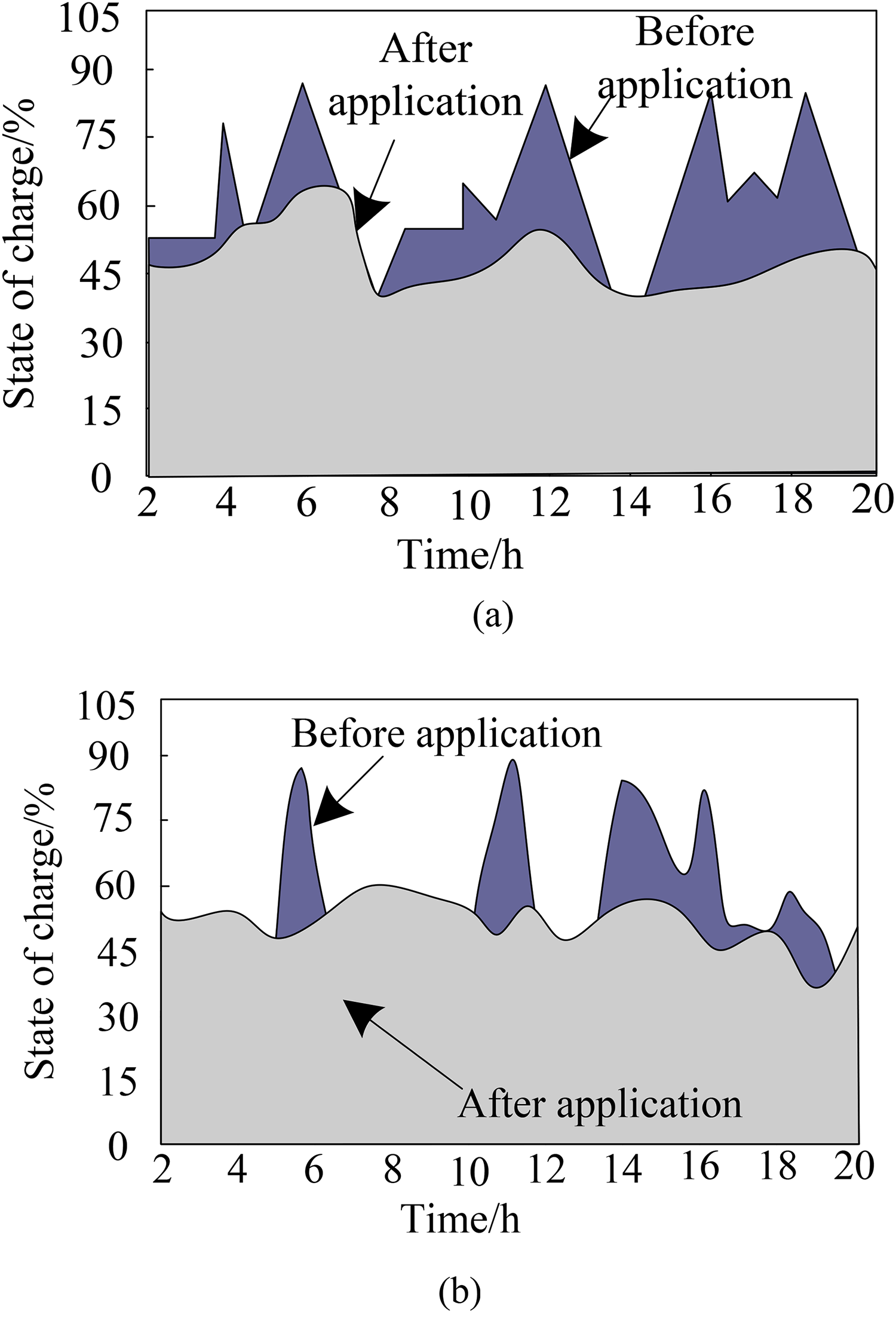
Changes in state of condition of capacity memory channel after arrange majorization. (a) Changes in a single scene. (b) Changes in multiple scenarios.
After analyzing the test results in Figure 4, it is concluded that, under the single scenario and multi-scenario operation scenarios, before the application of the method in this study, the state of condition of the vanadium redox battery changes significantly, with significant fluctuations, ranging from 0% to 90%, after which the change using the method in the state of charge of the vanadium redox battery is relatively gentle, and the fluctuation range is significantly decreased, between 0% and 60%. Therefore, the proposed method has good application potential and can decrease the degree of charge change in vanadium redox batteries.
In order to further verify the applicability of the method proposed in this paper, the methods in References Abbassi et al. (2022), Hajiaghasi et al. (2021), and Bhayo et al. (2022) were used for comparison. The effective consumption results of the new capacity at each node in the grid for the method proposed in this paper and the three comparison methods were obtained respectively. These results were used to measure the consumption capabilities of the four methods, and the test results are shown in Table 5. Due to the limited space, the results are only presented randomly for 10 nodes.
Test results of custom and solar effective absorption capacity for four methods(gw/h).
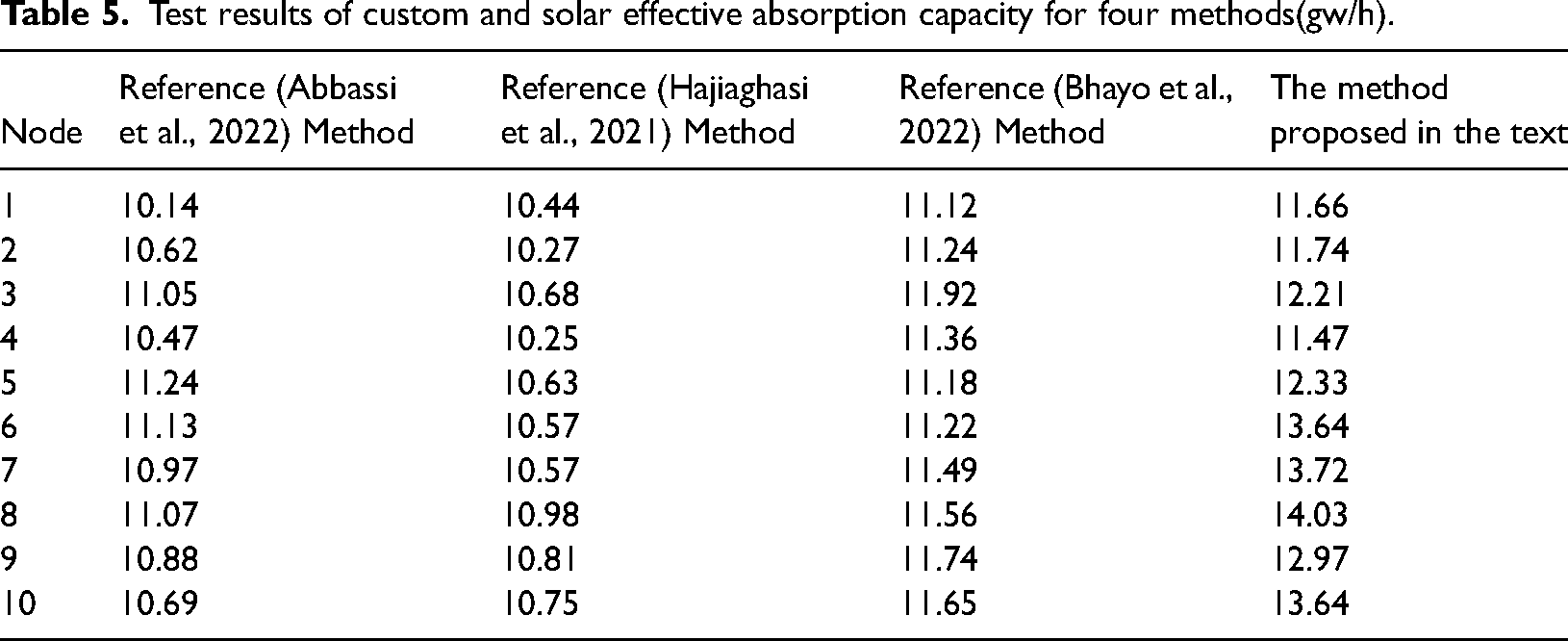
After analyzing the test results in Table 5, it is concluded that after the majorization of the vanadium redox battery arrange using the three methods of literature Abbassi et al. (2022), literature Hajiaghasi et al. (2021), and literature Bhayo et al. (2022), the custom and solar effective absorptive capacity of each node is within the range of 10∼12G W/h, and the maximum absorptive capacity values are 11.24 GW/h, 10.98 GW/h, and 11.92 GW/h, respectively. After the majorization of vanadium redox battery arrange using the method proposed in the study, the custom and solar effective absorptive capacity of each node is above 11 GW/h, of which the maximum value is 14.03 GW/h. Therefore, the method in this paper has better majorization effect of vanadium redox battery arrangement and can better realize custom and solar capacity expense.
Conclusion
In this study, we consider the uncertainty of wind and solar energy. From the perspective of new capacity consumption in the power channel, under the premise of given installed capacities of new wind power, photovoltaic, and energy storage systems, we analyze the outputs of wind power, photovoltaic, and new vanadium redox batteries, as well as their operation conditions. Then, we study the multi - region capacity optimization problem of the wind - solar - storage transmission grid, determine the optimization objectives for the arrangement, and obtain the optimized arrangement results of the new vanadium redox battery through solving the problem. After testing the application effect of the method, it is concluded that the method has a good application effect and can reasonably complete the arrange majorization of the new vanadium redox battery, so as to decrease the amount of custom and light abandonment and enhance the capacity exploitation efficiency and expense capacity. This method is universal for improving the stability and reliability of power systems in different parts of the world. Whether in developed or developing countries, the stable operation of power system is the cornerstone of economic development and normal operation of society. The intermittence and fluctuation of wind–solar power generation pose a challenge to the stable operation of the power system. By optimizing the configuration of vanadium batteries, this method can effectively smooth the output of wind–solar power generation, improve the acceptance of new energy in the power system, and enhance the stability of power supply. This means that in the face of energy demand fluctuations, natural disasters, and other situations, the power system can provide users with sustained and stable power services more reliably, reduce the frequency of power outages, and ensure the normal power demand of various industries and residents around the world.
Footnotes
Data availability statement
The data used to support the findings of this study are available from the corresponding author upon request.
Declaration of conflicting interests
The authors declared no potential conflicts of interest with respect to the research, authorship, and/or publication of this article.
Funding
The authors received no financial support for the research, authorship, and/or publication of this article.
