



Abstract
One of the main sources of crude oil and product losses in refineries is the storage tanks. The lightest hydrocarbons in these tanks evaporate during operation, causing not only a loss of the precious raw hydrocarbon material but also a source of dangerous gas pollution. For calculating these losses, several direct and indirect approaches have been devised. In this study, we used a method based on the comparison of the differences in the characteristics of crude oil or other products. This work aimed to find the specifications of two products, kerosene and gas oil, and calculate the losses that occur for the quantities in the dispatch warehouse in the NRC. Four samples of kerosene were used and named: kero@02-1, kero@05-2, kero@10-3, and kero@11-4, while four samples of gas oil were named: gaso@02-1, gaso@05-2, gaso@10-3, and gaso@11-4. Also, they depend on the date of certificate issue, respectively. The received quantities were calculated in ml and converted to cubic meters using the tank coefficient (kerosene tank coefficient 0.638 and gas oil tank coefficient 0.408). Calculations were made of 1500 ml for kerosene and 2500 ml for gas oil. In addition, this project dealt with a simplified method of work that includes the physical properties to find the actual quantities that are lost for the mentioned petroleum products. Moreover, the highest losses were for kerosene (5 m3) at sp. gr 0.750, and the highest losses were for gas oil (5 m3) at sp. gr 0.820. The results showed that there is a quantity of fluctuating losses that does not exceed 5 m3 / 1000 m3 and that these losses are in accordance with the permissible limits. The results recommend directing the laboratory tester's teams in the NRC Baiji to conduct periodic examinations of the petroleum products, as well as not to collusion when receiving a low product with laboratory examination specifications to reduce losses in quantities.
Introduction
Product losses happen during the transport of oil and petroleum products from the production site to the customer. The evaporation of stored raw materials, whose amount is roughly estimated to be 100,000 tons in the Russian Federation in 2018, is what causes losses from the tank during the storage of oil or petroleum products. There are three types of oil and petroleum product losses: natural, operational, and emergency. The suggested approach was created in this study to consider natural losses. Consequently, “working losses” and “standing losses” are two categories for natural losses. “Working losses” are caused by emptying and filling, and “standing losses” are brought on by changes in temperature during the day. Oil and oil products (O&OP) evaporate from reservoirs and causes economic losses, environmental contamination, and a decline in the physical and chemical characteristics of the stored commodity (Glushkov, 2022). Evaporative losses account for more than 50% of operational losses. They can be divided into two categories: qualitative ones brought on by changes in fluid composition and quantitative ones brought on by evaporation. Quantitative losses are often assessed by computation, but qualitative losses need a lab evaluation of the substance's composition (Levitin and Tryascin, 2016).
Kerosene, one of the by-products of petroleum was discovered in 1853 by Abraham Gesner, a British physician. Gesner developed a process to extract the inflammable liquid from asphalt. The term kerosene is derived from the Greek word keros. Kerosene (also known as jet fuel) is a combustible hydrocarbon liquid, widely used to power jet engines of aircrafts, and some rocket engines. It is also commonly used as a cooking and lighting fuel for fire toys. Kerosene lamps are widely used for lighting in rural areas, where electrical distribution is not available or too costly for widespread use. Kerosene, a thin, clear liquid formed from hydrocarbons, with a density of 0.78–0.81 g/cm3, is obtained from the fractional distillation of petroleum between 150 °C and 275 °C, resulting in a mixture of the carbon chains that typically contain between 6 and 16 carbon atoms per molecule (Raipure, 2018). Generally, oil products storage tank has two kinds, fixed roof vertical tank and fixed roof cubical type. A fixed roof tank is usually used when the quantity of the crude oil is not too large. The crude oil storage tanks can be installed inside the building as well as it can be installed in the open (Rutherford et al., 2021). The use of the fossil fuels in various sectors for heat and power generation continues to loom up global stability and sustainability, as well as low specifications in kerosene, gasoline, and diesel. These three fuels are making extra undesirable effects due to the loss in quantities (Ahmedzeki and Ibrahem, 2015).
In this study, the loss in the quantity of kerosene and gas oil products was studied, and it was found that the loss in gasoil product was highest of kerosene during physical properties like; specific gravity (Sp.gr), American Petroleum Institute (API), and distillation. However, the composition of kerosene is very complex. Kerosene is a conventional petroleum-derived jet fuel widely used as a fuel. It's mainly composed of hundreds of hydrocarbons, such as n-alkanes, iso-alkanes, cycloalkane, aromatic hydrocarbons, etc., with an average number of carbon atoms ranging from 10 to 16 (Bai et al., 2021).
The transportation of gas oil (also known as diesel fuel) from storage tanks, pipelines, processing plants, and petroleum transportation facilities is a loss of quantities (Khosravi et al., 2013). The issue of accounting for losses from the evaporation of LFH from the tank persists even though several studies in the oil and gas business have been conducted. For correct computations, different businesses across the country employ various techniques. Due to the fact that the composition of the product varies during evaporation, detailed calculations are required in order to determine the precise residual of the product contained in the tanks (Glushkov, 2022). Physical properties are considered one of the most important factors affecting the losses in quantities of petroleum products in general. By the nature of the work, the oil sector suffers from losing the quantities it loses annually from the transportation, storage, and handling of petroleum products. In particular, the oil depots in Baiji suffer from a loss in quantities and a difference between the quantities received from production and the quantities supplied to consumers through gas stations. The novelty of this study was to determine the percentage of real losses as a function of density for kerosene and gas oil products. The main target of this study is to determine the losses of two important petroleum products (kerosene & gas oil) from fuel storage tanks at the North Refineries Company, Baiji (Al-Irsal Warehouse) by estimating the difference in physical properties of the fuels.
Materials and methods
The source of fuel samples
In this work, the two fuel samples are kerosene and gasoil were presented and taken from the product fuel vertical storage tanks numbered as 3103 – FA for kerosene and 3105 – FA for gas oil from NRC Baiji Al-Irsal Warehouse.
Analytical methodology
There are many techniques for estimating the loss of light hydrocarbon fractions from losses from the tank through the breathing valve, depending on the country and occasionally the company itself [02]. Methods based on comparing the differences in the characteristics of petroleum products are often used which has been depended in this study. In this work, the physical properties of the two white fuel products samples of kerosene and gas oil have been measured to determine the fuel losses based on the fuel quantity received and delivered in vertical tanks to the Baiji refinery, the Al-Irsal Warehouse. Laboratory tests were conducted on petroleum products at the laboratory of the Oil Products Distribution Company, Western Authority, Salahulddin branch. The physical properties of fuel samples have been laboratory tested based on standard methods in literature. For example, the specific gravity (sp.gr) was measured according to ASTM D 4052 (Barbosa et al., 2015), flash point (F.P) according to ASTM D 93 (Abdelkhalik et al., 2018), color according to ASTM D 6045 (Rodriguez et al., 2017), and distillation according to ASTM D86-17 (Jati and Bhikuning, 2022). However, the distillation test included initial boiling point (I.B.P), end boiling point (E.B.P), total distillation (T.D), residue volume ml, and loss volume ml. Moreover, the quantities at NRC are received in ml, then converted into m3 by the volume factor of the tanks according to the design measurements where the modulus of the kerosene tank is 0.638 and the coefficient of the gas oil tank is 0.408.
Results and discussions
Physical properties of kerosene fuel
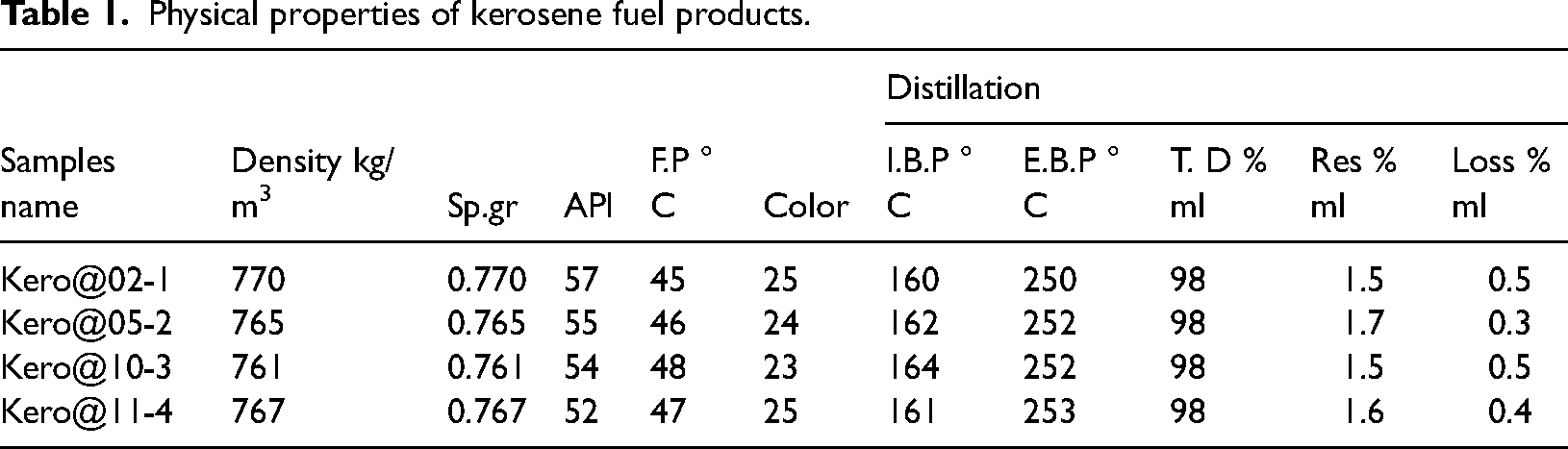
The approach we suggest here is based on the difference in the physical properties of kerosene petroleum product as shown in Table 1. As can be seen from Table 1, the measurements range of these four samples of kerosene were conducted to determine the fuel losses. The main physical properties of kerosene samples that were tested are Sp.gr, API, and distillation. The distillation test included I.B.P, E.B.P, total distillation percentage (T.D %), residue percentage (Res %), and loss percentage (Loss %). It can be seen from results obtained that specific gravity has high changes among the other physical properties: petroleum storage tank operation and maintenance. The capacity of an oil tank depends on the rate of production. The tank's capacity is also influenced by whether it is used for temporary or permanent storage. The past study showed that the range of sp.gr was of 0.750–0.800, API gravity range of 23.15–60 of kerosene (ASTM D-3238) [12]. Figure 1 shows physical properties of kerosene fuel products. However, further information is needed to calculate the oil losses: gross production rate in barrels of fluid per day (BFPD), water cut (WC,%-volume), tank conditions (pressure and temperature), oil specific gravity (SGo), formation water specific gravity (sp.gr), basic sediment and water (BS&W,%-volume), and hydro carbon composition (%-mole) [13].
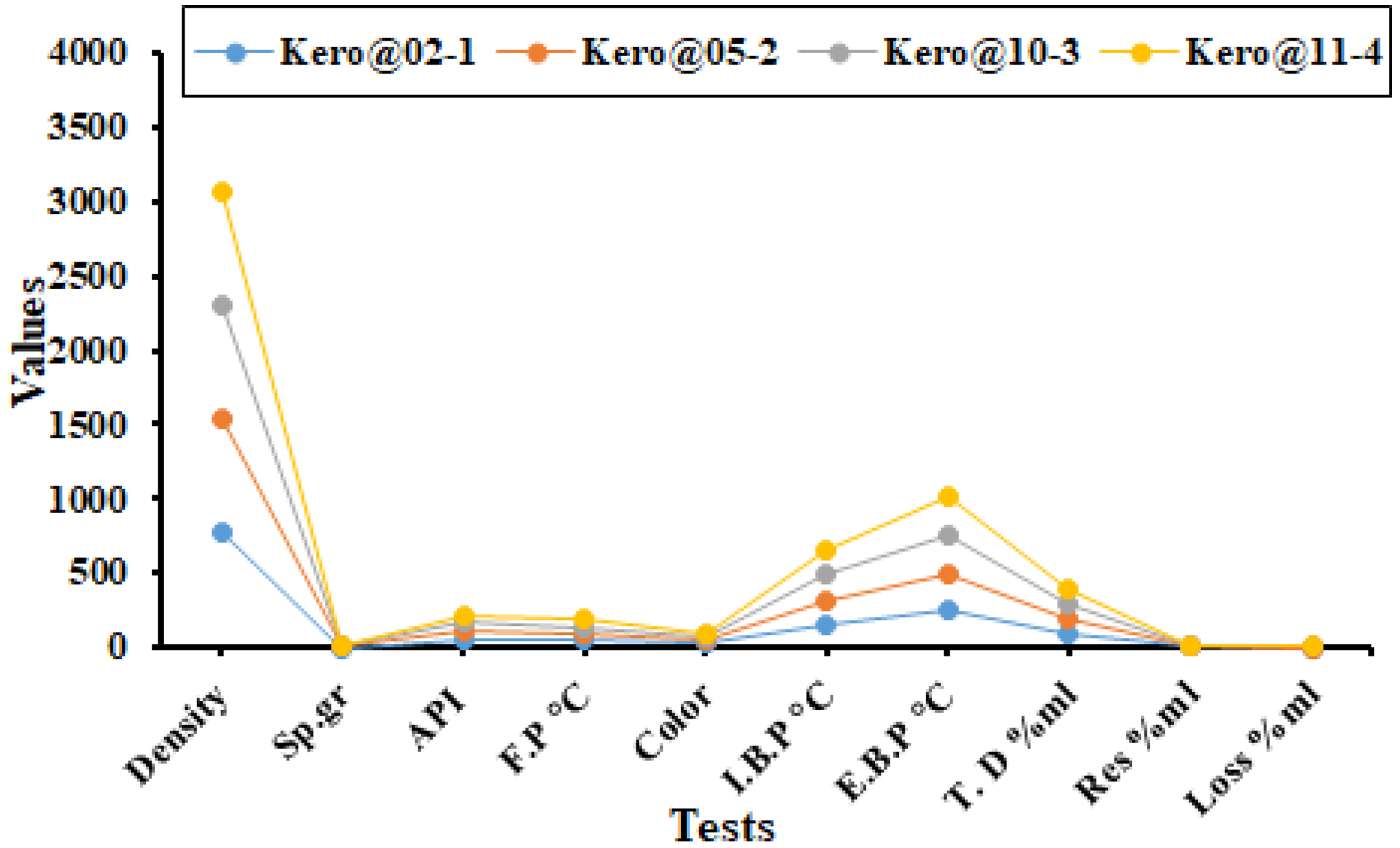
Physical properties of kerosene fuel products.
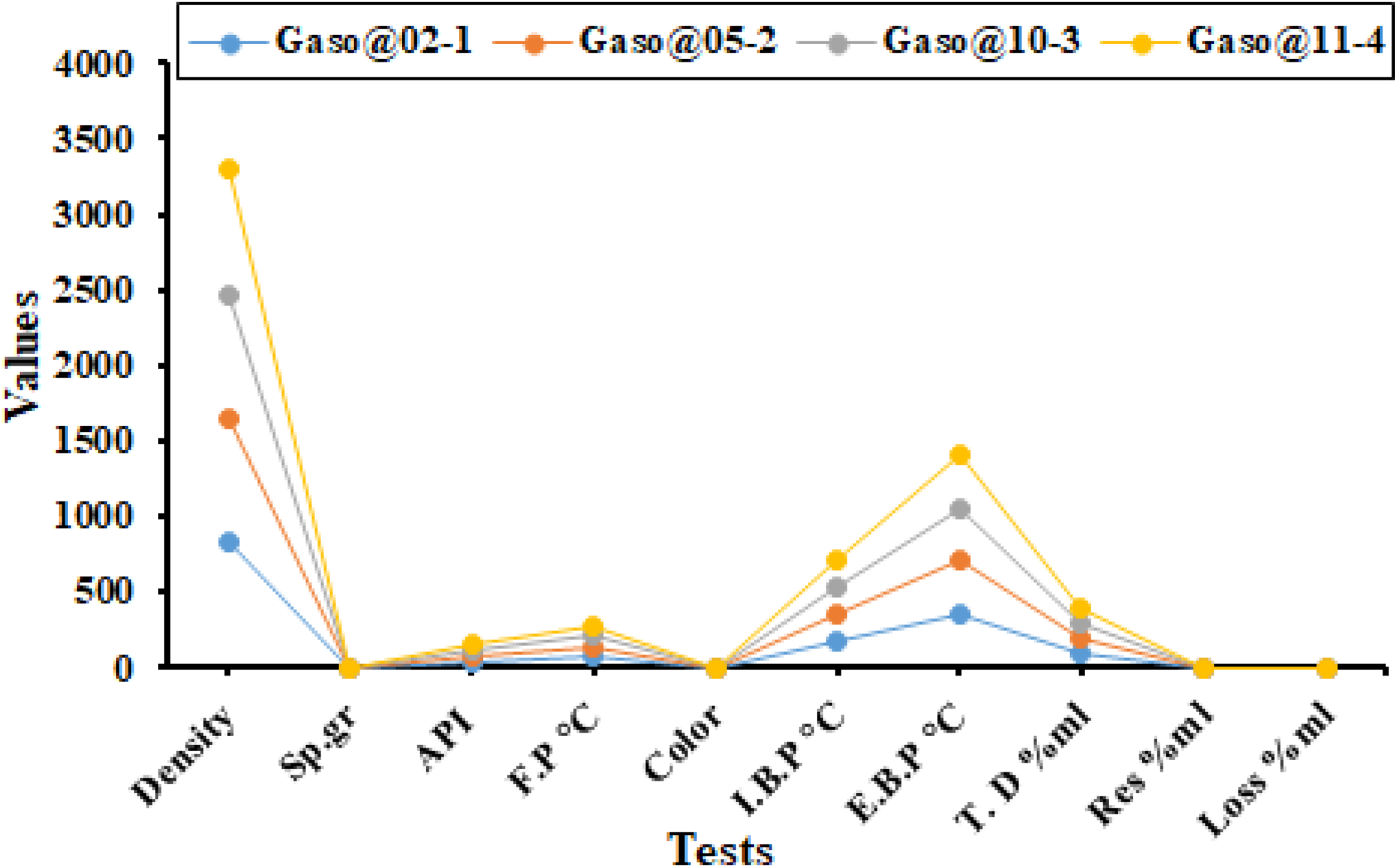
Physical properties of gas oil fuel products.
Physical properties of kerosene fuel products.
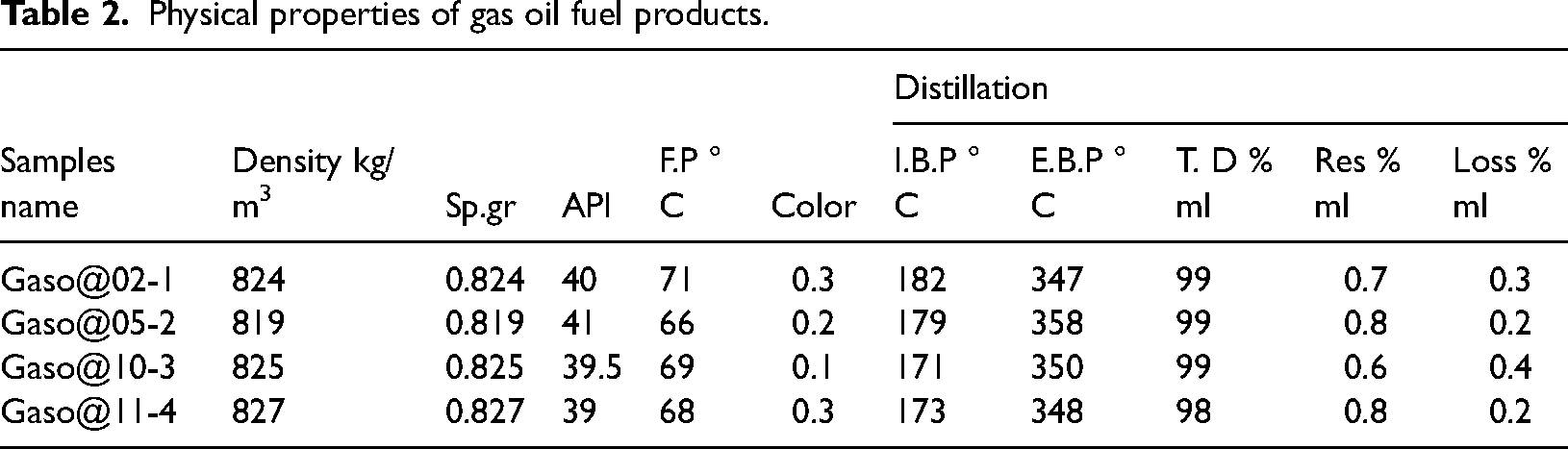
Physical properties of gas oil fuel
The physical properties of gas oil were investigated as in Table 2. This testis included Sp.gr, API, and distillation. The distillation test included I.B.P, E.B.P, T.D %, Res %, and Loss %. The past study showed that the range of sp.gr was of 0.800–0.850, API gravity range of 23.15–60 of gas oil (Laredo et al., 2002). Figure 2 shows physical properties of gas oil fuel products.
Physical properties of gas oil fuel products.
Fuel quantities received and loss
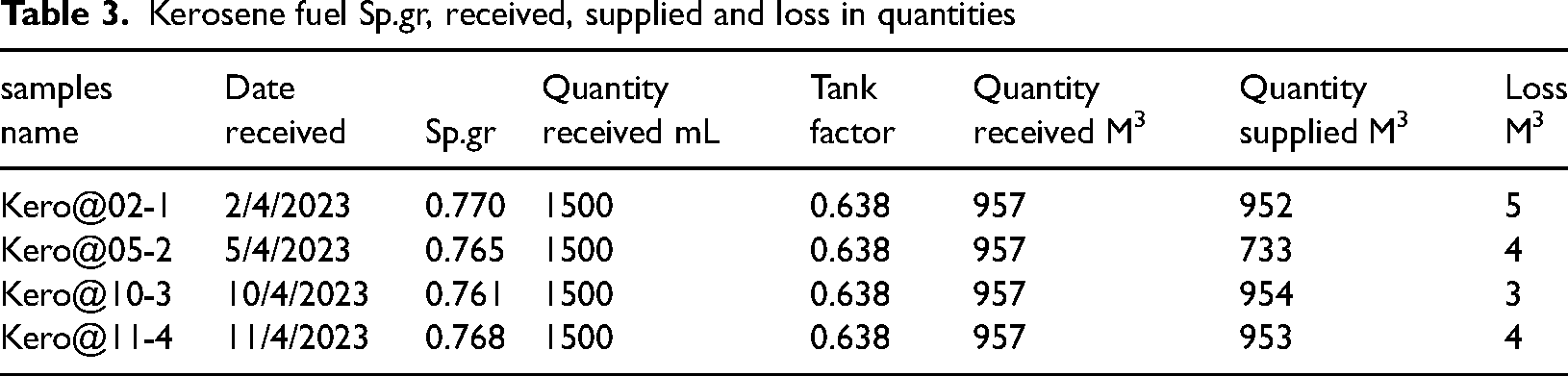
The fuel quantity of kerosene for tank No. 3013-FA was calculated as shown in Table 3, while the gas oil tank No. 3105-FA was calculated as shown in Table 4. The results that showed in Table 3 indicate that the highest volume losses reached 5 m3 because the density was 0.770, which indicates that the highest density loses the largest volume on the date of 2/10/2023 for the test certificate numbered kero@02-1 issued by the laboratories of the Oil Products Distribution Company (OPDC), Western Commission, Salahuddin Branch.
Kerosene fuel Sp.gr, received, supplied and loss in quantities
Gas oil fuel Sp.gr, received, supplied and loss in quantities
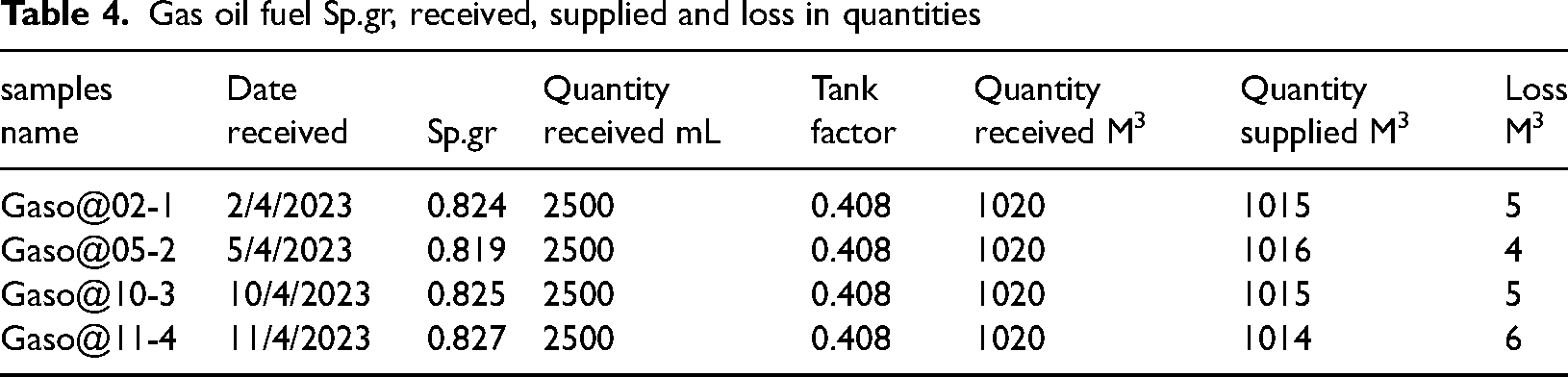
The results in Table 4 show that gas oil properties indicate that the highest volume losses reached 6 m3 because the density was 0.827, which indicates that the highest density loses the largest volume on the date of 11/4/2023 for the examination certificate numbered gaso@11-4 issued by the laboratories of the Oil Products Distribution Company (OPDC), Western Commission, Salahuddin Branch.
Conclusion
The petroleum products that are imported and exported from the fuel storage and distribution facilities are their own asset. Fuel products play a significant role in the energy, aviation, land, maritime, and oil & gas industries. Checking the fuel product losses with such a significant asset value is also quite critical. For this work, the number of losses of petroleum products with their amounts of the received and supplied from vertical fuel storage tanks at NRC Baiji were determined based on the measuring of the change difference in the physical properties received and supplied by kerosene and gas oil. Based on the findings from this study, it can be concluded that the specific gravity or API gravity is a special property that significantly influences group losses of the fuel products. It was found that there were losses in the quantities of the kerosene fuel and gas oil due to the specifications that the oil product is exposed to, and this is normal and there is no significant loss in the quantities. Through the results and laboratory tests dealt with in this study, we recommend the following: direct laboratory departments working on the test of fuel on the need for periodic examinations and not to deviate from low specifications. The need to conduct a periodic on-site inspection by the laboratory testers on the tanks to avoid more loss amount than is allowed because of the low and low specifications less than allowed.
Footnotes
Acknowledgment
The authors would like to thank Mr Sheet Younus Ramadhan, Director of Western Authority Distribution (OPDC). The authors would like to thank the Oil Products Distribution Company (OPDC), Salahuldeen Branch to support this research. The authors would like to express their appreciation to Eng. Adnan A. Khalaf, Deputy Head of Salahuldeen Branch (OPDC). The authors would like to Asco. Prof. Dr Mohamed A. Alrashedi deputy dean of the College of Petroleum and Mining Engineering, University of Mosul.
Declaration of conflicting interests
The author(s) declared no potential conflicts of interest with respect to the research, authorship, and/or publication of this article.
Funding
The author(s) received no financial support for the research, authorship, and/or publication of this article.
