




Abstract
The macroscopic failure of concrete used to form an artificial dam in an underground coal mine reservoir is the final manifestation of crack propagation and penetration: the mode of crack propagation is key to the safety evaluation of concrete structures. To improve the performance of concrete in such an artificial dam forming an underground coal mine reservoir, many scholars have investigated nano-modified concrete, but the effects of nanomaterials on the crack propagation mode and failure mode of saturated concrete are not yet fully understood. In the present research, uniaxial compression and acoustic emission (AE) experiments were conducted on saturated concrete specimens containing different types and amounts of nanomaterials, and the crack propagation mode, failure mode, and bearing capacity of different saturated concrete specimens were compared and studied. The results show that: the failure mode, crack propagation mode, and bearing capacity of saturated concrete can be modified by adding nanomaterials, and the type and content thereof can affect the modification effect provided. Considering the strength, bearing capacity, and crack-propagation mode, saturated concrete specimens containing 3 wt% nano-Al2O3 exhibit the best performance, with characteristics of high strength, high bearing capacity, steady crack propagation, and small-scale cracking. The results have guiding significance for damage-warning and safety assessment of hydraulic structures.
Introduction
Concrete is a heterogeneous composite material composed of cement, water, sand, and aggregate: it is also the most widely used building material. Many microcracks are generated in concrete during hydration and in combination with other fluids in service. Under load, microcracks will gradually nucleate, expand, and penetrate. The final failure of concrete arises from the gradual expansion and penetration of its internal microcracks. The crack propagation of concrete under uniaxial compression can be divided into three stages: crack initiation, stable crack growth, and unstable crack growth. Research into the evolution of concrete crack propagation has guiding significance for the safety assessment of, and damage-warning methods in, many building structures (Zhang et al., 2021).
Many scholars have done a lot of research on crack propagation of concrete materials. For concrete crack initiation, development, expansion,“the rocking spalling test” to investigate the crack-propagation velocity in concrete under dynamic tensile loading (Forquin, 2012); the relationships between crack speed and crack initiation strain rate in ultra-high performance concrete under various rates of loading (Pyo et al., 2016) and the cracking behavior of main cracks and branch cracks of concrete (Zhang et al., 2019) are also studied by scholars. In terms of concrete damage strain, some scholars explored the effect of alkali-resistant short glass fibers on the damage mechanism of glass fiber reinforced concrete under high-speed tensile load (Yao et al., 2015), others proposed a numerical model to simulate crack propagation at concrete matrix-aggregate interface, and studied the influences of side-edge constraint, aggregate direction, and interface fracture energy on the crack propagation behaviors (Wu and Tang, 2019).
With the development of science and technology and the increased range of application of concrete, some properties of ordinary concrete can no longer meet the requirements of construction engineering. One of the ways to improve the performance of concrete is to change the composition of materials. The mechanical properties of concrete can be enhanced by adding additives to concrete (Hakamy et al., 2015; Tian et al., 2015). Nanomaterials are currently at the forefront of material science research. The concrete can be endowed with better properties by mixing nanomaterials as admixtures to concrete materials. In addition to being small, nanomaterials have certain special characteristics, such as high specific surface energy, stability, and so on. Nano-SiO2 is the most widely used nanomaterial. The nano-SiO2 added into concrete can enhance the mechanical properties of the concrete (Nandhini and Ponmalar, 2018; Hosseini et al., 2010), optimize its microstructure and reduce the porosity of the concrete. In addition, nano-SiO2 also has high pozzolanic activity, which can promote the secondary hydration of cement and consume more Ca(OH)2 to form C-S-H gel (Kong et al., 2015; Liu et al., 2018). Moreover, some scholars have conducted research into the improvement caused by adding nano-Al2O3 on concrete performance: nano-Al2O3 can not only act as a filler but also plays a chemical role and accelerate the hydration of cement (Li et al., 2006b; Zhou et al., 2019); nano-Al2O3 can also be used to improve the chloride binding capacity of cement (Yang et al., 2019). Nano-TiO2 also has some excellent properties, such as its antibacterial and self-cleaning nature: the mechanical properties of concrete will be improved by adding nano-SiO2 (Essawy and Aleem, 2014; Zhang et al., 2015). Besides the types of nanomaterials, the amount of nanomaterial added also affects the mechanical properties of concrete. Each nanomaterial has its suitable range of content, and when exceeded, the enhancement effect of nanomaterials on the mechanical properties of concrete will be weakened (Li et al., 2006a; Nazari and Riahi, 2011). Nanomaterials can not only improve the mechanical properties and microstructure of concrete, but also affect crack propagation in concrete. In recent years, there have been some studies on this. Different nano materials modification (including nano-SiO2 and nano-limestone) have different effects on the crack initiation and propagation of nano-particles modified RAC (Li et al., 2017); the mixing method of nano-SiO2 has different effects on the failure process of cement-based materials (Barkoula et al., 2016); the amount of nano-additive TiO2 has a certain internal relationship with the failure process of self-compacting concrete based on granite aggregate (Pawel, 2018).
Acoustic emission (AE) counting supports the study of modes of crack propagation in concrete. AEs see part of the accumulated strain energy in the material released in the form of elastic wave when deformation and failure occur. AE signals in concrete materials come from sliding, deformation, crack propagation, friction effects among crystals, etc. By measuring the characteristic parameters of AEs, the fracture time and mode of failure of concrete can be adjudged (Hu et al., 2011). Therefore, acoustic emission has become an important way to study crack propagation of concrete. In the past few years, acoustic emission monitoring technology has been used to study the influence of fatigue load (Shah and Kishen, 2012), size effect (Alam et al., 2015) and loading rate (Khandelwal and Ranjith, 2017) on crack propagation of concrete.
Concrete has complex properties, and the crack propagation path and type in concrete are affected by various factors simultaneously. For example, the properties of concrete in the dry state and saturated state are quite different. In hydraulic structures such as dams and bridges, when concrete is saturated, the static strength decreases compared with that of dry concrete, but the dynamic strength and modulus of saturated concrete increases (Rossi et al., 1992; Yaman et al., 2002a; Yaman et al., 2002b; Wang and Li, 2007; Wang et al., 2016; Larki et al., 2019). These changes in mechanical properties are bound to cause many changes in the crack propagation mode of saturated concrete under uniaxial compression, however, there is little research on the influence of nanomaterials on the crack propagation of saturated concrete, and especially little research into the influence of different types and contents of nanomaterials on crack propagation in saturated concrete.
To study the effects of different types and contents of nanomaterials on crack propagation in saturated concrete used to form an artificial dam in an underground coal mine reservoir, uniaxial compression experiments and AE monitoring were conducted for different types and contents of saturated nano-additive-dosed concrete, and the effects of different types and contents of nanomaterials on the crack propagation and failure mode of saturated concrete were compared and investigated. In Section 2, several different types of saturated nanomaterial concrete specimens were prepared by adding different amounts of nano-SiO2 (NS), nano-Al2O3 (NA), and nano-TiO2 (NT) to the concrete. In Section 3, uniaxial compression tests and AE monitoring were performed on different types of saturated concrete specimens, and the experimental results are presented. In Section 4, the failure modes and crack-propagation modes of different saturated concrete specimens were explored according to the experimental results. In Section 5, the effects of the different types and amounts of nanomaterials on the bearing capacity of concrete were discussed based on the crack length of the damaged specimens. The effects of the types and contents of nanomaterials on the crack propagation of saturated concrete specimens under uniaxial compression were investigated, and the effects of different types and amounts of nanomaterials on the bearing capacity of saturated concrete specimens were ascertained. The results of this study have guiding significance for the research into nano-modified saturated concrete and damage-warning and safety-assessment systems used on hydraulic structures.
Specimen preparationMaterials
In this study, the materials for making saturated concrete mainly included cement, sand, stone, nanomaterials, and a water-reducing agent. The cement used was P.O42.5 Portland Cement and conforms to Chinese Standard GB175-2007. A river sand was used (sourced from the river around the city), with a yellow surface color, high hardness, intact particles, and good workability. The diameter of gravel as coarse aggregate ranged between 5 mm and 10 mm, with good workability and a high calcium content therein. The water-reducing agent used was a high-range polycarboxylate water reducer, showing good compatibility with the cement and being able to improve the fluidity and strength of the concrete. To compare the effects of different nanomaterials on the mechanical properties of saturated concrete, three types of nanomaterials were used: nano-SiO2, nano-Al2O3, and nano-TiO2.
Mixing method
To evaluate the effects of different contents and types of nanomaterials on the properties of saturated concrete, seven concrete mixes were prepared, with four specimens of each mix cast The first was concrete without nanomaterials, which was made of cement, sand, and gravel in the mass ratio of 1:2:2 (referred to as ordinary saturated concrete in the present study). Then, concrete specimens dosed with 3 wt% nano-SiO2, 6 wt% nano-SiO2, 3 wt% nano-Al2O3, 6 wt% nano-Al2O3, 3 wt% nano-TiO2, and 6 wt% nano-TiO2 were prepared by replacing three types of nanomaterials in the concrete materials. The mass of the nanomaterials was the same as that used with 3 wt% and 6 wt% cement. For all concrete specimens, the water-cement ratio was 0.6, and the mass of sand, gravel, and water-reducer remained constant (Table 1). Here, PC represents the ordinary concrete without added nanomaterials. NSC3 and NSC6 respectively denote the concrete containing 3 wt% and 6 wt% nano-SiO2. NAC3 and NAC6 respectively represent the concrete containing 3 wt% and 6 wt% nano-Al2O3. NTC3 and NTC6 respectively refer to the concrete containing 3 wt% and 6 wt% nano-TiO2.
Mix proportions.
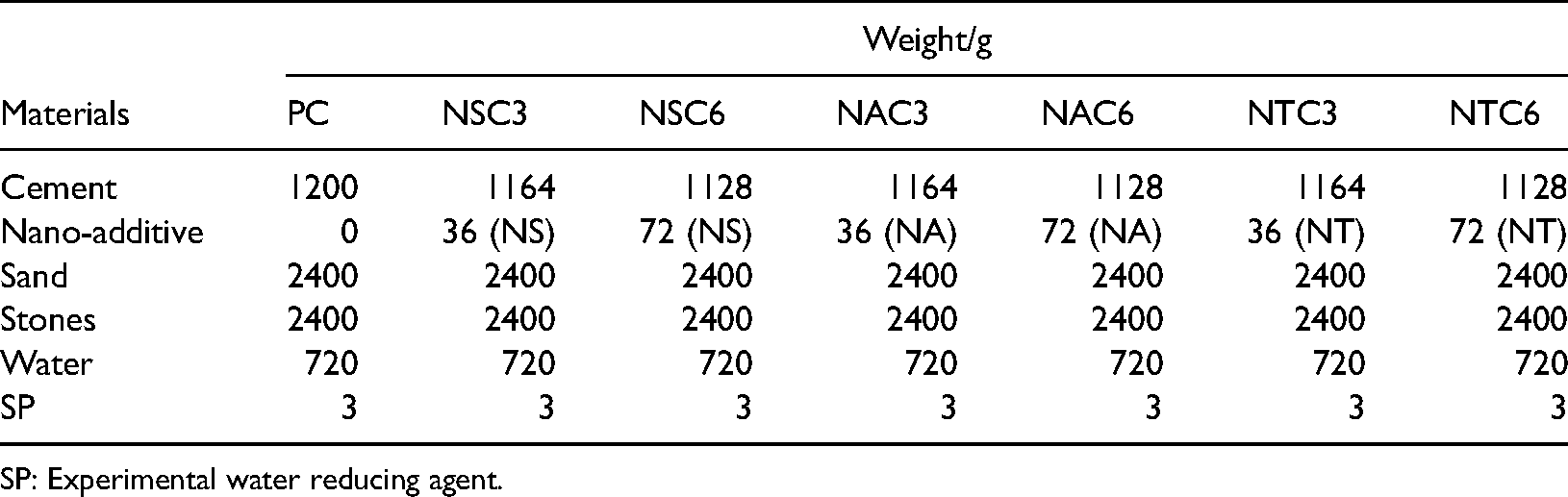
SP: Experimental water reducing agent.
Due to the high surface energy of nanomaterials, they readily agglomerate, and cause enlargement of nanomaterial particles and a deterioration in their properties ensues, therefore, nanomaterials should be dispersed before being mixed into each material. The nanomaterials mixed with water were placed into an ultrasonic cleaning machine and dispersed for 15 min. The aggregate, sand, and cement were then mixed evenly using a blender at a low speed for one minute: the nanomaterial dispersion solution and water-reducing agent were then poured into a bucket, and the mixture blended at a high speed for 10 min. Finally, the mixed slurry was poured into cube moulds, and the specimens were placed in the laboratory for one day until demoulding.
After demoulding, specimens measuring φ 50 mm × 100 mm were drilled (Figure 1). For the PC type, the specimens were denoted by C (a total of four specimens). For the type containing nano-SiO2, the specimens were denoted by S (S1-4 for NSC3, S5-8 NSC6), for the type containing nano-Al2O3, the specimens were denoted by A (A1-4 for NAC3, A5-8 NAC6), for the type containing nano-TiO2, the specimens were represented by T (T1-4 for NTC3, T5-8 NTC6) as shown. Thereafter the specimens were immersed in a sodium hydroxide solution with pH of 8 for 12 days to saturate the concrete specimens.
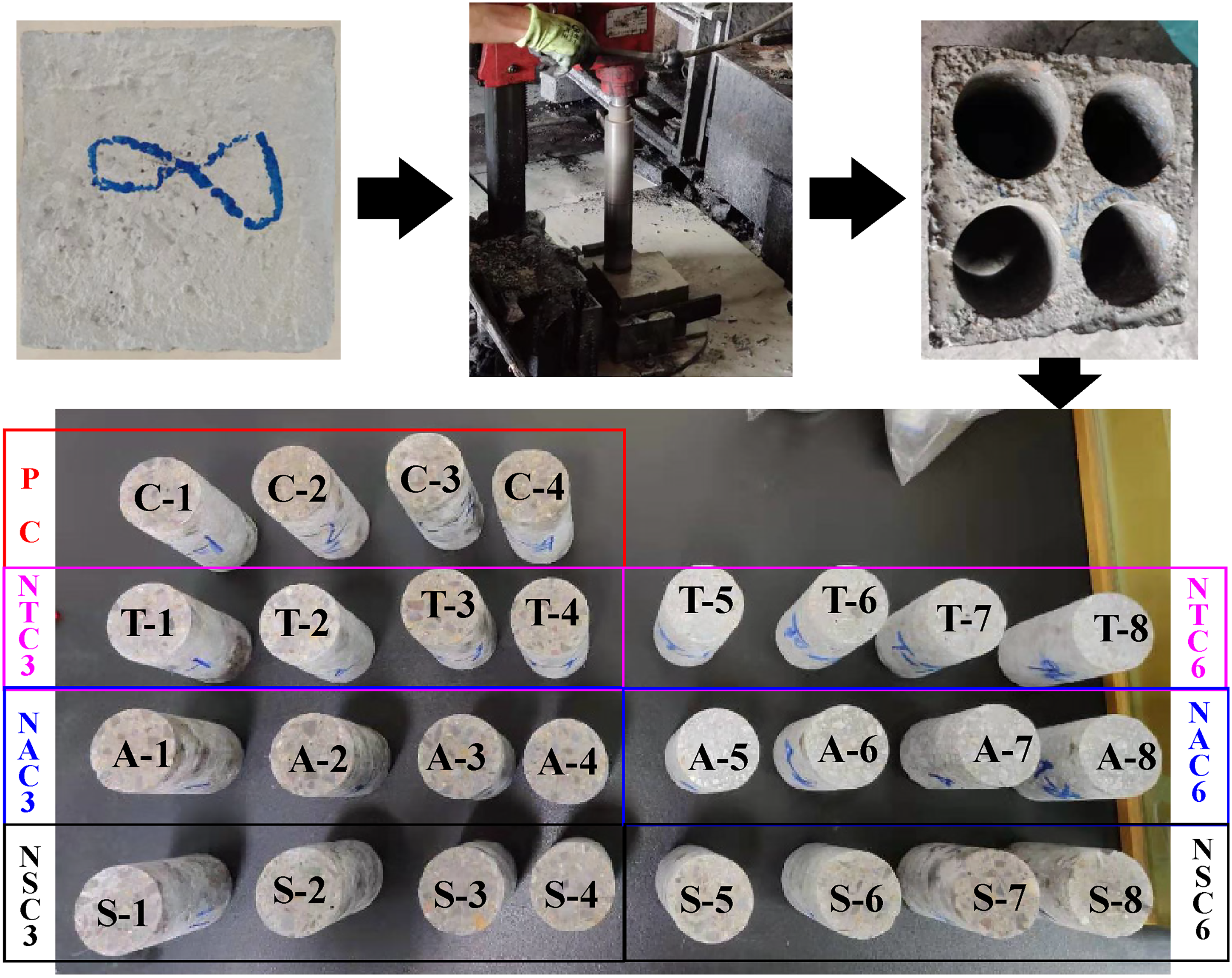
Specimen preparation.
Experimental results
Experimental set-up
The test system consisted of a load control system, a strain control system, and an AE monitoring system. In the uniaxial compression test, an RTR-1000 triaxial rock mechanics test system was used to load the specimens, and the AE signal acquisition system was adopted to monitor the AE signals. During the test, uniaxial compression and AE monitoring were guaranteed to be simultaneous. The experimental system is illustrated in Figure 2. After testing, the damaged specimens were photographed to record their failure mode.
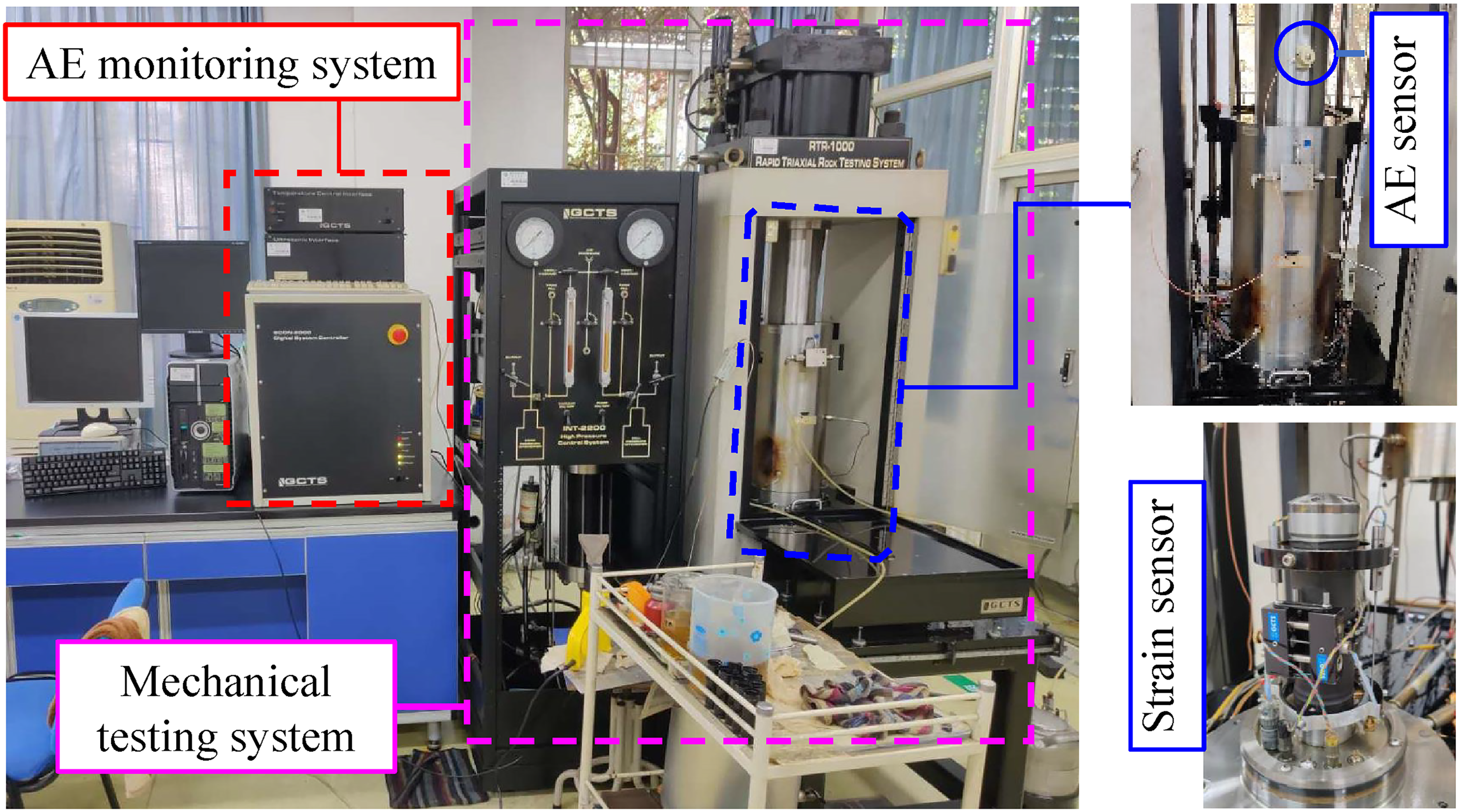
Experimental apparatus.
Test results: Uniaxial compression
The stress-strain curves are shown in Figure 3. Due to a sensor fault, data from Specimen A-4 were not recorded. According to the stress-strain curve, the compressive strength of each specimen could be obtained. The compressive strength of saturated nanometre concrete was compared with the compressive strength of ordinary saturated concrete at the same wave velocity (Figure 4).
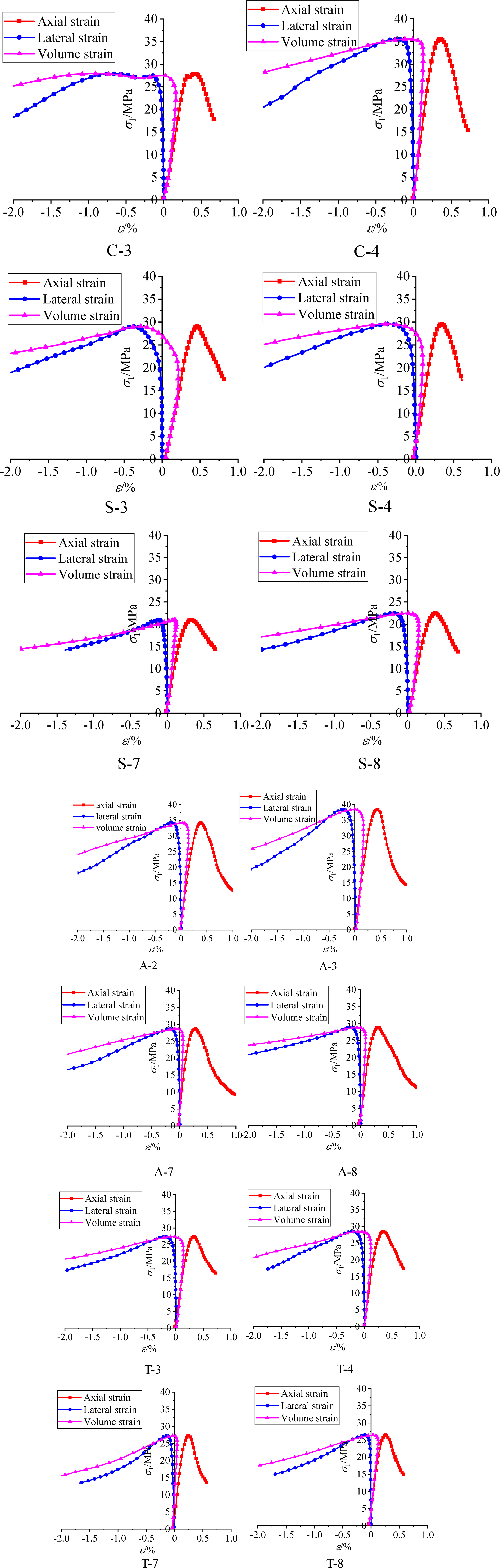
The stress-strain curves.
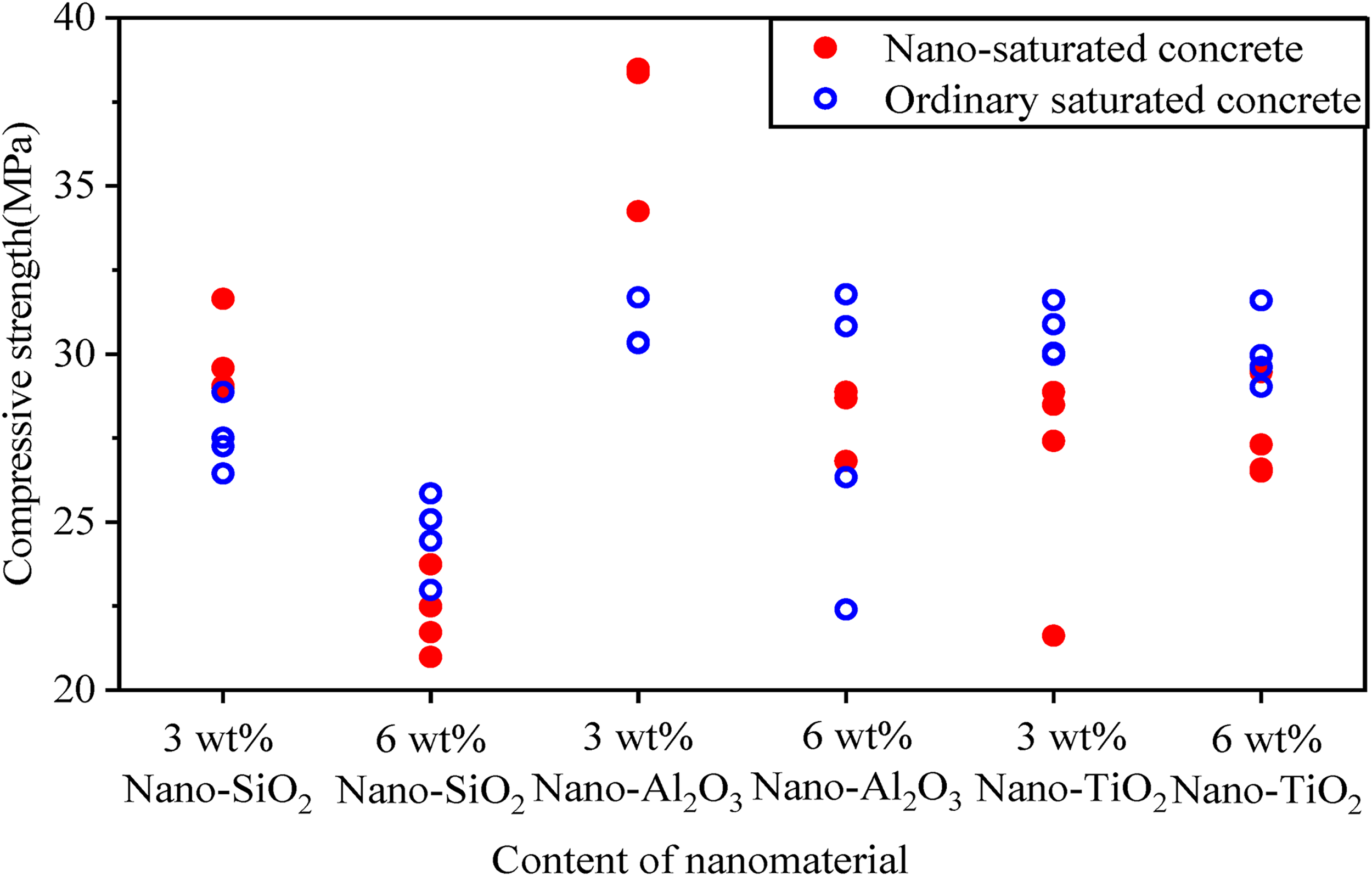
Comparison of compressive strength of saturated concrete.
As can be seen from Figure 4, the compressive strength of saturated concrete is affected by addition of nanomaterials. The compressive strengths of NSC3 specimens and NAC3 specimens are significantly increased compared with that of ordinary saturated concrete specimens, and NAC3 specimens show the greatest enhancement in compressive strength. The compressive strengths of other types of specimens are similar to, or lower than, that of ordinary saturated concrete.
Test results: Failure modes
The failure mode of each specimen is shown in Table 2.
Crack propagation mode.
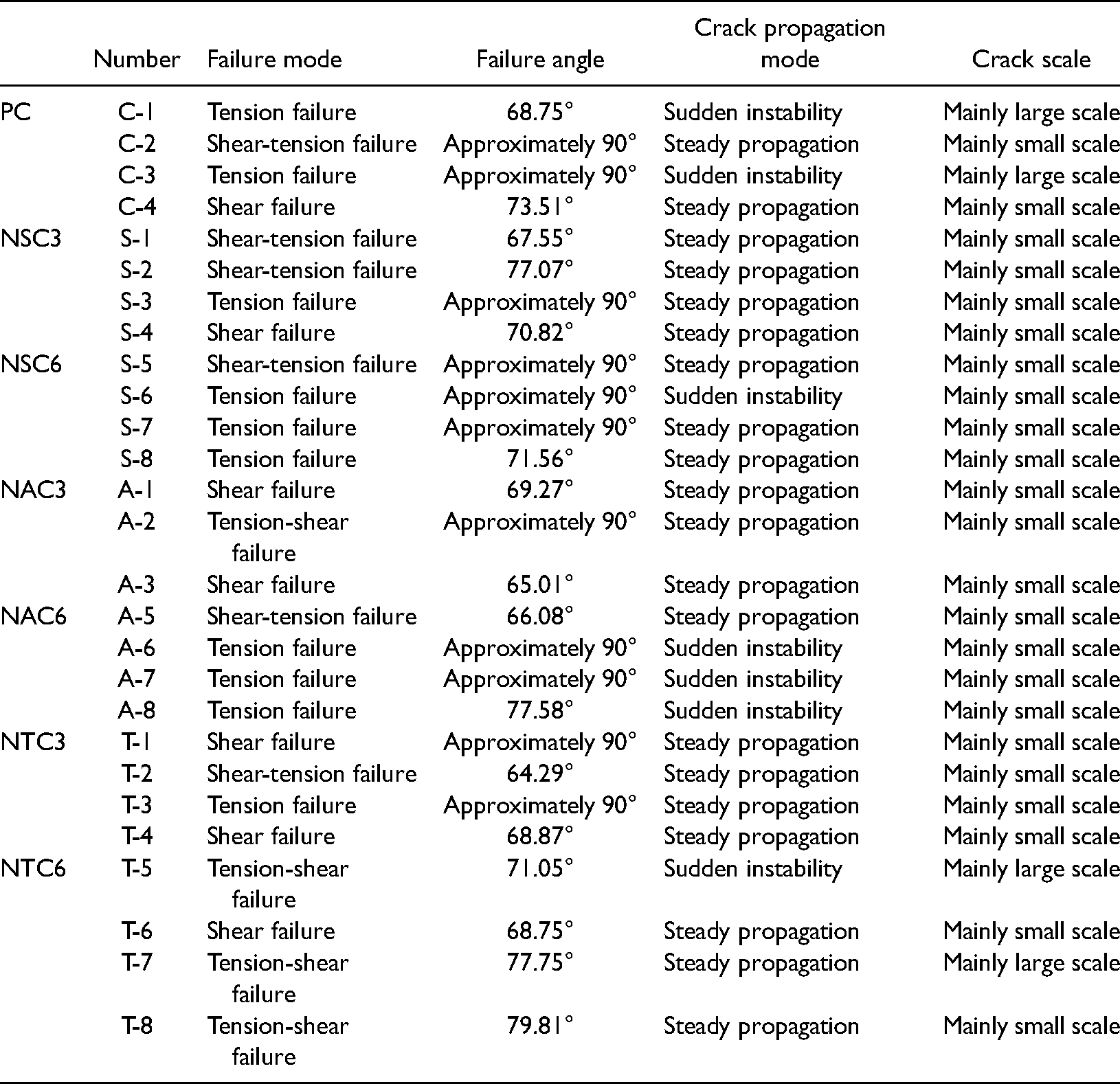
According to the failure state of each specimen without nanomaterials in Table 2, C-1 and C-3 specimens underwent tensile failure, C-2 was subjected to shear-tension failure, and C-4 underwent shear failure (when the angle between the failure crack and the vertical central axis of the sample is small, it is referred to as a tensile failure; when the angle is large, it is referred to as a shear failure).
For specimens containing 3% nano-SiO2, S-1,2 specimens undergo shear-tension failure, S-3 undergoes tensile failure, and S-4 undergoes shear failure. For those specimens containing 6% nano-SiO2, S-5 undergoes shear-tension failure, S-6,7 specimens undergo tensile failure, and S-8 undergoes tension-shear failure.
For specimens containing 3% nano-Al2O3, A-1,3 specimens undergo shear failure, while A-2 undergoes tension-shear failure. For those specimens containing 6% nano-Al2O3, A-5 undergoes shear-tension failure, while A-6, 7, 8 undergo tensile failure.
For specimens containing 3% nano-TiO2, T-1,4 specimens undergo shear failure, T-2 undergoes shear-tension failure, and T-3 undergoes tensile failure. T-57,8 specimens undergo tension-shear failure, and T-6 undergoes shear failure.
The failure modes of specimens without nanomaterials are relatively complicated, with both tension and shear failures accounting for half of all cases; however, for saturated concrete specimens containing nanomaterials, the failure modes of NSC3 specimens can be divided into tension failures and shear failures (50:50), while those of NSC6 and NAC6 specimens are dominated by tension failures, and the rest are dominated by shear failures.
Crack propagation modes of specimens based on AE
The AE amplitude represents the maximum amplitude of a single AE event. The AE amplitude can reflect the intensity of an AE event. The crack propagation mode and deformation failure mechanism of the saturated concrete specimens can be further understood by studying the amplitude distribution of specimens under uniaxial compression.
The parameter b can be used to describe the characteristics of the AE amplitude distribution of the specimen during uniaxial compression. The b-value is originally applied to seismic analysis to describe the relationship between the magnitude and frequency of earthquakes. The G-R relationship is proposed by Gutenberg and Richter in 1941 (Gutenberg and Richter, 1944):
where M is the magnitude of the earthquake, N is the earthquake frequency in the range of M to M + ΔM, and a and b are constants.
At present, the b-value can also be used to describe the AE amplitude characteristics of rock materials during failure. To study the change in the b-value of saturated concrete specimens during uniaxial compression, the b-value can be calculated thus:
According to equation (1), by calculating the amplitude of the AE event of each concrete specimen during uniaxial compression, the change in the b-value of each type of saturated concrete specimen is obtained (Figure 5).
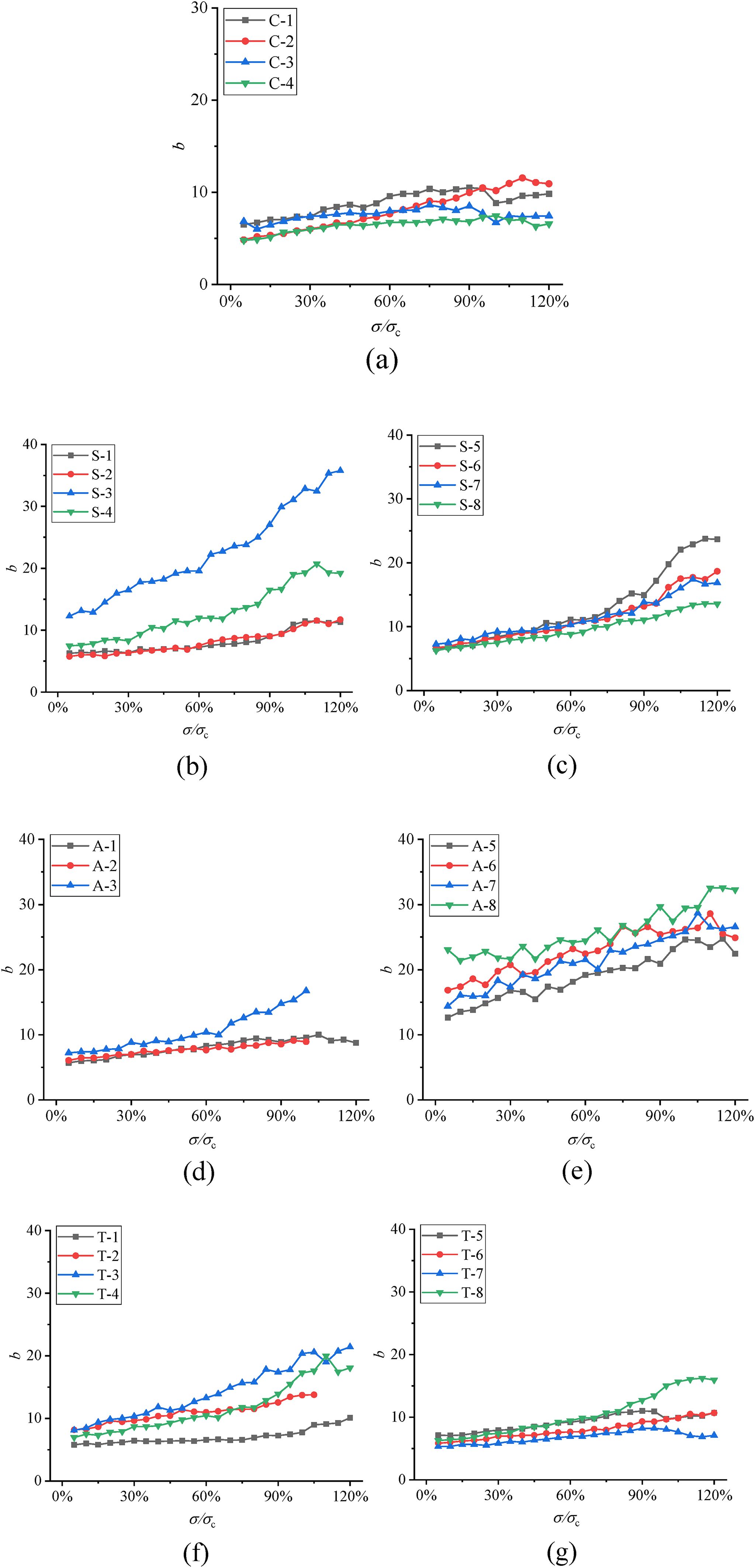
Variations in b of each saturated concrete specimen with stress. (a) PC; (b) NSC3; (c) NSC6; (d) NAC3; (e) NAC6; (f) NTC3; (g) NTC6.
The dynamic change characteristics of the b-value have specific physical meaning: when the b-value increases, the proportion of small-scale cracks increases. When the b-value decreases, the proportion of large-scale cracks increases. When the b-value remains unchanged, it means that the proportion of large-scale cracks and small-scale cracks is relatively constant. The b-value fluctuates within a small range, indicating that microcrack propagation is relatively slow, representing the steady propagation of the microcrack. The b-value undergoes a sudden transition to variation within a large range indicating a sudden change in microcrack state, representing the sudden instability of a microcrack.
The mode of crack propagation of each specimen is listed in Table 2.
It can be seen from Figure 5(a) that the b-values of ordinary concrete specimens as a whole show a slow upward trend. At the initial stage of loading, the b-value is small, indicating that high-amplitude events account for more of the total event count. With increasing stress, the b-value increases slowly, indicating that the proportion of low-amplitude AE events increases slowly, and the internal structure is dominated by microcrack propagation at this time. At a stress of 40% to 45% that at failure, the b-value decreases, indicating that some microcracks propagate to form macroscopic cracks, and the proportion of high-amplitude AE events increases. Then the b-value increases slowly, and when the stress level reaches 75% to 80% of that at failure, the b-value decreases again. Thereafter, the b-value continues to increase. At this time, the internal structure is still dominated by microcrack propagation. At peak stress, the specimen fails, more high-amplitude events occur, and the b-value decreases. It can be seen from the figure that the decrease in b-value of C-1 and C-3 at peak is significantly greater than that of C-2 and C-4. The results indicate that the crack propagation mode of C-1 and C-3 is one of sudden instability, mainly involving large-scale cracking, while the crack propagation mode of C-2 and C-4 is one of steady propagation, mainly involving small-scale cracking.
As can be seen from Figure 5(b), the b-values of NSC3 generally show a slow upward trend. At the initial stage of loading (below 15% of the peak stress), the b-value of each specimen is relatively stable, indicating that the various scales of cracks within specimens are stable at this time: the variation of b-value of S-1 and S-2 with stress is very similar. With increasing stress, the b-value increases slowly, indicating that the proportion of low-amplitude events of these two specimens gradually increases before the peak stress is reached, and the internal structure is dominated by microcrack propagation. Until the stress reaches its peak, the b-value decreases, indicating that some microcracks propagate to form macroscopic cracks, but the decrease is small: however, for the S-3 and S-4 specimens, the b-value decreases at 35% to 40% of the peak stress. Thereafter, the b-value gradually increases, and decreases again post-peak (albeit slightly). These results indicate that, at peak stress, the internal cracks of NSC3 are mainly small-scale cracks, and the crack propagation is steady.
It can be seen from Figure 5(c) that the b-values of NSC6 as a whole show a slow upward trend except that the b-value of S-6 undergoes a sudden transition within a large range of amplitudes after the stress reaches 90% of the peak stress; the b-value of the other specimen all changes within a small range. The above results indicate that the crack propagation of S-5, S-7 and S-8 is steady, while the crack propagation in S-6 is a form of sudden instability. The b-value is high when NSC6 type specimens are brought to failure, so the internal cracks in NSC6 specimens are mainly small-scale cracks.
It can be seen from Figure 5(d) that the b-values of NAC3 as a whole show a slow upward trend, and the b-value is larger when the specimens reach failure. These results indicate that the internal cracks in NAC3 specimens are mainly small-scale cracks. The b-value of each specimen fluctuates within a small range, indicating a steady crack propagation mode.
As can be seen from Figure 5(e), the b-values of each stage of the NAC6 specimens (except A-5) fluctuate over a large range, indicating that the crack propagation mode of A-5 is one of steady propagation. The proportion of cracks at various scales in the other specimens is uneven, and the crack propagation mode involves sudden instability.
As can be seen from Figure 5(f), the b-values of NSC3 as a whole show a slow upward trend: the b-values all fluctuate within a small range, indicating the crack propagation of small-scale cracks in a steady mode.
As can be seen from Figure 5(g), the b-values of NTC6 increase gradually before reaching the peak stress. The b-value of T-6 and T-8 gradually stabilizes post-peak, indicating that the crack propagation of small-scale cracks is in a steady mode. The b-value of T-7 increases slowly before reaching a stress of 90% of that at failure, and begins to gradually decrease thereafter, indicating that the proportion of large-scale cracks begins to increase at this time. The b-value of T-7 gradually tends to be stable post-peak, indicating that the internal cracks in T-7 are mainly large-scale cracks when T-7 fails, and the crack propagation is steady: however, the b-value of the T-5 decreases significantly at a stress of 95% of that at failure, indicating that the crack propagation mode is one of sudden instability of large-scale cracks.
In summary, both large-scale cracking and small-scale cracking occur when the ordinary saturated concrete specimens undergo failure, and the proportion of cracks at various scales is uneven. For nano-saturated concrete, except in some specimens of NTC6 with mainly large-scale cracking at failure, the other types of specimens mainly undergo small-scale cracking. On the one hand, this indicates that the proportion of large-scale cracking can be reduced by adding nanomaterials to saturated concrete: on the other it also indicates that, for nano-TiO2, at 6 wt%, it has exceeded its suitable content in saturated concrete.
For the crack propagation modes of ordinary saturated concrete specimens, sudden instability and steady propagation account for half of all cases. The modes of crack propagation of saturated concrete specimens containing 3 wt% nanomaterials mainly involve steady propagation. For saturated concrete specimens containing 6 wt% nanomaterials, the crack propagation modes of NAC6 involve sudden instability. The modes of crack propagation of NSC6 and NTC6 mainly involve steady propagation, but the crack propagation mode of some specimens involves sudden instability. The results indicate that the addition of nanomaterials to saturated concrete can change the mode of crack propagation to steady propagation.
Discussion
The most obvious characteristic of concrete damage and failure is the generation and propagation of cracks. The propagation of cracks in concrete can directly reflect the safety and durability of a concrete structure to some extent. Concrete is a composite material composed of water, cement, coarse and fine aggregates, etc. The joint surface between the slurry and the coarse aggregate is an area of weakness in concrete. When a concrete specimen is under uniaxial compression, the stress at the joint surface of the coarse aggregate and the slurry is greater than its bond strength, and the joint surface cracks first With increasing load, the crack gradually propagates and extends until different cracks penetrate each other to form a failure mode with one crack as the main driver of failure and multiple smaller cracks as an auxiliary thereto.
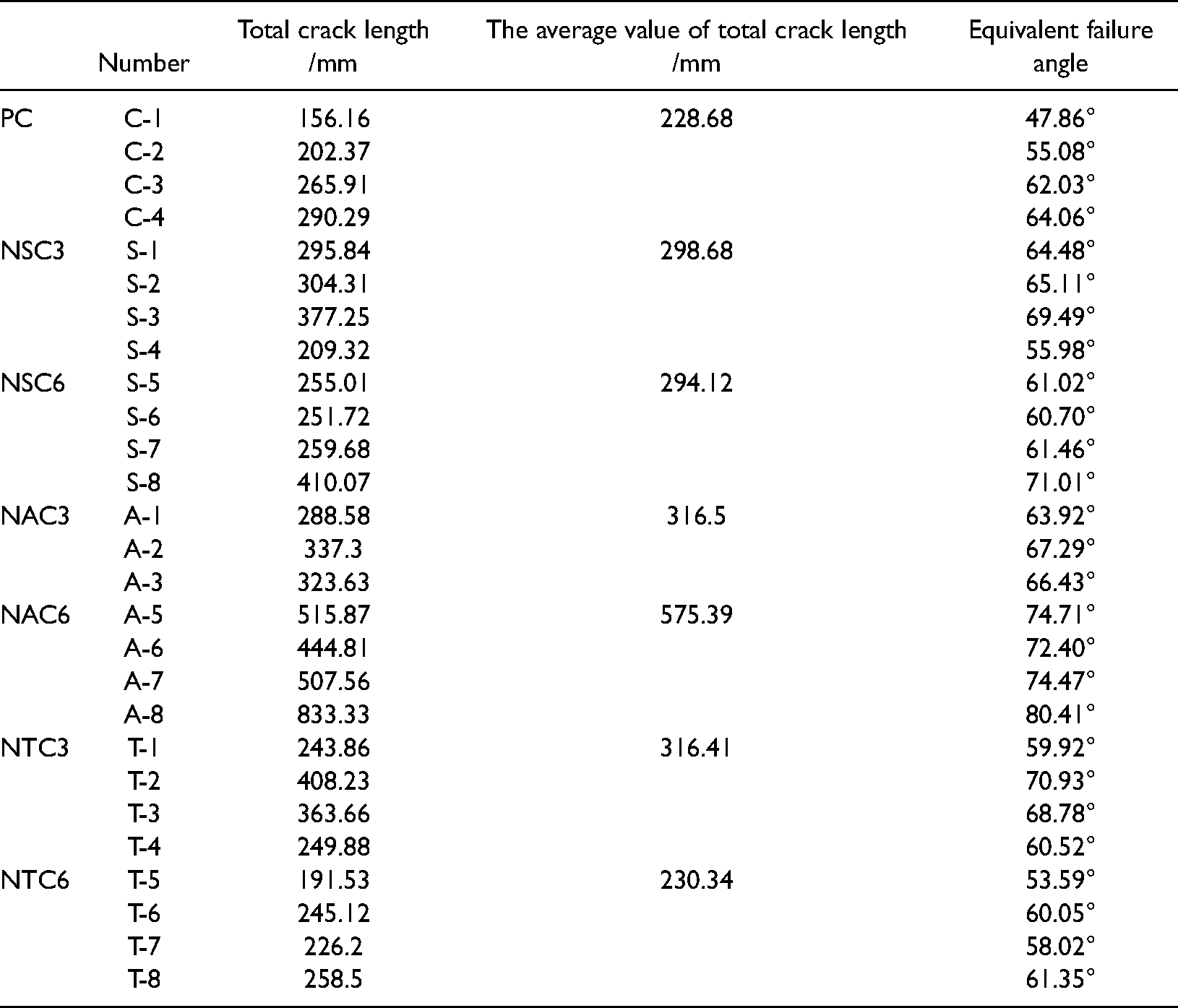
It can be seen from the failure mode of the concrete specimens in Table 2 that, although the failure angles of some specimens are similar, the total length of the cracks, is quite different. Therefore, the quantitative concept of the equivalent failure angle is introduced to describe the degree of fracturing of each specimen. The arctangent of the ratio of the total crack length to
Total crack length and equivalent failure angle of various types of specimens.
According to Griffith‘s strength theory, when concrete is subjected to load, the stress near the crack tip increases. When the stress exceeds its tensile strength, a new crack is generated at the crack tip, or it expands along the crack direction, which eventually leads to the failure of concrete materials. Crack propagation in saturated concrete can be studied in terms of energy:
When the elastic potential energy accumulated in the stress concentration at the crack tip is greater than the resistance to crack propagation in a saturated concrete specimen, the crack expands and releases the stored elastic potential energy. The work done by the released elastic potential energy is mainly absorbed in the energy required to generate a new crack surface.
It is assumed that, under elastic potential energy u, crack propagation Δa is generated, elastic potential energy Δu is released, and its rate of release is:

Let R be the crack propagation resistance, then
According to the above equation, the longer the total crack at failure, the more work done to overcome the resistance to crack propagation, the more elastic potential energy it needs to accumulate, the more work required to make the saturated concrete specimen lose its bearing capacity, the greater the specimen bearing capacity.
It can be seen from Table 3 that the total crack length of the ordinary saturated concrete specimen is the shortest, indicating that, under uniaxial compression, the work required to make it lose its load-bearing capacity is lowest With the addition of nanomaterials, the total crack length of the nano-saturated concrete specimen is increased to varying degrees, indicating that the bearing capacity of the saturated concrete can be improved by the addition of nanomaterials.
For saturated concrete specimens containing nano-SiO2, the total crack length of the specimens is not much different when the nanomaterial content is 3 wt% or 6 wt%, increasing by 29% compared with ordinary concrete specimens.
For saturated concrete specimens containing nano-Al2O3, the total crack length is increased by 38% compared with ordinary concrete specimens when the content of nanomaterials is 3 wt%, and the total crack length is increased by 152% compared with ordinary concrete specimens when the content of nanomaterials is 6 wt%.
For saturated concrete specimens containing nano-TiO2, the total crack length is increased by 38% compared with ordinary concrete specimens when the content of nanomaterials is 3 wt%, and the total crack length is not much different from that in ordinary concrete specimens when the content of nanomaterials is 6 wt%.
Comprehensive comparison of all nano-saturated concrete specimens, 3 wt% nano-Al2O3, 6 wt% nano-Al2O3 and 3 wt% nano-TiO2 have the best effect on improving the bearing capacity of saturated concrete, followed by 3 wt% nano-SiO2 and 6 wt% nano-SiO2: the 6 wt% nano-TiO2 has almost no effect on the bearing capacity of saturated concrete.
It can be seen that by adding nanomaterials to saturated concrete, the bearing capacity of engineering structures made therewith can be improved, the life of the building can be extended, and the safety of hydraulic concrete structures can be improved. For NAC3, NAC6, and NTC3 with their strong bearing capacity, the low strength of NAC6 and NTC3 is not conducive to maintaining the safety and stability of an engineering structure, therefore, comprehensively considering factors such as bearing capacity and strength improvement, the NAC3 show the best performance, with steady crack propagation, mainly small-scale cracking present, a high bearing capacity, and high strength.
Conclusions
Uniaxial compression experiments and AE monitoring were conducted on different types of nano-saturated concrete specimens. The effects of the type and content of nanomaterials on the mode of crack propagation, failure mode, and bearing capacity of saturated concrete were compared and studied. The following conclusions are drawn:
The failure mode of ordinary saturated concrete specimens is relatively complicated, with tension failures and shear failures accounting for half of all cases. Both tension failures and shear failures for saturated concrete specimens containing nanomaterials account for half of the failure modes of NSC3, the failure modes of NSC6 and NAC6 are mainly tensile, with the other types of specimens mainly undergoing shear failure. Both large-scale cracking and small-scale cracking occur when ordinary saturated concrete specimens fail. The proportion of cracks at various scales is uneven. For nano-saturated concrete, except that some specimens of NTC6 undergo mainly large-scale cracking at failure, the other types of specimens are subjected to mainly small-scale cracking. This finding indicates that the proportion of large-scale cracking can be reduced by adding nanomaterials to saturated concrete. By studying the total crack length of various types of saturated concrete specimens after failure, the bearing capacity of saturated concrete was found to be improved by the addition of nanomaterials: 3 wt% nano-Al2O3, 6 wt% nano-Al2O3 and 3 wt% nano-TiO2 have the best effect on improving the bearing capacity of saturated concrete, followed by 3 wt% nano-SiO2 and 6 wt% nano-SiO2: the 6 wt% nano-TiO2 exerts almost no effect on the bearing capacity of saturated concrete. Considering the mode of crack propagation, bearing capacity, and strength enhancement effects, the saturated concrete specimen demonstrates the best performance, with the characteristics of steady crack propagation, with mainly small-scale cracks present, a high bearing capacity, and a high strength.
Footnotes
Data availability
The data used to support the findings of this study are included within the article.
Declaration of conflicting interests
The author(s) declared no potential conflicts of interest with respect to the research, authorship, and/or publication of this article.
Funding
The author(s) disclosed receipt of the following financial support for the research, authorship, and/or publication of this article: This work was supported by the National Natural Science Foundation of China, (grant number No. 51804309, 52174097), and the 2030 Pilot Project of CHNENERGY Investment Group Co., Ltd: Research on Ecological Restoration and Protection of Coal Base in Arid Ecofragile Region (GJNY2030XDXM-19-03.2), and the Key Laboratory of Coal Mine Safety and High-Efficiency Mining as co-established by the Province and the Ministry(JYBSYS2018201), Open Research Grant of Joint National-Local Engineering Research Center for Safe and Precise Coal Mining(Grant NO.EC2021005), and State Key Laboratory of Water Resource Protection and Utilization in Coal Mining (GJNY-20-113-05).
