




Abstract
The study on the Zhangjialiang No. 2 coal of Middle Jurassic Yan'an Formation in the northeastern Ordos Basin has been analyzed by gas chromatography-mass spectrometry (GC-MS) to determine geochemical characteristics and reconstruct palaeovegetation and palaeoclimate changes. The distribution of n-alkanes is mainly unimodal, with a medium and high molecular weight. Pr/Ph ratio (2.03–10.6) is high in most samples. The values of Tm/Ts ratio are between 1.42 and 4.92, and a predominance of C29 over C27 steranes has been found for the analyzed samples. These parameters indicate that all samples were deposited in an oxidizing freshwater environment, and the organic matter was mainly derived from terrestrial higher plants, with a small amount of aquatic organisms. Thermal maturity parameters such as C3122S/(22S + 22R) homohopane, C30αβ/(αβ + βα) hopane, together with the total organic carbon (TOC) contents (43.1% - 58.6% (except floor 2-13)) and the detected of C2717β(H)-22, 29, 30-trisnorhopane (βTm), suggest that most of samples have a relatively low maturity in the early stage. Besides, gymnosperm-derived biomarkers, including labdane, norpimarane, isopimarane, phyllocladane, abietane, rimuane, ent-beyerane, ent-kaurane, suggest that the vegetation during the Middle Jurassic Yan’an Formation was characterized by conifers.
Introduction
As a carrier of geological information, coals are relatively stable during the evolution of the palaeosedimentary environment (Large et al., 2009; Diessel, 2007). It not only records coal-forming plants and climatic conditions during the coal-forming periods, but also indicates the occurrence of natural geological events, such as wildfires and volcanic activity (Bowman et al., 2009; Farhaduzzaman et al., 2012; Liu et al., 2022a; Uhl and Kerp, 2003). The distribution of molecular fossils (e.g. biomarkers) in peat swamps is mainly affected by biological sources, degradation of organic matter, environmental factors, such as temperature and pH. Biomarkers are an effective tool for reconstructing palaeoenvironment, tracking biodiversity and its change during geological period. The distribution of biomarker in the Middle Jurassic coal seams can effectively characterize the coal-forming environment and vegetation types in the study area. Numerous studies related to the Middle Jurassic coalfield in the northeastern Ordos Basin mainly focuses on regional geology (Ao et al., 2012), stratigraphic sequence (Zhang et al., 2020), spore-pollen zonation (Jiang and Wang, 2002; Xu et al., 2022), elements distribution pattern (Wang et al., 2014), mineral occurrence (Wang et al., 2018). Many scholars (Liu et al., 2022b; Liu et al., 2022c) have studied the palaeoenvironment and paleoclimate of the Middle Jurassic in the Ordos Basin by different methods. For example, Wang et al. (2022) analyzed the major and trace elements using X-ray fluorescence (XRF) and inductively coupled plasma-mass spectrometry (ICP-MS), suggested that climate changed from a relatively arid condition to a more humid climate. Xu et al. (2020) and Zhang et al. (2020) identified that there are frequent wildfires during Jurassic in the Ordos Basin. Macerals in the coalfields in the Ordos Basin were extensively studied by Wang et al. (2020), Du et al. (2019) and Ao et al. (2012). Nevertheless, there are a limited number of reports on the reconstruction of palaeoenvironment by biomarkers in coal seams in the basin.
In the paper, molecular distribution of the coals from the Zhangjialiang No. 2 coal in the Dongsheng coalfield of the Ordos Basin have been studied to discuss the thermal maturity, palaeovegetation types for organic matter, and depositional palaeoenvironment changes in the Middle Jurassic Yan'an Formation in the Dongsheng Coalfield, Ordos Basin, north China.
Geological setting
The Ordos Basin is a typical large-scale basin in various energy minerals and formed by the combination of the Pacific plate and Tethys oceanic crust with the Paleo-Asian continent. Furthermore, it is the second largest sedimentary basin in China (Cheng et al., 1997) and controlled by the Qinling Trough on the southern and southwestern margins and the “Paleo-Central Asian Ocean Basin” on the northern side. The Yimeng uplift is formed in parallel unconformity and micro-angle unconformity. The Zhangjialiang Mine is located in the eastern the Yimeng uplift in the northern Ordos Basin (Figure 1A).

Regional tectonic position (A) and sampling column section (Liu et al., 2006) (B) of the No. 2 coal from the Zhangjialiang Mine, Dongsheng Coalfield (Zhang et al., 2020).
During the Jurassic period, the global average temperature was mostly higher than the current temperature (Rees et al., 2004), and the climate in the mid-latitude region belonged to the warm temperate climate (Rees et al., 2000). Therefore, the relatively warm and humid climate provided good conditions for the growth of diverse plants. Additionally, the warm and humid climate is also conductive to the deposition of extremely thick coal seams and the preservation of vegetation fossils. The Middle Jurassic climate in northern China gradually changed from warm and humid to semi-humid and semi-arid, while the Middle Jurassic Yan'an Formation was mainly formed in a warm-humid temperate-subtropical climate condition. The flora was flourishing during this period, Gingko was the dominant species, followed by Filicinae, but with a high degree of differentiation, however, the content of Coniferales was relatively low.
The strata of the Dongsheng Coalfield belong to the northwest stratigraphic area of the Jurassic period of the Ordos Basin. The Yan'an Formation is the overlying stratum of the Fuxian Formation, and the two strata are conformable contact. The Yan'an Formation is in parallel unconformity contact with the overlying Zhiluo Formation. The No. 2 coal is the mineable coal seam with a thickness ranging from 2–5.03 m, and the average thickness is 3.38 m. The upper strata of the coal seam are covered by grayish black mudstones and carbonaceous mudstone intercalated with off-white siltstone, and the bottom strata are mostly off-white fine sandstone, gray-black silty mudstone and mudstone interbed (Figure 1B). The coal seam was formed in the Middle Jurassic Yan'an Formation, which is dominated by delta sedimentary plains, and then gradually transformed from delta facies to fluvial sediments. The No. 2 coal formed under a backshore swamp deposit, and its sedimentary system is a braided river deposit.
Materials and methods
Samples
The samples were collected from the No. 2 coal of Zhangjialiang open-pit coal Mine in the northeastern Ordos Basin. In accordance with GB/T482–2008 (2008) and combined with the actual mining situation to select fresh section for sampling from top to bottom. The thickness of each coal samples on the coal section is 20 cm, and a total of 12 coal samples and a single floor were collected. The samples are named 2-1, 2-2, …, 2-13 (floor). The fresh samples collected were carefully wrapped in aluminum foil, sealed, and stored in sample bags to reduce external contamination and oxidation.
Experimental methods
About 10 g (0.075 mm) of each sample for Soxhlet extraction with dichloromethane as the extractant, constant temperature extraction (45°C) in a water bath for 24 h. The extracts of organic matter (EOM) were obtained by rotary evaporation and blown dry with nitrogen and constant weight. Amount of 30 to 40 mg of EOM was separated into saturated hydrocarbon fraction, aromatic hydrocarbon fraction, and polar compounds which eluted by n-hexane, dichloromethane, and methanol, respectively, through column chromatography filling with activated silica gel. Saturated hydrocarbons, aromatic hydrocarbons, as well as polar compounds were gradually separated by using n-hexane, dichloromethane, and methanol, respectively. After rotary evaporation and drying, the weight of each component obtained is recorded in turn and awaits testing by GC-MS. The obtained hydrocarbon components were analyzed by Agilent gas chromatography-mass spectrometry (GC6890N/MSD5973N). The oven temperature was programmed from 60°C to 320°C at a rate of 4 °C/min, with a 25 min isothermal period, and the injector and transfer temperature were 280°C. High-purity helium was used as carrier gas at a flow rate of 1.5 ml/min. The mass spectrometer was operated in the electron impact mode (EI) at 70 eV ionization energy. The mass spectra are obtained by scanning from m/z 50 to m/z 600 at 2 scans per second. The internal standard is squalane for the quantification of saturated hydrocarbon. Concentrations were calculated by comparing peak areas between samples and standards, and data were processed using Agilent Mass Hunter Qualitative Analysis browser software. Identification of individual compounds was performed using retention times in total ion current (TIC) chromatography and by comparing with mass spectra of library and published data (Philp et al., 1981). All experiments were carried out at the Key Laboratory of Resource Exploration Research of Hebei Province, Handan, China.
Result
Geochemical parameters
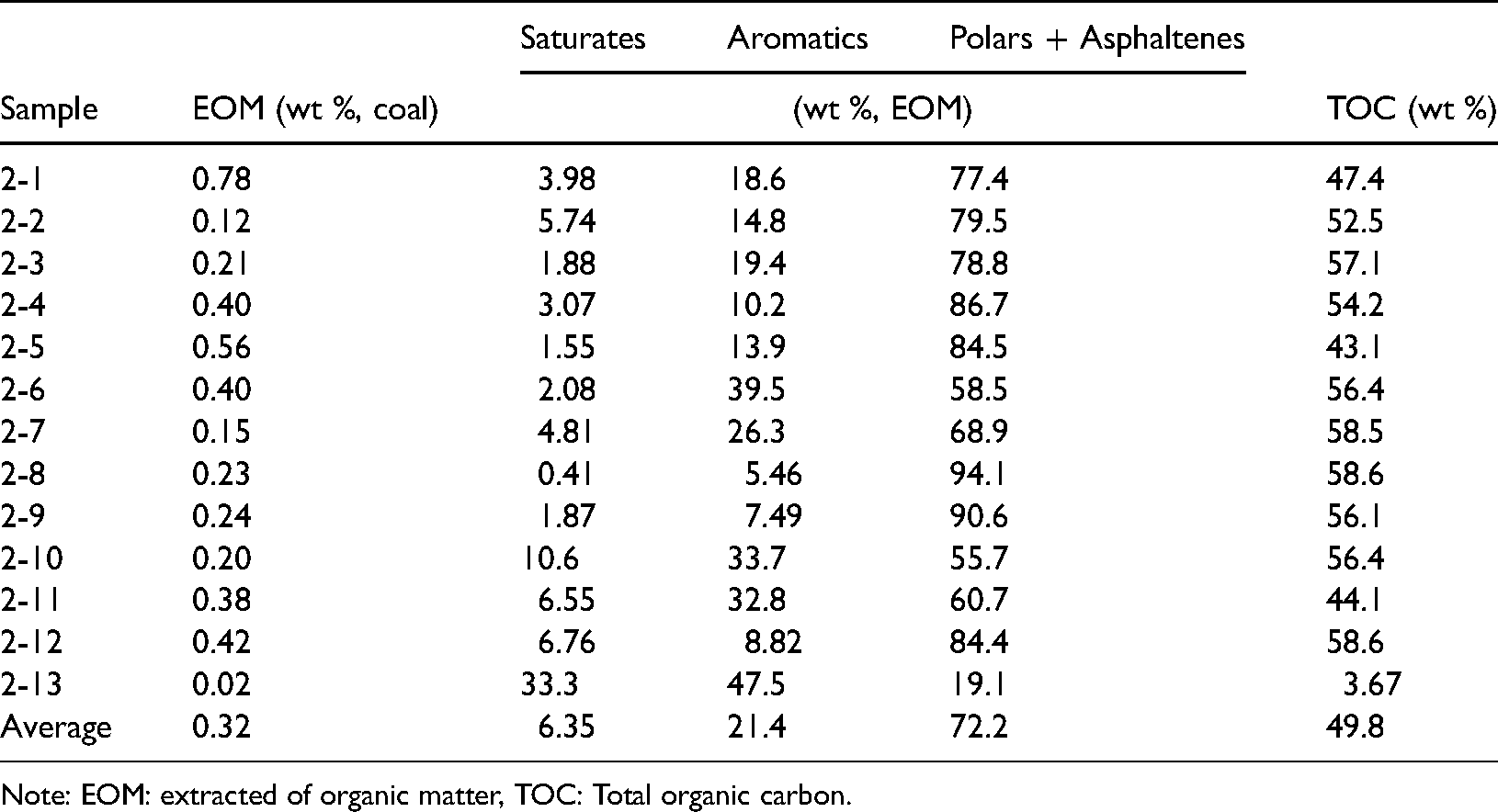
The content of extracted organic matter (EOM) (Table 1) shows that the extraction rate of organic matter of the Zhangjialiang No. 2 coal ranged from 0.02% to 0.78%, with an average (av.) value of 0.32%. The composition of organic matter in the study area mainly includes saturated hydrocarbons, aromatic hydrocarbons, polar compounds, and asphaltenes. The contents of saturated hydrocarbons (0.41% – 33.3%, av. 6.35%) and aromatic hydrocarbons (5.46% – 47.5%, av. 21.4%) in coal samples is low, slightly lower than the content of polars and asphaltenes (19.1% – 94.1%, av. 72.2%). The content of polars and asphaltenes is highest in all compounds (except floor 2-13), the content of aromatic hydrocarbons is higher than that of saturated hydrocarbons. However, the contents of saturated hydrocarbons (33.3%) and aromatic hydrocarbons (47.5%) on the floor (2-13) are higher than that of polars and asphaltenes (19.1%), which is significantly different from that of other coal samples. The contents of the total organic carbon (TOC) range from 43.1% to 58.6% (except floor 2-13), and the content of TOC is obvious different in the floor (2-13), depending on lithology and depositional environment.
Bulk geochemical parameters of the No. 2 coal in Yan'an Formation of Middle Jurassic in the Zhangjialiang Mine.
Note: EOM: extracted of organic matter, TOC: Total organic carbon.
The composition of saturated hydrocarbon
n-Alkanes and isoprenoids
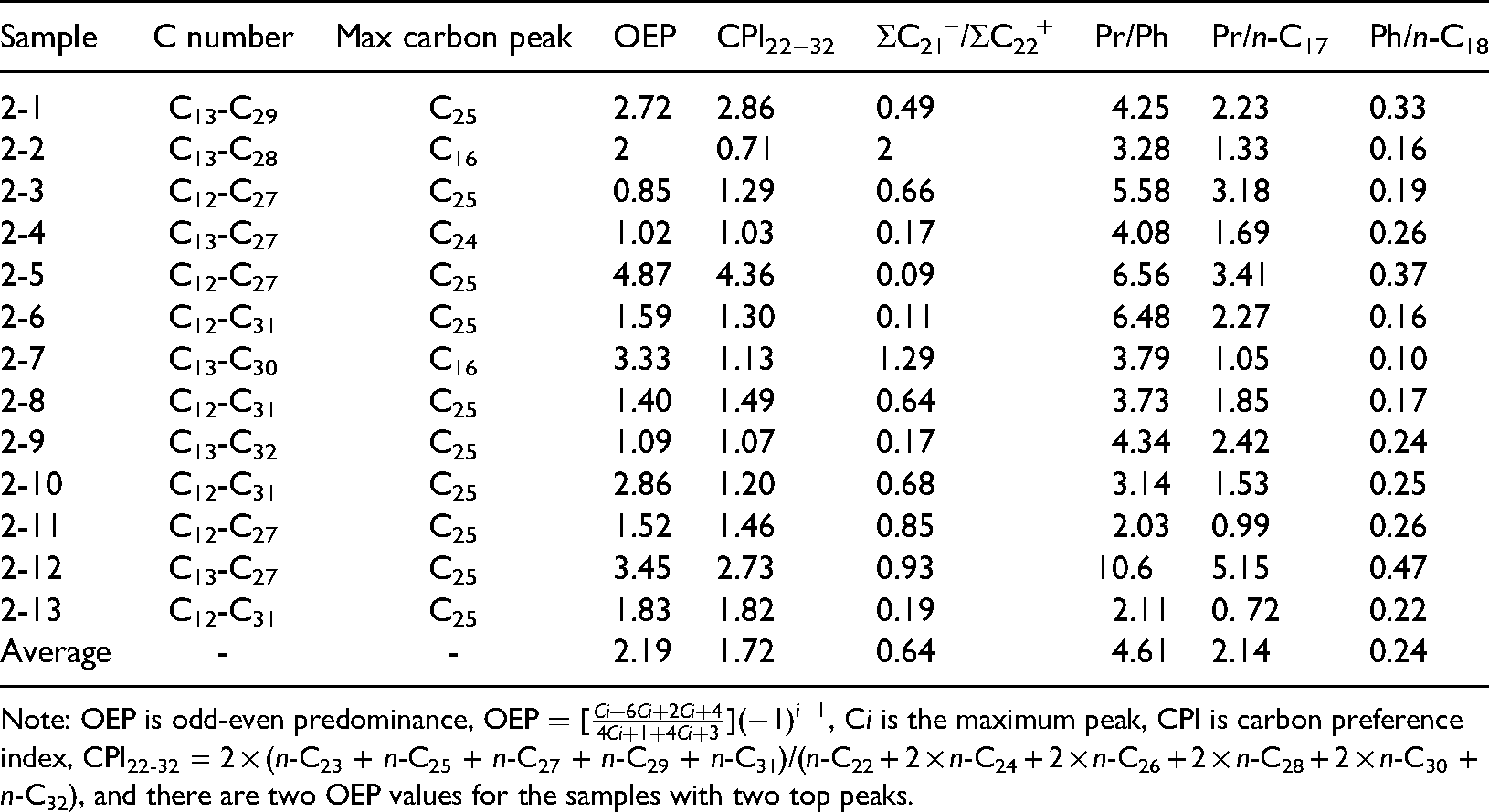
The distribution of n-alkanes in the Zhangjialiang Mine of the Jurassic Yan'an Formation is not complete, and the carbon number of most samples is distributed around n-C12 - n-C30 (Table 2), indicating that these samples were affected by microbial degradation. The n-alkane profiles of these samples fall into two patterns: (1) a unimodal distribution with a maximum at high molecular weight and a relatively obvious odd-over-even (Figure 2). (2) a unimodal distribution at the low molecular weight and a slight odd carbon advantage (Figure 2). When the main peak carbon number of n-alkanes is less than n-C20, the curve distribution type is pre-unimodal, which mostly occurs in aquatic algae and microorganisms. When the carbon number of the main peak is between n-C21 – n-C23, it indicates that the organic matter type is terrestrial higher plants, and the peak type is mainly posterior unimodal type. When the curve is bimodal, it indicates that the organic matter mainly comes from the mixed input of lower aquatic organisms and higher plants (Wang, 1990). In addition, the odd-to-even preference index (OEP) and the carbon preference index (CPI) (Peters et al., 2005; Scalan and Smith, 1970) can be used to determine the quantitative changes in terrestrial and aquatic organic matter and the degree of thermal evolution of organic matter, etc. The OEP value in the Zhangjialiang samples ranged from 0.85 to 4.87, with an average of 2.19 (Table 2), and the CPI22−32 value ranged from 0.71 to 4.36 (av. 1.72). OEP (except sample 2-3) and CPI22−32 (except sample 2-2) show a dominance of odd carbon number high molecular weight n-alkanes, and the input source mainly derive from terrigenous plants. The CPI value of sample 2-3 is below 1, indicating that the content of high molecular weight n-alkanes is low. The OEP value of sample 2-2 is below 1, showing differences in organic matter sources. The values of ΣC21−/ΣC22+ varied from 0.09 to 2 (av. 0.64), and these values (except sample 2-2) support a predominance of long-chain n-alkanes, and further showed that organic matter inputs were contributed by both terrestrial plants and a small amount of aquatic algae and microorganisms.
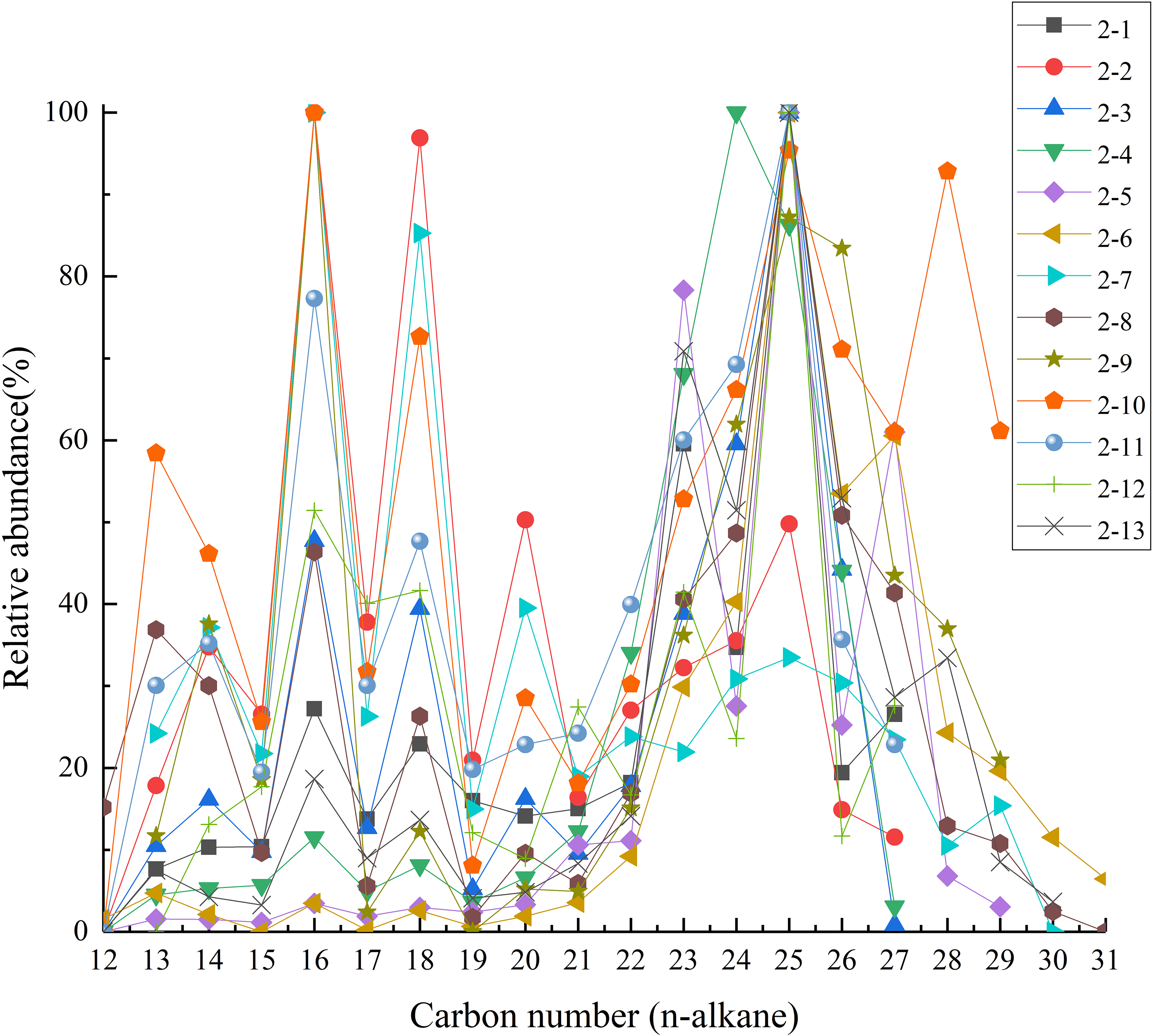
Normalised distribution of n-alkane for Jurassic Yan’an Formation coal samples in the Zhangjialiang No. 2 coal seam.
Parameter characteristics of n-alkanes and isoprenoid alkanes of the No. 2 coal samples from the Zhangjialiang Mine.
Note: OEP is odd-even predominance,
Isoprenoids are structurally stable in coals, and pristane (Pr) and phytane (Ph) are important parameters for evaluating paleoenvironmental evolution and organic matter types (Didyk et al., 1978). The ratio of pristane and phytane (Pr/Ph) can be used as one of the indicators to distinguish the redox conditions and water salinity in the depositional environment (Montero-Serrano et al., 2010). Low Pr/Ph ratios (< 1.0) indicated anoxic environment associated with carbonate deposition; high ratio (Pr/Ph > 3.0) manifested the input of terrestrial-derived organic matter deposited in the oxidation environment (Jiang and George, 2018). The Pr/Ph ratio in the Zhangjialiang No. 2 coal was in the range of 2.03 to 10.6, with an average of 4.61 (Table 2, Figure 3A, B). The Pr/Ph ratio are generally high, and the ratios (Pr/Ph > 3) predominate in the samples, indicating an oxidized freshwater sedimentary environment.

GC chromatograms of n-alkanes (m/z 85) in the saturated hydrocarbon fraction (A, B), Cross plot between Pr/n-C17 and Ph/n-C18 (C) (Philp, 1985), Partial mass chromatograms (m/z 123) of sesquiterpenoids and diterpenoids (D) of the No. 2 coal samples from the Zhangjialiang Mine, C14Bs: C14- Bicyclic sesquiterpanes, 4β(H)-E: 4β(H)- Eudesmane, 8β(H)-D: 8β(H)-Drimane, C16-Bt: C16- Bicyclic terpane, 8β(H)-H: 8β(H)- Homodrimane, βL: 8β(H)-Labdane,19NIP: 4β(H)-19-Norisopimarane, NA: 18-Norabietane,17NT: C19-17-Nortetracyclane, IP + βP: Isopimarane+16β(H)-Phyllocladane, A: Abietane, βK: ent-16β(H)-Kaurane, αP: 16α(H)-Phyllocladane.
Sesquiterpenoids and diterpenoids
A series of bicyclic sesquiterpanes of C14 – C16 were identified. The abundance of 8β(H)-drimane is the highest (except 2-6 and floor 2-13) sesquiterpene in the samples in the study area. Among the diterpenoids, 8β(H)-labdane, 4β(H)-19-norisopimarane, 18-norabietane, C19-17-nortetracyclane, 16β(H)-phyllocladane, ent-beyerane, and 16α(H)-phyllocladane, were detected. 18-Norabietane and abietane are higher in these samples, followed by C19-17-nortetracyclane (Figure 3D), while the content of other diterpenoids is relatively low. Noble et al. (1985) suggested that the variations in the content of 16α(H)-phyllocladane, 16β(H)-phyllocladane, and ent-16β(H)-kaurane were closely related to the thermal evolution of organic matter, and the relative content of 16β(H)-diterpenoids gradually increased with maturity. Because the content of diterpenoids is minimal, the determination of the organic matter maturity needs to be further explored.
Hopanes
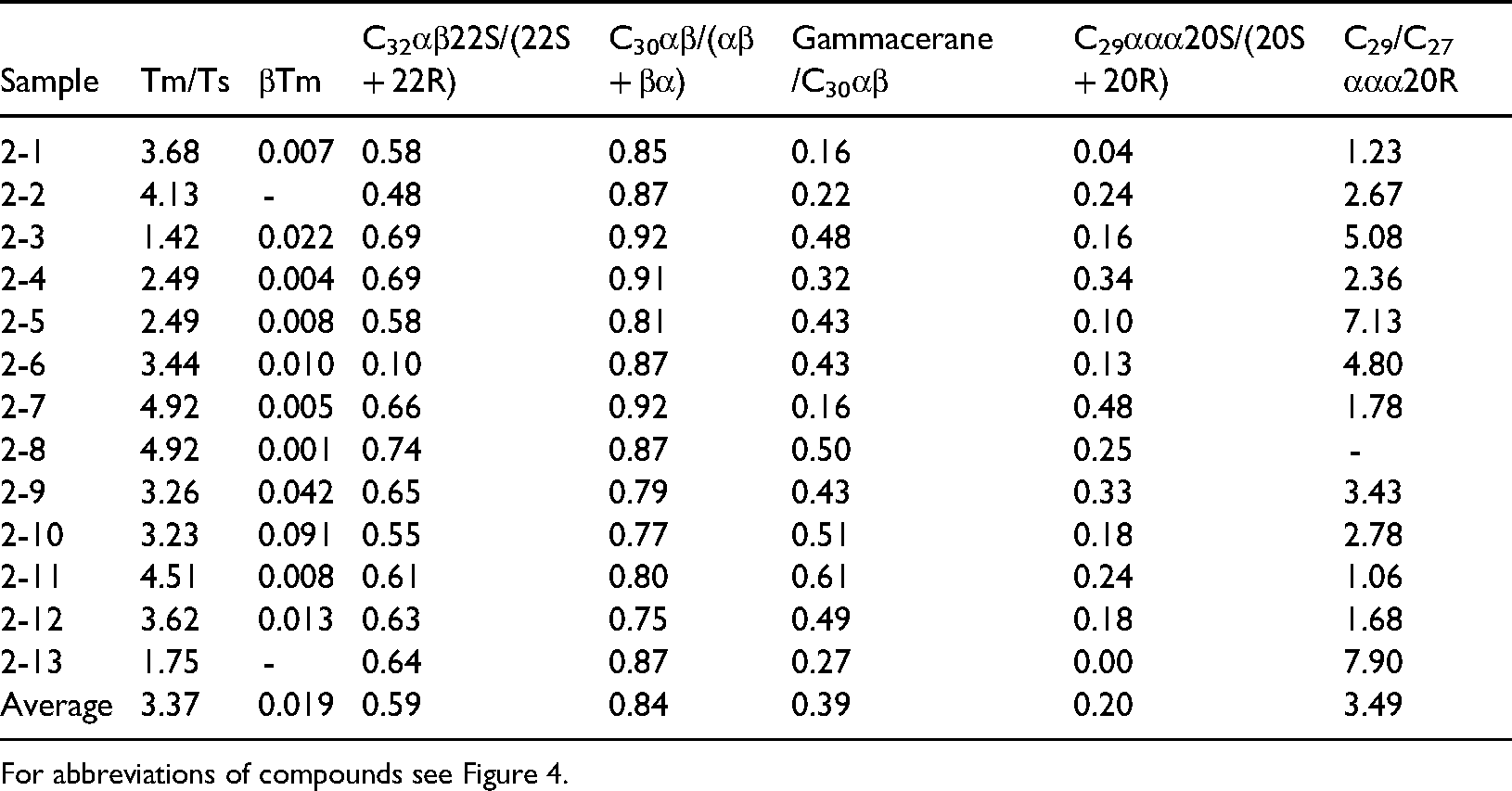
The content of hopane in the Zhangjialiang No. 2 coal is low, and the distribution is incomplete. C27 – C31 hopanes are the dominant compounds, and C31 and C32 homohopanes with both S and R epimers are present. The abundance of C30 hopanes is highest in samples 2-6 and 2-7, and C31 moretanes were the main peak and were normally distributed in the rest of samples. C27 17α(H)-22, 29, 30-trisnorhopane (Tm) is significantly more abundant than C27 18α(H)-22, 29, 30-trisnorgopane (Ts). Tm/Ts ratios range from 1.42 to 4.92 in all analyzed samples, suggesting that organic matter was deposited under relatively oxidizing conditions, in accordance with the conclusion derived from Pr/Ph ratios (Table 3, Figures 4A, B). The C30αβ/(αβ + βα) hopane ratios vary from 0.75 to 0.92, and these values are below and close to thermal equilibrium. The range of C31αβ22S/(22S + 22R) is 0.49–0.84 (av. 0.67), and C32αβ22S/(22S + 22R) ranged from 0.10 to 0.74 (av.0.59) (Table 3). Gammacerane is used as a marker to distinguish salinity and stable water bodies, and it is also a product of reducing and hypersaline environment (Sinninghe-Damste et al., 1995). The values of gammacerane in the studied samples ranged from 0 to 0.2 (av.0.07). Gammacerane was not detected in coal samples 2-6, 2-7, and 2-8, and the highest gammacerane was found in 2-13 (floor), and the values of other samples were low. These indicate that 2-13 (floor) is mainly formed in saline water, while the coal-forming environment of other samples has low salinity and formed in freshwater environment.

Partial m/z 191 (A, B) and m/z 217 (C, D) mass chromatograms of the No. 2 coal samples from the Dongsheng Coalfield (Hakimi and Abdullah, 2014). Abbreviations: Ts = C2718α(H)-22,29,30-trisnorneohopane, Tm = C2717α(H)-22,29,30-trisnorhopane, αβ and βα denote 17α(H)-hopanes and 17β(H)-moretane, βα, αβ, ααα and αββ = 13β(H), 17α(H)-diasteranes, 13α(H),17β(H)-diasteranes, 5α(H),14α(H),17α(H)- steranes and 5α(H),14β(H),17β(H)-steranes.
Biomarker parameters of coal samples from the No. 2 coal in the Zhangjialiang Mine in the Dongsheng Coalfield.
For abbreviations of compounds see Figure 4.
Steranes
Steranes are steroid acids derived from living organisms with special structures, stable properties, and strong resistance to biodegradation. The steranes in the Zhangjialiang No. 2 coal are relatively well preserved, mainly including regular steranes (C27 – C29), rearranged steranes, pregnane, and homopregnane, among which the contents of rearranged steranes, pregnane, and homopregnane are extremely low, and will not be specifically analyzed here. From the previous analysis, the study area is less affected by microbial degradation, and regular steranes have strong anti-biodegradation ability, indicating that regular steranes can better discriminate the palaeodepositional environment. The content of regular steranes C27 – C29 shows an obvious upward trend (Figures 4C, D). The contents of regular steranes C27, C28, and C29 are 0–0.29 μg/g, 0.00–0.37 μg/g, 0.01–0.59 μg/g respectively, with mean values of 0.09 μg/g, 0.10 μg/g, and 0.20 μg/g. The C29 isomerization parameters (C29ααα20S/(20S + 20R)) in steranes vary from 0.04–0.48 (av. 0.20) (Table 3).
Discussion
Thermal maturity of organic matter
C31αβ22S/(22S + 22R) and C32αβ22S/(22S + 22R) values are around 0.6, showing that the organic matter has reached thermal equilibrium. C31αβ22S/(22S + 22R) values are not much difference observed in these samples, indicating that the organic matter is formed during early maturity. The ratio of C32αβ22S/(22S + 22R) in sample 2-1 (0.10) is low, and the other samples fluctuate around 0.6, probably due to the inhomogeneity of organic matter evolution of coal seams. C30αβ/(αβ + βα) and high CPI (>1.0), together with C3122S/(22S + 22R) homohopane ratios suggest that the organic matter have a relatively low maturity. All of the above facts indicate that the organic matter in this area is in early mature stage. It is observed longitudinally in Table 2 that the organic matter input of samples 2-2 and 2-7 is dominated by aquatic algae and significantly affected by microbial degradation. The thermal stability of βTm among pentacyclic terpenoids is lower than that of Ts and Tm (Hong et al., 1986), thus the abundance of βTm gradually decreases with the increase of maturity. The low content of βTm was detected in some samples (Table 3), indicating that the organic matter is at a low thermal maturation stage. According to the vitrinite reflectance (av. 0.43), the results were low overall, which further confirms the low thermal evolution of organic matter.
Depositional environment
The comparative analysis of the relative content and distribution patterns of n-alkanes, the Pr/Ph ratios, and the Pr/n-C17 and Ph/n-C18 cross-plot (Figure 3C), indicates that the coal seams of Jurassic Yan'an Formation were mainly formed by terrestrial organic matter deposited under an oxidizing environment. It is also confirmed by the gammacerane/C30αβ hopane (gammacerane index) ratio in these samples, which indicate that the studied samples were mainly formed in a freshwater environment, but sample 2-13 (floor) was mainly formed in a brackish water environment, with subtle differences from other coal samples. Steranes are derived from steroid acids in algae, plankton, and higher plants (Riboulleau et al., 2007). Generally, C27 regular steranes are indicator for marine zooplankton and algal sources, while if the abundance of C29 is dominant in regular sterane, it is thought to originate from higher plants and diatoms. A high abundance of C28 regular steranes is typically indicative of a contribution from lacustrine algae (Huang and Meinschein, 1979; Volkman, 2005). Combining with mass chromatograms of regular sterane, most samples are dominated by C29 regular sterane, but the content of C27 and C29 are similar in samples 2-1 and 2-11, characterized by a “V” type, and the rest of the coal samples are mostly characterized by inverse “L” type distribution (Figures 4C, D), which indicates a large proportion input of higher plant (Huang and Meinschein, 1979; Volkman, 2005). The ratio of C29/C27 in regular steranes can be used to evaluate the source and degradation capacity of organic matter (Moore et al., 1992; Nichols et al., 1990). The C29/C27ααα20R ratios of the Zhangjialiang coal samples (Table 3) indicate a significant dominance of C29ααα20R, and it can be included that the organic matter is derived from terrestrial higher plants and mixed with trace low plankton. In the C29/C27ααα20R versus Pr/Ph cross-plot, most samples are located in the oxidation zone with land plant input (Figure 5A). Combined with the analysis of the regular sterane triple in Figure 5B, it can be inferred that most of the coal samples of the Zhangjialiang Mine are mainly formed from terrestrial plants and mixed sources. Due to the high abundance of C27ααα20R in a few samples, there may be a proportional aquatic plankton mixed in. In summary, the depositional environment of the Zhangjialiang Mine of Jurassic Yan'an Formation was oxidation with influence of freshwater and terrestrial plants.
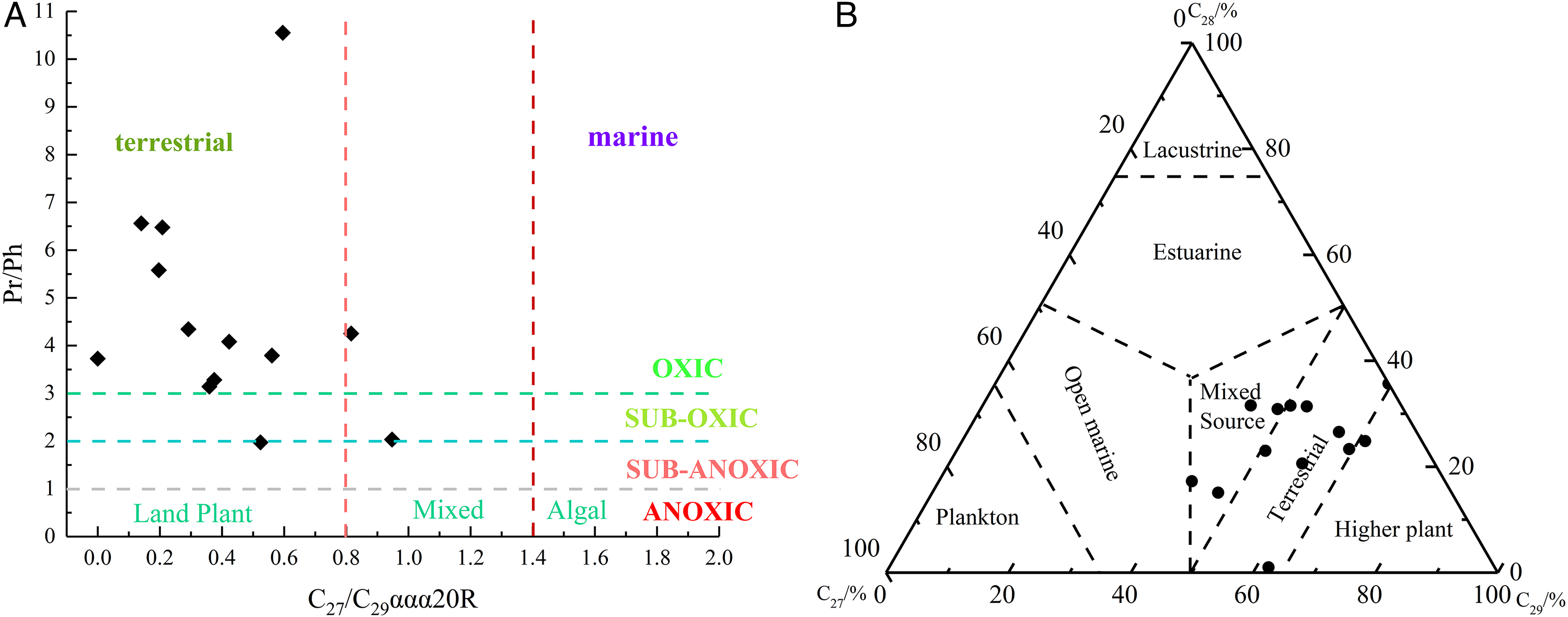
Triangular figure of regular steranes C27-C28-C29 (A) and cross-plot of the C27/C29ααα20R sterane ratio and Pr/Ph ratio(B) of the No. 2 coal samples from the Zhangjialiang Mine in the Dongsheng Coalfield (Zumberge, 1987).
Sources of palaeovegetation
The gymnosperms were dominated the Middle Jurassic Yan'an Formation in the northeastern Ordos Basin, mainly composed of filicopsida, ginkgopsida, and pinopsida, with rich species but high differentiation (Ge et al., 2006). Biomarkers of higher plants are widely distributed in sedimentary organic matter and can reconstruct the paleoenvironments and palaeovegetation composition (Liu et al., 2019, 2018). The higher carbon numbers of n-alkanes (e.g. C29, C31) and the regular sterane C29 in the studied samples indicate that they are derived from vascular plants (Nichols et al., 2010). The long-chain carbon number in most samples from the Zhangjialiang Mine was distributed around C29 or C30. Sesquiterpenes, as markers of higher plants, are highly representative for judging the input of palaeovegetation. The existence of bicyclic sesquiterpenes manifested that organic matter originates from microorganisms (Alexander et al., 1983). The high abundance of 8β(H)-drimane and the low content of 8β(H)-homodrimane in the studied samples suggested the input of higher plants and microorganisms during the deposition of peatland. A trace amount of 4β(H)-eudesmane in the Zhangjialiang coal samples, indicate the contribution of higher plants and mainly from coniferous trees (such as cupressaceae, pinaceane, taxodiaceae, pldocarpaceae, etc.) (Liu et al., 2019), caryophyllaceae and flowering plants. Diterpenoids can be divided into three categories according to the ring numbers of their structure: bicyclic diterpenoids (labdane-type), tricyclic diterpenoids (abietane-type and pimarane-type), and tetracyclic diterpenoids (kaurene-type, phyllocladane-type, and beyerane-type). Some researchers believe that labdane and its derivatives exist in conifers but have a microbial origin as well (Dimmler et al., 1984; Jiang and George, 2018). A small amount of 8β(H) -labdane was found as bicyclic diterpenoids, and 4β(H)-19-norpimarane, isopimarane, and C19-17-nortetracyclane are mainly derived from gymnosperms, especially Pinaceae, Cupressaceae, and Taxodiaceae, which play an important role in the plant community in the Jurassic samples from the Zhangjialiang Mine. The abundance of abietane and 18-norabietane in the tricyclic diterpenoids are high in these samples, which is consistent with the source of labdane and isopimarane and the widely distribution of conifers. Tetracyclic diterpenoids were mainly detected as 16α(H)-phyllocladane, 16β(H)-phyllocladane, and ent-16β(H)-kaurane, all of which were widely present in coniferous resins. These sesquiterpenoid and diterpenoid compounds all indicated that gymnosperm (conifers) were the main higher plants during the formation of the peatland.
Conclusions
Analysis of the aliphatic hydrocarbon fractions of thirteen Middle Jurassic Zhangjialiang coal samples from the Dongsheng Coalfield, Ordos Basin has revealed their thermal maturity, depositional environment, and sources of palaeovegetation.
The results from parameters such as C3222S/(22S + 22R) and C29ααα20S/(20S + 20R) indicate that the thermal evolution of organic matter is low. Some samples have a small amount of βTm, which indicates a low thermal maturity of organic matter. The parameters of n-alkanes showed that the samples have different influence of microbial degradation, among which samples 2-2 and 2-7 had higher contribution from microbial degradation. The distribution patterns of n-alkanes and parameters, such as Pr/Ph, the Pr/n-C17 versus Ph/n-C18 cross plot, the Pr/Ph versus C27/C29ααα20R sterane cross-plot, and gammacerane index indicate that these coal samples were deposited in an oxidizing freshwater environment, and the organic matter was dominated by terrigenous higher plants, with a small amount of aquatic organisms. A series of sesquiterpenoids, diterpenoids, and triterpenoids were detected in the Zhangjialiang coal samples. The small amount of bicyclic sesquiterpenoids, such as 8β(H)-drimane, 8β(H)-homodrimane, and 4β(H)-eudesmane indicate that the organic matter of study samples has the input of both higher plants and microorganisms. Diterpenoids such as 8β(H)-labdane, 4β(H)-19-norpimarane, isopimarane, and C19-17-nortetracyclane, abietane, 18-norabietane, 16α(H)-phyllocladane, 16β(H)-phyllocladane, and ent-16β(H)-kaurane in these samples suggest a predominant contribution from gymnosperms to the peatland during its formation.
Footnotes
Declaration of conflicting interests
The author(s) declared no potential conflicts of interest with respect to the research, authorship, and/or publication of this article.
Funding
The author(s) disclosed receipt of the following financial support for the research, authorship, and/or publication of this article: this work was supported by the Natural Science Foundation of Hebei Province (D2021402017, D2021402036) and the Science and Technology Research in Higher Education Institutions of Hebei Province (ZD2020184; QN2021033).

Biomarkers concentration data.
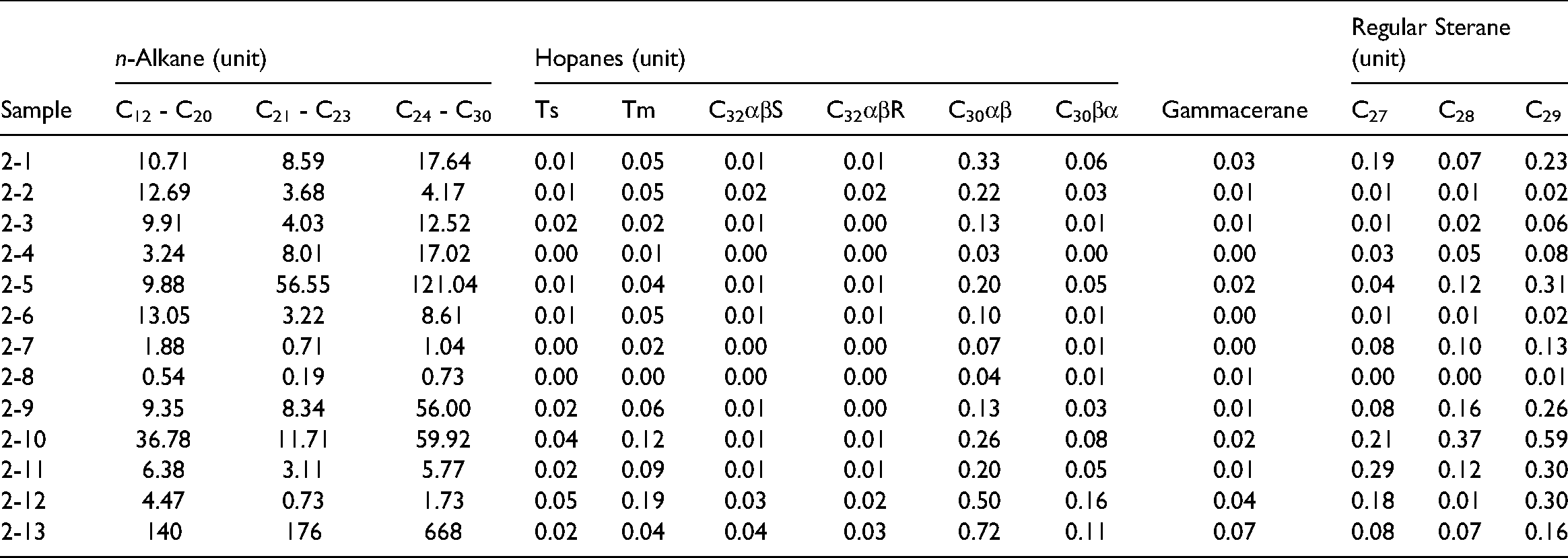
| Sample | n-Alkane (unit) | Hopanes (unit) | Regular Sterane (unit) | ||||||||||
|---|---|---|---|---|---|---|---|---|---|---|---|---|---|
| C12 - C20 | C21 - C23 | C24 - C30 | Ts | Tm | C32αβS | C32αβR | C30αβ | C30βα | Gammacerane | C27 | C28 | C29 | |
| 2-1 | 10.71 | 8.59 | 17.64 | 0.01 | 0.05 | 0.01 | 0.01 | 0.33 | 0.06 | 0.03 | 0.19 | 0.07 | 0.23 |
| 2-2 | 12.69 | 3.68 | 4.17 | 0.01 | 0.05 | 0.02 | 0.02 | 0.22 | 0.03 | 0.01 | 0.01 | 0.01 | 0.02 |
| 2-3 | 9.91 | 4.03 | 12.52 | 0.02 | 0.02 | 0.01 | 0.00 | 0.13 | 0.01 | 0.01 | 0.01 | 0.02 | 0.06 |
| 2-4 | 3.24 | 8.01 | 17.02 | 0.00 | 0.01 | 0.00 | 0.00 | 0.03 | 0.00 | 0.00 | 0.03 | 0.05 | 0.08 |
| 2-5 | 9.88 | 56.55 | 121.04 | 0.01 | 0.04 | 0.01 | 0.01 | 0.20 | 0.05 | 0.02 | 0.04 | 0.12 | 0.31 |
| 2-6 | 13.05 | 3.22 | 8.61 | 0.01 | 0.05 | 0.01 | 0.01 | 0.10 | 0.01 | 0.00 | 0.01 | 0.01 | 0.02 |
| 2-7 | 1.88 | 0.71 | 1.04 | 0.00 | 0.02 | 0.00 | 0.00 | 0.07 | 0.01 | 0.00 | 0.08 | 0.10 | 0.13 |
| 2-8 | 0.54 | 0.19 | 0.73 | 0.00 | 0.00 | 0.00 | 0.00 | 0.04 | 0.01 | 0.01 | 0.00 | 0.00 | 0.01 |
| 2-9 | 9.35 | 8.34 | 56.00 | 0.02 | 0.06 | 0.01 | 0.00 | 0.13 | 0.03 | 0.01 | 0.08 | 0.16 | 0.26 |
| 2-10 | 36.78 | 11.71 | 59.92 | 0.04 | 0.12 | 0.01 | 0.01 | 0.26 | 0.08 | 0.02 | 0.21 | 0.37 | 0.59 |
| 2-11 | 6.38 | 3.11 | 5.77 | 0.02 | 0.09 | 0.01 | 0.01 | 0.20 | 0.05 | 0.01 | 0.29 | 0.12 | 0.30 |
| 2-12 | 4.47 | 0.73 | 1.73 | 0.05 | 0.19 | 0.03 | 0.02 | 0.50 | 0.16 | 0.04 | 0.18 | 0.01 | 0.30 |
| 2-13 | 140 | 176 | 668 | 0.02 | 0.04 | 0.04 | 0.03 | 0.72 | 0.11 | 0.07 | 0.08 | 0.07 | 0.16 |