




Abstract
In order to create a suitable thermal and humidity environment for crop growth in the solar greenhouse, a novel polystyrene foam modular double film solar greenhouse was designed and constructed. The double film solar greenhouse wall adopted polystyrene foam modules, with internal and external supporting frameworks and covering double-layer film, forming a thermal buffer zone which can collect and store solar energy passively. We tested indoor environmental factors variation of the double film solar greenhouse and the ordinary single film greenhouse in winter. Compared with the single film solar greenhouse, results show that the double film solar greenhouse effectively improves the indoor air, soil temperature and CO2 concentration, and reduces the indoor air humidity and soil humidity. The value of environmental factors of light, heat, water and air system in double film greenhouse is more stable than that in single film ordinary greenhouse. It provides a theoretical basis for the construction of double film solar greenhouse and indoor environment regulation.
Keywords
Introduction
Solar energy has been considered as one of the main energy sources employed to reduce the global fossil energy (Xie et al., 2018). At present, solar energy has been widely used in power generation, construction, automobiles, electrical appliances, farmland irrigation, sewage treatment, food cooking, and other fields (Abu-Hamdeh and Alnefaie, 2020; Al Dulaimi, 2020). Solar greenhouse is one of the traditional solar energy passive utilization form, and widely used around the world, which can provide suitable thermal and humidity environment for better crop production. According to the latest statistics, there is an estimated 3.64 million hectares of greenhouse, which has increased six times worldwide (McNulty, 2017). Especially, various studies have examined the huge development prospects for solar energy utilization in greenhouse (Gorjian et al., 2021) as the energy source to output, reduce fossil fuel consumption (Esmaeli and Roshandel, 2019), moreover, extend the growth production time for a variety of crops (Zhang et al., 2020). Greenhouses are classified based on several criteria including shape, dimensions, orientation (E-W or SN), covering/shading and structure materials, applications and, the technology used for microclimate control (field or remote methods) (Ghani et al., 2019; Sahdev et al., 2019), or based on their applications as crop cultivation greenhouse. In addition, Greenhouse can improve yields up to 10 times compared with open-field agriculture (Le, 2016). Furthermore, greenhouses have obvious advantage, such as year-round crop production independent of external climate conditions, physical blockage from insect attacks, and minimum consumption of water and fertilizers (Van Os et al., 2020). A greenhouse system must protect plants against the external environments to help crops growth and to improve growth production and quality. As a closed or semi-closed thermodynamic system, which composed of envelope structure, indoor air, crops and soil, the indoor environment of solar greenhouse is not only affected by outdoor temperature, humidity, solar radiation intensity, wind speed and direction, etc., crop transpiration, photosynthesis and soil evaporation also have an important impact on the internal micro-environment of the greenhouse (Kichah et al., 2011). Growth characteristics of plants are mainly affected by environmental factors (Doan and Tanaka, 2022), and controlled factors well play an important role in the environment management, since it can directly adjust the internal environment. There are many controlled parameters in greenhouses, mainly including temperature (Chen et al., 2018b, 2018c; Li et al., 2017; Singhal and Kumar, 2016), relative humidity (Nicolosi et al., 2017), CO2 concentration (Su et al., 2017), air flow velocity (Alhusari et al., 2018) and light (Hassanien et al., 2016). Hence, it is important to master the change rules of environmental factors in greenhouse to ameliorate greenhouse structure, improve indoor crop production and control diseases (Roy et al., 2017; Salazar et al., 2017).
The Chinese solar greenhouse is the most important form of agricultural structure in the cold and arid regions of the north China, which can use solar irradiance passively to create a suitable indoor micro-climate for plant growth. As the common agricultural facility to cultivate crops and supply the needs of vegetables in winter, Chinese solar greenhouse has been widely promoted in China when the monthly average temperature below −10°C (Tong et al., 2013), even in some frigid area, it can also provide crops when the indoor and outdoor temperature differences reached as high as 30°C at night (Wu et al., 2021). Only in 2018, the area covered by solar greenhouses in China reached 5774.55 km2, which accounting for 30.5% of the whole greenhouse constructed that year (Facilities Horticultural Information Center, <http://www.sheshiyuanyi.com/>). The widespread application of solar greenhouses makes it one of the main contributors to China's economic development (Zhang et al., 2016). Chinese solar greenhouses are typical horticultural facilities in China (Tong et al., 2018), characterized by a north wall, a north roof, a south roof and two side walls. The walls are usually made of heavy thermal mass material. The south roof allows the incident solar irradiance to be transmitted through a transparent cover film during the daytime with an additional thermal insulation cover added at night to retain the heat inside. North wall can realize a passive heating with the stored solar energy daytime (Wang et al., 2014). Chinese solar greenhouses in China are passive greenhouse without environmental control systems which can maintain an acceptable indoor thermal and humidity environment, save a huge amount of energy. Passive solar heating designs utilize solar energy to heat the greenhouse by maximizing the solar thermal gain during winter daytime and minimizing the heat losses at light (Liu et al., 2019). However, the passive solar greenhouse covers a large area and is difficult to accurately regulate the indoor environment.
In recent years, in order to improve crop yield and quality, reduce greenhouse energy consumption simultaneously, different active solar energy systems are gradually applied, such as solar PV system and different types of solar heating system. In particular, the application of PV technologies to agricultural greenhouses has been investigated, with the aim to evaluate the potential energy, environmental and economic benefits from solar electricity, as well as the effects on plants growth. Nevertheless, active solar system not only increase initial investment of greenhouse, but also improve the management cost. Hence, a solar greenhouse with double films structure, which passively utilize solar energy to heat the greenhouse for crop production during the winter (Cao et al., 2019), has been gradually tried to apply in northern China. The earliest studies of double film solar greenhouse were conducted because of the excessive heat loss of a single film greenhouse. Energy savings averaging 32% were obtain, which compared with a double polyethylene that required to heat a single skin greenhouse in the same climatic conditions (Garzoli and Blackwell, 1987). An underground heat storage system in a double-film-covered greenhouse was designed on the basis of plant physiology to reduce the energy consumption in greenhouses. The results showed that the floor temperature was respectively 5.2°C, 4.6°C and 2.0°C higher than that of the soil in the adjacent reference greenhouse after heat storage in clear, cloudy and overcast sky in winter (Wang et al., 2006). Moreover, the temperature and humidity distribution of the canopy in double film solar greenhouse was studied based on computational hydrodynamics, and the simulation results showed high agreement with the measured values (Jiao et al., 2020). Between double polyethylene films with liquid foam during the day when solar radiation was high. Different greenhouse indoor environmental factors were measured. The results indicated that double polyethylene films with liquid foam as insulation, at winter night, decreased heat loss. The air temperature can be reduced and relative humidity be increased in summer (Aberkani et al., 2008).
To our best knowledge, there are few relevant literatures on double-film greenhouse, which include adding parallel structural layer on top of the original greenhouse with small space, and still used heavy thermal mass material on greenhouse envelop rather than polystyrene insulation module utilization, or simulation performance of greenhouse with software. In this work, a novel idea of double-film solar greenhouse with bigger thermal buffer zone is proposed for collecting and storing more solar energy. And using polystyrene foam modular as wall construction material to prevent thermal release to outside and decrease the heat transfer coefficient. The double-film solar greenhouse is designed and constructed. Its indoor environmental factors variation of the double-film solar greenhouse in winter is tested and compared with the ordinary single film solar greenhouse. The performance of the double-film solar greenhouse is better than that of the single film common greenhouse, which underlies the feasibility and a new way for heating of Chinese greenhouse in cold region. The paper is structured as follows: “Materials and methods”, the materials and methods of experimental greenhouse, including structural parameters, energy balance analysis, test content & instruments, experiment scheme, management, data analysis and evaluation methods are showed exhaustively. “Results and discussion” introduces results of test data and discuss distribution characteristics of indoor and outdoor environmental factors between double film solar greenhouse and single common greenhouse. The last part mainly draws the conclusion.
Materials and methods
Structural parameters
The experimental double-film solar greenhouse is located in Yuzhong County, Lanzhou, Gansu Province, which also is the Solar Energy Heating and Cooling Demonstration Base of Gansu Natural Energy Research Institute (E124°10’, N35°55’). The demonstration base is 1849.5 m above sea level, which is a typical temperate continental climate, with annual average temperature of 6.6°C, a frost-free period of 100–140 days, annual precipitation of 300mm-400 mm, annual sunshine time of about 2562.5 h, and extreme maximum temperature of 35.8°C, the extreme minimum temperature −27.2°C correspondingly.
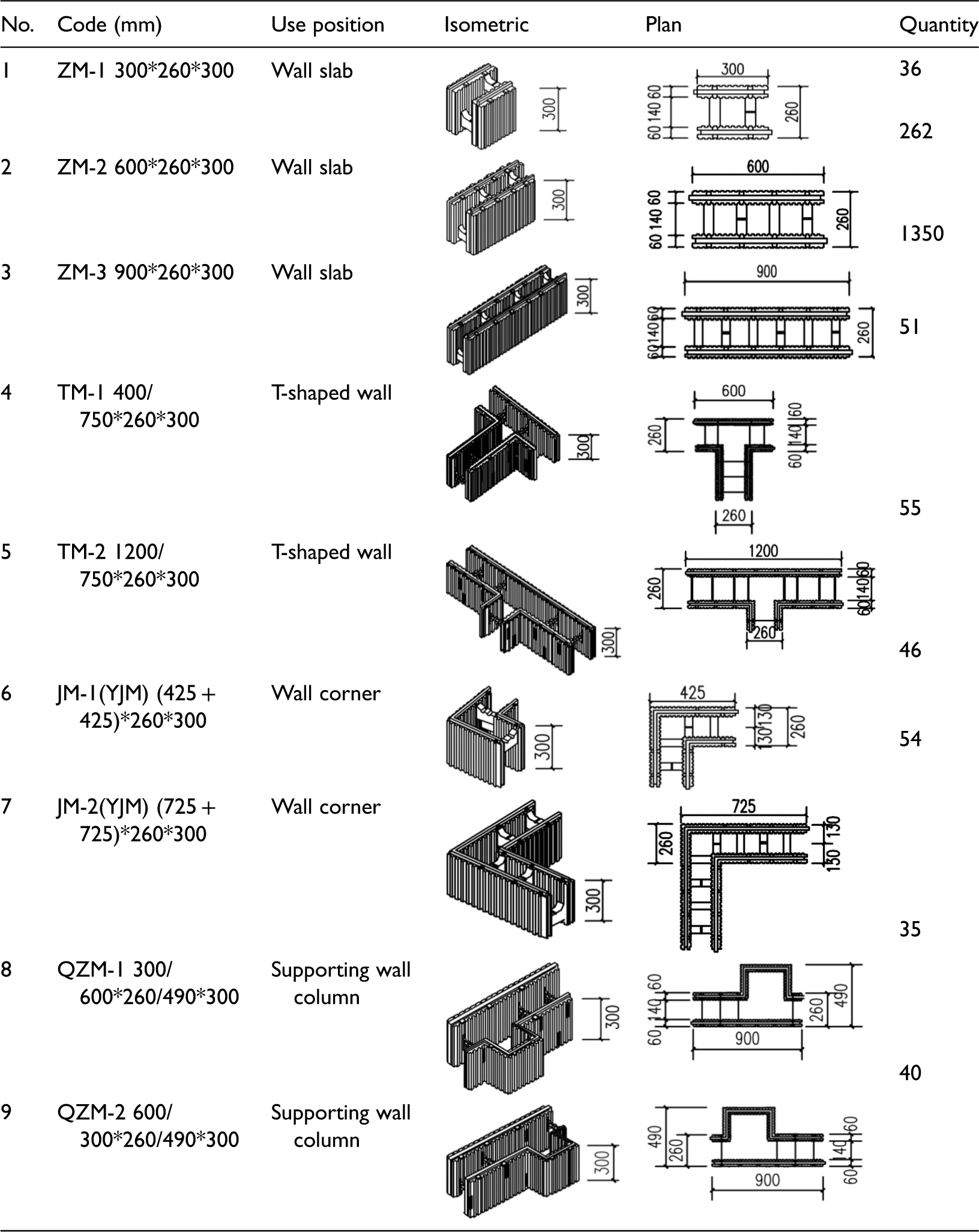
The experimental double-film solar greenhouse is orientated north and south, with north-south span of 8.55 m, ridge height of 5.45 m, back wall height of 3.30 m and length of 49.46 m in the east-west direction. The greenhouse overall area is 413.50 m2 and the ancillary area is 20.16 m2 (as shown in Figure 1). The double film solar greenhouse is enclosed by two-layer semi-circular arc steel skeleton, double polyvinyl chloride (PVC) films, color steel roof and wall together. The integral roof truss welded by two-layer elliptical pipes with a cross-section of 70 mm × 10 mm × 2 mm is reliably welded with the top of the south wall and the north wall to form the main greenhouse structure body. The north-facing roof of the greenhouse use 100 mm thermal insulation color steel plate, which is installed on the reverse slope. The greenhouse envelope includes three parts, the east-west gable wall and the north wall, which are polystyrene foam module cast-in-place concrete thermal insulation shear wall using polystyrene foam module, and the wall thickness is 0.30 m. The different specifications and quantities of polystyrene foam modules used for construction are shown in Table 1. The outer and inner film of the greenhouse roof covering material are made of polyvinyl chloride film. The bottom of the outer film is equipped with a lower vent and insect proof net with a width of 1200 mm, and an upper vent with a width of 1200 mm is installed at the top near the ridge. The vent opening and closing are controlled using 2 motors. At the same time, another control motor can realize the effective opening and closing of the inner film, close the inner film during the daytime to ensure the sufficient photosynthesis of crops, and open the inner film to the top of the south wall at nighttime. The 150 mm thickness composite insulation quilt is installed on the top of the outer side of the inner film as a night insulation layer. It is closed during the day and opened at night to the top of the south wall to form a confined indoor space. Different from the common double-film solar greenhouse at home and abroad with a narrow space formed by the nearly parallel double-films, in this paper, the volume of the thermal buffer zone formed between the inner and outer films is big, which accounts for 45.15% of the total volume of the greenhouse. The thermal buffer zone can collect and store solar energy during the daytime and significantly reduce the heat loss from the inner film planting area to the outside at night, so as to ensure a suitable growing environment for crops in the greenhouse. The structural characteristics of the greenhouse can be clearly seen from the profile of the greenhouse in Figure 2.
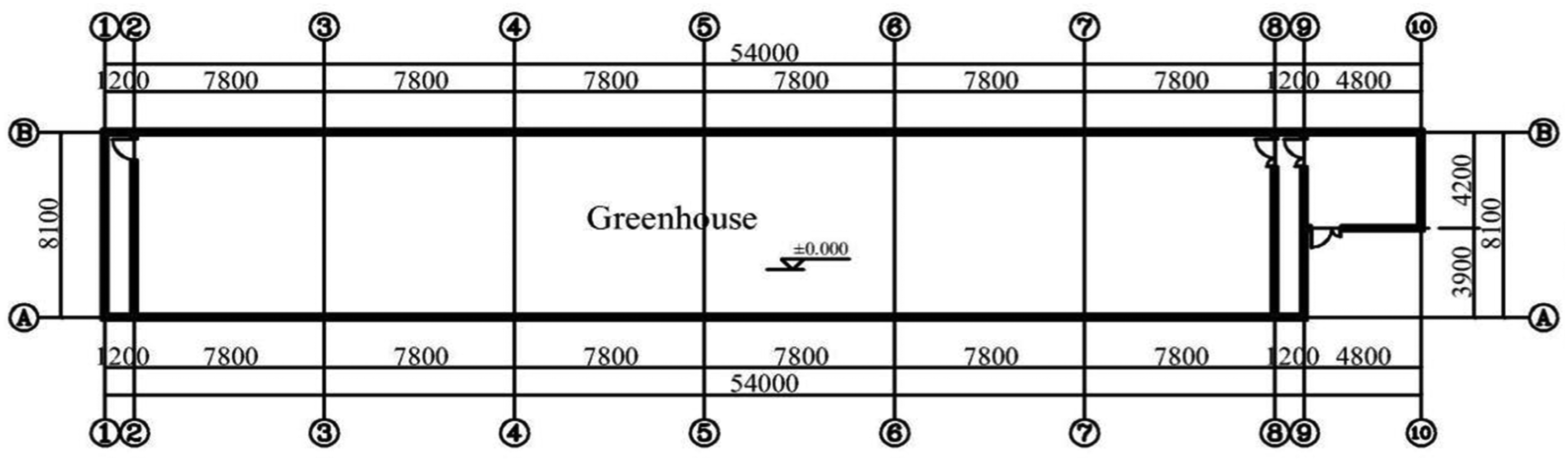
Double film solar greenhouse plan.
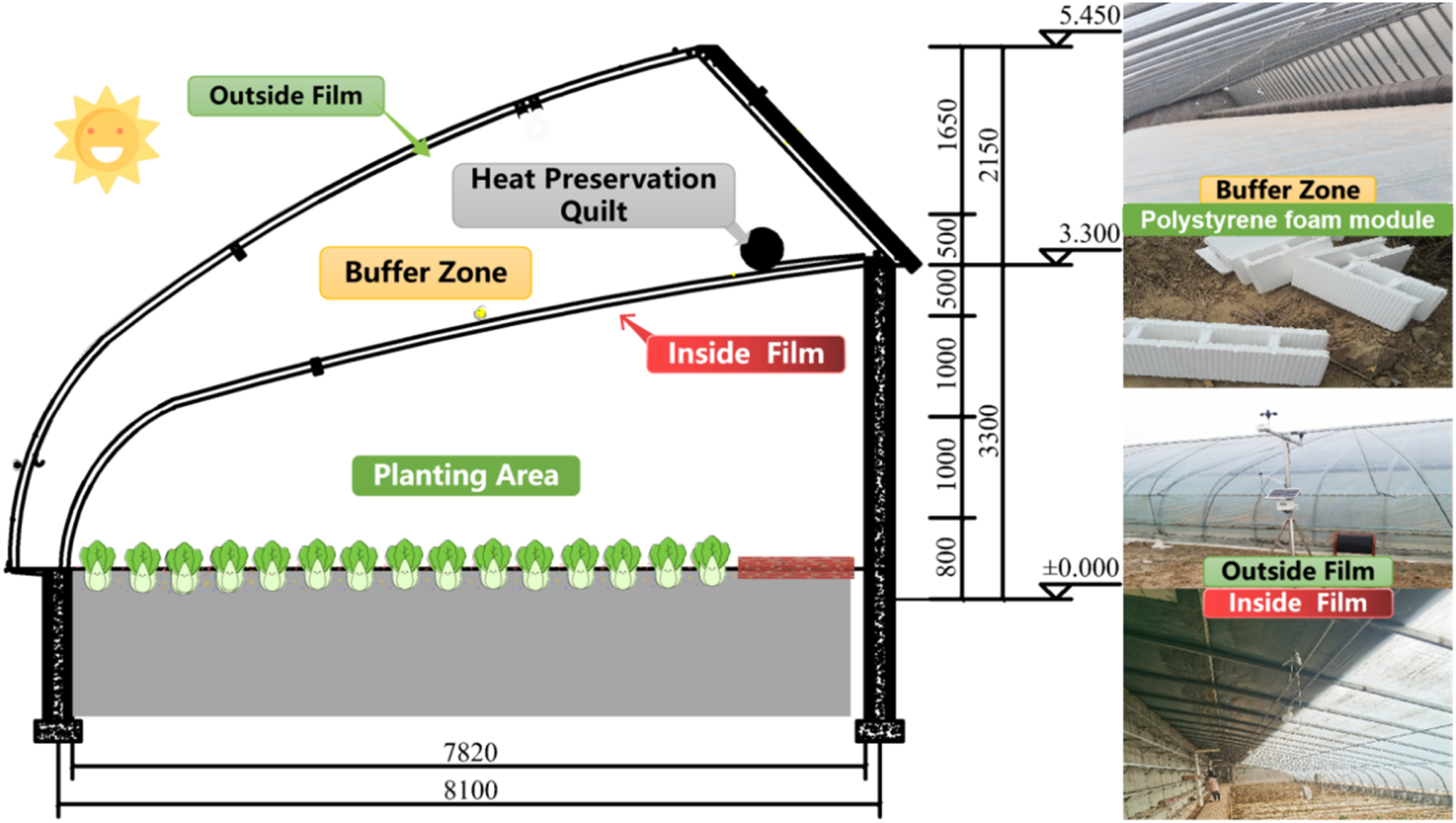
The profile and details of the greenhouse.
Wall polystyrene foam module.
The contrast greenhouse with a single film greenhouse, is located in the same area, which has the same structure and covering materials. The difference between them is the lack of an inner PVC film and form a bigger thermal buffer zone.
Energy balance of the double film solar greenhouse
The double film solar greenhouse is affected by both indoor and outdoor environmental factors, forming a complex energy exchange pattern in the greenhouse. The internal production environment of the greenhouse and its energy changes are affected by outdoor factors such as solar radiation, outdoor temperature and humidity, wind speed and wind direction.
As the incident angle and amount of solar radiation change with time, and the distribution of solar heat obtained inside the greenhouse also varies accordingly. Since the experimental greenhouse does not have active heating equipment to provide energy, changes of outdoor environment have a significant impact on the indoor environment. The main internal factors affecting the energy balance of the greenhouse include the structure and materials, the physical properties of the crops, the respiration, photosynthesis and transpiration of the crops, the heat conduction of the soil surface, the evapotranspiration of the soil surface, and the heat conduction between the greenhouse different covering layers and spaces, that is, the wall, film and the outside environment (Garzoli and Blackwell, 1987). When the solar energy gained by the greenhouse is greater than the energy lost, the greenhouse inner temperature increases, on the contrary, the temperature decreases. When the energy obtained by the greenhouse is equal to the energy dissipated, the greenhouse is in a state of energy dynamic balance, and the energy balance expression at a certain moment is (Ahamed et al., 2018):

Where Qh is the supplemental heating demand which is the difference of heat gain from all heat sources and heat loss from all heat sinks; Qs is the net solar heat gain; Qs−i is the heat exchange between the ground and the indoor greenhouse components; Qnw−i is the heat exchange between the north wall and the indoor greenhouse components; Qec is the heat addition from environmental control systems including supplemental lighting (Qsl), carbon dioxide supply system (QCO2), and air circulation system (Qm); Qloss is the transmission heat loss through the greenhouse envelope including conduction and convection loss (Qt), perimeter loss (Qp), and long-wave radiation loss (Qr); Qinf is the heat transfer caused by air exchange through infiltration, as no active ventilation is usually provided during the heating mode; and Qe is the heat transfer in the process of plant evapotranspiration.
The calculation of each parameter in the above energy balance formula of double film greenhouse is related to indoor and outdoor environmental factors. Therefore, it is necessary to test the indoor environmental factors and study the distribution of them in double-film solar greenhouse in cold regions.
Test content & instruments
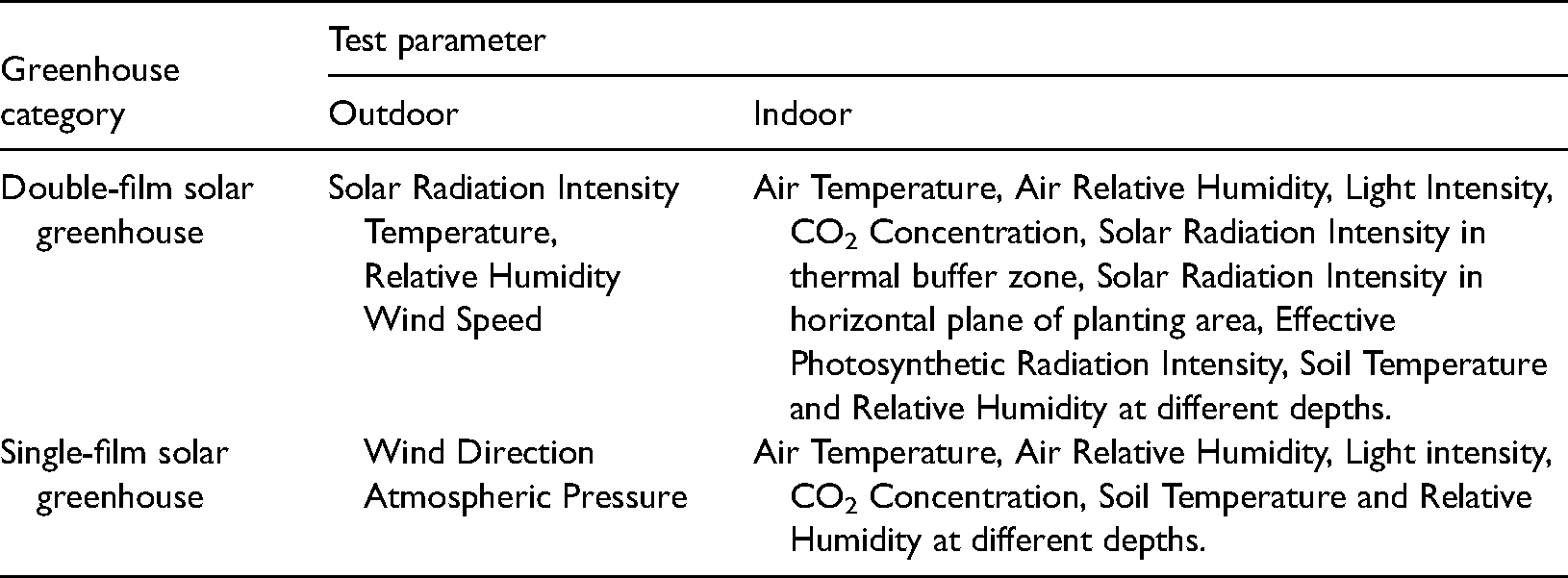
The performance of indoor and outdoor environmental factors should be tested for solar greenhouse comprehensively. The test indicators of the experimental double-film solar greenhouse and the contrast single-film solar greenhouse are shown in Table 2.
Test parameters of experimental greenhouse and contrast greenhouse.
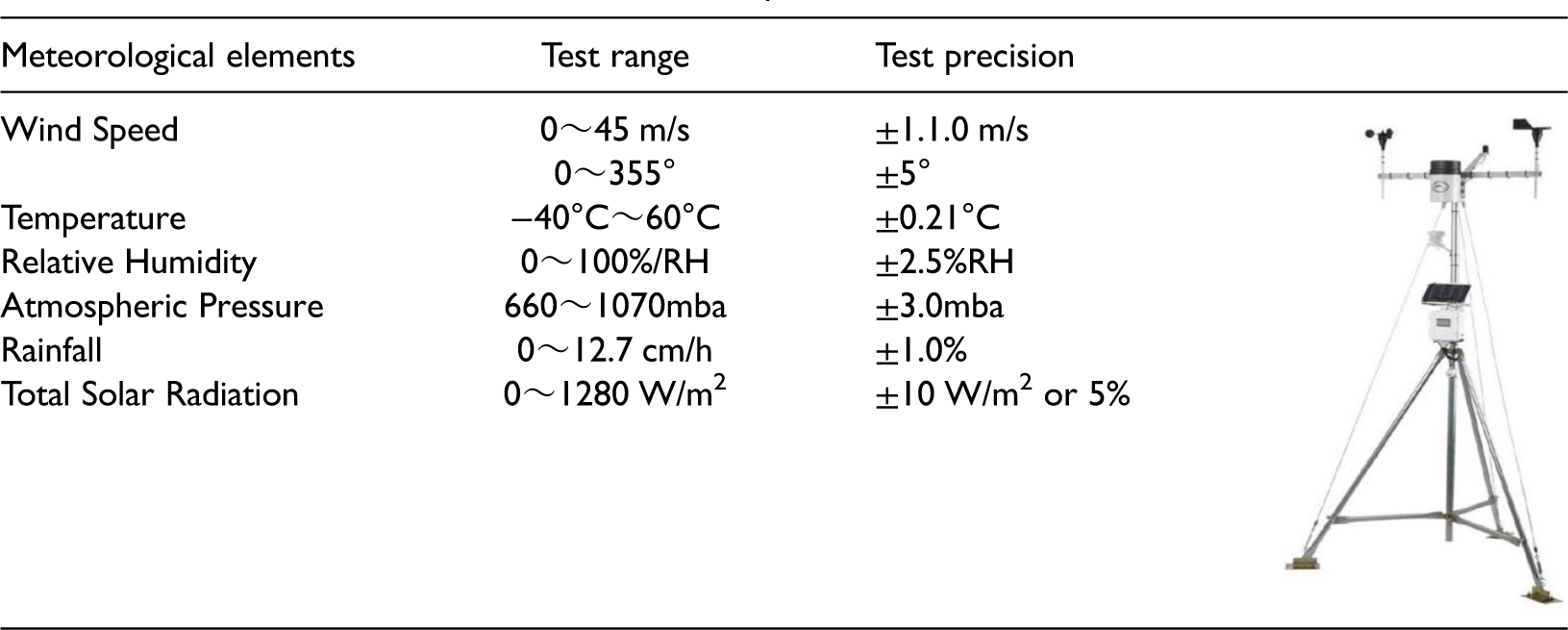
The outdoor environmental factors are mainly collected automatically by the HOBO U30/NRC (sensor parameters in Table 3) small climate monitoring station produced by Onset Company in the United States. The monitoring station can work in the environment of −40°C~60°C.
HOBO U30/NRC weather station sensor parameters.
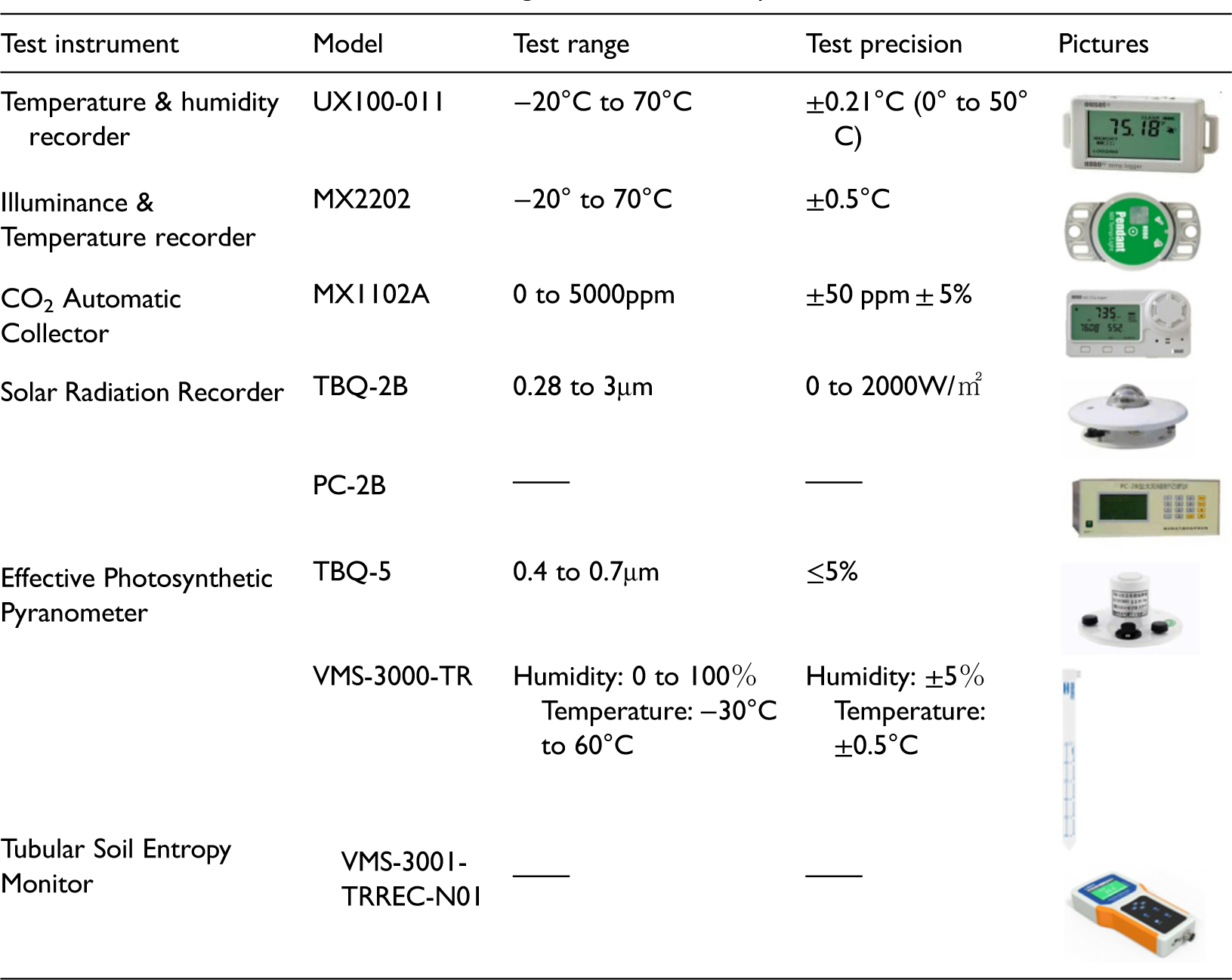
The indoor environmental factors of the experimental greenhouse include air temperature, air relative humidity, light intensity, and CO2 concentration. The temperature and humidity recorder UX100-011, the illuminance & temperature recorder UA-002-64, and the CO2 automatic collector MX1102A, are all produced by Onset Company in the United States to collect and record data. The solar radiation intensity of the thermal buffer zone between the double films, the solar radiation intensity of the horizontal plane of the planting area, and the effective photosynthetic radiation intensity of crops use the standard pyranometer TBQ-2-B, solar radiation recorder PC-2B and effective photosynthetic pyranometer PBQ-5 produced by Jinzhou Sunshine Meteorological Technology Co., Ltd Soil temperature and humidity at different depths were measured by a tubular soil entropy monitor VMS-3000-TR produced by Shandong Weimenshi Technology Co., Ltd All the test equipment are shown in Table 4.
Indoor environmental factors testing instrument sensor parameters.
Experiment scheme
The testing period was from November 2020 to May 2021. The experimental double-film solar greenhouse was divided into five test surfaces A, B, C, D and E from east to west (Figure 3).
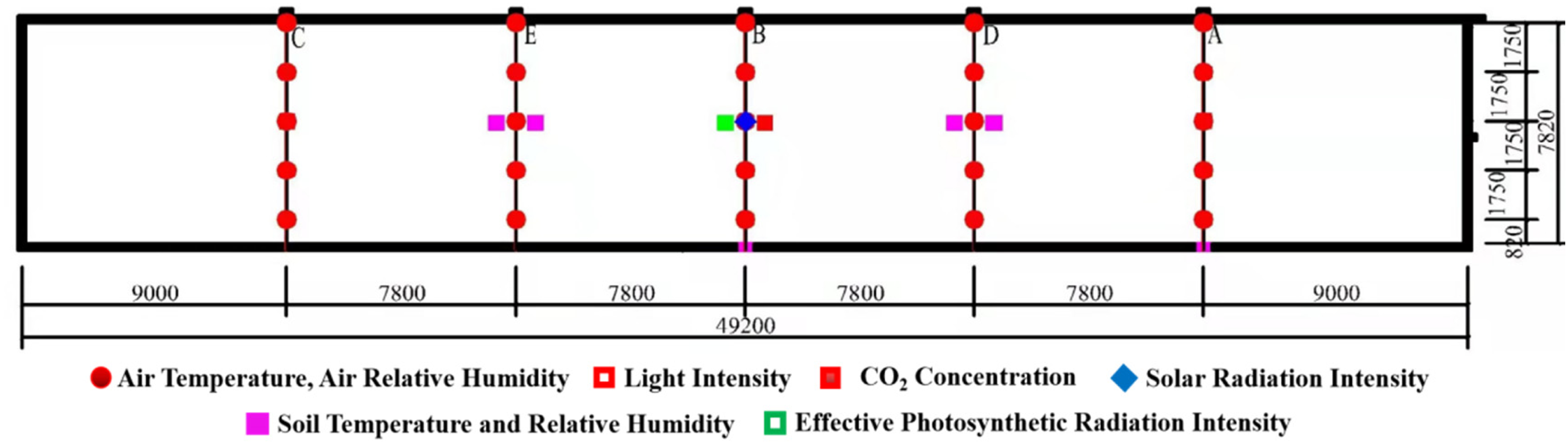
Schematic diagram of the test surface division of the experimental double-film greenhouse.
The test points are arranged in layers in the vertical direction of each test surface, as shown in Figure 4. The measuring 5 points on the first horizontal layer is 0.5 m higher than soil surface. And the second horizontal layer is 1.5 m higher than soil surface, also measuring 5 points. Obviously, the third layer measuring 3 points is 2.5 m higher than the soil surface. Moreover, the fourth floor measuring only 1 point is located at the top of the inner side of the inside film of the greenhouse. 2 measuring points as the fifth test layer arranged in the thermal buffer zone. The distance between measuring points of each test plane from north to south is 1.75 m. Among them, the A and C test surfaces are all equipped with air temperature and humidity sensors, in the A-2-3 points also equipped with light intensity test sensors simultaneously. In addition to the air temperature and humidity sensors arranged on the test surface B, a pyranometer and an automatic CO2 collector are installed at the position of B-5-2, and in B-2-3 fixed a pyranometer, an effective photosynthetic irradiance meter and light intensity sensor at the same time. The two test surfaces D and E are equipped with CO2 automatic collector and soil entropy meter. The soil temperature and humidity measuring points are arranged as shown in Figure 4(d). Take B-1-1 as an example for the naming method of measuring points, which means the first measuring point on the first level of the horizontal test layer on the B test surface. Due to the insufficient number of testing instruments, only the middle test surface was selected for the contrast greenhouse.
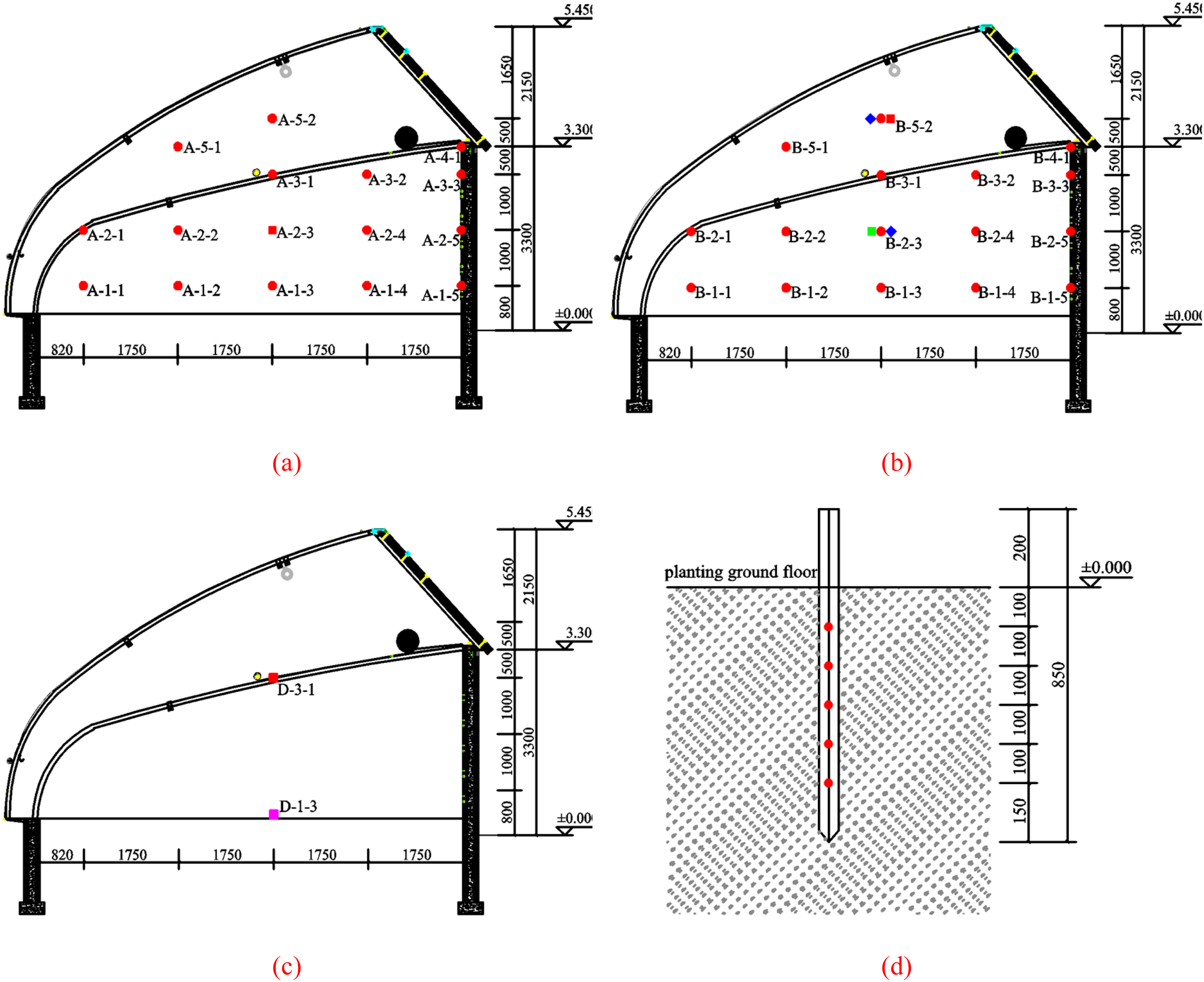
Schematic diagram of the layout of measuring points on test surfaces A and C (a) and test surface B (b), the arrangement of measuring points on D and E test surfaces (c) and soil temperature and humidity (d).
Solar greenhouse management methods
In winter, the double-film solar greenhouse is rolled up during the daytime, and the inner shed film is uncovered when the indoor temperature reaches the upper limit of the suitable temperature for crop growth. After the inner shed film opened, the indoor temperature first drops and then rises with the increase of solar radiation. When indoor temperature is higher than the upper limit of the suitable temperature for crop growth, open the upper vent of the outer film, and cover the inner shed film when the insulation quilt is placed at night. During the experiment, peppers were grown in the greenhouse, its optimum growth temperature is 15°C to 34°C. In the seedling stage, 22°C to 30°C during the daytime and 15°C to 18°C at nighttime are the best growth temperature requirements. Open the insulation quilt at 9:00 in the morning on a sunny day, when the indoor temperature is higher than 30°C, the inner film will be opened, from now on the room temperature will continue to rise. When it is higher than 34°C, open the upper vent and control the indoor temperature within the range of 22°C to 30°C. The ventilation time is about 1.5 to 2 h when the upper vent is continuously opened every day in winter coldest time. On the afternoon, as the solar radiation decreasing, the indoor temperature gradually reduced and close upper vent when the indoor temperature drops to 25°C. After that, the indoor temperature will still fluctuate, first going up and then going down. When it drops to 28°C, the inner film is closed. At this time, the thermal buffer zone between the inner and outer films still stores a certain amount of solar thermal energy. At around 5:00 p.m., the insulation quilt is turned off to complete the management control the whole day. When the outside temperature is too low on snowy days, do not remove the inner shed film during the day. The contrast single layer film greenhouse is covered and insulated according to the normal greenhouse management method.
Data analysis and evaluation methods
The observation data was selected and processed with Origin 2021 to obtain the dynamic changes of the indoor and outdoor temperature, humidity and solar radiation in the contrast single-layer film greenhouse and double-film greenhouse. The characteristics of environmental factors of single layer and double-film solar greenhouse were analyzed and evaluated.
Results and discussion
Selecting the data analysis of the coldest day during the entire experimental period. Compared the outdoor temperature test values of the whole test stage, the lowest average outdoor temperature for the whole day on January 7, 2021 was −15.34°C, and the minimum outdoor temperature was −20.22°C at 8:30 in the morning.
Comparative analysis of indoor and outdoor environmental factors in double film solar greenhouse
The test day was cloudy, and the whole test time was from 00:00 to 24:00 on January 7, 2021. Data collection and analysis were carried out on environmental factors such as indoor and outdoor temperature, relative humidity, solar irradiation and wind speed, as shown in Figures 5–7.
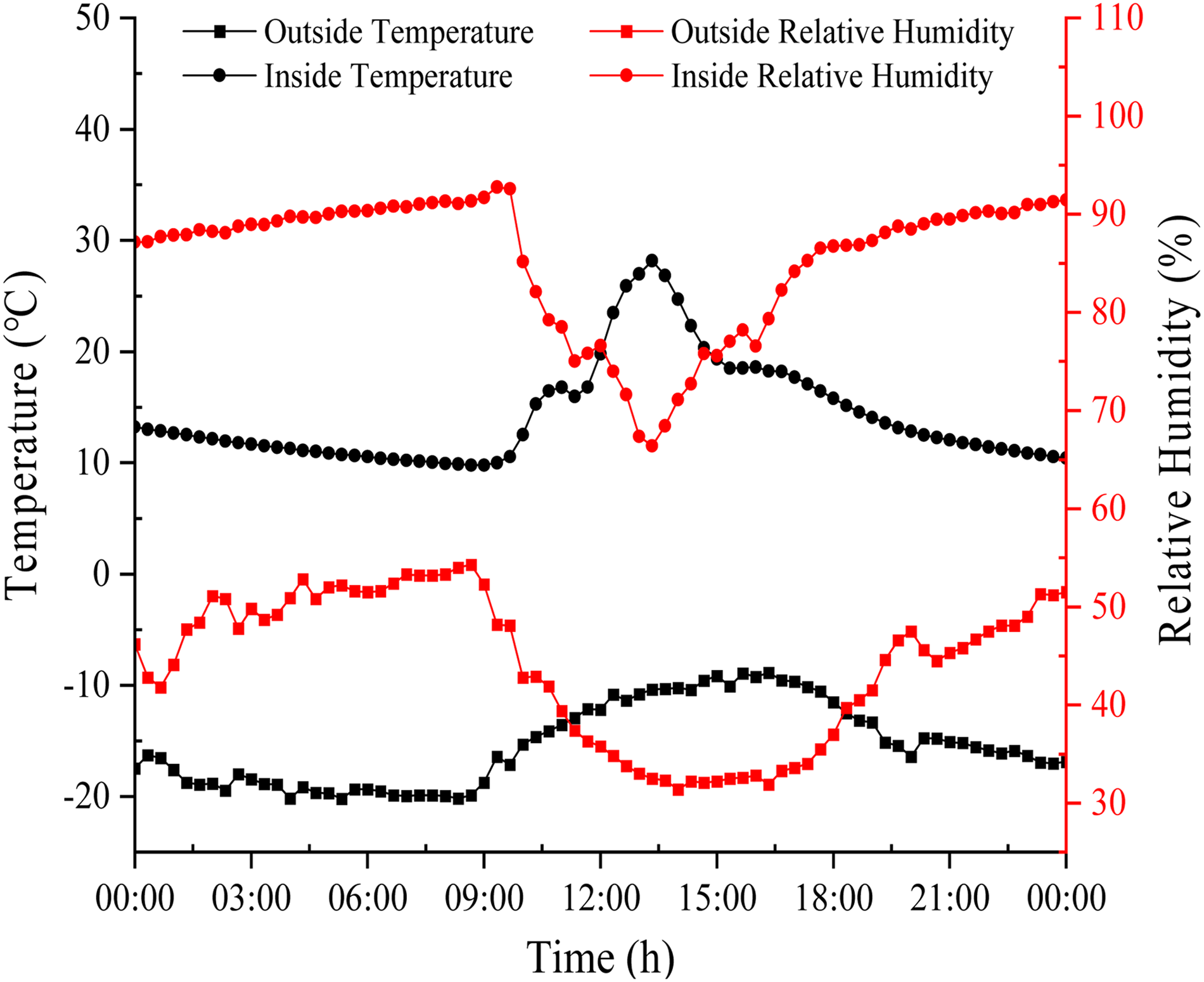
Temperature and relative humidity variation curve inside and outside of the double-film solar greenhouse.
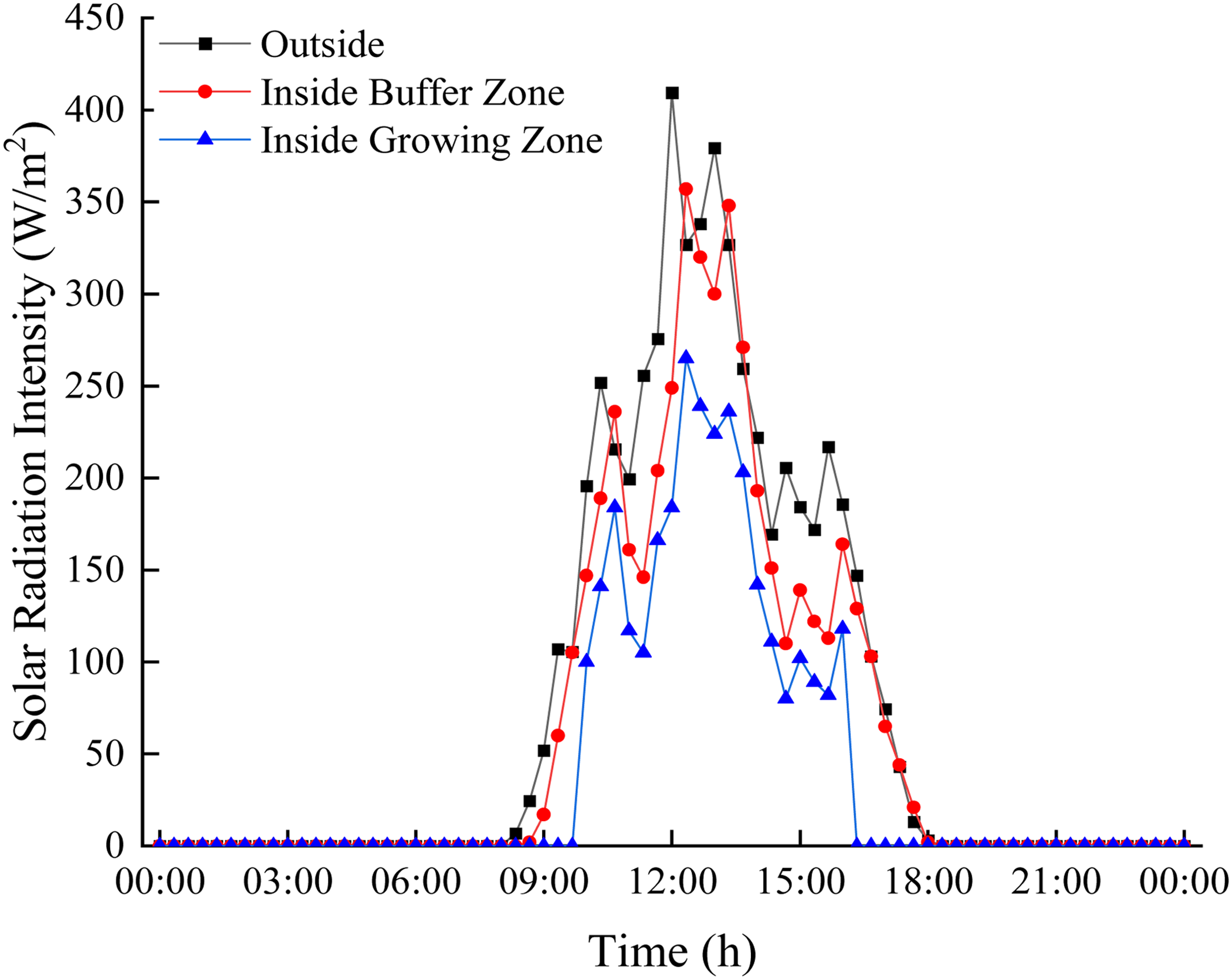
Variation curve of indoor and outdoor solar irradiation intensity.
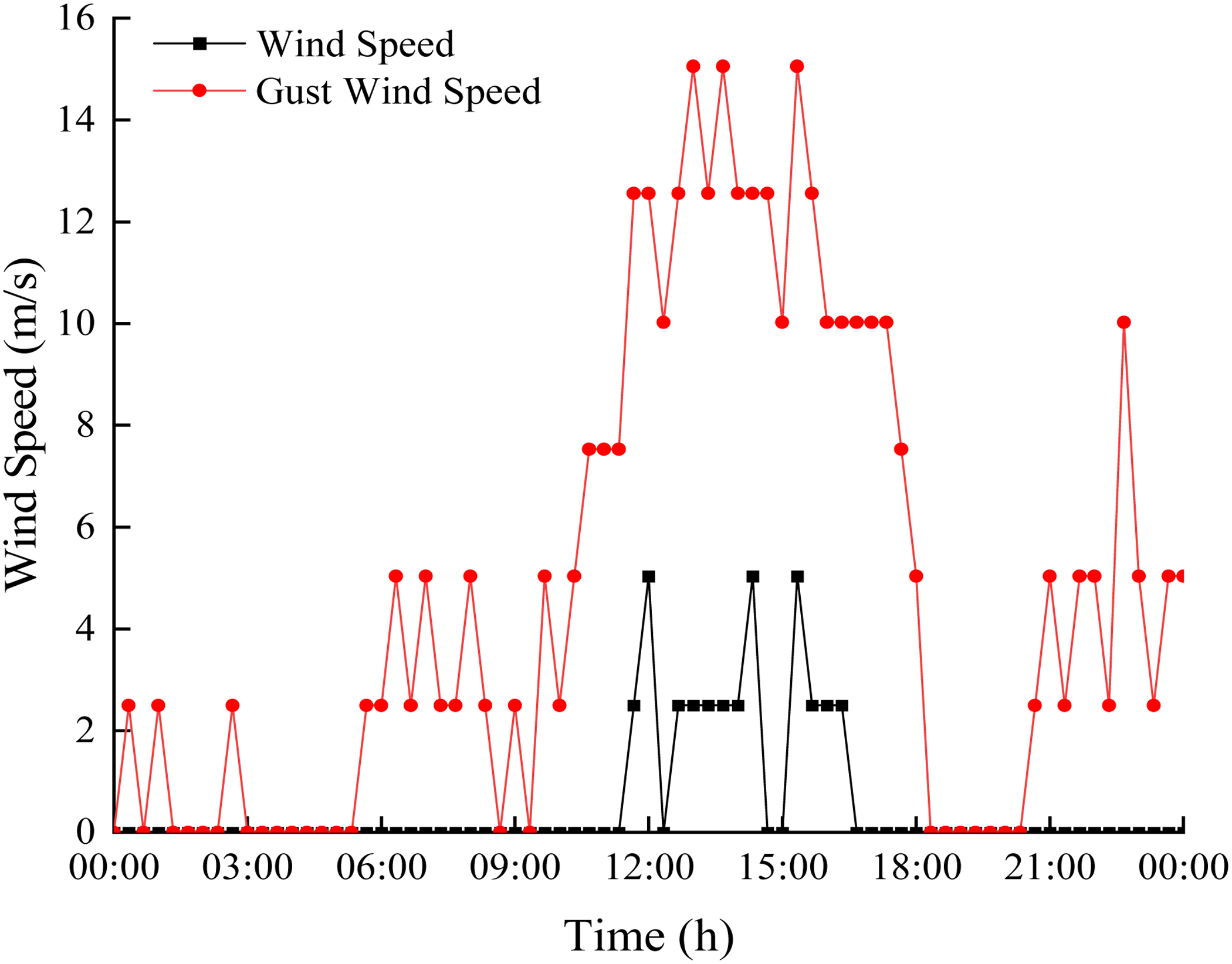
Variation curve of outdoor wind speed.
The internal temperature of double-film solar greenhouse changes with the external temperature, and the overall trend remains the same. The maximum outdoor temperature is −8.86°C, the minimum temperature is −20.22°C, and the average temperature is −15.34°C. The highest indoor temperature is 28.18°C, and the lowest 9.8°C accordingly, the average temperature is 14.33°C, and the average temperature difference throughout the day is 29.67°C. There is a “delay” phenomenon in the change of indoor and outdoor humidity. With the enhancement of solar radiation during the day, the humidity inside of the double-film solar greenhouse decreases firstly, and the outdoor humidity begins to reduce in about 1 h later, and the change of outdoor humidity lags behind. The maximum outdoor humidity is 54.3%, the minimum humidity is 41.80%, and the average value is 48.43%. The highest indoor humidity is 92.76%, the lowest humidity is 81.18%, and the average humidity is 85.42%.
The trend of outdoor solar radiation changes is similar. Over time, the amount of radiation received by the greenhouse increases, which improve the average temperature inside the greenhouse before ventilation. Because a large thermal buffer zone is designed between the two layers of the double-film solar greenhouse, the solar radiation intensity in the growing area of vegetable crops is reduced by the influence of the outer film. The outdoor solar radiation intensity is higher than that of the thermal buffer zone, and the solar radiation intensity of the thermal buffer zone is higher than the vegetable crop growing area.
The data of the outdoor wind speed is organized to obtain the outdoor wind speed change curve, as shown in Figure 7. The outdoor wind speed changes little during the day, and basically maintains an average value about 2.5 m/s. The outdoor wind speed has no significant effect on the temperature and humidity distribution in the greenhouse under the state of water and heat balance.
Indoor environment temperature and relative humidity analysis
Indoor environmental temperature and relative humidity in solar greenhouse is an important factor affecting crop growth. In order to fully reflect the change and distribution of indoor temperature and humidity in the double-film solar greenhouse, the average temperature and relative humidity changes of 5 horizontal layers of air on the three test vertical surfaces of the double-film solar greenhouse on the coldest day are analyzed. The average indoor temperature and relative humidity value are calculated from the average value recorded by the temperature and relative humidity sensors at a height of 1.5 m from the indoor ground. The test and analysis results of air temperature and relative humidity in three horizontal planes of 0.5 m, 1.5 m and 2.5 m along indoor ground are shown in Figures 8–10.
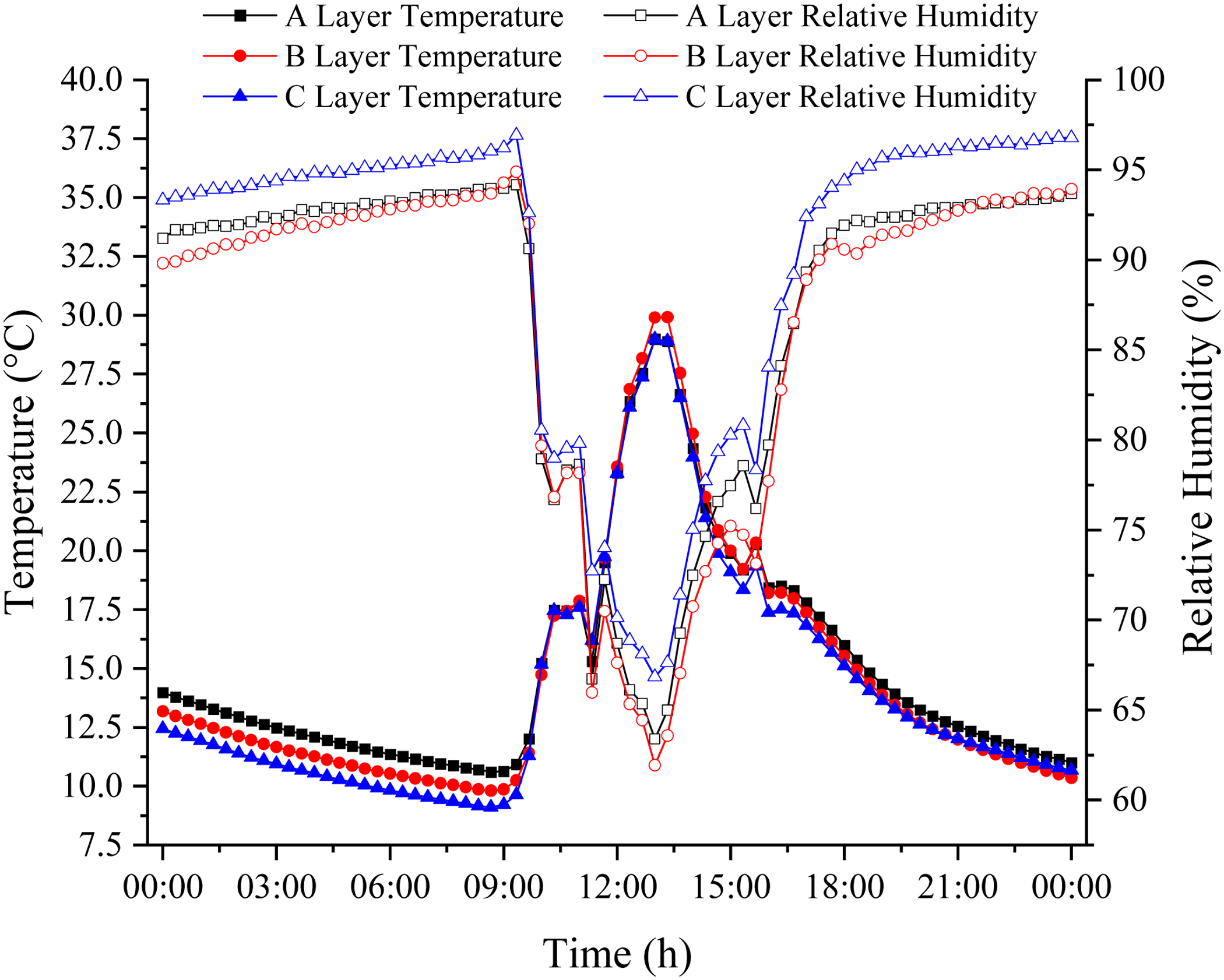
Variation curve of temperature and relative humidity in the double-film greenhouse at a height of 0.5 m.
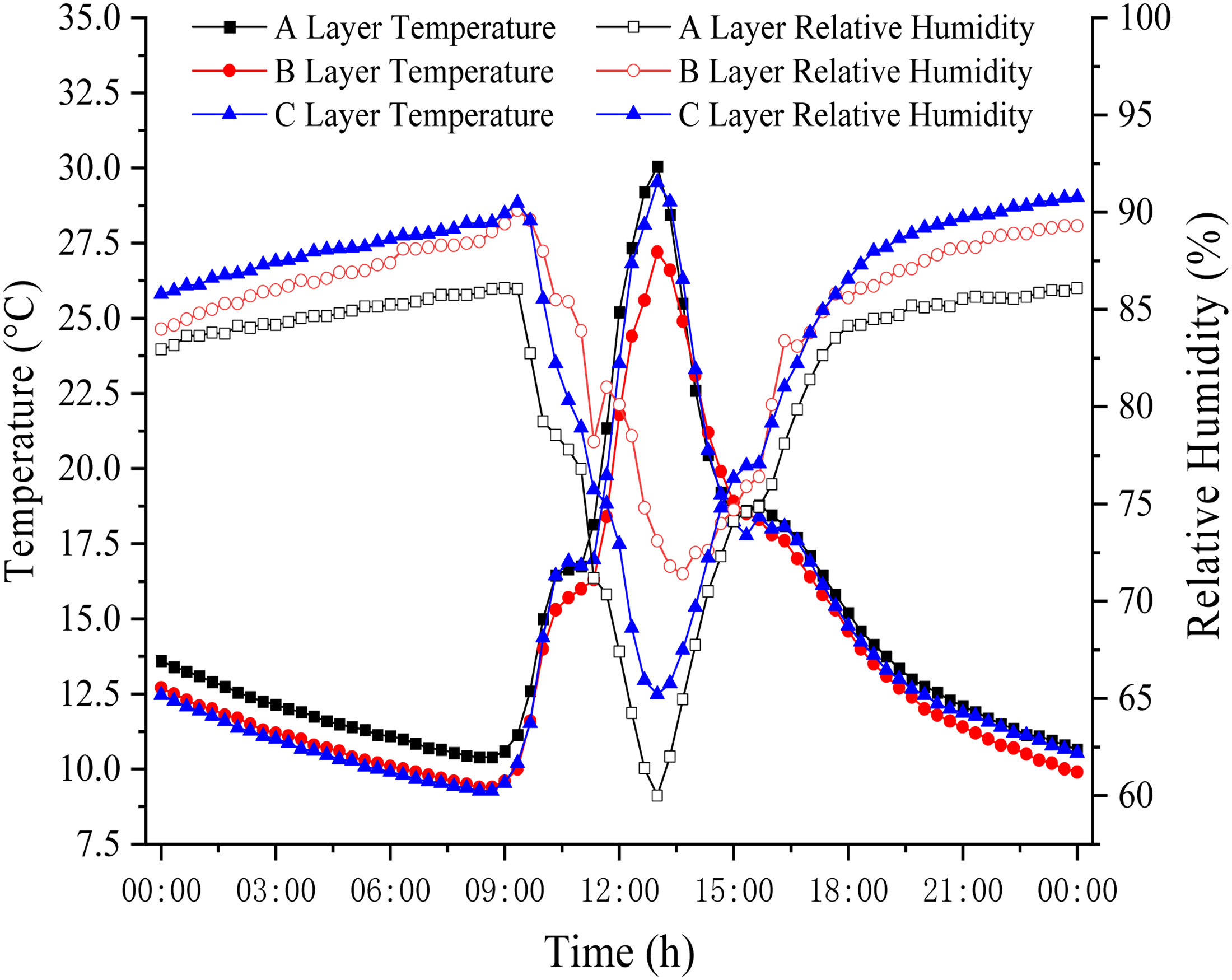
Variation curve of temperature and relative humidity in the greenhouse at a height of 2.5 m.
Figure 8 shows the variation of the average temperature and relative humidity in the greenhouse with time on a level 0.5 m above the indoor ground. The change trend of temperature and relative humidity of three indoor sections are basically same.
During the time before the insulation quilt is closed in the morning and after the insulation quilt is opened in the afternoon, the temperature of the A test surface is higher than that of the B and C surfaces, and the relative humidity of C surface is higher than A and B. When the insulation quilt is turned off, the sunlight enters the double-film greenhouse, and the indoor temperature increases, the relative humidity decreases synchronously. The temperature of the B surface is slightly higher than that of the A and C. After the upper vent is turned on around noon, the indoor relative humidity is significantly decreased. The relative humidity reduction trend on the three test surfaces is similar, and the lowest relative humidity value was 61.93%, which appears on the surface B. The average indoor temperature on the east side is slightly higher than that on the west side by 0.83°C throughout the day, and the average relative humidity on the east side is 2.59% lower than that on the west side. At 8:40 in the morning, the indoor temperature is the lowest, with a minimum temperature of 9.10°C. The highest temperature, which was 29.92°C, appear on the surface B at 13:30. After the greenhouse is turned on upper vent, the indoor temperature drops immediately. After the insulation quilt is closed, the relative humidity of the greenhouse drops, among which the relative humidity is low from 11:00 to 16:00, basically between 57.5% and 65%. At 13:00, the lowest indoor relative humidity value appears on the surface B, whose value is 61.93%. The indoor relative humidity at night is between 90% and 97.5%.
Figure 9 shows the variation of the average temperature and humidity in the double-film greenhouse with time on a level 1.5 m above the indoor ground. The indoor temperature and relative humidity are basically the same as the changes at a height of 0.5 m. The indoor temperature is the lowest at 8:40 in the morning, with a minimum temperature of 9.13°C. At 13:30 noon, the maximum temperature on test surface C is 30.05°C. The lowest value of indoor relative humidity throughout the day appeared on the surface C, which is 59.30%. After the insulation is turned on, the solar radiation disappears, the temperature drops and the relative humidity rises. The indoor relative humidity at night is between 87.5% and 95%, which is generally lower than the relative humidity value on the 0.5 m horizontal layer.
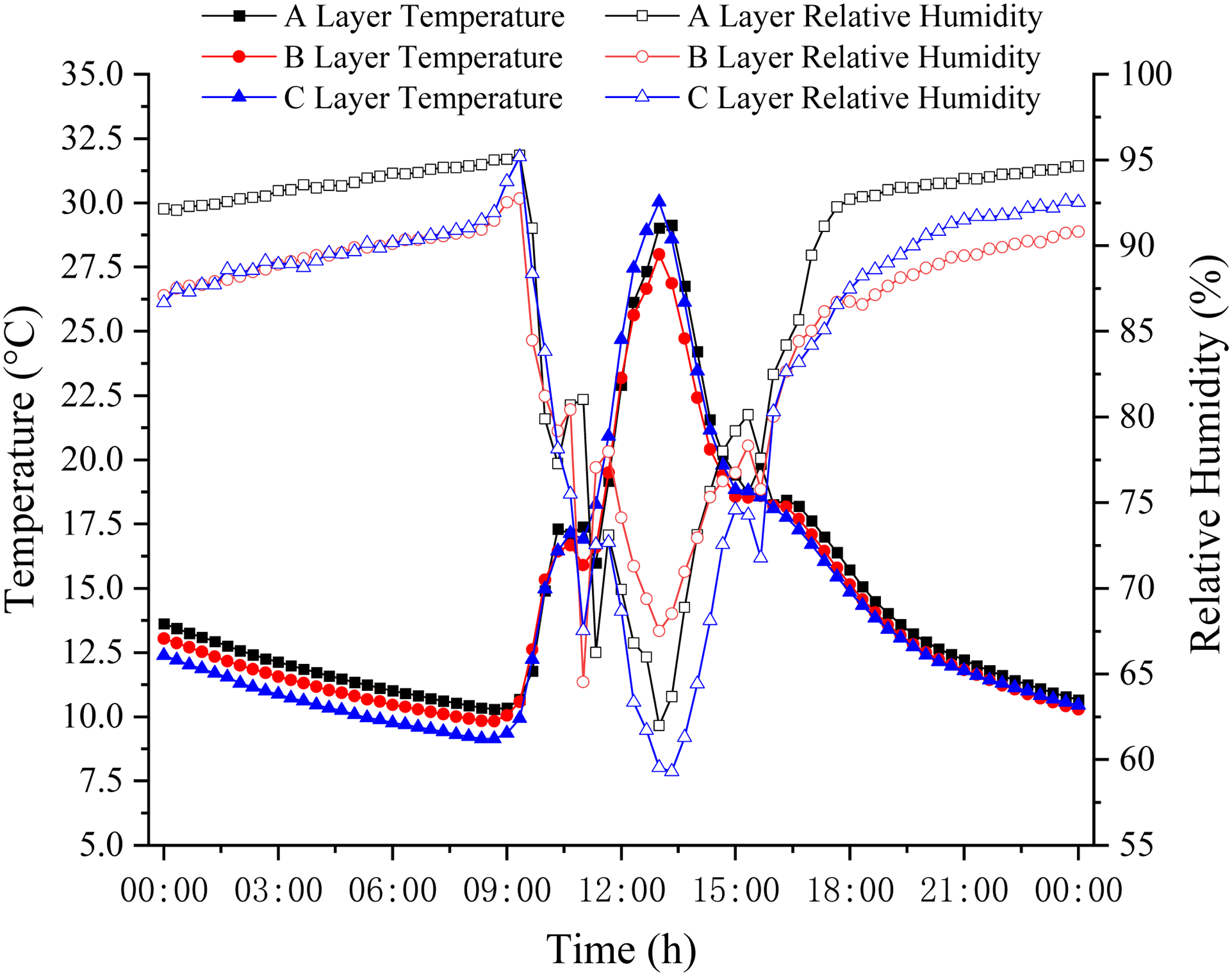
Variation curve of temperature and relative humidity in the double-film greenhouse at a height of 1.5 m.
Figure 10 shows the variation of the average temperature and relative humidity of the indoor environment with time on a level 2.5 m above the indoor ground, and the variation characteristics of indoor temperature and relative humidity are similar to the front 0.5 m and 1.5 m horizontal planes, but the temperature and relative humidity change difference of each section decreases. The highest temperature value appears on the A test surface, which is 30.05°C. During the time period before the insulation quilt is closed and after it opened, the relative humidity change is similar to that on the 0.5 m level.
Comprehensively analyze the variation characteristics of temperature and relative humidity with time on the three test surfaces A, B and C of the three horizontal planes in 0.5 m, 1.5 m and 2.5 m respectively. It is obvious that during the opening period of the insulation quilt, the temperature of test surface A in the three height directions is higher than surface B and C. Before and after the opening and closing time of up vent in daytime, the change of temperature and relative humidity fluctuates greatly, but the change fluctuation at 2.5 m is weaker than that at 0. 5 m and 1.5 m. The relative humidity of test surface A on the 0.5 m horizontal layer is higher than the B and C test surfaces during the day when the thermal insulation quilt is closed, and the relative humidity of test surface B on the 1.5 m and 2.5 m horizontal planes is higher than that of test surfaces A and C.
In order to further accurately analyze the variation law of air temperature and relative humidity over the vertical direction in the greenhouse, the data analysis of the four vertical measuring points in the middle of the B test surface and the corresponding four measuring points on the inner side of the north wall on the B test surface are shown in Figures 11 and 12.
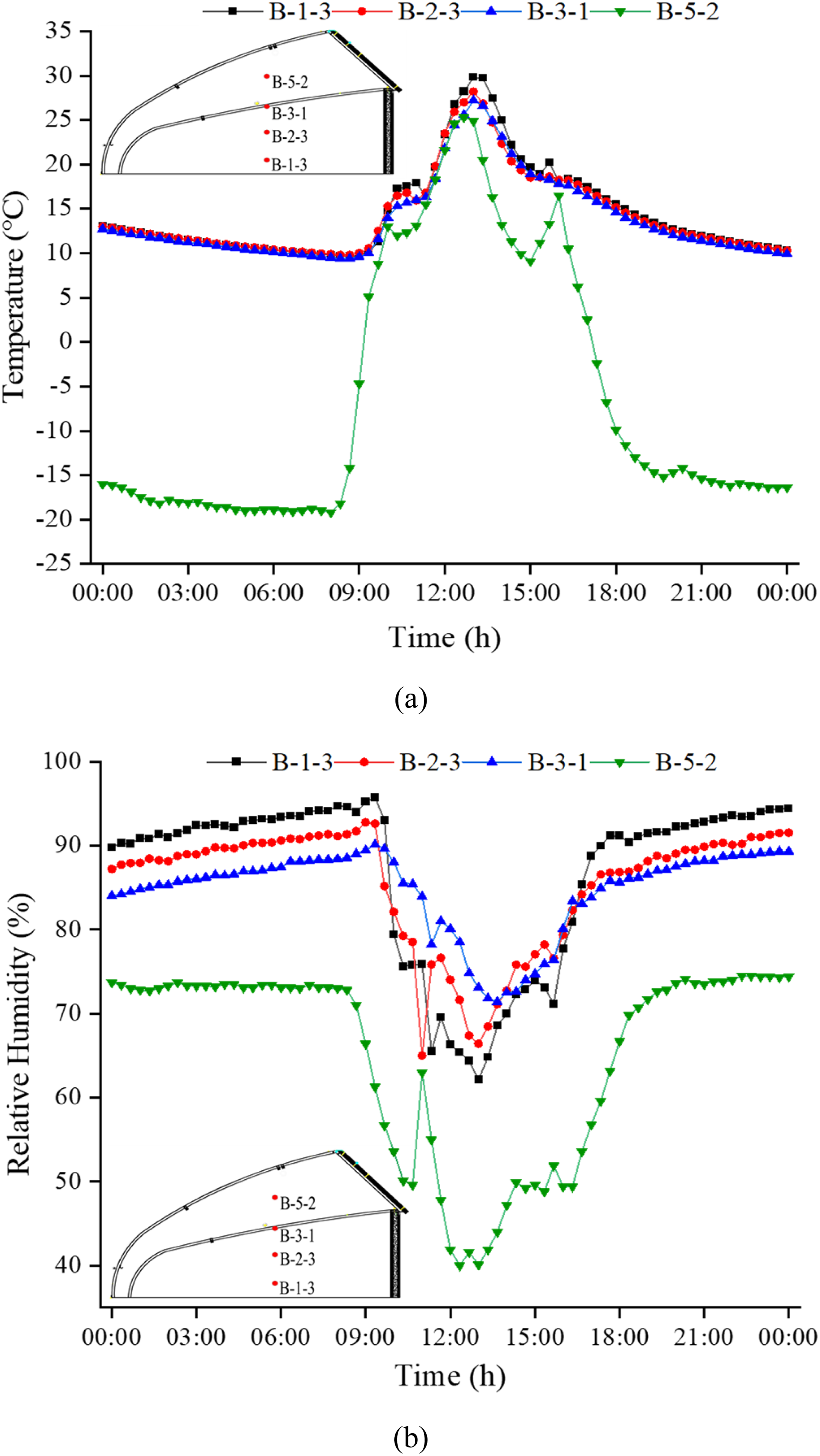
Temperature (a) and relative humidity (b) variation curve of the vertical line in the middle of the surface B.
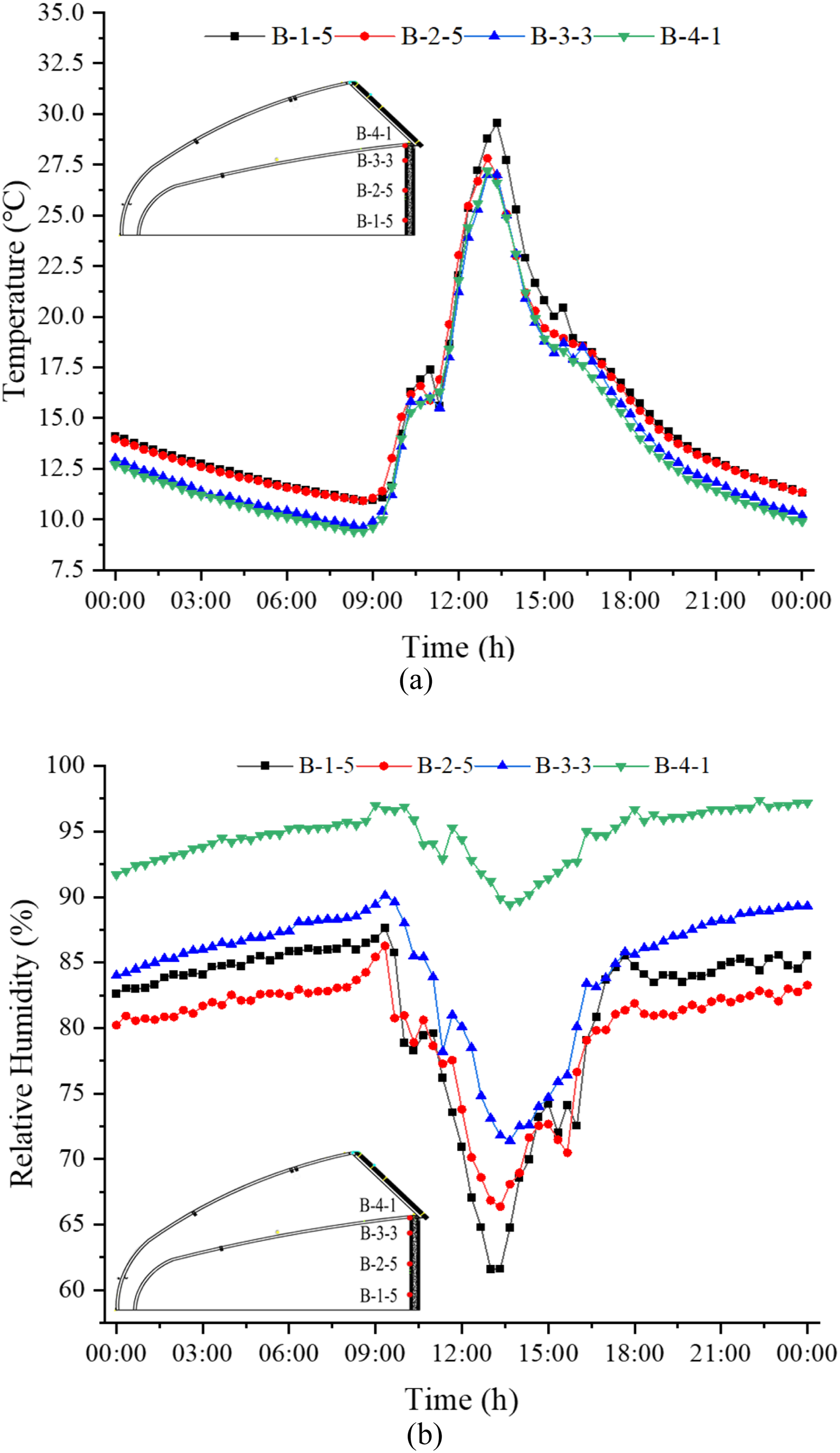
Temperature (a) and relative humidity (b) variation curve of vertical line on the inner surface of north wall in surface B.
Figure 11 shows the variation trend of air temperature and relative humidity with time at four vertical measuring points in the middle of test surface B. The air temperature of the four vertical measuring points in the middle of the test surface gradually decreases from low to high, and the relative humidity first increases and then decreases. The temperature variation characteristics of the three indoor measuring points are similar. The temperature change trend of the thermal buffer zone between the double films is similar to indoor space, but the lowest average temperature is −19.2°C at 8:00 a.m., which is almost close to the outdoor air temperature of −19.9°C. At 8:20 a.m., the lowest outdoor ambient temperature is −20.17°C, while the average temperature in the thermal buffer zone is −18.63°C. At 8:40 a.m., the indoor temperature is the lowest by 9.81°C. When the insulation quilt is turned off, with the enhancement of solar irradiation, the indoor and thermal buffer zone temperature increase significantly. At 12:40, the thermal buffer zone temperature reaches the maximum of 25.30°C and the relative humidity drops to the minimum of 40.1%. At 13:00, the indoor temperature reaches the maximum value of 29.80°C, and the average indoor relative humidity decrease to 62.16%. With the decrease of outdoor temperature, the thermal buffer zone temperature suddenly decreases to 9.10°C at 15:00. When the up vent is closed, the temperature in the thermal buffer zone rises rapidly again, reached to 16.50°C at 16:00, and finally decreases significantly. At 10:40 am, the inner film is closed, and the indoor planting space and thermal buffer zone connect together, the relative humidity in the thermal buffer area change significantly, increasing from 49.6% to 63%. Additionally, the maximum value of indoor air temperature appears about 20 min later than the thermal buffer zone, and the minimum value of air relative humidity also appears the same time delay.
Figure 12 shows the variation trend of air temperature and relative humidity with time at four vertical measuring points on the inner surface of the north wall of test plane B. The temperature and relative humidity changes of the four indoor measuring points are similar. The indoor temperature is the lowest at 8:20 a.m., and the minimum temperature is 8.20°C. When the insulation quilt is closed, with the increase of solar radiation, the indoor temperature improves significantly and the humidity decreases. The temperature reaches a maximum of 25.36°C at 12:20, and the humidity drops to a minimum of 56.88% at 13:00. During the period from the day before the insulation quilt is turned on until it is closed on the second day, the air temperature of the 4 measuring points gradually decreases from low to high, and the highest point B-4-1 have the biggest humidity. In addition, the measuring point B-3-3 at 2.5 m have the highest humidity, which is higher than the other two measuring points, the measuring point B-2-5 at 1.5 m from the ground has the lowest humidity. During the period from the closing of the insulation quilt to the opening of the day, the air temperature and humidity of the four measuring points gradually decrease from low to high, and the humidity of the highest point B-4-1 is the largest, and the change range is smaller than that of the other three measuring points.
According to the above analysis, it is found obviously that the temperature and relative humidity distribution of different levels in the greenhouse has similar characteristics over time. The temperature and humidity of the same level have little difference, and the average temperature on the east is slightly higher than the west, the average humidity on the east is lower than the west simultaneously. Differences in temperature and humidity changes is caused by the activities of test personnel activities in the east management room (accommodation, cooking, etc.). There are differences in temperature and humidity at different levels. The higher the distance from the indoor ground, the lower the average temperature and humidity, but the lowest indoor average temperature is higher than 9.1°C, and the lowest average humidity higher than 60%. The indoor air has a suitable humid and thermal indoor environment, which is more conducive to crop growth in double-film solar greenhouse.
Indoor Co2 concentration analysis
The CO2 concentration is one of the main factor affecting the photosynthesis intensity of crops. Appropriate concentration of CO2 can promote the growth of crop roots and seedlings, thicken crop leaves, reduce pore density, conductance and transpiration rate, increase water use efficiency, and enhance crop antioxidant capacity. Different photosynthetic pathways and varieties of crops have different responses to CO2 concentration. Therefore, it is necessary to test and analyze the change of indoor CO2 concentration.
Figure 13 shows the change of CO2 concentration with time at 1.5 m and 3.5 m of thermal buffer zone. It can be found from the figure that the overall change trend of CO2 concentration is consistent. The CO2 concentration inside the greenhouse is higher than the thermal buffer zone throughout the day, which is due to the respiration of crops at night, producing CO2 and emits it to the indoor environment. When the insulation quilt is closed, the CO2 concentration in both spaces is significantly reduced. However, because it is cloudy, the second layer of film is not opened, and the three curve do not cross. When it is sunny, as the indoor temperature increase, the second film open, the two spaces are connected together, and the CO2 concentration is similar. With the photosynthesis of plants in the second film growing zone during the day, the indoor CO2 concentration continue to decrease, with the lowest value of 420 ppm. After the insulation quilt is turned on, the plant stops photosynthesis and the CO2 concentration continues to rise.
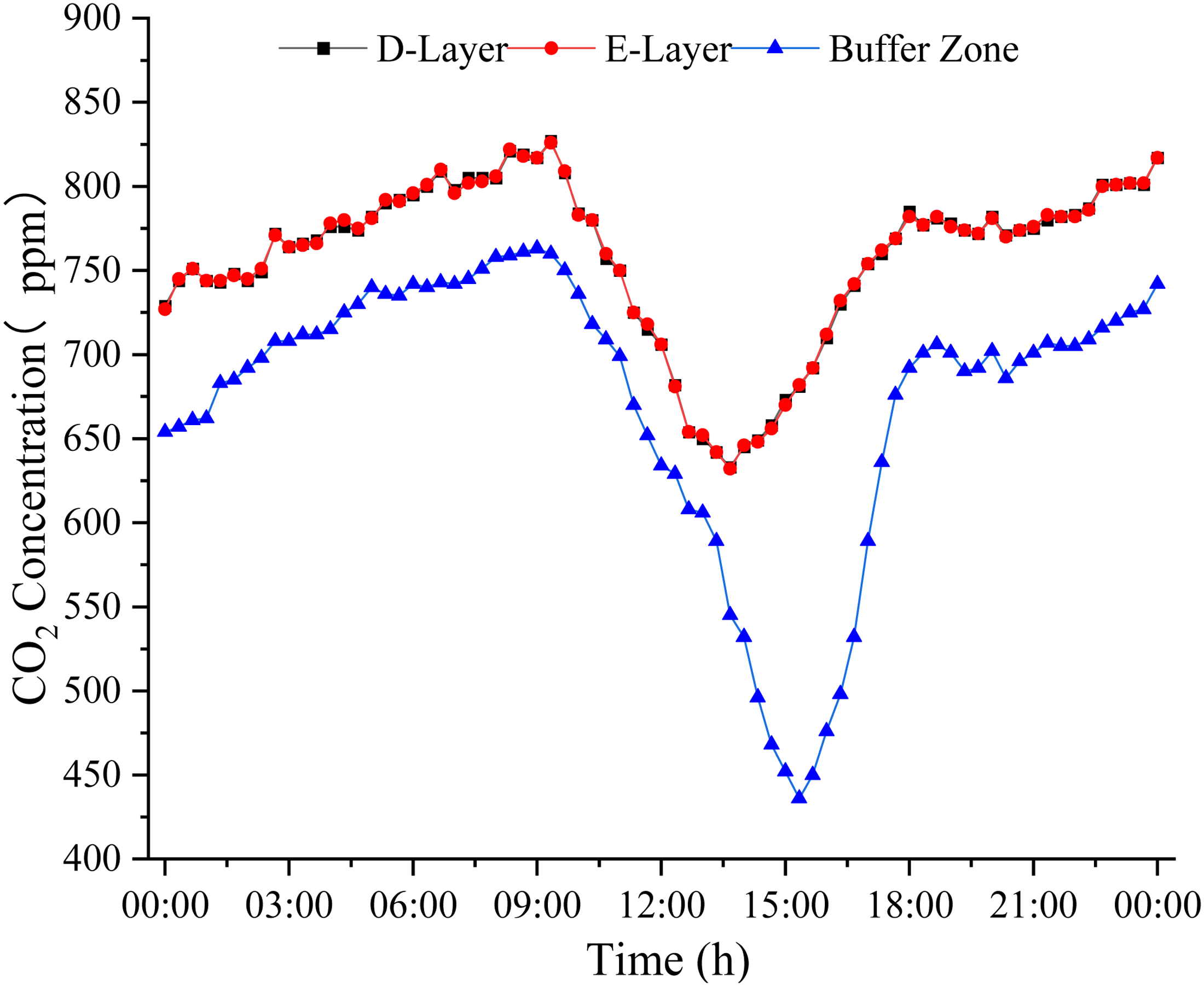
Variation curve of CO2 concentration.
Indoor effective photosynthetic irradiance and light intensity
Figure 14 shows the variation of the effective photosynthetic radiation intensity and light intensity with time in the double film greenhouse. Although the test day is cloudy and the greenhouse insulation quilt is turned off, the indoor effective photosynthetic radiation intensity and light intensity change in the same trend with the variation of time and solar radiation intensity. When the insulation quilt is opened, the indoor effective photosynthetic radiation intensity and light intensity are rapidly reduced to the lowest.
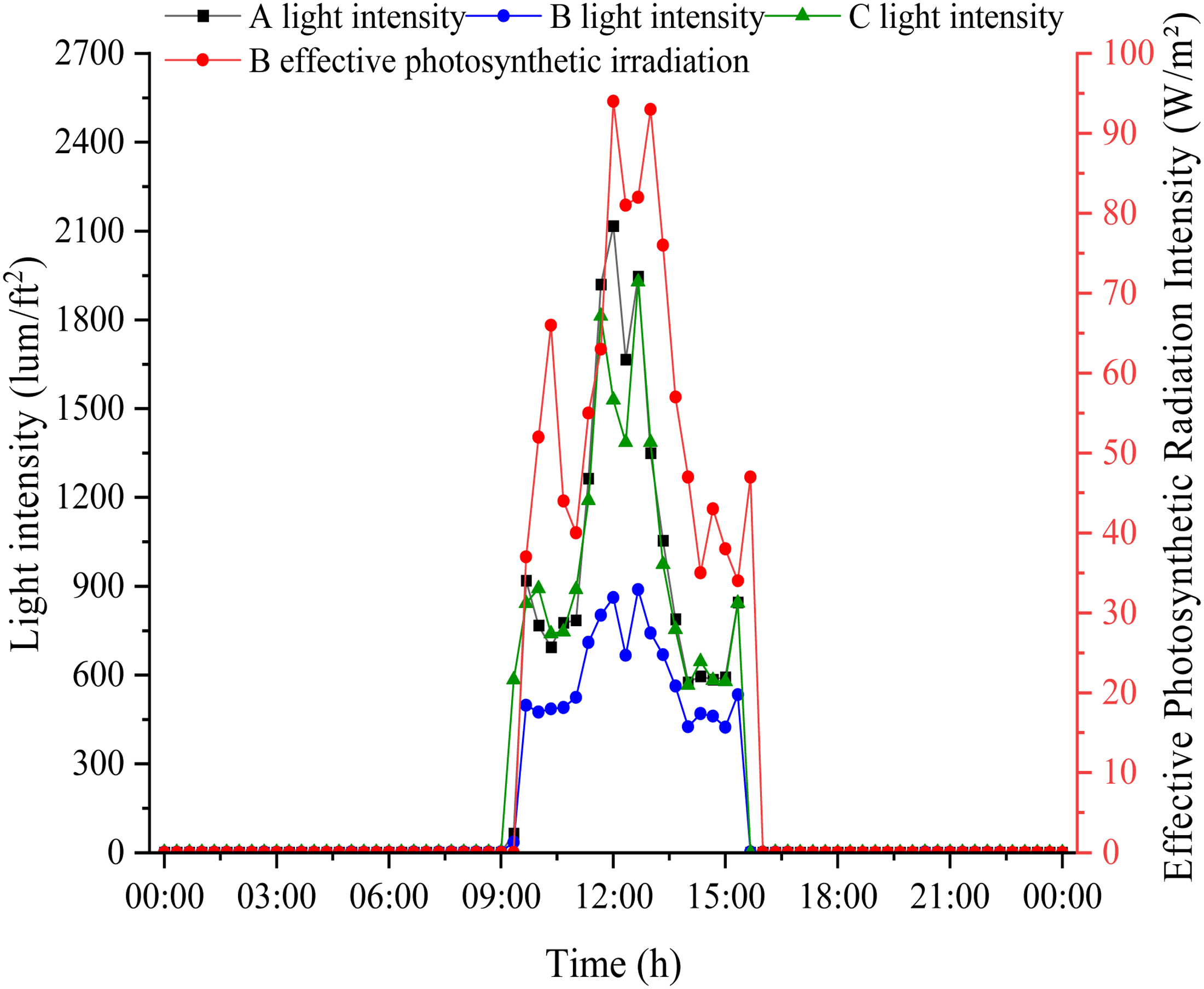
Variation curve of indoor effective photosynthetic irradiation and light intensity.
Indoor soil temperature and humidity analysis
Greenhouse crop roots grow in soil, soil temperature and relative humidity are important factors affecting crop growth. Soil surface start from the lower 10 cm, taking 10 cm as a layer, the total of 5 measuring points are designed, and the soil temperature and relative humidity are recorded every 10 min. The analysis of recorded data is shown in Figure 15.
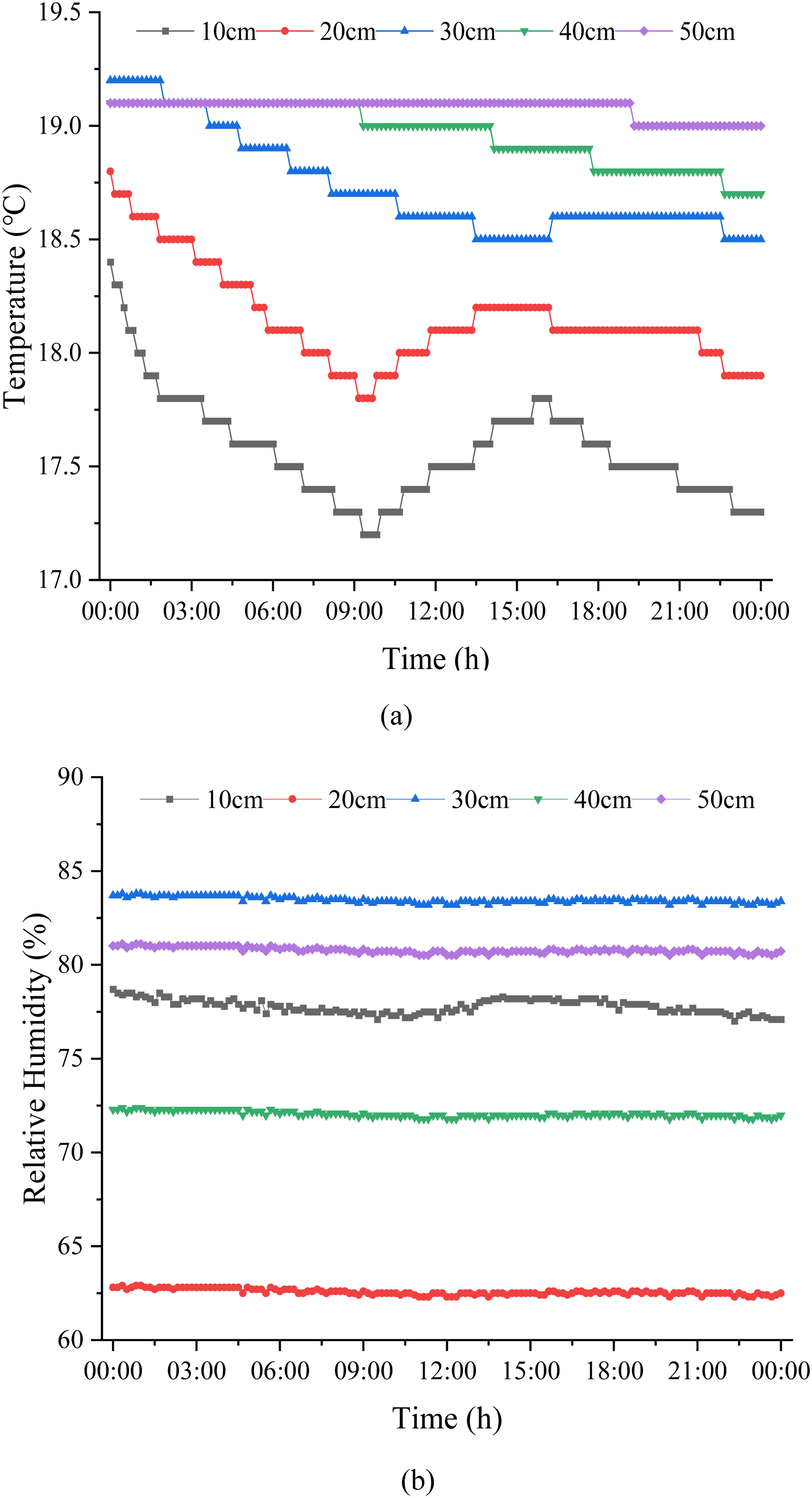
Variation curves of soil temperature and humidity at different depths in the greenhouse.
The soil temperature gradually increases with the getting bigger depth of the soil, and the soil temperature near the ground surface has an obvious change trend throughout the day. The temperature of the soil layer below the third layer changed little with time, and the soil temperature in the deepest layer (the fifth layer) remain basically unchanged throughout the day nearly 19.1°C. Except for the 10 cm soil layer, the soil humidity is relatively stable with time. The space where the root system of crops exists is basically 20 cm, and the soil moisture is the lowest.
Comparative analysis of indoor air temperature and humidity
Another structural layer added to the single-film solar greenhouse form the novel double-film solar greenhouse, and construct the thermal buffer zone. In order to study the variation and distribution of indoor environmental factors value between the double-film solar greenhouse and the ordinary solar greenhouse, the indoor environmental factor of the ordinary single film solar greenhouse with the same specification was tested under the similar conditions. The indoor temperature and relative humidity are compared and analyzed changes of soil temperature, relative humidity and CO2 concentration. Taking the geometric center point B-2-3 as the data reference point, comparative analysis environmental factors value of double-film greenhouse and ordinary solar greenhouse at the height of 1.5 m.
Figure 16 shows the variation of indoor air temperature and relative humidity with time in double-film solar greenhouse and ordinary single-film solar greenhouse.
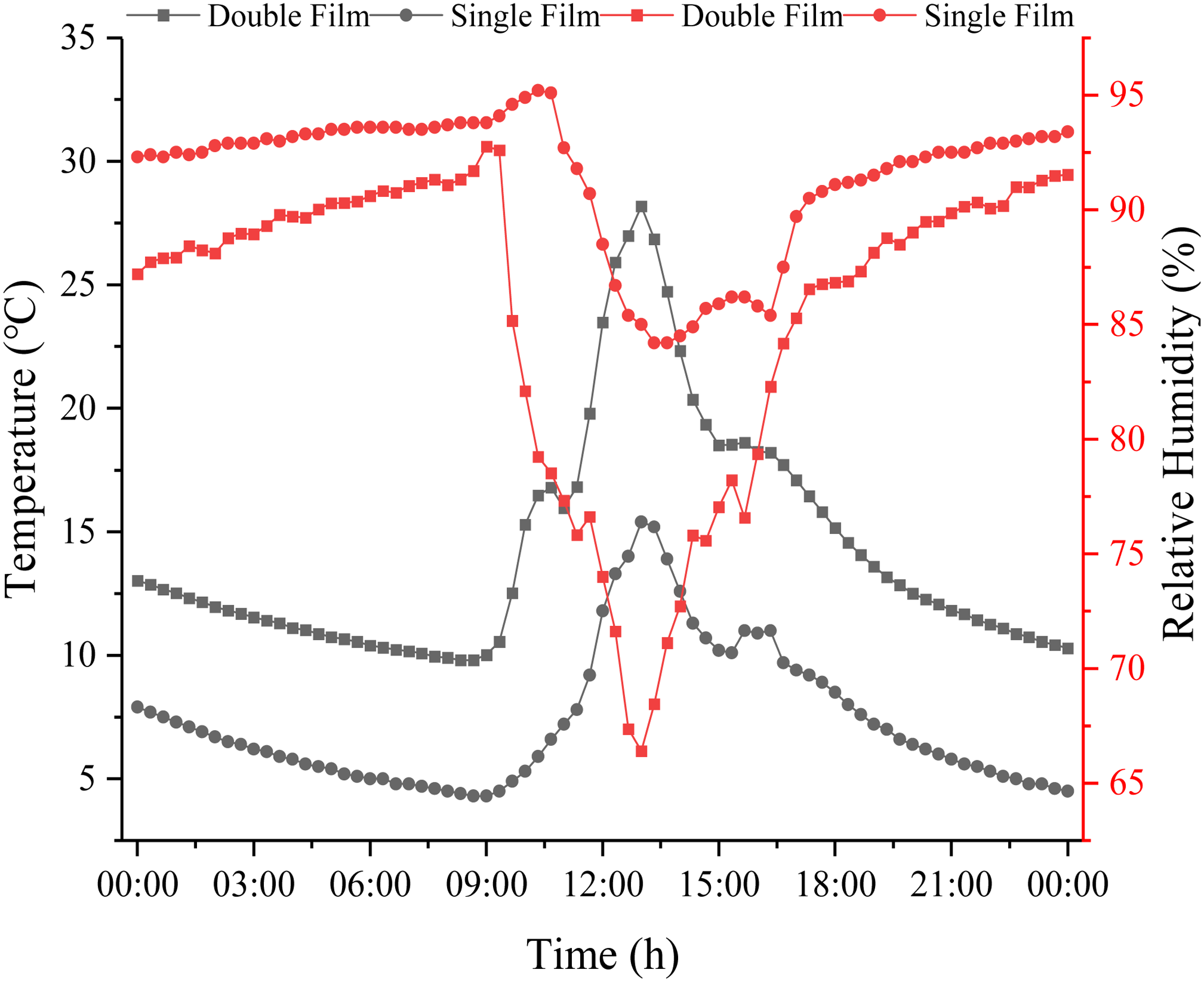
Comparison of indoor air temperature and relative humidity in double film and single film solar greenhouse.
The analysis shows that the indoor air temperature of the double-film solar greenhouse is generally higher than that of the single-film ordinary greenhouse, and the overall air relative humidity is lower than that of the single-film ordinary greenhouse. At 8:20 in the morning, the double-film greenhouse and the ordinary greenhouse reached the lowest temperature of the day almost at the same time. The minimum temperature of the double-film solar greenhouse is 9.81°C, the single-film ordinary solar greenhouse is 4.3°C correspondingly, and the minimum temperature difference is 5.51°C. The temperature difference in the greenhouse is almost always within 5.51°C∼5.8°C during the two time periods when the insulation quilt is opened all day. At 13:00, the two greenhouses reach the maximum temperature at the same time. The maximum temperature of the double-film greenhouse is 28.18°C, the single-film ordinary greenhouse is 15.4°C relatively, and the maximum temperature difference is 12.78°C. The average and the lowest air temperature in the double film solar greenhouse are 6.92°C and 5.51°C higher than that of the single film solar greenhouse, respectively. During the period when the insulation quilt is opened, the humidity of double film greenhouse is significantly lower than that of single film ordinary greenhouse, and the maximum relative humidity difference appear at 13:00, with the value of 18.59%. The maximum humidity of double film greenhouse is 92.76%, the minimum humidity 65.00%, and the average value is 85.34%. Correspondingly, for single film ordinary greenhouse, its maximum humidity is 95.2%, minimum humidity is 84.20%, and the average value is 91.38%. The average and minimum air humidity in the double film solar greenhouse are 5.94% and 17.79%,which are lower than that of the single film solar greenhouse, respectively. It is apparent that the indoor air temperature of double-film greenhouse is higher than ordinary single-film solar greenhouse, and the relative humidity is lower than ordinary single film solar greenhouse, the indoor air temperature and relative humidity of double film greenhouse is more conducive to the growth of crops.
Indoor Co2 concentration
According to the analysis in Figure 17, it can be seen that the variation characteristics of indoor CO2 concentration of double film solar greenhouse and single film solar greenhouse are similar, but the overall indoor CO2 concentration of double film solar greenhouse is higher than single film solar greenhouse.
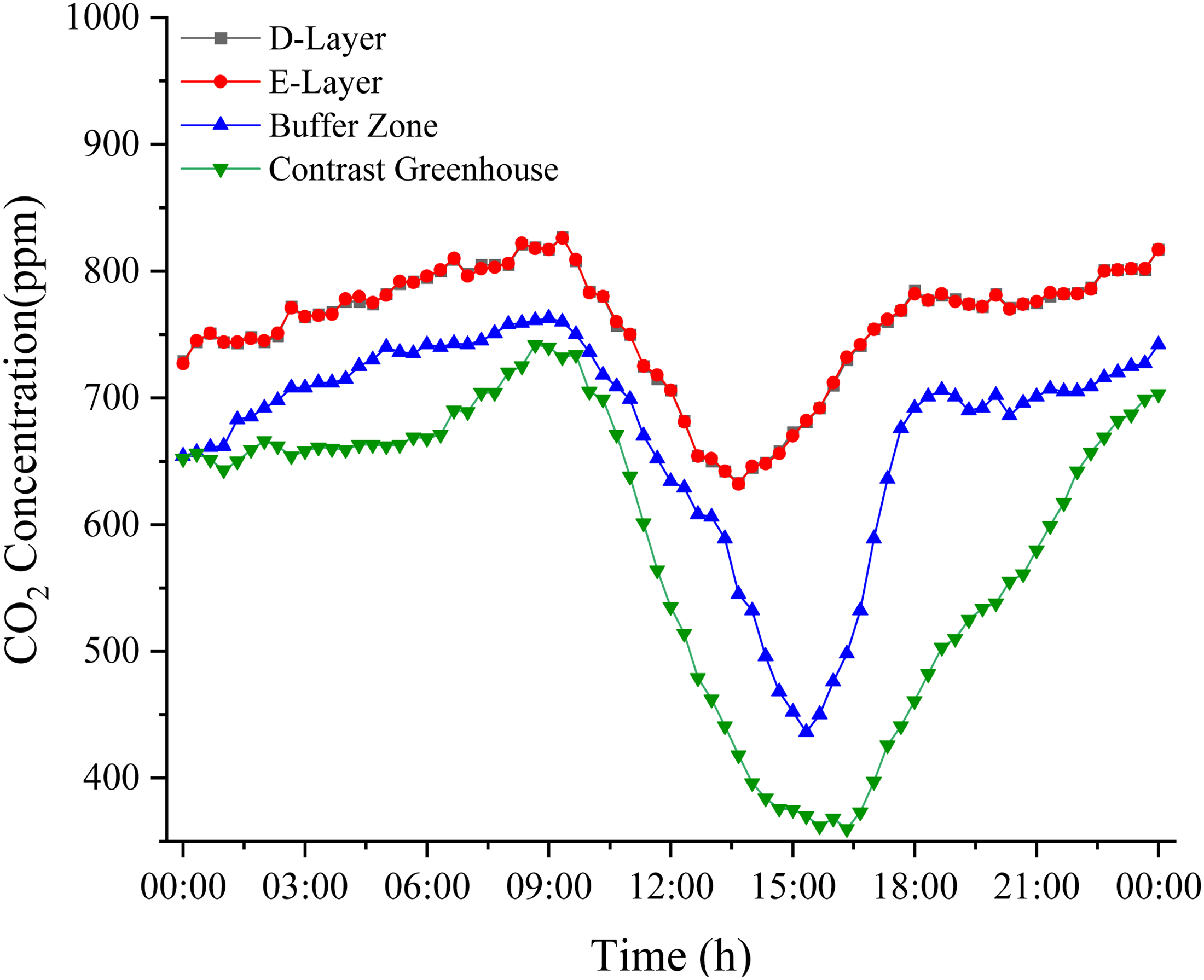
Comparison of indoor CO2 concentrations in double film and single film solar greenhouse.
The average CO2 concentration in the planting area of the double film greenhouse is 759.29 ppm, in the thermal buffer zone between the double films is 701.95 ppm, and in the single film ordinary greenhouse is 588.07 ppm homologous. The average CO2 concentration in the planting area and thermal buffer zone of the double film solar greenhouse increase by 28.78% and 14.34%, respectively. The phenomenon of “delay” in the lowest value of CO2 concentration is that the intensity of crop photosynthesis becomes stronger with the increase of indoor temperature. Compared with double film solar greenhouse, the indoor temperature of single film ordinary solar greenhouse is lower, and the photosynthetic intensity of crops decreases, resulting in the reduce of the rate of indoor CO2 participating in photosynthesis. The average CO2 concentration in the planting area of double film greenhouse is 29.12% higher than that of single film ordinary greenhouse, which is more conducive to the improvement of crop photosynthesis intensity.
Indoor soil temperature and humidity
The soil entropy meter for the soil temperature and humidity test in the single-film ordinary solar greenhouse is arranged at the geometric center of the greenhouse ground, under the same conditions as the test in double film greenhouse. The analysis of soil temperature and humidity test is shown in Figure 18.
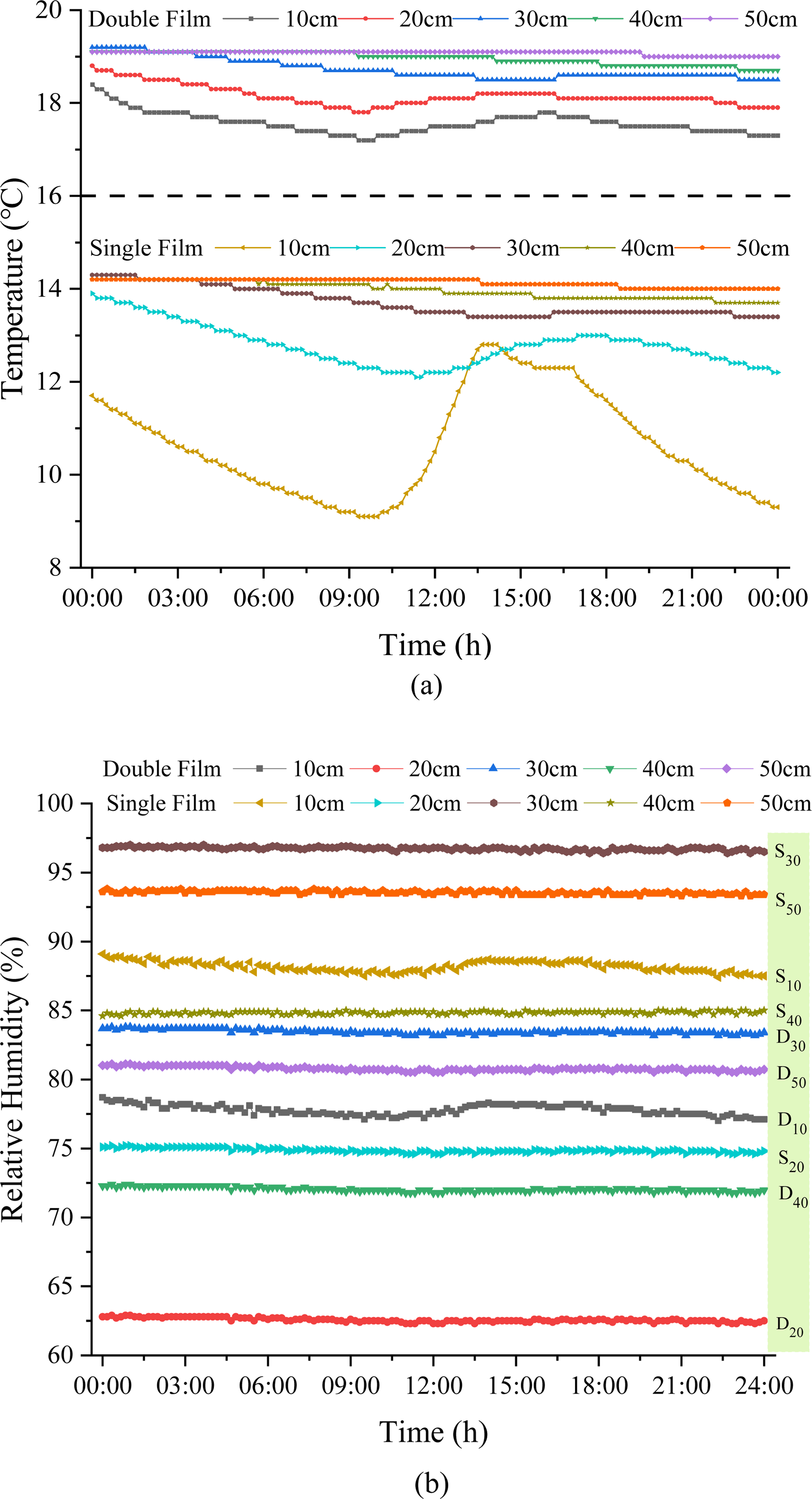
Comparison of soil temperature and humidity at different depths in double-film and single-film solar greenhouse.
Figure 18 shows the variation of the average temperature and humidity in the indoor soil of the double-film greenhouse and the single-film ordinary greenhouse with time. The dotted line in Figure 18(a) is the change of soil temperature with time in the double-film solar greenhouse and the single-film ordinary greenhouse, respectively. The shallow soil temperature of the single-film ordinary greenhouse is lower than that of the double film solar greenhouse throughout the day, and the fluctuation of the soil surface temperature of the single film ordinary greenhouse is obviously stronger than that of the double film solar greenhouse. The daily average soil temperature at a depth of 10 cm in the double film solar greenhouse reaches 17.51°C, and the corresponding daily average soil temperature of the single film ordinary greenhouse is 10.56°C, with a temperature difference of 6.95°C. The daily average soil temperature at a depth of 20 cm depth of double film solar greenhouse reaches 18.09°C, the corresponding value is 12.65°C in single film ordinary greenhouse, with a temperature difference of 5.43°C. The soil temperature fluctuations of the two greenhouses in the soil layer with a depth of 30 cm and below are small, but the average temperature of the double film greenhouse is higher than that of the single film ordinary greenhouse. The difference of the average soil temperature of the corresponding depth soil layer is 5.04°C, 5.01°C and 4.95°C respectively. With the increasing of soil layer thickness, the soil temperature increases, and the difference between the average soil temperature values of the soil layers corresponding to the two greenhouses becomes smaller.
In Figure 18(b), the label S30 on the right side represents the soil humidity where the soil layer thickness of the single film ordinary greenhouse is 30 cm, and D30 represents the soil humidity where the soil layer thickness of the double film greenhouse is 30 cm. Comparing the curve changes, it is found that the soil humidity in the double film greenhouse is generally lower than that in the single film ordinary greenhouse. The daily average of soil humidity at a depth of 10 cm in the double film solar greenhouse is 77.71%, and the corresponding daily average of the soil humidity in the single film ordinary greenhouse is 88.11%, which is 10.4% higher than that of the double film greenhouse. The daily average of soil humidity at a depth of 20 cm reaches 62.53%, the corresponding value in the single film ordinary greenhouse is 74.83%, and the humidity difference is 12.53%. The difference between the average soil humidity values of the soil layer with a depth of 30 cm and the corresponding depth soil layers of the two greenhouses are 13.30%, 12.84% and 12.79%, respectively. With the increase of soil layer thickness, the soil humidity difference firstly increased and then decreased. Obviously, within the depth of crop root soil layer of 10 cm∼20 cm, the soil temperature of double-film greenhouse is significantly higher than ordinary solar greenhouse, and the overall relative humidity is lower than ordinary greenhouse. The relative high temperature and low humidity of the double film greenhouse soil is conducive to the growth of crops.
Conclusion
In general, it is feasible to use polystyrene foam module as wall material to build solar greenhouse, which can shorten the construction cycle of solar greenhouse and save land resource. Different from the existing parallel double film structure solar greenhouse, the double structure solar greenhouse in this study effectively expands the space between double film and forms a single ridge heat buffer zone. The thermal buffer zone effectively improves the indoor air, soil temperature and CO2 concentration of the double-film solar greenhouse, and reduces the indoor air and soil humidity. The value of environmental factors of light, thermal, water and air system in double film greenhouse is more stable than that in single film ordinary greenhouse.
The indoor air temperature of the double film solar greenhouse is generally higher than that of the single-film ordinary greenhouse, and the overall air humidity is lower than that of the single film ordinary greenhouse. The overall indoor CO2 concentration of the double film solar greenhouse is higher than the single film solar greenhouse. Compared with the single film ordinary greenhouse, which is more conducive to the improvement of the photosynthesis intensity of crops. The shallow soil temperature of the single film ordinary greenhouse is lower than that of the double-film solar greenhouse throughout the day, and the fluctuation of the soil surface temperature of the single film ordinary greenhouse is obviously stronger than that of the double film solar greenhouse. With the increase of soil layer thickness, the soil temperature improves, and the difference between the average soil temperature values of the soil layers corresponding to the two greenhouses becomes smaller. The soil humidity of the double film greenhouse is generally lower than that of the single film ordinary greenhouse. The relative “high temperature and low humidity” environment of double film greenhouse soil is conducive to the healthy growth of crop roots.
This study provides a novel double-film solar greenhouse, which is more suitable for cold region. The polystyrene foam module is used as the structural material for greenhouse envelope construction. And the “enlarged” thermal buffer zone makes the passive heating of greenhouse more direct, and obtain the variation rule of indoor environmental factors in double-film greenhouse. However, according to different climatic regions and different crop growth characteristics, the control methods and the economic analysis of double-film greenhouse are not involved in this paper. Additionally, the numerical simulation of the thermal and humid environment of the double-film solar greenhouse with thermal buffer zone, the material, energy transfer and distribution law of the thermal system of the double-film greenhouse, even for greenhouse management methods that match different crops, need to be further studied.
Highlights
A novel idea of double-film solar greenhouse with thermal buffer zone was proposed for collecting more solar heating energy.
A novel mathod of using polystyrene foam modular as wall construction material was proposed to increase the heat transfer coefficient of the wall, prevent thermal releasing to outside and save land.
The performance of the double film solar greenhouse is better than that of the single film common greenhouse, which underlies the feasibility and a new way for heating of Chinese greenhouse in cold region.
Footnotes
Acknowledgements
This publication has been jointly written within the Key research and development project “Research and demonstration of key technology for solar heating in greenhouse in severe cold season of Gansu cold region”. The authors gratefully acknowledge the funding support from the Gansu Provincial Department of Science and Technology (grant number 18YF1FA090 and 20JR5RA086) and from Gansu Natural Research Institute (grant number 2018YF-02)
Declaration of conflicting interests
The author(s) declared no potential conflicts of interest with respect to the research, authorship, and/or publication of this article.
Funding
The author(s) disclosed receipt of the following financial support for the research, authorship, and/or publication of this article: This work was supported by the Gansu Provincial Department of Science and Technology, Gansu Natural Energy Research Institute, (grant number 18YF1FA090, 20JR5RA086, 2018YF-02).
