




Abstract
In view of solving the problems of large top coal loss and low recovery rate in the traditional caving process of horizontal section fully mechanized caving mining, taking the fully mechanized caving face of steeply inclined and extra-thick coal seam in Yimen Coal Mine as the engineering background and the research method of numerical simulation and field measurement was used to study the coal gangue flow characteristics under different coal caving directions and different number of coal caving ports at the bottom plate side, revealing the mechanism of top coal loss and proposing the technology to improve the recovery rate. The results show that the action time of top gangue and the ‘ rotation ‘ of coal gangue flow in the triangle coal area jointly promote the release of triangle coal in the bottom plate, which makes the coal gangue interface steeper and the release rate higher when the coal is released in the lateral direction of the bottom plate; adjusting the number of opening coal mouths when the initial coal caving at the floor side can coordinate the top coal caving speed, gangue down-channeling speed and the closing time of the coal caving mouth. When the first coal caving opens two coal caving mouths, the recovery rate of bottom triangular coal is the highest. Yimen Coal Mine adopted the floor lateral roof side caving and double-mouth caving technology. Compared with the original scheme, the top coal recovery rate of the working face increased by 3%, and the top coal recovery rate of the floor triangle area increased by 7%.
Keywords
Introduction
There are a large number of steeply inclined coal seams with buried dip angle greater than 45° in China. With the continuous development of coal resources, the proportion of steeply inclined coal seam mining is increasing. (Chuang et al., 2019, Jiachen et al., 2022, Li et al., 2020, Xingping et al., 2020, Yang et al., 2020). Horizontal sublevel fully mechanized caving mining is a common mining method in steeply inclined thick coal seam (Jiang et al., 2020), which has the characteristics of small length of working face, large thickness of sublevel top coal and low discharge rate at both ends of working face. (Feng et al., 2015, Si and Belle, 2019, Xingping et al., 2014, Yongping et al., 2000, Si et al., 2020, Wu et al., 2022),influence of mining and caving process parameters on discharge rate is higher than general longwall fully mechanized caving face (Jiachen, 2018).Therefore, it is of great significance to optimize the caving process parameters of horizontal section fully mechanized caving mining to improve the recovery rate of top coal and the utilization rate of resources.
Many scholars in China have carried out a lot of research work on the horizontal sublevel caving mining of steeply inclined coal seams, and have achieved fruitful research results. According to the characteristics of the low-level fully mechanized caving mining process, Wang Jiachen (Jiachen and Jinwang, 2015, Jiachen and Qiang, 2002) proposed a theoretical model of granular medium flow, revealing the real flow process of top coal in the process of low-level fully mechanized caving; Wang Jiachen and Song Zhengyang et al. (Jiachen and Zhengyang, 2015)proposed that in the process of fully mechanized caving mining, the initial coal-gangue boundary had a control effect on the subsequent caving; Through the similar simulation experiment, Shi Pingwu et al. (Pingwu et al., 2005)studied the law of coal caving at the top and bottom of the steeply inclined horizontal section, confirmed that the triangle coal of the bottom plate was the main coal loss of the horizontal section fully mechanized caving mining method, and proposed the section height control method; Combined with the actual production conditions of Weihuliang Mine, Jiang et al. (Xinjun, 2007, Xinjun et al., 2006)studied the influence of sublevel height, coal caving method, coal caving step distance and other factors on top coal caving in horizontal sublevel fully mechanized caving mining; Using similar simulation experiments, Wang and Yang et al. (Jiachen, 2018)calculated the recovery rate of top coal in different directions based on the condition that the bottom triangular coal was discharged, and proved that the coal caving process in different directions had certain influence on the recovery rate.
Studies have shown that the top coal loss of horizontal sublevel caving mining is mainly located at the end of the working face. However, the existing research results on the mechanism of end top coal loss, the direction of end coal caving and the number of coal caving ports are not in-depth. Therefore, in this paper, combined with the production geological conditions of the horizontal sublevel caving face in the steeply inclined and extra-thick coal seam of Yimen Coal Mine in Liangzhou, Sichuan Province, the numerical simulation method is used to study the coal gangue flow law and top coal recovery under different caving directions and different numbers of caving ports on the floor side, to explore the mechanism of top coal loss at the end, and to optimize and determine the reasonable mining and caving process parameters, so as to improve the top coal recovery rate and provide reference for the mining of similar coal seam conditions.
Project background
Yimen Coal Mine is located in the alpine zone 3 km northeast of Yimen Town, Huili County, Liangshan Prefecture, and its position is shown in Figure 1. The main coal seams are C1 ∼ C2 and C3, the thickness of which is 10 ∼ 65 m, with an average of 30 m and an average inclination of 45°, belonging to the steeply inclined coal seam. The comprehensive histogram and occurrence profile of the coal seam are shown in Figures 2 and 3.
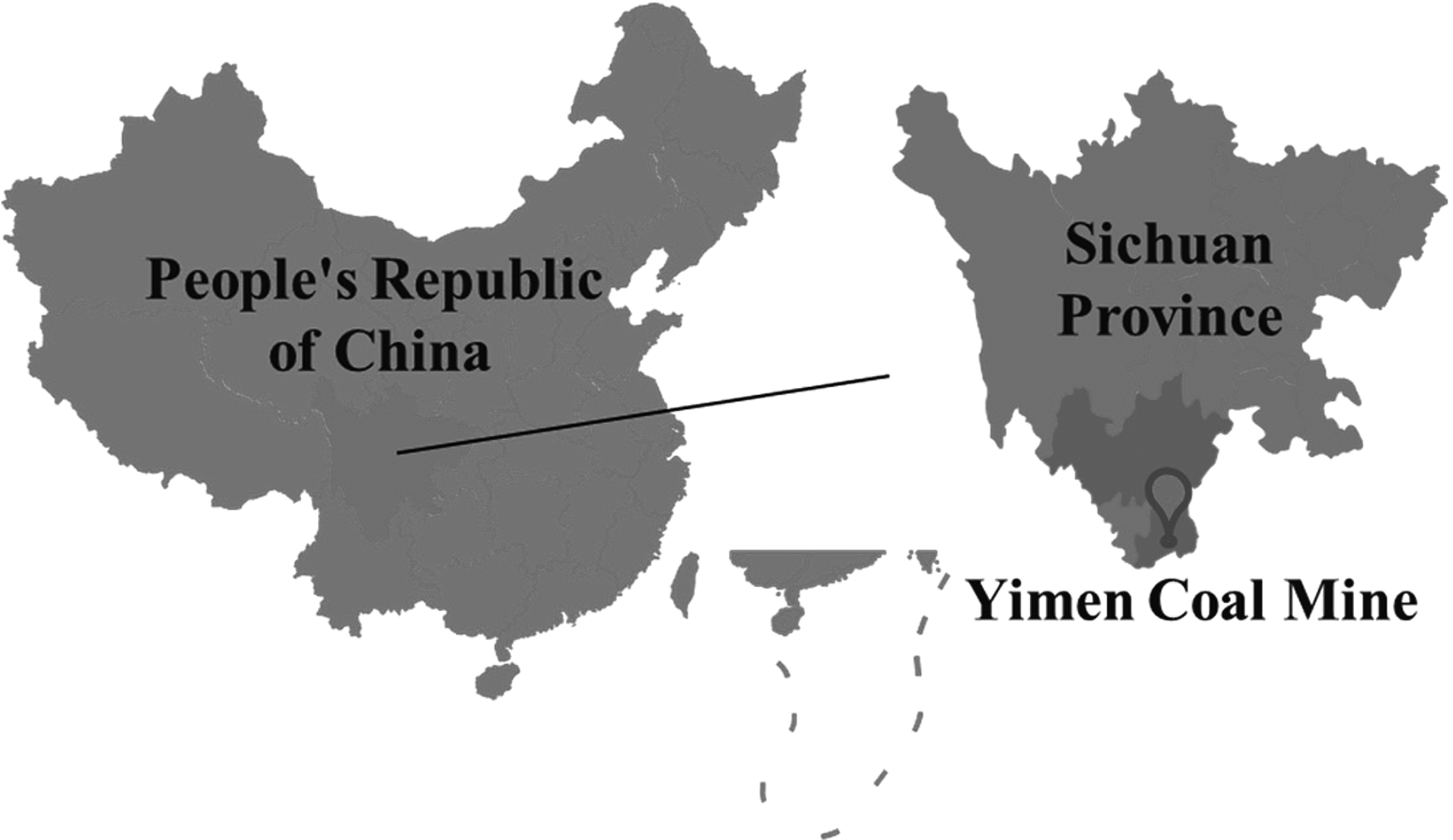
Geographical location of Yimen Coal Mine.
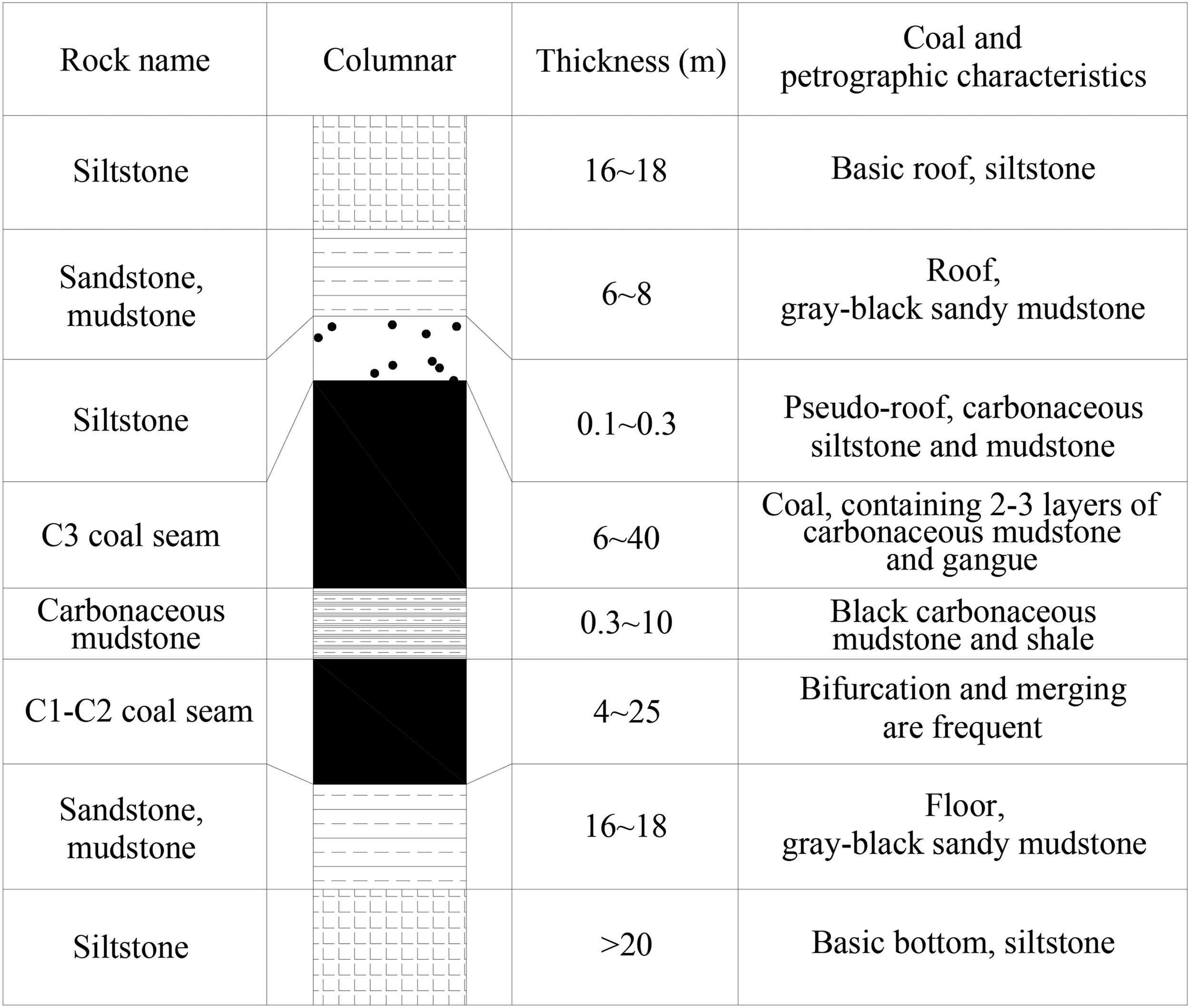
Comprehensive histogram of C1-C2 and C3 coal seams.
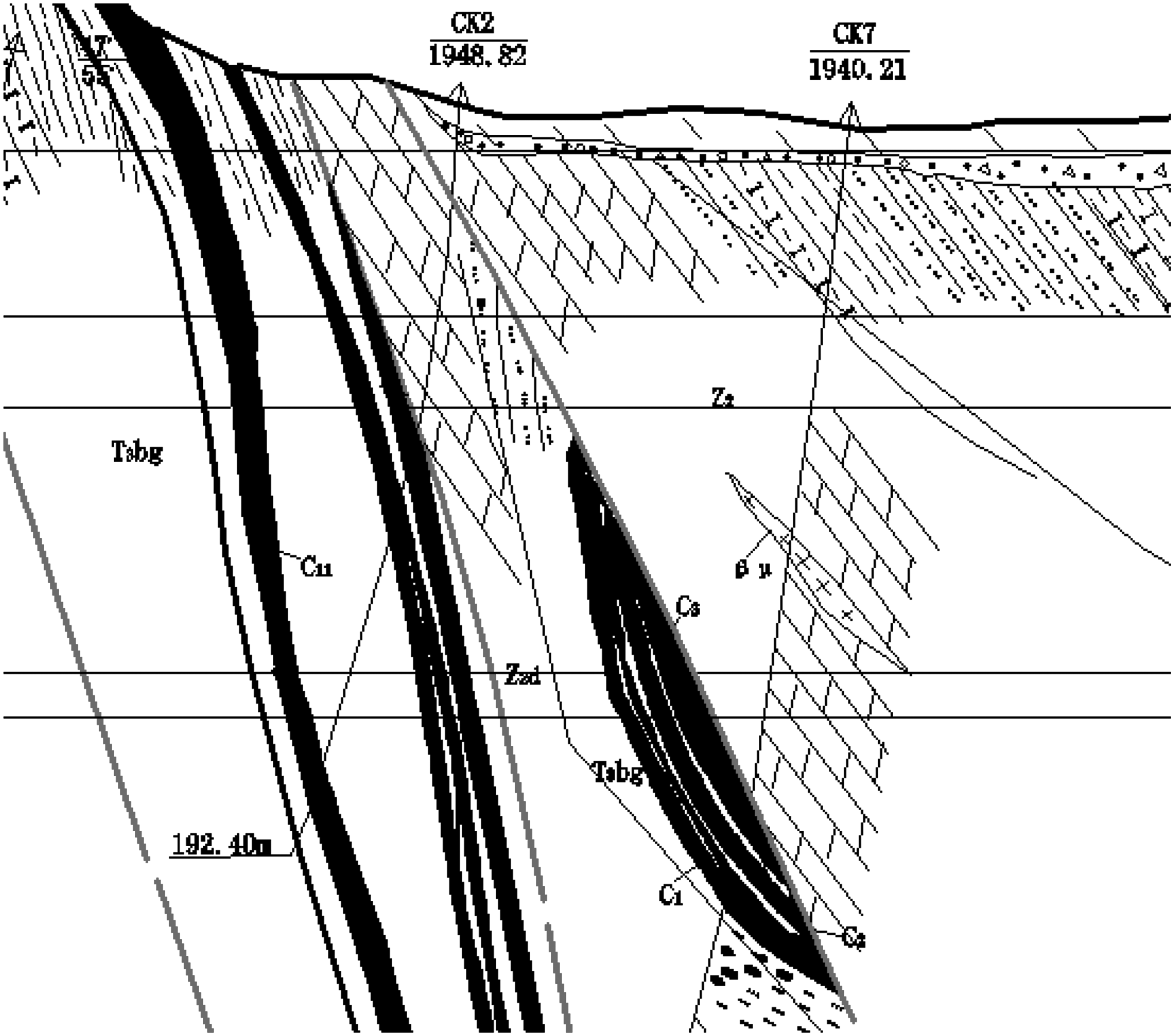
Occurrence profile of C1-C2 and C3 coal seams.
The working face of the mine is +2020 m horizontal section working face, and the comprehensive mechanized top coal caving mining method is adopted. The horizontal section height is 10 m, the cutting height is 2.5 m, the caving height is 7.5 m, and the ratio of mining and caving is 1:3. The width of the working face is 42 m, and the length is about 190 m. The mining roadway is arranged in the coal seam below the roof and floor, and the length and height are 3 m. The two supports at the end of the working face do not discharge coal, and the support of the bottom plate is discharged sequentially from the lateral direction of the roof. All caving method is used to manage roof.
Model building
Combined with the occurrence conditions of C1 - C2 and C3 coal seams in Yimen Coal Mine, the +2020 horizontal section is selected as the research object to establish the PFC2D numerical model, as shown in Figure 4. The position of +2020 horizontal section working face is shown in the red boxed area in Figure 4(a), and the corresponding numerical calculation model is shown in Figure 4(b).
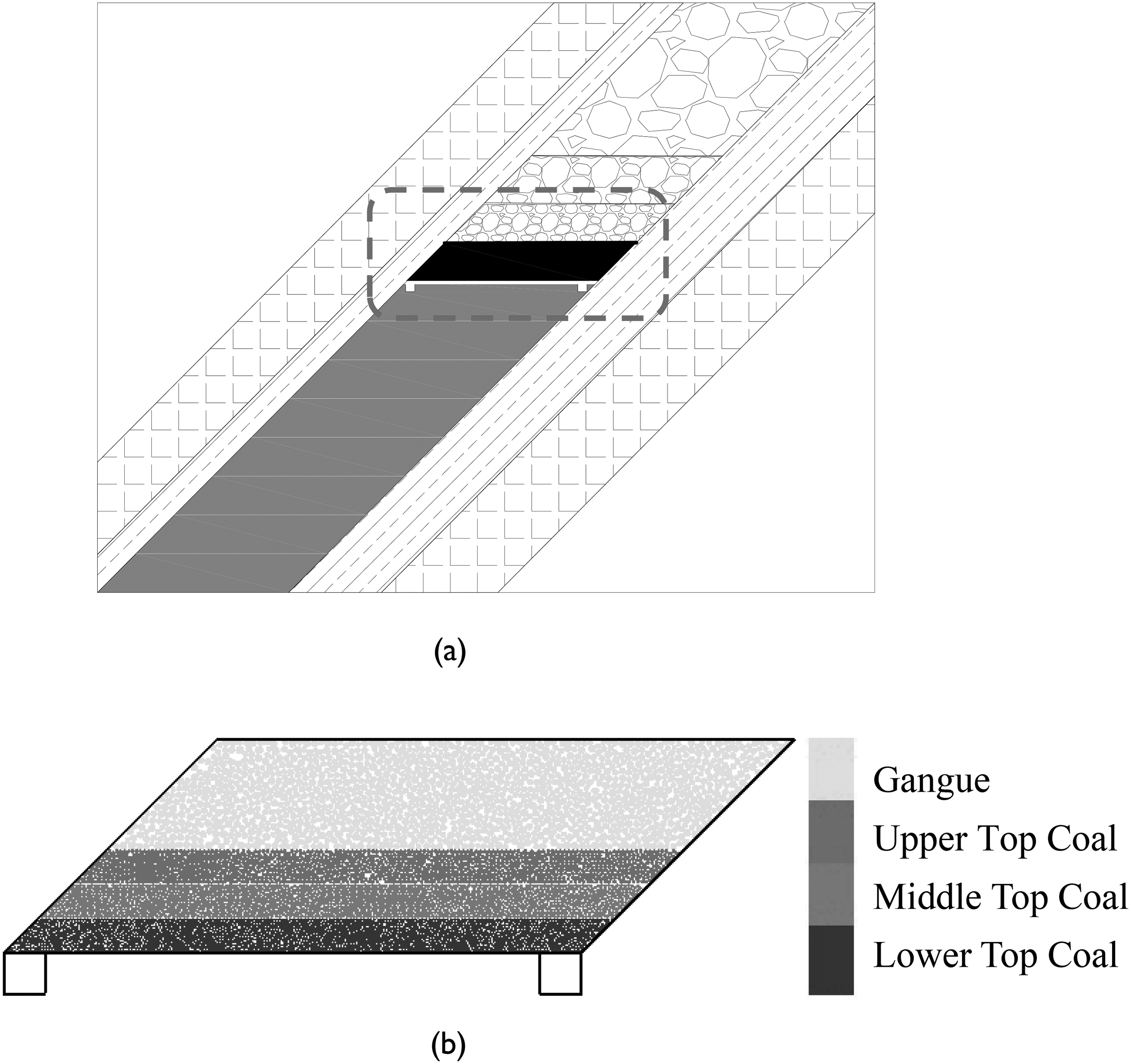
Model Establishment Diagram. (a) Schematic diagram of horizontal subsection fully mechanized top-coal caving face. (b) Numerical calculation model.
The numerical calculation model is 42 m long and 15.5 m high. The top and both sides are surrounded by the wall command. The dip angle of coal seam and roof and floor is 45°. From top to bottom, different color ball particles are used to represent gangue, upper top coal, median top coal and lower top coal. During the operation, a total of 20 coal caving supports are arranged at the bottom, the width of single coal caving port is 1.5 m, and the first and last coal caving positions are kept 3 m without coal caving distance.
The model is divided into 39579 particles. Combined with the same type of simulation parameters of similar geological conditions, according to the mechanical properties parameters and block characteristics of coal and rock provided by Yimen Coal Mine as shown in Table 1, the simulation particle stiffness, friction coefficient and block radius are calibrated. The calibration results are shown in Table 2.
Coal mechanics parameter table of Yimen Coal Mine.

Mechanical parameter table of model particles.
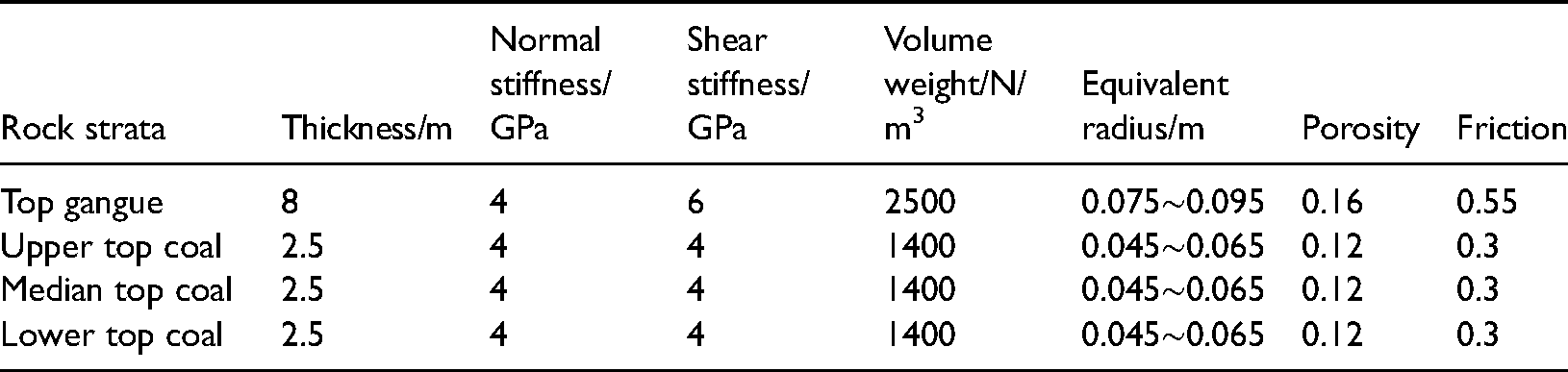
In the simulation of coal caving process, the model assumes that the roof and floor are rigid body, and there is no deformation and collapse in the process of fully mechanized caving mining. Therefore, the linear stiffness contact is used between particles, and the initial velocity is 0 m/s, the gravity acceleration is 9.8 m/s2, and the coal body is released from the weight. The control of coal caving is strictly in accordance with the principle of ‘ see gangue close window ‘ (when gangue is found in the caving body of the coal caving, the coal caving is closed immediately and the coal caving operation is stopped). The falling particles are stacked below to count the amount of each coal discharge.
Influence of caving direction on top coal recovery rate
The length of horizontal section fully mechanized caving face is short, and the recovery of triangular coal in the floor becomes the main influencing factor of the recovery rate of the working face. Floor triangle coal refers to the coal body composed of coal gangue interface and floor at the side end of the floor. Practice and physical tests have shown that different coal caving directions will change the recovery rate of horizontal section floor triangle coal. In order to find out the influence of coal caving direction on the recovery rate of triangular coal in the floor, this section studies the interface characteristics, force chain characteristics, flow rate law and discharge law of coal gangue in horizontal section under the influence of different coal caving directions.
Interface characteristics of coal gangue
In the low-level fully mechanized caving mining, the coal-gangue interface of bulk top coal usually presents a trend of slow upward and rapid downward. However, with the movement of the position of the caving mouth, the slope of the top coal seam position line and the coal-gangue interface gradually increases. When the floor triangular coal is fixed on one side of the boundary, a relatively steep coal-gangue interface means a higher flow rate of the lower top coal and less top coal loss within the scope of the caving mouth. Therefore, optimizing the coal caving process and promoting the formation of reasonable shape of coal gangue interface are of great significance to improve the recovery rate of triangular coal.
The model simulates the interface shape of coal and gangue when the coal caving is completed. According to the interface shape of coal and gangue in different caving directions, the change diagram of coal and gangue interface is drawn as shown in Figure 5. Different colors represent the interface of coal and gangue after the coal caving of each support. When the first coal caving occurs, there are two left and right interface shapes.

Evolution process of coal gangue interface in different directions. (a) From roof side to floor side. (b) From floor side to roof side.
It can be seen from Figure 5 that when the coal is discharged from the roof side to the floor side, the number of top coal particles in the vertical direction of the first coal caving is small, and the coal caving time is short. The left coal gangue boundary is that the roof side terminates the coal gangue interface, and the right interface continues to advance and change in the direction of coal caving. In contrast, the top coal particles above the first caving mouth are more and the caving time is longer when the coal is discharged from the lateral roof of the floor. The initial coal gangue interface on the right side is the triangle coal end coal gangue interface of the floor. The left coal gangue interface moves forward with the opening of the coal caving mouth, and finally forms the end coal gangue interface at the leftmost coal caving mouth.
Affected by the special boundary, the coal-gangue interface on both sides of the horizontal sublevel caving mouth in steeply inclined extra-thick coal seam usually has obvious asymmetry. After the first coal caving on the side of the roof and the floor, the left side of the coal caving mouth is circular, and the slope of the interface is changed from negative to positive from floor to top, and the whole is concave into the left side, which ends in the roof and the coal caving mouth, respectively. The top of the interface is lower than the right coal gangue interface at the same time, as shown in Figure 5(a). This is because the roof as a boundary constrains the top gangue flow that moves downward to the left, so that it invades above the top coal of the end triangle and cuts off the outflow path of the top coal. The coal gangue interface on the right side of the coal caving mouth is generally long, and the slope of the interface is small and the change is slow. This is because the horizontal velocity component of the upper gangue on the interface is large, and the front gangue flows to the roof, which has a large range of influence on the horizontal movement of the right rear top coal, driving the upper top coal to the direction of the coal caving mouth, and also promoting the middle and lower top coal to the direction of the coal caving mouth. With the continuous right shift of the coal caving port, the top gangue of the upper part of the interface becomes thinner and tends to be stable. The left gangue body of the coal caving port is compacted and penetrated into the top coal particle flow to the right. The new disturbed top gangue no longer continues to channel down, which makes the long coal gangue interface gradually shorter and steeper, and the slope change increases. Finally, the triangular coal gangue interface of the floor of the central bulge is formed.
When the coal is discharged from the side of the floor to the side of the roof, after the end of the first coal discharge at the side of the floor, the left coal gangue interface of the coal discharge port is steeper and the slope is larger than that of the side of the roof. As shown in Figure 5(b), this is caused by the thicker gangue at the upper part of the interface, the stronger downward extrusion and driving ability, the faster change of the flow velocity direction and the faster downward intrusion of the gangue. As the left interface moves forward, the gangue flows into the coal body, which also makes the interface steep and the slope increases. When the coal is pushed to the end of the roof side, the upper gangue of the top coal at the end does not appear missing, so the record of the top coal discharge at this end is less, which is slightly different from the actual situation. Compared with the roof side coal caving method, the initial coal gangue interface on the right side of the floor side coal caving port is the triangle coal interface of the floor. The thickness of the upper flowing gangue is larger, the extrusion ability is stronger, and the slope of the interface is larger. In the first coal caving process, the top gangue flow at the top of the coal caving port does not occur right invasion, and the lower top coal does not produce a bulge in the direction of the coal caving, which is more conducive to the discharge of the floor triangle coal.
Flow transfer force chain characteristics of coal gangue
The difference of the top load between the steeply inclined horizontal section and the near-horizontal coal seam during the top coal caving mining is the existence of gangue at the head-side triangle area at both ends. During the formation of triangular coal in the floor, the flow and extrusion of the increased gangue in the triangle area to the coal discharge port directly affect the triangular coal in the floor, which will be more conducive to the top coal discharge. By comparing the force chain characteristics of the formation time of the triangle area of the floor, the action law of coal gangue in two directions can be compared to analyze the effect of top coal caving. Figure 6 shows the characteristics of the transfer force chain when the two coal drawing directions form the floor triangle coal.

The transfer force chain of triangular coal in floor formed by different coal caving directions. (a) Side opening from roof to floor. (b) Side tail opening from roof to floor. (c) Side opening from floor to roof.
The force chain refers to the force transfer chains with different strength formed when the contact between particles adjacent to the particle system occurs under gravity or external load (Jinwang, 2017). It can be seen from Figure 6 that a small number of strong chains support most of the weight and external load of the particle system, and its fracture and reconstruction correspond to the extrusion, release and velocity change of the particle flow. The number of weak chain is large, which mainly exists in the top gangue and the end of the far coal caving port, connects with the strong chain at the coal caving port and the lower top coal, and participates in the fracture and reconstruction process of the strong chain.
At the end of the first coal caving in the side of the roof and the floor, the strength chain is concentrated on the top of the coal caving mouth and the right lower top coal, and the strength of the middle force chain is weak, as shown in Figure 6(a), indicating that the extrusion of the right gangue and the upper top coal on the lower top coal is mainly in the vertical direction, and the load transmitted to the horizontal direction of the coal caving mouth is less. The rear top coal does not occur or less occur horizontal flow, and the top coal is stable and difficult to be pressed out. At the same time, the extrusion and driving force of the horizontal direction of the gangue in the triangle area act on the whole top coal from the coal caving mouth to the floor side. With the continuous right shift of the coal caving mouth, the particle flow velocity above the coal caving mouth changes rapidly and violently, and the flow phenomenon of the back top coal to the coal caving mouth is obvious. As shown in Figure 6(b), the thickness of the gangue in the upper part of the floor triangle coal becomes thinner, and the strong chain is concentrated in the inside of the floor triangle coal, and the promotion effect of the gangue in the triangle area becomes weaker.
When the coal is discharged from the side of the floor, the strength chain is concentrated above the coal discharge port, as shown in Figure 6(c), the gangue in the triangle area directly acts on the top of the triangle coal of the floor, and with the transfer of the force chain, the lower top coal is extruded to the left side of the coal discharge port to promote the discharge of the triangle coal of the floor. Therefore, when coal is discharged from the side direction of the floor, the triangular coal flow discharge effect is more obvious and the recovery rate is higher.
Flow velocity characteristics of coal gangue
In the process of top coal caving, the velocity characteristics of coal gangue are often used to characterize the motion state of granular flow. Special coal gangue particle flow motion will lead to different top coal caving results, shape different interface forms of coal gangue, and affect the recovery rate of top coal at the boundary.
Figure 7 is the diagram of particle velocity direction when the initial coal gangue interface is formed under different coal caving directions. Different colors represent different velocities of particles, and the arrow indicates the direction of particle movement. It can be seen that the horizontal displacement and vertical displacement of top coal from the starting point to the coal caving mouth are increasing. The top coal above the support is mainly slow horizontal displacement, and the vertical displacement near the tail beam of the support is mainly fast-growing. In the process of velocity change, there are different shapes and sizes of counterclockwise ‘rotation’ caused by different directions of coal discharge.

Particle velocity during the formation of coal gangue interface. (a) From roof side to floor side. (b) From floor side to roof side.
The ‘rotation’ of coal gangue particle flow affects the shape of coal gangue interface on the top and floor sides. When the coal is released from the roof side, the gangue at the top of the coal body moves to the direction of the coal discharge port at the roof side. After contacting with the roof and the coal and rock near the roof, the flow direction changes due to the constraints of the roof, and collides with the subsequent particle flow, resulting in the overall ‘ rotation ‘ flow characteristics. Under the action of the roof side roadway and the top coal above the end, the top coal is driven and discharged, and finally forms the initial coal and gangue interface to the left sag, as shown in Figure 7(a). In Figure 7(b), when the coal is discharged from the side of the floor to the side of the roof, the left gangue flows downward and the right gangue flows downward in the triangle area. There are more gangue particles on both sides collide above the coal discharge port, and the velocity component in the horizontal direction decreases. At this time, the left top gangue is more than the right side of the coal discharge port, and the lower part of the floor triangular coal produces clockwise ‘ rotary ‘ particle flow. The coal gangue boundary is oriented to the inner depression of the floor triangular coal, which drives more triangular coal particles to discharge with the coal discharge port, thus improving the discharge rate of the floor triangular coal.
Comparison of top coal recovery rate
Theoretical study of granular medium flow shows that top coal and gangue particles will gradually move to the coal caving port with the path of minimum resistance. Different coal caving directions have obvious differences in single-port caving time and residual body shape. The coal caving ports are numbered as 1∼20 respectively from the roof side to the floor side, and the coal caving quantity of each coal caving port is counted as shown in Figure 8.
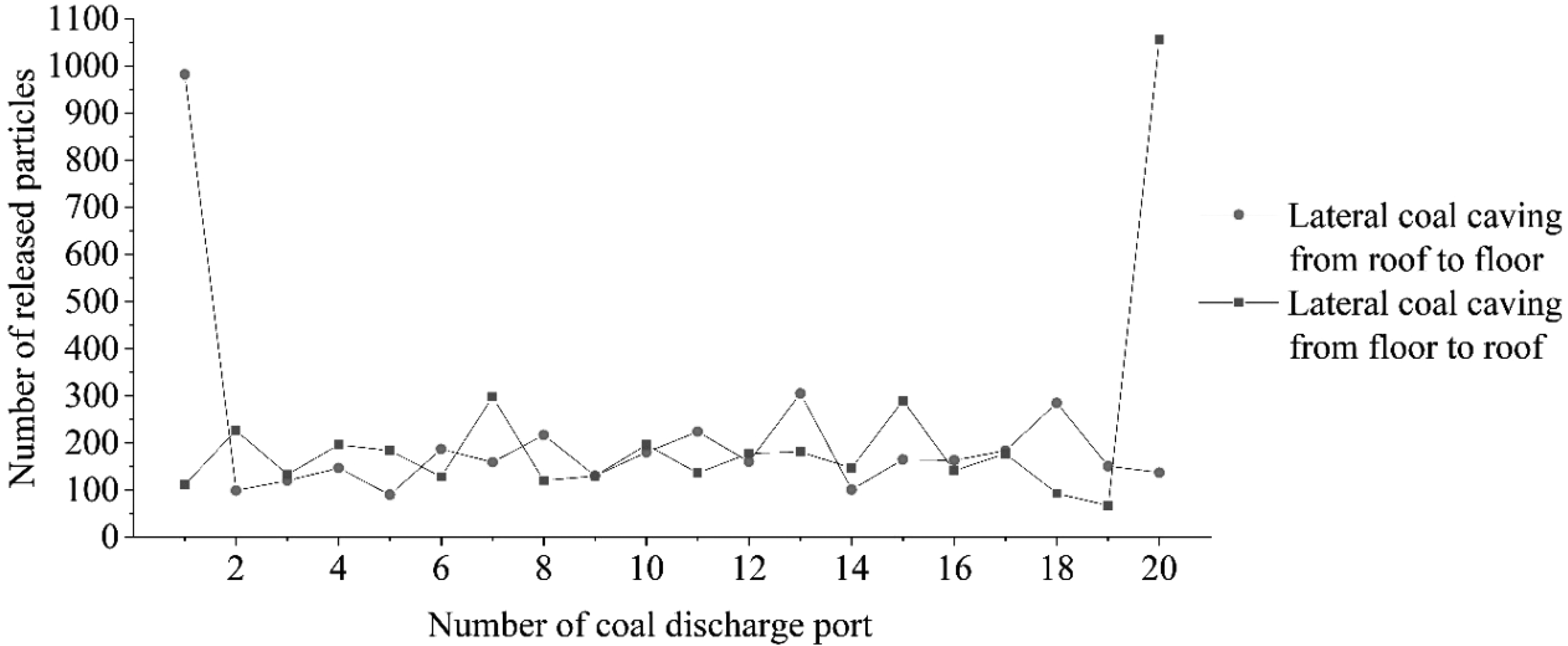
Coal discharge from each coal discharge port.
As can be seen from Figure 8, the coal caving amount at the first caving port in the two coal caving directions is much larger than that at other caving ports, and the coal caving amount at the subsequent caving ports fluctuates up and down, but the overall average value remains basically unchanged. On this basis, the recovery rate calculation shows that the recovery rate and overall recovery rate of triangular coal at the end side of the floor in the coal caving mode from the floor side to the roof side are better than those from the roof side to the floor side, and the results are shown in Figure 9.
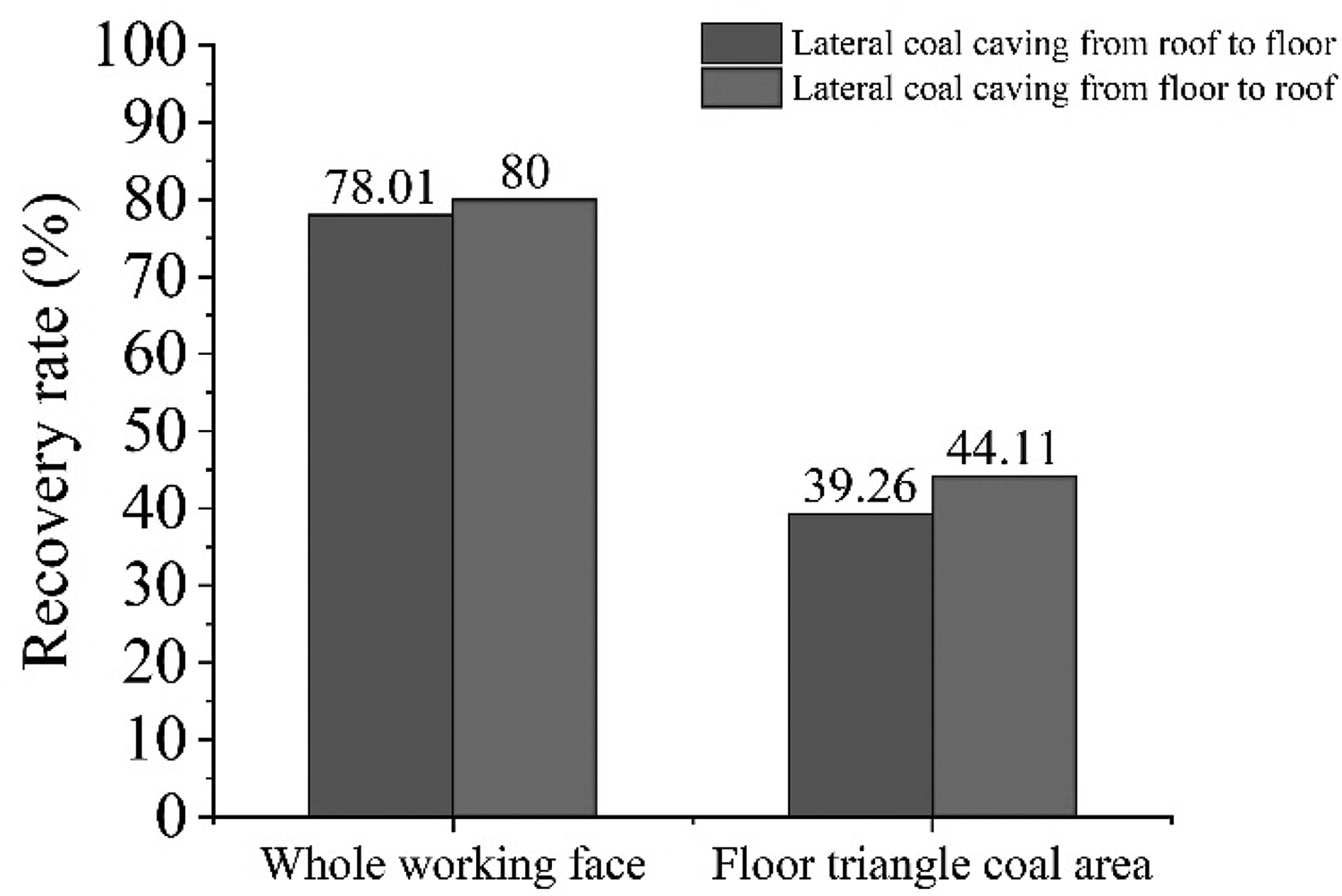
Statistics of recovery rate in different coal drawing directions.
Influence of the number of coal caving openings on the recovery rate of top coal
In the process of coal caving from floor side to roof side, floor triangle coal is formed by opening coal at the initial coal caving port, and the right boundary of coal caving port is the final coal caving boundary of floor triangle coal. Controlling the number of coal caving openings at the first coal caving on the floor side can optimize the residual coal boundary and improve the recovery rate of top coal on the floor side.
In the actual operation process, the width control of coal caving port is realized by opening different number of coal caving ports. Under normal circumstances, the number of open coal ports at the same time should not exceed 3. For this reason, the model restored the top coal caving body shape and the bottom triangle coal shape when the number of coal caving ports is 1∼3.
Shape of top coal caving body
Figure 10 corresponds to the shape of coal caving body after coal caving with different number of coal caving openings. It can be seen that the more coal caving openings are opened, the larger the disturbed range at the top, the larger the coal caving quantity and the larger the caving volume. However, due to the window closing conditions of the coal caving openings, the height of the caving body gradually widens after reaching the top coal height, and the upper and lower ends of the top coal caving body become longer and the top becomes sharp. This shows that with the increase of the coal caving port, the two sides above the caving body of the coal caving port can not be discharged because of the truncation of the gangue flow, and become the remaining coal body, thus reducing the top coal recovery rate.

Shape of top coal caving body with different number of caving openings. (a) Single-port coal caving. (b) Double-port coal caving. (c) Three-port coal caving.
Morphology of floor triangle coal
Figure 11 corresponds to the shape of triangular coal on the floor after coal caving with different numbers of coal caving openings. It can be seen that the triangular coal on the side of the floor presents a convex and concave shape caused by the “rotation” of the top gangue flow. With the increase of the number of coal caving openings, the concave feature is no longer obvious, the interface between coal and gangue is gradually smooth, and the height of triangular coal is also reduced. In the width of triangular coal, the double-port is less than the single-port, and the single-port is less than the three-port. In slope aspect, the slope of bottom triangle coal after single and double coal caving is similar, and the slope of three coal caving is smaller than that of single and double coal caving.

Morphology of floor triangle coal after coal caving with different number of coal caving openings. (a) Single-port coal caving. (b) Double-port coal caving. (c) Three-port coal caving.
The control effect of the number of coal caving ports on the top coal recovery rate on the floor side is mainly reflected in the control of the top coal flow velocity. Figure 12 is a velocity vector diagram of coal caving particles with different number of coal caving ports, It can be seen that under certain coal and rock conditions, the more coal outlets, the larger the starting range of coal and rock, the faster the top coal flows, the larger the starting range of coal and gangue body, the larger the disturbed range of coal at the side end of the floor, and the steeper the interface between coal and gangue, which is more beneficial to the coal caving at the side end of the floor and the recovery rate of top coal at the side end of the floor. However, with the increase of particle velocity, the dense gangue particles are easier to escape to the bottom coal caving port, the height of triangular coal on the bottom plate is squeezed and reduced, and the surface is polished smoothly. The flow of gangue particles accelerates the closure of the coal caving port, increases the loss of top coal and reduces the recovery rate of top coal.

Coal particle velocity with different number of coal caving openings. (a) Double-port coal caving. (b) Three-port coal caving.
Comparison of coal drawing effect
According to the statistics of the top coal recovery rate on the floor side when the number of coal caving openings for the first time is 1∼3, the results are 43%, 45.3% and 23.2% respectively. As shown in Figure 13, it can be seen that the top coal recovery rate on the floor side is the highest when two coal caving openings are opened for the first time on the floor side.
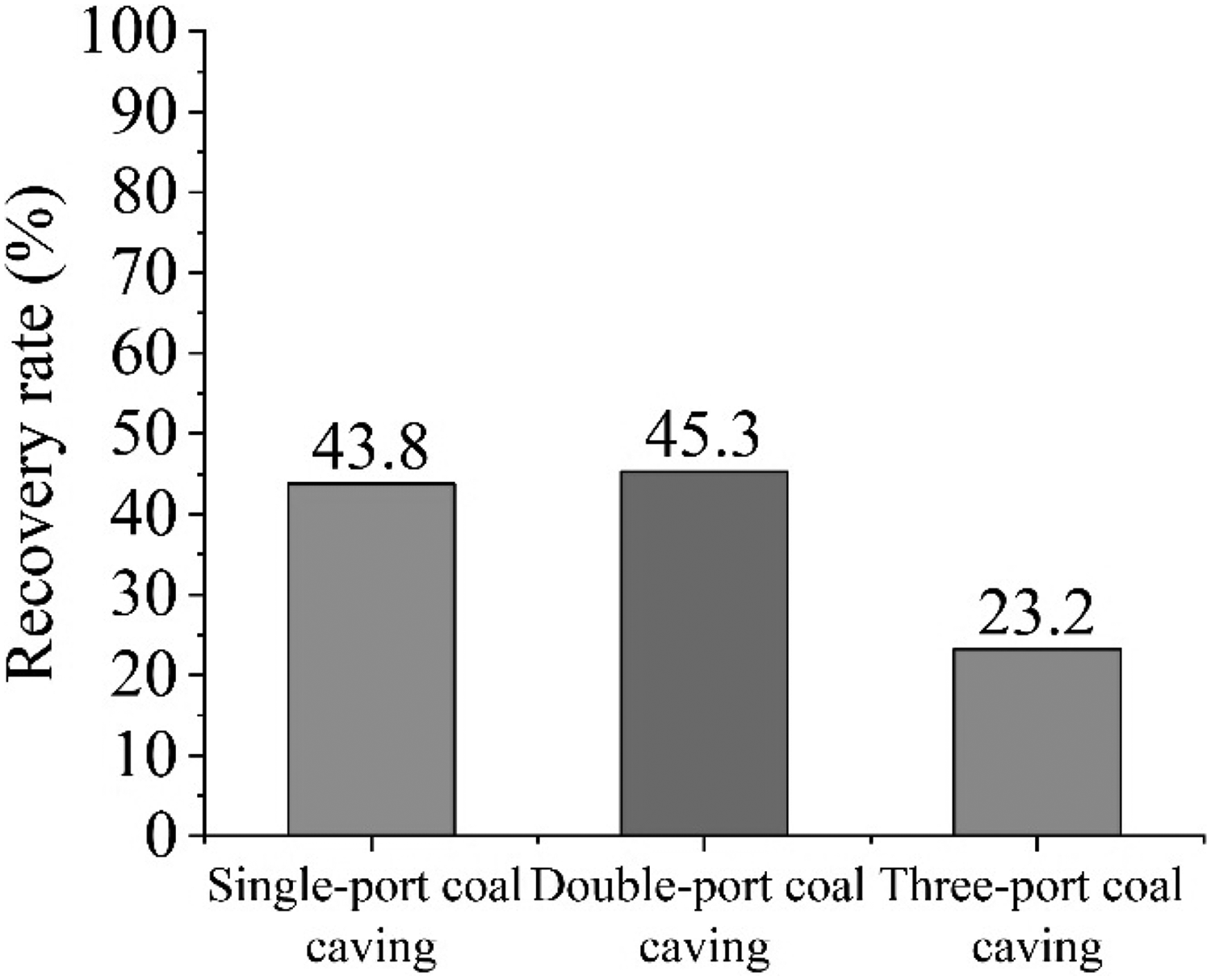
Recovery rate of top coal on floor side with different number of coal caving openings on floor side.
Engineering application
In the +2020 m horizontal sublevel working face of Yimen Coal Mine, the original single coal caving port from roof side to floor side was used for coal caving, but the double coal caving port from floor side to roof side was used for coal caving. After that, a coal quantity measuring instrument was installed on the belt conveyor of the transportation lane, and on this basis, the recovery rate of top coal and top coal on floor side was calculated. The statistical results show that the top coal recovery rate increases from 79.9% to 82.3%, and the top coal recovery rate increases from 42% to 49% in the bottom triangle area. It can be seen that adopting the way of drawing coal from floor side to roof side and drawing coal from double ports is beneficial to improve the top coal recovery rate and the overall top coal recovery rate in the horizontal sublevel floor triangle area.
Conclusions
In the mining process of horizontal sublevel fully mechanized top-coal caving face in steep coal seam, The main coal loss lies in the top coal lost in the triangle area of floor side. When coal is drawn from floor side to roof side, the “rotation” of top coal and top gangue particles in the direction above the coal drawing port and the action of roof gangue on top coal jointly promote the drawing of bottom triangle coal, which is beneficial to improve the recovery rate of top coal.
The more coal caving ports, the larger the disturbed range of the top coal at the side end of the floor, which is more conducive to the top coal caving at the side end of the floor, but at the same time, it also makes it easier for the dense gangue particles to “go down” to the bottom coal caving port, which accelerates the closure of the coal caving port and increases the loss of top coal. On the whole, the recovery rate of top coal caving at the same time by two coal caving ports is the highest.
The technological parameters of coal caving from floor side to roof side in +2020 m horizontal sublevel working face in Yimen Coal Mine are determined. Field observation shows that the top coal recovery rate of working face is increased by 3%, and that of top coal recovery rate in floor triangle area is increased by 7%, which has achieved remarkable economic and social benefits.
Footnotes
Acknowledgements
This project is supported by the National Natural Science Foundation of China (52174138). The author sincerely thanks the above-mentioned institutions for their financial support.
Declaration of conflicting interests
The author(s) declared no potential conflicts of interest with respect to the research, authorship, and/or publication of this article.
Funding
The author(s) disclosed receipt of the following financial support for the research, authorship, and/or publication of this article: This work was supported by the National Natural Science Foundation of China, (grant number 52174138).
